Introduction
• Water, watereverywhere, not a single drop to drink.
These lines show the concern over deficiency of water
resources. Now a days water is becoming an important
natural resources because the demand of water is
constantly rising because of rising population and
development of living standard of the people.
• This chapter deals with various concepts related to
water resources with causes of deficiency and methods
of replenishment.
3.
Water: Some factsand figures
97.5% is present in the f0rm of saline water in oceans, seas and
lakes.
Only .5% is present as fresh water.
70% of fresh water is present in the form of ice and glaciers.
India receives nearly 4 per cent of the global precipitation and ranks 133
in the world in terms of water availability per person per annum.
The total renewable water resources of India are estimated at 1,897 sq km
per annum.
By 2025, large parts of India will face acute water shortage.
Water scarcity & the need for water conservation & management.
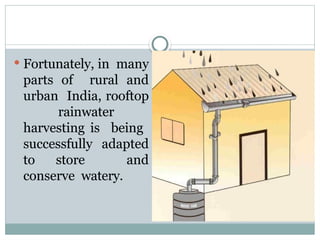
Shortage of water is called water scarcity.
4.
Causes of WaterScarcity
Natural Cause: Due to some climatic reasons, there is
less or no rainfall.
Excessive demand and use of Water: People use and
waste water excessively. Water scarcity may be an
outcome of large and growing population and
consequent greater demands for water, and unequal
access to it. A large population means more water not
only for domestic use but also to produce more food.
Hence, to facilitate higher food- grain production, water
resources are being over- exploited to expand irrigated
areas and dry-season agriculture.
5.
Urbanization: Growingup of cities in last
century has increased the demand of water too
much.
Industrialization: The huge demand of water
from industries has divided the use of water.
The ever increasing number of industries has
made matters worse by exerting pressure on
existing freshwater resources.
6.
Agriculture: Aspopulation increased, the demand of
food grew and burdened the water resource. Most
farmers have their own wells and tube-wells in their
farms for irrigation to increase their produce. It may
lead to falling groundwater levels. adversely affecting
water availability and food security of the people.
Pollution: Due to industrial and domestic waste, rivers
are being polluted and increasing health hazard.
7.
Dams
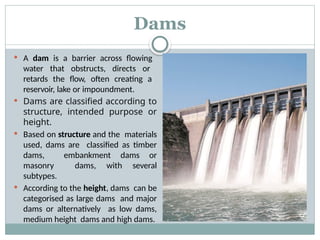
A damis a barrier across flowing
water that obstructs, directs or
retards the flow, often creating a
reservoir, lake or impoundment.
Dams are classified according to
structure, intended purpose or
height.
Based on structure and the materials
used, dams are classified as timber
dams, embankment dams or
masonry dams, with several
subtypes.
According to the height, dams can be
categorised as large dams and major
dams or alternatively as low dams,
medium height dams and high dams.
8.
Multi-purpose Projects
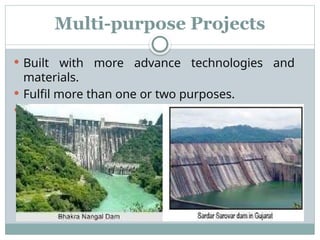
Builtwith more advance technologies and
materials.
Fulfil more than one or two purposes.
They are comparatively big and large in size.
9.
Benefits of Multi-purposeProjects
Serve as water storage.
Provide water for agriculture.
Help for fish-breeding.
Work as water transportation.
Water reservoir can be used as tourist spot as they
attract birds.
Hydro-Electricity generation.
Multi-purpose projects, launched after Independence
with their integrated water resources management
approach, were thought of as the vehicle that would
lead the nation to development and progress,
overcoming the handicap of its colonial past.
So Jawaharlal Nehru proudly proclaimed the dams as
the ‘temples of modern India’.
10.
Opposition to Multi-purposeProjects
1. Regulating and damming of rivers affect their natural flow
causing poor sediment flow.
2. Excessive sedimentation at the bottom of the reservoir.
3. Rockier stream beds.
4. Poorer habitats for the rivers’ aquatic life.
5. Dams also fragment rivers making it difficult for aquatic fauna to
migrate, especially for spawning.
6. The reservoirs that are created on the flood plains also
submerge the existing vegetation and soil leading to its
decomposition over a period of time.
7. Dams have been unsuccessful in controlling floods.
8. Dams cause large scale displacement of local communities.
11.
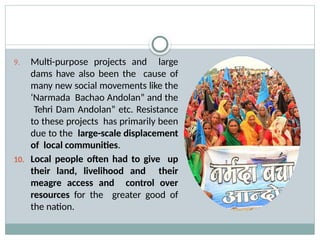
9. Multi-purpose projectsand large
dams have also been the cause of
many new social movements like the
‘Narmada Bachao Andolan” and the
Tehri Dam Andolan” etc. Resistance
to these projects has primarily been
due to the large-scale displacement
of local communities.
10. Local people often had to give up
their land, livelihood and their
meagre access and control over
resources for the greater good of
the nation.
12.
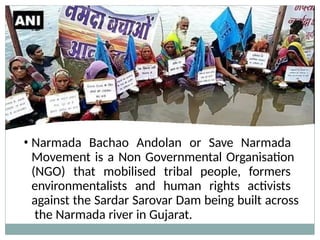
• Narmada BachaoAndolan or Save Narmada
Movement is a Non Governmental Organisation
(NGO) that mobilised tribal people, formers
environmentalists and human rights activists
against the Sardar Sarovar Dam being built across
the Narmada river in Gujarat.
13.
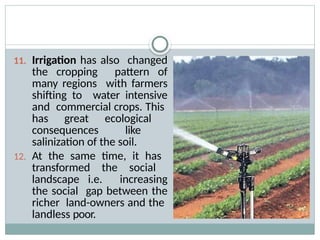
11. Irrigation hasalso changed
the cropping pattern of
many regions with farmers
shifting to water intensive
and commercial crops. This
has great ecological
consequences like
salinization of the soil.
12. At the same time, it has
transformed the social
landscape i.e. increasing
the social gap between the
richer land-owners and the
landless poor.
14.
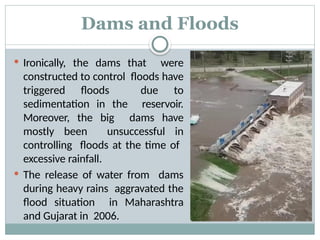
Dams and Floods
Ironically, the dams that were
constructed to control floods have
triggered floods due to
sedimentation in the reservoir.
Moreover, the big dams have
mostly been unsuccessful in
controlling floods at the time of
excessive rainfall.
The release of water from dams
during heavy rains aggravated the
flood situation in Maharashtra
and Gujarat in 2006.
15.
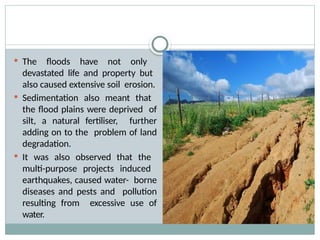
The floodshave not only
devastated life and property but
also caused extensive soil erosion.
Sedimentation also meant that
the flood plains were deprived of
silt, a natural fertiliser, further
adding on to the problem of land
degradation.
It was also observed that the
multi-purpose projects induced
earthquakes, caused water- borne
diseases and pests and pollution
resulting from excessive use of
water.
16.
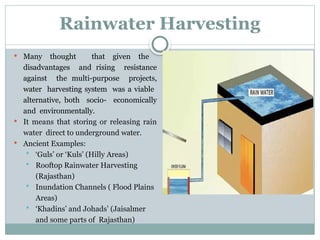
Rainwater Harvesting
Manythought that given the
disadvantages and rising resistance
against the multi-purpose projects,
water harvesting system was a viable
alternative, both socio- economically
and environmentally.
It means that storing or releasing rain
water direct to underground water.
Ancient Examples:
‘Guls’ or ‘Kuls’ (Hilly Areas)
Rooftop Rainwater Harvesting
(Rajasthan)
Inundation Channels ( Flood Plains
Areas)
‘Khadins’ and Johads’ (Jaisalmer
and some parts of Rajasthan)
17.
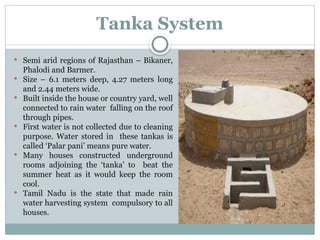
Tanka System
Semiarid regions of Rajasthan – Bikaner,
Phalodi and Barmer.
Size – 6.1 meters deep, 4.27 meters long
and 2.44 meters wide.
Built inside the house or country yard, well
connected to rain water falling on the roof
through pipes.
First water is not collected due to cleaning
purpose. Water stored in these tankas is
called ‘Palar pani’ means pure water.
Many houses constructed underground
rooms adjoining the ‘tanka’ to beat the
summer heat as it would keep the room
cool.
Tamil Nadu is the state that made rain
water harvesting system compulsory to all
houses.
18.
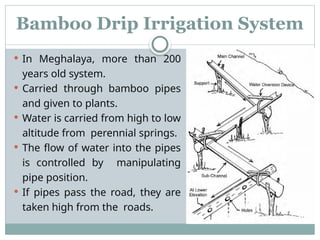
Bamboo Drip IrrigationSystem
In Meghalaya, more than 200
years old system.
Carried through bamboo pipes
and given to plants.
Water is carried from high to low
altitude from perennial springs.
The flow of water into the pipes
is controlled by manipulating
pipe position.
If pipes pass the road, they are
taken high from the roads.
19.
In ancientIndia, along with the sophisticated hydraulic
structures, there existed an extraordinary tradition of
water-harvesting system. People had in-depth knowledge
of rainfall regimes and soil types and developed wide
ranging techniques to harvest rainwater, groundwater.
river water and flood water in keeping with the local
ecological conditions and their water needs.
In hill and mountainous regions, people built diversion
channels like the ‘guls’ or ‘kuls’ of the Western Himalayas
for agricultures.
20.
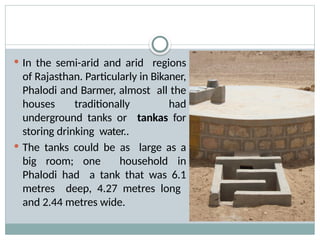
In thesemi-arid and arid regions
of Rajasthan. Particularly in Bikaner,
Phalodi and Barmer, almost all the
houses traditionally had
underground tanks or tankas for
storing drinking water..
The tanks could be as large as a
big room; one household in
Phalodi had a tank that was 6.1
metres deep, 4.27 metres long
and 2.44 metres wide.
21.
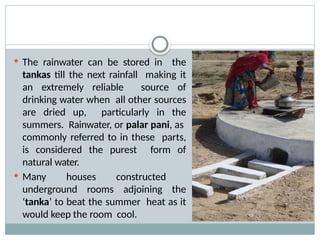
The rainwatercan be stored in the
tankas till the next rainfall making it
an extremely reliable source of
drinking water when all other sources
are dried up, particularly in the
summers. Rainwater, or palar pani, as
commonly referred to in these parts,
is considered the purest form of
natural water.
Many houses constructed
underground rooms adjoining the
‘tanka’ to beat the summer heat as it
would keep the room cool.
22.
Fortunately, inmany
parts of rural and
urban India, rooftop
rainwater
harvesting is being
successfully adapted
to store and
conserve watery.
23.
In Gendathur,a remote backward village in Mysore.
Karnataka. villagers have installed, in their household’s
rooftop, rainwater harvesting system to meet their water
needs.
Nearly 200 households have installed this system and the
village has earned the rare distinction of being rich in
rainwater.
Gendathur receives an annual precipitation of 1000 mm, and
with 80 percent of collection efficiency and of about 10 fillings,
every house can collect and use about 50,000 litres of water
annually.
From the 20 houses, the net amount of rainwater harvested
annually amounts to 1,00,000 litres.
 Most read
 Most read
 Most read