Water Resources
One Shot Live Revision Series
Date Class 10th
Live @ 6:00 PM Daily Class 9th
Live @ 8:45 PM Daily
17 Sep 23 The rise of nationalism in Europe The French Revolution
18 Sep 23 Resources and Development India - Size and Location
19 Sep 23 Power Sharing What is democracy? Why democracy?
20 Sep 23 Development The story of village Palampur
21 Sep 23 Nationalism in India Socialism in Europe and the Russian Revolution
22 Sep 23 Forest and Wildlife Resources Physical Features of India
23 Sep 23 Federalism Constitutional Design
24 Sep 23 Sectors of the Indian Economy People as Resource
25 Sep 23 Gender , Religion and Caste Electoral politics
26 Sep 23 Water Resources Drainage
Introduction
● Water is essential for all forms of life
● All water moves within the hydrological cycle,
ensuring that water is a renewable resource
Water scarcity Causes Conservation and management
● Multi purpose river projects and
integrated water resources management.
● Rain water harvesting
Water Resources
Jeevan Mission (JJM)
The Goal of JJM is to enable every rural household get assured supply of
potable piped water at a service level of 55 litres per capita per day regularly
on long-term basis by ensuring functionality of the tap water connections.
Causes of water scarcity
Causes
.
.
.Conservation and management is essential.
Quantitative and Qualitative aspect
Factors Affecting the Quality of Water
How?
● Uneven availability of water resources
● Over-exploitation, excessive use and
unequal access to water
● Population growth
● Wastage of fresh drinking water Intensive
industrialisation and urbanisation
● Agriculture as the major consumer of water
● Domestic and industrial wastes
● Indiscriminate use of chemicals
like fertilisers and pesticides
● Overdrawing of groundwater
leading to fluoride concentration
Water Resources
Multipurpose River Projects and Integrated Water Resources Management
Hydraulic Structures in Ancient India
● In the first century B.C., Sringaverapura near Allahabad had sophisticated water
harvesting system channelling the flood water of the river Ganga.
● During the time of Chandragupta Maurya, dams, lakes and irrigation systems
were extensively built.
● Evidences of sophisticated irrigation works have also been found in Kalinga,
(Odisha), Nagarjunakonda (Andhra Pradesh), Bennur (Karnataka), Kolhapur
(Maharashtra), etc.
● In the 11th Century, Bhopal Lake, one of the largest artificial lakes of its time
was built.
● In the 14th Century, the tank in Hauz Khas, Delhi was constructed by Iltutmish
for supplying water to Siri Fort area.
Water Resources
Dams Multipurpose river projects
● Used to irrigate agricultural fields.
● Electricity generation
● Water supply for domestic and industrial uses.
● Flood control
● Recreation.
● Inland navigation and fish breeding
Water Resources
A dam is a barrier across flowing
water that obstructs, directs or
retards the flow, often creating a
reservoir, lake or impoundment.
"Dam" refers to the reservoir
rather than the structure.
.
.
. Jawaharlal Nehru proudly proclaimed the dams as the temples of modern India
Opposition and criticism of dams
● Regulating and damming of rivers affect their natural flow leading to poorer,
habitats for the river's aquatic life.
● Dams Created on the floodplains submerge the Existing vegetation and Soil,
leading to its decomposition oven a period of time
● Creating large dams has been the cause of many new Environmental movements
like the 'Narmada Bachao Andolan and the Tehri Dam Andolan etc. leading to
large scale displacement.
● Many times local people had to give up their land, livelihood and their Control
over resources for the Construction of the dam.
● Changed the cropping pattern and increased the social gap.
Water Resources
Most of the objections to the projects arose due to their
failure to achieve the purposes for which they were built
● Caused flood → Floods have devastated life and property.
● Caused extensive soil erosion.
● Sedimentation also meant that the flood plains were deprived of silt, a natural
fertiliser, further adding on to the problem of land degradation.
● It was also observed that the multi-purpose projects induced earthquakes.
● Caused water-borne diseases and pests and pollution.
Water Resources
Rain water harvesting
Sophisticated ancient water harvesting system.
● In hill and mountainous regions, people built diversion channels like the 'guls' or 'kuls of the
Western Himalayas for agriculture
● In the flood plains of Bengal, people developed inundation channels to irrigate their fields.
● In arid and semi-arid regions, agricultural fields were converted into rain fed storage structures
that allowed the water to stand and moisten the soil like the 'khadins' in Jaisalmer and ‘Johads'
in other parts of Rajasthan.
● In the semi-arid and arid regions had underground tanks or tankas for storing drinking water.
The tankas were part of the well-developed rooftop rainwater harvesting system. Rooftop
rainwater harvesting was commonly practised to store drinking water, particularly in Rajasthan.
Structures
Meaning
Need
Water Resources
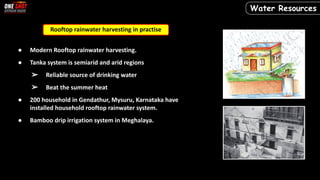
Rooftop rainwater harvesting in practise
● Modern Rooftop rainwater harvesting.
● Tanka system is semiarid and arid regions
➢ Reliable source of drinking water
➢ Beat the summer heat
● 200 household in Gendathur, Mysuru, Karnataka have
installed household rooftop rainwater system.
● Bamboo drip irrigation system in Meghalaya.
Water Resources
Team - DSR
Join our telegram channel
Please subscribe both the channels
For Upcoming sessions
One Shot Live Revision Series
Date Class 10th
Live @ 6:00 PM Daily Class 9th
Live @ 8:45 PM Daily
17 Sep 23 The rise of nationalism in Europe The French Revolution
18 Sep 23 Resources and Development India - Size and Location
19 Sep 23 Power Sharing What is democracy? Why democracy?
20 Sep 23 Development The story of village Palampur
21 Sep 23 Nationalism in India Socialism in Europe and the Russian Revolution
22 Sep 23 Forest and Wildlife Resources Physical Features of India
23 Sep 23 Federalism Constitutional Design
24 Sep 23 Sectors of the Indian Economy People as Resource
25 Sep 23 Gender , Religion and Caste Electoral politics
26 Sep 23 Water Resources Drainage
Water Resources one shot.pdf

Water Resources one shot.pdf

  • 2.
  • 3.
    One Shot LiveRevision Series Date Class 10th Live @ 6:00 PM Daily Class 9th Live @ 8:45 PM Daily 17 Sep 23 The rise of nationalism in Europe The French Revolution 18 Sep 23 Resources and Development India - Size and Location 19 Sep 23 Power Sharing What is democracy? Why democracy? 20 Sep 23 Development The story of village Palampur 21 Sep 23 Nationalism in India Socialism in Europe and the Russian Revolution 22 Sep 23 Forest and Wildlife Resources Physical Features of India 23 Sep 23 Federalism Constitutional Design 24 Sep 23 Sectors of the Indian Economy People as Resource 25 Sep 23 Gender , Religion and Caste Electoral politics 26 Sep 23 Water Resources Drainage
  • 4.
    Introduction ● Water isessential for all forms of life ● All water moves within the hydrological cycle, ensuring that water is a renewable resource Water scarcity Causes Conservation and management ● Multi purpose river projects and integrated water resources management. ● Rain water harvesting Water Resources Jeevan Mission (JJM) The Goal of JJM is to enable every rural household get assured supply of potable piped water at a service level of 55 litres per capita per day regularly on long-term basis by ensuring functionality of the tap water connections.
  • 5.
    Causes of waterscarcity Causes . . .Conservation and management is essential. Quantitative and Qualitative aspect Factors Affecting the Quality of Water How? ● Uneven availability of water resources ● Over-exploitation, excessive use and unequal access to water ● Population growth ● Wastage of fresh drinking water Intensive industrialisation and urbanisation ● Agriculture as the major consumer of water ● Domestic and industrial wastes ● Indiscriminate use of chemicals like fertilisers and pesticides ● Overdrawing of groundwater leading to fluoride concentration Water Resources
  • 6.
    Multipurpose River Projectsand Integrated Water Resources Management Hydraulic Structures in Ancient India ● In the first century B.C., Sringaverapura near Allahabad had sophisticated water harvesting system channelling the flood water of the river Ganga. ● During the time of Chandragupta Maurya, dams, lakes and irrigation systems were extensively built. ● Evidences of sophisticated irrigation works have also been found in Kalinga, (Odisha), Nagarjunakonda (Andhra Pradesh), Bennur (Karnataka), Kolhapur (Maharashtra), etc. ● In the 11th Century, Bhopal Lake, one of the largest artificial lakes of its time was built. ● In the 14th Century, the tank in Hauz Khas, Delhi was constructed by Iltutmish for supplying water to Siri Fort area. Water Resources
  • 7.
    Dams Multipurpose riverprojects ● Used to irrigate agricultural fields. ● Electricity generation ● Water supply for domestic and industrial uses. ● Flood control ● Recreation. ● Inland navigation and fish breeding Water Resources A dam is a barrier across flowing water that obstructs, directs or retards the flow, often creating a reservoir, lake or impoundment. "Dam" refers to the reservoir rather than the structure. . . . Jawaharlal Nehru proudly proclaimed the dams as the temples of modern India
  • 8.
    Opposition and criticismof dams ● Regulating and damming of rivers affect their natural flow leading to poorer, habitats for the river's aquatic life. ● Dams Created on the floodplains submerge the Existing vegetation and Soil, leading to its decomposition oven a period of time ● Creating large dams has been the cause of many new Environmental movements like the 'Narmada Bachao Andolan and the Tehri Dam Andolan etc. leading to large scale displacement. ● Many times local people had to give up their land, livelihood and their Control over resources for the Construction of the dam. ● Changed the cropping pattern and increased the social gap. Water Resources
  • 9.
    Most of theobjections to the projects arose due to their failure to achieve the purposes for which they were built ● Caused flood → Floods have devastated life and property. ● Caused extensive soil erosion. ● Sedimentation also meant that the flood plains were deprived of silt, a natural fertiliser, further adding on to the problem of land degradation. ● It was also observed that the multi-purpose projects induced earthquakes. ● Caused water-borne diseases and pests and pollution. Water Resources
  • 10.
    Rain water harvesting Sophisticatedancient water harvesting system. ● In hill and mountainous regions, people built diversion channels like the 'guls' or 'kuls of the Western Himalayas for agriculture ● In the flood plains of Bengal, people developed inundation channels to irrigate their fields. ● In arid and semi-arid regions, agricultural fields were converted into rain fed storage structures that allowed the water to stand and moisten the soil like the 'khadins' in Jaisalmer and ‘Johads' in other parts of Rajasthan. ● In the semi-arid and arid regions had underground tanks or tankas for storing drinking water. The tankas were part of the well-developed rooftop rainwater harvesting system. Rooftop rainwater harvesting was commonly practised to store drinking water, particularly in Rajasthan. Structures Meaning Need Water Resources
  • 11.
    Rooftop rainwater harvestingin practise ● Modern Rooftop rainwater harvesting. ● Tanka system is semiarid and arid regions ➢ Reliable source of drinking water ➢ Beat the summer heat ● 200 household in Gendathur, Mysuru, Karnataka have installed household rooftop rainwater system. ● Bamboo drip irrigation system in Meghalaya. Water Resources
  • 12.
    Team - DSR Joinour telegram channel Please subscribe both the channels For Upcoming sessions
  • 13.
    One Shot LiveRevision Series Date Class 10th Live @ 6:00 PM Daily Class 9th Live @ 8:45 PM Daily 17 Sep 23 The rise of nationalism in Europe The French Revolution 18 Sep 23 Resources and Development India - Size and Location 19 Sep 23 Power Sharing What is democracy? Why democracy? 20 Sep 23 Development The story of village Palampur 21 Sep 23 Nationalism in India Socialism in Europe and the Russian Revolution 22 Sep 23 Forest and Wildlife Resources Physical Features of India 23 Sep 23 Federalism Constitutional Design 24 Sep 23 Sectors of the Indian Economy People as Resource 25 Sep 23 Gender , Religion and Caste Electoral politics 26 Sep 23 Water Resources Drainage