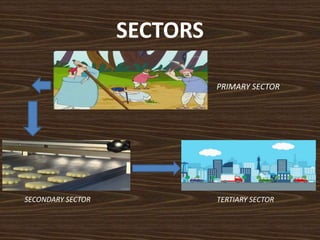


SECTORS
PRIMARY SECTOR
SECONDARY SECTOR TERTIARY SECTOR
THE PRIMARY SECTOR
When we produce a good by exploiting
natural resources is an activity of the Primary
Sector.
The Primary Sector includes all the raw
materials from:
Agriculture, Diary, Fishing, Forestry
This sector is also called agriculture and
related sector
THE SECONDARY SECTOR
When we convert the natural resources or raw
material into finished goods it is called the
Secondary Sectors.
It could be in a factory, a workshop or at
home.
This sector is also called manufacturing or
industrial sector.
THE TERTIARY SECTOR
This sector do not produce a good but they
are an aid or support for the production
process.
The Tertiary Sector includes:
Transport, Communication, Storage, Banking
and Trade
This sector is also called service sector as it
helps in the development of the primary and
secondary sectors.
More in Service Sector
 washerman
 Barber
 Cobbler
 Lawyer
 Recent Included IT such as:
 Internet Café
 ATM Booths
 Call Centres
 Software Companies
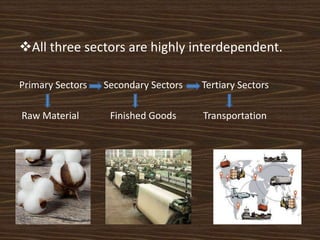
All three sectors are highly interdependent.
Primary Sectors Secondary Sectors Tertiary Sectors
Raw Material Finished Goods Transportation
COMPARING THE THREE SECTORS
Three sectors
Primary Sector
produced large number of goods and services,
Provide employment to many people.
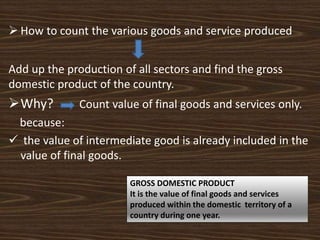
 How to count the various goods and service produced
Add up the production of all sectors and find the gross
domestic product of the country.
Why? Count value of final goods and services only.
because:
 the value of intermediate good is already included in the
value of final goods.
GROSS DOMESTIC PRODUCT
It is the value of final goods and services
produced within the domestic territory of a
country during one year.
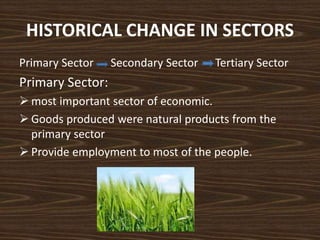
HISTORICAL CHANGE IN SECTORS
Primary Sector Secondary Sector Tertiary Sector
Primary Sector:
 most important sector of economic.
 Goods produced were natural products from the
primary sector
 Provide employment to most of the people.
Secondary Sector:
 New method of manufacturing
 People
shifted their work place from farm to factories.
prefer goods produce in factories as are of cheap rate
Secondary sector gradually became most important in total
production and employment.
This is generally observe in developed countries.
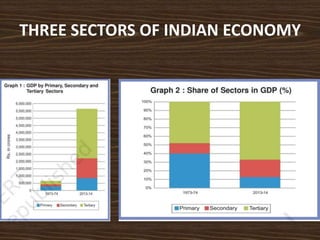
THREE SECTORS OF INDIAN ECONOMY
Tertiary Sector: The Rising Importance
1. Government has to take responsibility on basic
services such as: post & telegraph, police station.
Court, banks, insurance companies etc.
2. Development of primary and secondary sector
leads to the development of service sector.
3. Rise in income demanding for services like
shops, tourism, private schools, professional
training etc.
4. Services based on information and communication
technology become important and essential
production of these services rising rapidly
Where are the most of people employed?
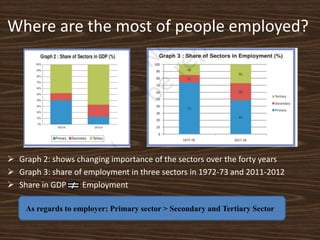
 Graph 2: shows changing importance of the sectors over the forty years
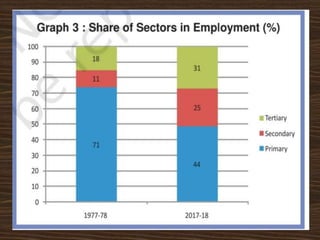
 Graph 3: share of employment in three sectors in 1972-73 and 2011-2012
 Share in GDP Employment
As regards to employer: Primary sector > Secondary and Tertiary Sector
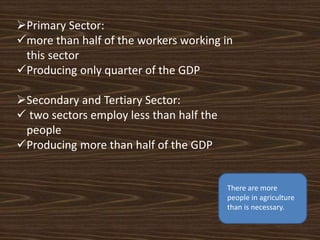
Primary Sector:
more than half of the workers working in
this sector
Producing only quarter of the GDP
Secondary and Tertiary Sector:
 two sectors employ less than half the
people
Producing more than half of the GDP
There are more
people in agriculture
than is necessary.
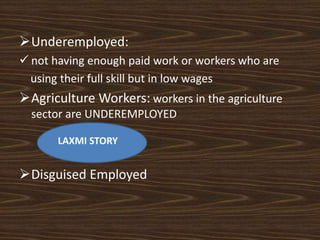
Underemployed:
 not having enough paid work or workers who are
using their full skill but in low wages
Agriculture Workers: workers in the agriculture
sector are UNDEREMPLOYED
Disguised Employed
LAXMI STORY
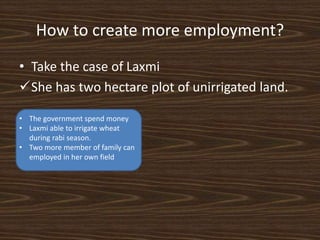
How to create more employment?
• Take the case of Laxmi
She has two hectare plot of unirrigated land.
• The government spend money
• Laxmi able to irrigate wheat
during rabi season.
• Two more member of family can
employed in her own field
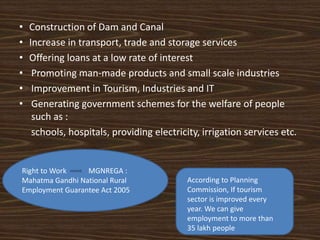
• Construction of Dam and Canal
• Increase in transport, trade and storage services
• Offering loans at a low rate of interest
• Promoting man-made products and small scale industries
• Improvement in Tourism, Industries and IT
• Generating government schemes for the welfare of people
such as :
schools, hospitals, providing electricity, irrigation services etc.
According to Planning
Commission, If tourism
sector is improved every
year. We can give
employment to more than
35 lakh people
Right to Work MGNREGA :
Mahatma Gandhi National Rural
Employment Guarantee Act 2005
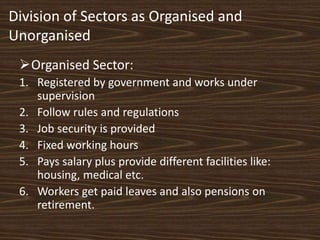
Division of Sectors as Organised and
Unorganised
Organised Sector:
1. Registered by government and works under
supervision
2. Follow rules and regulations
3. Job security is provided
4. Fixed working hours
5. Pays salary plus provide different facilities like:
housing, medical etc.
6. Workers get paid leaves and also pensions on
retirement.
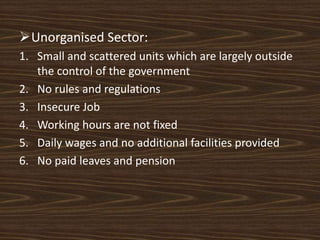
Unorganised Sector:
1. Small and scattered units which are largely outside
the control of the government
2. No rules and regulations
3. Insecure Job
4. Working hours are not fixed
5. Daily wages and no additional facilities provided
6. No paid leaves and pension
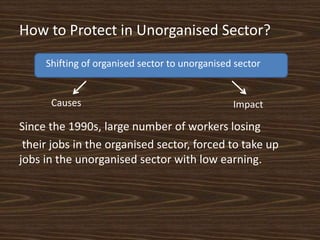
How to Protect in Unorganised Sector?
Since the 1990s, large number of workers losing
their jobs in the organised sector, forced to take up
jobs in the unorganised sector with low earning.
Shifting of organised sector to unorganised sector
Causes Impact
Protection of Workers in Unorganised Sector
 In Rural area:
 Landless agricultural labourers, small and marginal farmers, sharecropper
and artisans such as weavers, blacksmith and carpenters are neded to be
protected
 They must be supported through adequate facility for timely delivery of
seeds, agricultural inputs credits, storage facilities and marketing outlets.
 In Urban area:
 Workers in small scale industries, casual workers in construction, trade
and transport etc. are working in unorganised sector.
 They need government support to procure raw material and marketing of
output.
Socio economic sector like SC,ST,OBC also need protection as
faced economic as well as social discrimination.
Sector in Terms of Ownership:Public & Private
 Public Sector:
• Government owns most of the assets and provides all the
services.
example: Railways and Post Office
• Service motive
 Private Sector:
• Private and individual owns of assets and provides all the
services.
example: TISCO or RIL
• Profit motive
Class10 Social Sectors of Indian economy