WRM
1
What is WRM?
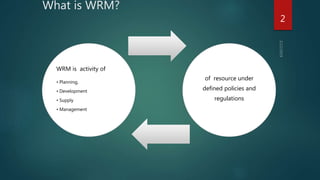
WRM is activity of
• Planning,
• Development
• Supply
• Management
of resource under
defined policies and
regulations
2
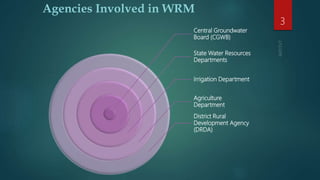
Central Groundwater
Board (CGWB)
State Water Resources
Departments
Irrigation Department
Agriculture
Department
District Rural
Development Agency
(DRDA)
Agencies Involved in WRM
3
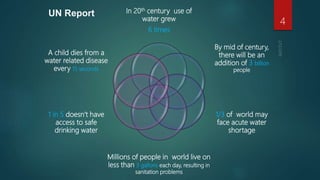
In 20th century use of
water grew
6 times
By mid of century,
there will be an
addition of 3 billion
people
1/3 of world may
face acute water
shortage
Millions of people in world live on
less than 3 gallons each day, resulting in
sanitation problems
1 in 5 doesn‘t have
access to safe
drinking water
A child dies from a
water related disease
every 15 seconds
UN Report
4
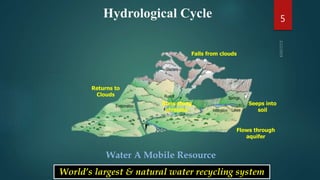
Water A Mobile Resource
Falls from clouds
Runs along
streams
Seeps into
soil
Flows through
aquifer
Returns to
Clouds
World’s largest & natural water recycling system
Hydrological Cycle 5
6
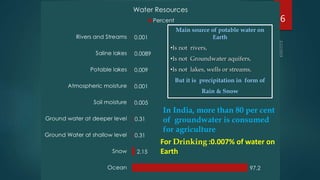
Main source of potable water on
Earth
•Is not rivers,
•Is not Groundwater aquifers,
•Is not lakes, wells or streams,
But it is precipitation in form of
Rain & Snow
In India, more than 80 per cent
of groundwater is consumed
for agriculture
For Drinking :0.007% of water on
Earth
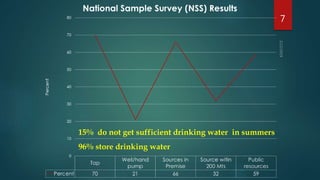
15% do not get sufficient drinking water in summers
96% store drinking water
7
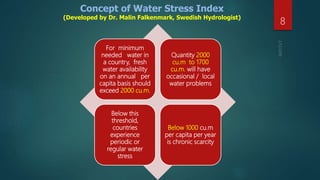
Concept of Water Stress Index
(Developed by Dr. Malin Falkenmark, Swedish Hydrologist)
For minimum
needed water in
a country, fresh
water availability
on an annual per
capita basis should
exceed 2000 cu.m.
Quantity 2000
cu.m to 1700
cu.m. will have
occasional / local
water problems
Below this
threshold,
countries
experience
periodic or
regular water
stress
Below 1000 cu.m
per capita per year
is chronic scarcity
8
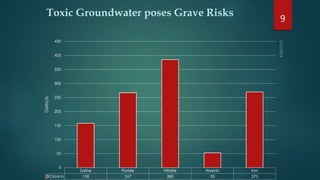
Toxic Groundwater poses Grave Risks
9
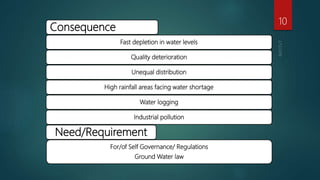
Consequence
Fast depletion in water levels
Quality deterioration
Unequal distribution
High rainfall areas facing water shortage
Water logging
Industrial pollution
Need/Requirement
For/of Self Governance/ Regulations
Ground Water law
10
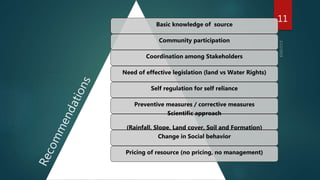
Basic knowledge of source
Community participation
Coordination among Stakeholders
Need of effective legislation (land vs Water Rights)
Self regulation for self reliance
Preventive measures / corrective measures
Scientific approach
(Rainfall, Slope, Land cover, Soil and Formation)
Change in Social behavior
Pricing of resource (no pricing, no management)
11
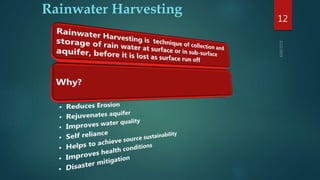
Rainwater Harvesting
12
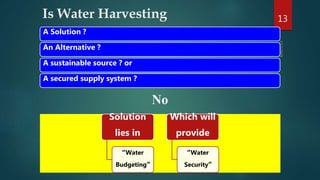
Is Water Harvesting 13
A Solution ?
An Alternative ?
A sustainable source ? or
A secured supply system ?
No
Solution
lies in
“Water
Budgeting”
Which will
provide
“Water
Security”
Recharge
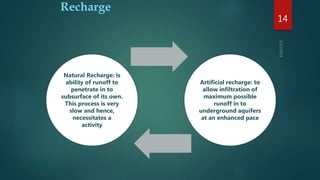
Natural Recharge: is
ability of runoff to
penetrate in to
subsurface of its own.
This process is very
slow and hence,
necessitates a
activity
Artificial recharge: to
allow infiltration of
maximum possible
runoff in to
underground aquifers
at an enhanced pace
14
Recharge Where?
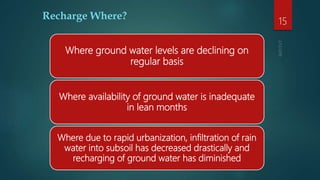
Where ground water levels are declining on
regular basis
Where availability of ground water is inadequate
in lean months
Where due to rapid urbanization, infiltration of rain
water into subsoil has decreased drastically and
recharging of ground water has diminished
15
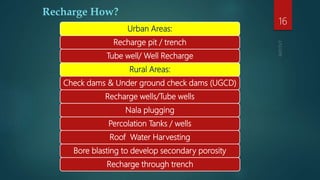
Urban Areas:
Recharge pit / trench
Tube well/ Well Recharge
Rural Areas:
Check dams & Under ground check dams (UGCD)
Recharge wells/Tube wells
Nala plugging
Percolation Tanks / wells
Roof Water Harvesting
Bore blasting to develop secondary porosity
Recharge through trench
Recharge How?
16
After Recharge ? 17
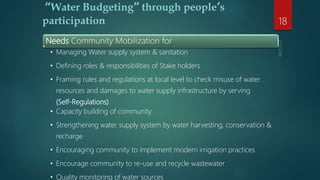
Needs Community Mobilization for
• Managing Water supply system & sanitation
• Defining roles & responsibilities of Stake holders
• Framing rules and regulations at local level to check misuse of water
resources and damages to water supply infrastructure by serving
(Self-Regulations)
• Capacity building of community
• Strengthening water supply system by water harvesting, conservation &
recharge
• Encouraging community to implement modern irrigation practices
• Encourage community to re-use and recycle wastewater
• Quality monitoring of water sources
“Water Budgeting” through people’s
participation 18
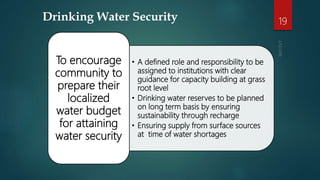
Drinking Water Security
• A defined role and responsibility to be
assigned to institutions with clear
guidance for capacity building at grass
root level
• Drinking water reserves to be planned
on long term basis by ensuring
sustainability through recharge
• Ensuring supply from surface sources
at time of water shortages
To encourage
community to
prepare their
localized
water budget
for attaining
water security
19
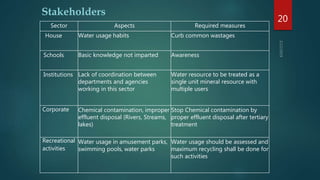
Sector Aspects Required measures
House Water usage habits Curb common wastages
Schools Basic knowledge not imparted Awareness
Institutions Lack of coordination between
departments and agencies
working in this sector
Water resource to be treated as a
single unit mineral resource with
multiple users
Corporate Chemical contamination, improper
effluent disposal (Rivers, Streams,
lakes)
Stop Chemical contamination by
proper effluent disposal after tertiary
treatment
Recreational
activities
Water usage in amusement parks,
swimming pools, water parks
Water usage should be assessed and
maximum recycling shall be done for
such activities
Stakeholders
20
Stakeholders
21
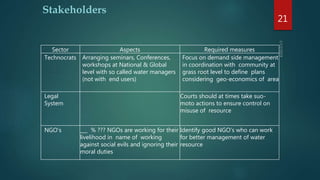
Sector Aspects Required measures
Technocrats Arranging seminars, Conferences,
workshops at National & Global
level with so called water managers
(not with end users)
Focus on demand side management
in coordination with community at
grass root level to define plans
considering geo-economics of area
Legal
System
Courts should at times take suo-
moto actions to ensure control on
misuse of resource
NGO’s ___ % ??? NGOs are working for their
livelihood in name of working
against social evils and ignoring their
moral duties
Identify good NGO's who can work
for better management of water
resource
Water Scarcity
2

Water Resource Management

  • 1.
  • 2.
    What is WRM? WRMis activity of • Planning, • Development • Supply • Management of resource under defined policies and regulations 2
  • 3.
    Central Groundwater Board (CGWB) StateWater Resources Departments Irrigation Department Agriculture Department District Rural Development Agency (DRDA) Agencies Involved in WRM 3
  • 4.
    In 20th centuryuse of water grew 6 times By mid of century, there will be an addition of 3 billion people 1/3 of world may face acute water shortage Millions of people in world live on less than 3 gallons each day, resulting in sanitation problems 1 in 5 doesn‘t have access to safe drinking water A child dies from a water related disease every 15 seconds UN Report 4
  • 5.
    Water A MobileResource Falls from clouds Runs along streams Seeps into soil Flows through aquifer Returns to Clouds World’s largest & natural water recycling system Hydrological Cycle 5
  • 6.
    6 Main source ofpotable water on Earth •Is not rivers, •Is not Groundwater aquifers, •Is not lakes, wells or streams, But it is precipitation in form of Rain & Snow In India, more than 80 per cent of groundwater is consumed for agriculture For Drinking :0.007% of water on Earth
  • 7.
    15% do notget sufficient drinking water in summers 96% store drinking water 7
  • 8.
    Concept of WaterStress Index (Developed by Dr. Malin Falkenmark, Swedish Hydrologist) For minimum needed water in a country, fresh water availability on an annual per capita basis should exceed 2000 cu.m. Quantity 2000 cu.m to 1700 cu.m. will have occasional / local water problems Below this threshold, countries experience periodic or regular water stress Below 1000 cu.m per capita per year is chronic scarcity 8
  • 9.
  • 10.
    Consequence Fast depletion inwater levels Quality deterioration Unequal distribution High rainfall areas facing water shortage Water logging Industrial pollution Need/Requirement For/of Self Governance/ Regulations Ground Water law 10
  • 11.
    Basic knowledge ofsource Community participation Coordination among Stakeholders Need of effective legislation (land vs Water Rights) Self regulation for self reliance Preventive measures / corrective measures Scientific approach (Rainfall, Slope, Land cover, Soil and Formation) Change in Social behavior Pricing of resource (no pricing, no management) 11
  • 12.
  • 13.
    Is Water Harvesting13 A Solution ? An Alternative ? A sustainable source ? or A secured supply system ? No Solution lies in “Water Budgeting” Which will provide “Water Security”
  • 14.
    Recharge Natural Recharge: is abilityof runoff to penetrate in to subsurface of its own. This process is very slow and hence, necessitates a activity Artificial recharge: to allow infiltration of maximum possible runoff in to underground aquifers at an enhanced pace 14
  • 15.
    Recharge Where? Where groundwater levels are declining on regular basis Where availability of ground water is inadequate in lean months Where due to rapid urbanization, infiltration of rain water into subsoil has decreased drastically and recharging of ground water has diminished 15
  • 16.
    Urban Areas: Recharge pit/ trench Tube well/ Well Recharge Rural Areas: Check dams & Under ground check dams (UGCD) Recharge wells/Tube wells Nala plugging Percolation Tanks / wells Roof Water Harvesting Bore blasting to develop secondary porosity Recharge through trench Recharge How? 16
  • 17.
  • 18.
    Needs Community Mobilizationfor • Managing Water supply system & sanitation • Defining roles & responsibilities of Stake holders • Framing rules and regulations at local level to check misuse of water resources and damages to water supply infrastructure by serving (Self-Regulations) • Capacity building of community • Strengthening water supply system by water harvesting, conservation & recharge • Encouraging community to implement modern irrigation practices • Encourage community to re-use and recycle wastewater • Quality monitoring of water sources “Water Budgeting” through people’s participation 18
  • 19.
    Drinking Water Security •A defined role and responsibility to be assigned to institutions with clear guidance for capacity building at grass root level • Drinking water reserves to be planned on long term basis by ensuring sustainability through recharge • Ensuring supply from surface sources at time of water shortages To encourage community to prepare their localized water budget for attaining water security 19
  • 20.
    Sector Aspects Requiredmeasures House Water usage habits Curb common wastages Schools Basic knowledge not imparted Awareness Institutions Lack of coordination between departments and agencies working in this sector Water resource to be treated as a single unit mineral resource with multiple users Corporate Chemical contamination, improper effluent disposal (Rivers, Streams, lakes) Stop Chemical contamination by proper effluent disposal after tertiary treatment Recreational activities Water usage in amusement parks, swimming pools, water parks Water usage should be assessed and maximum recycling shall be done for such activities Stakeholders 20
  • 21.
    Stakeholders 21 Sector Aspects Requiredmeasures Technocrats Arranging seminars, Conferences, workshops at National & Global level with so called water managers (not with end users) Focus on demand side management in coordination with community at grass root level to define plans considering geo-economics of area Legal System Courts should at times take suo- moto actions to ensure control on misuse of resource NGO’s ___ % ??? NGOs are working for their livelihood in name of working against social evils and ignoring their moral duties Identify good NGO's who can work for better management of water resource
  • 22.