Presented By:
Group X
Shazzadur Rahman – 1116016
Abir Mohammad – 1116017
Sabiha Tabassum - 1116025
FLOOD FORECASTING
Presented To:
Dr. Md. Mostafa Ali
Associate professor,
Department of Water Resources
Engineering, BUET.
Overview
Introduction
Role of Flood Forecasting in Flood Mitigation
Design Considerations
Data Requirements
Flood Forecasting Methods & Models
Challenges in Bangladesh
Case Studies
Introduction
What is Flood Forecasting?
Flood forecasting is the use of forecasted precipitation and streamflow data
in rainfall runoff and streamflow routing models to forecast flow rates and water
levels for periods ranging from a few hours to days ahead.
What is Flood Warning?
Flood warning is the task of making use of these forecasts to make decisions about
whether warnings of floods should be issued to the general public or whether
previous warnings should be rescinded or retracted.
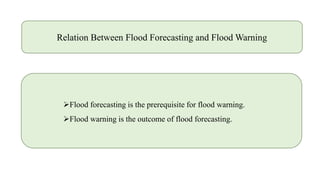
Relation Between Flood Forecasting and Flood Warning
Flood forecasting is the prerequisite for flood warning.
Flood warning is the outcome of flood forecasting.
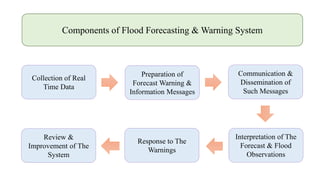
Components of Flood Forecasting & Warning System
Collection of Real
Time Data
Preparation of
Forecast Warning &
Information Messages
Communication &
Dissemination of
Such Messages
Interpretation of The
Forecast & Flood
Observations
Response to The
Warnings
Review &
Improvement of The
System
Role of Flood Forecasting in Flood Mitigation
Prerequisite for successful mitigation of flood damage.
Can be effectively combined with other measures for flood prevention such
as retention, land use and structural measures, flood emergency and public
awareness.
Plays vital role in flood management when no preventive or defence
measures can be completely effective.
Increases flood resilience of the flood affected people.
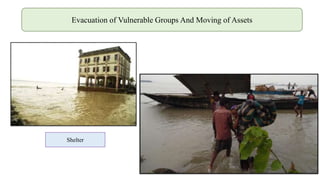
Evacuation of Vulnerable Groups And Moving of Assets
Shelter
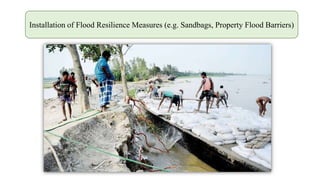
Installation of Flood Resilience Measures (e.g. Sandbags, Property Flood Barriers)
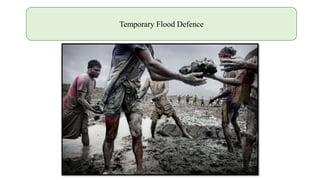
Temporary Flood Defence
Design Considerations
Basic Consideration
Hydromorphological Characteristics of The Basin, Topography, Geology
Shape, Boundaries And Content of A
Water Body.
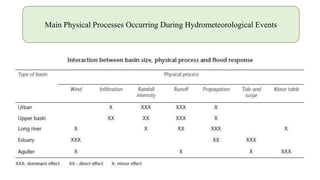
Main Physical Processes Occurring During Hydrometeorological Events
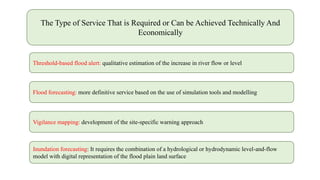
The Type of Service That is Required or Can be Achieved Technically And
Economically
Threshold-based flood alert: qualitative estimation of the increase in river flow or level
Flood forecasting: more definitive service based on the use of simulation tools and modelling
Vigilance mapping: development of the site-specific warning approach
Inundation forecasting: It requires the combination of a hydrological or hydrodynamic level-and-flow
model with digital representation of the flood plain land surface
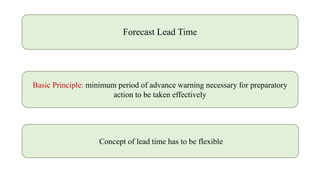
Forecast Lead Time
Basic Principle: minimum period of advance warning necessary for preparatory
action to be taken effectively
Concept of lead time has to be flexible
DATA REQUIREMENTS
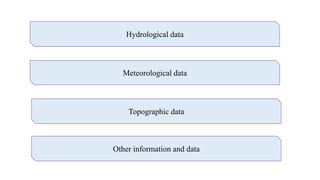
Hydrological data
Meteorological data
Topographic data
Other information and data
Hydrological Data
Discharge & Water level
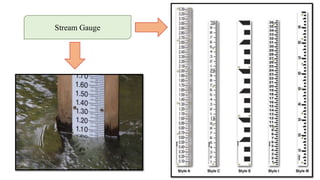
Stream Gauge
Meteorological data
Rainfall intensity and duration,
precipitation forecasts and past data
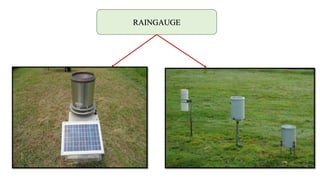
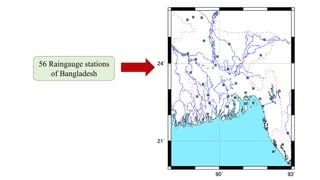
RAINGAUGE
56 Raingauge stations
of Bangladesh
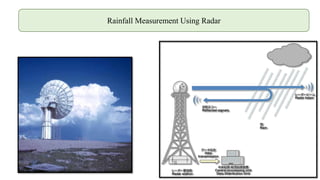
Rainfall Measurement Using Radar
Topographic data
Information about the elevation of
the surface of the Earth
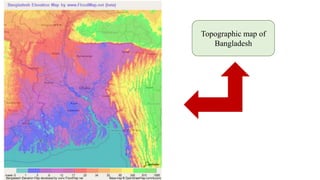
Topographic map of
Bangladesh
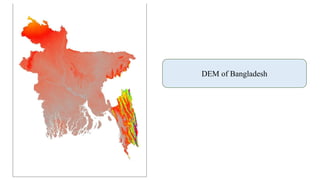
DEM of Bangladesh
(a) Population and demographic data to indicate settlements at risk;
(b) Inventories of properties at risk;
(c) Reservoir and flood protection infrastructure control rules;
(d) Location of key transport, power and water supply infrastructure;
(e) Systematic post-flood damage assessments.
Other information and data
FLOOD FORECASTING METHODS AND
MODELS
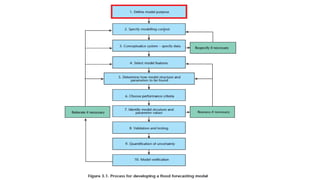
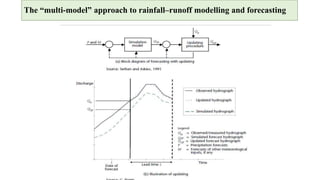
The “multi-model” approach to rainfall–runoff modelling and forecasting
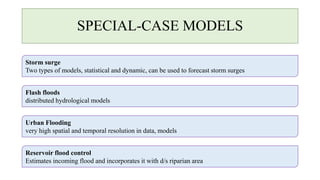
SPECIAL-CASE MODELS
Storm surge
Two types of models, statistical and dynamic, can be used to forecast storm surges
Flash floods
distributed hydrological models
Urban Flooding
very high spatial and temporal resolution in data, models
Reservoir flood control
Estimates incoming flood and incorporates it with d/s riparian area
Examples
MIKE FLOOD
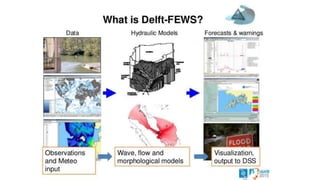
Delft-FEWS
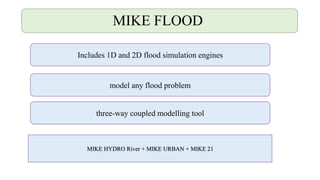
MIKE FLOOD
Includes 1D and 2D flood simulation engines
model any flood problem
three-way coupled modelling tool
MIKE HYDRO River + MIKE URBAN + MIKE 21
Delft-FEWS
provide an open shell for managing
the data handling and forecasting
process
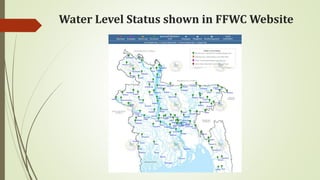
In Bangladesh, FFWC
• uses GIS techniques extensively to display water level and
rainfall status
• flood forecast model MIKE 11 FF
LIMITATIONS
• not sufficient on its own to reduce risk
• Models require continuous improvisation (calibration)
• Cost of running the system
• Cost of sourcing meteorological data
• system inaccuracies may lead to complacency
• availability of communication channels requires resource
Challenges in Bangladesh
Data Collection
57 transboundary river
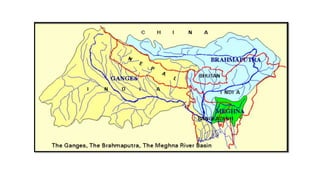
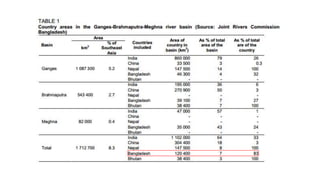
Location of Bangladesh in GBM
basin
Tidal Influence on River
Uncertainty in Forecast of Rainfall
Other Challenges
Limited Resource
Limited Skilled Manpower
Case Studies
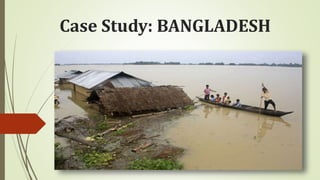
Case Study: BANGLADESH
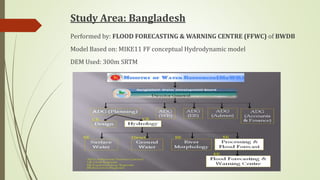
Study Area: Bangladesh
Performed by: FLOOD FORECASTING & WARNING CENTRE (FFWC) of BWDB
Model Based on: MIKE11 FF conceptual Hydrodynamic model
DEM Used: 300m SRTM
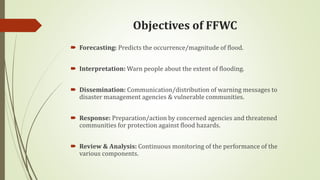
Objectives of FFWC
 Forecasting: Predicts the occurrence/magnitude of flood.
 Interpretation: Warn people about the extent of flooding.
 Dissemination: Communication/distribution of warning messages to
disaster management agencies & vulnerable communities.
 Response: Preparation/action by concerned agencies and threatened
communities for protection against flood hazards.
 Review & Analysis: Continuous monitoring of the performance of the
various components.
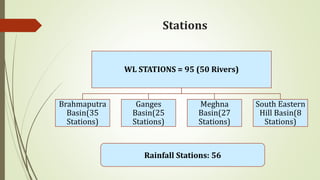
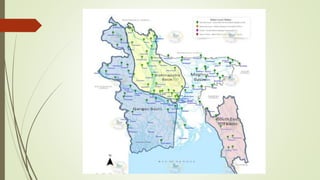
Stations
WL STATIONS = 95 (50 Rivers)
Brahmaputra
Basin(35
Stations)
Ganges
Basin(25
Stations)
Meghna
Basin(27
Stations)
South Eastern
Hill Basin(8
Stations)
Rainfall Stations: 56
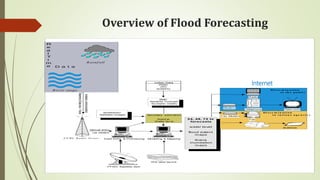
Overview of Flood Forecasting
Indian Data
WMO
JRC
WARPO
F F WC R a d io To we r
FFWC Satellite dish
24, 48, 72 hr
forecasts
water level
flood extent
m aps
thana
inundation
m aps
Telephone
Fax
Fax Modem
Modem
Telev ision
Bulletine
GIS data lay ers
Radio
wirelesscommunication
via modem
manual entry
Telemetry/Databox/Voice
SPARRSO
Sattelite images
BMD
Weather f orecast
Sy noptic charts
Boundary estimation
Rainf al,
Water lev el
Data Entry & Processing Modelling & Mapping
R iv er stage
R ainf all
R
e
a
l
T
i
m
e D a t a
D i s s e m i n a ti o n
t o th e pu bl i c
D i s s e m i n a t i o n
t o va ri o u s a g e n c i e s
Internet
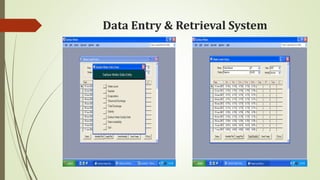
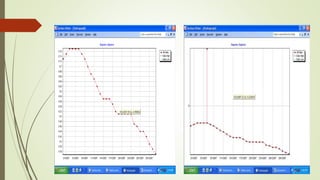
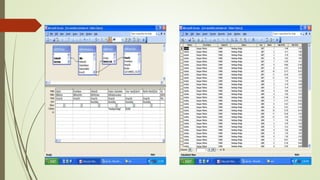
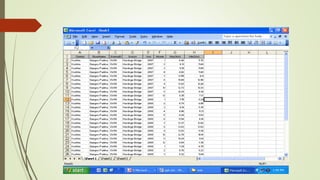
Data Entry & Retrieval System
Water Level Status shown in FFWC Website
Types of Flood Forecasting
Probabilistic Method (10 days)
Deterministic Method (5 days)
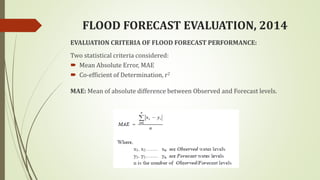
FLOOD FORECAST EVALUATION, 2014
EVALUATION CRITERIA OF FLOOD FORECAST PERFORMANCE:
Two statistical criteria considered:
 Mean Absolute Error, MAE
 Co-efficient of Determination, r2
MAE: Mean of absolute difference between Observed and Forecast levels.
r2: Co-efficient of Determination for the correlation of Observed and Forecast water
levels.
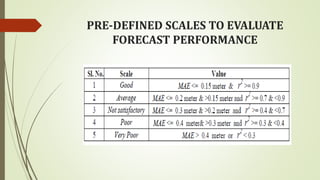
PRE-DEFINED SCALES TO EVALUATE
FORECAST PERFORMANCE
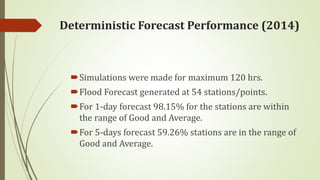
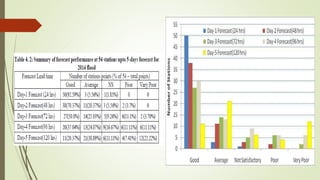
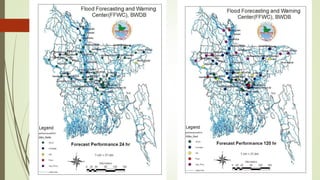
Simulations were made for maximum 120 hrs.
Flood Forecast generated at 54 stations/points.
For 1-day forecast 98.15% for the stations are within
the range of Good and Average.
For 5-days forecast 59.26% stations are in the range of
Good and Average.
Deterministic Forecast Performance (2014)
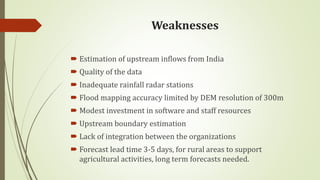
Weaknesses
 Estimation of upstream inflows from India
 Quality of the data
 Inadequate rainfall radar stations
 Flood mapping accuracy limited by DEM resolution of 300m
 Modest investment in software and staff resources
 Upstream boundary estimation
 Lack of integration between the organizations
 Forecast lead time 3-5 days, for rural areas to support
agricultural activities, long term forecasts needed.
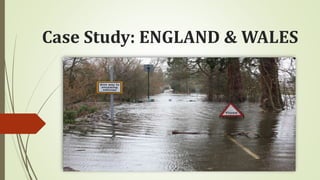
Case Study: ENGLAND & WALES
Study Area: England & Wales
 Performed by: Flood Forecasting Centre (FFC), a partnership between the
Environment Agency & the Met Office.
Separate operational forecasting rooms in each of the eight Environment
Agency Regions.
 Warning Time: 30 minutes to 72 hours.
Objectives
 Monitoring of environmental variables that may lead to flooding
 Forecasting of possible flood
 Warning, in the sense of decision making when flooding risks are
realizable
 Dissemination of warning messages
 Response to the threat.
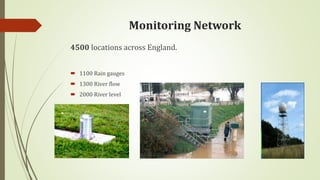
Monitoring Network
4500 locations across England.
 1100 Rain gauges
 1300 River flow
 2000 River level
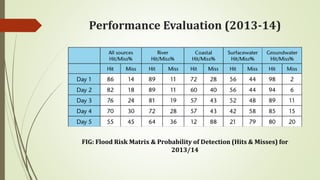
Performance Evaluation (2013-14)
FIG: Flood Risk Matrix & Probability of Detection (Hits & Misses) for
2013/14
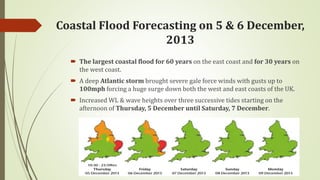
Coastal Flood Forecasting on 5 & 6 December,
2013
 The largest coastal flood for 60 years on the east coast and for 30 years on
the west coast.
 A deep Atlantic storm brought severe gale force winds with gusts up to
100mph forcing a huge surge down both the west and east coasts of the UK.
 Increased WL & wave heights over three successive tides starting on the
afternoon of Thursday, 5 December until Saturday, 7 December.
 Potential surge was first spotted 7 days ahead.
 The risk level in the Flood Guidance Statement was escalated during
that week up to high likelihood of severe flooding (red).
 Government contacts & emergency responders were given good
notice of the developing situation.
 Coastal surge & wave models developed were hosted on the Met
Office supercomputer, helped inform critical decision-making.
 As the surge moved down the North Sea the FFC maintained a round
the clock commentary on live observations against the forecast.
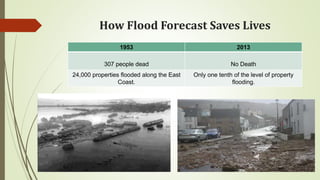
How Flood Forecast Saves Lives
1953 2013
307 people dead No Death
24,000 properties flooded along the East
Coast.
Only one tenth of the level of property
flooding.
Thank You

Flood forecasting presentation final

  • 1.
    Presented By: Group X ShazzadurRahman – 1116016 Abir Mohammad – 1116017 Sabiha Tabassum - 1116025 FLOOD FORECASTING Presented To: Dr. Md. Mostafa Ali Associate professor, Department of Water Resources Engineering, BUET.
  • 2.
    Overview Introduction Role of FloodForecasting in Flood Mitigation Design Considerations Data Requirements Flood Forecasting Methods & Models Challenges in Bangladesh Case Studies
  • 3.
  • 4.
    What is FloodForecasting? Flood forecasting is the use of forecasted precipitation and streamflow data in rainfall runoff and streamflow routing models to forecast flow rates and water levels for periods ranging from a few hours to days ahead.
  • 5.
    What is FloodWarning? Flood warning is the task of making use of these forecasts to make decisions about whether warnings of floods should be issued to the general public or whether previous warnings should be rescinded or retracted.
  • 6.
    Relation Between FloodForecasting and Flood Warning Flood forecasting is the prerequisite for flood warning. Flood warning is the outcome of flood forecasting.
  • 7.
    Components of FloodForecasting & Warning System Collection of Real Time Data Preparation of Forecast Warning & Information Messages Communication & Dissemination of Such Messages Interpretation of The Forecast & Flood Observations Response to The Warnings Review & Improvement of The System
  • 9.
    Role of FloodForecasting in Flood Mitigation
  • 10.
    Prerequisite for successfulmitigation of flood damage. Can be effectively combined with other measures for flood prevention such as retention, land use and structural measures, flood emergency and public awareness. Plays vital role in flood management when no preventive or defence measures can be completely effective. Increases flood resilience of the flood affected people.
  • 11.
    Evacuation of VulnerableGroups And Moving of Assets Shelter
  • 12.
    Installation of FloodResilience Measures (e.g. Sandbags, Property Flood Barriers)
  • 13.
  • 16.
  • 17.
    Basic Consideration Hydromorphological Characteristicsof The Basin, Topography, Geology Shape, Boundaries And Content of A Water Body.
  • 18.
    Main Physical ProcessesOccurring During Hydrometeorological Events
  • 19.
    The Type ofService That is Required or Can be Achieved Technically And Economically Threshold-based flood alert: qualitative estimation of the increase in river flow or level Flood forecasting: more definitive service based on the use of simulation tools and modelling Vigilance mapping: development of the site-specific warning approach Inundation forecasting: It requires the combination of a hydrological or hydrodynamic level-and-flow model with digital representation of the flood plain land surface
  • 20.
    Forecast Lead Time BasicPrinciple: minimum period of advance warning necessary for preparatory action to be taken effectively Concept of lead time has to be flexible
  • 21.
  • 22.
  • 23.
  • 24.
  • 25.
    Meteorological data Rainfall intensityand duration, precipitation forecasts and past data
  • 26.
  • 27.
  • 28.
  • 29.
    Topographic data Information aboutthe elevation of the surface of the Earth
  • 30.
  • 31.
  • 32.
    (a) Population anddemographic data to indicate settlements at risk; (b) Inventories of properties at risk; (c) Reservoir and flood protection infrastructure control rules; (d) Location of key transport, power and water supply infrastructure; (e) Systematic post-flood damage assessments. Other information and data
  • 33.
  • 35.
    The “multi-model” approachto rainfall–runoff modelling and forecasting
  • 37.
    SPECIAL-CASE MODELS Storm surge Twotypes of models, statistical and dynamic, can be used to forecast storm surges Flash floods distributed hydrological models Urban Flooding very high spatial and temporal resolution in data, models Reservoir flood control Estimates incoming flood and incorporates it with d/s riparian area
  • 38.
  • 39.
    MIKE FLOOD Includes 1Dand 2D flood simulation engines model any flood problem three-way coupled modelling tool MIKE HYDRO River + MIKE URBAN + MIKE 21
  • 40.
    Delft-FEWS provide an openshell for managing the data handling and forecasting process
  • 42.
    In Bangladesh, FFWC •uses GIS techniques extensively to display water level and rainfall status • flood forecast model MIKE 11 FF
  • 43.
    LIMITATIONS • not sufficienton its own to reduce risk • Models require continuous improvisation (calibration) • Cost of running the system • Cost of sourcing meteorological data • system inaccuracies may lead to complacency • availability of communication channels requires resource
  • 44.
  • 45.
    Data Collection 57 transboundaryriver Location of Bangladesh in GBM basin
  • 48.
    Tidal Influence onRiver Uncertainty in Forecast of Rainfall
  • 49.
  • 50.
  • 51.
  • 52.
    Study Area: Bangladesh Performedby: FLOOD FORECASTING & WARNING CENTRE (FFWC) of BWDB Model Based on: MIKE11 FF conceptual Hydrodynamic model DEM Used: 300m SRTM
  • 53.
    Objectives of FFWC Forecasting: Predicts the occurrence/magnitude of flood.  Interpretation: Warn people about the extent of flooding.  Dissemination: Communication/distribution of warning messages to disaster management agencies & vulnerable communities.  Response: Preparation/action by concerned agencies and threatened communities for protection against flood hazards.  Review & Analysis: Continuous monitoring of the performance of the various components.
  • 54.
    Stations WL STATIONS =95 (50 Rivers) Brahmaputra Basin(35 Stations) Ganges Basin(25 Stations) Meghna Basin(27 Stations) South Eastern Hill Basin(8 Stations) Rainfall Stations: 56
  • 56.
    Overview of FloodForecasting Indian Data WMO JRC WARPO F F WC R a d io To we r FFWC Satellite dish 24, 48, 72 hr forecasts water level flood extent m aps thana inundation m aps Telephone Fax Fax Modem Modem Telev ision Bulletine GIS data lay ers Radio wirelesscommunication via modem manual entry Telemetry/Databox/Voice SPARRSO Sattelite images BMD Weather f orecast Sy noptic charts Boundary estimation Rainf al, Water lev el Data Entry & Processing Modelling & Mapping R iv er stage R ainf all R e a l T i m e D a t a D i s s e m i n a ti o n t o th e pu bl i c D i s s e m i n a t i o n t o va ri o u s a g e n c i e s Internet
  • 57.
    Data Entry &Retrieval System
  • 61.
    Water Level Statusshown in FFWC Website
  • 62.
    Types of FloodForecasting Probabilistic Method (10 days) Deterministic Method (5 days)
  • 63.
    FLOOD FORECAST EVALUATION,2014 EVALUATION CRITERIA OF FLOOD FORECAST PERFORMANCE: Two statistical criteria considered:  Mean Absolute Error, MAE  Co-efficient of Determination, r2 MAE: Mean of absolute difference between Observed and Forecast levels.
  • 64.
    r2: Co-efficient ofDetermination for the correlation of Observed and Forecast water levels.
  • 65.
    PRE-DEFINED SCALES TOEVALUATE FORECAST PERFORMANCE
  • 66.
    Simulations were madefor maximum 120 hrs. Flood Forecast generated at 54 stations/points. For 1-day forecast 98.15% for the stations are within the range of Good and Average. For 5-days forecast 59.26% stations are in the range of Good and Average. Deterministic Forecast Performance (2014)
  • 69.
    Weaknesses  Estimation ofupstream inflows from India  Quality of the data  Inadequate rainfall radar stations  Flood mapping accuracy limited by DEM resolution of 300m  Modest investment in software and staff resources  Upstream boundary estimation  Lack of integration between the organizations  Forecast lead time 3-5 days, for rural areas to support agricultural activities, long term forecasts needed.
  • 70.
  • 71.
    Study Area: England& Wales  Performed by: Flood Forecasting Centre (FFC), a partnership between the Environment Agency & the Met Office. Separate operational forecasting rooms in each of the eight Environment Agency Regions.  Warning Time: 30 minutes to 72 hours.
  • 72.
    Objectives  Monitoring ofenvironmental variables that may lead to flooding  Forecasting of possible flood  Warning, in the sense of decision making when flooding risks are realizable  Dissemination of warning messages  Response to the threat.
  • 73.
    Monitoring Network 4500 locationsacross England.  1100 Rain gauges  1300 River flow  2000 River level
  • 74.
    Performance Evaluation (2013-14) FIG:Flood Risk Matrix & Probability of Detection (Hits & Misses) for 2013/14
  • 75.
    Coastal Flood Forecastingon 5 & 6 December, 2013  The largest coastal flood for 60 years on the east coast and for 30 years on the west coast.  A deep Atlantic storm brought severe gale force winds with gusts up to 100mph forcing a huge surge down both the west and east coasts of the UK.  Increased WL & wave heights over three successive tides starting on the afternoon of Thursday, 5 December until Saturday, 7 December.
  • 76.
     Potential surgewas first spotted 7 days ahead.  The risk level in the Flood Guidance Statement was escalated during that week up to high likelihood of severe flooding (red).  Government contacts & emergency responders were given good notice of the developing situation.  Coastal surge & wave models developed were hosted on the Met Office supercomputer, helped inform critical decision-making.  As the surge moved down the North Sea the FFC maintained a round the clock commentary on live observations against the forecast.
  • 77.
    How Flood ForecastSaves Lives 1953 2013 307 people dead No Death 24,000 properties flooded along the East Coast. Only one tenth of the level of property flooding.
  • 78.