
Dr. Rahul B. Pandit
Faculty of Nursing
Sassoon General Hospital, Pune
Introduction
 Water to be one of four elementary substances
along with Earth, Fire and Air.
 Water is a precious resource and without it life
is not possible on earth.
 Water is a prime natural resource.
 Water is essential for drinking, cooking,
bathing and washing, laundering, ablution,
domestic, sanitation, Agriculture and
industries.
Safe and wholesome water must be
 Free of pathogenic organisms
 Free from harmful chemical substances
 Acceptable to taste and appearance
 Usable for domestic purposes
Sources of Water
There are mainly three sources of water
1. RAIN
2. SURFACE WATER
• Impounding reservoirs
• Rivers and streams
• Tanks, ponds and lakes.
3. GROUND WATER
• Shallow wells
• Deep wells
• Springs
Rain
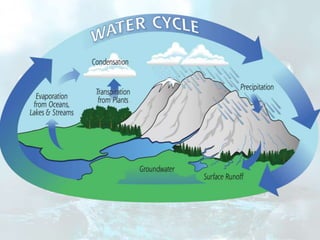
 Rain is the prime source of all water.
 Purest form of water
 clear, bright and sparkling
 No biological contamination
 Soft, slightly acidic (carbonic acid)
 Contaminants- from the atmosphere
 Acid rain
Surface Water
 Surface water originates from rain water.
 It is the main source of water supply in many
areas.
 Examples of surface water include rivers, tanks,
lakes, man – made reservoirs and sea water.
 Surface water is prone to contamination from
human and animal sources.
 Surface water needs purification before use for
drinking and cooking purposes.
Impounding reservoirs
 These are artificial lakes constructed usually of
earthwork in which large quantities of surface water
is stored.
 Dams built across rivers and mountain streams also
provide large reserves of surface water.
 The area draining into the reservoir is called
“catchment area”.
 The disadvantage of storing water is the growth of
algae and other microscopic organisms, which impart
bad tastes and odors to water.
Impounding reservoirs
Characteristics
 Impounding reservoirs usually furnish a fairly
good quality of water.
 The water is usually clear, palatable and
ranks next to rain water in purity.
 The water is usually soft and considered tobe
free of pathogenic organisms.
Impounding reservoirs
Impurities
The upland surface water derives its
impurities from the catchment area, the
sources being human habitations and animal
keepig or grazing..
River
Characteristics
 River water is turbid during rainy season; it
may be clear in other seasons.
 Clarity of water is no guarantee that river
water is safe for drinking.
 It contains dissolved and suspended impurities
of all kinds.
River
Impurities
The impurities of river water are derived from
 Surface washings
 Sewage and sullage water
 Industrial and trade wastes
 Drainage from agricultural areas.
Tank
 Tanks are large excavations in which surface
water is stored.
 They are an important source of water supply
in some parts of the country.
 Tanks are recipients of contamination of all
sorts.
 They are full of silt and colloidal matter,
especially after the rains.
 Older tanks may be full of aquatic vegetation.
Sea Water
 Though this source is plentiful, it has great
many limitations.
 It contains 3.5 per cent of salts in solution.
 Offshore waters of the oceans and seas have a
salt concentration of 30,000 to 36,000 mg/litre
(30-36 g/litre) of dissolved solids
 19,000 mg/litre of chloride, 10,600 mg/litre of
sodium and 1,270 mg/litre of magnesium.
Ground Water
 Rain water percolating into ground water
constitutes ground water.
 Ground water is the cheapest and most
practical means of providing water to small
communities.
 Ground water is superior to surface water,
because the ground itself provides an effective
filtering medium.
Ground Water
Advantages and Disadvantages
 It is likely to be free from pathogenic agents
 It is usually requires no treatment.
 The supply is likely to be certain even during dry
season.
 It is less subject to contamination than surface
water.
 It is high in mineral content.
 It requires pumping or some arrangement to lift the
water.
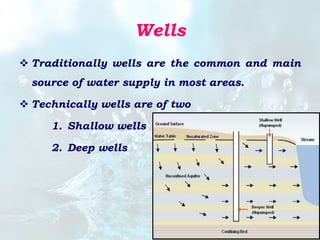
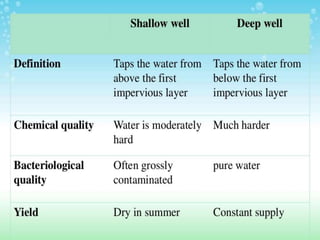
Wells
 Traditionally wells are the common and main
source of water supply in most areas.
 Technically wells are of two
1. Shallow wells
2. Deep wells
Classification
Wells are classified according to method of
construction
1. Dug wells
2. Tube wells
Sanitary Well
 This is a well that is properly located, suitably
constructed and well protected from
contamination, thus supplying safe water.
 The following important points are to be taken into
consideration in constructing safe wells:
a) Location
b) Lining
c) Parapet
d) Platform
e) Drain
f) Covering
g) Hand-pump
 Location – Should be away not less than 15m
from sources of contamination. Distant
between well and the house (<100m)
 Lining – Lining should be built of bricks or
stones set in cement up to 6 m deep, to allow
the water to enter from the bottom and not
from the sides of the well. Lining should be
curried 60-90cm above the ground.
 Parapet wall – A parapet wall around the well
up to the height of at least (70-75 cm) should
be provided above the ground.
 Platform – Along with the parapet wall the platform
should be made with cement concrete extending at
least 1m in all directions. It should have gentle slope
outward leading to a drain built along its edges.
 Drain – A pucca drain should be built to collect the
spilt and dirty water from the platform of the well
and this should be channeled to a drain or soak pit
that is away from the well.
 Covering – The top of the well should be covered well
by a cement concrete cover to avoid direct
contamination.
 Hand pump – A good sanitary well should be equipped
with a hand pump to lift the water in a clean manner.
Tube Well
 Tube wells are successful as a source of
drinking water in many parts of India.
 They yield water which is bacteriologically
safe, and are also cheap in comparison to
other sources of supply.
 Shallow tube wells have become the largest
individual source of water supply to the rural
community.
Springs
 Ground water comes to the surface and flows freely
under natural pressure
 Two types
Shallow springs
Deep springs
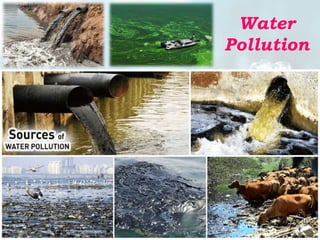
Water
Pollution
Purification of Water
 Water is very basic and essential element of
human life.
 Source of infection.
 To prevent water borne diseases needs
purification.
 Water purification can be done at large scale
and small scale.
Purification of Water
 To provide safe water to the community many
water treatment methods are used to purify
water.
 There are various methods of purification of
water.
 Selection of purification method depends on
nature and quality of water.
Methods of purification
 Storage
 Filtration
 disinfection
Storage
 Storage is the natural method of purification.
 Water collected from the source in the
reservoirs are treated by using storage system.
 Storage means allowing water to remain for
required number of hours in natural or
artificial storage reservoirs.
 Suitable time duration allowed for storage of
river water is 10-14 days.
Storage
 More than 15 days of storage would cause bad
smell and color changes due to algae growth.
 Storage reduces the impurities of water like
physical, chemical and biological.
Physical
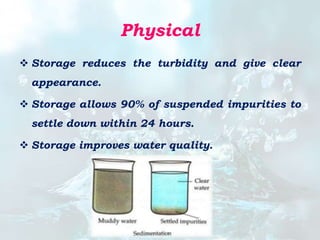
 Storage reduces the turbidity and give clear
appearance.
 Storage allows 90% of suspended impurities to
settle down within 24 hours.
 Storage improves water quality.
Biological
 Storage reduces the pathogens presents in
water.
 Storage of river water for period of 5 to 7 days
reduces the 90% of bacterial count.
Chemical
 Storage helps to decrease the presence of free
ammonia as result of oxidation.
Filtration
 Filtration is the second step in water
purification.
 It is the most essential step because it cause
99% reduction in bacterial count.
 There are two types of filters
slow sand filter / biological filter
Rapid sand filter / Mechanical filter
Principles of Filtration
 It is a simple process.
 Impure water is allowed to flow through sand
layer that provides physical and biological
treatment.
 Slow sand filter use biological process.
 Rapid sand filter use physical treatment.

Environment: water

  • 1.
    Dr. Rahul B.Pandit Faculty of Nursing Sassoon General Hospital, Pune
  • 8.
    Introduction  Water tobe one of four elementary substances along with Earth, Fire and Air.  Water is a precious resource and without it life is not possible on earth.  Water is a prime natural resource.  Water is essential for drinking, cooking, bathing and washing, laundering, ablution, domestic, sanitation, Agriculture and industries.
  • 9.
    Safe and wholesomewater must be  Free of pathogenic organisms  Free from harmful chemical substances  Acceptable to taste and appearance  Usable for domestic purposes
  • 10.
    Sources of Water Thereare mainly three sources of water 1. RAIN 2. SURFACE WATER • Impounding reservoirs • Rivers and streams • Tanks, ponds and lakes. 3. GROUND WATER • Shallow wells • Deep wells • Springs
  • 11.
    Rain  Rain isthe prime source of all water.  Purest form of water  clear, bright and sparkling  No biological contamination  Soft, slightly acidic (carbonic acid)  Contaminants- from the atmosphere  Acid rain
  • 13.
    Surface Water  Surfacewater originates from rain water.  It is the main source of water supply in many areas.  Examples of surface water include rivers, tanks, lakes, man – made reservoirs and sea water.  Surface water is prone to contamination from human and animal sources.  Surface water needs purification before use for drinking and cooking purposes.
  • 14.
    Impounding reservoirs  Theseare artificial lakes constructed usually of earthwork in which large quantities of surface water is stored.  Dams built across rivers and mountain streams also provide large reserves of surface water.  The area draining into the reservoir is called “catchment area”.  The disadvantage of storing water is the growth of algae and other microscopic organisms, which impart bad tastes and odors to water.
  • 15.
    Impounding reservoirs Characteristics  Impoundingreservoirs usually furnish a fairly good quality of water.  The water is usually clear, palatable and ranks next to rain water in purity.  The water is usually soft and considered tobe free of pathogenic organisms.
  • 16.
    Impounding reservoirs Impurities The uplandsurface water derives its impurities from the catchment area, the sources being human habitations and animal keepig or grazing..
  • 17.
    River Characteristics  River wateris turbid during rainy season; it may be clear in other seasons.  Clarity of water is no guarantee that river water is safe for drinking.  It contains dissolved and suspended impurities of all kinds.
  • 18.
    River Impurities The impurities ofriver water are derived from  Surface washings  Sewage and sullage water  Industrial and trade wastes  Drainage from agricultural areas.
  • 19.
    Tank  Tanks arelarge excavations in which surface water is stored.  They are an important source of water supply in some parts of the country.  Tanks are recipients of contamination of all sorts.  They are full of silt and colloidal matter, especially after the rains.  Older tanks may be full of aquatic vegetation.
  • 20.
    Sea Water  Thoughthis source is plentiful, it has great many limitations.  It contains 3.5 per cent of salts in solution.  Offshore waters of the oceans and seas have a salt concentration of 30,000 to 36,000 mg/litre (30-36 g/litre) of dissolved solids  19,000 mg/litre of chloride, 10,600 mg/litre of sodium and 1,270 mg/litre of magnesium.
  • 21.
    Ground Water  Rainwater percolating into ground water constitutes ground water.  Ground water is the cheapest and most practical means of providing water to small communities.  Ground water is superior to surface water, because the ground itself provides an effective filtering medium.
  • 22.
    Ground Water Advantages andDisadvantages  It is likely to be free from pathogenic agents  It is usually requires no treatment.  The supply is likely to be certain even during dry season.  It is less subject to contamination than surface water.  It is high in mineral content.  It requires pumping or some arrangement to lift the water.
  • 23.
    Wells  Traditionally wellsare the common and main source of water supply in most areas.  Technically wells are of two 1. Shallow wells 2. Deep wells
  • 25.
    Classification Wells are classifiedaccording to method of construction 1. Dug wells 2. Tube wells
  • 26.
    Sanitary Well  Thisis a well that is properly located, suitably constructed and well protected from contamination, thus supplying safe water.  The following important points are to be taken into consideration in constructing safe wells: a) Location b) Lining c) Parapet d) Platform e) Drain f) Covering g) Hand-pump
  • 27.
     Location –Should be away not less than 15m from sources of contamination. Distant between well and the house (<100m)  Lining – Lining should be built of bricks or stones set in cement up to 6 m deep, to allow the water to enter from the bottom and not from the sides of the well. Lining should be curried 60-90cm above the ground.  Parapet wall – A parapet wall around the well up to the height of at least (70-75 cm) should be provided above the ground.
  • 28.
     Platform –Along with the parapet wall the platform should be made with cement concrete extending at least 1m in all directions. It should have gentle slope outward leading to a drain built along its edges.  Drain – A pucca drain should be built to collect the spilt and dirty water from the platform of the well and this should be channeled to a drain or soak pit that is away from the well.  Covering – The top of the well should be covered well by a cement concrete cover to avoid direct contamination.  Hand pump – A good sanitary well should be equipped with a hand pump to lift the water in a clean manner.
  • 29.
    Tube Well  Tubewells are successful as a source of drinking water in many parts of India.  They yield water which is bacteriologically safe, and are also cheap in comparison to other sources of supply.  Shallow tube wells have become the largest individual source of water supply to the rural community.
  • 30.
    Springs  Ground watercomes to the surface and flows freely under natural pressure  Two types Shallow springs Deep springs
  • 31.
  • 32.
    Purification of Water Water is very basic and essential element of human life.  Source of infection.  To prevent water borne diseases needs purification.  Water purification can be done at large scale and small scale.
  • 33.
    Purification of Water To provide safe water to the community many water treatment methods are used to purify water.  There are various methods of purification of water.  Selection of purification method depends on nature and quality of water.
  • 34.
    Methods of purification Storage  Filtration  disinfection
  • 36.
    Storage  Storage isthe natural method of purification.  Water collected from the source in the reservoirs are treated by using storage system.  Storage means allowing water to remain for required number of hours in natural or artificial storage reservoirs.  Suitable time duration allowed for storage of river water is 10-14 days.
  • 37.
    Storage  More than15 days of storage would cause bad smell and color changes due to algae growth.  Storage reduces the impurities of water like physical, chemical and biological.
  • 38.
    Physical  Storage reducesthe turbidity and give clear appearance.  Storage allows 90% of suspended impurities to settle down within 24 hours.  Storage improves water quality.
  • 39.
    Biological  Storage reducesthe pathogens presents in water.  Storage of river water for period of 5 to 7 days reduces the 90% of bacterial count.
  • 40.
    Chemical  Storage helpsto decrease the presence of free ammonia as result of oxidation.
  • 41.
    Filtration  Filtration isthe second step in water purification.  It is the most essential step because it cause 99% reduction in bacterial count.  There are two types of filters slow sand filter / biological filter Rapid sand filter / Mechanical filter
  • 43.
    Principles of Filtration It is a simple process.  Impure water is allowed to flow through sand layer that provides physical and biological treatment.  Slow sand filter use biological process.  Rapid sand filter use physical treatment.