ENVIRONMENT AND
HEALTH
Presented by
N.Nitya Krishna
2nd Year Postgraduate
Department of Public Health Dentistry
1
Contents
 Introduction
 Basic terminologies
 Classification of environment
 Water
1.Uses
2. Sources
3. Purification of water
4. Disinfection of water
5. Standards of Drinking water
6. Survellience of drinking water
7. Hardness of water
 Air
 Noise
 Ventilation
 Light
 Radiation
 Housing‘
 Conclusion
 References
2
Introduction
 Environment living/non-living, material and non-material
 Modern concept – social and economic conditions.
 Man is responsible for pollution of his environment through urbanization,
industrialization and other human activities
 In 1972 the UN conference on the Human Environment focused worldwide
attention on the environmental hazards that threaten human beings.
3
Definition
4
ENVIRONMENT
All that which is external to the individual human host, living and non-living, and with
which he is in constant interaction.
HEALTH
A state of complete physical, social and mental wellbeing, and not merely the absence
of disease or infirmity
WHO (1948)
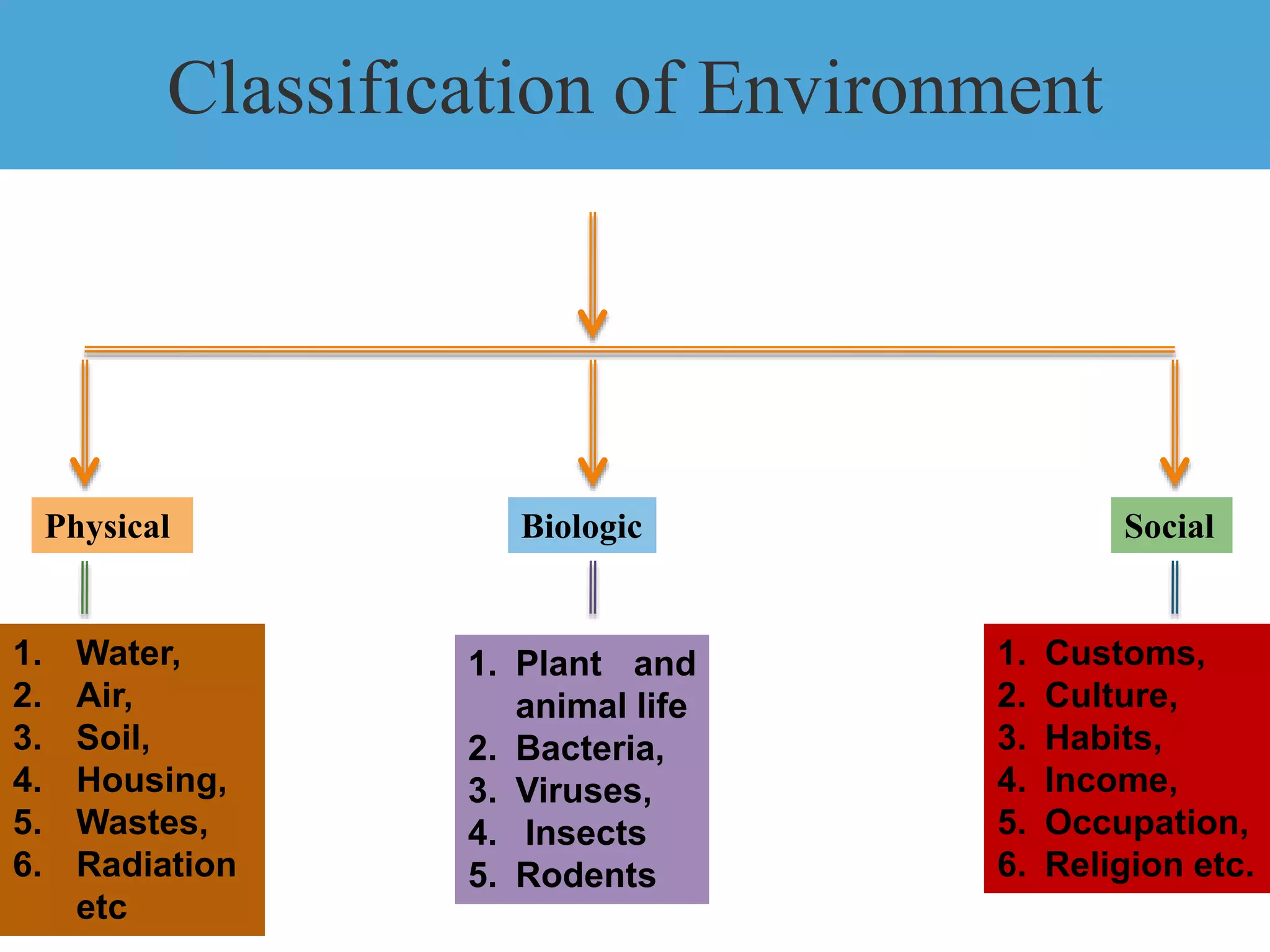
Classification of Environment
5
Physical Biologic Social
1. Water,
2. Air,
3. Soil,
4. Housing,
5. Wastes,
6. Radiation
etc
1. Plant and
animal life
2. Bacteria,
3. Viruses,
4. Insects
5. Rodents
1. Customs,
2. Culture,
3. Habits,
4. Income,
5. Occupation,
6. Religion etc.
Water
 In 1981, the 34th World Health Assembly – “safe drinking water is a basic
element of "primary health care" which is the key to the attainment of "Health
for All by the year 2000 AD".
 Safe and wholesome water
a. Free from pathogenic agents
b. Free from harmful chemical substances
c. Pleasant to the taste, i.e., free from colour and odour; and .
d. Usable for domestic purposes.
 Water requirement -
Basic physiological requirements-2 litres per head per day.
A daily supply of 150-200 litres per capita -urban domestic purposes.
6
7
Sources of Water
Rain water
Surface water
8
15M
Depth-6m with bricks or stones
Height-70-75cms
Cement-concrete platform-1m
Pucca drain
Cement-concrete
covering
9
Ground water
Water pollution
10
 Pure uncontaminated water does not occur in nature.
 It contains impurities of various kinds - natural and manmade
 A more serious aspect of water pollution is that caused by human activity -
urbanization and industrialization.
 Sources of pollution :
(a) sewage,
(b) industrial and trade wastes,
(c) agricultural pollutants,
(d) Physical pollutants,
Water Related Diseases
A. Biological (Water-borne diseases)
1. Presence of an infective agent :
 (a) Viral : Viral hepatitis A, hepatitis E, poliomyelitis, rotavirus
diarrhoea in infants
 (b) Bacterial : Typhoid and paratyphoid fever, bacillary
dysentery, Esch. coli diarrhoea, cholera
 (c) Protozoa! : Amoebiasis, giardiasis
 (d) Helminthic : Roundworm, threadworm, hydatid disease.
 (e) Leptospiral : Weil's disease
2. presence of an aquatic host :
(a) Snail : schistosomiasis
(b) Cyclops : guineaworm, fish tape worm. 11
B. Chemical pollutants
Solvents, cyanides, heavy metals, minerals and organic acids, nitrogenous
substances, bleaching agents, dyes, pigments, sulphides, ammonia, toxic
etc.
In addition,
(a) Dental health : high levels of fluoride cause mottling;
(b) Cyanosis in infant : methaemoglobinaemia.
(c) Cardiovascular diseases : Hardness of water
(d) Diseases - inadequate use of water like shigellosis, trachoma and
conjunctivitis, ascariasis, scabies.
(e) Disease carrying insects breeding in or near water, like : malaria, filaria,
arboviruses, onchocerciasis, African trypanosomiasis
12
WATER POLLUTION LAW
 Indian Parliament in 1974 passed the Water (Prevention and Control of
Pollution) Act.
 Provide legal deterrent against the spread of water pollution.
13
Water Purification
Purification of water on small scalePurification of water on large scale
14
1.Storage-
A) Physical-By gravity
B) Chemical- Free Ammonia is reduced
C) Biological- bacterial count
2.
Filtration
Slow sand or Biological filters Rapid sand or Mechanical filters
(1) Supernatant (raw) water
(2) A bed of graded sand
(3) An under-drainage system; and
(4) A system of filter control valves.
(1) Coagulation
(2) Rapid Mixing
(3) Flocculation
(4) Sedimentation
(5) Filtration
Household Purification Disinfection of wells
1. Boiling
2. Chemical disinfection
3. Filtration
4. Ultraviolet radiation
5. Multistage reverse osmosis purification
3. Disinfection
SLOW SAND FLITRATION
15
16
Disinfection
Criteria :
(A) Capable of destroying the pathogenic organisms
(B) Should not leave products of reaction which render the water toxic
(C) Have ready and dependable availability
(D) Possess the property of leaving residual concentration
(E) Be amenable to detection
17
Chlorination
It oxidizes iron, manganese and hydrogen sulphide;
It destroys some taste and odour producing constituents;
It controls algae and slime organisms; and
Aids coagulation.
Action of chlorine :
18
The sum of the chlorine demand of the specific water plus the free residual
chlorine of 0.5 mg/L constitutes the correct dose of chlorine to be applied.
Minimum recommended concentration of free chlorine is 0.5 mg/L for one
hour .
Contact period
"Chlorine demand" of the water should be estimated.
Clear and free from turbidity
19
Principles of Chlorination
METHOD OF CHLORINATION
 For disinfecting large bodies of water, chlorine is applied either as
(1) chlorine gas
(2) chloramine or
(3) perchloron.
 Chlorine gas -cheap, quick in action, efficient and easy to apply.
 Paterson's chloronome -measuring, regulating and administering gaseous
chlorine to water supplies.
 Chloramines are loose compounds of chlorine and ammonia.
 Perchloron or high test hypochlorite (H.T.H.) is a calcium compound - 60-70
per cent of available chlorine.
20
 BREAK POINT CHLORINATION
 SUPERCHLORINATION
Addition of large doses of chlorine to the water, and removal of excess of
chlorine.
21
ORTHOTOLIDINE (OT) TEST
 Enables both free and combined chlorine in water to be determined with
speed and accuracy.
 Carried out by adding 0.1 ml of the reagent to 1 ml of water.
 The yellow colour produced is matched against suitable standards or colour
discs.
ORTHOTOLIDINE-ARSENITE (OTA) TEST
 Determine the free and combined chlorine residuals separately.
22
OZONATION
 Uses in water treatment-oxidation of organic chemicals, primary disinfectant.
 Ozone gas (0) is formed by passing dry air or oxygen through a high-voltage
electric field.
 Dissolution of atleast 80% of the applied ozone should be possible, with the
remainder contained in the off gas.
 Ozonation relies on achieving the desired concentration after a given contact
period.
 Oxidation of organic chemicals- oxidizable pesticides-0.5 mg/I after a
contact time of upto 20 minutes
 The doses are typically in the range 2-5 mg/l.
23
 Membrane processes
These processes have traditionally been applied to the production of water for
industrial or pharmaceutical applications, but are now being applied to the
treatment of drinking-water.
24
PURIFICATION OF WATER ON SMALL SCALE
 Household purification •"Rolling boil" for 10 to 20 minutes
•It kills all bacteria, spores, cysts and ova
and yields sterilized water.
• Boiling also removes temporary hardness
by driving off carbon dioxide and
precipitating the calcium carbonate.
a) Boiling
b) Chemical disinfection
Bleaching powder-
It contains about 33
per cent of "available
chlorine".
Chlorine solution-
If 4 kg of bleaching
powder with 25 per cent
available chlorine is
mixed with 20 litres of
water, it will give a 5 per
cent solution of chlorine
Iodine-
2 drops of 2 %ethanol
solution of iodine will
suffice for 1lit of
clear water.
25
A single
tablet of 0.5 g
is sufficient
to disinfect
20 litres of
water
c) Filtration
Pasteur chamberland filter Berkefeld filter
d) Ultraviolet irradiation
Involves the exposure of a film of
water, upto about 120 mm thick, to one
or several quartz mercury vapour arc
lamps emitting ultraviolet radiation at a
wavelength of 254nm
26
e) Multistage reverse osmosis water purification
27
DISINFECTION OF WELL-1.By Adding Bleaching Powder
If free residual chlorine < 0.5 mg/L the process should be repeated
Do OTA test to measure free residual chlorine
Allow 1 hour contact
Deliver chlorine solution in to the well
Transfer supernatant chlorine solution to another bucket
Allow 10 minutes sedimentation
Bleaching powder (max.100 g) mixed with water in a bucket (water up to 3/4th of
bucket)
Find the amount of bleaching powder needed by Horrock’s apparatus
Find volume of water in well (V in Litres) = 3.14 x h x d2/4 x 1000
28
2 . DOUBLE POT METHOD/DOUBLE JAR DIFFUSER
 By NEERI,Nagpur,India
 Placed 1 meter below the water level
 Effective for chlorination of well (4500 L water)
with a daily withdrawal of 450 L water ---2-3 weeks
Inner pot
(28 cm ht)
Hole
(1 cm diam)
Bleaching powder 1kg
+
2 kg coarse sand
Moist mixture
Outer pot ( 1ft ht)
Rope
Polyethylene foil
Hole 1 cm diam
29
WATER QUALITY - CRITERIA AND STANDARDS
 The guidelines for drinking water quality recommended by WHO (2011)
relate to following variables :
I Acceptability aspects
II Microbiological aspects
III Chemical aspects
IV Radiological aspects.
30
1. Acceptability aspects
Physical parmeters
Turbidity Turbidity > 4 nephelometric turbidity units (NTU) - noticeable to
the naked eye.
Color Levels > 15 TCU can be detected in a glass of water.
Taste and odour Presence of potentially harmful substances.
Temperature Cool water -palatable.
Low water temperature -decrease the efficiency of treatment
process.
High water temperature -enhances the growth of microorganisms.
No guideline value
31
Inorganic constituents
Chlorides Standard prescribed -200 mg/litre.
Maximum permissible level - 600 mg/litre
Hardness 100-300 mg/litre
In some instances- excess of 500 mg/litre is tolerated by consumers.
Ammonia Natural levels -below 0.2 mg/litre.
Anaerobic ground -upto 3mg/litre
pH 6.5 and 8.5.
Hydrogen sulphide 0.05 and 0.1 mg/litre.
The "rotten eggs" odour -as a result of oxygen depletion and the
subsequent reduction of sulphate by bacterial activity
Iron At level above 0.3 mg/litre, iron stains laundry and plumbing fixtures
Sodium Average taste threshold for sodium is about 200 mg/litre.
Sulphate 270 and 90 mg/litre for the calcium and magnesium respectively
Aluminium 0.2mg/lit
Total dissolved solids TDS below 1000 mg/litre is usually acceptable to the consumers
Zinc < 3mg/lit
Manganese <0.1mg/lit
32
2.Microbiological aspects
a) Bacteriological aspects-
 Primary bacterial indicator -coliform group
 Supplementary indicator -faecal streptococci and sulphite-reducing clostridia.
 Coliform organisms are chosen as indicators because:
(1) Coliform organisms -constantly present in the human intestine.
Average person excretes 200-400 billion/day.
(1) Easily detected by culture methods - as small as one bacteria in 100 ml of
water.
(2) Survive longer than the pathogens
(3) Have greater resistance
33
b)Virological aspects :
 Disinfection with 0.5 mg/L of free chlorine residual at a pH of 8.0 is
sufficient to inactivate virus.
 Ozone - 0.2-0.4 mg/L are maintained for 4 minutes.
c)Biological aspects :
(i) Protozoa - Entamoeba histolytica, Giardia spp. and rarely,
Balantidium coli.
(ii) Helminths : The infective stages of many parasitic roundworms
and flatworms can be transmitted to man through drinking water.
(iii) Free-living organisms : fungi, algae etc.
34
3.Chemical parameters
35
a. Inorganic Constituents b. Organic Constituents
4. Radiological aspects
36
 The activity of a radio-active material is the number of nuclear disintegration
per unit of time.
 The unit of activity is a becquerel (Bq); 1 Bq 1 disintegration per second.
Formerly, the unit of activity was curie {Ci).
 The proposed guideline values are :
gross alpha activity 0.5 Bq IL
gross beta activity 1.0 Bq IL
Activities
 Approval of new sources(Including private owned)
 Watershed protection
 Approval-construction & operating procedures of water works
 Disinfection of the plant & distribution system
 Periodic flushing programmes & cleaning of water storage facilities
 Certification of operators
 Regulation of chemical substances
 Cross-connection control, back flow prevention ,leak detection control
 Sanitary surveys
 Monitoring programmes
 Development of codes of practice for well construction, pump installation and
plumbing
 Inspection quality control in bottled water
Survelience of drinking water
37
 Sanitary Survey
 Sampling
 Bacteriological Surveillance 1)Presumptive
Coliform Test
- Multiple Tube Method
-Membrane Filtration Technique
2)Detection of Faecal Strep & Cl.Perfringes
3)Colony Count
 Biological Examination
 Chemical Surveillance
38
Winchster Quart Bottles
Sampling from well
Hardness of water
39
 Hardness may be defined as the soap destroying power of water.
 Caused mainly by four dissolved compounds.
(1) Calcium bicarbonate
(2) Magnesium bicarbonate
(3) Calcium sulphate, and
(4) Magnesium sulphate
HOW HARDNESS CLASSIFIED?
Hardness of water
Carbonate Hardness
(Temporary Hardness)
Calcium & Magnesium
Bicarbonates
Non-Carbonate
hardness
(Permanent Hardness)
Calcium Sulphate
Magnesium Sulphate
Calcium Nitrates
Magnesium Nitrates
Calcium and Magnesium
Chlorides
12
40
MEASUREMENT OF HARDNESS
13
 Expressed as milli -equivalent per litre (m Eq/l) or mg/L
 1 mEq /l of hardness = 50mg CaCO3 (50ppm) in one litre
41
DISADVANTAGES
1
4
Consumes More soap and detergent.
 When water boiled carbonates precipitates,deposited in boiler - Industrial loss and
boiler inefficiency may explode
 Shorten the life of- cloth fabrics
 Not suited for various industrial processes
Shorten life span of pipes (deposition and scaling of salts)
42
REMOVAL OF HARDNESS
1. Boiling
2. Addition of lime
3. Addition of sodium carbonates
4. Base exchange process
1. Addition of Sodium carbonate
2. Base exchange process
15
Temporary
Hardness
Permanent
Hardness
43
44
1. BOILING
2. ADDITION OF LIME
Reduces total hardness but also accomplishes magnesium reduction.
3. ADDITION OF SODIUM CARBONATE
4. BASE EXCHANGE PROCESS
1. Sodium Permutit is used ( Na2 Al2 Si2O H2O)
2. Exchange Na ions for Ca and Mg ions
3. Ca and Mg Permutit is formed .
4. Removes 100% hardness
5. Some raw water is added to protect against corrosive action of 100% soft water
Fluoridation & Defluoridation of Water
 Is Naturally present in water
 Essential for dental and bone health
 Deficiency = dental caries
 Excess = Dental fluorosis ; Skeletal fluorosis
 1 ppm is the optimum requirement in water
 Defluoridation is the process of removing excess fluoride.
18
45
Water ATM
46
 Piramal Sarvajal social enterprise that provides clean
water through Water ATM’s.
 The RFID device sends a GPRS message to the SEMS
server (Sarvajal Enterprise Management System) which
authorizes the transaction instantly.
 The plant works on a reverse osmosis and UV based
filtration technology.
 The water quality is in accordance with the international
drinking water quality standard, IS 10500.
 Sarvajal presently operates in Gujarat, Rajasthan, Madhya
Pradesh and Uttar Pradesh
http://www.sarvajal.com/water-atm.php
Rally for rivers
47
 Launched by Isha foundation by Sadhguru on september 3 .
 On october 3, a river revitalization draft proposal was presented by Sadhguru
to Narendra Modi.
 Karnataka, Assam, Chhattisgarh, Punjab, Maharashtra and Gujarat signed
Memorandums of Understanding (MOU) With Isha Foundation to plant trees
along river banks.
Mission Bhagiratha
48 A safe drinking water project of government of telangana with a budget of
₹42,853 crores.
 Initiated by k. Chandrashekar rao
 Aims to provide piped water to 2.32 crore people in 20 lakh households in urban
and 60 lakhs in rural areas of telangana by march 2018.
 The ambitious project will supply clean drinking water to all households in the
state through water that is sourced from river godavari (22 tmc) and river
krishna (19 tmc).
 It is expected to be completed in first week of march 2018
missionbhagiratha.telangana.gov.in/
49
Vision
 To ensure safe and sustainable piped drinking water supply from surface
water sources at:
 100 LPCD ( litres per capita per day) for rural areas,
 135 LPCD for Municipalities
 150 LPCD for Municipal Corporations
 10% Quantity allocated to Industrial requirements
 To provide each household with a tap connection.
 10% of water in all Irrigation sources reserved for Drinking Water.
missionbhagiratha.telangana.gov.in/
Mission kakatiya
50
 The Program was inaugurated on 12 March 2015 by chief minister Kalvakuntla
Chandrashekar Rao at Patha Cheruvu in Sadashiva Nagar in Nizamabad district.
 Aims- restoring all the minor irrigation tanks and lakes in Telangana State, India.
 The goal of this program is to restore 46,531 tanks and lakes across the state
of Telangana with in five years.
 The program is carried out by removing silt from existing water bodies to increase
the water storage capacity of a tank, by rejuvenating old tanks and building new
ones.
https://missionkakatiya.cgg.gov.in/
51
The irrigated land (ayacut) under 70,000 tanks in Telangana in 1956 was around 25 lakh
acres, by 2014 the tanks left were 46,531, nearly half of them not storing any water.
The farmers started depending on wells for water.
 Phase 1 - 8003 tanks
 Phase 2 - 8927 tanks
 Phase 3 - 5886 tanks
 Phase 4 - 5703 tanks
 Phase 5 - Remainder and New tanks creation.
AIR
 The immediate environment of man comprises of air.
 Functions-
 The requirement for air is relatively constant (about 10 - 20 m3 per day).
Composition
 Nitrogen - 78.1 %; oxygen - 20.93%; carbon dioxide - 0.03%.
 Traces- Argon, Neon, krypton, Xenon and Helium.
52
Air in occupied room
(a) CHEMICAL CHANGES :
A person at rest gives off 0. 7 c.ft. of carbon dioxide per hour; this may increase up
to 2 c.ft. during physical activity.
(b) PHYSICAL CHANGES :
53
Rise in temperature
Body odours Bacterial pollution
54
Discomfort
 Discomfort is a subjective sensation which people
experience in ill-ventilated and crowded rooms.
In the 'Black Hole of Kolkata’
 146 prisoners were imprisoned in a room-18 x 14 x 10
out of whom only 23 survived.
 INDICES OF THERMAL COMFORT
1. Air temperature
2. Air temperature and humidity
3. Cooling power
4. Effective temperature
55
5.Corrected effective temperature
Air pollution
DEFINITION:
WHO
An increase in any of the constituents of the atmosphere which is harmful to the living
beings and their environment, is known as air pollution .
56
According to the 2014 WHO report, air pollution in 2012 caused the deaths of
around 7 million people worldwide
20 Most polluted cities in the world.
Source: WHO mid-2016 report57
58
Source of air pollution
 Primary air pollutants
 Secondary air pollutants
 Gaseous air pollutants
 Particulate air pollutants
Air pollutants
o Carbon monoxide
o Sulphur dioxide
o Lead
o Carbon dioxide
o Hydrocarbons
o Cadmium
o Hydrogen sulphide
o Ozone
o Polynuclear aromatic hydrocarbons (PAH)
o Particulate matter
Air pollutants – sources & effects
Pollutant Anthropogenic sources Effects on human health
SO2 Combustion of fossil fuel
<500 µg/m3- 10 mins ; <35.0 µg/m3 -1 hour
narrows the airway, causing wheezing
and shortness of breath, especially in
those with asthma
NO2 Biomass & fossil fuel burning
<150 µg/m3-24 hours
affects lungs and causes wheezing;
increases chance of respiratory
infection
CO Colourless, odourless product of incomplete
combustion of carbon containing materials,
such as in automobiles, industrial process,
heating facilities and incinerators
< 100mg/m3-15mins; <10mg/m3- 8 hours
deprives body of O2 causing
headaches, fatigue, and impaired
vision
O3 Reaction of sunlight on air containing
hydrocarbons and Nox
<100-200ug/m3- 8 hours
irritate respiratory system
and asthma; reduces lung
function by inflaming and damaging
lining of lungs
59
Pollutants Anthropogenic sources Effects on human health
PAH Incomplete combustion of fuels.
produced by incomplete burning of carbon
containing material like wood, garbage, coal and oil.
Automobile exhaust, industrial emission and smoke
from burning wood, charcoal and tobacco contain
high levels of PAHs
8.7 * 10-5 ng/m3
Respiratory disorder, mutagenic,
carcinogenic effects
PM2.5 Vehicular emission, Industrial & residential
combustion, Biomass burning, thermal power plants
Respiratory disorder, Cardiovascular
problems , Oxidative stress,
Systemic & immune alterations ,
Genotoxicity
Neurotoxicity, Reprotoxicity
Pb Automobile exhaust, Cosmetics, firewood
burning, tobacco, batteries Waste incineration,
Metal processing, Paint,
Effects on CNS, cardiovascular
system, kidneys, immune
system, miscarriage & reduction
of fertility
Air pollutants: sources & effects
60
Indoor air pollution
61
Outdoor Air Pollution
62
 Smog -large-scale outdoor pollution.
Temperature inversion
63
 Acid rain: The Greenhouse Effect:
 Ozone depletion-
Chemicals released by our activities affect the stratosphere, one of the atmospheric
layers surrounding earth.
Release of chlorofluorocarbons (CFC’s) from aerosol cans, cooling systems and
refrigerator equipment removes some of the ozone, causing “holes” to open up in
this layer and allowing the radiation to reach the earth.
Monitoring of air pollution
 INDICATORS:-
A. Sulphur dioxide - concentration in air
B. Smoke or soiling index
C. Grit & dust measurement
D. Coefficient of haze- amount of smoke or aerosol in air
E. Air pollution index- arbitrary index takes into account one or more
pollutants .
64
AIR PREVENTION AND CONTROL
65
NATIONAL AMBIENT AIR QUALITYSTANDARDS (NAAQS)
66
http://cpcb.nic.in
To arrest the deterioration in the air quality.
Main Function of CPCB:
 Advise the Central Government -Improvement of the quality of the air and the
prevention, control and abatement of air pollution.
 To plan a nation-wide programme
 Provide technical assistance and guidance
 To carry out sponsor investigations and research
 To collect, compile and publish technical and statistical data
 To lay down standards for the quality of air.
Air (Prevention & Control of Pollution) Act, 1981
67
Ventilation
 Control of the quality of incoming air with regard to its temperature, humidity and
purity with a view to provide a thermal environment that is comfortable and free
from risk of infection.
 Standards of ventilation
(1) Cubic space : minimal fresh air supply - 300 ~ 3,000 c.ft. per hour per person .
(2) Air change : living rooms- 2 or 3 air changes in one hour; work rooms and
assemblies- 4 to 6 air changes.
Based on this concept, it is now considered that a space of 1,000 to 1,200 c.ft. per
person is quite sufficient.
(3) Floor space: The optimum floor space requirements per person vary from 50 to
100 sq.ft. 68
Natural ventilation
Mechanical ventilation
Exhaust ventilation Plenum ventilation Balanced ventilation Air conditioning
69
Light
“Natural agent that stimulates sight and makes things visible.”
Requirements of good lighting
• Sufficiency: 15 to 20 foot candles-basic
minimum for satisfactory vision
• Distribution: uniform with same intensity
• Absence of glare
• Absence of sharp shadows
• Steadiness
• Colour of light
• Surroundings
70
Types of lighting
Based on the way of usage:
• Task lighting Accent lighting General lighting
Based on the source:
Natural lighting
• From visible sky + reflection
• Depends on:
-time of day
-season
-atmospheric pollution
• Accompanied by radiant heat
Requirements of improving daylight illumination:
• Orientation: towards North or South-provides
uniform illumination
• Removal of obstruction
• Windows properly planned
• Interior of the rooms: ceilings should be white,
upper portions of wall-light tinted and lower
portions should be darker
71
Measurement of daylight
• In terms of a factor called DAYLIGHT FACTOR
“It is the ratio of illumination at a given point to illumination at a point exposed
simultaneously to the whole hemisphere of sky (~500 foot candles)
excluding direct sunlight.”
D.F. = instantaneous illumination INDOORS
simultaneously occuring illumination OUTDOORS
Determined by Daylight Factor Meter
*100
72
Artificial Lighting
System of lighting:
• Direct: 99-100% light projected towards working area
• Semi-direct: 10-40% light is projected upwards, reflected back on the
object by ceiling
• Indirect: 90-100% of light is projected towards the ceiling and walls
• Semi-indirect: 60-90% light directed upwards and rest downwards
• Direct-Indirect: light is distributed equally
Methods of artificial lighting
FILAMENT LAMPS FLUORESCNT LAMP
73
Lighting Standards
“The illumination level should be 30 times higher than the level at which
the task can just be done”
Some recommended illuminations suggested by IES (in lux):
• Reading-100
• General office work-400
• Fine assembly-900
• Watch making-2000-3000
Biological effects of light
Radiation and UV Rays
Therapeutic effect in premature infants with hyperbilirubinemia
Activation of precursors of vit. D
Headache frequency, stress, and increased blood pressure-higher lighting levels.
74
Noise
 Defined as “Wrong sound, in the wrong place, at the wrong time".
Sources
75
Properties of Noise
Loudness/intensity Frequency
85 dB is a the limit The human ear can hear
frequencies from about
20 to 20,000 Hz
Sometimes noise is expressed in psycho-acoustic
terms - the phon.
76
Guignon AN. RDH Mag. 2016;36(6):70-
3
77
Auditory Non-Auditory
•Auditory fatigue –
•Deafness (hearing loss)-
1. Speech disturbance - SIL 12dB
2. Annoyancce
3. Reduction in work efficiency
4. Physiological changes
78
CONTROL OF NOISE
79
ISSUES AND REGULATION ON NOISE POLLUTION IN
INDIA
80
1. Ambient Noise Standards - 1989
2. Noise Limits for Domestic Appliances/Construction Equipment
- 1990
3. Noise Limits for Motor Vehicles – 1990
4. Noise Limits for Diesel Generator Sets - 1999
5. Noise Limits for Fire-crackers - 1999
6. Noise Limits for Petrol/Kerosene Generator Sets - 2000
7. Noise Limits for Motor Vehicles (revision) - 2000
8. Noise Pollution (Regulation & Control) Rules – 2000
9. Noise Limits for Diesel Generator Sets (revision) – 2002.
AMBIENT NOISE STANDARDS
(Noise Rules, 2000 and its amendments)
Category of Area / Zone Limits in dB
Day time Night time
Industrial area 75 70
Commercial area 65 55
Residential area 55 45
Silence Zone 50 40
81
Radiation
 Radiation is a process in which energetic particles or energetic waves travel
through a medium or space
Sources
82
 TYPES OF RADIATION
1.Ionizing radiation
2.Non-ionizing radiation
83
 BIOLOGICAL EFFECTS OF RADIATION
The biological response of high dose of radiation is as follows
 < 5 rad : No immediate observable effects
 5 rad to 50 rad : Slight blood changes may be detected
 50 rad to 150 rad : Slight blood changes with symptoms of nausea, fatigue,
vomiting etc. likely.
 150 rad to 1, 100 rad : Severe blood changes
 - 1, 100 rad to 2,000 rad : The probability of death increases to 100%
84
RADIATION PROTECTION
 The WHO has published permissible radiation levels in drinking water.
 The IAEA has sponsored many symposia on radioactive waste disposal and
associated subjects
85
Housing
 A WHO Expert Group (1961) - defined as the physical structure that man uses
and the environs of the structure including all necessary services, facilities,
equipment and devices needed or desired for the physical and mental health and
the social well-being of the family and the individual.
Social goals of housing
86
 CRITERIA FOR HEALTHFUL HOUSING
An Expert Committee of the WHO recommended the following criteria:
1.
87
Housing standards
 Recommended by EHC (1947):-
A) SITE B) SET BACK
C) FLOOR
(a) The height of the plinth should be 2 to 3 feet (0.6 to 1 metre).
88
 WALLS :
 These standards can be attained by 9-inch brick-wall plastered smooth and
coloured cream or white.
ROOF : should not be less than 10 feet (3 m) in the absence of air-conditioning
for comfort.
ROOMS :
89
 FLOOR AREA : Living room -120 sq.ft. (12 sq. m.) .
 CUBIC SPACE : Height of rooms should be such as to give an air space of
at least 500 c.ft. per capita, preferably 1,000 c.ft.
 WINDOWS :
(a) Every living room -2 windows
(b) Placed at a height of not more than 3 feet (1 m) above the ground.
(c) Should be 1/5th of the floor area.
LIGHTING KITCHEN
KITCHEN
KITCHEN
90
PRIVY : A sanitary privy is a MUST in every house, belonging exclusively to it
and readily accessible.
 GARBAGE AND REFUSE
 BATHING AND WASHING
 WATER SUPPLY
Housing and health
1. Respiratory Infections.
2. Skin Infections
3. Rat Infestation
4. Arthropods.
5. Accidents
6. Morbidity
7. Psychosocial Effects
91
 Overcrowding
Overcrowding refers to the situation in which more people are living within a single
dwelling than there is space for, so that movement is restricted, privacy secluded,
hygiene impossible, rest and sleep difficult.
The accepted standards with respect to overcrowding are as below :
1. PERSONS PER ROOM:
1 room-2 persons
2 rooms -3 persons
3 rooms-5 persons
4 rooms -7 persons
5 or more rooms -10 persons
2. FLOOR SPACE:
1. 110 sq.ft. (11 sq. m.) or more ..... 2 persons
2. 90-100 sq.ft. (9-10 sq. m.)------11/2 persons
3. 70-90 sq.ft. (7-9 sq. m.)------1 person
4. 50.:.._70 sq.ft. (5-7 sq. m.)-----1/ 2 person
5. Under 50 sq.ft (5 sq. m.)-----nil
92
Indicators of housing
 (1) Physical
 (2) Economic indicators
 (3) Social indicators: The following were proposed at an inter-regional seminar on
the Social Aspects of Housing, organized by the UN in 1975.
(a) Indicators related to comfort :
( 1) Thermal comfort
(2) Acoustic comfort
(3) Visual comfort
(4) Spatial comfort.
93
 (b) Indicators related to prevention of illness :
(1) Inadequate sewage and garbage collection.
(2) Contaminated water source.
(3) Insect borne diseases
(4) Overcrowding.
(5) Accidents.
(6) Proximity to animals.
(7) Access to medical facility.
 (c) Indicators related to mental health and social well-being
(1) Frequency of suicides in the neighbourhood
(2) Neglected and abandoned youth
(3) Drug abuse (including alcohol
94
Public policy
95
 The approach to public policy on housing in India - Five Year Plans.
 In 1952, a separate Ministry of Works and Housing was created at the Centre.
 The Government Housing Programmes :- public sector housing and social housing
schemes.
 Four organizations, viz The National Buildings Organization (NBO), National
Buildings Construction Corporation Ltd., Housing and Urban Development
Corporation (HUDCO) and the Hindustan Housing Factory are functioning under
the aegis of the Union Ministry of works and Housing to deal with various aspects
of housing
96
 According to an assessment by NBO, the housing stock in 1961 was estimated
to be 14.1 million in urban areas and 65.2 million in rural areas (total 79.3
million).
 This increased to 93 million in 1971, 116. 7 million in 1981and 148.8 million in
1991 .
Chandran E et al. Sookhive's 8th Five Year Plan (1992-97)
 In 2001 census, - 249 million houses.
Govt. of India, Census of India 2001
 According to 2011 census- 330.84 million, 220. 7 million houses - rural areas
and 110.14 million houses - urban areas
Govt. of India, A statistical compendium 2013
97
 House site and construction assistance : formed the core of the rural housing
programme during Seventh and subsequent Five Year Plans.
 Indira Awas Yojana (JAY) : Introduced in the Central Sector in 1985-86 as part
of the Rural Landless Employment Guarantee Programme which provides
houses have one room, one kitchen attached with latrine, bathroom and a
smokeless chullah .
Recent Housing Schemes
98
Pradhan Mantri Awas Yojana (PMAY)
 launched by PM Narendra Modi in 2015.
 Also known as the Housing For All scheme, the mission is to provide shelters to the
homeless by 2022.
 The Centre would be providing assistance to states and UT to provide homes to every
citizen within seven years.
 Government will provide interest subsidy of three to four per cent for a home loan
amount of up to Rs 9 lakh and Rs 12 lakh.
https://pmaymis.gov.in
99
Pradhan Mantri Gramin Awaas Yojana
 Earlier known as Indira Awas Yojna, - pucca houses with basic amenities to homeless
families.
 Objective –Build 1 crore homes of 25 sqm by 2022.
 The government shares the cost of construction with the state in the ratio of 60:40 in plain
areas and 90:10 for northeastern and hilly areas.
 The cost for the unit assistance of Rs 1.2 lakh is also provided to the beneficiary.
People who will be benefitted are:
 1) Households without shelter
 2) Destitute/living on alms
 3) Manual scavengers
 4) Tribal groups
 5) Legally released bonded labour
http://www.iay.nic.in/netiay/home.aspx
100
Rajiv swagruha
 Objective - “every person having no house of his or her own must own an
affordable house”
 For moderate income groups in the urban area of the State in the year 2007.
 Provide the houses at cost 25% less than the prevailing local market.
 cost range of houses is from Rs. 1635/- per sft to Rs. 2500/- per Sft only.
http://rajivswagruhaap.gov.in/ais/index.php?action=viewScheme
References
101
 Park K. Textbook of Preventive & Social Medicine. 2nd ed. Jabalpur: Bhanot
Publishers; 2013.
 Peter S. Essentials of Preventive & Community Dentistry, 2nd ed. New Delhi:
Arya Publishing House; 2004.
 Marya CM. A Textbook of Public Health Dentistry.; 1st ed. Jaypee
Brothers;2011.
 Hiremath SS. Textbook of preventive and community dentistry. 1st ed.
Elsevier pub; 2011
102
 http://rajivswagruhaap.gov.in/ais/index.php?action=viewScheme
 https://pmaymis.gov.in
 http://envfor.nic.in/downloads/public-information/noise-pollution-rules
 http://www.iay.nic.in/netiay/home.aspx
 http://www.sarvajal.com/water-atm.php
103
 missionbhagiratha.telangana.gov.in
 https://missionkakatiya.cgg.gov.in
 http://www.who.int/en/
 Chandran E et al. Sookhive's 8th Five Year Plan (1992-97)

Env

  • 1.
    ENVIRONMENT AND HEALTH Presented by N.NityaKrishna 2nd Year Postgraduate Department of Public Health Dentistry 1
  • 2.
    Contents  Introduction  Basicterminologies  Classification of environment  Water 1.Uses 2. Sources 3. Purification of water 4. Disinfection of water 5. Standards of Drinking water 6. Survellience of drinking water 7. Hardness of water  Air  Noise  Ventilation  Light  Radiation  Housing‘  Conclusion  References 2
  • 3.
    Introduction  Environment living/non-living,material and non-material  Modern concept – social and economic conditions.  Man is responsible for pollution of his environment through urbanization, industrialization and other human activities  In 1972 the UN conference on the Human Environment focused worldwide attention on the environmental hazards that threaten human beings. 3
  • 4.
    Definition 4 ENVIRONMENT All that whichis external to the individual human host, living and non-living, and with which he is in constant interaction. HEALTH A state of complete physical, social and mental wellbeing, and not merely the absence of disease or infirmity WHO (1948)
  • 5.
    Classification of Environment 5 PhysicalBiologic Social 1. Water, 2. Air, 3. Soil, 4. Housing, 5. Wastes, 6. Radiation etc 1. Plant and animal life 2. Bacteria, 3. Viruses, 4. Insects 5. Rodents 1. Customs, 2. Culture, 3. Habits, 4. Income, 5. Occupation, 6. Religion etc.
  • 6.
    Water  In 1981,the 34th World Health Assembly – “safe drinking water is a basic element of "primary health care" which is the key to the attainment of "Health for All by the year 2000 AD".  Safe and wholesome water a. Free from pathogenic agents b. Free from harmful chemical substances c. Pleasant to the taste, i.e., free from colour and odour; and . d. Usable for domestic purposes.  Water requirement - Basic physiological requirements-2 litres per head per day. A daily supply of 150-200 litres per capita -urban domestic purposes. 6
  • 7.
  • 8.
    Sources of Water Rainwater Surface water 8
  • 9.
    15M Depth-6m with bricksor stones Height-70-75cms Cement-concrete platform-1m Pucca drain Cement-concrete covering 9 Ground water
  • 10.
    Water pollution 10  Pureuncontaminated water does not occur in nature.  It contains impurities of various kinds - natural and manmade  A more serious aspect of water pollution is that caused by human activity - urbanization and industrialization.  Sources of pollution : (a) sewage, (b) industrial and trade wastes, (c) agricultural pollutants, (d) Physical pollutants,
  • 11.
    Water Related Diseases A.Biological (Water-borne diseases) 1. Presence of an infective agent :  (a) Viral : Viral hepatitis A, hepatitis E, poliomyelitis, rotavirus diarrhoea in infants  (b) Bacterial : Typhoid and paratyphoid fever, bacillary dysentery, Esch. coli diarrhoea, cholera  (c) Protozoa! : Amoebiasis, giardiasis  (d) Helminthic : Roundworm, threadworm, hydatid disease.  (e) Leptospiral : Weil's disease 2. presence of an aquatic host : (a) Snail : schistosomiasis (b) Cyclops : guineaworm, fish tape worm. 11
  • 12.
    B. Chemical pollutants Solvents,cyanides, heavy metals, minerals and organic acids, nitrogenous substances, bleaching agents, dyes, pigments, sulphides, ammonia, toxic etc. In addition, (a) Dental health : high levels of fluoride cause mottling; (b) Cyanosis in infant : methaemoglobinaemia. (c) Cardiovascular diseases : Hardness of water (d) Diseases - inadequate use of water like shigellosis, trachoma and conjunctivitis, ascariasis, scabies. (e) Disease carrying insects breeding in or near water, like : malaria, filaria, arboviruses, onchocerciasis, African trypanosomiasis 12
  • 13.
    WATER POLLUTION LAW Indian Parliament in 1974 passed the Water (Prevention and Control of Pollution) Act.  Provide legal deterrent against the spread of water pollution. 13
  • 14.
    Water Purification Purification ofwater on small scalePurification of water on large scale 14 1.Storage- A) Physical-By gravity B) Chemical- Free Ammonia is reduced C) Biological- bacterial count 2. Filtration Slow sand or Biological filters Rapid sand or Mechanical filters (1) Supernatant (raw) water (2) A bed of graded sand (3) An under-drainage system; and (4) A system of filter control valves. (1) Coagulation (2) Rapid Mixing (3) Flocculation (4) Sedimentation (5) Filtration Household Purification Disinfection of wells 1. Boiling 2. Chemical disinfection 3. Filtration 4. Ultraviolet radiation 5. Multistage reverse osmosis purification 3. Disinfection
  • 15.
  • 16.
  • 17.
    Disinfection Criteria : (A) Capableof destroying the pathogenic organisms (B) Should not leave products of reaction which render the water toxic (C) Have ready and dependable availability (D) Possess the property of leaving residual concentration (E) Be amenable to detection 17
  • 18.
    Chlorination It oxidizes iron,manganese and hydrogen sulphide; It destroys some taste and odour producing constituents; It controls algae and slime organisms; and Aids coagulation. Action of chlorine : 18
  • 19.
    The sum ofthe chlorine demand of the specific water plus the free residual chlorine of 0.5 mg/L constitutes the correct dose of chlorine to be applied. Minimum recommended concentration of free chlorine is 0.5 mg/L for one hour . Contact period "Chlorine demand" of the water should be estimated. Clear and free from turbidity 19 Principles of Chlorination
  • 20.
    METHOD OF CHLORINATION For disinfecting large bodies of water, chlorine is applied either as (1) chlorine gas (2) chloramine or (3) perchloron.  Chlorine gas -cheap, quick in action, efficient and easy to apply.  Paterson's chloronome -measuring, regulating and administering gaseous chlorine to water supplies.  Chloramines are loose compounds of chlorine and ammonia.  Perchloron or high test hypochlorite (H.T.H.) is a calcium compound - 60-70 per cent of available chlorine. 20
  • 21.
     BREAK POINTCHLORINATION  SUPERCHLORINATION Addition of large doses of chlorine to the water, and removal of excess of chlorine. 21
  • 22.
    ORTHOTOLIDINE (OT) TEST Enables both free and combined chlorine in water to be determined with speed and accuracy.  Carried out by adding 0.1 ml of the reagent to 1 ml of water.  The yellow colour produced is matched against suitable standards or colour discs. ORTHOTOLIDINE-ARSENITE (OTA) TEST  Determine the free and combined chlorine residuals separately. 22
  • 23.
    OZONATION  Uses inwater treatment-oxidation of organic chemicals, primary disinfectant.  Ozone gas (0) is formed by passing dry air or oxygen through a high-voltage electric field.  Dissolution of atleast 80% of the applied ozone should be possible, with the remainder contained in the off gas.  Ozonation relies on achieving the desired concentration after a given contact period.  Oxidation of organic chemicals- oxidizable pesticides-0.5 mg/I after a contact time of upto 20 minutes  The doses are typically in the range 2-5 mg/l. 23
  • 24.
     Membrane processes Theseprocesses have traditionally been applied to the production of water for industrial or pharmaceutical applications, but are now being applied to the treatment of drinking-water. 24
  • 25.
    PURIFICATION OF WATERON SMALL SCALE  Household purification •"Rolling boil" for 10 to 20 minutes •It kills all bacteria, spores, cysts and ova and yields sterilized water. • Boiling also removes temporary hardness by driving off carbon dioxide and precipitating the calcium carbonate. a) Boiling b) Chemical disinfection Bleaching powder- It contains about 33 per cent of "available chlorine". Chlorine solution- If 4 kg of bleaching powder with 25 per cent available chlorine is mixed with 20 litres of water, it will give a 5 per cent solution of chlorine Iodine- 2 drops of 2 %ethanol solution of iodine will suffice for 1lit of clear water. 25 A single tablet of 0.5 g is sufficient to disinfect 20 litres of water
  • 26.
    c) Filtration Pasteur chamberlandfilter Berkefeld filter d) Ultraviolet irradiation Involves the exposure of a film of water, upto about 120 mm thick, to one or several quartz mercury vapour arc lamps emitting ultraviolet radiation at a wavelength of 254nm 26
  • 27.
    e) Multistage reverseosmosis water purification 27
  • 28.
    DISINFECTION OF WELL-1.ByAdding Bleaching Powder If free residual chlorine < 0.5 mg/L the process should be repeated Do OTA test to measure free residual chlorine Allow 1 hour contact Deliver chlorine solution in to the well Transfer supernatant chlorine solution to another bucket Allow 10 minutes sedimentation Bleaching powder (max.100 g) mixed with water in a bucket (water up to 3/4th of bucket) Find the amount of bleaching powder needed by Horrock’s apparatus Find volume of water in well (V in Litres) = 3.14 x h x d2/4 x 1000 28
  • 29.
    2 . DOUBLEPOT METHOD/DOUBLE JAR DIFFUSER  By NEERI,Nagpur,India  Placed 1 meter below the water level  Effective for chlorination of well (4500 L water) with a daily withdrawal of 450 L water ---2-3 weeks Inner pot (28 cm ht) Hole (1 cm diam) Bleaching powder 1kg + 2 kg coarse sand Moist mixture Outer pot ( 1ft ht) Rope Polyethylene foil Hole 1 cm diam 29
  • 30.
    WATER QUALITY -CRITERIA AND STANDARDS  The guidelines for drinking water quality recommended by WHO (2011) relate to following variables : I Acceptability aspects II Microbiological aspects III Chemical aspects IV Radiological aspects. 30
  • 31.
    1. Acceptability aspects Physicalparmeters Turbidity Turbidity > 4 nephelometric turbidity units (NTU) - noticeable to the naked eye. Color Levels > 15 TCU can be detected in a glass of water. Taste and odour Presence of potentially harmful substances. Temperature Cool water -palatable. Low water temperature -decrease the efficiency of treatment process. High water temperature -enhances the growth of microorganisms. No guideline value 31
  • 32.
    Inorganic constituents Chlorides Standardprescribed -200 mg/litre. Maximum permissible level - 600 mg/litre Hardness 100-300 mg/litre In some instances- excess of 500 mg/litre is tolerated by consumers. Ammonia Natural levels -below 0.2 mg/litre. Anaerobic ground -upto 3mg/litre pH 6.5 and 8.5. Hydrogen sulphide 0.05 and 0.1 mg/litre. The "rotten eggs" odour -as a result of oxygen depletion and the subsequent reduction of sulphate by bacterial activity Iron At level above 0.3 mg/litre, iron stains laundry and plumbing fixtures Sodium Average taste threshold for sodium is about 200 mg/litre. Sulphate 270 and 90 mg/litre for the calcium and magnesium respectively Aluminium 0.2mg/lit Total dissolved solids TDS below 1000 mg/litre is usually acceptable to the consumers Zinc < 3mg/lit Manganese <0.1mg/lit 32
  • 33.
    2.Microbiological aspects a) Bacteriologicalaspects-  Primary bacterial indicator -coliform group  Supplementary indicator -faecal streptococci and sulphite-reducing clostridia.  Coliform organisms are chosen as indicators because: (1) Coliform organisms -constantly present in the human intestine. Average person excretes 200-400 billion/day. (1) Easily detected by culture methods - as small as one bacteria in 100 ml of water. (2) Survive longer than the pathogens (3) Have greater resistance 33
  • 34.
    b)Virological aspects : Disinfection with 0.5 mg/L of free chlorine residual at a pH of 8.0 is sufficient to inactivate virus.  Ozone - 0.2-0.4 mg/L are maintained for 4 minutes. c)Biological aspects : (i) Protozoa - Entamoeba histolytica, Giardia spp. and rarely, Balantidium coli. (ii) Helminths : The infective stages of many parasitic roundworms and flatworms can be transmitted to man through drinking water. (iii) Free-living organisms : fungi, algae etc. 34
  • 35.
    3.Chemical parameters 35 a. InorganicConstituents b. Organic Constituents
  • 36.
    4. Radiological aspects 36 The activity of a radio-active material is the number of nuclear disintegration per unit of time.  The unit of activity is a becquerel (Bq); 1 Bq 1 disintegration per second. Formerly, the unit of activity was curie {Ci).  The proposed guideline values are : gross alpha activity 0.5 Bq IL gross beta activity 1.0 Bq IL
  • 37.
    Activities  Approval ofnew sources(Including private owned)  Watershed protection  Approval-construction & operating procedures of water works  Disinfection of the plant & distribution system  Periodic flushing programmes & cleaning of water storage facilities  Certification of operators  Regulation of chemical substances  Cross-connection control, back flow prevention ,leak detection control  Sanitary surveys  Monitoring programmes  Development of codes of practice for well construction, pump installation and plumbing  Inspection quality control in bottled water Survelience of drinking water 37
  • 38.
     Sanitary Survey Sampling  Bacteriological Surveillance 1)Presumptive Coliform Test - Multiple Tube Method -Membrane Filtration Technique 2)Detection of Faecal Strep & Cl.Perfringes 3)Colony Count  Biological Examination  Chemical Surveillance 38 Winchster Quart Bottles Sampling from well
  • 39.
    Hardness of water 39 Hardness may be defined as the soap destroying power of water.  Caused mainly by four dissolved compounds. (1) Calcium bicarbonate (2) Magnesium bicarbonate (3) Calcium sulphate, and (4) Magnesium sulphate
  • 40.
    HOW HARDNESS CLASSIFIED? Hardnessof water Carbonate Hardness (Temporary Hardness) Calcium & Magnesium Bicarbonates Non-Carbonate hardness (Permanent Hardness) Calcium Sulphate Magnesium Sulphate Calcium Nitrates Magnesium Nitrates Calcium and Magnesium Chlorides 12 40
  • 41.
    MEASUREMENT OF HARDNESS 13 Expressed as milli -equivalent per litre (m Eq/l) or mg/L  1 mEq /l of hardness = 50mg CaCO3 (50ppm) in one litre 41
  • 42.
    DISADVANTAGES 1 4 Consumes More soapand detergent.  When water boiled carbonates precipitates,deposited in boiler - Industrial loss and boiler inefficiency may explode  Shorten the life of- cloth fabrics  Not suited for various industrial processes Shorten life span of pipes (deposition and scaling of salts) 42
  • 43.
    REMOVAL OF HARDNESS 1.Boiling 2. Addition of lime 3. Addition of sodium carbonates 4. Base exchange process 1. Addition of Sodium carbonate 2. Base exchange process 15 Temporary Hardness Permanent Hardness 43
  • 44.
    44 1. BOILING 2. ADDITIONOF LIME Reduces total hardness but also accomplishes magnesium reduction. 3. ADDITION OF SODIUM CARBONATE 4. BASE EXCHANGE PROCESS 1. Sodium Permutit is used ( Na2 Al2 Si2O H2O) 2. Exchange Na ions for Ca and Mg ions 3. Ca and Mg Permutit is formed . 4. Removes 100% hardness 5. Some raw water is added to protect against corrosive action of 100% soft water
  • 45.
    Fluoridation & Defluoridationof Water  Is Naturally present in water  Essential for dental and bone health  Deficiency = dental caries  Excess = Dental fluorosis ; Skeletal fluorosis  1 ppm is the optimum requirement in water  Defluoridation is the process of removing excess fluoride. 18 45
  • 46.
    Water ATM 46  PiramalSarvajal social enterprise that provides clean water through Water ATM’s.  The RFID device sends a GPRS message to the SEMS server (Sarvajal Enterprise Management System) which authorizes the transaction instantly.  The plant works on a reverse osmosis and UV based filtration technology.  The water quality is in accordance with the international drinking water quality standard, IS 10500.  Sarvajal presently operates in Gujarat, Rajasthan, Madhya Pradesh and Uttar Pradesh http://www.sarvajal.com/water-atm.php
  • 47.
    Rally for rivers 47 Launched by Isha foundation by Sadhguru on september 3 .  On october 3, a river revitalization draft proposal was presented by Sadhguru to Narendra Modi.  Karnataka, Assam, Chhattisgarh, Punjab, Maharashtra and Gujarat signed Memorandums of Understanding (MOU) With Isha Foundation to plant trees along river banks.
  • 48.
    Mission Bhagiratha 48 Asafe drinking water project of government of telangana with a budget of ₹42,853 crores.  Initiated by k. Chandrashekar rao  Aims to provide piped water to 2.32 crore people in 20 lakh households in urban and 60 lakhs in rural areas of telangana by march 2018.  The ambitious project will supply clean drinking water to all households in the state through water that is sourced from river godavari (22 tmc) and river krishna (19 tmc).  It is expected to be completed in first week of march 2018 missionbhagiratha.telangana.gov.in/
  • 49.
    49 Vision  To ensuresafe and sustainable piped drinking water supply from surface water sources at:  100 LPCD ( litres per capita per day) for rural areas,  135 LPCD for Municipalities  150 LPCD for Municipal Corporations  10% Quantity allocated to Industrial requirements  To provide each household with a tap connection.  10% of water in all Irrigation sources reserved for Drinking Water. missionbhagiratha.telangana.gov.in/
  • 50.
    Mission kakatiya 50  TheProgram was inaugurated on 12 March 2015 by chief minister Kalvakuntla Chandrashekar Rao at Patha Cheruvu in Sadashiva Nagar in Nizamabad district.  Aims- restoring all the minor irrigation tanks and lakes in Telangana State, India.  The goal of this program is to restore 46,531 tanks and lakes across the state of Telangana with in five years.  The program is carried out by removing silt from existing water bodies to increase the water storage capacity of a tank, by rejuvenating old tanks and building new ones. https://missionkakatiya.cgg.gov.in/
  • 51.
    51 The irrigated land(ayacut) under 70,000 tanks in Telangana in 1956 was around 25 lakh acres, by 2014 the tanks left were 46,531, nearly half of them not storing any water. The farmers started depending on wells for water.  Phase 1 - 8003 tanks  Phase 2 - 8927 tanks  Phase 3 - 5886 tanks  Phase 4 - 5703 tanks  Phase 5 - Remainder and New tanks creation.
  • 52.
    AIR  The immediateenvironment of man comprises of air.  Functions-  The requirement for air is relatively constant (about 10 - 20 m3 per day). Composition  Nitrogen - 78.1 %; oxygen - 20.93%; carbon dioxide - 0.03%.  Traces- Argon, Neon, krypton, Xenon and Helium. 52
  • 53.
    Air in occupiedroom (a) CHEMICAL CHANGES : A person at rest gives off 0. 7 c.ft. of carbon dioxide per hour; this may increase up to 2 c.ft. during physical activity. (b) PHYSICAL CHANGES : 53 Rise in temperature Body odours Bacterial pollution
  • 54.
    54 Discomfort  Discomfort isa subjective sensation which people experience in ill-ventilated and crowded rooms. In the 'Black Hole of Kolkata’  146 prisoners were imprisoned in a room-18 x 14 x 10 out of whom only 23 survived.  INDICES OF THERMAL COMFORT 1. Air temperature 2. Air temperature and humidity 3. Cooling power 4. Effective temperature
  • 55.
  • 56.
    Air pollution DEFINITION: WHO An increasein any of the constituents of the atmosphere which is harmful to the living beings and their environment, is known as air pollution . 56 According to the 2014 WHO report, air pollution in 2012 caused the deaths of around 7 million people worldwide
  • 57.
    20 Most pollutedcities in the world. Source: WHO mid-2016 report57
  • 58.
    58 Source of airpollution  Primary air pollutants  Secondary air pollutants  Gaseous air pollutants  Particulate air pollutants Air pollutants o Carbon monoxide o Sulphur dioxide o Lead o Carbon dioxide o Hydrocarbons o Cadmium o Hydrogen sulphide o Ozone o Polynuclear aromatic hydrocarbons (PAH) o Particulate matter
  • 59.
    Air pollutants –sources & effects Pollutant Anthropogenic sources Effects on human health SO2 Combustion of fossil fuel <500 µg/m3- 10 mins ; <35.0 µg/m3 -1 hour narrows the airway, causing wheezing and shortness of breath, especially in those with asthma NO2 Biomass & fossil fuel burning <150 µg/m3-24 hours affects lungs and causes wheezing; increases chance of respiratory infection CO Colourless, odourless product of incomplete combustion of carbon containing materials, such as in automobiles, industrial process, heating facilities and incinerators < 100mg/m3-15mins; <10mg/m3- 8 hours deprives body of O2 causing headaches, fatigue, and impaired vision O3 Reaction of sunlight on air containing hydrocarbons and Nox <100-200ug/m3- 8 hours irritate respiratory system and asthma; reduces lung function by inflaming and damaging lining of lungs 59
  • 60.
    Pollutants Anthropogenic sourcesEffects on human health PAH Incomplete combustion of fuels. produced by incomplete burning of carbon containing material like wood, garbage, coal and oil. Automobile exhaust, industrial emission and smoke from burning wood, charcoal and tobacco contain high levels of PAHs 8.7 * 10-5 ng/m3 Respiratory disorder, mutagenic, carcinogenic effects PM2.5 Vehicular emission, Industrial & residential combustion, Biomass burning, thermal power plants Respiratory disorder, Cardiovascular problems , Oxidative stress, Systemic & immune alterations , Genotoxicity Neurotoxicity, Reprotoxicity Pb Automobile exhaust, Cosmetics, firewood burning, tobacco, batteries Waste incineration, Metal processing, Paint, Effects on CNS, cardiovascular system, kidneys, immune system, miscarriage & reduction of fertility Air pollutants: sources & effects 60
  • 61.
  • 62.
    Outdoor Air Pollution 62 Smog -large-scale outdoor pollution. Temperature inversion
  • 63.
    63  Acid rain:The Greenhouse Effect:  Ozone depletion- Chemicals released by our activities affect the stratosphere, one of the atmospheric layers surrounding earth. Release of chlorofluorocarbons (CFC’s) from aerosol cans, cooling systems and refrigerator equipment removes some of the ozone, causing “holes” to open up in this layer and allowing the radiation to reach the earth.
  • 64.
    Monitoring of airpollution  INDICATORS:- A. Sulphur dioxide - concentration in air B. Smoke or soiling index C. Grit & dust measurement D. Coefficient of haze- amount of smoke or aerosol in air E. Air pollution index- arbitrary index takes into account one or more pollutants . 64
  • 65.
  • 66.
    NATIONAL AMBIENT AIRQUALITYSTANDARDS (NAAQS) 66 http://cpcb.nic.in
  • 67.
    To arrest thedeterioration in the air quality. Main Function of CPCB:  Advise the Central Government -Improvement of the quality of the air and the prevention, control and abatement of air pollution.  To plan a nation-wide programme  Provide technical assistance and guidance  To carry out sponsor investigations and research  To collect, compile and publish technical and statistical data  To lay down standards for the quality of air. Air (Prevention & Control of Pollution) Act, 1981 67
  • 68.
    Ventilation  Control ofthe quality of incoming air with regard to its temperature, humidity and purity with a view to provide a thermal environment that is comfortable and free from risk of infection.  Standards of ventilation (1) Cubic space : minimal fresh air supply - 300 ~ 3,000 c.ft. per hour per person . (2) Air change : living rooms- 2 or 3 air changes in one hour; work rooms and assemblies- 4 to 6 air changes. Based on this concept, it is now considered that a space of 1,000 to 1,200 c.ft. per person is quite sufficient. (3) Floor space: The optimum floor space requirements per person vary from 50 to 100 sq.ft. 68
  • 69.
    Natural ventilation Mechanical ventilation Exhaustventilation Plenum ventilation Balanced ventilation Air conditioning 69
  • 70.
    Light “Natural agent thatstimulates sight and makes things visible.” Requirements of good lighting • Sufficiency: 15 to 20 foot candles-basic minimum for satisfactory vision • Distribution: uniform with same intensity • Absence of glare • Absence of sharp shadows • Steadiness • Colour of light • Surroundings 70
  • 71.
    Types of lighting Basedon the way of usage: • Task lighting Accent lighting General lighting Based on the source: Natural lighting • From visible sky + reflection • Depends on: -time of day -season -atmospheric pollution • Accompanied by radiant heat Requirements of improving daylight illumination: • Orientation: towards North or South-provides uniform illumination • Removal of obstruction • Windows properly planned • Interior of the rooms: ceilings should be white, upper portions of wall-light tinted and lower portions should be darker 71
  • 72.
    Measurement of daylight •In terms of a factor called DAYLIGHT FACTOR “It is the ratio of illumination at a given point to illumination at a point exposed simultaneously to the whole hemisphere of sky (~500 foot candles) excluding direct sunlight.” D.F. = instantaneous illumination INDOORS simultaneously occuring illumination OUTDOORS Determined by Daylight Factor Meter *100 72
  • 73.
    Artificial Lighting System oflighting: • Direct: 99-100% light projected towards working area • Semi-direct: 10-40% light is projected upwards, reflected back on the object by ceiling • Indirect: 90-100% of light is projected towards the ceiling and walls • Semi-indirect: 60-90% light directed upwards and rest downwards • Direct-Indirect: light is distributed equally Methods of artificial lighting FILAMENT LAMPS FLUORESCNT LAMP 73
  • 74.
    Lighting Standards “The illuminationlevel should be 30 times higher than the level at which the task can just be done” Some recommended illuminations suggested by IES (in lux): • Reading-100 • General office work-400 • Fine assembly-900 • Watch making-2000-3000 Biological effects of light Radiation and UV Rays Therapeutic effect in premature infants with hyperbilirubinemia Activation of precursors of vit. D Headache frequency, stress, and increased blood pressure-higher lighting levels. 74
  • 75.
    Noise  Defined as“Wrong sound, in the wrong place, at the wrong time". Sources 75
  • 76.
    Properties of Noise Loudness/intensityFrequency 85 dB is a the limit The human ear can hear frequencies from about 20 to 20,000 Hz Sometimes noise is expressed in psycho-acoustic terms - the phon. 76
  • 77.
    Guignon AN. RDHMag. 2016;36(6):70- 3 77
  • 78.
    Auditory Non-Auditory •Auditory fatigue– •Deafness (hearing loss)- 1. Speech disturbance - SIL 12dB 2. Annoyancce 3. Reduction in work efficiency 4. Physiological changes 78
  • 79.
  • 80.
    ISSUES AND REGULATIONON NOISE POLLUTION IN INDIA 80 1. Ambient Noise Standards - 1989 2. Noise Limits for Domestic Appliances/Construction Equipment - 1990 3. Noise Limits for Motor Vehicles – 1990 4. Noise Limits for Diesel Generator Sets - 1999 5. Noise Limits for Fire-crackers - 1999 6. Noise Limits for Petrol/Kerosene Generator Sets - 2000 7. Noise Limits for Motor Vehicles (revision) - 2000 8. Noise Pollution (Regulation & Control) Rules – 2000 9. Noise Limits for Diesel Generator Sets (revision) – 2002.
  • 81.
    AMBIENT NOISE STANDARDS (NoiseRules, 2000 and its amendments) Category of Area / Zone Limits in dB Day time Night time Industrial area 75 70 Commercial area 65 55 Residential area 55 45 Silence Zone 50 40 81
  • 82.
    Radiation  Radiation isa process in which energetic particles or energetic waves travel through a medium or space Sources 82
  • 83.
     TYPES OFRADIATION 1.Ionizing radiation 2.Non-ionizing radiation 83
  • 84.
     BIOLOGICAL EFFECTSOF RADIATION The biological response of high dose of radiation is as follows  < 5 rad : No immediate observable effects  5 rad to 50 rad : Slight blood changes may be detected  50 rad to 150 rad : Slight blood changes with symptoms of nausea, fatigue, vomiting etc. likely.  150 rad to 1, 100 rad : Severe blood changes  - 1, 100 rad to 2,000 rad : The probability of death increases to 100% 84
  • 85.
    RADIATION PROTECTION  TheWHO has published permissible radiation levels in drinking water.  The IAEA has sponsored many symposia on radioactive waste disposal and associated subjects 85
  • 86.
    Housing  A WHOExpert Group (1961) - defined as the physical structure that man uses and the environs of the structure including all necessary services, facilities, equipment and devices needed or desired for the physical and mental health and the social well-being of the family and the individual. Social goals of housing 86
  • 87.
     CRITERIA FORHEALTHFUL HOUSING An Expert Committee of the WHO recommended the following criteria: 1. 87
  • 88.
    Housing standards  Recommendedby EHC (1947):- A) SITE B) SET BACK C) FLOOR (a) The height of the plinth should be 2 to 3 feet (0.6 to 1 metre). 88
  • 89.
     WALLS : These standards can be attained by 9-inch brick-wall plastered smooth and coloured cream or white. ROOF : should not be less than 10 feet (3 m) in the absence of air-conditioning for comfort. ROOMS : 89
  • 90.
     FLOOR AREA: Living room -120 sq.ft. (12 sq. m.) .  CUBIC SPACE : Height of rooms should be such as to give an air space of at least 500 c.ft. per capita, preferably 1,000 c.ft.  WINDOWS : (a) Every living room -2 windows (b) Placed at a height of not more than 3 feet (1 m) above the ground. (c) Should be 1/5th of the floor area. LIGHTING KITCHEN KITCHEN KITCHEN 90
  • 91.
    PRIVY : Asanitary privy is a MUST in every house, belonging exclusively to it and readily accessible.  GARBAGE AND REFUSE  BATHING AND WASHING  WATER SUPPLY Housing and health 1. Respiratory Infections. 2. Skin Infections 3. Rat Infestation 4. Arthropods. 5. Accidents 6. Morbidity 7. Psychosocial Effects 91
  • 92.
     Overcrowding Overcrowding refersto the situation in which more people are living within a single dwelling than there is space for, so that movement is restricted, privacy secluded, hygiene impossible, rest and sleep difficult. The accepted standards with respect to overcrowding are as below : 1. PERSONS PER ROOM: 1 room-2 persons 2 rooms -3 persons 3 rooms-5 persons 4 rooms -7 persons 5 or more rooms -10 persons 2. FLOOR SPACE: 1. 110 sq.ft. (11 sq. m.) or more ..... 2 persons 2. 90-100 sq.ft. (9-10 sq. m.)------11/2 persons 3. 70-90 sq.ft. (7-9 sq. m.)------1 person 4. 50.:.._70 sq.ft. (5-7 sq. m.)-----1/ 2 person 5. Under 50 sq.ft (5 sq. m.)-----nil 92
  • 93.
    Indicators of housing (1) Physical  (2) Economic indicators  (3) Social indicators: The following were proposed at an inter-regional seminar on the Social Aspects of Housing, organized by the UN in 1975. (a) Indicators related to comfort : ( 1) Thermal comfort (2) Acoustic comfort (3) Visual comfort (4) Spatial comfort. 93
  • 94.
     (b) Indicatorsrelated to prevention of illness : (1) Inadequate sewage and garbage collection. (2) Contaminated water source. (3) Insect borne diseases (4) Overcrowding. (5) Accidents. (6) Proximity to animals. (7) Access to medical facility.  (c) Indicators related to mental health and social well-being (1) Frequency of suicides in the neighbourhood (2) Neglected and abandoned youth (3) Drug abuse (including alcohol 94
  • 95.
    Public policy 95  Theapproach to public policy on housing in India - Five Year Plans.  In 1952, a separate Ministry of Works and Housing was created at the Centre.  The Government Housing Programmes :- public sector housing and social housing schemes.  Four organizations, viz The National Buildings Organization (NBO), National Buildings Construction Corporation Ltd., Housing and Urban Development Corporation (HUDCO) and the Hindustan Housing Factory are functioning under the aegis of the Union Ministry of works and Housing to deal with various aspects of housing
  • 96.
    96  According toan assessment by NBO, the housing stock in 1961 was estimated to be 14.1 million in urban areas and 65.2 million in rural areas (total 79.3 million).  This increased to 93 million in 1971, 116. 7 million in 1981and 148.8 million in 1991 . Chandran E et al. Sookhive's 8th Five Year Plan (1992-97)  In 2001 census, - 249 million houses. Govt. of India, Census of India 2001  According to 2011 census- 330.84 million, 220. 7 million houses - rural areas and 110.14 million houses - urban areas Govt. of India, A statistical compendium 2013
  • 97.
    97  House siteand construction assistance : formed the core of the rural housing programme during Seventh and subsequent Five Year Plans.  Indira Awas Yojana (JAY) : Introduced in the Central Sector in 1985-86 as part of the Rural Landless Employment Guarantee Programme which provides houses have one room, one kitchen attached with latrine, bathroom and a smokeless chullah .
  • 98.
    Recent Housing Schemes 98 PradhanMantri Awas Yojana (PMAY)  launched by PM Narendra Modi in 2015.  Also known as the Housing For All scheme, the mission is to provide shelters to the homeless by 2022.  The Centre would be providing assistance to states and UT to provide homes to every citizen within seven years.  Government will provide interest subsidy of three to four per cent for a home loan amount of up to Rs 9 lakh and Rs 12 lakh. https://pmaymis.gov.in
  • 99.
    99 Pradhan Mantri GraminAwaas Yojana  Earlier known as Indira Awas Yojna, - pucca houses with basic amenities to homeless families.  Objective –Build 1 crore homes of 25 sqm by 2022.  The government shares the cost of construction with the state in the ratio of 60:40 in plain areas and 90:10 for northeastern and hilly areas.  The cost for the unit assistance of Rs 1.2 lakh is also provided to the beneficiary. People who will be benefitted are:  1) Households without shelter  2) Destitute/living on alms  3) Manual scavengers  4) Tribal groups  5) Legally released bonded labour http://www.iay.nic.in/netiay/home.aspx
  • 100.
    100 Rajiv swagruha  Objective- “every person having no house of his or her own must own an affordable house”  For moderate income groups in the urban area of the State in the year 2007.  Provide the houses at cost 25% less than the prevailing local market.  cost range of houses is from Rs. 1635/- per sft to Rs. 2500/- per Sft only. http://rajivswagruhaap.gov.in/ais/index.php?action=viewScheme
  • 101.
    References 101  Park K.Textbook of Preventive & Social Medicine. 2nd ed. Jabalpur: Bhanot Publishers; 2013.  Peter S. Essentials of Preventive & Community Dentistry, 2nd ed. New Delhi: Arya Publishing House; 2004.  Marya CM. A Textbook of Public Health Dentistry.; 1st ed. Jaypee Brothers;2011.  Hiremath SS. Textbook of preventive and community dentistry. 1st ed. Elsevier pub; 2011
  • 102.
    102  http://rajivswagruhaap.gov.in/ais/index.php?action=viewScheme  https://pmaymis.gov.in http://envfor.nic.in/downloads/public-information/noise-pollution-rules  http://www.iay.nic.in/netiay/home.aspx  http://www.sarvajal.com/water-atm.php
  • 103.
    103  missionbhagiratha.telangana.gov.in  https://missionkakatiya.cgg.gov.in http://www.who.int/en/  Chandran E et al. Sookhive's 8th Five Year Plan (1992-97)