Water Pollution in
Lakes
Cañaveral | Eleccion | Gingoyon | Manto | Sarong | Ybarley
Limnology
the study of the biological,
chemical, and physical
features of lakes and other
bodies of fresh water.
2
Stratification
& turn over
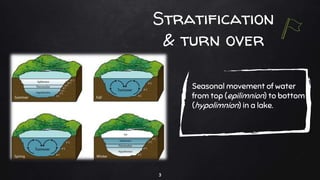
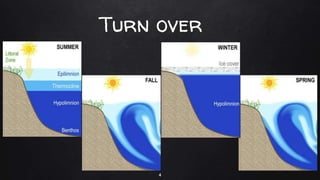
Seasonal movement of water
from top (epilimnion) to bottom
(hypolimnion) in a lake.
3
Let’s start with the first set of slides
4
Turn over
Biological
Zones
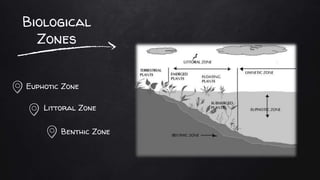
Euphotic Zone
Littoral Zone
Benthic Zone
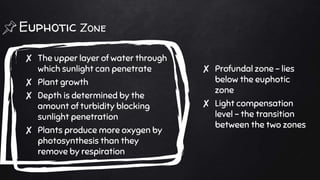
Euphotic Zone
✘ The upper layer of water through
which sunlight can penetrate
✘ Plant growth
✘ Depth is determined by the
amount of turbidity blocking
sunlight penetration
✘ Plants produce more oxygen by
photosynthesis than they
remove by respiration
✘ Profundal zone – lies
below the euphotic
zone
✘ Light compensation
level – the transition
between the two zones
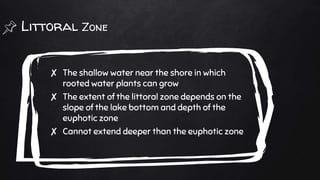
Littoral Zone
✘ The shallow water near the shore in which
rooted water plants can grow
✘ The extent of the littoral zone depends on the
slope of the lake bottom and depth of the
euphotic zone
✘ Cannot extend deeper than the euphotic zone
Benthic Zone
✘ Bottom sediments
✘ Bacteria are always present
✘ Presence of worms, insects and other higher life
forms
LAKE
PRODUCTIVITY
 a measure of its ability to support a food
web and may be determined by
measuring the amount of the algal
growth that can be supported by the
available nutrients.
 The base of the food web is algae
 Increased productivity generally results
in reduced water quality because of
undesirable changes that occur as algal
growth increases.
Oligotrophic
Eutrophic
Mesotrophic
Senescent
10
Classification of
Lakes
Classification of Lakes
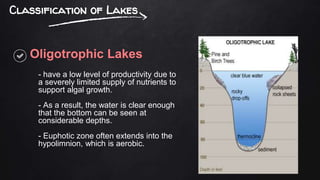
Oligotrophic Lakes
- have a low level of productivity due to
a severely limited supply of nutrients to
support algal growth.
- As a result, the water is clear enough
that the bottom can be seen at
considerable depths.
- Euphotic zone often extends into the
hypolimnion, which is aerobic.
Lake Tahoe
California-Nevada
Classification of Lakes
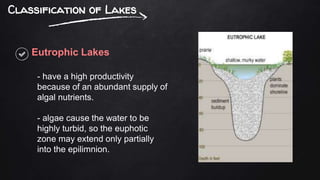
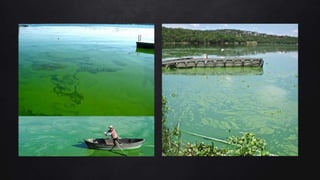
Eutrophic Lakes
- have a high productivity
because of an abundant supply of
algal nutrients.
- algae cause the water to be
highly turbid, so the euphotic
zone may extend only partially
into the epilimnion.
Classification of Lakes
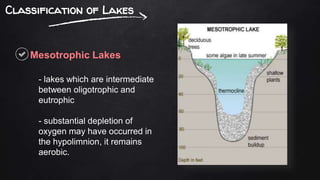
Mesotrophic Lakes
- lakes which are intermediate
between oligotrophic and
eutrophic
- substantial depletion of
oxygen may have occurred in
the hypolimnion, it remains
aerobic.
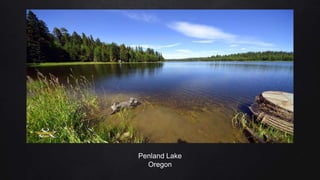
Penland Lake
Oregon
Classification of Lakes
Senescent Lakes
- very old, shallow lakes which have thick organic
sediments and rooted water plants in great
abundance
- these lakes wil eventually become marshes
Dwarf Lake
Sky Lakes Wilderness
EUTROPHICATION
Is a natural process in which lakes gradually
become shallower and more productive
through the introduction and cycling of
nutrients
Thus, oligotrophic lakes gradually pass through
the mesotrophic, eutrophic, and senescent
stages, eventually filling completely
Cultural Eutrophication
- caused when human activity speeds the
processes naturally occurring by increasing the
rate at which sediments and nutrients are added
to the lake.
- lake pollution can be seen as the intensification
of a natural process
Algal growth
requirements
MACRONUTRIENTS
a. CARBON
b. NITROGEN
c. PHOSPHORUS
d. MICRONUTRIENTS
- TRACE ELEMENTS
NOTE!
For algae to grow,
ALL nutrients must be
available
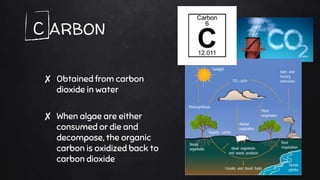
C ARBON
✘ Obtained from carbon
dioxide in water
✘ When algae are either
consumed or die and
decompose, the organic
carbon is oxidized back to
carbon dioxide
N itrogen
✘ Usually in the form of nitrates [NO3
−
]
✘ Converting nitrogen gas to organic
nitrogen though nitrogen-fixing bacteria
such as cyanobacteria
✘ Comes from external sources by way of
inflowing streams or groundwater
✘ Aerobic
○ When taken for algal growth, forms
amino-nitrogen NO2
−
○ When algae dies, forms ammonia
[NH3 ]
✘ Anaerobic
○ Nitrate is reduced to [N2] through
denitrification
P hosphorus
✘ Originates from external
sources
✘ Taken up by algae in the
inorganic form [PO4
3−
] and
incorporated into organic
compounds
✘ When algae dies, returns to
its inorganic form
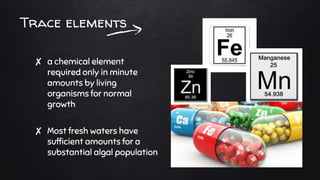
Trace elements
✘ a chemical element
required only in minute
amounts by living
organisms for normal
growth
✘ Most fresh waters have
sufficient amounts for a
substantial algal population
Acidification
of
lakes
Acidification of lakes
Change towards more acidic conditions in
lakes
A lake can be considered acid or slightly
acid when pH is below neutral (<6.5). More
evident biological consequences will
develop at pH < 5.5.
👉
👉
Causes
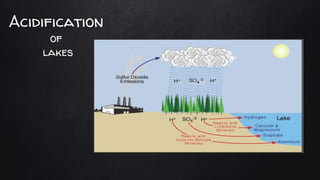
✘ Acid Rain
is caused by emissions of sulphur
dioxide and nitrogen oxide, which react
with the water molecules in the
atmosphere to produce acids.
✘ Buffer Solution
a solution that resists changes in pH
when acid or alkali is added to it.
Harmful Effects
✘ Fish and other aquatic animals will die in
water with low pH.
✘ Acidified water cannot be used for drinking.
First the water has to be neutralized (neutral
pH), as acidic water is damaging to your
health and could possibly cause kidney
problems.
✘ High aluminum concentrations are often the
trigger that kills fish
Solution
✘ Liming Method
de-acidification of the lakes by
adding a suspension of calcium
carbonate.
✘ Stop air pollution at its source and so
reduce acid rain.

Water Pollution in Lakes

  • 1.
    Water Pollution in Lakes Cañaveral| Eleccion | Gingoyon | Manto | Sarong | Ybarley
  • 2.
    Limnology the study ofthe biological, chemical, and physical features of lakes and other bodies of fresh water. 2
  • 3.
    Stratification & turn over Seasonalmovement of water from top (epilimnion) to bottom (hypolimnion) in a lake. 3
  • 4.
    Let’s start withthe first set of slides 4 Turn over
  • 5.
  • 6.
    Euphotic Zone ✘ Theupper layer of water through which sunlight can penetrate ✘ Plant growth ✘ Depth is determined by the amount of turbidity blocking sunlight penetration ✘ Plants produce more oxygen by photosynthesis than they remove by respiration ✘ Profundal zone – lies below the euphotic zone ✘ Light compensation level – the transition between the two zones
  • 7.
    Littoral Zone ✘ Theshallow water near the shore in which rooted water plants can grow ✘ The extent of the littoral zone depends on the slope of the lake bottom and depth of the euphotic zone ✘ Cannot extend deeper than the euphotic zone
  • 8.
    Benthic Zone ✘ Bottomsediments ✘ Bacteria are always present ✘ Presence of worms, insects and other higher life forms
  • 9.
    LAKE PRODUCTIVITY  a measureof its ability to support a food web and may be determined by measuring the amount of the algal growth that can be supported by the available nutrients.  The base of the food web is algae  Increased productivity generally results in reduced water quality because of undesirable changes that occur as algal growth increases.
  • 10.
  • 11.
    Classification of Lakes OligotrophicLakes - have a low level of productivity due to a severely limited supply of nutrients to support algal growth. - As a result, the water is clear enough that the bottom can be seen at considerable depths. - Euphotic zone often extends into the hypolimnion, which is aerobic.
  • 12.
  • 13.
    Classification of Lakes EutrophicLakes - have a high productivity because of an abundant supply of algal nutrients. - algae cause the water to be highly turbid, so the euphotic zone may extend only partially into the epilimnion.
  • 15.
    Classification of Lakes MesotrophicLakes - lakes which are intermediate between oligotrophic and eutrophic - substantial depletion of oxygen may have occurred in the hypolimnion, it remains aerobic.
  • 16.
  • 17.
    Classification of Lakes SenescentLakes - very old, shallow lakes which have thick organic sediments and rooted water plants in great abundance - these lakes wil eventually become marshes
  • 18.
  • 19.
    EUTROPHICATION Is a naturalprocess in which lakes gradually become shallower and more productive through the introduction and cycling of nutrients Thus, oligotrophic lakes gradually pass through the mesotrophic, eutrophic, and senescent stages, eventually filling completely
  • 20.
    Cultural Eutrophication - causedwhen human activity speeds the processes naturally occurring by increasing the rate at which sediments and nutrients are added to the lake. - lake pollution can be seen as the intensification of a natural process
  • 21.
    Algal growth requirements MACRONUTRIENTS a. CARBON b.NITROGEN c. PHOSPHORUS d. MICRONUTRIENTS - TRACE ELEMENTS NOTE! For algae to grow, ALL nutrients must be available
  • 22.
    C ARBON ✘ Obtainedfrom carbon dioxide in water ✘ When algae are either consumed or die and decompose, the organic carbon is oxidized back to carbon dioxide
  • 23.
    N itrogen ✘ Usuallyin the form of nitrates [NO3 − ] ✘ Converting nitrogen gas to organic nitrogen though nitrogen-fixing bacteria such as cyanobacteria ✘ Comes from external sources by way of inflowing streams or groundwater ✘ Aerobic ○ When taken for algal growth, forms amino-nitrogen NO2 − ○ When algae dies, forms ammonia [NH3 ] ✘ Anaerobic ○ Nitrate is reduced to [N2] through denitrification
  • 24.
    P hosphorus ✘ Originatesfrom external sources ✘ Taken up by algae in the inorganic form [PO4 3− ] and incorporated into organic compounds ✘ When algae dies, returns to its inorganic form
  • 25.
    Trace elements ✘ achemical element required only in minute amounts by living organisms for normal growth ✘ Most fresh waters have sufficient amounts for a substantial algal population
  • 26.
  • 27.
    Acidification of lakes Changetowards more acidic conditions in lakes A lake can be considered acid or slightly acid when pH is below neutral (<6.5). More evident biological consequences will develop at pH < 5.5. 👉 👉
  • 28.
    Causes ✘ Acid Rain iscaused by emissions of sulphur dioxide and nitrogen oxide, which react with the water molecules in the atmosphere to produce acids. ✘ Buffer Solution a solution that resists changes in pH when acid or alkali is added to it.
  • 29.
    Harmful Effects ✘ Fishand other aquatic animals will die in water with low pH. ✘ Acidified water cannot be used for drinking. First the water has to be neutralized (neutral pH), as acidic water is damaging to your health and could possibly cause kidney problems. ✘ High aluminum concentrations are often the trigger that kills fish
  • 30.
    Solution ✘ Liming Method de-acidificationof the lakes by adding a suspension of calcium carbonate. ✘ Stop air pollution at its source and so reduce acid rain.

Editor's Notes

  • #6 -lakes contain several distinct zones of biological activity -largely determined by the availability of light and oxygen
  • #7 -turbidity is due to algal growth in lakes
  • #29 The soil usually has substances that ensure that the pH is neutral and that the acid will be removed: The Buffer solution. If the buffer solution is finished then the soil will become acid. This may cause toxic chemicals or nitrate to be released. The rain will cause the nitrate or the toxic chemicals to rinse out the surface water or ground water, causing them to contaminate water.
  • #31 1. Help restore natural ph of lakes 2. Reducing the use of SO2(Sulfur dioxide), [[NOx]] and NH3 (Ammonia). Lowering the use of these substances is done by using low-Sulphur fuel, or flue gas desulphurization.