EVAPORATION
ELECCION, NICELY JANE R.
Department of Chemical Engineering
College of Engineering and Architecture
Cebu Institute of Technology – University
N. Bacalso Ave., Cebu City 6000
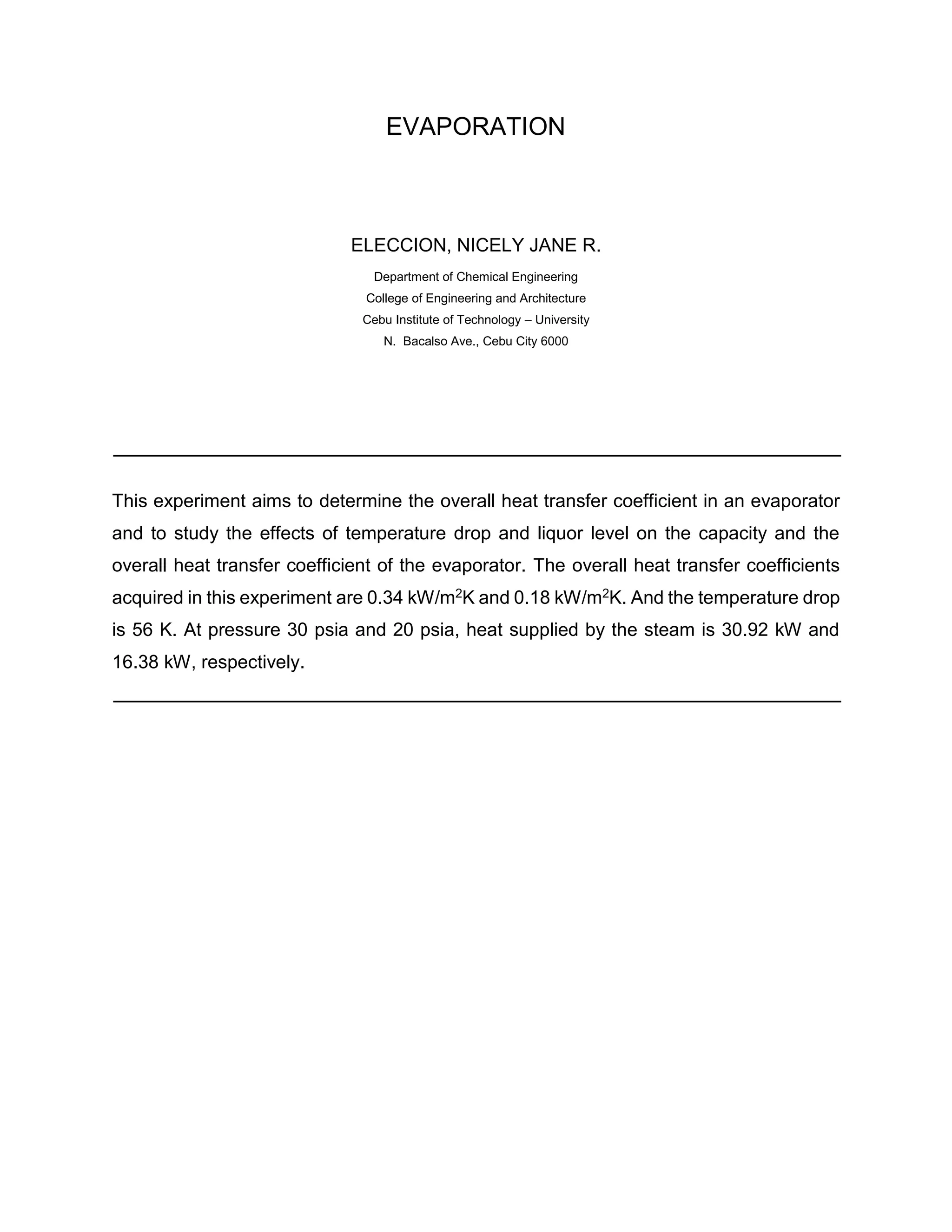
This experiment aims to determine the overall heat transfer coefficient in an evaporator
and to study the effects of temperature drop and liquor level on the capacity and the
overall heat transfer coefficient of the evaporator. The overall heat transfer coefficients
acquired in this experiment are 0.34 kW/m2K and 0.18 kW/m2K. And the temperature drop
is 56 K. At pressure 30 psia and 20 psia, heat supplied by the steam is 30.92 kW and
16.38 kW, respectively.
1. Introduction
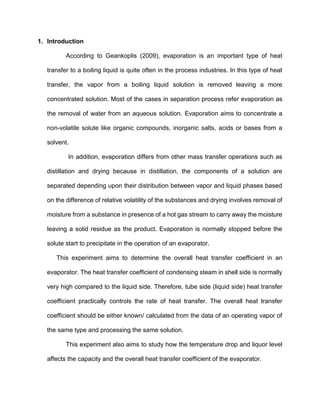
According to Geankoplis (2009), evaporation is an important type of heat
transfer to a boiling liquid is quite often in the process industries. In this type of heat
transfer, the vapor from a boiling liquid solution is removed leaving a more
concentrated solution. Most of the cases in separation process refer evaporation as
the removal of water from an aqueous solution. Evaporation aims to concentrate a
non-volatile solute like organic compounds, inorganic salts, acids or bases from a
solvent.
In addition, evaporation differs from other mass transfer operations such as
distillation and drying because in distillation, the components of a solution are
separated depending upon their distribution between vapor and liquid phases based
on the difference of relative volatility of the substances and drying involves removal of
moisture from a substance in presence of a hot gas stream to carry away the moisture
leaving a solid residue as the product. Evaporation is normally stopped before the
solute start to precipitate in the operation of an evaporator.
This experiment aims to determine the overall heat transfer coefficient in an
evaporator. The heat transfer coefficient of condensing steam in shell side is normally
very high compared to the liquid side. Therefore, tube side (liquid side) heat transfer
coefficient practically controls the rate of heat transfer. The overall heat transfer
coefficient should be either known/ calculated from the data of an operating vapor of
the same type and processing the same solution.
This experiment also aims to study how the temperature drop and liquor level
affects the capacity and the overall heat transfer coefficient of the evaporator.
2. Materials and Methods
2.1 Equipment and Materials
 Evaporator
 Condenser
 Steam Trap
 Steam Condenser Tank
 Vapor Condenser Tank
 Water
 Steam
2.2 Methods
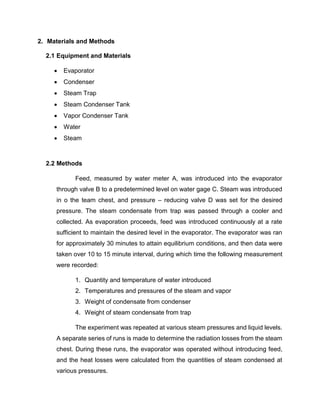
Feed, measured by water meter A, was introduced into the evaporator
through valve B to a predetermined level on water gage C. Steam was introduced
in o the team chest, and pressure – reducing valve D was set for the desired
pressure. The steam condensate from trap was passed through a cooler and
collected. As evaporation proceeds, feed was introduced continuously at a rate
sufficient to maintain the desired level in the evaporator. The evaporator was ran
for approximately 30 minutes to attain equilibrium conditions, and then data were
taken over 10 to 15 minute interval, during which time the following measurement
were recorded:
1. Quantity and temperature of water introduced
2. Temperatures and pressures of the steam and vapor
3. Weight of condensate from condenser
4. Weight of steam condensate from trap
The experiment was repeated at various steam pressures and liquid levels.
A separate series of runs is made to determine the radiation losses from the steam
chest. During these runs, the evaporator was operated without introducing feed,
and the heat losses were calculated from the quantities of steam condensed at
various pressures.
3. Results
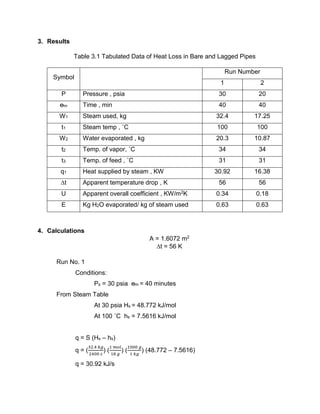
Table 3.1 Tabulated Data of Heat Loss in Bare and Lagged Pipes
Symbol
Run Number
1 2
P Pressure , psia 30 20
ꝋm Time , min 40 40
W1 Steam used, kg 32.4 17.25
t1 Steam temp , ˚C 100 100
W2 Water evaporated , kg 20.3 10.87
t2 Temp. of vapor, ˚C 34 34
t3 Temp. of feed , ˚C 31 31
q1 Heat supplied by steam , KW 30.92 16.38
∆t Apparent temperature drop , K 56 56
U Apparent overall coefficient , KW/m2K 0.34 0.18
E Kg H2O evaporated/ kg of steam used 0.63 0.63
4. Calculations
A = 1.6072 m2
∆t = 56 K
Run No. 1
Conditions:
Ps = 30 psia ꝋm = 40 minutes
From Steam Table
At 30 psia Hs = 48.772 kJ/mol
At 100 ˚C hs = 7.5616 kJ/mol
q = S (Hs – hs)
q = (
32.4 𝑘𝑔
2400 𝑠
) (
1 𝑚𝑜𝑙
18 𝑔
) (
1000 𝑔
1 𝑘𝑔
) (48.772 – 7.5616)
q = 30.92 kJ/s
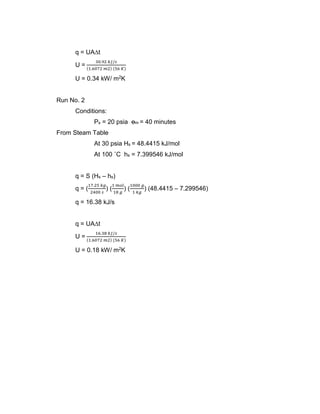
q = UA∆t
U =
30.92 𝑘𝐽/𝑠
(1.6072 𝑚2) (56 𝐾)
U = 0.34 kW/ m2K
Run No. 2
Conditions:
Ps = 20 psia ꝋm = 40 minutes
From Steam Table
At 30 psia Hs = 48.4415 kJ/mol
At 100 ˚C hs = 7.399546 kJ/mol
q = S (Hs – hs)
q = (
17.25 𝑘𝑔
2400 𝑠
) (
1 𝑚𝑜𝑙
18 𝑔
) (
1000 𝑔
1 𝑘𝑔
) (48.4415 – 7.299546)
q = 16.38 kJ/s
q = UA∆t
U =
16.38 𝑘𝐽/𝑠
(1.6072 𝑚2) (56 𝐾)
U = 0.18 kW/ m2K
5. Sketch
6. Discussion
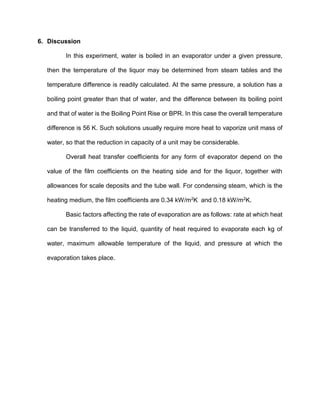
In this experiment, water is boiled in an evaporator under a given pressure,
then the temperature of the liquor may be determined from steam tables and the
temperature difference is readily calculated. At the same pressure, a solution has a
boiling point greater than that of water, and the difference between its boiling point
and that of water is the Boiling Point Rise or BPR. In this case the overall temperature
difference is 56 K. Such solutions usually require more heat to vaporize unit mass of
water, so that the reduction in capacity of a unit may be considerable.
Overall heat transfer coefficients for any form of evaporator depend on the
value of the film coefficients on the heating side and for the liquor, together with
allowances for scale deposits and the tube wall. For condensing steam, which is the
heating medium, the film coefficients are 0.34 kW/m2K and 0.18 kW/m2K.
Basic factors affecting the rate of evaporation are as follows: rate at which heat
can be transferred to the liquid, quantity of heat required to evaporate each kg of
water, maximum allowable temperature of the liquid, and pressure at which the
evaporation takes place.
7. Conclusion
Evaporation is a process of concentrating a solution by vaporizing part or all of
the solvent – usually water. The important practical considerations in evaporators are
the: maximum allowable temperature, which may be substantially below 100°C,
promotion of circulation of the liquid across the heat transfer surfaces, to attain
reasonably high heat transfer coefficients and to prevent any local overheating,
viscosity of the fluid which will often increase substantially as the concentration of the
dissolved materials increases, tendency to foam which makes separation of liquid and
vapor difficult.
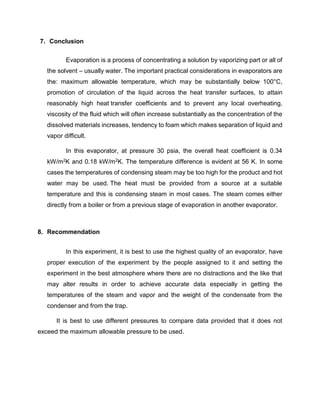
In this evaporator, at pressure 30 psia, the overall heat coefficient is 0.34
kW/m2K and 0.18 kW/m2K. The temperature difference is evident at 56 K. In some
cases the temperatures of condensing steam may be too high for the product and hot
water may be used. The heat must be provided from a source at a suitable
temperature and this is condensing steam in most cases. The steam comes either
directly from a boiler or from a previous stage of evaporation in another evaporator.
8. Recommendation
In this experiment, it is best to use the highest quality of an evaporator, have
proper execution of the experiment by the people assigned to it and setting the
experiment in the best atmosphere where there are no distractions and the like that
may alter results in order to achieve accurate data especially in getting the
temperatures of the steam and vapor and the weight of the condensate from the
condenser and from the trap.
It is best to use different pressures to compare data provided that it does not
exceed the maximum allowable pressure to be used.
9. References
[1] Geankoplis, C.J. (2009) Principles of Transport Processes and Separation
Processes. 1st edition. Pearson Education South Asia PTE. LTD.
10.Web References
[1] Design of Evaporator: Introduction, Types of Evaporators, Methods of Feeding of
Evaporators, General Design Consideration of Evaporator. (2015). Retrieved
February 20, 2018, from http://nptel.ac.in/courses/103103027/pdf/mod3.pdf
[2] Earle, R. (1983). Unit Operations in Food Processing. Retrieved February 19,
2018, from http://www.nzifst.org.nz/unitoperations/evaporation1.htm

Evaporation

  • 1.
    EVAPORATION ELECCION, NICELY JANER. Department of Chemical Engineering College of Engineering and Architecture Cebu Institute of Technology – University N. Bacalso Ave., Cebu City 6000 This experiment aims to determine the overall heat transfer coefficient in an evaporator and to study the effects of temperature drop and liquor level on the capacity and the overall heat transfer coefficient of the evaporator. The overall heat transfer coefficients acquired in this experiment are 0.34 kW/m2K and 0.18 kW/m2K. And the temperature drop is 56 K. At pressure 30 psia and 20 psia, heat supplied by the steam is 30.92 kW and 16.38 kW, respectively.
  • 2.
    1. Introduction According toGeankoplis (2009), evaporation is an important type of heat transfer to a boiling liquid is quite often in the process industries. In this type of heat transfer, the vapor from a boiling liquid solution is removed leaving a more concentrated solution. Most of the cases in separation process refer evaporation as the removal of water from an aqueous solution. Evaporation aims to concentrate a non-volatile solute like organic compounds, inorganic salts, acids or bases from a solvent. In addition, evaporation differs from other mass transfer operations such as distillation and drying because in distillation, the components of a solution are separated depending upon their distribution between vapor and liquid phases based on the difference of relative volatility of the substances and drying involves removal of moisture from a substance in presence of a hot gas stream to carry away the moisture leaving a solid residue as the product. Evaporation is normally stopped before the solute start to precipitate in the operation of an evaporator. This experiment aims to determine the overall heat transfer coefficient in an evaporator. The heat transfer coefficient of condensing steam in shell side is normally very high compared to the liquid side. Therefore, tube side (liquid side) heat transfer coefficient practically controls the rate of heat transfer. The overall heat transfer coefficient should be either known/ calculated from the data of an operating vapor of the same type and processing the same solution. This experiment also aims to study how the temperature drop and liquor level affects the capacity and the overall heat transfer coefficient of the evaporator.
  • 3.
    2. Materials andMethods 2.1 Equipment and Materials  Evaporator  Condenser  Steam Trap  Steam Condenser Tank  Vapor Condenser Tank  Water  Steam 2.2 Methods Feed, measured by water meter A, was introduced into the evaporator through valve B to a predetermined level on water gage C. Steam was introduced in o the team chest, and pressure – reducing valve D was set for the desired pressure. The steam condensate from trap was passed through a cooler and collected. As evaporation proceeds, feed was introduced continuously at a rate sufficient to maintain the desired level in the evaporator. The evaporator was ran for approximately 30 minutes to attain equilibrium conditions, and then data were taken over 10 to 15 minute interval, during which time the following measurement were recorded: 1. Quantity and temperature of water introduced 2. Temperatures and pressures of the steam and vapor 3. Weight of condensate from condenser 4. Weight of steam condensate from trap The experiment was repeated at various steam pressures and liquid levels. A separate series of runs is made to determine the radiation losses from the steam chest. During these runs, the evaporator was operated without introducing feed, and the heat losses were calculated from the quantities of steam condensed at various pressures.
  • 4.
    3. Results Table 3.1Tabulated Data of Heat Loss in Bare and Lagged Pipes Symbol Run Number 1 2 P Pressure , psia 30 20 ꝋm Time , min 40 40 W1 Steam used, kg 32.4 17.25 t1 Steam temp , ˚C 100 100 W2 Water evaporated , kg 20.3 10.87 t2 Temp. of vapor, ˚C 34 34 t3 Temp. of feed , ˚C 31 31 q1 Heat supplied by steam , KW 30.92 16.38 ∆t Apparent temperature drop , K 56 56 U Apparent overall coefficient , KW/m2K 0.34 0.18 E Kg H2O evaporated/ kg of steam used 0.63 0.63 4. Calculations A = 1.6072 m2 ∆t = 56 K Run No. 1 Conditions: Ps = 30 psia ꝋm = 40 minutes From Steam Table At 30 psia Hs = 48.772 kJ/mol At 100 ˚C hs = 7.5616 kJ/mol q = S (Hs – hs) q = ( 32.4 𝑘𝑔 2400 𝑠 ) ( 1 𝑚𝑜𝑙 18 𝑔 ) ( 1000 𝑔 1 𝑘𝑔 ) (48.772 – 7.5616) q = 30.92 kJ/s
  • 5.
    q = UA∆t U= 30.92 𝑘𝐽/𝑠 (1.6072 𝑚2) (56 𝐾) U = 0.34 kW/ m2K Run No. 2 Conditions: Ps = 20 psia ꝋm = 40 minutes From Steam Table At 30 psia Hs = 48.4415 kJ/mol At 100 ˚C hs = 7.399546 kJ/mol q = S (Hs – hs) q = ( 17.25 𝑘𝑔 2400 𝑠 ) ( 1 𝑚𝑜𝑙 18 𝑔 ) ( 1000 𝑔 1 𝑘𝑔 ) (48.4415 – 7.299546) q = 16.38 kJ/s q = UA∆t U = 16.38 𝑘𝐽/𝑠 (1.6072 𝑚2) (56 𝐾) U = 0.18 kW/ m2K
  • 6.
  • 7.
    6. Discussion In thisexperiment, water is boiled in an evaporator under a given pressure, then the temperature of the liquor may be determined from steam tables and the temperature difference is readily calculated. At the same pressure, a solution has a boiling point greater than that of water, and the difference between its boiling point and that of water is the Boiling Point Rise or BPR. In this case the overall temperature difference is 56 K. Such solutions usually require more heat to vaporize unit mass of water, so that the reduction in capacity of a unit may be considerable. Overall heat transfer coefficients for any form of evaporator depend on the value of the film coefficients on the heating side and for the liquor, together with allowances for scale deposits and the tube wall. For condensing steam, which is the heating medium, the film coefficients are 0.34 kW/m2K and 0.18 kW/m2K. Basic factors affecting the rate of evaporation are as follows: rate at which heat can be transferred to the liquid, quantity of heat required to evaporate each kg of water, maximum allowable temperature of the liquid, and pressure at which the evaporation takes place.
  • 8.
    7. Conclusion Evaporation isa process of concentrating a solution by vaporizing part or all of the solvent – usually water. The important practical considerations in evaporators are the: maximum allowable temperature, which may be substantially below 100°C, promotion of circulation of the liquid across the heat transfer surfaces, to attain reasonably high heat transfer coefficients and to prevent any local overheating, viscosity of the fluid which will often increase substantially as the concentration of the dissolved materials increases, tendency to foam which makes separation of liquid and vapor difficult. In this evaporator, at pressure 30 psia, the overall heat coefficient is 0.34 kW/m2K and 0.18 kW/m2K. The temperature difference is evident at 56 K. In some cases the temperatures of condensing steam may be too high for the product and hot water may be used. The heat must be provided from a source at a suitable temperature and this is condensing steam in most cases. The steam comes either directly from a boiler or from a previous stage of evaporation in another evaporator. 8. Recommendation In this experiment, it is best to use the highest quality of an evaporator, have proper execution of the experiment by the people assigned to it and setting the experiment in the best atmosphere where there are no distractions and the like that may alter results in order to achieve accurate data especially in getting the temperatures of the steam and vapor and the weight of the condensate from the condenser and from the trap. It is best to use different pressures to compare data provided that it does not exceed the maximum allowable pressure to be used.
  • 9.
    9. References [1] Geankoplis,C.J. (2009) Principles of Transport Processes and Separation Processes. 1st edition. Pearson Education South Asia PTE. LTD. 10.Web References [1] Design of Evaporator: Introduction, Types of Evaporators, Methods of Feeding of Evaporators, General Design Consideration of Evaporator. (2015). Retrieved February 20, 2018, from http://nptel.ac.in/courses/103103027/pdf/mod3.pdf [2] Earle, R. (1983). Unit Operations in Food Processing. Retrieved February 19, 2018, from http://www.nzifst.org.nz/unitoperations/evaporation1.htm