Thomas Meixner, Devin Castendyk: State University of New York,
Oneonta
Cathy Gibson:, Skidmore College
NSF TUES Project:
The use of high-frequency data to engage students in quantitative
reasoning and scientific discourse
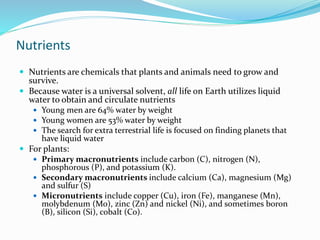
Nutrients
 Nutrients are chemicals that plants and animals need to grow and
survive.
 Because water is a universal solvent, all life on Earth utilizes liquid
water to obtain and circulate nutrients
 Young men are 64% water by weight
 Young women are 53% water by weight
 The search for extra terrestrial life is focused on finding planets that
have liquid water
 For plants:
 Primary macronutrients include carbon (C), nitrogen (N),
phosphorous (P), and potassium (K).
 Secondary macronutrients include calcium (Ca), magnesium (Mg)
and sulfur (S)
 Micronutrients include copper (Cu), iron (Fe), manganese (Mn),
molybdenum (Mo), zinc (Zn) and nickel (Ni), and sometimes boron
(B), silicon (Si), cobalt (Co).
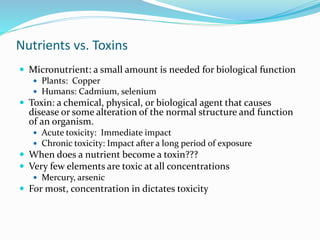
Nutrients vs. Toxins
 Micronutrient: a small amount is needed for biological function
 Plants: Copper
 Humans: Cadmium, selenium
 Toxin: a chemical, physical, or biological agent that causes
disease or some alteration of the normal structure and function
of an organism.
 Acute toxicity: Immediate impact
 Chronic toxicity: Impact after a long period of exposure
 When does a nutrient become a toxin???
 Very few elements are toxic at all concentrations
 Mercury, arsenic
 For most, concentration in dictates toxicity
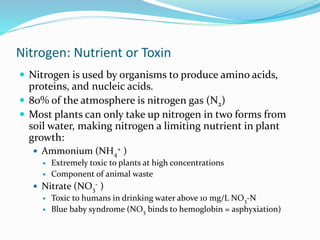
Nitrogen: Nutrient or Toxin
 Nitrogen is used by organisms to produce amino acids,
proteins, and nucleic acids.
 80% of the atmosphere is nitrogen gas (N2)
 Most plants can only take up nitrogen in two forms from
soil water, making nitrogen a limiting nutrient in plant
growth:
 Ammonium (NH4
+ )
 Extremely toxic to plants at high concentrations
 Component of animal waste
 Nitrate (NO3
- )
 Toxic to humans in drinking water above 10 mg/L NO3-N
 Blue baby syndrome (NO3 binds to hemoglobin = asphyxiation)
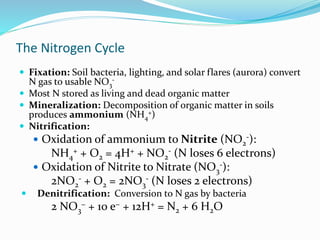
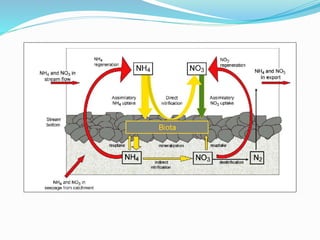
The Nitrogen Cycle
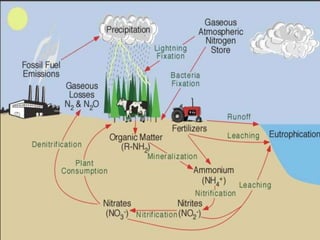
 Fixation: Soil bacteria, lighting, and solar flares (aurora) convert
N gas to usable NO3
-
 Most N stored as living and dead organic matter
 Mineralization: Decomposition of organic matter in soils
produces ammonium (NH4
+)
 Nitrification:
 Oxidation of ammonium to Nitrite (NO2
-):
NH4
+ + O2 = 4H+ + NO2
- (N loses 6 electrons)
 Oxidation of Nitrite to Nitrate (NO3
-):
2NO2
- + O2 = 2NO3
- (N loses 2 electrons)
 Denitrification: Conversion to N gas by bacteria
2 NO3
− + 10 e− + 12H+ = N2 + 6 H2O
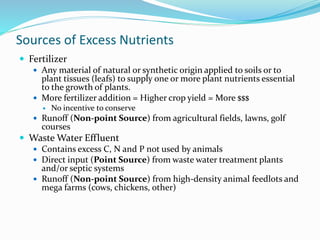
Sources of Excess Nutrients
 Fertilizer
 Any material of natural or synthetic origin applied to soils or to
plant tissues (leafs) to supply one or more plant nutrients essential
to the growth of plants.
 More fertilizer addition = Higher crop yield = More $$$
 No incentive to conserve
 Runoff (Non-point Source) from agricultural fields, lawns, golf
courses
 Waste Water Effluent
 Contains excess C, N and P not used by animals
 Direct input (Point Source) from waste water treatment plants
and/or septic systems
 Runoff (Non-point Source) from high-density animal feedlots and
mega farms (cows, chickens, other)
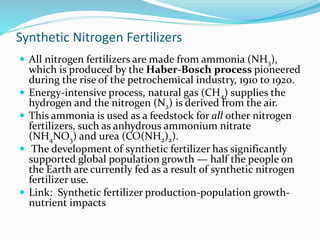
Synthetic Nitrogen Fertilizers
 All nitrogen fertilizers are made from ammonia (NH3),
which is produced by the Haber-Bosch process pioneered
during the rise of the petrochemical industry, 1910 to 1920.
 Energy-intensive process, natural gas (CH4) supplies the
hydrogen and the nitrogen (N2) is derived from the air.
 This ammonia is used as a feedstock for all other nitrogen
fertilizers, such as anhydrous ammonium nitrate
(NH4NO3) and urea (CO(NH2)2).
 The development of synthetic fertilizer has significantly
supported global population growth — half the people on
the Earth are currently fed as a result of synthetic nitrogen
fertilizer use.
 Link: Synthetic fertilizer production-population growth-
nutrient impacts
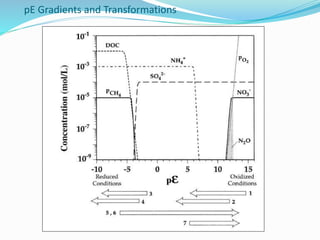
pE Gradients and Transformations
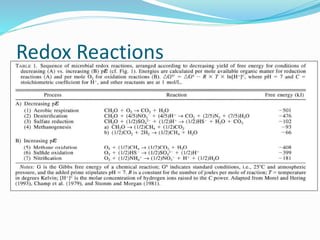
Redox Reactions
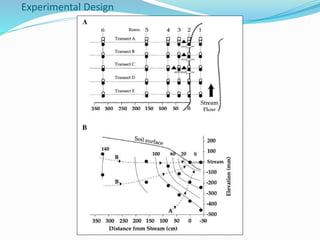
Experimental Design
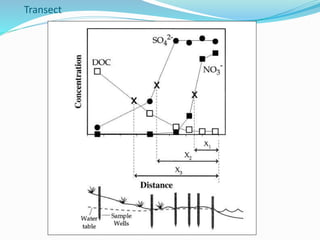
Transect
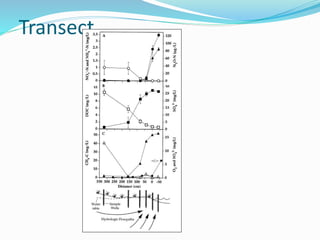
Transect
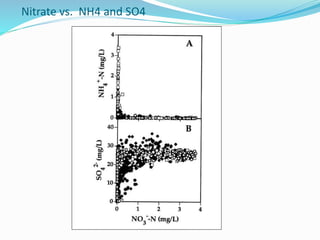
Nitrate vs. NH4 and SO4
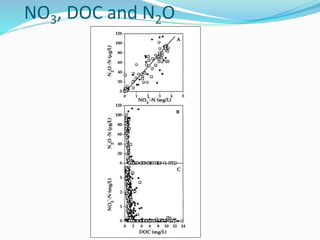
NO3, DOC and N2O
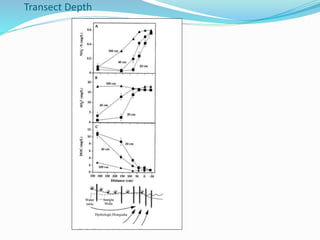
Transect Depth
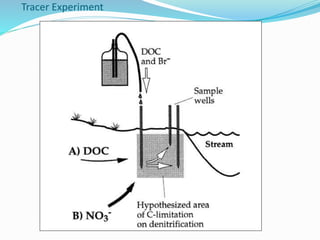
Tracer Experiment
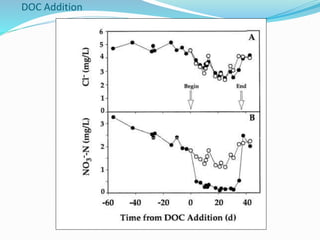
DOC Addition
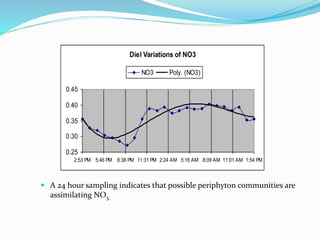
 A 24 hour sampling indicates that possible periphyton communities are
assimilating NO3.
Diel Variations of NO3
0.25
0.30
0.35
0.40
0.45
2:53 PM 5:46 PM 8:38 PM 11:31 PM 2:24 AM 5:16 AM 8:09 AM 11:01 AM 1:54 PM
NO3 Poly. (NO3)
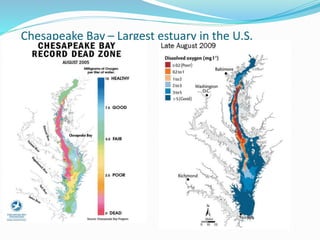
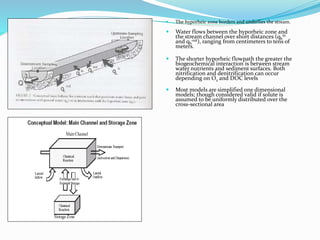
 The hyporheic zone borders and underlies the stream.
 Water flows between the hyporheic zone and
the stream channel over short distances (qh
in
and qh
out), ranging from centimeters to tens of
meters.
 The shorter hyporheic flowpath the greater the
biogeochemical interaction is between stream
water nutrients and sediment surfaces. Both
nitrification and denitrification can occur
depending on O2 and DOC levels
 Most models are simplified one dimensional
models; though considered valid if solute is
assumed to be uniformly distributed over the
cross-sectional area
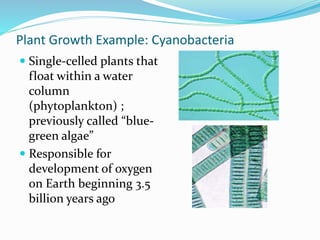
Plant Growth Example: Cyanobacteria
 Single-celled plants that
float within a water
column
(phytoplankton) ;
previously called “blue-
green algae”
 Responsible for
development of oxygen
on Earth beginning 3.5
billion years ago
Cyanobacteria Blooms
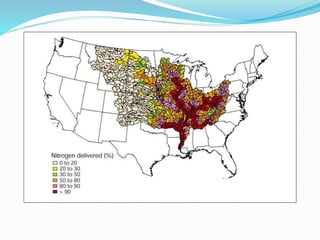
 “Nutrient pollution is one of America's most
widespread, costly and challenging environmental
problems, and is caused by excess nitrogen and
phosphorus in the air and water” (US EPA)
 “Blooms” are events where excessive cyanobacteria
production occurs over a very short period of time. In
extreme cases, this can result in a thick, green “scum”
over a lake surface. which is unpleasant to look at,
smells, and greatly depreciates the aesthetic and
recreational value of the lake.
Impact on Aesthetic Value
 Visual
 Olfactory (smell)
 Loss of recreational value
 Loss of tourist revenue
 Example: Lake Atitlan, Guatemala
Impact on Eutrophication in Lakes
 Eutrophication is the normally slow aging process by
which a lake evolves into a bog or marsh and
ultimately assumes a completely terrestrial state and
disappears.
 During eutrophication the lake becomes so rich in
nutritive compounds, especially nitrogen and
phosphorus, that cyanobacteria and other microscopic
plant life become superabundant, thereby "choking"
the lake with organic matter.
 Eutrophication may be accelerated by human
activities, speeding up the filling of a lake.
Impact on Ecosystem and Fisheries
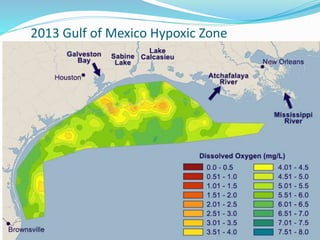
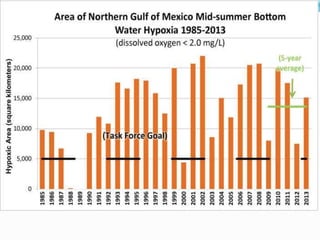
 Hypoxia: Low oxygen. Hypoxic waters have dissolved
oxygen concentrations of less than 2-3 ppm.
 Dead cyanobacteria settle to the bottom of the water
column and decompose. Oxygen is consumed; process
called decomposition
DOC + O2 → CO2
 This forces fish to either swim away or die and can
suffocate plants living in the water. Low oxygen water
called “Dead Zone.”
 Examples: Gulf of Mexico and Chesapeake Bay
 Slides on Fish kills in lakes
2013 Gulf of Mexico Hypoxic Zone
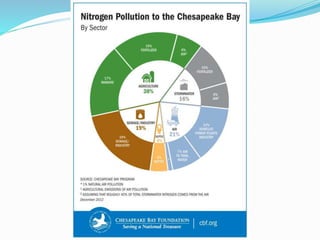
Chesapeake Bay – Largest estuary in the U.S.
Impact on Drinking Water Supply
 Many municipalities obtain drinking water from lakes
and reservoirs
 Toledo, Ohio: Lake Erie
 Chicago: Lake Michigan
 New York City: Catskill Reservoirs
 Los Vegas: Lake Mead
 The health of citizens depends upon lake and reservoir
water quality
Which ecosystem has lower water quality?
 A small stream with a high concentration (>14 mg/L)
of NO3?
 A large river with a low (< 0.5 mg/L) concentration of
NO3?
Which system causes greater downstream impact
on lakes or estuaries?
 A small stream (low Q) with a high concentration
(high C) of N?
 A large river (high Q) with a low concentration (low Q)
of N?
 How can be best compare systems?
Stream Load
 Mass of substance (Nitrogen, Phosphorous, Sediment,
etc.) transported by a stream per unit of time
 Load (M, mass/time) =
Discharge (Q, vol/time) *
Concentration (C, mass/vol)
Management: The Clean Water Act
 The U.S. Clean Water Act (CWA) is a series of federal
legislative acts that form the foundation for protection
of U.S. water resources:
 Water Quality Act of 1965,
 Federal Water Pollution Control Act of 1972,
 Clean Water Act of 1977, and
 Water Quality Act of 1987.
 The goal of the Clean Water Act (CWA) is "to restore
and maintain the chemical, physical, and biological
integrity of the Nation's waters"
State 303(d) Lists
 Under section 303(d) of the CWA, states, territories, and
authorized tribes, collectively referred to in the act as
"states," are required to develop lists of impaired and
threatened waters (stream/river segments, lakes)
 These are waters for which technology-based regulations
and other required controls are not stringent enough
to meet the water quality standards set by states.
 The law requires that states establish priority rankings for
waters on 303(d) lists
 All states to submit 303(d) lists for EPA approval every two
years on even-numbered years.
Total Maximum Daily Load (TMDL)
 A calculation of the maximum daily load of a pollutant that
a waterbody can receive and still meet water quality
standards
 The load is allocated among the various sources of that
pollutant
 TMDLs must also include a margin of safety (MOS) to
account for the uncertainty
 Predicting how well pollutant reduction will meet water
quality standards
 Account for seasonal variations
 Under the CWA, states establish priorities for development
of TMDLs from waters on 303(d) lists based on the severity
of the pollution and the sensitivity of the uses
 States then provide a long-term plan for completing
TMDLs within 8 to 13 years from first listing.
Assignment
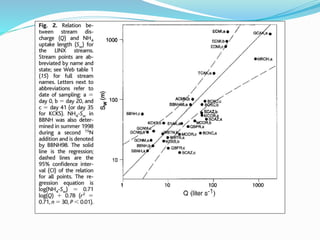
 Why is nutrient load important?
 Qualitative understanding discharge-nitrate
concentrations correlation
 Quantitative correlation analysis
 Calculate nutrient loads for a single location
 Understand the impact of sampling frequency on load
estimates

Introduction to Loads

  • 1.
    Thomas Meixner, DevinCastendyk: State University of New York, Oneonta Cathy Gibson:, Skidmore College NSF TUES Project: The use of high-frequency data to engage students in quantitative reasoning and scientific discourse
  • 2.
    Nutrients  Nutrients arechemicals that plants and animals need to grow and survive.  Because water is a universal solvent, all life on Earth utilizes liquid water to obtain and circulate nutrients  Young men are 64% water by weight  Young women are 53% water by weight  The search for extra terrestrial life is focused on finding planets that have liquid water  For plants:  Primary macronutrients include carbon (C), nitrogen (N), phosphorous (P), and potassium (K).  Secondary macronutrients include calcium (Ca), magnesium (Mg) and sulfur (S)  Micronutrients include copper (Cu), iron (Fe), manganese (Mn), molybdenum (Mo), zinc (Zn) and nickel (Ni), and sometimes boron (B), silicon (Si), cobalt (Co).
  • 3.
    Nutrients vs. Toxins Micronutrient: a small amount is needed for biological function  Plants: Copper  Humans: Cadmium, selenium  Toxin: a chemical, physical, or biological agent that causes disease or some alteration of the normal structure and function of an organism.  Acute toxicity: Immediate impact  Chronic toxicity: Impact after a long period of exposure  When does a nutrient become a toxin???  Very few elements are toxic at all concentrations  Mercury, arsenic  For most, concentration in dictates toxicity
  • 4.
    Nitrogen: Nutrient orToxin  Nitrogen is used by organisms to produce amino acids, proteins, and nucleic acids.  80% of the atmosphere is nitrogen gas (N2)  Most plants can only take up nitrogen in two forms from soil water, making nitrogen a limiting nutrient in plant growth:  Ammonium (NH4 + )  Extremely toxic to plants at high concentrations  Component of animal waste  Nitrate (NO3 - )  Toxic to humans in drinking water above 10 mg/L NO3-N  Blue baby syndrome (NO3 binds to hemoglobin = asphyxiation)
  • 5.
    The Nitrogen Cycle Fixation: Soil bacteria, lighting, and solar flares (aurora) convert N gas to usable NO3 -  Most N stored as living and dead organic matter  Mineralization: Decomposition of organic matter in soils produces ammonium (NH4 +)  Nitrification:  Oxidation of ammonium to Nitrite (NO2 -): NH4 + + O2 = 4H+ + NO2 - (N loses 6 electrons)  Oxidation of Nitrite to Nitrate (NO3 -): 2NO2 - + O2 = 2NO3 - (N loses 2 electrons)  Denitrification: Conversion to N gas by bacteria 2 NO3 − + 10 e− + 12H+ = N2 + 6 H2O
  • 7.
    Sources of ExcessNutrients  Fertilizer  Any material of natural or synthetic origin applied to soils or to plant tissues (leafs) to supply one or more plant nutrients essential to the growth of plants.  More fertilizer addition = Higher crop yield = More $$$  No incentive to conserve  Runoff (Non-point Source) from agricultural fields, lawns, golf courses  Waste Water Effluent  Contains excess C, N and P not used by animals  Direct input (Point Source) from waste water treatment plants and/or septic systems  Runoff (Non-point Source) from high-density animal feedlots and mega farms (cows, chickens, other)
  • 8.
    Synthetic Nitrogen Fertilizers All nitrogen fertilizers are made from ammonia (NH3), which is produced by the Haber-Bosch process pioneered during the rise of the petrochemical industry, 1910 to 1920.  Energy-intensive process, natural gas (CH4) supplies the hydrogen and the nitrogen (N2) is derived from the air.  This ammonia is used as a feedstock for all other nitrogen fertilizers, such as anhydrous ammonium nitrate (NH4NO3) and urea (CO(NH2)2).  The development of synthetic fertilizer has significantly supported global population growth — half the people on the Earth are currently fed as a result of synthetic nitrogen fertilizer use.  Link: Synthetic fertilizer production-population growth- nutrient impacts
  • 15.
    pE Gradients andTransformations
  • 16.
  • 17.
  • 18.
  • 19.
  • 20.
  • 21.
  • 22.
  • 23.
  • 24.
  • 25.
     A 24hour sampling indicates that possible periphyton communities are assimilating NO3. Diel Variations of NO3 0.25 0.30 0.35 0.40 0.45 2:53 PM 5:46 PM 8:38 PM 11:31 PM 2:24 AM 5:16 AM 8:09 AM 11:01 AM 1:54 PM NO3 Poly. (NO3)
  • 26.
     The hyporheiczone borders and underlies the stream.  Water flows between the hyporheic zone and the stream channel over short distances (qh in and qh out), ranging from centimeters to tens of meters.  The shorter hyporheic flowpath the greater the biogeochemical interaction is between stream water nutrients and sediment surfaces. Both nitrification and denitrification can occur depending on O2 and DOC levels  Most models are simplified one dimensional models; though considered valid if solute is assumed to be uniformly distributed over the cross-sectional area
  • 28.
    Plant Growth Example:Cyanobacteria  Single-celled plants that float within a water column (phytoplankton) ; previously called “blue- green algae”  Responsible for development of oxygen on Earth beginning 3.5 billion years ago
  • 29.
    Cyanobacteria Blooms  “Nutrientpollution is one of America's most widespread, costly and challenging environmental problems, and is caused by excess nitrogen and phosphorus in the air and water” (US EPA)  “Blooms” are events where excessive cyanobacteria production occurs over a very short period of time. In extreme cases, this can result in a thick, green “scum” over a lake surface. which is unpleasant to look at, smells, and greatly depreciates the aesthetic and recreational value of the lake.
  • 30.
    Impact on AestheticValue  Visual  Olfactory (smell)  Loss of recreational value  Loss of tourist revenue  Example: Lake Atitlan, Guatemala
  • 31.
    Impact on Eutrophicationin Lakes  Eutrophication is the normally slow aging process by which a lake evolves into a bog or marsh and ultimately assumes a completely terrestrial state and disappears.  During eutrophication the lake becomes so rich in nutritive compounds, especially nitrogen and phosphorus, that cyanobacteria and other microscopic plant life become superabundant, thereby "choking" the lake with organic matter.  Eutrophication may be accelerated by human activities, speeding up the filling of a lake.
  • 32.
    Impact on Ecosystemand Fisheries  Hypoxia: Low oxygen. Hypoxic waters have dissolved oxygen concentrations of less than 2-3 ppm.  Dead cyanobacteria settle to the bottom of the water column and decompose. Oxygen is consumed; process called decomposition DOC + O2 → CO2  This forces fish to either swim away or die and can suffocate plants living in the water. Low oxygen water called “Dead Zone.”  Examples: Gulf of Mexico and Chesapeake Bay
  • 33.
     Slides onFish kills in lakes
  • 34.
    2013 Gulf ofMexico Hypoxic Zone
  • 37.
    Chesapeake Bay –Largest estuary in the U.S.
  • 38.
    Impact on DrinkingWater Supply  Many municipalities obtain drinking water from lakes and reservoirs  Toledo, Ohio: Lake Erie  Chicago: Lake Michigan  New York City: Catskill Reservoirs  Los Vegas: Lake Mead  The health of citizens depends upon lake and reservoir water quality
  • 39.
    Which ecosystem haslower water quality?  A small stream with a high concentration (>14 mg/L) of NO3?  A large river with a low (< 0.5 mg/L) concentration of NO3?
  • 40.
    Which system causesgreater downstream impact on lakes or estuaries?  A small stream (low Q) with a high concentration (high C) of N?  A large river (high Q) with a low concentration (low Q) of N?  How can be best compare systems?
  • 41.
    Stream Load  Massof substance (Nitrogen, Phosphorous, Sediment, etc.) transported by a stream per unit of time  Load (M, mass/time) = Discharge (Q, vol/time) * Concentration (C, mass/vol)
  • 42.
    Management: The CleanWater Act  The U.S. Clean Water Act (CWA) is a series of federal legislative acts that form the foundation for protection of U.S. water resources:  Water Quality Act of 1965,  Federal Water Pollution Control Act of 1972,  Clean Water Act of 1977, and  Water Quality Act of 1987.  The goal of the Clean Water Act (CWA) is "to restore and maintain the chemical, physical, and biological integrity of the Nation's waters"
  • 43.
    State 303(d) Lists Under section 303(d) of the CWA, states, territories, and authorized tribes, collectively referred to in the act as "states," are required to develop lists of impaired and threatened waters (stream/river segments, lakes)  These are waters for which technology-based regulations and other required controls are not stringent enough to meet the water quality standards set by states.  The law requires that states establish priority rankings for waters on 303(d) lists  All states to submit 303(d) lists for EPA approval every two years on even-numbered years.
  • 44.
    Total Maximum DailyLoad (TMDL)  A calculation of the maximum daily load of a pollutant that a waterbody can receive and still meet water quality standards  The load is allocated among the various sources of that pollutant  TMDLs must also include a margin of safety (MOS) to account for the uncertainty  Predicting how well pollutant reduction will meet water quality standards  Account for seasonal variations  Under the CWA, states establish priorities for development of TMDLs from waters on 303(d) lists based on the severity of the pollution and the sensitivity of the uses  States then provide a long-term plan for completing TMDLs within 8 to 13 years from first listing.
  • 45.
    Assignment  Why isnutrient load important?  Qualitative understanding discharge-nitrate concentrations correlation  Quantitative correlation analysis  Calculate nutrient loads for a single location  Understand the impact of sampling frequency on load estimates