Outline
1. Impact of marine debris on coastal
ecosystems
A. What is marine debris?
B. Where does it come from?
C. What impacts does it have?
D. How can we clean it up?
What is marine debris?
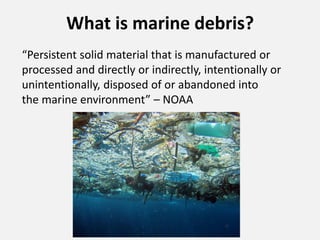
“Persistent solid material that is manufactured or
processed and directly or indirectly, intentionally or
unintentionally, disposed of or abandoned into
the marine environment” – NOAA
What is marine debris?
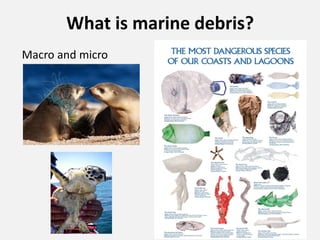
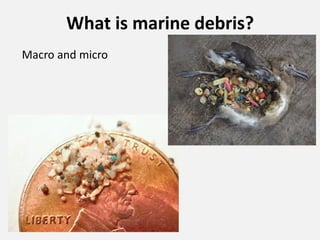
Macro and micro
What is marine debris?
Macro and micro
What is marine debris?
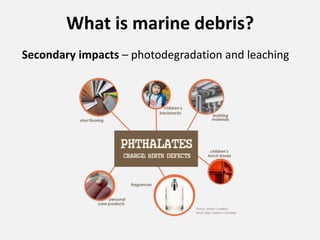
Secondary impacts – photodegradation and leaching
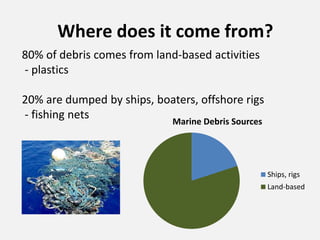
80% of debris comes from land-based activities
- plastics
20% are dumped by ships, boaters, offshore rigs
- fishing nets Marine Debris Sources
Ships, rigs
Land-based
Where does it come from?
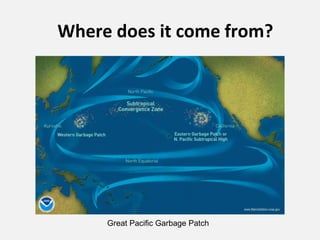
Great Pacific Garbage Patch
Where does it come from?
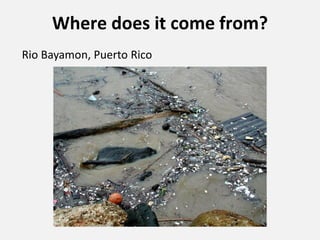
Rio Bayamon, Puerto Rico
Where does it come from?
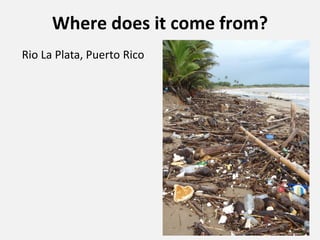
Rio La Plata, Puerto Rico
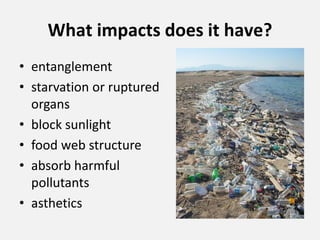
What impacts does it have?
• entanglement
• starvation or ruptured
organs
• block sunlight
• food web structure
• absorb harmful
pollutants
• asthetics
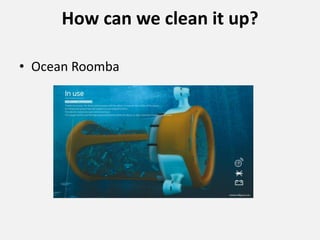
How can we clean it up?
• Ocean Roomba
How can we clean it up?
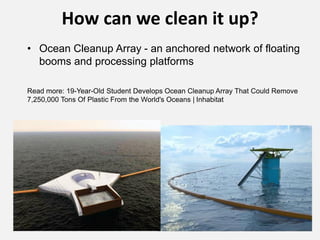
• Ocean Cleanup Array - an anchored network of floating
booms and processing platforms
Read more: 19-Year-Old Student Develops Ocean Cleanup Array That Could Remove
7,250,000 Tons Of Plastic From the World's Oceans | Inhabitat
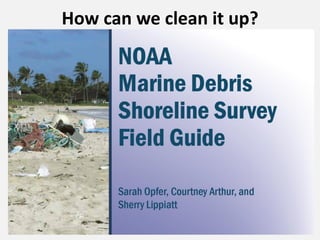
How can we clean it up?
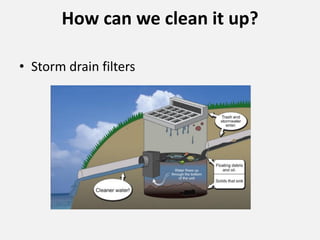
• Storm drain filters
How can we clean it up?
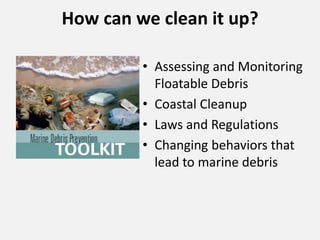
• Assessing and Monitoring
Floatable Debris
• Coastal Cleanup
• Laws and Regulations
• Changing behaviors that
lead to marine debris
How can we clean it up?
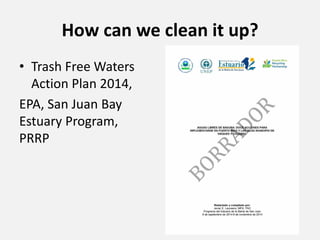
• Trash Free Waters
Action Plan 2014,
EPA, San Juan Bay
Estuary Program,
PRRP
Discussion
• Where does marine debris have more impact
– open ocean or coastal zone?
• Do we know all the impacts?
• What mitigation measures are viable?
• At what scale should mitigation take place?
Further reading
• Eriksen, M., Lebreton, L. C. M., Carson, H. S., Thiel, M., Moore, C. J., Borerro, J. C., … Reisser, J. (2014). Plastic Pollution in the
World’s Oceans: More than 5 Trillion Plastic Pieces Weighing over 250,000 Tons Afloat at Sea. PLoS ONE, 9(12), e111913.
http://doi.org/10.1371/journal.pone.0111913
• Zettler, E. R., Mincer, T. J., & Amaral-Zettler, L. A. (2013). Life in the “plastisphere”: microbial communities on plastic marine
debris. Environmental Science & Technology, 47(13), 7137–46. http://doi.org/10.1021/es401288x
• Baztan, J., Carrasco, A., Chouinard, O., Cleaud, M., Gabaldon, J. E., Huck, T., … Vanderlinden, J.-P. (2014). Protected areas in
the Atlantic facing the hazards of micro-plastic pollution: first diagnosis of three islands in the Canary Current. Marine
Pollution Bulletin, 80(1-2), 302–11. http://doi.org/10.1016/j.marpolbul.2013.12.052
• Hajszan, T., & Leranth, C. (2010). Bisphenol A interferes with synaptic remodeling. Frontiers in Neuroendocrinology, 31(4),
519–30. http://doi.org/10.1016/j.yfrne.2010.06.004
• Mankidy, R., Wiseman, S., Ma, H., & Giesy, J. P. (2013). Biological impact of phthalates. Toxicology Letters, 217(1), 50–58.
Retrieved from http://www.sciencedirect.com/science/article/pii/S0378427412014051
• Oros, D. R., Jarman, W. M., Lowe, T., David, N., Lowe, S., & Davis, J. A. (2003). Surveillance for previously unmonitored
organic contaminants in the San Francisco Estuary. Marine Pollution Bulletin, 46(9), 1102–10. http://doi.org/10.1016/S0025-
326X(03)00248-0
• Stewart, M., Olsen, G., Hickey, C. W., Ferreira, B., Jelić, A., Petrović, M., & Barcelo, D. (2014). A survey of emerging
contaminants in the estuarine receiving environment around Auckland, New Zealand. The Science of the Total Environment,
468-469, 202–10. http://doi.org/10.1016/j.scitotenv.2013.08.039

Marine debris discussion

  • 2.
    Outline 1. Impact ofmarine debris on coastal ecosystems A. What is marine debris? B. Where does it come from? C. What impacts does it have? D. How can we clean it up?
  • 3.
    What is marinedebris? “Persistent solid material that is manufactured or processed and directly or indirectly, intentionally or unintentionally, disposed of or abandoned into the marine environment” – NOAA
  • 4.
    What is marinedebris? Macro and micro
  • 5.
    What is marinedebris? Macro and micro
  • 6.
    What is marinedebris? Secondary impacts – photodegradation and leaching
  • 7.
    80% of debriscomes from land-based activities - plastics 20% are dumped by ships, boaters, offshore rigs - fishing nets Marine Debris Sources Ships, rigs Land-based Where does it come from?
  • 8.
    Where does itcome from? Great Pacific Garbage Patch
  • 9.
    Where does itcome from? Rio Bayamon, Puerto Rico
  • 10.
    Where does itcome from? Rio La Plata, Puerto Rico
  • 11.
    What impacts doesit have? • entanglement • starvation or ruptured organs • block sunlight • food web structure • absorb harmful pollutants • asthetics
  • 12.
    How can weclean it up? • Ocean Roomba
  • 13.
    How can weclean it up? • Ocean Cleanup Array - an anchored network of floating booms and processing platforms Read more: 19-Year-Old Student Develops Ocean Cleanup Array That Could Remove 7,250,000 Tons Of Plastic From the World's Oceans | Inhabitat
  • 14.
    How can weclean it up? • Storm drain filters
  • 15.
    How can weclean it up?
  • 16.
    How can weclean it up? • Assessing and Monitoring Floatable Debris • Coastal Cleanup • Laws and Regulations • Changing behaviors that lead to marine debris
  • 17.
    How can weclean it up? • Trash Free Waters Action Plan 2014, EPA, San Juan Bay Estuary Program, PRRP
  • 18.
    Discussion • Where doesmarine debris have more impact – open ocean or coastal zone? • Do we know all the impacts? • What mitigation measures are viable? • At what scale should mitigation take place?
  • 19.
    Further reading • Eriksen,M., Lebreton, L. C. M., Carson, H. S., Thiel, M., Moore, C. J., Borerro, J. C., … Reisser, J. (2014). Plastic Pollution in the World’s Oceans: More than 5 Trillion Plastic Pieces Weighing over 250,000 Tons Afloat at Sea. PLoS ONE, 9(12), e111913. http://doi.org/10.1371/journal.pone.0111913 • Zettler, E. R., Mincer, T. J., & Amaral-Zettler, L. A. (2013). Life in the “plastisphere”: microbial communities on plastic marine debris. Environmental Science & Technology, 47(13), 7137–46. http://doi.org/10.1021/es401288x • Baztan, J., Carrasco, A., Chouinard, O., Cleaud, M., Gabaldon, J. E., Huck, T., … Vanderlinden, J.-P. (2014). Protected areas in the Atlantic facing the hazards of micro-plastic pollution: first diagnosis of three islands in the Canary Current. Marine Pollution Bulletin, 80(1-2), 302–11. http://doi.org/10.1016/j.marpolbul.2013.12.052 • Hajszan, T., & Leranth, C. (2010). Bisphenol A interferes with synaptic remodeling. Frontiers in Neuroendocrinology, 31(4), 519–30. http://doi.org/10.1016/j.yfrne.2010.06.004 • Mankidy, R., Wiseman, S., Ma, H., & Giesy, J. P. (2013). Biological impact of phthalates. Toxicology Letters, 217(1), 50–58. Retrieved from http://www.sciencedirect.com/science/article/pii/S0378427412014051 • Oros, D. R., Jarman, W. M., Lowe, T., David, N., Lowe, S., & Davis, J. A. (2003). Surveillance for previously unmonitored organic contaminants in the San Francisco Estuary. Marine Pollution Bulletin, 46(9), 1102–10. http://doi.org/10.1016/S0025- 326X(03)00248-0 • Stewart, M., Olsen, G., Hickey, C. W., Ferreira, B., Jelić, A., Petrović, M., & Barcelo, D. (2014). A survey of emerging contaminants in the estuarine receiving environment around Auckland, New Zealand. The Science of the Total Environment, 468-469, 202–10. http://doi.org/10.1016/j.scitotenv.2013.08.039