Marine Environmental Management,OCEAN-305 hafezahmad
1
1: Pollution
Pollution is defined as the presence of impurities or pollutant substances in sufficient concentration levels,
causing harmful effects on human beings, animals, plant life or material resources when exposed for a
sufficient duration of time, thus reducing the quality of life in the environment.
The term 'pollution' describes the occurrence and inputs of wastes and the impact of these wastes on the
environment.
A Pollutant is a substance or energy introduced into the environment that has undesired effects,or
adversely affects the usefulness of a resource. Pollutants include solid, liquid or gaseous substances
present in greater than natural abundance, produce due to human activity, which have a determined effect
on our environment.
2: types of pollution based on nature , characteristics ,source
7. Types of Pollution 1. Air Pollution 2. Water Pollution 3. Soil/Land Pollution 4. Noise Pollution 5.
Radioactive Pollution 6. Environmental Pollution.
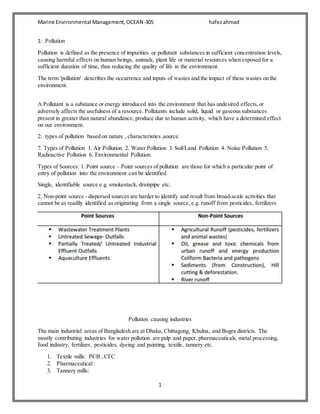
Types of Sources: 1. Point source – Point sources of pollution are those for which a particular point of
entry of pollution into the environment can be identified.
Single, identifiable source e.g. smokestack, drainpipe etc.
2. Non-point source - dispersed sources are harder to identify and result from broad-scale activities that
cannot be as readily identified as originating from a single source,e.g. runoff from pesticides, fertilizers
Pollution causing industries
The main industrial areas of Bangladesh are at Dhaka, Chittagong, Khulna, and Bogra districts. The
mostly contributing industries for water pollution are pulp and paper, pharmaceuticals, metal processing,
food industry, fertilizer, pesticides, dyeing and painting, textile, tannery etc.
1. Textile mills: PCB , CFC
2. Pharmaceutical:
3. Tannery mills:
Marine Environmental Management,OCEAN-305 hafezahmad
2
4. Ship breaking industries
Pollutants from discharged from pollution causing industries
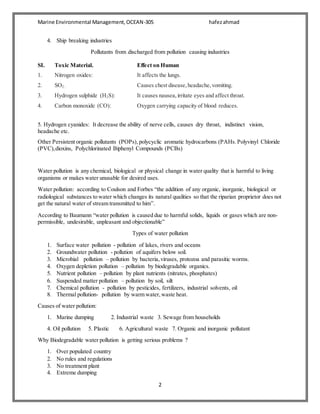
SI. Toxic Material. Effect on Human
1. Nitrogen oxides: It affects the lungs.
2. SO2.: Causes chest disease,headache,vomiting.
3. Hydrogen sulphide (H2S): It causes nausea,irritate eyes and affect throat.
4. Carbon monoxide (CO): Oxygen carrying capacity of blood reduces.
5. Hydrogen cyanides: It decrease the ability of nerve cells, causes dry throat, indistinct vision,
headache etc.
Other Persistent organic pollutants (POPs),polycyclic aromatic hydrocarbons (PAHs.Polyvinyl Chloride
(PVC),dioxins, Polychlorinated Biphenyl Compounds (PCBs)
Water pollution is any chemical, biological or physical change in water quality that is harmful to living
organisms or makes water unusable for desired uses.
Water pollution: according to Coulson and Forbes “the addition of any organic, inorganic, biological or
radiological substances to water which changes its natural qualities so that the riparian proprietor does not
get the natural water of stream transmitted to him”.
According to Baumann “water pollution is caused due to harmful solids, liquids or gases which are non-
permissible, undesirable, unpleasant and objectionable”
Types of water pollution
1. Surface water pollution - pollution of lakes, rivers and oceans
2. Groundwater pollution - pollution of aquifers below soil.
3. Microbial pollution – pollution by bacteria,viruses, protozoa and parasitic worms.
4. Oxygen depletion pollution – pollution by biodegradable organics.
5. Nutrient pollution – pollution by plant nutrients (nitrates, phosphates)
6. Suspended matter pollution – pollution by soil, silt
7. Chemical pollution - pollution by pesticides, fertilizers, industrial solvents, oil
8. Thermal pollution- pollution by warm water,waste heat.
Causes of water pollution:
1. Marine dumping 2. Industrial waste 3. Sewage from households
4. Oil pollution 5. Plastic 6. Agricultural waste 7. Organic and inorganic pollutant
Why Biodegradable water pollution is getting serious problems ?
1. Over populated country
2. No rules and regulations
3. No treatment plant
4. Extreme dumping
Marine Environmental Management,OCEAN-305 hafezahmad
3
Marine pollution
Marine pollution refers to the contamination or presence of pollutants in oceans and seas. Marine
pollution includes a range of threats including from land based sources,oil spills, untreated sewage,heavy
siltation, eutrophication (nutrient enrichment), invasive species, persistent organic pollutants (POP’s),
heavy metals from mine tailings and other sources, acidification, radioactive substances,marine litter,
overfishing and destruction of coastal and marine habitats.
Marine Pollution (UN definition) –“The introduction by man, directly, or indirectly, of substances or
energy to the marine environment resulting in deleterious effects such as:hazards to human health,
hindrance to marine activities, impairment of the quality of seawater for various uses and reduction of
amenities.
Types of Marine Pollution
1. Sedimentation
2. Agricultural runoff (herbicides, pesticides and nutrients)
3. Energy (thermal and light)
4. Sewage (FaecalColiform and nutrients)
5. Solid Waste
6. Chemicals, Metals and Radioactive Substances
7. Oil
8. Biological
Some important sea based sources of marine pollution are given below-
 Crude Petroleum- (PAHs)
 Antifouling Agents- (TBT)
 Volatile Organic Compound (VOC)- PCBs,DDTs,Dioxins, Furans
 Oil Spill, Bilge from Ship, Boats
 Dumping of Wastes
 Introduction of Alien species through ballast water etc.
Present Status of Marine Pollution
Rivers of Bangladesh are heavily contaminated with untreated municipal sewage, industrial effluent,
agricultural run-off and sediments. One of the most serious impacts is the decline in estuarine and
coastal water quality caused by rising levels of nutrients from land-based sources. Expansion of
intensive agricultural practices has resulted in increasing agrochemical pollution, particularly in
developing countries of the region.
Impacts on water quality and benthos
Impacts on Benthos
1. Unable to move
2. Suffocation
3. Migration
4.
Marine Environmental Management,OCEAN-305 hafezahmad
4
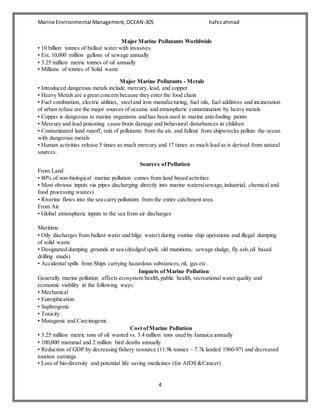
Major Marine Pollutants Worldwide
‱ 10 billion tonnes of ballast water with invasives
‱ Est. 10,000 million gallons of sewage annually
‱ 3.25 million metric tonnes of oil annually
‱ Millions of tonnes of Solid waste
Major Marine Pollutants - Metals
‱ Introduced dangerous metals include mercury, lead, and copper
‱ Heavy Metals are a great concern because they enter the food chain
‱ Fuel combustion, electric utilities, steeland iron manufacturing, fuel oils, fuel additives and incineration
of urban refuse are the major sources of oceanic and atmospheric contamination by heavy metals
‱ Copper is dangerous to marine organisms and has been used in marine anti-fouling paints
‱ Mercury and lead poisoning cause brain damage and behavioral disturbances in children
‱ Contaminated land runoff, rain of pollutants from the air, and fallout from shipwrecks pollute the ocean
with dangerous metals
‱ Human activities release 5 times as much mercury and 17 times as much lead as is derived from natural
sources.
Sources ofPollution
From Land
‱ 80% of non-biological marine pollution comes from land based activities
‱ Most obvious inputs via pipes discharging directly into marine waters(sewage, industrial, chemical and
food processing wastes)
‱ Riverine flows into the sea carry pollutants from the entire catchment area.
From Air
‱ Global atmospheric inputs to the sea from air discharges
Maritime
‱ Oily discharges from ballast water and bilge water) during routine ship operations and illegal dumping
of solid waste
‱ Designated dumping grounds at sea (dredged spoil, old munitions, sewage sludge, fly ash,oil based
drilling muds)
‱ Accidental spills from Ships carrying hazardous substances,oil, gas etc.
Impacts ofMarine Pollution
Generally marine pollution affects ecosystem health,public health, recreational water quality and
economic viability in the following ways:
‱ Mechanical
‱ Eutrophication
‱ Saphrogenic
‱ Toxicity
‱ Mutagenic and Carcinogenic
Cost ofMarine Pollution
‱ 3.25 million metric tons of oil wasted vs. 3.4 million tons used by Jamaica annually
‱ 100,000 mammal and 2 million bird deaths annually
‱ Reduction of GDP by decreasing fishery resource (11.9k tonnes – 7.7k landed 1960-97) and decreased
tourism earnings
‱ Loss of bio-diversity and potential life saving medicines (for AIDS &Cancer)
Marine Environmental Management,OCEAN-305 hafezahmad
5
Major problems of World Ocean
GESAMP (1991) summarized the major problems of the world ocean as
 nutrient contamination;
 microbial contamination of seafood;
 disposal of debris (particularly plastic debris);
 trace contaminants such as lead, cadmium, and mercury when discharged in high
concentrations;
 occurrence of synthetic organic compounds in sediments and in predators at the top of the
marine food chain
 oil in marine systems, mainly the global impact of tar bails on beaches and the effects of
spills in local sheltered areas.
 They added that radioactive contamination is a public concern.
Solutions to Pollution
Two main methods
– Correction – costly and time intensive
– Prevention – requires attitude changes
Coastal Scientists believe that prevention is better than cure since the effects of marine pollution may be
irreversible and we may therefore be creating everlasting damage to the marine ecosystem.
“An ounce of prevention is worth a pound of cure”
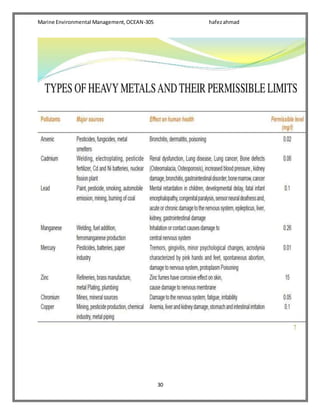
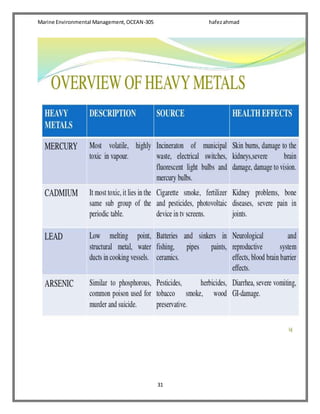
Heavy metal refers to any metallic chemical element that has a relatively high density and is toxic or
poisonous at low concentrations. Examples of heavy metals include mercury (Hg), cadmium (Cd), arsenic
(As),chromium (Cr), thallium (Tl), and lead (Pb).Heavy metals are known as persistent, bio-accumulative
and toxic chemicals.
Sources of heavy metal
1. Natural sources
a. Rock weathering
b. Volcanic activity
c. Atmosphere
2. Anthropogenic sources
a. Domestic waste waters and urban run off: Cr, Zn , Mn ,As
b. Industrial waste : Cu, Pb, Zn , Hg
c. Agricultural activities : pesticide , fertilizer ,herbicide , fungicide
d. Mining activities
Heavy metals are serious pollutants because they are stable compounds, not readily removed by
oxidation, precipitation or by any other natural process. Heavy metals have seasonal variation during
rainy and dry season in the coastal area of Chittagong. There are some studies and reports of
marine fish analysis from the Bay of Bengal for As, Cr, Hg, Se, Zn along with K, Ca, Mg, Fe, Ni, Cu, Pb,
Sr and Rb.
Heavy Metals Entering Oceans
Marine Environmental Management,OCEAN-305 hafezahmad
6
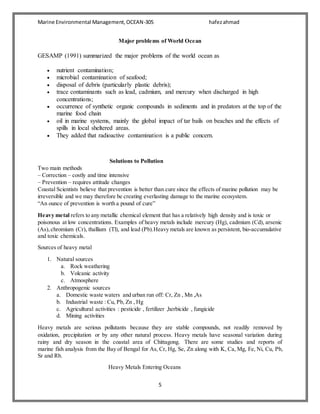
Heavy metal accumulation in food chain:
Heavy metals are dangerous because they tend to bioaccumulate. Bioaccumulation means an increase in
the concentration of a chemical in a biological organism over time, compared to the chemical's
concentration in the environment. Compounds accumulate in living things any time they are taken up and
stored faster than they are broken down (metabolized) or excreted.
Accumulation pattern in marine food chain :
Biomagnification of heavy metals is a process where they are passed from one trophic level to another
and exhibit increasing concentrations in organisms at higher trophic levels. It involves uptake of heavy
metal with ingested food. The food ingested, assimilated and excreted but heavy metal accumulates in the
tissue of the organisms.
Marine organisms absorb heavy metal from the abiotic environment by a number of mechanisms. Fish
can absorb through their respiratory surfaces .another important mode of adsorption of heavy metal on
body surface by diffusion.
Intake in phytoplankton on cell wall. Another mechanism of uptake is digestive system through ingested
food in fish , mollusk , crustacean ,filter feeder and detritus feeder.
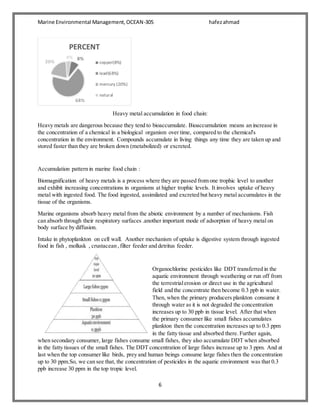
Organochlorine pesticides like DDT transferred in the
aquatic environment through weathering or run off from
the terrestrialerosion or direct use in the agricultural
field and the concentrate then become 0.3 ppb in water.
Then, when the primary producers plankton consume it
through water as it is not degraded the concentration
increases up to 30 ppb in tissue level. After that when
the primary consumer like small fishes accumulates
plankton then the concentration increases up to 0.3 ppm
in the fatty tissue and absorbed there. Further again,
when secondary consumer, large fishes consume small fishes, they also accumulate DDT when absorbed
in the fatty tissues of the small fishes. The DDT concentration of large fishes increase up to 3 ppm. And at
last when the top consumer like birds, prey and human beings consume large fishes then the concentration
up to 30 ppm.So, we can see that, the concentration of pesticides in the aquatic environment was that 0.3
ppb increase 30 ppm in the top tropic level.
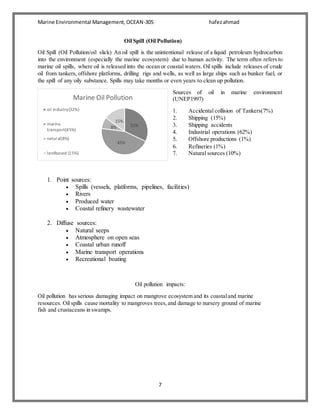
8%
68%
20%
4%
PERCENT
copper(8%)
lead(68%)
mercury (20%)
natural
Marine Environmental Management,OCEAN-305 hafezahmad
7
Oil Spill (Oil Pollution)
Oil Spill (Oil Pollution/oil slick) An oil spill is the unintentional release of a liquid petroleum hydrocarbon
into the environment (especially the marine ecosystem) due to human activity. The term often refers to
marine oil spills, where oil is released into the ocean or coastal waters. Oil spills include releases of crude
oil from tankers, offshore platforms, drilling rigs and wells, as well as large ships such as bunker fuel, or
the spill of any oily substance. Spills may take months or even years to clean up pollution.
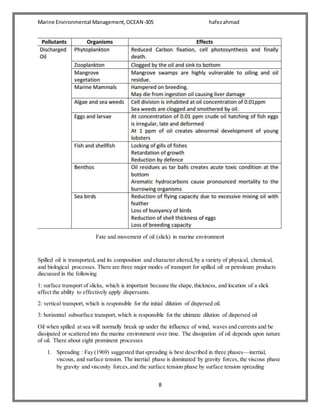
Sources of oil in marine environment
(UNEP1997)
1. Accidental collision of Tankers(7%)
2. Shipping (15%)
3. Shipping accidents
4. Industrial operations (62%)
5. Offshore productions (1%)
6. Refineries (1%)
7. Natural sources (10%)
1. Point sources:
 Spills (vessels, platforms, pipelines, facilities)
 Rivers
 Produced water
 Coastal refinery wastewater
2. Diffuse sources:
 Natural seeps
 Atmosphere on open seas
 Coastal urban runoff
 Marine transport operations
 Recreational boating
Oil pollution impacts:
Oil pollution has serious damaging impact on mangrove ecosystem and its coastaland marine
resources. Oil spills cause mortality to mangroves trees,and damage to nursery ground of marine
fish and crustaceans in swamps.
32%
45%
8%
15%
Marine Oil Pollution
oil industry(32%)
marine
transport(45%)
natural(8%)
landbased (15%)
Marine Environmental Management,OCEAN-305 hafezahmad
8
Fate and movement of oil (slick) in marine environment
Spilled oil is transported, and its composition and character altered,by a variety of physical, chemical,
and biological processes. There are three major modes of transport for spilled oil or petroleum products
discussed in the following
1: surface transport of slicks, which is important because the shape,thickness, and location of a slick
affect the ability to effectively apply dispersants.
2: vertical transport, which is responsible for the initial dilution of dispersed oil.
3: horizontal subsurface transport, which is responsible for the ultimate dilution of dispersed oil
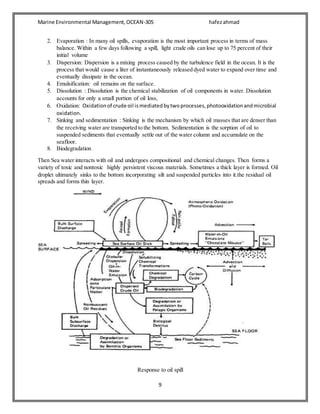
Oil when spilled at sea will normally break up under the influence of wind, waves and currents and be
dissipated or scattered into the marine environment over time. The dissipation of oil depends upon nature
of oil. There about eight prominent processes
1. Spreading : Fay (1969) suggested that spreading is best described in three phases—inertial,
viscous, and surface tension. The inertial phase is dominated by gravity forces, the viscous phase
by gravity and viscosity forces,and the surface tension phase by surface tension spreading
Marine Environmental Management,OCEAN-305 hafezahmad
9
2. Evaporation : In many oil spills, evaporation is the most important process in terms of mass
balance. Within a few days following a spill, light crude oils can lose up to 75 percent of their
initial volume
3. Dispersion: Dispersion is a mixing process caused by the turbulence field in the ocean. It is the
process that would cause a liter of instantaneously released dyed water to expand over time and
eventually dissipate in the ocean.
4. Emulsification: oil remains on the surface.
5. Dissolution : Dissolution is the chemical stabilization of oil components in water. Dissolution
accounts for only a small portion of oil loss,
6. Oxidation: Oxidationof crude oil ismediatedbytwoprocesses,photooxidationandmicrobial
oxidation.
7. Sinking and sedimentation : Sinking is the mechanism by which oil masses that are denser than
the receiving water are transported to the bottom. Sedimentation is the sorption of oil to
suspended sediments that eventually settle out of the water column and accumulate on the
seafloor.
8. Biodegradation
Then Sea water interacts with oil and undergoes compositional and chemical changes. Then forms a
variety of toxic and nontoxic highly persistent viscous materials. Sometimes a thick layer is formed. Oil
droplet ultimately sinks to the bottom incorporating silt and suspended particles into it.the residual oil
spreads and forms thin layer.
Response to oil spill
Marine Environmental Management,OCEAN-305 hafezahmad
10
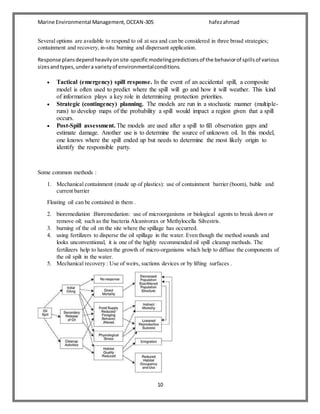
Several options are available to respond to oil at sea and can be considered in three broad strategies;
containment and recovery, in-situ burning and dispersant application.
Response plansdependheavilyonsite-specificmodelingpredictionsof the behaviorof spillsof various
sizesandtypes,undera varietyof environmentalconditions.
 Tactical (emergency) spill response. In the event of an accidental spill, a composite
model is often used to predict where the spill will go and how it will weather. This kind
of information plays a key role in determining protection priorities.
 Strategic (contingency) planning. The models are run in a stochastic manner (multiple-
runs) to develop maps of the probability a spill would impact a region given that a spill
occurs.
 Post-Spill assessment. The models are used after a spill to fill observation gaps and
estimate damage. Another use is to determine the source of unknown oil. In this model,
one knows where the spill ended up but needs to determine the most likely origin to
identify the responsible party.
Some common methods :
1. Mechanical containment (made up of plastics): use of containment barrier (boom), buble and
current barrier
Floating oil can be contained in them .
2. bioremediation :Bioremediation: use of microorganisms or biological agents to break down or
remove oil; such as the bacteria Alcanivorax or Methylocella Silvestris.
3. burning of the oil on the site where the spillage has occurred.
4. using fertilizers to disperse the oil spillage in the water. Even though the method sounds and
looks unconventional, it is one of the highly recommended oil spill cleanup methods. The
fertilizers help to hasten the growth of micro-organisms which help to diffuse the components of
the oil spilt in the water.
5. Mechanical recovery : Use of weirs, suctions devices or by lifting surfaces .
Marine Environmental Management,OCEAN-305 hafezahmad
11
An agrochemical is any substance used to help manage an agricultural ecosystem,or the community of
organisms in a farming area. Agrochemicals include: (1) fertilizers, (2) liming and acidifying agents,(3)
soil conditioners, (4) pesticides, and (5) chemicals used in animal husbandry, such as antibiotics and
hormones.
4: Biomagnification of hg in marine environment
5: environmental modelling , basic techniques and tools
Environmental modelling is the creation and use of mathematical models of the environment.
Environmental modelling involves the application of multidisciplinary knowledge to explain, explore and
predict the Earth’s response to environmental change, both natural and human-induced.
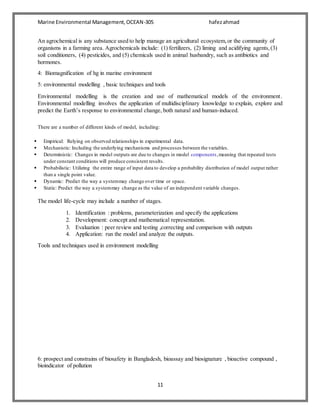
There are a number of different kinds of model, including:
 Empirical: Relying on observed relationships in experimental data.
 Mechanistic: Including the underlying mechanisms and processes between the variables.
 Deterministic: Changes in model outputs are due to changes in model components,meaning that repeated tests
under constant conditions will produce consistent results.
 Probabilistic: Utilizing the entire range of input data to develop a probability distribution of model output rather
than a single point value.
 Dynamic: Predict the way a systemmay change over time or space.
 Static: Predict the way a systemmay change as the value of an independent variable changes.
The model life-cycle may include a number of stages.
1. Identification : problems, parameterization and specify the applications
2. Development: concept and mathematical representation.
3. Evaluation : peer review and testing ,correcting and comparison with outputs
4. Application: run the model and analyze the outputs.
Tools and techniques used in environment modelling
6: prospect and constrains of biosafety in Bangladesh, bioassay and biosignature , bioactive compound ,
bioindicator of pollution
Marine Environmental Management,OCEAN-305 hafezahmad
12
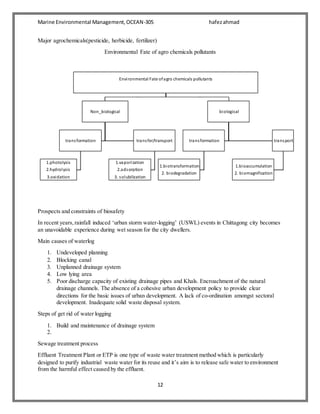
Major agrochemicals(pesticide, herbicide, fertilizer)
Environmental Fate of agro chemicals pollutants
Prospects and constraints of biosafety
In recent years,rainfall induced ‘urban storm water-logging’ (USWL) events in Chittagong city becomes
an unavoidable experience during wet season for the city dwellers.
Main causes of waterlog
1. Undeveloped planning
2. Blocking canal
3. Unplanned drainage system
4. Low lying area
5. Poor discharge capacity of existing drainage pipes and Khals. Encroachment of the natural
drainage channels. The absence of a cohesive urban development policy to provide clear
directions for the basic issues of urban development. A lack of co-ordination amongst sectoral
development. Inadequate solid waste disposal system.
Steps of get rid of water logging
1. Build and maintenance of drainage system
2.
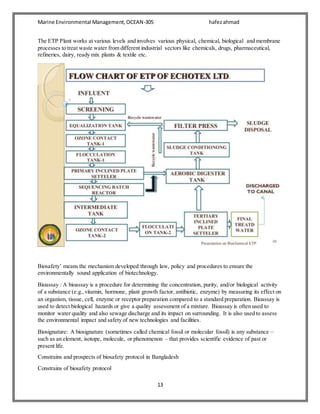
Sewage treatment process
Effluent Treatment Plant or ETP is one type of waste water treatment method which is particularly
designed to purify industrial waste water for its reuse and it’s aim is to release safe water to environment
from the harmful effect caused by the effluent.
Environmental Fate ofagro chemicals pollutants
Non_biological
transformation
1.photolysis
2.hydrolysis
3.oxidation
transfer/transport
1.vaporization
2.adsorption
3. solubilization
biological
transformation
1.biotransformation
2. biodegradation
transport
1.bioaccumulation
2. biomagnification
Marine Environmental Management,OCEAN-305 hafezahmad
13
The ETP Plant works at various levels and involves various physical, chemical, biological and membrane
processes to treat waste water from different industrial sectors like chemicals, drugs, pharmaceutical,
refineries, dairy, ready mix plants & textile etc.
Biosafety’ means the mechanism developed through law, policy and procedures to ensure the
environmentally sound application of biotechnology.
Bioassay : A bioassay is a procedure for determining the concentration, purity, and/or biological activity
of a substance (e.g.,vitamin, hormone, plant growth factor, antibiotic, enzyme) by measuring its effect on
an organism, tissue, cell, enzyme or receptor preparation compared to a standard preparation. Bioassay is
used to detect biological hazards or give a quality assessment of a mixture. Bioassay is often used to
monitor water quality and also sewage discharge and its impact on surrounding. It is also used to assess
the environmental impact and safety of new technologies and facilities.
Biosignature: A biosignature (sometimes called chemical fossil or molecular fossil) is any substance –
such as an element, isotope, molecule, or phenomenon – that provides scientific evidence of past or
present life.
Constrains and prospects of biosafety protocol in Bangladesh
Constrains of biosafety protocol
Marine Environmental Management,OCEAN-305 hafezahmad
14
1. Absence of standards
2. Absence of well managed infrastructure
3. Lack f adequate laboratories
4. Insufficient trained man power
5. No management of genetically modified organisms
6. No perfect Cartagena Protocoland the national biosafety regulations.
Prospects of biosafety protocol
1. Safety food
2. Healthy environment
3.
Environmental management: the process of allocating natural and artificial resources so as to make
optimum use of the environment in satisfying basic human needs at the minimum and more if possible on
a sustainable basis.(jolly , 1978)
Environmental management tools:
i. environmental management systems
ii. environmental auditing
iii. environmental labeling
iv. life cycle assessment
v. environmental indicators
vi. environmental policies
vii. eco-balances
viii. environmental reporting
ix. environmental charters
Tool and techniques uses in environment monitoring
Environmental monitoring describes the processes and activities that need to take place to characterize and
monitor the quality of the environment. Environmental monitoring is used in the preparation of
environmental impact assessments,as wellas in many circumstances in which human activities carry a risk
of harmful effects on the natural environment. All monitoring strategies and programmes have reasons and
justifications which are often designed to establish the current statusof an environment or to establish trends
in environmental parameters.
Monitoring is the regular gathering and analysis of information needed for your day-to-day management,
to inform your decision-making and to evaluate your progress in achieving your planned outcomes over a
given period.
Tools : 1. ph meter
2.
Techniques of environmental monitoring
1. SWOT : strength , weakness , opportunities and threats
Marine Environmental Management,OCEAN-305 hafezahmad
15
2. PEST : political , economical , social and
3. QUEST
4. Industry analysis
5. Competitor analysis
LD50 and LC50
LC stands for "Lethal Concentration". LC values usually refer to the concentration of a chemical in air but
in environmental studies it can also mean the concentration of a chemical in water. The unit of measure
for the LC50 is usually expressed as part per million (ppm)
LD stands for "Lethal Dose". LD50 is the amount of a material, given all at once, which causes the death
of 50% (one half) of a group of test animals. The LD50 is one way to measure the short-term poisoning
potential (acute toxicity) of a material.
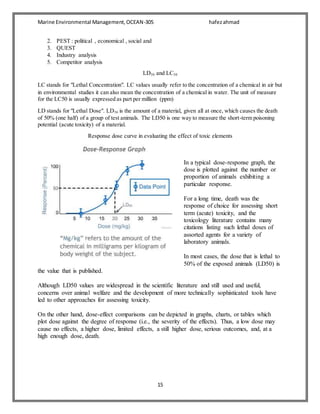
Response dose curve in evaluating the effect of toxic elements
In a typical dose-response graph, the
dose is plotted against the number or
proportion of animals exhibiting a
particular response.
For a long time, death was the
response of choice for assessing short
term (acute) toxicity, and the
toxicology literature contains many
citations listing such lethal doses of
assorted agents for a variety of
laboratory animals.
In most cases, the dose that is lethal to
50% of the exposed animals (LD50) is
the value that is published.
Although LD50 values are widespread in the scientific literature and still used and useful,
concerns over animal welfare and the development of more technically sophisticated tools have
led to other approaches for assessing toxicity.
On the other hand, dose-effect comparisons can be depicted in graphs, charts, or tables which
plot dose against the degree of response (i.e., the severity of the effects). Thus, a low dose may
cause no effects, a higher dose, limited effects, a still higher dose, serious outcomes, and, at a
high enough dose, death.
Marine Environmental Management,OCEAN-305 hafezahmad
16
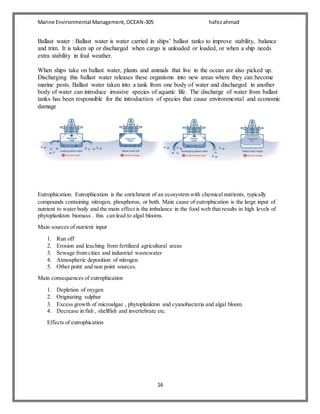
Ballast water : Ballast water is water carried in ships’ ballast tanks to improve stability, balance
and trim. It is taken up or discharged when cargo is unloaded or loaded, or when a ship needs
extra stability in foul weather.
When ships take on ballast water, plants and animals that live in the ocean are also picked up.
Discharging this ballast water releases these organisms into new areas where they can become
marine pests. Ballast water taken into a tank from one body of water and discharged in another
body of water can introduce invasive species of aquatic life. The discharge of water from ballast
tanks has been responsible for the introduction of species that cause environmental and economic
damage
Eutrophication: Eutrophication is the enrichment of an ecosystem with chemical nutrients, typically
compounds containing nitrogen, phosphorus, or both. Main cause of eutrophication is the large input of
nutrient to water body and the main effect is the imbalance in the food web that results in high levels of
phytoplankton biomass . this can lead to algal blooms.
Main sources of nutrient input
1. Run off
2. Erosion and leaching from fertilized agricultural areas
3. Sewage from cities and industrial wastewater
4. Atmospheric deposition of nitrogen
5. Other point and non point sources.
Main consequences of eutrophication
1. Depletion of oxygen
2. Originating sulphur
3. Excess growth of microalgae , phytoplankton and cyanobacteria and algal bloom.
4. Decrease in fish , shellfish and invertebrate etc.
Effects of eutrophication
Marine Environmental Management,OCEAN-305 hafezahmad
17
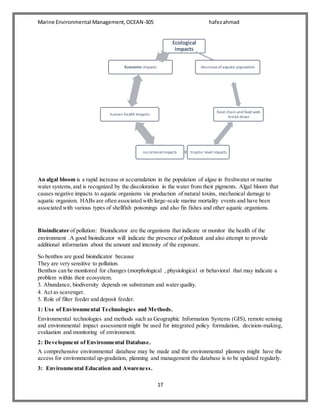
An algal bloom is a rapid increase or accumulation in the population of algae in freshwater or marine
water systems,and is recognized by the discoloration in the water from their pigments. Algal bloom that
causes negative impacts to aquatic organisms via production of natural toxins, mechanical damage to
aquatic organism. HABs are often associated with large-scale marine mortality events and have been
associated with various types of shellfish poisonings and also fin fishes and other aquatic organisms.
Bioindicator of pollution: Bioindicator are the organisms that indicate or monitor the health of the
environment .A good bioindicator will indicate the presence of pollutant and also attempt to provide
additional information about the amount and intensity of the exposure.
So benthos are good bioindicator because
They are very sensitive to pollution.
Benthos can be monitored for changes (morphological , physiological or behavioral that may indicate a
problem within their ecosystem.
3. Abundance, biodiversity depends on substratum and water quality.
4. Act as scavenger.
5. Role of filter feeder and deposit feeder.
1: Use of Environmental Technologies and Methods.
Environmental technologies and methods such as Geographic Information Systems (GIS), remote sensing
and environmental impact assessment might be used for integrated policy formulation, decision-making,
evaluation and monitoring of environment.
2: Development of Environmental Database.
A comprehensive environmental database may be made and the environmental planners might have the
access for environmental up-gradation, planning and management the database is to be updated regularly.
3: Environmental Education and Awareness.
Ecological
impacts
decreaseofaquatic population
food chain and food web
break down
trophic level impactsrecrationalimpacts
human health imapcts
Economic impacts
Marine Environmental Management,OCEAN-305 hafezahmad
18
Formal and informal methods of education might be adopted through local media, seminars, celebrations,
workshops, walks and student competitions to aware the people regarding the process of environmental
degradation.
4: Industrial and Solid Waste Management.
The government might take appropriate measures to monitor emission limits and Market Based Incentives
(MBI) for reducing pollution control. The industries might be given both technical and financial support
for introducing mitigation measures, promoting green technologies, using less pollution technologies and
recycling the waste.
5: Enforcement of Rules and Regulation.
Environmental Conservation Rules of 1997, traffic rules and other relevant environmental laws might be
enforced further to punish the violation of the emission limits.
6: Urban Transport Management.
Government must strengthen vehicle emission standards, complete the emission inventory and conduct an
investigation on the emission control measures. Auto-rickshaw must be restricted in Dhaka city.
Government must replace old vehicles, two-stroke engine vehicles, improve traffic conditions and promote
an equivalent and efficient alternative public transportation services to improve urban transport
management.
7: Reduce Sulfur in Diesel.
Government must take necessarystepstoremove sulfur content from diesel through hydro-desulphurization
(HDS) process. The government must also enforce the vehicle manufacturers to install catalytic converters
in every vehicle to reduce the vehicular emissions.
Sewage pollution and management
Sludge: Sludge means any solid, semi-solid, or liquid waste generated from a municipal, commercial, or
industrial wastewater treatment plant, water supply treatment plant, or air pollution control facility
exclusive of the treated effluent from a wastewater treatment plant.
Sewage: Sewage is the term used for wastewater that often contains faeces,urine and laundry waste.
Sewage (or domestic wastewater or municipal wastewater) is a type of wastewater that is produced from a
community of people. Sewage is generated by residential, institutional, commercial and industrial
establishments. It includes household waste water from toilets, baths, showers,kitchens, sinks and so
forth that is disposed off via sewers. In many areas,sewage also includes liquid waste from industry and
commerce.
Sewage is mainly classified in two groups: 1) Domestic Sewage. 2) Industrial Sewage.
1. It is composed of human waste and waste water resulting from personal washing, institutions, and other
waste products of normal living. It contain low amount of solid usually being 99% of water. It contains
millions of bacteria per milliliter which may cause cholera, dysentery, and typhoid fever. It contains
numbers of synthetic detergent, resistant to biodegradation.
2. Industrial sewage:These are wastes that result from an industrial process or the production or
manufacture of goods. Their flows and strength are usually more varied, intense, and concentrated than
those of sanitary sewage. It contain both organic and inorganic compound. It contain high amount of solid
content.
Marine Environmental Management,OCEAN-305 hafezahmad
19
Composition of sewage water
1. Organic matter
2. Nutrients (Nitrogen, Phosphorus, Potassium)
3. inorganic matter (dissolved minerals)
4. Toxic chemicals (heavy metal and pesticides)
5. Pathogens
Sewage contains human feces, and therefore often contains pathogens of one of the four types
 Bacteria (for example Salmonella, Shigella, Vibrio cholerae),
 Viruses (for example hepatitis A, rotavirus)
 Protozoa (for example Entamoeba histolytica) and
 Parasites such as helminths and their eggs (e.g. ascaris (roundworm)
Pollution caused by sewage water is one of the major problems in cities the world over. Sewage water is
drained off into rivers without treatment. Careless disposal of sewage water leads to creation of a chain of
problems like spreading of diseases,eutrophication, increase in Biological Oxygen Demand (BOD)
Effects on Health
Pathogens present in sewage water are responsible for spreading different kinds diseases. Stagnant water
fosters the growth of mosquitoes, which in turn causes diseases like malaria. Another disease which
originates from contaminated water is typhoid. Sewage water may also contain protozoans like
Cryptosporium and Giardia. These pathogens pose a great risk to human health. Therefore,polluted water
ac oxins released in rivers through sewage water are consumed by fish and other aquatic organisms; thus,
the possibility of toxins entering the food chain increases manifold. It is observed that coral reefs get
affected by sewage pollution the world over. The sewage water dumped in oceans can affect the coral
reefs to a great extent. The toxins present in polluted water inhibit the growth of corals.ts as a host to
severalpathogenic microbes.
Removal of contaminants is the main objective of treatment of sewage water. Before the actualtreatment
of water,effluents are pretreated.
‱ The process of pre-treatment helps in the separation of oils, greases,gravel and sand from polluted
water. This process is carried out by filtration of sewage water.
‱ Biological wastes dissolved in water are treated with microbes. It helps in converting wastes into a solid
mass which can be easily separated later on.
Marine Environmental Management,OCEAN-305 hafezahmad
20
‱ Once the biological treatment is over, partially-pure effluents are treated with chemical disinfectants.
The water treated in treatment plants can be used in golf courses,for watering lawns and also in
agriculture for irrigation.
‱ Sewage treatment plants generate clear and clean water. Some of the treatment plants dispose the wastes
into oceans. This is one form of pollution and it should prove to be harmful for the environment.
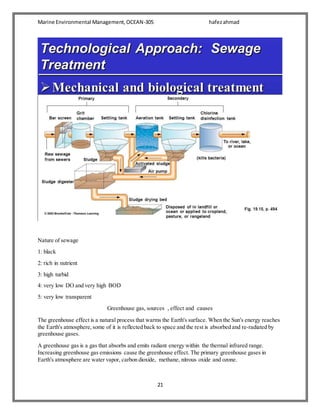
Sewage treatment
SEWAGE TREATMENT:The treatment of wastewater is divided into three phases: 1. Pre-treatment. 2.
Primary treatment. 3. Secondary treatment
1. Pre-treatment large solids (i.e. those with a diameter of more than 2cm) and grit (heavy
solids) are removed by screening. These are disposed of in landfills.
2. Primary treatment the water is left to stand so that solids can sink to the bottom and oil and
grease can rise to the surface. The solids are scraped off the bottom and the scum is washed off
with water jets. These two substances are combined to form sludge.
3. Secondary treatment  the sludge is further treated in 'sludge digesters': large heated tanks in
which its chemical decomposition is catalyzed by microorganisms. The sludge is largely
converted to biogas which is used to generate electricity for the plant. The liquid is treated by
bacteria which break down the organic matter remaining in solution.it is then sent to oxidation
ponds where heterotrophic bacteria continue the breakdown of the organics and solar uv light
destroys the harmful bacteria.
Marine Environmental Management,OCEAN-305 hafezahmad
21
Nature of sewage
1: black
2: rich in nutrient
3: high turbid
4: very low DO and very high BOD
5: very low transparent
Greenhouse gas, sources , effect and causes
The greenhouse effect is a natural process that warms the Earth's surface. When the Sun's energy reaches
the Earth's atmosphere,some of it is reflected back to space and the rest is absorbed and re-radiated by
greenhouse gases.
A greenhouse gas is a gas that absorbs and emits radiant energy within the thermal infrared range.
Increasing greenhouse gas emissions cause the greenhouse effect. The primary greenhouse gases in
Earth's atmosphere are water vapor, carbon dioxide, methane, nitrous oxide and ozone.
Marine Environmental Management,OCEAN-305 hafezahmad
22
Sources of greenhouse gas emissions are: fossil fuel use, deforestation, intensive livestock farming, use of
synthetic fertilizers and industrial processes. The other is through natural processes like animal and plant
respiration.
Major Greenhouse gases & their sources
1: H2O (water vapor) – evaporation, plant respiration.
2: CO2 (Carbon dioxide)-fossil fuels, volcanic eruptions
3: CH4 (Methane) -animal waste,fossil fuels, landfills, sewage,wetlands
4: N2O (Nitrous Oxide) – deforestation, fossil fuels, microbe activities (in soil)
5 : CFCs (Chlorofluorocarbons)-aerosols, propellants, solvents, refrigerants
Causes of the Greenhouse Effect
1. Burning ofFossil Fuels:Fossil fuels like coal, oil and natural gas have become an integral part of our
life. They are used on large basis to produce electricity and for transportation. When they are burnt, the
carbon stored inside them is released which combines with oxygen in the air to create carbon dioxide.
2. Deforestation. Large scale development has resulted in cutting down of trees and forests which has
forced people to look for alternate places for living. When the wood is burnt, the stored carbon in
converted back into carbon dioxide.
3. Increase in Population. New manufacturing hubs have come up cities and towns that release some
harmful gases into the atmosphere which increases the greenhouse effect. Also, more people means more
usage of fossil fuels which in turn has aggravated the problem.
4. Farming: Nitrous oxide is one the greenhouse gas that is used in fertilizer and contributes to
greenhouse effect which in turn leads to global warming.
5. Industrial Waste and Landfills: Industries which are involved in cement production, fertilizers, coal
mining activities, oil extraction produce harmful greenhouse gases. Also, landfills filled with garbage
produce carbon dioxide and methane gas contributing significantly to greenhouse effect.
Global warming , effect ,causes
a gradual increase in the overall temperature of the earth's atmosphere generally attributed to the
greenhouse effect caused by increased levels of carbon dioxide, CFCs, and other pollutants.
Effect of global warming
 Melting glaciers, early snowmelt, and severe droughts will cause more dramatic water shortages
and increase the risk of wildfires in the American West.
 Rising sea levels will lead to coastalflooding
 Forests, farms,and cities will face troublesome new pests, heat waves,heavy downpours, and
increased flooding. All those factors will damage or destroy agriculture and fisheries.
Marine Environmental Management,OCEAN-305 hafezahmad
23
 Disruption of habitats such as coral reefs and Alpine meadows could drive many plant and animal
species to extinction.
 Allergies, asthma, and infectious disease outbreaks will become more common.
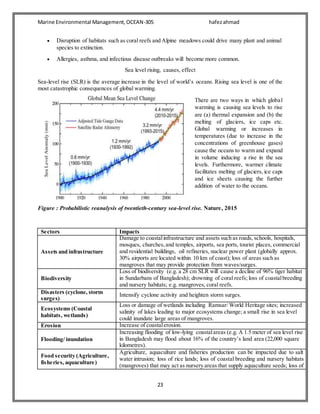
Sea level rising, causes, effect
Sea-level rise (SLR) is the average increase in the level of world’s oceans. Rising sea level is one of the
most catastrophic consequences of global warming.
There are two ways in which global
warming is causing sea levels to rise
are (a) thermal expansion and (b) the
melting of glaciers, ice caps etc.
Global warming or increases in
temperatures (due to increase in the
concentrations of greenhouse gases)
cause the oceans to warm and expand
in volume inducing a rise in the sea
levels. Furthermore, warmer climate
facilitates melting of glaciers, ice caps
and ice sheets causing the further
addition of water to the oceans.
Figure : Probabilistic reanalysis of twentieth-century sea-level rise. Nature, 2015
Sectors Impacts
Assets and infrastructure
Damage to coastalinfrastructure and assets such as roads, schools, hospitals,
mosques, churches,and temples, airports, sea ports, tourist places, commercial
and residential buildings, oil refineries, nuclear power plant (globally approx.
30% airports are located within 10 km of coast); loss of areas such as
mangroves that may provide protection from waves/surges.
Biodiversity
Loss of biodiversity (e.g. a 28 cm SLR will cause a decline of 96% tiger habitat
in Sundarbans of Bangladesh); drowning of coral reefs; loss of coastalbreeding
and nursery habitats; e.g. mangroves, coral reefs.
Disasters (cyclone, storm
surges)
Intensify cyclone activity and heighten storm surges.
Ecosystems (Coastal
habitats, wetlands)
Loss or damage of wetlands including Ramsar/ World Heritage sites; increased
salinity of lakes leading to major ecosystems change; a small rise in sea level
could inundate large areas of mangroves.
Erosion Increase of coastalerosion.
Flooding/ inundation
Increasing flooding of low-lying coastalareas (e.g. A 1.5 meter of sea level rise
in Bangladesh may flood about 16% of the country’s land area (22,000 square
kilometres).
Food security (Agriculture,
fisheries, aquaculture)
Agriculture, aquaculture and fisheries production can be impacted due to salt
water intrusion; loss of rice lands; loss of coastal breeding and nursery habitats
(mangroves) that may act as nursery areas that supply aquaculture seeds; loss of
Marine Environmental Management,OCEAN-305 hafezahmad
24
areas available for freshwater
aquaculture; reduce production of coastal and related fisheries.
Health security
Increase in cholera outbreak and hypertension (e.g. cholera bacterium, Vibrio
cholerae
survive longer in salinity range from 2.5 ppt to 30 ppt and need sodium ion
(Na+) for growth)) and increased breeding of salinity-tolerant mosquitoes.
Displacement and migration
Forced displacement/migration or climate refugees (e.g. 72-187 million people
will be displaced due to SLR & most of them are from South, Southeast, and
East Asia).
Salinisation
Agricultural land, freshwater aquifers,deltas and estuaries would be affected
due to saltwater intrusion.
Soil quality Decline in soil quality due to salinization.
Tourism Loss of tourism, recreation, and transportation functions.
Water security
Surface and groundwater quality would deteriorate due to salinisation or
increase of salinity
(EC) (e.g. chloride contamination of freshwater aquifers); SLR is likely to
reduce the thickness of the freshwater lens on atolls (coral reefs) of the Pacific
and Indian Ocean.
Impact of SLR
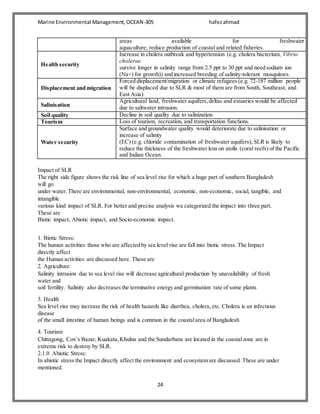
The right side figure shows the risk line of sea level rise for which a huge part of southern Bangladesh
will go
under water. There are environmental, non-environmental, economic, non-economic, social, tangible, and
intangible
various kind impact of SLR. For better and precise analysis we categorized the impact into three part.
These are
Biotic impact, Abiotic impact, and Socio-economic impact.
1. Biotic Stress:
The human activities those who are affected by sea level rise are fall into biotic stress. The Impact
directly affect
the Human activities are discussed here. These are
2. Agriculture:
Salinity intrusion due to sea level rise will decrease agricultural production by unavailability of fresh
water and
soil fertility. Salinity also decreases the terminative energy and germination rate of some plants
3. Health
Sea level rise may increase the risk of health hazards like diarrhea, cholera, etc. Cholera is an infectious
disease
of the small intestine of human beings and is common in the coastalarea of Bangladesh
4. Tourism
Chittagong, Cox’s Bazar, Kuakata,Khulna and the Sundarbans are located in the coastalzone are in
extreme risk to destroy by SLR.
2.1.0 Abiotic Stress:
In abiotic stress the Impact directly affect the environment and ecosystem are discussed. These are under
mentioned.
Marine Environmental Management,OCEAN-305 hafezahmad
25
2.2 Monsoon flooding
SLRs in the coast of Bangladesh are 14 cm, 32 cm and 88 cm for the year 2030, 2050 and 2100. In a
recent study, IWM (2006) predicted that flooding of coastal lands may increase by 21% by the year 2001
while it is 10.3% for the year 2050 with respect to ordinary flooding condition when approximately 50%
lands go under flood.
2.3 Reduction of Agriculture Land
According to the Intergovernmental Panel on Climate Change, Bangladesh is slated to lose the largest
amount of
cultivated land due to rising sea levels. A 1 meter rise in sea levels would inundate 20 percent of the
country’s
landmass. Reduction of agriculture land is a vast problem for the local people and they are suffering much
for
the cause.
2.4 Decline in Soil Quality
Due to sea level rise salinity intrusion causes decline in soil quality. The soil profile of the affected area is
totally
changing and this situation led to unproductive land. The soil profile is also changing which has a
devastating
effect on coastal areas.
2.5 Species Disappearing
It is predicted that sea level rise can cause to destroy the forest, land, fresh water resource,and living
environment of costal areas. As a result some species may extinct in the coastal zone.
2.6 Coastal Erosion
Islam et al. (1999) predicted that average recession of the eastern coastline of Bangladesh would be about
87 times the SLR. If that is true then the land loss is:
‱ 6.26 sq. km for SLR of 0.1 m
‱ 18.79 sq. km for SLR of 0.3 m
‱ 62.64 sq. km for SLR of 1.0 m
2.7 Water Logging
3.1.0 Socio-Economic Impact of Sea Level Rise. There are nineteen coastaldistricts in Bangladesh which
are on
high risky position in terms of socio economic vulnerability due to Sea level rise. According to BBS,
there are
35.1 million people are living in the coastal areas are Bangladesh which are counted as 28 percent of total
population size of the country.
3.2 Unemployment
Unemployment will be the crucial outcome of Sea level rise in the coastalareas of Bangladesh.
3.3 Infrastructure Destruction. Our most important tourist attraction cox’s bazaar,kuakata, st. martin,
Sundarbon will be adversely affected by the sea level rise. Near future tourist business will loose revenue
from these areas. The people those who are employed in tourist sector in the coastal zone will be in risk
on massive job lose.
3.4.2 Emergence of Climate Refugee
According to IPCC 1 meter rise in sea level will lead to go down most of the part of southern and western
Marine Environmental Management,OCEAN-305 hafezahmad
26
region
of Bangladesh under water. As a result 3 crore people from southern and western part of Bangladesh will
be
deadly affected.
3.4.3 High Cost of NaturalDisasters
There is a significant socio-economic cost of natural disaster caused by sea level rise. According to
weather dept.
of Bangladesh, during 1990 to 2004 every year 10 cyclone hits the coastalarea of Bangladesh. But in
2006 16
cyclone hits Bangladesh & in 2008 it stands to 20. after 2020 cyclone will hit more rapidly and the cost of
damage of life, asset,environment, plant, animal will be sky high.
3.4.5 Risk on Education System
Due to Sea level rise natural disaster i.e tsunami, cyclone, flood, tidal upsurge, water logging will be
frequent.
As a result educational institutions near to coastalarea get flooded or ruined and remain closed until
reconstruction So in upcoming time education system will be hampered magnificently in coastalreason.
Which will imply higher level of socio-economic cost.
3.4.6 High Economic Cost of Loosing Natural Resources. According to the prediction of WB (2000) by
2020 Sundarban will inundates 15% and by
2050 it will Inundates 40% and by 2100 whole sundarban will be lost due to sea level rise.
3.4.7 Diminution of Social Welfare
Sea level rise will cause to disrupt the basic needs of coastalpeople i.e. Food, Cloths, Housing, Health,
and
Education. Poor people will be more vulnerable and social safety net will be break down of the affected
areas.
Hence,the social welfare of the people will be trimmed down.
Causes of sea level rise
Human activities, such as burning coal and oil and cutting down tropical forests, have increased
atmospheric concentrations of heat-trapping gases and caused the planet to warm
1. Rising temperatures are warming ocean waters,which expand as the temperature increases. This
thermal expansion was the main driver of global sea level rise for 75 - 100 years after the start of
the Industrial Revolution, though its relative contribution has declined as the shrinking of land ice
has accelerated.
2. Land ice—glaciers, ice caps, and ice sheets—is shrinking at a faster rate in response to rising
temperatures,adding water to the world's oceans.
3. As the rate of ice loss has accelerated,its contribution to global sea level rise has increased from a
little more than half of the total increase from 1993 - 2008 to 75 - 80 percent of the total increase
between 2003 - 2007.
Air pollution , causes and effect on biota and human beings
Air pollution refers to the release of pollutants into the air that are detrimental to human health and the
planet as a whole. Air pollution occurs when harmful or excessive quantities of substances including
Marine Environmental Management,OCEAN-305 hafezahmad
27
gases,particulates, and biological molecules are introduced into Earth's atmosphere. It may cause
diseases,allergies and even death to humans.
Effects ofAir Pollution
 Air pollution causes irritation in the throat, nose, lungs and eyes. It causes breathing problems
and aggravates existing health conditions such as emphysema and asthma.
 Contaminated air reduces the body’s defenses and decreases the body’s capacity to fight other
infections in the respiratory system.
 Frequent exposure to polluted air increases the risk of cardiovascular disease. Breathing air that
is filled with fine particulate matter can induce hardening of the arteries,triggering cardiac
arrhythmia or even a heart attack.
 People who exercise outdoors are susceptible to the adverse effects of air pollution because it
involves deeper and faster breathing.
 Acid rain contains hydrogen ions, which can damage trees,crops, harm marine animals and
induce corrosion in metals.
 Smog causes harmful health effects in humans and animals. Studies have shown signs of black
lung disease in dolphins of due to high concentrations of carbon particles in the air.
 People afflicted with heart disease, children and older people are more sensitive to air pollution.
Causes ofair pollution : Air pollutants can either be the primary sources or the secondary sources. The
pollutants that are a direct result of various processes are referred to as primary pollutants. A few examples
of primary pollutants are the carbon-dioxide gas emitted from vehicle exhaust, and the sulfur dioxide
emitted from factories. Secondary pollutants are the ones which result from the intermingling and reactions
of the aforementioned primary pollutants. For instance, the smog created when the crackers are burst in
excess or when there is too much vehicle exhaust due to traffic is known to be as a secondary pollutant.
1. Burning of Fossil Fuels: Sulfur dioxide emitted from the combustion of fossil fuels like coal,
petroleum and other factory combustibles are one of the major cause of air pollution. Pollutants
emitted from vehicles further contribute to the degradation of the environment. Carbon Monoxide
produced by the incomplete combustion of fuel is another major pollutant along with the Nitrogen
Oxides, that are produced from both natural and man-made processes.
2. Agricultural Activities: Ammonia is a very common byproduct of the agriculture-related
activities and is one of the most hazardous gases in the atmosphere. The use of insecticides,
pesticides and fertilizers in agriculture also leads to the emission of harmful chemicals causing
pollution.
3. Exhaust from Factories and Industries: Manufacturing industries and petroleum refineries
release a large amount of carbon monoxide, hydrocarbons, organic compounds and chemicals
into the air thereby depleting the quality of air.
4. Mining Operations: During the process of mining, huge volumes of dust and other chemicals
are released into the air causing massive air pollution and leading to deteriorating health
conditions of mining workers and nearby residents.
Marine Environmental Management,OCEAN-305 hafezahmad
28
5. Indoor Air Pollution: Household cleaning products, painting supplies etc. emit toxic chemicals
in the air while causing air pollution.
6. Suspended Particulate Matter: Popular by its acronym SPM, it is another cause of air pollution.
While referring to the particles afloat in the air, the SPM is usually caused by dust, combustion
etc.
Effect on human : Air pollution can severely harm the health of people and animals, damage plants or
stop them from growing properly. Some of the major health issues caused by air pollution are:
 respiratory diseases (including asthma and changes in lung function)
 cardiovascular diseases
 adverse pregnancy outcomes (such as preterm birth)
 even death in some cases
Effects on Earth : The air pollution has a number of repercussions, mentioned as follows:
1. Global Warming: With increased temperatures worldwide, the resulting increase in sea levels and the
melting of ice from the colder regions and icebergs, or the loss of habitat have already signalled an
impending disaster if actions for preservation and normalization aren’t undertaken soon.
2. Acid Rain: Harmful gases like the nitrogen oxides and sulfur oxides released into the atmosphere during
the burning of fossil fuels combine with water droplets during rain forming acids and leading to acid rain.
Acid rain can cause great damage to living organisms, plants and monuments.
3. Eutrophication: It is a condition where a high amount of nitrogen present in pollutants gets accumulated
on the surface of a water body, leading to the deposition of green algae. Reducing the amount of sunlight
entering and the dissolved oxygen in the water,it really affects the aquatic life.
4. Effect on Wildlife: Toxic chemicals present in the air affect wildlife and force it to move to new places
and change habitats leading to an imbalance in the flora and fauna of a particular area.
5. Depletion ofOzone layer: Ozone exists in the Earth’s stratosphere and is responsible for protecting the
mankind from harmful ultraviolet (UV) rays. The Ozone layer is getting depleted due to the presence of
chlorofluorocarbon and hydro chlorofluorocarbons in the atmosphere resulting in an increased effect of
UV rays causing skin and eye diseases.
Several other methods to curb air pollution are listed as follows:
1. Using Public Mode ofTransportation: Encourage people to use more and more public modes
of transportation to reduce pollution. Also, try to make use of carpooling which is indeed a good
option to save energy and money.
2. Conserving Energy: Switch off fans and lights when you are going out. A large number of fossil
fuels are burnt to produce electricity. Switching off fans and lights while going out can reduce
the amount of fuel being used.
3. Understanding the Concept ofReduce, Reuse and Recycle: Do not throw away the items that
are no longer of any use but reuse them. For instance, use the old jars to store cereals or pulses.
Use items that are biodegradable and can be recycled.
Marine Environmental Management,OCEAN-305 hafezahmad
29
5. Emphasizing on Clean Energy Resources: Clean energy technologies like solar, wind and
geothermal energy are on high these days. Governments of various countries have been providing
grants to consumers who are interested in installing solar panels for their homes and offices.
6. Using Energy Efficient Devices: The CFL lights consume less electricity as compared to their
counterparts. They last longer, consume less electricity, lower the electricity bills and also help
you to reduce pollution by consuming less energy.
Marine Environmental Management,OCEAN-305 hafezahmad
30
Marine Environmental Management,OCEAN-305 hafezahmad
31

Marine environmental management 305b

  • 1.
    Marine Environmental Management,OCEAN-305hafezahmad 1 1: Pollution Pollution is defined as the presence of impurities or pollutant substances in sufficient concentration levels, causing harmful effects on human beings, animals, plant life or material resources when exposed for a sufficient duration of time, thus reducing the quality of life in the environment. The term 'pollution' describes the occurrence and inputs of wastes and the impact of these wastes on the environment. A Pollutant is a substance or energy introduced into the environment that has undesired effects,or adversely affects the usefulness of a resource. Pollutants include solid, liquid or gaseous substances present in greater than natural abundance, produce due to human activity, which have a determined effect on our environment. 2: types of pollution based on nature , characteristics ,source 7. Types of Pollution 1. Air Pollution 2. Water Pollution 3. Soil/Land Pollution 4. Noise Pollution 5. Radioactive Pollution 6. Environmental Pollution. Types of Sources: 1. Point source – Point sources of pollution are those for which a particular point of entry of pollution into the environment can be identified. Single, identifiable source e.g. smokestack, drainpipe etc. 2. Non-point source - dispersed sources are harder to identify and result from broad-scale activities that cannot be as readily identified as originating from a single source,e.g. runoff from pesticides, fertilizers Pollution causing industries The main industrial areas of Bangladesh are at Dhaka, Chittagong, Khulna, and Bogra districts. The mostly contributing industries for water pollution are pulp and paper, pharmaceuticals, metal processing, food industry, fertilizer, pesticides, dyeing and painting, textile, tannery etc. 1. Textile mills: PCB , CFC 2. Pharmaceutical: 3. Tannery mills:
  • 2.
    Marine Environmental Management,OCEAN-305hafezahmad 2 4. Ship breaking industries Pollutants from discharged from pollution causing industries SI. Toxic Material. Effect on Human 1. Nitrogen oxides: It affects the lungs. 2. SO2.: Causes chest disease,headache,vomiting. 3. Hydrogen sulphide (H2S): It causes nausea,irritate eyes and affect throat. 4. Carbon monoxide (CO): Oxygen carrying capacity of blood reduces. 5. Hydrogen cyanides: It decrease the ability of nerve cells, causes dry throat, indistinct vision, headache etc. Other Persistent organic pollutants (POPs),polycyclic aromatic hydrocarbons (PAHs.Polyvinyl Chloride (PVC),dioxins, Polychlorinated Biphenyl Compounds (PCBs) Water pollution is any chemical, biological or physical change in water quality that is harmful to living organisms or makes water unusable for desired uses. Water pollution: according to Coulson and Forbes “the addition of any organic, inorganic, biological or radiological substances to water which changes its natural qualities so that the riparian proprietor does not get the natural water of stream transmitted to him”. According to Baumann “water pollution is caused due to harmful solids, liquids or gases which are non- permissible, undesirable, unpleasant and objectionable” Types of water pollution 1. Surface water pollution - pollution of lakes, rivers and oceans 2. Groundwater pollution - pollution of aquifers below soil. 3. Microbial pollution – pollution by bacteria,viruses, protozoa and parasitic worms. 4. Oxygen depletion pollution – pollution by biodegradable organics. 5. Nutrient pollution – pollution by plant nutrients (nitrates, phosphates) 6. Suspended matter pollution – pollution by soil, silt 7. Chemical pollution - pollution by pesticides, fertilizers, industrial solvents, oil 8. Thermal pollution- pollution by warm water,waste heat. Causes of water pollution: 1. Marine dumping 2. Industrial waste 3. Sewage from households 4. Oil pollution 5. Plastic 6. Agricultural waste 7. Organic and inorganic pollutant Why Biodegradable water pollution is getting serious problems ? 1. Over populated country 2. No rules and regulations 3. No treatment plant 4. Extreme dumping
  • 3.
    Marine Environmental Management,OCEAN-305hafezahmad 3 Marine pollution Marine pollution refers to the contamination or presence of pollutants in oceans and seas. Marine pollution includes a range of threats including from land based sources,oil spills, untreated sewage,heavy siltation, eutrophication (nutrient enrichment), invasive species, persistent organic pollutants (POP’s), heavy metals from mine tailings and other sources, acidification, radioactive substances,marine litter, overfishing and destruction of coastal and marine habitats. Marine Pollution (UN definition) –“The introduction by man, directly, or indirectly, of substances or energy to the marine environment resulting in deleterious effects such as:hazards to human health, hindrance to marine activities, impairment of the quality of seawater for various uses and reduction of amenities. Types of Marine Pollution 1. Sedimentation 2. Agricultural runoff (herbicides, pesticides and nutrients) 3. Energy (thermal and light) 4. Sewage (FaecalColiform and nutrients) 5. Solid Waste 6. Chemicals, Metals and Radioactive Substances 7. Oil 8. Biological Some important sea based sources of marine pollution are given below-  Crude Petroleum- (PAHs)  Antifouling Agents- (TBT)  Volatile Organic Compound (VOC)- PCBs,DDTs,Dioxins, Furans  Oil Spill, Bilge from Ship, Boats  Dumping of Wastes  Introduction of Alien species through ballast water etc. Present Status of Marine Pollution Rivers of Bangladesh are heavily contaminated with untreated municipal sewage, industrial effluent, agricultural run-off and sediments. One of the most serious impacts is the decline in estuarine and coastal water quality caused by rising levels of nutrients from land-based sources. Expansion of intensive agricultural practices has resulted in increasing agrochemical pollution, particularly in developing countries of the region. Impacts on water quality and benthos Impacts on Benthos 1. Unable to move 2. Suffocation 3. Migration 4.
  • 4.
    Marine Environmental Management,OCEAN-305hafezahmad 4 Major Marine Pollutants Worldwide ‱ 10 billion tonnes of ballast water with invasives ‱ Est. 10,000 million gallons of sewage annually ‱ 3.25 million metric tonnes of oil annually ‱ Millions of tonnes of Solid waste Major Marine Pollutants - Metals ‱ Introduced dangerous metals include mercury, lead, and copper ‱ Heavy Metals are a great concern because they enter the food chain ‱ Fuel combustion, electric utilities, steeland iron manufacturing, fuel oils, fuel additives and incineration of urban refuse are the major sources of oceanic and atmospheric contamination by heavy metals ‱ Copper is dangerous to marine organisms and has been used in marine anti-fouling paints ‱ Mercury and lead poisoning cause brain damage and behavioral disturbances in children ‱ Contaminated land runoff, rain of pollutants from the air, and fallout from shipwrecks pollute the ocean with dangerous metals ‱ Human activities release 5 times as much mercury and 17 times as much lead as is derived from natural sources. Sources ofPollution From Land ‱ 80% of non-biological marine pollution comes from land based activities ‱ Most obvious inputs via pipes discharging directly into marine waters(sewage, industrial, chemical and food processing wastes) ‱ Riverine flows into the sea carry pollutants from the entire catchment area. From Air ‱ Global atmospheric inputs to the sea from air discharges Maritime ‱ Oily discharges from ballast water and bilge water) during routine ship operations and illegal dumping of solid waste ‱ Designated dumping grounds at sea (dredged spoil, old munitions, sewage sludge, fly ash,oil based drilling muds) ‱ Accidental spills from Ships carrying hazardous substances,oil, gas etc. Impacts ofMarine Pollution Generally marine pollution affects ecosystem health,public health, recreational water quality and economic viability in the following ways: ‱ Mechanical ‱ Eutrophication ‱ Saphrogenic ‱ Toxicity ‱ Mutagenic and Carcinogenic Cost ofMarine Pollution ‱ 3.25 million metric tons of oil wasted vs. 3.4 million tons used by Jamaica annually ‱ 100,000 mammal and 2 million bird deaths annually ‱ Reduction of GDP by decreasing fishery resource (11.9k tonnes – 7.7k landed 1960-97) and decreased tourism earnings ‱ Loss of bio-diversity and potential life saving medicines (for AIDS &Cancer)
  • 5.
    Marine Environmental Management,OCEAN-305hafezahmad 5 Major problems of World Ocean GESAMP (1991) summarized the major problems of the world ocean as  nutrient contamination;  microbial contamination of seafood;  disposal of debris (particularly plastic debris);  trace contaminants such as lead, cadmium, and mercury when discharged in high concentrations;  occurrence of synthetic organic compounds in sediments and in predators at the top of the marine food chain  oil in marine systems, mainly the global impact of tar bails on beaches and the effects of spills in local sheltered areas.  They added that radioactive contamination is a public concern. Solutions to Pollution Two main methods – Correction – costly and time intensive – Prevention – requires attitude changes Coastal Scientists believe that prevention is better than cure since the effects of marine pollution may be irreversible and we may therefore be creating everlasting damage to the marine ecosystem. “An ounce of prevention is worth a pound of cure” Heavy metal refers to any metallic chemical element that has a relatively high density and is toxic or poisonous at low concentrations. Examples of heavy metals include mercury (Hg), cadmium (Cd), arsenic (As),chromium (Cr), thallium (Tl), and lead (Pb).Heavy metals are known as persistent, bio-accumulative and toxic chemicals. Sources of heavy metal 1. Natural sources a. Rock weathering b. Volcanic activity c. Atmosphere 2. Anthropogenic sources a. Domestic waste waters and urban run off: Cr, Zn , Mn ,As b. Industrial waste : Cu, Pb, Zn , Hg c. Agricultural activities : pesticide , fertilizer ,herbicide , fungicide d. Mining activities Heavy metals are serious pollutants because they are stable compounds, not readily removed by oxidation, precipitation or by any other natural process. Heavy metals have seasonal variation during rainy and dry season in the coastal area of Chittagong. There are some studies and reports of marine fish analysis from the Bay of Bengal for As, Cr, Hg, Se, Zn along with K, Ca, Mg, Fe, Ni, Cu, Pb, Sr and Rb. Heavy Metals Entering Oceans
  • 6.
    Marine Environmental Management,OCEAN-305hafezahmad 6 Heavy metal accumulation in food chain: Heavy metals are dangerous because they tend to bioaccumulate. Bioaccumulation means an increase in the concentration of a chemical in a biological organism over time, compared to the chemical's concentration in the environment. Compounds accumulate in living things any time they are taken up and stored faster than they are broken down (metabolized) or excreted. Accumulation pattern in marine food chain : Biomagnification of heavy metals is a process where they are passed from one trophic level to another and exhibit increasing concentrations in organisms at higher trophic levels. It involves uptake of heavy metal with ingested food. The food ingested, assimilated and excreted but heavy metal accumulates in the tissue of the organisms. Marine organisms absorb heavy metal from the abiotic environment by a number of mechanisms. Fish can absorb through their respiratory surfaces .another important mode of adsorption of heavy metal on body surface by diffusion. Intake in phytoplankton on cell wall. Another mechanism of uptake is digestive system through ingested food in fish , mollusk , crustacean ,filter feeder and detritus feeder. Organochlorine pesticides like DDT transferred in the aquatic environment through weathering or run off from the terrestrialerosion or direct use in the agricultural field and the concentrate then become 0.3 ppb in water. Then, when the primary producers plankton consume it through water as it is not degraded the concentration increases up to 30 ppb in tissue level. After that when the primary consumer like small fishes accumulates plankton then the concentration increases up to 0.3 ppm in the fatty tissue and absorbed there. Further again, when secondary consumer, large fishes consume small fishes, they also accumulate DDT when absorbed in the fatty tissues of the small fishes. The DDT concentration of large fishes increase up to 3 ppm. And at last when the top consumer like birds, prey and human beings consume large fishes then the concentration up to 30 ppm.So, we can see that, the concentration of pesticides in the aquatic environment was that 0.3 ppb increase 30 ppm in the top tropic level. 8% 68% 20% 4% PERCENT copper(8%) lead(68%) mercury (20%) natural
  • 7.
    Marine Environmental Management,OCEAN-305hafezahmad 7 Oil Spill (Oil Pollution) Oil Spill (Oil Pollution/oil slick) An oil spill is the unintentional release of a liquid petroleum hydrocarbon into the environment (especially the marine ecosystem) due to human activity. The term often refers to marine oil spills, where oil is released into the ocean or coastal waters. Oil spills include releases of crude oil from tankers, offshore platforms, drilling rigs and wells, as well as large ships such as bunker fuel, or the spill of any oily substance. Spills may take months or even years to clean up pollution. Sources of oil in marine environment (UNEP1997) 1. Accidental collision of Tankers(7%) 2. Shipping (15%) 3. Shipping accidents 4. Industrial operations (62%) 5. Offshore productions (1%) 6. Refineries (1%) 7. Natural sources (10%) 1. Point sources:  Spills (vessels, platforms, pipelines, facilities)  Rivers  Produced water  Coastal refinery wastewater 2. Diffuse sources:  Natural seeps  Atmosphere on open seas  Coastal urban runoff  Marine transport operations  Recreational boating Oil pollution impacts: Oil pollution has serious damaging impact on mangrove ecosystem and its coastaland marine resources. Oil spills cause mortality to mangroves trees,and damage to nursery ground of marine fish and crustaceans in swamps. 32% 45% 8% 15% Marine Oil Pollution oil industry(32%) marine transport(45%) natural(8%) landbased (15%)
  • 8.
    Marine Environmental Management,OCEAN-305hafezahmad 8 Fate and movement of oil (slick) in marine environment Spilled oil is transported, and its composition and character altered,by a variety of physical, chemical, and biological processes. There are three major modes of transport for spilled oil or petroleum products discussed in the following 1: surface transport of slicks, which is important because the shape,thickness, and location of a slick affect the ability to effectively apply dispersants. 2: vertical transport, which is responsible for the initial dilution of dispersed oil. 3: horizontal subsurface transport, which is responsible for the ultimate dilution of dispersed oil Oil when spilled at sea will normally break up under the influence of wind, waves and currents and be dissipated or scattered into the marine environment over time. The dissipation of oil depends upon nature of oil. There about eight prominent processes 1. Spreading : Fay (1969) suggested that spreading is best described in three phases—inertial, viscous, and surface tension. The inertial phase is dominated by gravity forces, the viscous phase by gravity and viscosity forces,and the surface tension phase by surface tension spreading
  • 9.
    Marine Environmental Management,OCEAN-305hafezahmad 9 2. Evaporation : In many oil spills, evaporation is the most important process in terms of mass balance. Within a few days following a spill, light crude oils can lose up to 75 percent of their initial volume 3. Dispersion: Dispersion is a mixing process caused by the turbulence field in the ocean. It is the process that would cause a liter of instantaneously released dyed water to expand over time and eventually dissipate in the ocean. 4. Emulsification: oil remains on the surface. 5. Dissolution : Dissolution is the chemical stabilization of oil components in water. Dissolution accounts for only a small portion of oil loss, 6. Oxidation: Oxidationof crude oil ismediatedbytwoprocesses,photooxidationandmicrobial oxidation. 7. Sinking and sedimentation : Sinking is the mechanism by which oil masses that are denser than the receiving water are transported to the bottom. Sedimentation is the sorption of oil to suspended sediments that eventually settle out of the water column and accumulate on the seafloor. 8. Biodegradation Then Sea water interacts with oil and undergoes compositional and chemical changes. Then forms a variety of toxic and nontoxic highly persistent viscous materials. Sometimes a thick layer is formed. Oil droplet ultimately sinks to the bottom incorporating silt and suspended particles into it.the residual oil spreads and forms thin layer. Response to oil spill
  • 10.
    Marine Environmental Management,OCEAN-305hafezahmad 10 Several options are available to respond to oil at sea and can be considered in three broad strategies; containment and recovery, in-situ burning and dispersant application. Response plansdependheavilyonsite-specificmodelingpredictionsof the behaviorof spillsof various sizesandtypes,undera varietyof environmentalconditions.  Tactical (emergency) spill response. In the event of an accidental spill, a composite model is often used to predict where the spill will go and how it will weather. This kind of information plays a key role in determining protection priorities.  Strategic (contingency) planning. The models are run in a stochastic manner (multiple- runs) to develop maps of the probability a spill would impact a region given that a spill occurs.  Post-Spill assessment. The models are used after a spill to fill observation gaps and estimate damage. Another use is to determine the source of unknown oil. In this model, one knows where the spill ended up but needs to determine the most likely origin to identify the responsible party. Some common methods : 1. Mechanical containment (made up of plastics): use of containment barrier (boom), buble and current barrier Floating oil can be contained in them . 2. bioremediation :Bioremediation: use of microorganisms or biological agents to break down or remove oil; such as the bacteria Alcanivorax or Methylocella Silvestris. 3. burning of the oil on the site where the spillage has occurred. 4. using fertilizers to disperse the oil spillage in the water. Even though the method sounds and looks unconventional, it is one of the highly recommended oil spill cleanup methods. The fertilizers help to hasten the growth of micro-organisms which help to diffuse the components of the oil spilt in the water. 5. Mechanical recovery : Use of weirs, suctions devices or by lifting surfaces .
  • 11.
    Marine Environmental Management,OCEAN-305hafezahmad 11 An agrochemical is any substance used to help manage an agricultural ecosystem,or the community of organisms in a farming area. Agrochemicals include: (1) fertilizers, (2) liming and acidifying agents,(3) soil conditioners, (4) pesticides, and (5) chemicals used in animal husbandry, such as antibiotics and hormones. 4: Biomagnification of hg in marine environment 5: environmental modelling , basic techniques and tools Environmental modelling is the creation and use of mathematical models of the environment. Environmental modelling involves the application of multidisciplinary knowledge to explain, explore and predict the Earth’s response to environmental change, both natural and human-induced. There are a number of different kinds of model, including:  Empirical: Relying on observed relationships in experimental data.  Mechanistic: Including the underlying mechanisms and processes between the variables.  Deterministic: Changes in model outputs are due to changes in model components,meaning that repeated tests under constant conditions will produce consistent results.  Probabilistic: Utilizing the entire range of input data to develop a probability distribution of model output rather than a single point value.  Dynamic: Predict the way a systemmay change over time or space.  Static: Predict the way a systemmay change as the value of an independent variable changes. The model life-cycle may include a number of stages. 1. Identification : problems, parameterization and specify the applications 2. Development: concept and mathematical representation. 3. Evaluation : peer review and testing ,correcting and comparison with outputs 4. Application: run the model and analyze the outputs. Tools and techniques used in environment modelling 6: prospect and constrains of biosafety in Bangladesh, bioassay and biosignature , bioactive compound , bioindicator of pollution
  • 12.
    Marine Environmental Management,OCEAN-305hafezahmad 12 Major agrochemicals(pesticide, herbicide, fertilizer) Environmental Fate of agro chemicals pollutants Prospects and constraints of biosafety In recent years,rainfall induced ‘urban storm water-logging’ (USWL) events in Chittagong city becomes an unavoidable experience during wet season for the city dwellers. Main causes of waterlog 1. Undeveloped planning 2. Blocking canal 3. Unplanned drainage system 4. Low lying area 5. Poor discharge capacity of existing drainage pipes and Khals. Encroachment of the natural drainage channels. The absence of a cohesive urban development policy to provide clear directions for the basic issues of urban development. A lack of co-ordination amongst sectoral development. Inadequate solid waste disposal system. Steps of get rid of water logging 1. Build and maintenance of drainage system 2. Sewage treatment process Effluent Treatment Plant or ETP is one type of waste water treatment method which is particularly designed to purify industrial waste water for its reuse and it’s aim is to release safe water to environment from the harmful effect caused by the effluent. Environmental Fate ofagro chemicals pollutants Non_biological transformation 1.photolysis 2.hydrolysis 3.oxidation transfer/transport 1.vaporization 2.adsorption 3. solubilization biological transformation 1.biotransformation 2. biodegradation transport 1.bioaccumulation 2. biomagnification
  • 13.
    Marine Environmental Management,OCEAN-305hafezahmad 13 The ETP Plant works at various levels and involves various physical, chemical, biological and membrane processes to treat waste water from different industrial sectors like chemicals, drugs, pharmaceutical, refineries, dairy, ready mix plants & textile etc. Biosafety’ means the mechanism developed through law, policy and procedures to ensure the environmentally sound application of biotechnology. Bioassay : A bioassay is a procedure for determining the concentration, purity, and/or biological activity of a substance (e.g.,vitamin, hormone, plant growth factor, antibiotic, enzyme) by measuring its effect on an organism, tissue, cell, enzyme or receptor preparation compared to a standard preparation. Bioassay is used to detect biological hazards or give a quality assessment of a mixture. Bioassay is often used to monitor water quality and also sewage discharge and its impact on surrounding. It is also used to assess the environmental impact and safety of new technologies and facilities. Biosignature: A biosignature (sometimes called chemical fossil or molecular fossil) is any substance – such as an element, isotope, molecule, or phenomenon – that provides scientific evidence of past or present life. Constrains and prospects of biosafety protocol in Bangladesh Constrains of biosafety protocol
  • 14.
    Marine Environmental Management,OCEAN-305hafezahmad 14 1. Absence of standards 2. Absence of well managed infrastructure 3. Lack f adequate laboratories 4. Insufficient trained man power 5. No management of genetically modified organisms 6. No perfect Cartagena Protocoland the national biosafety regulations. Prospects of biosafety protocol 1. Safety food 2. Healthy environment 3. Environmental management: the process of allocating natural and artificial resources so as to make optimum use of the environment in satisfying basic human needs at the minimum and more if possible on a sustainable basis.(jolly , 1978) Environmental management tools: i. environmental management systems ii. environmental auditing iii. environmental labeling iv. life cycle assessment v. environmental indicators vi. environmental policies vii. eco-balances viii. environmental reporting ix. environmental charters Tool and techniques uses in environment monitoring Environmental monitoring describes the processes and activities that need to take place to characterize and monitor the quality of the environment. Environmental monitoring is used in the preparation of environmental impact assessments,as wellas in many circumstances in which human activities carry a risk of harmful effects on the natural environment. All monitoring strategies and programmes have reasons and justifications which are often designed to establish the current statusof an environment or to establish trends in environmental parameters. Monitoring is the regular gathering and analysis of information needed for your day-to-day management, to inform your decision-making and to evaluate your progress in achieving your planned outcomes over a given period. Tools : 1. ph meter 2. Techniques of environmental monitoring 1. SWOT : strength , weakness , opportunities and threats
  • 15.
    Marine Environmental Management,OCEAN-305hafezahmad 15 2. PEST : political , economical , social and 3. QUEST 4. Industry analysis 5. Competitor analysis LD50 and LC50 LC stands for "Lethal Concentration". LC values usually refer to the concentration of a chemical in air but in environmental studies it can also mean the concentration of a chemical in water. The unit of measure for the LC50 is usually expressed as part per million (ppm) LD stands for "Lethal Dose". LD50 is the amount of a material, given all at once, which causes the death of 50% (one half) of a group of test animals. The LD50 is one way to measure the short-term poisoning potential (acute toxicity) of a material. Response dose curve in evaluating the effect of toxic elements In a typical dose-response graph, the dose is plotted against the number or proportion of animals exhibiting a particular response. For a long time, death was the response of choice for assessing short term (acute) toxicity, and the toxicology literature contains many citations listing such lethal doses of assorted agents for a variety of laboratory animals. In most cases, the dose that is lethal to 50% of the exposed animals (LD50) is the value that is published. Although LD50 values are widespread in the scientific literature and still used and useful, concerns over animal welfare and the development of more technically sophisticated tools have led to other approaches for assessing toxicity. On the other hand, dose-effect comparisons can be depicted in graphs, charts, or tables which plot dose against the degree of response (i.e., the severity of the effects). Thus, a low dose may cause no effects, a higher dose, limited effects, a still higher dose, serious outcomes, and, at a high enough dose, death.
  • 16.
    Marine Environmental Management,OCEAN-305hafezahmad 16 Ballast water : Ballast water is water carried in ships’ ballast tanks to improve stability, balance and trim. It is taken up or discharged when cargo is unloaded or loaded, or when a ship needs extra stability in foul weather. When ships take on ballast water, plants and animals that live in the ocean are also picked up. Discharging this ballast water releases these organisms into new areas where they can become marine pests. Ballast water taken into a tank from one body of water and discharged in another body of water can introduce invasive species of aquatic life. The discharge of water from ballast tanks has been responsible for the introduction of species that cause environmental and economic damage Eutrophication: Eutrophication is the enrichment of an ecosystem with chemical nutrients, typically compounds containing nitrogen, phosphorus, or both. Main cause of eutrophication is the large input of nutrient to water body and the main effect is the imbalance in the food web that results in high levels of phytoplankton biomass . this can lead to algal blooms. Main sources of nutrient input 1. Run off 2. Erosion and leaching from fertilized agricultural areas 3. Sewage from cities and industrial wastewater 4. Atmospheric deposition of nitrogen 5. Other point and non point sources. Main consequences of eutrophication 1. Depletion of oxygen 2. Originating sulphur 3. Excess growth of microalgae , phytoplankton and cyanobacteria and algal bloom. 4. Decrease in fish , shellfish and invertebrate etc. Effects of eutrophication
  • 17.
    Marine Environmental Management,OCEAN-305hafezahmad 17 An algal bloom is a rapid increase or accumulation in the population of algae in freshwater or marine water systems,and is recognized by the discoloration in the water from their pigments. Algal bloom that causes negative impacts to aquatic organisms via production of natural toxins, mechanical damage to aquatic organism. HABs are often associated with large-scale marine mortality events and have been associated with various types of shellfish poisonings and also fin fishes and other aquatic organisms. Bioindicator of pollution: Bioindicator are the organisms that indicate or monitor the health of the environment .A good bioindicator will indicate the presence of pollutant and also attempt to provide additional information about the amount and intensity of the exposure. So benthos are good bioindicator because They are very sensitive to pollution. Benthos can be monitored for changes (morphological , physiological or behavioral that may indicate a problem within their ecosystem. 3. Abundance, biodiversity depends on substratum and water quality. 4. Act as scavenger. 5. Role of filter feeder and deposit feeder. 1: Use of Environmental Technologies and Methods. Environmental technologies and methods such as Geographic Information Systems (GIS), remote sensing and environmental impact assessment might be used for integrated policy formulation, decision-making, evaluation and monitoring of environment. 2: Development of Environmental Database. A comprehensive environmental database may be made and the environmental planners might have the access for environmental up-gradation, planning and management the database is to be updated regularly. 3: Environmental Education and Awareness. Ecological impacts decreaseofaquatic population food chain and food web break down trophic level impactsrecrationalimpacts human health imapcts Economic impacts
  • 18.
    Marine Environmental Management,OCEAN-305hafezahmad 18 Formal and informal methods of education might be adopted through local media, seminars, celebrations, workshops, walks and student competitions to aware the people regarding the process of environmental degradation. 4: Industrial and Solid Waste Management. The government might take appropriate measures to monitor emission limits and Market Based Incentives (MBI) for reducing pollution control. The industries might be given both technical and financial support for introducing mitigation measures, promoting green technologies, using less pollution technologies and recycling the waste. 5: Enforcement of Rules and Regulation. Environmental Conservation Rules of 1997, traffic rules and other relevant environmental laws might be enforced further to punish the violation of the emission limits. 6: Urban Transport Management. Government must strengthen vehicle emission standards, complete the emission inventory and conduct an investigation on the emission control measures. Auto-rickshaw must be restricted in Dhaka city. Government must replace old vehicles, two-stroke engine vehicles, improve traffic conditions and promote an equivalent and efficient alternative public transportation services to improve urban transport management. 7: Reduce Sulfur in Diesel. Government must take necessarystepstoremove sulfur content from diesel through hydro-desulphurization (HDS) process. The government must also enforce the vehicle manufacturers to install catalytic converters in every vehicle to reduce the vehicular emissions. Sewage pollution and management Sludge: Sludge means any solid, semi-solid, or liquid waste generated from a municipal, commercial, or industrial wastewater treatment plant, water supply treatment plant, or air pollution control facility exclusive of the treated effluent from a wastewater treatment plant. Sewage: Sewage is the term used for wastewater that often contains faeces,urine and laundry waste. Sewage (or domestic wastewater or municipal wastewater) is a type of wastewater that is produced from a community of people. Sewage is generated by residential, institutional, commercial and industrial establishments. It includes household waste water from toilets, baths, showers,kitchens, sinks and so forth that is disposed off via sewers. In many areas,sewage also includes liquid waste from industry and commerce. Sewage is mainly classified in two groups: 1) Domestic Sewage. 2) Industrial Sewage. 1. It is composed of human waste and waste water resulting from personal washing, institutions, and other waste products of normal living. It contain low amount of solid usually being 99% of water. It contains millions of bacteria per milliliter which may cause cholera, dysentery, and typhoid fever. It contains numbers of synthetic detergent, resistant to biodegradation. 2. Industrial sewage:These are wastes that result from an industrial process or the production or manufacture of goods. Their flows and strength are usually more varied, intense, and concentrated than those of sanitary sewage. It contain both organic and inorganic compound. It contain high amount of solid content.
  • 19.
    Marine Environmental Management,OCEAN-305hafezahmad 19 Composition of sewage water 1. Organic matter 2. Nutrients (Nitrogen, Phosphorus, Potassium) 3. inorganic matter (dissolved minerals) 4. Toxic chemicals (heavy metal and pesticides) 5. Pathogens Sewage contains human feces, and therefore often contains pathogens of one of the four types  Bacteria (for example Salmonella, Shigella, Vibrio cholerae),  Viruses (for example hepatitis A, rotavirus)  Protozoa (for example Entamoeba histolytica) and  Parasites such as helminths and their eggs (e.g. ascaris (roundworm) Pollution caused by sewage water is one of the major problems in cities the world over. Sewage water is drained off into rivers without treatment. Careless disposal of sewage water leads to creation of a chain of problems like spreading of diseases,eutrophication, increase in Biological Oxygen Demand (BOD) Effects on Health Pathogens present in sewage water are responsible for spreading different kinds diseases. Stagnant water fosters the growth of mosquitoes, which in turn causes diseases like malaria. Another disease which originates from contaminated water is typhoid. Sewage water may also contain protozoans like Cryptosporium and Giardia. These pathogens pose a great risk to human health. Therefore,polluted water ac oxins released in rivers through sewage water are consumed by fish and other aquatic organisms; thus, the possibility of toxins entering the food chain increases manifold. It is observed that coral reefs get affected by sewage pollution the world over. The sewage water dumped in oceans can affect the coral reefs to a great extent. The toxins present in polluted water inhibit the growth of corals.ts as a host to severalpathogenic microbes. Removal of contaminants is the main objective of treatment of sewage water. Before the actualtreatment of water,effluents are pretreated. ‱ The process of pre-treatment helps in the separation of oils, greases,gravel and sand from polluted water. This process is carried out by filtration of sewage water. ‱ Biological wastes dissolved in water are treated with microbes. It helps in converting wastes into a solid mass which can be easily separated later on.
  • 20.
    Marine Environmental Management,OCEAN-305hafezahmad 20 ‱ Once the biological treatment is over, partially-pure effluents are treated with chemical disinfectants. The water treated in treatment plants can be used in golf courses,for watering lawns and also in agriculture for irrigation. ‱ Sewage treatment plants generate clear and clean water. Some of the treatment plants dispose the wastes into oceans. This is one form of pollution and it should prove to be harmful for the environment. Sewage treatment SEWAGE TREATMENT:The treatment of wastewater is divided into three phases: 1. Pre-treatment. 2. Primary treatment. 3. Secondary treatment 1. Pre-treatment large solids (i.e. those with a diameter of more than 2cm) and grit (heavy solids) are removed by screening. These are disposed of in landfills. 2. Primary treatment the water is left to stand so that solids can sink to the bottom and oil and grease can rise to the surface. The solids are scraped off the bottom and the scum is washed off with water jets. These two substances are combined to form sludge. 3. Secondary treatment  the sludge is further treated in 'sludge digesters': large heated tanks in which its chemical decomposition is catalyzed by microorganisms. The sludge is largely converted to biogas which is used to generate electricity for the plant. The liquid is treated by bacteria which break down the organic matter remaining in solution.it is then sent to oxidation ponds where heterotrophic bacteria continue the breakdown of the organics and solar uv light destroys the harmful bacteria.
  • 21.
    Marine Environmental Management,OCEAN-305hafezahmad 21 Nature of sewage 1: black 2: rich in nutrient 3: high turbid 4: very low DO and very high BOD 5: very low transparent Greenhouse gas, sources , effect and causes The greenhouse effect is a natural process that warms the Earth's surface. When the Sun's energy reaches the Earth's atmosphere,some of it is reflected back to space and the rest is absorbed and re-radiated by greenhouse gases. A greenhouse gas is a gas that absorbs and emits radiant energy within the thermal infrared range. Increasing greenhouse gas emissions cause the greenhouse effect. The primary greenhouse gases in Earth's atmosphere are water vapor, carbon dioxide, methane, nitrous oxide and ozone.
  • 22.
    Marine Environmental Management,OCEAN-305hafezahmad 22 Sources of greenhouse gas emissions are: fossil fuel use, deforestation, intensive livestock farming, use of synthetic fertilizers and industrial processes. The other is through natural processes like animal and plant respiration. Major Greenhouse gases & their sources 1: H2O (water vapor) – evaporation, plant respiration. 2: CO2 (Carbon dioxide)-fossil fuels, volcanic eruptions 3: CH4 (Methane) -animal waste,fossil fuels, landfills, sewage,wetlands 4: N2O (Nitrous Oxide) – deforestation, fossil fuels, microbe activities (in soil) 5 : CFCs (Chlorofluorocarbons)-aerosols, propellants, solvents, refrigerants Causes of the Greenhouse Effect 1. Burning ofFossil Fuels:Fossil fuels like coal, oil and natural gas have become an integral part of our life. They are used on large basis to produce electricity and for transportation. When they are burnt, the carbon stored inside them is released which combines with oxygen in the air to create carbon dioxide. 2. Deforestation. Large scale development has resulted in cutting down of trees and forests which has forced people to look for alternate places for living. When the wood is burnt, the stored carbon in converted back into carbon dioxide. 3. Increase in Population. New manufacturing hubs have come up cities and towns that release some harmful gases into the atmosphere which increases the greenhouse effect. Also, more people means more usage of fossil fuels which in turn has aggravated the problem. 4. Farming: Nitrous oxide is one the greenhouse gas that is used in fertilizer and contributes to greenhouse effect which in turn leads to global warming. 5. Industrial Waste and Landfills: Industries which are involved in cement production, fertilizers, coal mining activities, oil extraction produce harmful greenhouse gases. Also, landfills filled with garbage produce carbon dioxide and methane gas contributing significantly to greenhouse effect. Global warming , effect ,causes a gradual increase in the overall temperature of the earth's atmosphere generally attributed to the greenhouse effect caused by increased levels of carbon dioxide, CFCs, and other pollutants. Effect of global warming  Melting glaciers, early snowmelt, and severe droughts will cause more dramatic water shortages and increase the risk of wildfires in the American West.  Rising sea levels will lead to coastalflooding  Forests, farms,and cities will face troublesome new pests, heat waves,heavy downpours, and increased flooding. All those factors will damage or destroy agriculture and fisheries.
  • 23.
    Marine Environmental Management,OCEAN-305hafezahmad 23  Disruption of habitats such as coral reefs and Alpine meadows could drive many plant and animal species to extinction.  Allergies, asthma, and infectious disease outbreaks will become more common. Sea level rising, causes, effect Sea-level rise (SLR) is the average increase in the level of world’s oceans. Rising sea level is one of the most catastrophic consequences of global warming. There are two ways in which global warming is causing sea levels to rise are (a) thermal expansion and (b) the melting of glaciers, ice caps etc. Global warming or increases in temperatures (due to increase in the concentrations of greenhouse gases) cause the oceans to warm and expand in volume inducing a rise in the sea levels. Furthermore, warmer climate facilitates melting of glaciers, ice caps and ice sheets causing the further addition of water to the oceans. Figure : Probabilistic reanalysis of twentieth-century sea-level rise. Nature, 2015 Sectors Impacts Assets and infrastructure Damage to coastalinfrastructure and assets such as roads, schools, hospitals, mosques, churches,and temples, airports, sea ports, tourist places, commercial and residential buildings, oil refineries, nuclear power plant (globally approx. 30% airports are located within 10 km of coast); loss of areas such as mangroves that may provide protection from waves/surges. Biodiversity Loss of biodiversity (e.g. a 28 cm SLR will cause a decline of 96% tiger habitat in Sundarbans of Bangladesh); drowning of coral reefs; loss of coastalbreeding and nursery habitats; e.g. mangroves, coral reefs. Disasters (cyclone, storm surges) Intensify cyclone activity and heighten storm surges. Ecosystems (Coastal habitats, wetlands) Loss or damage of wetlands including Ramsar/ World Heritage sites; increased salinity of lakes leading to major ecosystems change; a small rise in sea level could inundate large areas of mangroves. Erosion Increase of coastalerosion. Flooding/ inundation Increasing flooding of low-lying coastalareas (e.g. A 1.5 meter of sea level rise in Bangladesh may flood about 16% of the country’s land area (22,000 square kilometres). Food security (Agriculture, fisheries, aquaculture) Agriculture, aquaculture and fisheries production can be impacted due to salt water intrusion; loss of rice lands; loss of coastal breeding and nursery habitats (mangroves) that may act as nursery areas that supply aquaculture seeds; loss of
  • 24.
    Marine Environmental Management,OCEAN-305hafezahmad 24 areas available for freshwater aquaculture; reduce production of coastal and related fisheries. Health security Increase in cholera outbreak and hypertension (e.g. cholera bacterium, Vibrio cholerae survive longer in salinity range from 2.5 ppt to 30 ppt and need sodium ion (Na+) for growth)) and increased breeding of salinity-tolerant mosquitoes. Displacement and migration Forced displacement/migration or climate refugees (e.g. 72-187 million people will be displaced due to SLR & most of them are from South, Southeast, and East Asia). Salinisation Agricultural land, freshwater aquifers,deltas and estuaries would be affected due to saltwater intrusion. Soil quality Decline in soil quality due to salinization. Tourism Loss of tourism, recreation, and transportation functions. Water security Surface and groundwater quality would deteriorate due to salinisation or increase of salinity (EC) (e.g. chloride contamination of freshwater aquifers); SLR is likely to reduce the thickness of the freshwater lens on atolls (coral reefs) of the Pacific and Indian Ocean. Impact of SLR The right side figure shows the risk line of sea level rise for which a huge part of southern Bangladesh will go under water. There are environmental, non-environmental, economic, non-economic, social, tangible, and intangible various kind impact of SLR. For better and precise analysis we categorized the impact into three part. These are Biotic impact, Abiotic impact, and Socio-economic impact. 1. Biotic Stress: The human activities those who are affected by sea level rise are fall into biotic stress. The Impact directly affect the Human activities are discussed here. These are 2. Agriculture: Salinity intrusion due to sea level rise will decrease agricultural production by unavailability of fresh water and soil fertility. Salinity also decreases the terminative energy and germination rate of some plants 3. Health Sea level rise may increase the risk of health hazards like diarrhea, cholera, etc. Cholera is an infectious disease of the small intestine of human beings and is common in the coastalarea of Bangladesh 4. Tourism Chittagong, Cox’s Bazar, Kuakata,Khulna and the Sundarbans are located in the coastalzone are in extreme risk to destroy by SLR. 2.1.0 Abiotic Stress: In abiotic stress the Impact directly affect the environment and ecosystem are discussed. These are under mentioned.
  • 25.
    Marine Environmental Management,OCEAN-305hafezahmad 25 2.2 Monsoon flooding SLRs in the coast of Bangladesh are 14 cm, 32 cm and 88 cm for the year 2030, 2050 and 2100. In a recent study, IWM (2006) predicted that flooding of coastal lands may increase by 21% by the year 2001 while it is 10.3% for the year 2050 with respect to ordinary flooding condition when approximately 50% lands go under flood. 2.3 Reduction of Agriculture Land According to the Intergovernmental Panel on Climate Change, Bangladesh is slated to lose the largest amount of cultivated land due to rising sea levels. A 1 meter rise in sea levels would inundate 20 percent of the country’s landmass. Reduction of agriculture land is a vast problem for the local people and they are suffering much for the cause. 2.4 Decline in Soil Quality Due to sea level rise salinity intrusion causes decline in soil quality. The soil profile of the affected area is totally changing and this situation led to unproductive land. The soil profile is also changing which has a devastating effect on coastal areas. 2.5 Species Disappearing It is predicted that sea level rise can cause to destroy the forest, land, fresh water resource,and living environment of costal areas. As a result some species may extinct in the coastal zone. 2.6 Coastal Erosion Islam et al. (1999) predicted that average recession of the eastern coastline of Bangladesh would be about 87 times the SLR. If that is true then the land loss is: ‱ 6.26 sq. km for SLR of 0.1 m ‱ 18.79 sq. km for SLR of 0.3 m ‱ 62.64 sq. km for SLR of 1.0 m 2.7 Water Logging 3.1.0 Socio-Economic Impact of Sea Level Rise. There are nineteen coastaldistricts in Bangladesh which are on high risky position in terms of socio economic vulnerability due to Sea level rise. According to BBS, there are 35.1 million people are living in the coastal areas are Bangladesh which are counted as 28 percent of total population size of the country. 3.2 Unemployment Unemployment will be the crucial outcome of Sea level rise in the coastalareas of Bangladesh. 3.3 Infrastructure Destruction. Our most important tourist attraction cox’s bazaar,kuakata, st. martin, Sundarbon will be adversely affected by the sea level rise. Near future tourist business will loose revenue from these areas. The people those who are employed in tourist sector in the coastal zone will be in risk on massive job lose. 3.4.2 Emergence of Climate Refugee According to IPCC 1 meter rise in sea level will lead to go down most of the part of southern and western
  • 26.
    Marine Environmental Management,OCEAN-305hafezahmad 26 region of Bangladesh under water. As a result 3 crore people from southern and western part of Bangladesh will be deadly affected. 3.4.3 High Cost of NaturalDisasters There is a significant socio-economic cost of natural disaster caused by sea level rise. According to weather dept. of Bangladesh, during 1990 to 2004 every year 10 cyclone hits the coastalarea of Bangladesh. But in 2006 16 cyclone hits Bangladesh & in 2008 it stands to 20. after 2020 cyclone will hit more rapidly and the cost of damage of life, asset,environment, plant, animal will be sky high. 3.4.5 Risk on Education System Due to Sea level rise natural disaster i.e tsunami, cyclone, flood, tidal upsurge, water logging will be frequent. As a result educational institutions near to coastalarea get flooded or ruined and remain closed until reconstruction So in upcoming time education system will be hampered magnificently in coastalreason. Which will imply higher level of socio-economic cost. 3.4.6 High Economic Cost of Loosing Natural Resources. According to the prediction of WB (2000) by 2020 Sundarban will inundates 15% and by 2050 it will Inundates 40% and by 2100 whole sundarban will be lost due to sea level rise. 3.4.7 Diminution of Social Welfare Sea level rise will cause to disrupt the basic needs of coastalpeople i.e. Food, Cloths, Housing, Health, and Education. Poor people will be more vulnerable and social safety net will be break down of the affected areas. Hence,the social welfare of the people will be trimmed down. Causes of sea level rise Human activities, such as burning coal and oil and cutting down tropical forests, have increased atmospheric concentrations of heat-trapping gases and caused the planet to warm 1. Rising temperatures are warming ocean waters,which expand as the temperature increases. This thermal expansion was the main driver of global sea level rise for 75 - 100 years after the start of the Industrial Revolution, though its relative contribution has declined as the shrinking of land ice has accelerated. 2. Land ice—glaciers, ice caps, and ice sheets—is shrinking at a faster rate in response to rising temperatures,adding water to the world's oceans. 3. As the rate of ice loss has accelerated,its contribution to global sea level rise has increased from a little more than half of the total increase from 1993 - 2008 to 75 - 80 percent of the total increase between 2003 - 2007. Air pollution , causes and effect on biota and human beings Air pollution refers to the release of pollutants into the air that are detrimental to human health and the planet as a whole. Air pollution occurs when harmful or excessive quantities of substances including
  • 27.
    Marine Environmental Management,OCEAN-305hafezahmad 27 gases,particulates, and biological molecules are introduced into Earth's atmosphere. It may cause diseases,allergies and even death to humans. Effects ofAir Pollution  Air pollution causes irritation in the throat, nose, lungs and eyes. It causes breathing problems and aggravates existing health conditions such as emphysema and asthma.  Contaminated air reduces the body’s defenses and decreases the body’s capacity to fight other infections in the respiratory system.  Frequent exposure to polluted air increases the risk of cardiovascular disease. Breathing air that is filled with fine particulate matter can induce hardening of the arteries,triggering cardiac arrhythmia or even a heart attack.  People who exercise outdoors are susceptible to the adverse effects of air pollution because it involves deeper and faster breathing.  Acid rain contains hydrogen ions, which can damage trees,crops, harm marine animals and induce corrosion in metals.  Smog causes harmful health effects in humans and animals. Studies have shown signs of black lung disease in dolphins of due to high concentrations of carbon particles in the air.  People afflicted with heart disease, children and older people are more sensitive to air pollution. Causes ofair pollution : Air pollutants can either be the primary sources or the secondary sources. The pollutants that are a direct result of various processes are referred to as primary pollutants. A few examples of primary pollutants are the carbon-dioxide gas emitted from vehicle exhaust, and the sulfur dioxide emitted from factories. Secondary pollutants are the ones which result from the intermingling and reactions of the aforementioned primary pollutants. For instance, the smog created when the crackers are burst in excess or when there is too much vehicle exhaust due to traffic is known to be as a secondary pollutant. 1. Burning of Fossil Fuels: Sulfur dioxide emitted from the combustion of fossil fuels like coal, petroleum and other factory combustibles are one of the major cause of air pollution. Pollutants emitted from vehicles further contribute to the degradation of the environment. Carbon Monoxide produced by the incomplete combustion of fuel is another major pollutant along with the Nitrogen Oxides, that are produced from both natural and man-made processes. 2. Agricultural Activities: Ammonia is a very common byproduct of the agriculture-related activities and is one of the most hazardous gases in the atmosphere. The use of insecticides, pesticides and fertilizers in agriculture also leads to the emission of harmful chemicals causing pollution. 3. Exhaust from Factories and Industries: Manufacturing industries and petroleum refineries release a large amount of carbon monoxide, hydrocarbons, organic compounds and chemicals into the air thereby depleting the quality of air. 4. Mining Operations: During the process of mining, huge volumes of dust and other chemicals are released into the air causing massive air pollution and leading to deteriorating health conditions of mining workers and nearby residents.
  • 28.
    Marine Environmental Management,OCEAN-305hafezahmad 28 5. Indoor Air Pollution: Household cleaning products, painting supplies etc. emit toxic chemicals in the air while causing air pollution. 6. Suspended Particulate Matter: Popular by its acronym SPM, it is another cause of air pollution. While referring to the particles afloat in the air, the SPM is usually caused by dust, combustion etc. Effect on human : Air pollution can severely harm the health of people and animals, damage plants or stop them from growing properly. Some of the major health issues caused by air pollution are:  respiratory diseases (including asthma and changes in lung function)  cardiovascular diseases  adverse pregnancy outcomes (such as preterm birth)  even death in some cases Effects on Earth : The air pollution has a number of repercussions, mentioned as follows: 1. Global Warming: With increased temperatures worldwide, the resulting increase in sea levels and the melting of ice from the colder regions and icebergs, or the loss of habitat have already signalled an impending disaster if actions for preservation and normalization aren’t undertaken soon. 2. Acid Rain: Harmful gases like the nitrogen oxides and sulfur oxides released into the atmosphere during the burning of fossil fuels combine with water droplets during rain forming acids and leading to acid rain. Acid rain can cause great damage to living organisms, plants and monuments. 3. Eutrophication: It is a condition where a high amount of nitrogen present in pollutants gets accumulated on the surface of a water body, leading to the deposition of green algae. Reducing the amount of sunlight entering and the dissolved oxygen in the water,it really affects the aquatic life. 4. Effect on Wildlife: Toxic chemicals present in the air affect wildlife and force it to move to new places and change habitats leading to an imbalance in the flora and fauna of a particular area. 5. Depletion ofOzone layer: Ozone exists in the Earth’s stratosphere and is responsible for protecting the mankind from harmful ultraviolet (UV) rays. The Ozone layer is getting depleted due to the presence of chlorofluorocarbon and hydro chlorofluorocarbons in the atmosphere resulting in an increased effect of UV rays causing skin and eye diseases. Several other methods to curb air pollution are listed as follows: 1. Using Public Mode ofTransportation: Encourage people to use more and more public modes of transportation to reduce pollution. Also, try to make use of carpooling which is indeed a good option to save energy and money. 2. Conserving Energy: Switch off fans and lights when you are going out. A large number of fossil fuels are burnt to produce electricity. Switching off fans and lights while going out can reduce the amount of fuel being used. 3. Understanding the Concept ofReduce, Reuse and Recycle: Do not throw away the items that are no longer of any use but reuse them. For instance, use the old jars to store cereals or pulses. Use items that are biodegradable and can be recycled.
  • 29.
    Marine Environmental Management,OCEAN-305hafezahmad 29 5. Emphasizing on Clean Energy Resources: Clean energy technologies like solar, wind and geothermal energy are on high these days. Governments of various countries have been providing grants to consumers who are interested in installing solar panels for their homes and offices. 6. Using Energy Efficient Devices: The CFL lights consume less electricity as compared to their counterparts. They last longer, consume less electricity, lower the electricity bills and also help you to reduce pollution by consuming less energy.
  • 30.
  • 31.