Presented By:
Bisma Gulzar
Ph.D Scholar
OUTLINE
INTRODUCTION
SYMBIOTIC RELATIONSHIP
TYPES OF CORALS
OCCURENCE
IMPORTANCE OF CORAL REEFS
DISTRIBUTION OF CORAL REEFS
THREATS TO CORAL REEFS
CORAL BLEACHING
MANAGEMENT AND CONSERVATION OF CORAL REEFS
REGULATORY MEASURES
REFERENCES
Introduction
• Referred as ‘rainforests of the sea’- diverse ecosystem
• Occupy less than 1% of the world ocean surface
• Home for 25% of the all marine species
• Annual global economic value- US$ 375 billion
• Prevent sediments from washing up & damaging the shoreline
• Act as physical barrier; creates healthier, protected coastline
habitat
The symbiotic relationship
 Coralsexcrete theirwastes to tinyalgae.
 The tinyalgae produce nutrition forcoral polyps.
• Corals secrete hard carbonate exoskeleton which support and protect the
coral polyps.
• Coral has a symbiotic relationship with zooxanthallae,a microscopic algae
which live in the polyp’s tissue.
• Color of coral reef –Zooxanthallae
• Builders of coral reefs are tiny animals –polyps. These polyps thrive, grow
then die leaving their limestone skeleton behind.
• The limestone is colonized by new polyps.
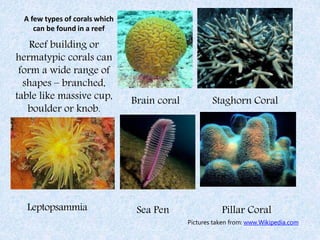
A few types of corals which
can be found in a reef
Reef building or
hermatypic corals can
form a wide range of
shapes – branched,
table like massive cup,
boulder or knob.
Brain coral
Sea PenLeptopsammia Pillar Coral
Staghorn Coral
Pictures taken from: www.Wikipedia.com
TYPE OF CORAL REEFS
Three MAJOR types of coral reefs:
1. Fringing Reefs
2. Barrier Reefs
3. Atolls
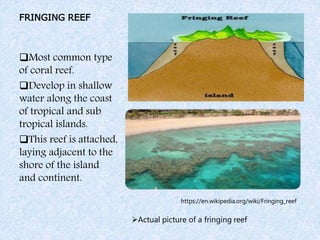
FRINGING REEF
Most common type
of coral reef.
Develop in shallow
water along the coast
of tropical and sub
tropical islands.
This reef is attached,
laying adjacent to the
shore of the island
and continent.
https://en.wikipedia.org/wiki/Fringing_reef
Actual picture of a fringing reef
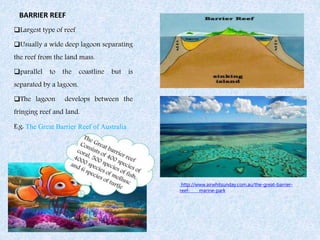
BARRIER REEF
Largest type of reef
Usually a wide deep lagoon separating
the reef from the land mass.
parallel to the coastline but is
separated by a lagoon.
The lagoon develops between the
fringing reef and land.
E.g: The Great Barrier Reef of Australia
http://www.airwhitsunday.com.au/the-great-barrier-
reef- marine-park
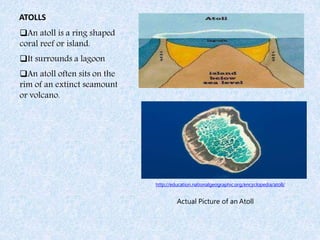
ATOLLS
An atoll is a ring shaped
coral reef or island.
It surrounds a lagoon
An atoll often sits on the
rim of an extinct seamount
or volcano.
http://education.nationalgeographic.org/encyclopedia/atoll/
Actual Picture of an Atoll
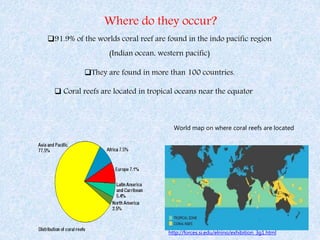
Where do they occur?
http://forces.si.edu/elnino/exhibition_3g1.html
World map on where coral reefs are located
91.9% of the worlds coral reef are found in the indo pacific region
(Indian ocean, western pacific)
They are found in more than 100 countries.
 Coral reefs are located in tropical oceans near the equator
Why are they important?
.
The ridges in coral reefs can reduce wave energy, this protects us from threats such
as tsunami’s.
The reef acts as barriers that help protect 14% of the worlds coastlines from
erosion caused by waters. Hence the name “the barrier reef”.
Coral reefs are home to thousands of different species.
Coral extracts have been used for treatment of cancer, asthma, arthritis, and heart
disease. It has also been used for bone replacement.
 Help moderate atmospheric temperature by removing 𝐶𝑂2 from the atmosphere.
 Contribute to the economy as many people earn a living from collecting and
processing reef products.
They are also a tourist attraction as many people love to see this amazing creation
 Provide food for other marine life.
 Support fish population.
They provide substrate for mangroves.
CORAL REEF DISTRIBUTION IN INDIA
Total coral reef area in India approximately 5790 sq.
kms.
 Gulf of Mannar
 Palk bay
 Gulf of Kutch
 Andaman and Nicobar Islands
 The Lakshadweep islands
The Lakshadweep reefs are atolls, the others are all
fringing reefs.
Patchy coral is present in the inter-tidal areas of the
central west coast of the country.
MANAGEMENT AND CONSERVATION OF
CORAL REEFS AND SOFT CORALS
• Marine Protected Areas (MPAs), Biosphere reserves, marine parks,
national monuments world heritage status, fishery management
and habitat protection can protect reefs from anthropogenic
damage.
• Many governments now prohibit removal of coral from reefs, and
inform coastal residents about reef protection and ecology. While
local action such as habitat restoration and herbivore protection
can reduce local damage, the longer-term threats of acidification,
temperature change and sea-level rise remain a challenge.
• To eliminate destruction of corals in their indigenous regions,
projects have been started to grow corals in non-tropical countries.
• All the development activities in the coral areas are at present
prohibited.
• Considerable awareness and research also was initiated after
adoption of CRZ.
Regulatory Measures
Legislative/Regulatory Instruments:-
 The Wildlife (Protection) Act, 1972 :
All Reef-building, Fire and Sea Fan Corals put in Schedule-I of the Act
(Prohibited from exploitation).
 Environment (Protection) Act, 1986 : Section 5 of the Act delegates
powers to State Governments, and UTs for taking punitive action.
 Coastal Regulation Zone Notification, 1991 : Places corals, coral reefs,
and marine parks in Coastal Regulation Zone-I, i.e., ecologically sensitive,
and important areas. Constitutes National Coastal Zone Management
Authority (NCZMA) at the Centre, and 13 CZMAs at States/Union
Territories.
 Formulation of Integrated Coastal Zone Management Plans (ICZMP) by
Coastal States.
National & International
Regulations
• Corals should not be collected, either alive or dead from wild
• The United States federal government prohibits the removal or
destruction of corals from all of the areas continental shelf
within a three-mile limit
• The Florida Fish and Wildlife Conservation Commission
prohibits the collection of living or dead stony corals
• The Convention on International Trade in Endangered Species
of Wild Fauna and Flora (CITES) regulates international trade
of certain vulnerable corals as well as fish species
• Indo-Pacific blue coral (Heliopora coerulea; Family Helioporidae,
Order Helioporacea)
• Organ-pipe coral (Tubipora musica; Family Tubiporidae, Order
Stolonifera
• All corals in the Order Scleractinia (1634 species of reef- building,
stonycorals)
• All corals in the order Antipatharia (245 species of black corals)
Precautions to be taken
• Tourists should make sure not to sit on, stand on, or even touch
live coral
• Divers or snorkelers should rest by floating or standing on the
sandy bottom near the coral reefs
• Should be very careful not to grab on to any coral formations
• Take photos of coral reefs rather than collecting dead or living
coral, which damages the reef and is prohibited in many areas.
• Boaters should take care when navigating around the coral reefs
• Anchors shouldn't be dropped directly on the reef, but on a
nearby sandy area
REFERENCES
 Cinner, Joshua E. (2005). "Conservation and community benefits from traditional coral reef management at Ahus
Island, Papua New Guinea". Conservation Biology. 19 (6): 1714–1723.
 Clapham, M. and Payne (2011). "Acidification, anoxia, and extinction: A multiple logistic regression analysis of
extinction selectivity during the Middle and Late Permian". Geology. 39 (11): 1059–1062.
 McClanahan, Timothy; Marnane, Michael; (2006). "A Comparison of Marine Protected Areas and Alternative
Approaches to Coral-Reef Management". Current Biology. 16 (14): 1408–13.
 Spalding MD, Grenfell AM (1997). "New estimates of global and regional coral reef areas". Coral Reefs. 16 (4):
225–230.
 Spalding, Mark, Corinna Ravilious and Edmund P. Green. World Atlas of Coral Reefs. Berkeley: University of
California, 2001, p. 16.
 Thomas David S.G. and Andrew Goudie (eds.) (2000), The Dictionary of Physical Geography, 3rd edn., Oxford,
Blackwell, p. 403.
 Tobin, B. (2003). "How the Great Barrier Reef was formed" Australian Institute of Marine Science. Archived
from the original on October 5, 2006.
 Webster, Jody M.; Braga, Juan Carlos; Clague, David A.; Gallup, Christina; Hein, James R.; Potts (2009). "Coral
reef evolution on rapidly subsiding margins". Global and Planetary Change”. 66 (1–2): 129–148.
www.reefcheckaustrali
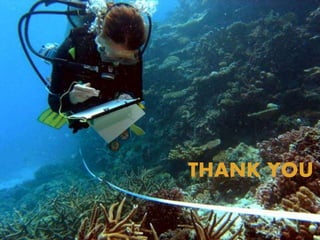
THANK YOU

Coral reefs.ppt

  • 1.
  • 2.
    OUTLINE INTRODUCTION SYMBIOTIC RELATIONSHIP TYPES OFCORALS OCCURENCE IMPORTANCE OF CORAL REEFS DISTRIBUTION OF CORAL REEFS THREATS TO CORAL REEFS CORAL BLEACHING MANAGEMENT AND CONSERVATION OF CORAL REEFS REGULATORY MEASURES REFERENCES
  • 3.
    Introduction • Referred as‘rainforests of the sea’- diverse ecosystem • Occupy less than 1% of the world ocean surface • Home for 25% of the all marine species • Annual global economic value- US$ 375 billion • Prevent sediments from washing up & damaging the shoreline • Act as physical barrier; creates healthier, protected coastline habitat
  • 4.
    The symbiotic relationship Coralsexcrete theirwastes to tinyalgae.  The tinyalgae produce nutrition forcoral polyps.
  • 5.
    • Corals secretehard carbonate exoskeleton which support and protect the coral polyps. • Coral has a symbiotic relationship with zooxanthallae,a microscopic algae which live in the polyp’s tissue. • Color of coral reef –Zooxanthallae • Builders of coral reefs are tiny animals –polyps. These polyps thrive, grow then die leaving their limestone skeleton behind. • The limestone is colonized by new polyps.
  • 6.
    A few typesof corals which can be found in a reef Reef building or hermatypic corals can form a wide range of shapes – branched, table like massive cup, boulder or knob. Brain coral Sea PenLeptopsammia Pillar Coral Staghorn Coral Pictures taken from: www.Wikipedia.com
  • 7.
    TYPE OF CORALREEFS Three MAJOR types of coral reefs: 1. Fringing Reefs 2. Barrier Reefs 3. Atolls
  • 8.
    FRINGING REEF Most commontype of coral reef. Develop in shallow water along the coast of tropical and sub tropical islands. This reef is attached, laying adjacent to the shore of the island and continent. https://en.wikipedia.org/wiki/Fringing_reef Actual picture of a fringing reef
  • 9.
    BARRIER REEF Largest typeof reef Usually a wide deep lagoon separating the reef from the land mass. parallel to the coastline but is separated by a lagoon. The lagoon develops between the fringing reef and land. E.g: The Great Barrier Reef of Australia http://www.airwhitsunday.com.au/the-great-barrier- reef- marine-park
  • 10.
    ATOLLS An atoll isa ring shaped coral reef or island. It surrounds a lagoon An atoll often sits on the rim of an extinct seamount or volcano. http://education.nationalgeographic.org/encyclopedia/atoll/ Actual Picture of an Atoll
  • 11.
    Where do theyoccur? http://forces.si.edu/elnino/exhibition_3g1.html World map on where coral reefs are located 91.9% of the worlds coral reef are found in the indo pacific region (Indian ocean, western pacific) They are found in more than 100 countries.  Coral reefs are located in tropical oceans near the equator
  • 12.
    Why are theyimportant? . The ridges in coral reefs can reduce wave energy, this protects us from threats such as tsunami’s. The reef acts as barriers that help protect 14% of the worlds coastlines from erosion caused by waters. Hence the name “the barrier reef”. Coral reefs are home to thousands of different species. Coral extracts have been used for treatment of cancer, asthma, arthritis, and heart disease. It has also been used for bone replacement.  Help moderate atmospheric temperature by removing 𝐶𝑂2 from the atmosphere.  Contribute to the economy as many people earn a living from collecting and processing reef products. They are also a tourist attraction as many people love to see this amazing creation  Provide food for other marine life.  Support fish population. They provide substrate for mangroves.
  • 13.
    CORAL REEF DISTRIBUTIONIN INDIA Total coral reef area in India approximately 5790 sq. kms.  Gulf of Mannar  Palk bay  Gulf of Kutch  Andaman and Nicobar Islands  The Lakshadweep islands The Lakshadweep reefs are atolls, the others are all fringing reefs. Patchy coral is present in the inter-tidal areas of the central west coast of the country.
  • 14.
    MANAGEMENT AND CONSERVATIONOF CORAL REEFS AND SOFT CORALS • Marine Protected Areas (MPAs), Biosphere reserves, marine parks, national monuments world heritage status, fishery management and habitat protection can protect reefs from anthropogenic damage. • Many governments now prohibit removal of coral from reefs, and inform coastal residents about reef protection and ecology. While local action such as habitat restoration and herbivore protection can reduce local damage, the longer-term threats of acidification, temperature change and sea-level rise remain a challenge. • To eliminate destruction of corals in their indigenous regions, projects have been started to grow corals in non-tropical countries. • All the development activities in the coral areas are at present prohibited. • Considerable awareness and research also was initiated after adoption of CRZ.
  • 15.
    Regulatory Measures Legislative/Regulatory Instruments:- The Wildlife (Protection) Act, 1972 : All Reef-building, Fire and Sea Fan Corals put in Schedule-I of the Act (Prohibited from exploitation).  Environment (Protection) Act, 1986 : Section 5 of the Act delegates powers to State Governments, and UTs for taking punitive action.  Coastal Regulation Zone Notification, 1991 : Places corals, coral reefs, and marine parks in Coastal Regulation Zone-I, i.e., ecologically sensitive, and important areas. Constitutes National Coastal Zone Management Authority (NCZMA) at the Centre, and 13 CZMAs at States/Union Territories.  Formulation of Integrated Coastal Zone Management Plans (ICZMP) by Coastal States.
  • 16.
    National & International Regulations •Corals should not be collected, either alive or dead from wild • The United States federal government prohibits the removal or destruction of corals from all of the areas continental shelf within a three-mile limit • The Florida Fish and Wildlife Conservation Commission prohibits the collection of living or dead stony corals • The Convention on International Trade in Endangered Species of Wild Fauna and Flora (CITES) regulates international trade of certain vulnerable corals as well as fish species
  • 17.
    • Indo-Pacific bluecoral (Heliopora coerulea; Family Helioporidae, Order Helioporacea) • Organ-pipe coral (Tubipora musica; Family Tubiporidae, Order Stolonifera • All corals in the Order Scleractinia (1634 species of reef- building, stonycorals) • All corals in the order Antipatharia (245 species of black corals)
  • 18.
    Precautions to betaken • Tourists should make sure not to sit on, stand on, or even touch live coral • Divers or snorkelers should rest by floating or standing on the sandy bottom near the coral reefs • Should be very careful not to grab on to any coral formations • Take photos of coral reefs rather than collecting dead or living coral, which damages the reef and is prohibited in many areas.
  • 19.
    • Boaters shouldtake care when navigating around the coral reefs • Anchors shouldn't be dropped directly on the reef, but on a nearby sandy area
  • 20.
    REFERENCES  Cinner, JoshuaE. (2005). "Conservation and community benefits from traditional coral reef management at Ahus Island, Papua New Guinea". Conservation Biology. 19 (6): 1714–1723.  Clapham, M. and Payne (2011). "Acidification, anoxia, and extinction: A multiple logistic regression analysis of extinction selectivity during the Middle and Late Permian". Geology. 39 (11): 1059–1062.  McClanahan, Timothy; Marnane, Michael; (2006). "A Comparison of Marine Protected Areas and Alternative Approaches to Coral-Reef Management". Current Biology. 16 (14): 1408–13.  Spalding MD, Grenfell AM (1997). "New estimates of global and regional coral reef areas". Coral Reefs. 16 (4): 225–230.  Spalding, Mark, Corinna Ravilious and Edmund P. Green. World Atlas of Coral Reefs. Berkeley: University of California, 2001, p. 16.  Thomas David S.G. and Andrew Goudie (eds.) (2000), The Dictionary of Physical Geography, 3rd edn., Oxford, Blackwell, p. 403.  Tobin, B. (2003). "How the Great Barrier Reef was formed" Australian Institute of Marine Science. Archived from the original on October 5, 2006.  Webster, Jody M.; Braga, Juan Carlos; Clague, David A.; Gallup, Christina; Hein, James R.; Potts (2009). "Coral reef evolution on rapidly subsiding margins". Global and Planetary Change”. 66 (1–2): 129–148.
  • 21.