Seminar Topic On
Under Water Weilding
Presented To:- Presented By:-
Prof R.N.Yadav Ashish Singh Yadav
(Department of ME)
Under The Supervision:- prof ajai kumar
Content
• Introduction
• Classification
• Principal operation
• Wet welding
• Dry welding
• Requirement
• Advantages
• Disadvantages
• Application
• Future Scope
• Conclusion
• Reference
INTRODUCTION
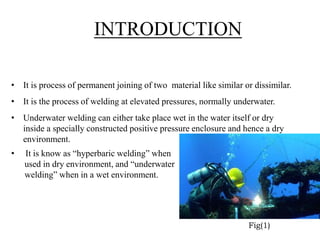
• It is process of permanent joining of two material like similar or dissimilar.
• It is the process of welding at elevated pressures, normally underwater.
• Underwater welding can either take place wet in the water itself or dry
inside a specially constructed positive pressure enclosure and hence a dry
environment.
• It is know as “hyperbaric welding” when
used in dry environment, and “underwater
welding” when in a wet environment.
Fig(1)
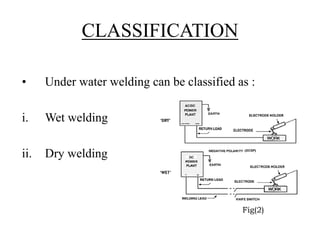
CLASSIFICATION
• Under water welding can be classified as :
i. Wet welding
ii. Dry welding
Fig(2)
WET WELDING
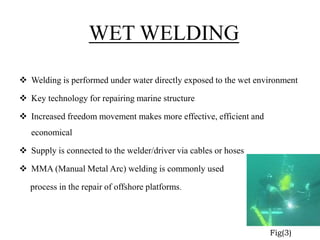
 Welding is performed under water directly exposed to the wet environment
 Key technology for repairing marine structure
 Increased freedom movement makes more effective, efficient and
economical
 Supply is connected to the welder/driver via cables or hoses
 MMA (Manual Metal Arc) welding is commonly used
process in the repair of offshore platforms.
Fig(3)
PRINCIPLE OF OPERATION
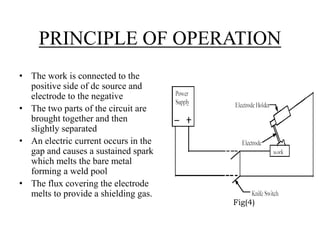
• The work is connected to the
positive side of dc source and
electrode to the negative
• The two parts of the circuit are
brought together and then
slightly separated
• An electric current occurs in the
gap and causes a sustained spark
which melts the bare metal
forming a weld pool
• The flux covering the electrode
melts to provide a shielding gas.
Fig(4)
DRY WELDING
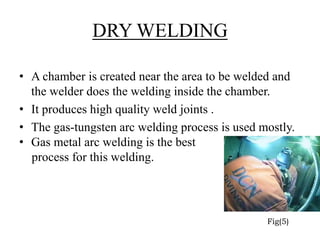
• A chamber is created near the area to be welded and
the welder does the welding inside the chamber.
• It produces high quality weld joints .
• The gas-tungsten arc welding process is used mostly.
• Gas metal arc welding is the best
process for this welding.
Fig(5)
 Power supply requrements-400 amp or larger. DC
generators, motor generators and rectifiers are acceptable
power supplies
 Power converters.
 Welding Generator, Pre-Setup
 Polarity.
 Diesel Driven Welding GeneratorAmperage and Voltage
settings.
 Gas Manifolds.
Requirement
8
Advantages:-
 Welder/diver safety
 Good quality weld
 Surface monitoring
 Non destructive testing
 The versatility and low cost.
Disadvantages:-
 This welding requires large quantities of complex
equipment.
 Cost is extremely high
 Hydrogen embrittlement causes cracks.
 Poor visibility due to water contaminance
Applications
 Construction of pipeline inside the water.
 Temporary repair work caused by ship’s collisions,
unexpected accidents.
 Repair and maintenance of ships.
 Construction of large ships.
Scope of further developments
• Hyper baric welding is generally used in researched.
• Research being carried out for welding at a range of
500 to 1000m deep.
• THOR-1 (Tig Hyperbaric Orbital Robot) is developed
where diver performs pipe fitting, installs the tracks
and orbital head on the pipe and rest process is
automated.
Conclusion
 Wet welding is still being used for underwater repairs, but the
quality of wet welding is poor than dry welding. But the dry
welding is costlier than wet welding.
 Underwater welding is mostly employed in marine engineering
products –in installations of oil and gas rigs. Underwater
welding can be classified depending upon the types of
equipment's and the types of procedures involved. The most
common underwater welding process, known as manual metal
arc building (MMA), is employed for deep water repairing
activities.
References
• www.twi.com
• www.aws.com
• Production Technology- O.P.Khanna
• www.howstuffworks.com
THANK YOU

Under water weilding

  • 1.
    Seminar Topic On UnderWater Weilding Presented To:- Presented By:- Prof R.N.Yadav Ashish Singh Yadav (Department of ME) Under The Supervision:- prof ajai kumar
  • 2.
    Content • Introduction • Classification •Principal operation • Wet welding • Dry welding • Requirement • Advantages • Disadvantages • Application • Future Scope • Conclusion • Reference
  • 3.
    INTRODUCTION • It isprocess of permanent joining of two material like similar or dissimilar. • It is the process of welding at elevated pressures, normally underwater. • Underwater welding can either take place wet in the water itself or dry inside a specially constructed positive pressure enclosure and hence a dry environment. • It is know as “hyperbaric welding” when used in dry environment, and “underwater welding” when in a wet environment. Fig(1)
  • 4.
    CLASSIFICATION • Under waterwelding can be classified as : i. Wet welding ii. Dry welding Fig(2)
  • 5.
    WET WELDING  Weldingis performed under water directly exposed to the wet environment  Key technology for repairing marine structure  Increased freedom movement makes more effective, efficient and economical  Supply is connected to the welder/driver via cables or hoses  MMA (Manual Metal Arc) welding is commonly used process in the repair of offshore platforms. Fig(3)
  • 6.
    PRINCIPLE OF OPERATION •The work is connected to the positive side of dc source and electrode to the negative • The two parts of the circuit are brought together and then slightly separated • An electric current occurs in the gap and causes a sustained spark which melts the bare metal forming a weld pool • The flux covering the electrode melts to provide a shielding gas. Fig(4)
  • 7.
    DRY WELDING • Achamber is created near the area to be welded and the welder does the welding inside the chamber. • It produces high quality weld joints . • The gas-tungsten arc welding process is used mostly. • Gas metal arc welding is the best process for this welding. Fig(5)
  • 8.
     Power supplyrequrements-400 amp or larger. DC generators, motor generators and rectifiers are acceptable power supplies  Power converters.  Welding Generator, Pre-Setup  Polarity.  Diesel Driven Welding GeneratorAmperage and Voltage settings.  Gas Manifolds. Requirement 8
  • 9.
    Advantages:-  Welder/diver safety Good quality weld  Surface monitoring  Non destructive testing  The versatility and low cost.
  • 10.
    Disadvantages:-  This weldingrequires large quantities of complex equipment.  Cost is extremely high  Hydrogen embrittlement causes cracks.  Poor visibility due to water contaminance
  • 11.
    Applications  Construction ofpipeline inside the water.  Temporary repair work caused by ship’s collisions, unexpected accidents.  Repair and maintenance of ships.  Construction of large ships.
  • 12.
    Scope of furtherdevelopments • Hyper baric welding is generally used in researched. • Research being carried out for welding at a range of 500 to 1000m deep. • THOR-1 (Tig Hyperbaric Orbital Robot) is developed where diver performs pipe fitting, installs the tracks and orbital head on the pipe and rest process is automated.
  • 13.
    Conclusion  Wet weldingis still being used for underwater repairs, but the quality of wet welding is poor than dry welding. But the dry welding is costlier than wet welding.  Underwater welding is mostly employed in marine engineering products –in installations of oil and gas rigs. Underwater welding can be classified depending upon the types of equipment's and the types of procedures involved. The most common underwater welding process, known as manual metal arc building (MMA), is employed for deep water repairing activities.
  • 14.
    References • www.twi.com • www.aws.com •Production Technology- O.P.Khanna • www.howstuffworks.com
  • 15.