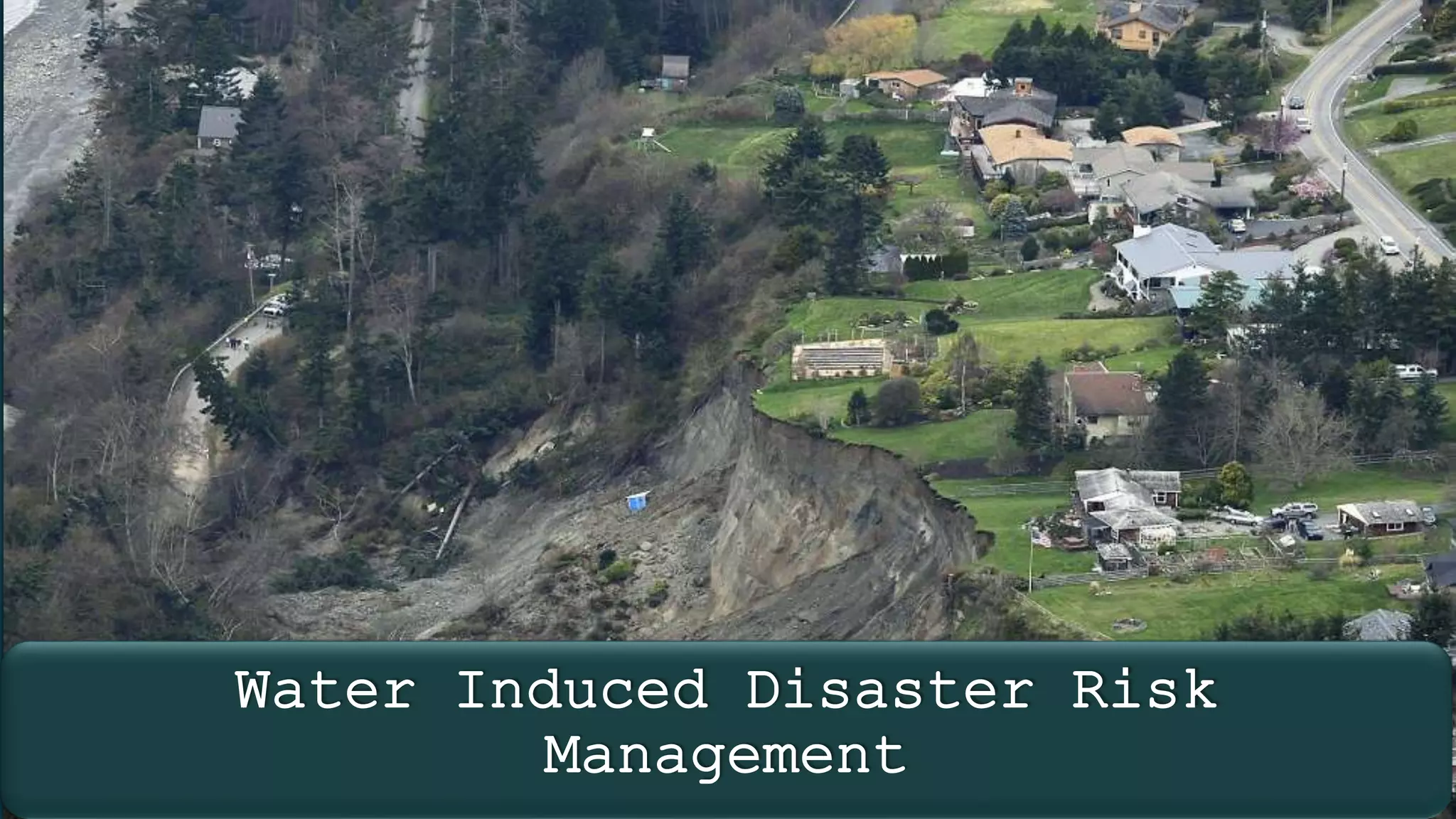



















Water Induced Disaster Risk
Management
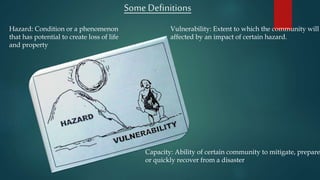
Some Definitions
Hazard: Condition or a phenomenon
that has potential to create loss of life
and property
Vulnerability: Extent to which the community will
affected by an impact of certain hazard.
Capacity: Ability of certain community to mitigate, prepare
or quickly recover from a disaster
Disaster: Tragic event causing significant
physical damage or destruction, loss of life
and property or drastic change in the
environment.
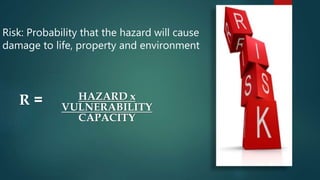
Risk: Probability that the hazard will cause
damage to life, property and environment
R = HAZARD x
VULNERABILITY
CAPACITY
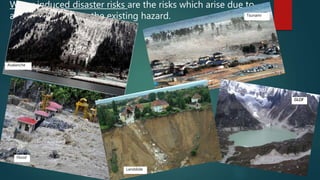
Water induced disaster risks are the risks which arise due to
actions of water on the existing hazard.
Avalanche
Flood
Tsunamii
Landslide
GLOF
Water Induced Disaster Risk Management: Systematic process of using administrative
decisions, organizations, operational capacities to implement policies, strategies and
coping capacities to lessen the impacts of hazards.
It comprises of the following
components:
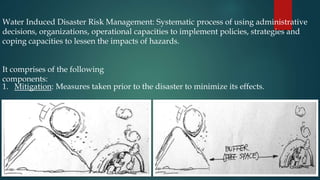
1. Mitigation: Measures taken prior to the disaster to minimize its effects.
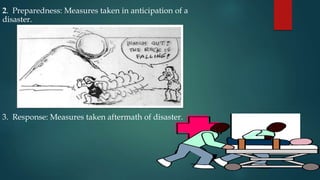
2. Preparedness: Measures taken in anticipation of a
disaster.
3. Response: Measures taken aftermath of disaster.
4. Recovery: Re-establishments of services and provisions.
The Study Area
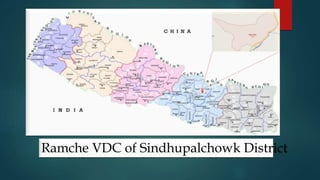
Ramche VDC of Sindhupalchowk District
Features of Ramche
 Located at the boundary of Lesser Himalayas and Higher Himalayas.
 Main Central Thrust (MCT) passes through this area.
 Has Kunchha formation consisting of thinly bedded phyllites, gritty phyllites with thin intercalation of
white
quartzite.
 Highly vulnerable to the water induced disasters such as landslide, soil erosion, slope failure, mass
movement etc. due to
• poor geological condition
• high relief and steep slopes
• active geology and
• intense monsoon rainfall.
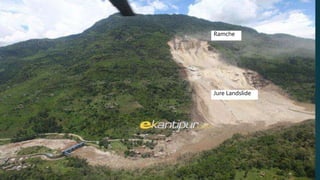
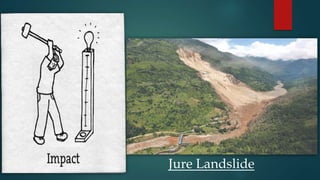
 Was struck by a BIG landslide known as Jure Landslide on August 2, 2014 which claimed lives of
156 people.
Ramche
Jure Landslide
 To observe the potential risks of Ramche VDC and people who will be affected by it.
 To propose mitigation measures which can be adopted to minimize or eliminate those r
 To propose a safe habitable area for the people of Ramche VDC currently residing in the
vulnerable area.
 To study the social, economic and psychological impacts of the Jure landslide.
 To propose plans and strategies to minimize or eliminate the problems being faced by l
people due to the landslide.
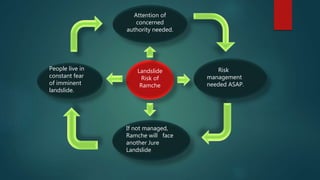
Landslide
Risk of
Ramche
Attention of
concerned
authority needed.
Risk
management
needed ASAP.
If not managed,
Ramche will face
another Jure
Landslide
People live in
constant fear
of imminent
landslide.
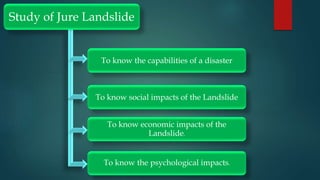
Study of Jure Landslide
To know the capabilities of a disaster
To know social impacts of the Landslide
To know economic impacts of the
Landslide.
To know the psychological impacts.
Methodolog
y
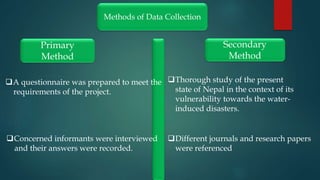
Methods of Data Collection
Primary
Method
Secondary
Method
A questionnaire was prepared to meet the
requirements of the project.
Concerned informants were interviewed
and their answers were recorded.
Thorough study of the present
state of Nepal in the context of its
vulnerability towards the water-
induced disasters.
Different journals and research papers
were referenced
Methods of Data
Analysis
 Consisted of examining the surveys for correctness and completeness.
 The information collected by the enumerators was compiled and studied.
 Finally the refined data was analyzed with the help of construction
of the bar graph created using Excel 2013
Discussions
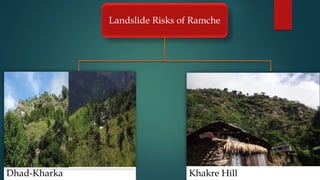
Landslide Risks of Ramche
Dhad-Kharka Khakre Hill
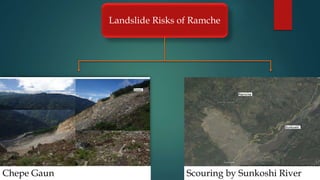
Landslide Risks of Ramche
Chepe Gaun Scouring by Sunkoshi River
Landslide Risks of Ramche
Earthquake: Recent
major earthquake of 25
April and its aftershocks
have weakened the
fragile rocks of Ramche.
Cracks have been
developed at various
places.
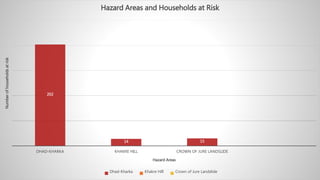
202
14 15
DHAD-KHARKA KHAKRE HILL CROWN OF JURE LANDSLIDE
Numberofhouseholdsatrisk
Hazard Areas
Hazard Areas and Households at Risk
Dhad-Kharka Khakre Hill Crown of Jure Landslide
Mitigatio
n
.
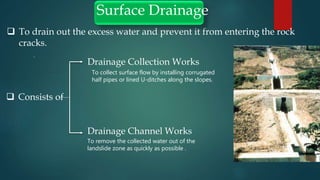
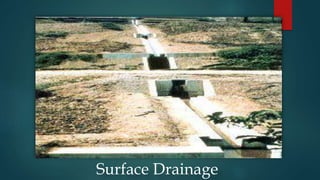
 To drain out the excess water and prevent it from entering the rock
cracks.
Surface Drainage
 Consists of
Drainage Collection Works
To collect surface flow by installing corrugated
half pipes or lined U-ditches along the slopes.
Drainage Channel Works
To remove the collected water out of the
landslide zone as quickly as possible .
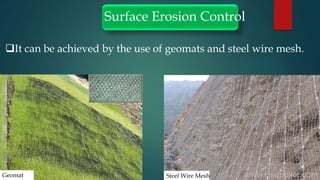
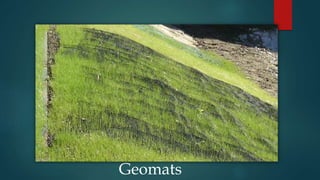
Surface Erosion Control
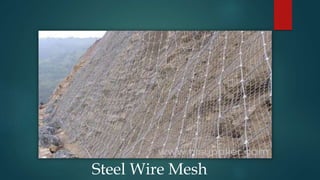
It can be achieved by the use of geomats and steel wire mesh.
Geomat Steel Wire Mesh
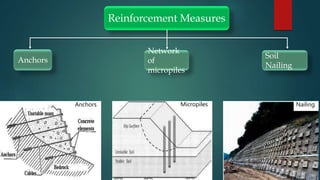
Anchors
Reinforcement Measures
Network
of
micropiles
Soil
Nailing
Anchors Micropiles Nailing
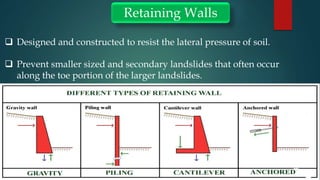
Retaining Walls
 Designed and constructed to resist the lateral pressure of soil.
 Prevent smaller sized and secondary landslides that often occur
along the toe portion of the larger landslides.
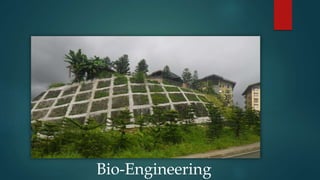
Bio-
engineering
Application of engineering design and technology to living systems
 Offers environmental friendly and highly cost and time effective solution t
slope instability and problems in mountainous and hilly areas.
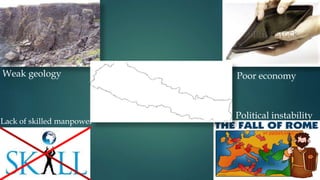
Weak geology Poor economy
Political instability
Lack of skilled manpower
Surface Drainage
Geomats
Steel Wire Mesh
Bio-Engineering
Preparedness
 Landslide hazard zonation of Ramche.
 Awareness of the local people.
 Organization of communication, information and warning sys
 Stock of foods, drugs and other essential commodities.
 Development of evacuation plans.
 Provision of landslide insurance
Response
 Emergency response to a landslide should be pre-planned
 Resources needed to cope with the disaster should be amassed
 Search and rescue of affected persons is paramount
Jure Landslide
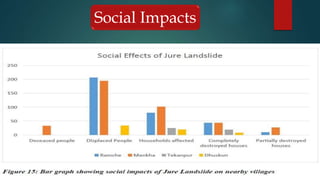
Social Impacts
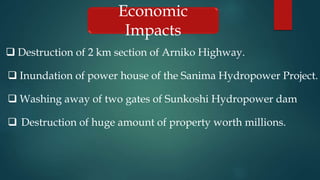
Economic
Impacts
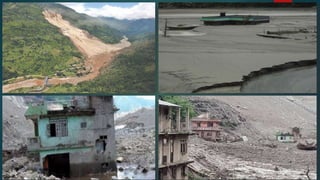
 Destruction of 2 km section of Arniko Highway.
 Inundation of power house of the Sanima Hydropower Project.
 Washing away of two gates of Sunkoshi Hydropower dam
 Destruction of huge amount of property worth millions.
Problems due to
Jure Landslide
 People are still living in the tents and temporary huts.
 No nearby water resources is available in those areas.
Problems of irrigation due to destruction of low scale irrigation
channels.
 Problems of frequent power cuts due to damaging of electric sup
lines.
 No plans from government to migrate the people living in risky a
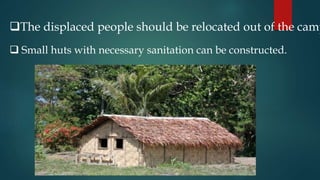
The displaced people should be relocated out of the camp
 Small huts with necessary sanitation can be constructed.
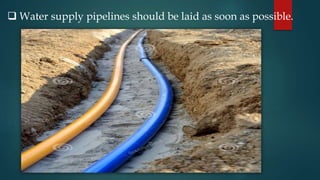
 Water supply pipelines should be laid as soon as possible.
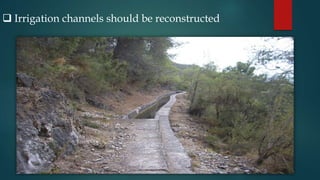
 Irrigation channels should be reconstructed
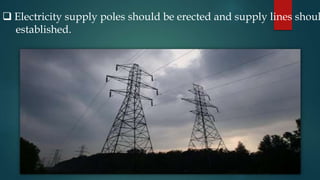
 Electricity supply poles should be erected and supply lines shoul
established.
People from affected area should be provided jobs to support th
 People of Ramche VDC living in the risky areas should be relocat
If relocation is not possible, then the geological threats should be
minimized.
 Water induced disaster risks are common in the scenario of Nepa
 Ramche VDC which suffered a major landslide in recent times is
vulnerable to further disasters.
 It is necessary to adopt disaster risk management schemes in this
village to avoid imminent disasters.
The mistakes carried out in the past should not be repeated and sa
of villagers of Ramche be ensured as soon as possible.
Dipendra
Man Rajak
Gokul Saud Himalay Shah
Kamlesh
Yadav
Manoj Kafle
Raj Kumar
Khadka

Water Induced Disaster Risk Management

  • 1.
    Water Induced DisasterRisk Management
  • 2.
    Some Definitions Hazard: Conditionor a phenomenon that has potential to create loss of life and property Vulnerability: Extent to which the community will affected by an impact of certain hazard. Capacity: Ability of certain community to mitigate, prepare or quickly recover from a disaster
  • 3.
    Disaster: Tragic eventcausing significant physical damage or destruction, loss of life and property or drastic change in the environment.
  • 4.
    Risk: Probability thatthe hazard will cause damage to life, property and environment R = HAZARD x VULNERABILITY CAPACITY
  • 5.
    Water induced disasterrisks are the risks which arise due to actions of water on the existing hazard. Avalanche Flood Tsunamii Landslide GLOF
  • 7.
    Water Induced DisasterRisk Management: Systematic process of using administrative decisions, organizations, operational capacities to implement policies, strategies and coping capacities to lessen the impacts of hazards. It comprises of the following components: 1. Mitigation: Measures taken prior to the disaster to minimize its effects.
  • 8.
    2. Preparedness: Measurestaken in anticipation of a disaster. 3. Response: Measures taken aftermath of disaster.
  • 9.
    4. Recovery: Re-establishmentsof services and provisions.
  • 10.
  • 11.
    Ramche VDC ofSindhupalchowk District
  • 12.
    Features of Ramche Located at the boundary of Lesser Himalayas and Higher Himalayas.  Main Central Thrust (MCT) passes through this area.  Has Kunchha formation consisting of thinly bedded phyllites, gritty phyllites with thin intercalation of white quartzite.  Highly vulnerable to the water induced disasters such as landslide, soil erosion, slope failure, mass movement etc. due to • poor geological condition • high relief and steep slopes • active geology and • intense monsoon rainfall.  Was struck by a BIG landslide known as Jure Landslide on August 2, 2014 which claimed lives of 156 people. Ramche Jure Landslide
  • 14.
     To observethe potential risks of Ramche VDC and people who will be affected by it.  To propose mitigation measures which can be adopted to minimize or eliminate those r  To propose a safe habitable area for the people of Ramche VDC currently residing in the vulnerable area.  To study the social, economic and psychological impacts of the Jure landslide.  To propose plans and strategies to minimize or eliminate the problems being faced by l people due to the landslide.
  • 17.
    Landslide Risk of Ramche Attention of concerned authorityneeded. Risk management needed ASAP. If not managed, Ramche will face another Jure Landslide People live in constant fear of imminent landslide.
  • 18.
    Study of JureLandslide To know the capabilities of a disaster To know social impacts of the Landslide To know economic impacts of the Landslide. To know the psychological impacts.
  • 19.
  • 20.
    Methods of DataCollection Primary Method Secondary Method A questionnaire was prepared to meet the requirements of the project. Concerned informants were interviewed and their answers were recorded. Thorough study of the present state of Nepal in the context of its vulnerability towards the water- induced disasters. Different journals and research papers were referenced
  • 21.
    Methods of Data Analysis Consisted of examining the surveys for correctness and completeness.  The information collected by the enumerators was compiled and studied.  Finally the refined data was analyzed with the help of construction of the bar graph created using Excel 2013
  • 22.
  • 23.
    Landslide Risks ofRamche Dhad-Kharka Khakre Hill
  • 24.
    Landslide Risks ofRamche Chepe Gaun Scouring by Sunkoshi River
  • 25.
    Landslide Risks ofRamche Earthquake: Recent major earthquake of 25 April and its aftershocks have weakened the fragile rocks of Ramche. Cracks have been developed at various places.
  • 26.
    202 14 15 DHAD-KHARKA KHAKREHILL CROWN OF JURE LANDSLIDE Numberofhouseholdsatrisk Hazard Areas Hazard Areas and Households at Risk Dhad-Kharka Khakre Hill Crown of Jure Landslide
  • 28.
  • 29.
    .  To drainout the excess water and prevent it from entering the rock cracks. Surface Drainage  Consists of Drainage Collection Works To collect surface flow by installing corrugated half pipes or lined U-ditches along the slopes. Drainage Channel Works To remove the collected water out of the landslide zone as quickly as possible .
  • 30.
    Surface Erosion Control Itcan be achieved by the use of geomats and steel wire mesh. Geomat Steel Wire Mesh
  • 31.
  • 32.
    Retaining Walls  Designedand constructed to resist the lateral pressure of soil.  Prevent smaller sized and secondary landslides that often occur along the toe portion of the larger landslides.
  • 33.
    Bio- engineering Application of engineeringdesign and technology to living systems  Offers environmental friendly and highly cost and time effective solution t slope instability and problems in mountainous and hilly areas.
  • 34.
    Weak geology Pooreconomy Political instability Lack of skilled manpower
  • 35.
  • 36.
  • 37.
  • 38.
  • 39.
  • 40.
     Landslide hazardzonation of Ramche.  Awareness of the local people.  Organization of communication, information and warning sys  Stock of foods, drugs and other essential commodities.  Development of evacuation plans.  Provision of landslide insurance
  • 41.
  • 42.
     Emergency responseto a landslide should be pre-planned  Resources needed to cope with the disaster should be amassed  Search and rescue of affected persons is paramount
  • 43.
  • 44.
  • 45.
    Economic Impacts  Destruction of2 km section of Arniko Highway.  Inundation of power house of the Sanima Hydropower Project.  Washing away of two gates of Sunkoshi Hydropower dam  Destruction of huge amount of property worth millions.
  • 47.
    Problems due to JureLandslide  People are still living in the tents and temporary huts.  No nearby water resources is available in those areas. Problems of irrigation due to destruction of low scale irrigation channels.  Problems of frequent power cuts due to damaging of electric sup lines.  No plans from government to migrate the people living in risky a
  • 49.
    The displaced peopleshould be relocated out of the camp  Small huts with necessary sanitation can be constructed.
  • 50.
     Water supplypipelines should be laid as soon as possible.
  • 51.
     Irrigation channelsshould be reconstructed
  • 52.
     Electricity supplypoles should be erected and supply lines shoul established.
  • 53.
    People from affectedarea should be provided jobs to support th
  • 54.
     People ofRamche VDC living in the risky areas should be relocat If relocation is not possible, then the geological threats should be minimized.
  • 56.
     Water induceddisaster risks are common in the scenario of Nepa  Ramche VDC which suffered a major landslide in recent times is vulnerable to further disasters.  It is necessary to adopt disaster risk management schemes in this village to avoid imminent disasters. The mistakes carried out in the past should not be repeated and sa of villagers of Ramche be ensured as soon as possible.
  • 58.
    Dipendra Man Rajak Gokul SaudHimalay Shah Kamlesh Yadav Manoj Kafle Raj Kumar Khadka