1
Chapter-Five
Contents of The Chapter;
Introduction to WDM
Traditional forms of WDM
The Scope of WDM Measures
Reuse and Recycling, and Water Loss
Trends in WDM
Constraints of WDM
Prioritization for short- and long-term WD
Chapter-Five
2
Introduction to water demand management (WDM)
 WDM is the adaptation and implementation of a strategy by a water institution to influence
the water demand and usage of water to meet:
economic efficiency,
social development,
social equity,
 environmental protection,
 political acceptability.
 sustainability of water supply and services, and
 WDM approaches aims to promote water use efficient, equitable and sustainable practices
and policies.
 Simply WDM is getting the most of the water that we have’, while taking into account the
social, political, economic and ecological contexts in which this process takes place
 WDM corresponds to use of price, quantitative restrictions and other devices to limit the
demand of water.
3
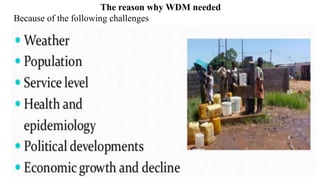
The reason why WDM needed
Because of the following challenges
4
 Traditional WDM believe that water needs are “requirements” that
must be met and not the “demands” that are changeable.
 Traditionally new facilities and structures are developed using
available sources to meet perceived “increasing” water needs.
 This has led to over-use of the resources, over-capitalization,
pollution and other problems of varying severity.
 Traditionally water supply design not give attention to demand;
 determinants,  pricing structures,
 and also financial policies is not sustainable.
5
6
The Scope of WDM Measures
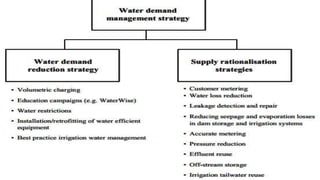
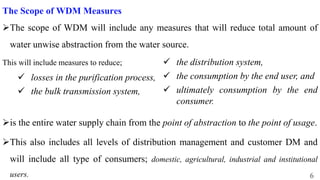
The scope of WDM will include any measures that will reduce total amount of
water unwise abstraction from the water source.
This will include measures to reduce;
 losses in the purification process,
 the bulk transmission system,
is the entire water supply chain from the point of abstraction to the point of usage.
This also includes all levels of distribution management and customer DM and
will include all type of consumers; domestic, agricultural, industrial and institutional
users.
 the distribution system,
 the consumption by the end user, and
 ultimately consumption by the end
consumer.
7
Benefits of WDM
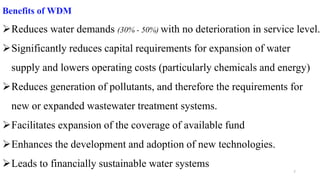
Reduces water demands (30% - 50%) with no deterioration in service level.
Significantly reduces capital requirements for expansion of water
supply and lowers operating costs (particularly chemicals and energy)
Reduces generation of pollutants, and therefore the requirements for
new or expanded wastewater treatment systems.
Facilitates expansion of the coverage of available fund
Enhances the development and adoption of new technologies.
Leads to financially sustainable water systems
8
Water Reuse and Recycling
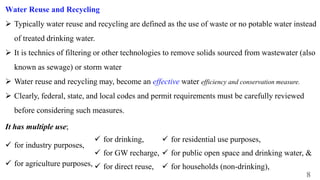
 Typically water reuse and recycling are defined as the use of waste or no potable water instead
of treated drinking water.
 It is technics of filtering or other technologies to remove solids sourced from wastewater (also
known as sewage) or storm water
 Water reuse and recycling may, become an effective water efficiency and conservation measure.
 Clearly, federal, state, and local codes and permit requirements must be carefully reviewed
before considering such measures.
It has multiple use;
 for industry purposes,
 for agriculture purposes,
 for residential use purposes,
 for public open space and drinking water, &
 for households (non-drinking),
 for drinking,
 for GW recharge,
 for direct reuse,
9
Key Reasons to Recycle Water:
 Recycled water can be used for applications that require lower quality water, thus
conserving high quality water for high value uses.
 Recycled wastewater is climate independent, and is available any time of year.
 The volume of wastewater available for recycling is growing as the state grows.
 The recycling process draws on less energy than some other sources, such as desalination.
 Recycling improves both short-term and long-term water supply and demand security.
 The cost effectiveness of using recycled water better than cost of major new scheme
(technology) to use water.
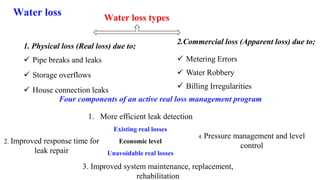
Water loss
2.Commercial loss (Apparent loss) due to;
 Metering Errors
 Water Robbery
 Billing Irregularities
Water loss types
1. Physical loss (Real loss) due to;
 Pipe breaks and leaks
 Storage overflows
 House connection leaks
1. More efficient leak detection
Existing real losses
Economic level
Unavoidable real losses
2. Improved response time for
leak repair
3. Improved system maintenance, replacement,
rehabilitation
4. Pressure management and level
control
Four components of an active real loss management program
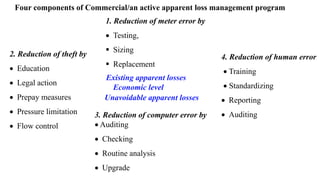
Four components of Commercial/an active apparent loss management program
2. Reduction of theft by
 Education
 Legal action
 Prepay measures
 Pressure limitation
 Flow control
4. Reduction of human error
 Training
 Standardizing
 Reporting
 Auditing
3. Reduction of computer error by
 Auditing
 Checking
 Routine analysis
 Upgrade
1. Reduction of meter error by
 Testing,
 Sizing
 Replacement
Economic level
Unavoidable apparent losses
Existing apparent losses
12
Water Loss Reduction Strategies
 Increase system efficiency,
 Increase end use efficiency,
 Promoting distributed sources of supply,
 Substitute resource use,
 Periodic area-wise network maintenance; valves, street surface boxes, signs, etc.,
are locally inspected, cleaned, made accessible or restored.
 Periodic pressure surge measurements and misplaced current measurements; to
maintain the up-to-date situation of performance analysis.
 Improve the market on resource usage,
 Network monitoring and leakage
control,
 Regular network flushing’s & hydrant,
controls;
13
Trends in WD: temporal and spatial extent (world, region, countries)
 Water resources are being altered due to changes in climate, population,
economic development and environmental considerations.
 Global supply of available freshwater is more than adequate to meet all current
and foreseeable water demands, its spatial and temporal distributions are not.
 There are many regions where freshwater resources are inadequate to meet
domestic, economic development and environmental needs.
 In such regions, the lack of adequate clean water to meet human drinking water
and sanitation needs is indeed a constraint on human health and productivity.
 These challenging whole world.
14
This can be minimized by;
I. controlling demographic growth, increasing the efficiency of the use of goods
II. studying of trends and relationships between water use, population change, non-revenue water, system
capacity, per capita use, and climate conditions.
III. analyzing daily, weekly, monthly, annual, and multi-year water consumption and to assess historical
trends of water consumption for various service classes (residential, multi-residential, commercial,
irrigation, and summer services).
IV. analyzing water production and storage and trends of reservoirs volume change and supply from the
treatment plant.
V. analyzing trends of average and peak daily demand and average per capita demand.
VI. knowing trends in non-revenue water over the study period and evaluate correlation with demand levels
and time of the year.
 The results will also help define feasible service level targets and support decisions on system
operations, capacity planning, and demand management.
15
0
1
2
3
4
5
6
7
8
9
10
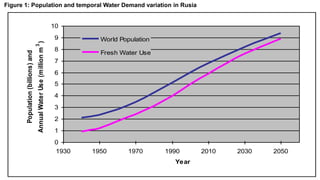
1930 1950 1970 1990 2010 2030 2050
Year
Population
(billions)
and
Annual
Water
Use
(million
m
3
) World Population
Fresh Water Use
Figure 1: Population and temporal Water Demand variation in Rusia
16
0
10
20
30
40
50
60
70
80
90
100
Africa
Asia
Central
America
Europe
North
America
South
America
Countries
Percent
(%)
1970
2000
2025
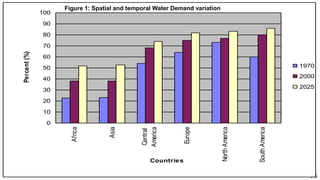
Figure 1: Spatial and temporal Water Demand variation
17
Constraints in Water Demand Management: (Institutional, Cultural, Economic, Political)
There are many constraints of water use;
 losses in the distribution system,
 not using social impact assessment to determine net social gains from implementing WDM,
 lack of ongoing financial and infrastructure support by government to community-based
WDM committees,
 limitation of timing of water use,
 not Using water at off-peak times for other purposes to reduces strain on the water delivery
system, and
 not able to continue to supply the basic needs of the population during times of drought or
seasonal water shortages.
 lower quality, high costly in economic angle,
 ignorance about what drives regional economies,
18
Constraints:
 lack of understanding of the need for
WDM
 lack of planning and implementation
skills
 lack of appropriate institutions and
funding
 weak policy and legal instruments
 negative view towards WDM
 practical (funds, skills and capacity)
 not understood of WDM benefits
 supply bias among stakeholders
 inappropriate training of
professionals
 uninformed or dissatisfied
customers
19
Constraints of efficient utilization of water resource in Ethiopia
1. lack of skilled man power
2. lack of modern technology
3. lack of good governance
4. land fragmentation
5. poor policy and strategy
6. Financial problem
7. political macro-economic instability
8. poor infrastructure
20
Economic Constraints
Economic constraints related to;
 incentives such as repayment, tax
credits and
 disincentive such as real cost,
penalties,
Institutional constraints
 Policies and Laws
 Economic policies, government
regulations, standards on appliance
redesign and marketing:
 policy to promote water saving devices
 encouraging water savings in industries
 Effective public/stakeholder education
and awareness measures
 Wise use of water; direct restrictions on
use and etc
 A direct means of controlling water
demand and generating revenues to cover
costs,
 Complementary to other measures of
water demand management, etc.
21
Cultural constraints
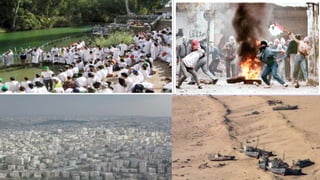
Water has great religious significance like;
 making it an important cultural symbol
for over half of the world’s population,
 The Baptist baptized in the waters,
 Moses delivered the Ten Commandments,
• As a result, as holy sites, and
 natural GOD gift and etc.
Political constraints
 Problems related to the lack of
co-ordination.
 Many significant implementation
difficulties have been observed,
primarily relating to political will,
 the lack of workable methods of
distributive governance,
 the role of law,
 and stakeholder participation.
22
23
WDM Prioritization for short- and long-term
The activities are based on short- and long-term needs, and should include both active and
passive conservation.
Long-term WDM; enables a response to permanent/long period shortages, supply fluctuations
and reductions in water use.
Long-term Water Use Efficiency (WUE) programs should be integrated with other resource planning.
 WUE strategies include metering, progressive rate setting, water loss control programs,
conservation ordinances, and efficiency refund and replacement programs.
 Long-term WDM, consider horizons >or= 20 to 30 years;
 building long-lifespan water supply infrastructures such as desalination plants, storages,
or large-capacity inter-basin transfers.
 Long term planning, are liable to modify both the customer base and per unit water
consumption.
24
Short-Term WDM: respond to temporary shortages or fluctuations in supply, especially those
associated with droughts or other short-term emergencies.
 Short-term aims at anticipating water demand over the coming hours, days, or weeks, so as to
optimize the operation of water systems (reservoirs, desalination plants) while factoring in changes
in weather and consumer behaviors.
 Short-term demand management can help estimate revenues from water sales and plan short-term
expenditures.
Long and short term Demand management program
included the following
 Pricing and billing reform
 Leakage detection and repair
 Rebates & give-aways for water efficient shower
heads
 Point of sale rebate for front loading washing
machines
 Discounted residential retrofit
 Free water audit for non-residential
customers
 A water efficient demonstration house and
garden
 Effluent reuse in a new village
 A school education program
25
THANK
YOU

Ch-5 water demand management.pptx

  • 1.
    1 Chapter-Five Contents of TheChapter; Introduction to WDM Traditional forms of WDM The Scope of WDM Measures Reuse and Recycling, and Water Loss Trends in WDM Constraints of WDM Prioritization for short- and long-term WD
  • 2.
    Chapter-Five 2 Introduction to waterdemand management (WDM)  WDM is the adaptation and implementation of a strategy by a water institution to influence the water demand and usage of water to meet: economic efficiency, social development, social equity,  environmental protection,  political acceptability.  sustainability of water supply and services, and  WDM approaches aims to promote water use efficient, equitable and sustainable practices and policies.  Simply WDM is getting the most of the water that we have’, while taking into account the social, political, economic and ecological contexts in which this process takes place  WDM corresponds to use of price, quantitative restrictions and other devices to limit the demand of water.
  • 3.
    3 The reason whyWDM needed Because of the following challenges
  • 4.
    4  Traditional WDMbelieve that water needs are “requirements” that must be met and not the “demands” that are changeable.  Traditionally new facilities and structures are developed using available sources to meet perceived “increasing” water needs.  This has led to over-use of the resources, over-capitalization, pollution and other problems of varying severity.  Traditionally water supply design not give attention to demand;  determinants,  pricing structures,  and also financial policies is not sustainable.
  • 5.
  • 6.
    6 The Scope ofWDM Measures The scope of WDM will include any measures that will reduce total amount of water unwise abstraction from the water source. This will include measures to reduce;  losses in the purification process,  the bulk transmission system, is the entire water supply chain from the point of abstraction to the point of usage. This also includes all levels of distribution management and customer DM and will include all type of consumers; domestic, agricultural, industrial and institutional users.  the distribution system,  the consumption by the end user, and  ultimately consumption by the end consumer.
  • 7.
    7 Benefits of WDM Reduceswater demands (30% - 50%) with no deterioration in service level. Significantly reduces capital requirements for expansion of water supply and lowers operating costs (particularly chemicals and energy) Reduces generation of pollutants, and therefore the requirements for new or expanded wastewater treatment systems. Facilitates expansion of the coverage of available fund Enhances the development and adoption of new technologies. Leads to financially sustainable water systems
  • 8.
    8 Water Reuse andRecycling  Typically water reuse and recycling are defined as the use of waste or no potable water instead of treated drinking water.  It is technics of filtering or other technologies to remove solids sourced from wastewater (also known as sewage) or storm water  Water reuse and recycling may, become an effective water efficiency and conservation measure.  Clearly, federal, state, and local codes and permit requirements must be carefully reviewed before considering such measures. It has multiple use;  for industry purposes,  for agriculture purposes,  for residential use purposes,  for public open space and drinking water, &  for households (non-drinking),  for drinking,  for GW recharge,  for direct reuse,
  • 9.
    9 Key Reasons toRecycle Water:  Recycled water can be used for applications that require lower quality water, thus conserving high quality water for high value uses.  Recycled wastewater is climate independent, and is available any time of year.  The volume of wastewater available for recycling is growing as the state grows.  The recycling process draws on less energy than some other sources, such as desalination.  Recycling improves both short-term and long-term water supply and demand security.  The cost effectiveness of using recycled water better than cost of major new scheme (technology) to use water.
  • 10.
    Water loss 2.Commercial loss(Apparent loss) due to;  Metering Errors  Water Robbery  Billing Irregularities Water loss types 1. Physical loss (Real loss) due to;  Pipe breaks and leaks  Storage overflows  House connection leaks 1. More efficient leak detection Existing real losses Economic level Unavoidable real losses 2. Improved response time for leak repair 3. Improved system maintenance, replacement, rehabilitation 4. Pressure management and level control Four components of an active real loss management program
  • 11.
    Four components ofCommercial/an active apparent loss management program 2. Reduction of theft by  Education  Legal action  Prepay measures  Pressure limitation  Flow control 4. Reduction of human error  Training  Standardizing  Reporting  Auditing 3. Reduction of computer error by  Auditing  Checking  Routine analysis  Upgrade 1. Reduction of meter error by  Testing,  Sizing  Replacement Economic level Unavoidable apparent losses Existing apparent losses
  • 12.
    12 Water Loss ReductionStrategies  Increase system efficiency,  Increase end use efficiency,  Promoting distributed sources of supply,  Substitute resource use,  Periodic area-wise network maintenance; valves, street surface boxes, signs, etc., are locally inspected, cleaned, made accessible or restored.  Periodic pressure surge measurements and misplaced current measurements; to maintain the up-to-date situation of performance analysis.  Improve the market on resource usage,  Network monitoring and leakage control,  Regular network flushing’s & hydrant, controls;
  • 13.
    13 Trends in WD:temporal and spatial extent (world, region, countries)  Water resources are being altered due to changes in climate, population, economic development and environmental considerations.  Global supply of available freshwater is more than adequate to meet all current and foreseeable water demands, its spatial and temporal distributions are not.  There are many regions where freshwater resources are inadequate to meet domestic, economic development and environmental needs.  In such regions, the lack of adequate clean water to meet human drinking water and sanitation needs is indeed a constraint on human health and productivity.  These challenging whole world.
  • 14.
    14 This can beminimized by; I. controlling demographic growth, increasing the efficiency of the use of goods II. studying of trends and relationships between water use, population change, non-revenue water, system capacity, per capita use, and climate conditions. III. analyzing daily, weekly, monthly, annual, and multi-year water consumption and to assess historical trends of water consumption for various service classes (residential, multi-residential, commercial, irrigation, and summer services). IV. analyzing water production and storage and trends of reservoirs volume change and supply from the treatment plant. V. analyzing trends of average and peak daily demand and average per capita demand. VI. knowing trends in non-revenue water over the study period and evaluate correlation with demand levels and time of the year.  The results will also help define feasible service level targets and support decisions on system operations, capacity planning, and demand management.
  • 15.
    15 0 1 2 3 4 5 6 7 8 9 10 1930 1950 19701990 2010 2030 2050 Year Population (billions) and Annual Water Use (million m 3 ) World Population Fresh Water Use Figure 1: Population and temporal Water Demand variation in Rusia
  • 16.
  • 17.
    17 Constraints in WaterDemand Management: (Institutional, Cultural, Economic, Political) There are many constraints of water use;  losses in the distribution system,  not using social impact assessment to determine net social gains from implementing WDM,  lack of ongoing financial and infrastructure support by government to community-based WDM committees,  limitation of timing of water use,  not Using water at off-peak times for other purposes to reduces strain on the water delivery system, and  not able to continue to supply the basic needs of the population during times of drought or seasonal water shortages.  lower quality, high costly in economic angle,  ignorance about what drives regional economies,
  • 18.
    18 Constraints:  lack ofunderstanding of the need for WDM  lack of planning and implementation skills  lack of appropriate institutions and funding  weak policy and legal instruments  negative view towards WDM  practical (funds, skills and capacity)  not understood of WDM benefits  supply bias among stakeholders  inappropriate training of professionals  uninformed or dissatisfied customers
  • 19.
    19 Constraints of efficientutilization of water resource in Ethiopia 1. lack of skilled man power 2. lack of modern technology 3. lack of good governance 4. land fragmentation 5. poor policy and strategy 6. Financial problem 7. political macro-economic instability 8. poor infrastructure
  • 20.
    20 Economic Constraints Economic constraintsrelated to;  incentives such as repayment, tax credits and  disincentive such as real cost, penalties, Institutional constraints  Policies and Laws  Economic policies, government regulations, standards on appliance redesign and marketing:  policy to promote water saving devices  encouraging water savings in industries  Effective public/stakeholder education and awareness measures  Wise use of water; direct restrictions on use and etc  A direct means of controlling water demand and generating revenues to cover costs,  Complementary to other measures of water demand management, etc.
  • 21.
    21 Cultural constraints Water hasgreat religious significance like;  making it an important cultural symbol for over half of the world’s population,  The Baptist baptized in the waters,  Moses delivered the Ten Commandments, • As a result, as holy sites, and  natural GOD gift and etc. Political constraints  Problems related to the lack of co-ordination.  Many significant implementation difficulties have been observed, primarily relating to political will,  the lack of workable methods of distributive governance,  the role of law,  and stakeholder participation.
  • 22.
  • 23.
    23 WDM Prioritization forshort- and long-term The activities are based on short- and long-term needs, and should include both active and passive conservation. Long-term WDM; enables a response to permanent/long period shortages, supply fluctuations and reductions in water use. Long-term Water Use Efficiency (WUE) programs should be integrated with other resource planning.  WUE strategies include metering, progressive rate setting, water loss control programs, conservation ordinances, and efficiency refund and replacement programs.  Long-term WDM, consider horizons >or= 20 to 30 years;  building long-lifespan water supply infrastructures such as desalination plants, storages, or large-capacity inter-basin transfers.  Long term planning, are liable to modify both the customer base and per unit water consumption.
  • 24.
    24 Short-Term WDM: respondto temporary shortages or fluctuations in supply, especially those associated with droughts or other short-term emergencies.  Short-term aims at anticipating water demand over the coming hours, days, or weeks, so as to optimize the operation of water systems (reservoirs, desalination plants) while factoring in changes in weather and consumer behaviors.  Short-term demand management can help estimate revenues from water sales and plan short-term expenditures. Long and short term Demand management program included the following  Pricing and billing reform  Leakage detection and repair  Rebates & give-aways for water efficient shower heads  Point of sale rebate for front loading washing machines  Discounted residential retrofit  Free water audit for non-residential customers  A water efficient demonstration house and garden  Effluent reuse in a new village  A school education program
  • 25.

Editor's Notes

  • #3  The model has the capability of being used for watersheds as well as major river systems. developed to predict the impact of land management practices on water, sediment, and agricultural chemical yields in large, complex watersheds with varying soils, land use, and management conditions over long periods of time. For simulation, a watershed is subdivided into a number of homogenous sub basins (hydrologic response units or HRUs) having unique soil and land use properties.