DISASTER READINESS AND RISK
REDUCTION
QUARTER 4 MIKO ANSELM A. GALLON – SST I
MOST ESSENTIAL LEARNING COMPETENCIES
 Interpret geological maps. DRR11/12-IIa-b-30
 Apply mitigation strategies to prevent loss of
lives and properties. DRR11/12-IIa-b-31
INTERPRETATION OF
GEOLOGICAL MAPS
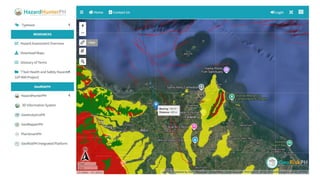
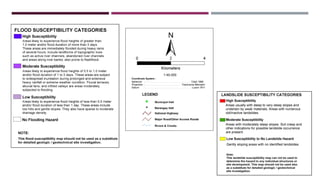
GEOLOGICAL HAZARD MAPS
 A map of geological hazards is a map showing the
areas that are vulnerable to earthquake threats,
volcanic eruptions, and landslides. It is a tool that
scientists and local authorities use to anticipate any
hazard that a geological event could bring. It also
helps educate the public about and train them for
the geological threat.
GEOLOGICAL HAZARD MAPS
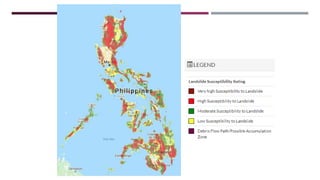
There are different geological maps or geological
hazard maps we have per municipal here in the
Philippines. The maps depend on what disaster it
focuses on.
Legend per type of geological map varies, it
describes the severity of the disaster in that area.
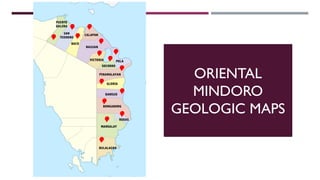
ORIENTAL
MINDORO
GEOLOGIC MAPS
GEOLOGICAL HAZARD MAPS
Parts of Geological Map:
1. Legend
2. Interpretation
3.Title
4. Susceptibility
5. Sources
MITIGATION STRATEGIES:A
PREVENTIONTO LOSS OF
LIVES AND PROPERTIES
MITIGATION STRATEGIES
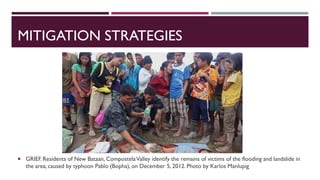
 2012 New Bataan (CompostelaValley) Debris Flow
Rains brought by Typhoon Pablo (Bopha) caused a massive
debris flow in Barangay Andap in New Bataan, Compostela Valley
on December 4, 2012. The flow of mud, boulders, and gravel
rushed towards Barangay Andap, which was on the mouth of a
steep mountain drainage network. At least 128 died and 450 went
missing as the village was buried under the debris in the wake of
the disaster.
MITIGATION STRATEGIES
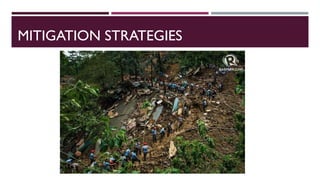
 GRIEF. Residents of New Bataan, CompostelaValley identify the remains of victims of the flooding and landslide in
the area, caused by typhoon Pablo (Bopha), on December 5, 2012. Photo by Karlos Manlupig
MITIGATION STRATEGIES
 Mitigation involves acting to reduce the risk
of life or property damage from a potentially
dangerous incident. There is no way to avoid
natural disasters, but people and organizations
may take steps to minimize the harm and
losses that they cause.
PROGRAMSTHAT INTENSIFY NATION’S HAZARD MITIGATION
CAPABILITIES INCLUDESTHE FOLLOWING STEPS:
 1. Protection of schools and hospitals
All new schools and hospitals should be located and
constructed to ensure that high-hazard areas are avoided
and that special provisions are made to reduce the potential
for damage by natural hazards. Furthermore, existing school
and hospital buildings should be surveyed to determine their
resistance levels to relevant hazards.
PROGRAMSTHAT INTENSIFY NATION’S HAZARD MITIGATION
CAPABILITIES INCLUDESTHE FOLLOWING STEPS:
 2.Adoption of nonstructural measures
Businesses and households should adopt non-structural
mitigation measures to mitigate casualties from natural
hazards and property damage. For example, furniture and
equipment can be easily secured to reduce earthquake
injuries and damage. Other non-structural steps are
vegetation management to reduce damage from wildfires,
and structure position away from high-risk areas.
PROGRAMSTHAT INTENSIFY NATION’S HAZARD MITIGATION
CAPABILITIES INCLUDESTHE FOLLOWING STEPS:
 3. Incorporation of mitigation into new development
Local jurisdictions should ensure that new developments are
located, designed and built to resist natural hazards. They should
use hazard and risk assessment information, land use plans and
zoning regulations to limit the development of hazard-prone
areas. Compatible uses of floodplains and other hazardous areas
should be incorporated into local planning and zoning so that
losses are reduced.
PROGRAMSTHAT INTENSIFY NATION’S HAZARD MITIGATION
CAPABILITIES INCLUDESTHE FOLLOWING STEPS:
 4. Protection of cultural properties
Mitigation preparation and intervention will include
preservation of libraries, landmarks, historic buildings, art
works, and other cultural resources.
PROGRAMSTHAT INTENSIFY NATION’S HAZARD MITIGATION
CAPABILITIES INCLUDESTHE FOLLOWING STEPS:
 5. Protection of natural resources
The mitigation plans and protection measures included in
the disaster response plans should identify particularly
valuable natural resources such as endangered species of
wildlife, fish, and plants. These natural resources are not only
present in the wild but also in zoos and parks.
PROGRAMSTHAT INTENSIFY NATION’S HAZARD MITIGATION
CAPABILITIES INCLUDESTHE FOLLOWING STEPS:
 6. Government leadership of mitigation
implementation
Government at all levels should set an example by
requiring that new facilities that they fund, regulate, or lease
be designed, built, and located in accordance with modern
building codes and sound.
PROGRAMSTHAT INTENSIFY NATION’S HAZARD MITIGATION
CAPABILITIES INCLUDESTHE FOLLOWING STEPS:
 7. Mitigation training
Training programs should be developed and offered with a
focus on contemporary challenges associated with mitigation
implementation.
 8. Hazard-specific research
Recent disasters showed the advantages of mitigation
activities, thus emphasizing the need for research to improve
mitigation practices.
ACTIONS OR PLANSTO PROTECT HUMAN LIVES AND
PROPERTIES
 1. Develop and rehearse a family disaster
plan—what to do if you are forced to leave
home.
 2. Include a communications plan—how to
contact each other if you become separated.
ACTIONS OR PLANSTO PROTECT HUMAN LIVES AND
PROPERTIES
 3. Put emergency supplies together, prepare
one set for your home. Emergency supplies will
contain food, water, a kit for first aid, flashlights,
a radio and several batteries.
ACTIONS OR PLANSTO PROTECT HUMAN LIVES AND
PROPERTIES
 4. Know how to shut off your appliances and keep the
resources you need in hand. Make sure other family
members know how to do that, too.
 5. Duplicate important documents such as wills, birth
certificates, financial statements, insurance plans and
numbers of credit cards. Keep the originals in a box for
safe deposit.
ACTIONS OR PLANSTO PROTECT HUMAN LIVES AND
PROPERTIES
6. Make a detailed inventory of your personal
belongings, home or an apartment, garage and
surrounding property, with photographs or
videos and store it in a safe place.
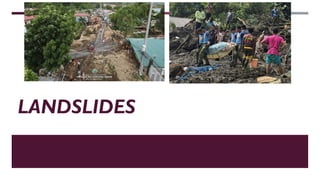
LANDSLIDES
A. BEFORE A LANDSLIDE
1. Be familiar with your surroundings. Watch for any changes to certain objects'
presence or positions. When there is a sudden debris flow, this could be a good
indicator of an incoming landslide.
2. Avoid open storm-water drainage and runoff as these areas are likely to
receive debris and soil from higher elevations, especially when there is a storm
or heavy rainfall.
3. Be updated on news regarding the condition of your area.
4. Be aware of the disaster plans of your local government.
5. Learn and participate in emergency response and evacuation plans for your
community.
B. DURING A LANDSLIDE
1. Be attentive to anything unusual such as cracking objects, moving debris, and
rolling boulders.
2. Stay away from the path of debris.This is more dangerous if mudflow occurs.
3. Stay alert and awake. Listen for unusual sounds that might indicate moving
debris, such as trees cracking or boulders knocking together.
4. Stay on an elevated and sturdy area. Avoid low-lying areas and steep slopes.
5. If escape is not possible, curl into a tight ball and protect your head. Find a
structure that can serve to protect you from the flow of debris.
C.AFTER A LANDSLIDE
1. Stay away from a slide area as there is still danger of more landslides.
2. Listen for the latest emergency information.
3. Follow warnings and instruction from the local government.
4. If the landslide is caused by rainfall, watch out for flooding as it will follow
the same path taken by the debris flow.
5. Check for injured or trapped people near the slide, and flooding as it will
follow other potential hazards. Report these immediately to the rescuers or
authorities
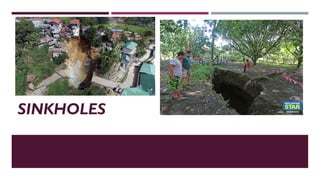
SINKHOLES
IN AN EVENTTHAT SINKHOLES ARE NOT DETECTED EARLIER
AND IT APPEARS SUDDENLY, DOTHE FOLLOWING:
1.Find refuge in a stable ground or open area.
2. Wait until the structures on and around the sinkhole stops
moving. Do not attempt to go back and retrieve your
belongings.
3. Wait for the local government’s announcement when it is
safe to go back.
AFTER A SINKHOLE’S APPEARANCE, HERE ARETHE FOLLOWING
STEPSTO DO:
1. Stay away from the sinkhole.
2. Monitor the damages on objects. For example, if the crack gets
longer or wider the sinkhole may still enlarge.
3. Do not throw anything into the sinkhole. Anything thrown into it
may contaminate the groundwater.
4. Secure whatever is left of your properties and relocate to safe
grounds, preferably far from this location because the same bedrock
or soil profile may characterize the vicinities of the sinkhole.


Disaster Readiness and Risk Reduction

  • 1.
    DISASTER READINESS ANDRISK REDUCTION QUARTER 4 MIKO ANSELM A. GALLON – SST I
  • 2.
    MOST ESSENTIAL LEARNINGCOMPETENCIES  Interpret geological maps. DRR11/12-IIa-b-30  Apply mitigation strategies to prevent loss of lives and properties. DRR11/12-IIa-b-31
  • 3.
  • 4.
    GEOLOGICAL HAZARD MAPS A map of geological hazards is a map showing the areas that are vulnerable to earthquake threats, volcanic eruptions, and landslides. It is a tool that scientists and local authorities use to anticipate any hazard that a geological event could bring. It also helps educate the public about and train them for the geological threat.
  • 7.
    GEOLOGICAL HAZARD MAPS Thereare different geological maps or geological hazard maps we have per municipal here in the Philippines. The maps depend on what disaster it focuses on. Legend per type of geological map varies, it describes the severity of the disaster in that area.
  • 8.
  • 9.
    GEOLOGICAL HAZARD MAPS Partsof Geological Map: 1. Legend 2. Interpretation 3.Title 4. Susceptibility 5. Sources
  • 11.
  • 12.
  • 13.
    MITIGATION STRATEGIES  2012New Bataan (CompostelaValley) Debris Flow Rains brought by Typhoon Pablo (Bopha) caused a massive debris flow in Barangay Andap in New Bataan, Compostela Valley on December 4, 2012. The flow of mud, boulders, and gravel rushed towards Barangay Andap, which was on the mouth of a steep mountain drainage network. At least 128 died and 450 went missing as the village was buried under the debris in the wake of the disaster.
  • 14.
    MITIGATION STRATEGIES  GRIEF.Residents of New Bataan, CompostelaValley identify the remains of victims of the flooding and landslide in the area, caused by typhoon Pablo (Bopha), on December 5, 2012. Photo by Karlos Manlupig
  • 15.
    MITIGATION STRATEGIES  Mitigationinvolves acting to reduce the risk of life or property damage from a potentially dangerous incident. There is no way to avoid natural disasters, but people and organizations may take steps to minimize the harm and losses that they cause.
  • 16.
    PROGRAMSTHAT INTENSIFY NATION’SHAZARD MITIGATION CAPABILITIES INCLUDESTHE FOLLOWING STEPS:  1. Protection of schools and hospitals All new schools and hospitals should be located and constructed to ensure that high-hazard areas are avoided and that special provisions are made to reduce the potential for damage by natural hazards. Furthermore, existing school and hospital buildings should be surveyed to determine their resistance levels to relevant hazards.
  • 17.
    PROGRAMSTHAT INTENSIFY NATION’SHAZARD MITIGATION CAPABILITIES INCLUDESTHE FOLLOWING STEPS:  2.Adoption of nonstructural measures Businesses and households should adopt non-structural mitigation measures to mitigate casualties from natural hazards and property damage. For example, furniture and equipment can be easily secured to reduce earthquake injuries and damage. Other non-structural steps are vegetation management to reduce damage from wildfires, and structure position away from high-risk areas.
  • 18.
    PROGRAMSTHAT INTENSIFY NATION’SHAZARD MITIGATION CAPABILITIES INCLUDESTHE FOLLOWING STEPS:  3. Incorporation of mitigation into new development Local jurisdictions should ensure that new developments are located, designed and built to resist natural hazards. They should use hazard and risk assessment information, land use plans and zoning regulations to limit the development of hazard-prone areas. Compatible uses of floodplains and other hazardous areas should be incorporated into local planning and zoning so that losses are reduced.
  • 19.
    PROGRAMSTHAT INTENSIFY NATION’SHAZARD MITIGATION CAPABILITIES INCLUDESTHE FOLLOWING STEPS:  4. Protection of cultural properties Mitigation preparation and intervention will include preservation of libraries, landmarks, historic buildings, art works, and other cultural resources.
  • 20.
    PROGRAMSTHAT INTENSIFY NATION’SHAZARD MITIGATION CAPABILITIES INCLUDESTHE FOLLOWING STEPS:  5. Protection of natural resources The mitigation plans and protection measures included in the disaster response plans should identify particularly valuable natural resources such as endangered species of wildlife, fish, and plants. These natural resources are not only present in the wild but also in zoos and parks.
  • 21.
    PROGRAMSTHAT INTENSIFY NATION’SHAZARD MITIGATION CAPABILITIES INCLUDESTHE FOLLOWING STEPS:  6. Government leadership of mitigation implementation Government at all levels should set an example by requiring that new facilities that they fund, regulate, or lease be designed, built, and located in accordance with modern building codes and sound.
  • 22.
    PROGRAMSTHAT INTENSIFY NATION’SHAZARD MITIGATION CAPABILITIES INCLUDESTHE FOLLOWING STEPS:  7. Mitigation training Training programs should be developed and offered with a focus on contemporary challenges associated with mitigation implementation.  8. Hazard-specific research Recent disasters showed the advantages of mitigation activities, thus emphasizing the need for research to improve mitigation practices.
  • 23.
    ACTIONS OR PLANSTOPROTECT HUMAN LIVES AND PROPERTIES  1. Develop and rehearse a family disaster plan—what to do if you are forced to leave home.  2. Include a communications plan—how to contact each other if you become separated.
  • 24.
    ACTIONS OR PLANSTOPROTECT HUMAN LIVES AND PROPERTIES  3. Put emergency supplies together, prepare one set for your home. Emergency supplies will contain food, water, a kit for first aid, flashlights, a radio and several batteries.
  • 25.
    ACTIONS OR PLANSTOPROTECT HUMAN LIVES AND PROPERTIES  4. Know how to shut off your appliances and keep the resources you need in hand. Make sure other family members know how to do that, too.  5. Duplicate important documents such as wills, birth certificates, financial statements, insurance plans and numbers of credit cards. Keep the originals in a box for safe deposit.
  • 26.
    ACTIONS OR PLANSTOPROTECT HUMAN LIVES AND PROPERTIES 6. Make a detailed inventory of your personal belongings, home or an apartment, garage and surrounding property, with photographs or videos and store it in a safe place.
  • 27.
  • 28.
    A. BEFORE ALANDSLIDE 1. Be familiar with your surroundings. Watch for any changes to certain objects' presence or positions. When there is a sudden debris flow, this could be a good indicator of an incoming landslide. 2. Avoid open storm-water drainage and runoff as these areas are likely to receive debris and soil from higher elevations, especially when there is a storm or heavy rainfall. 3. Be updated on news regarding the condition of your area. 4. Be aware of the disaster plans of your local government. 5. Learn and participate in emergency response and evacuation plans for your community.
  • 29.
    B. DURING ALANDSLIDE 1. Be attentive to anything unusual such as cracking objects, moving debris, and rolling boulders. 2. Stay away from the path of debris.This is more dangerous if mudflow occurs. 3. Stay alert and awake. Listen for unusual sounds that might indicate moving debris, such as trees cracking or boulders knocking together. 4. Stay on an elevated and sturdy area. Avoid low-lying areas and steep slopes. 5. If escape is not possible, curl into a tight ball and protect your head. Find a structure that can serve to protect you from the flow of debris.
  • 30.
    C.AFTER A LANDSLIDE 1.Stay away from a slide area as there is still danger of more landslides. 2. Listen for the latest emergency information. 3. Follow warnings and instruction from the local government. 4. If the landslide is caused by rainfall, watch out for flooding as it will follow the same path taken by the debris flow. 5. Check for injured or trapped people near the slide, and flooding as it will follow other potential hazards. Report these immediately to the rescuers or authorities
  • 31.
  • 32.
    IN AN EVENTTHATSINKHOLES ARE NOT DETECTED EARLIER AND IT APPEARS SUDDENLY, DOTHE FOLLOWING: 1.Find refuge in a stable ground or open area. 2. Wait until the structures on and around the sinkhole stops moving. Do not attempt to go back and retrieve your belongings. 3. Wait for the local government’s announcement when it is safe to go back.
  • 33.
    AFTER A SINKHOLE’SAPPEARANCE, HERE ARETHE FOLLOWING STEPSTO DO: 1. Stay away from the sinkhole. 2. Monitor the damages on objects. For example, if the crack gets longer or wider the sinkhole may still enlarge. 3. Do not throw anything into the sinkhole. Anything thrown into it may contaminate the groundwater. 4. Secure whatever is left of your properties and relocate to safe grounds, preferably far from this location because the same bedrock or soil profile may characterize the vicinities of the sinkhole.