DISASTER PREPAREDNESS &
PLANNING MANAGEMENT
III YEAR B.Tech II SEM
COMPUTER SECIENCE ENGINEERING
J NARESH
Department of Civil Engineering
VIGNAN institute of Technology & Science
UNIT-4
DISASTER RISK REUDCTION
Disaster Management Cycle
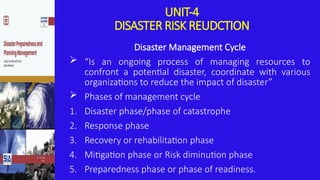
 “Is an ongoing process of managing resources to
confront a potential disaster, coordinate with various
organizations to reduce the impact of disaster”
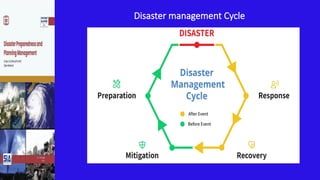
 Phases of management cycle
1. Disaster phase/phase of catastrophe
2. Response phase
3. Recovery or rehabilitation phase
4. Mitigation phase or Risk diminution phase
5. Preparedness phase or phase of readiness.
Disaster management Cycle
Disaster Management Cycle
1. Disaster phase: phase at which crisis occurs causing
damage to life, property, environment. The
affected people are in a state of profound shock.
2. Response phase: in this phase efforts are put forth
to minimize the problems a disaster.
 Providing assistance to the effected people.
 Providing food, water, shelter and temporary
repairs to infrastructure.
 The main objective is to meet the basic need of the
people.
Disaster Management Cycle
3. Recovery or Rehabilitation phase: phase at which
crisis occurs causing damage to life, property,
environment. The affected people are in a state of
profound shock.
4. Response phase: in this phase efforts are put forth
to minimize the problems a disaster.
 Providing assistance to the effected people.
 Providing food, water, shelter and temporary repairs
to infrastructure.
 The main objective is to meet the basic need of the
people.
Stages of Disaster Management
Stages of Disaster
1. Pre disaster stage
Preparedness
Mitigation Phase
2. Emergency stage
3. Post disaster stage
Stages of Disaster Management
Stages of Disaster
1. Pre disaster stage
Preparedness:
 This phase involves in planning to respond
immediately in anticipation of disaster.
 Includes awareness about emergency exercises.
 Installation of disaster warning systems.
 Storage of food, equipment, medicine must be
maintained.
Stages of Disaster Management
Preparedness:
 Also involves in
 Hazard zone mapping
 Hazard forecasting, warning and prediction
 Disaster preparedness plan
 Emergency operations plan (EOP) document
Stages of Disaster Management
Mitigation Phase:
 This is second aspect of pre-disaster stage.
 Construction of disaster resistant houses.
 Decreasing population in hazard sensitive zones.
 Awareness to public about do’s and don’ts at the
time of disaster.
 Land use control.
 Strengthening the important existing buildings.
Stages of Disaster Management
2. Emergency stage:
 This is the stage at which crisis occurs.
 All the efforts are put forth to minimize the
problems created by a disaster.
 Providing assistance to affected population with
transportation, food & shelter.
 Objective of this phase is meet the basic needs of
the affected population.
Stages of Disaster Management
3. Post Disaster stage:
 This phase includes recovery and rehabilitation.
 Reconstruction of damaged infrastructure.
 Educating people about health and safety, post
trauma counseling to volunteers.
Approaches involved in Disaster
Management
Approaches involved in disaster management:
 Landscape approach
 Ecosystem approach
 Perception approach
RISK REDUCTION PLAN
Steps involved in risk reduction plan:
 Disaster prevention and mitigation
 Disaster preparedness
 Disaster response
 Disaster rehabilitation and recovery
RISK REDUCTION PLAN
 Structural & Non – Structural measures of Disaster
Risk Reduction (DRR).
 Structural Mitigation measures.
1. Reservoirs for storing monsoon flows.
2. Preventing overbank spilling by constructing
embankments & flood walls.
3. Construction of proper flow channels.
4. Improving drainage.
RISK REDUCTION PLAN
 Structural & Non – Structural measures of Disaster Risk
Reduction (DRR).
 Non- Structural Mitigation measures.
1. Managing flood plains by flood plain zoning, flood
proofing.
2. Wetland management.
3. Pre disaster management such as relief, flood fighting,
education.
4. Post disaster management measure such as search,
rescue, medical psychiatric assistance and flood insurance.
Strategies used in Disaster Management
 Strategies for Disaster Management include.
1. Monitoring & Mapping of Hazards
2. Risk & Vulnerability Assessment
3. Prediction & Forecasting
4. Preparation of Building Guidelines
5. Retrofitting of existing unsafe structures &
buildings
Strategies used in Disaster Management
 Strategies for Disaster Management include.
1. Monitoring & Mapping of Hazards:
 Hazard monitoring is an important step in the
preparedness stage of disaster.
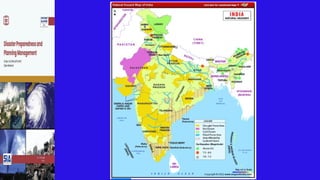
 The regions vulnerable to natural disasters must be
mapped accurately using latest techniques via RS &
GIS.
 Assess the parameters like soil type, mineral forming
rocks, water resources, vegetation and climate etc.
Strategies used in Disaster Management
2. Risk and Vulnerability Assessment:
 Identification of risks involved and the potential
consequences of hazards, as well as impacts on life
and property.
 Vulnerability indicators
• Improper design and building construction.
• Insufficient care for the assets.
• Lack of awareness among public.
• Insufficient preparedness.
Strategies used in Disaster Management
3. Prediction & Forecasting:
 Methods to predict natural disasters.
1. Fractal method: a mathematical formula to identify
disasters
2. Dilatancy theory: prediction of earthquake by
observation on rock samples.
3. Scientific method: advanced meteorological and
satellite systems is used to predict hurricanes,
tornadoes and cyclones.
4. Animal Behavior : behavior pattern of animals, birds
and insects change before impending disaster.
Strategies used in Disaster Management
4. Preparation of Building Guidelines:
 Follow the building codes to improve the quality of
new construction materials to resist disaster.
 Follow ethics in engineering to prevent adverse
effects.
5. Retrofitting of existing unsafe structures and buildings
 All the important structures should be repaired.
 Strengthen the structures using latest techniques.
Mitigation measures- Earthquake
 Mitigation measures
 Avoid construction of houses in earthquake areas
(ganga plains, western parts of Rajasthan)
 The ground should be stable and rocky.
 Use seismic retrofitting in structures.
 Avoid dumping of waste fluids in deep wells.
 Stop digging excessive bore wells.
 Minimize nuclear blasts.
 Educate people living earthquake prone areas.
Mitigation measures- Earthquake
 Minimize the impact of earthquake
 The houses should be securely attached to their
foundations.
 The water heaters and gas appliances should fixed to
walls to avoid accidents during earthquakes.
 Book cases, tall furniture and showcases should be
bolted to walls.
 Heavy items such as pictures and mirrors should be away
from beds.
 Overhead light fixtures should be fixed properly.
 Hazardous chemical should stored in closed cabinets.
Flood Control Measures
 Controlling measures
1. River engineering:
 Construction of large reservoirs dams.
 Construction of embankments.
 Desilting and dredging of rivers.
 Widening and deepening of rivers channels.
 Protection to river bank erosions.
2. Afforestation: planting trees will absorb moisture and
controlls the soil erosion.
Flood Control Measures
 Controlling measures
3. Planned urban development:
 Raising plinth area of the beams.
 Use of flood resistant buildings
 Use stainless or galvanized iron to avoid rusting of
important things.
 Base of the house must be water proof and proper
sealing should be done.
 Placing sand bags against the floods.
Cyclone Mitigation Measures
 Cyclone mitigation measures
1. Structural mitigation measures:
a. Construction of sea wall &embankment
b. Coastal bio shield: plant vegetation cover.
c. Multipurpose cyclone shelters with basic amenities
d. Cyclone resisting housing & infrastructure.
Cyclone Mitigation Measures
 Cyclone mitigation measures
2. Non- structural Mitigation measures
a. Early warning systems
b. Awareness & education
c. Community participation
Volcanic eruptions
 Methods to reduce the impact Volcanic eruption
 Avoid construction activities near the areas.
 Construction of RCC barrier wall to stop lava flow.
 Cooling lava with sea water.
 Construction of lava diversion channels.
 Digging of trenches away from residential areas.
 Always be informed about volcanic eruption.
 Provide awareness on such disasters.
LAND SLIDES
 Mitigation measures
 Avoid exploration of natural resources.
 Promote afforestation
 Soil erosion is avoided in steep slope areas.
 Construct embankments and walls at bottom of hill.
 Planting trees on steep slopes.
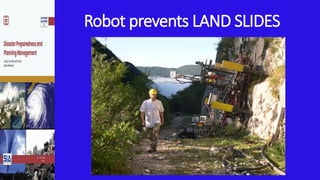
 Use robots which can prevent landslides.
 Stabilization of unsafe rocks & boulders
Robot prevents LAND SLIDES
Toxic chemicals
 Types of toxic chemicals
1. Carcinogens: cancer causing chemicals – arsenic,
benzene, formaldehyde, radiation, vinyl chloride.
2. Mutagens: cause changes in the DNA molecules –
nitrous acid, preservatives in food.
3. Teratogens: cause birth defects – lead, mercury,
benzene, formaldehyde.
Toxic chemicals
 Toxic chemicals mitigation measures
 Inventory management
 Alteration in the production process
 Recovery and reuse of chemical wastes.
 Designing sustainable products.
Toxic chemicals
 Toxic chemicals mitigation measures
 Inventory management
 Alteration in the production process
 Recovery and reuse of chemical wastes.
 Designing sustainable products.
Methods to control & Monitor Hazards
 Monitoring & control of environmental hazards
 Remote sensing instruments
 Arial photography
 Colour infrared film (CIR)
 Thermal infrared multispectral scanner (TIMS)
 Airnorne Oceanographic Lidar (AOL)
 Synthetic Aperture Radar (SAR)
 Magnetic Resonance Imaging (MRI) &X-Ray
 Geostationary satellites – INSAT & GOES
Methods to control & Monitor Hazards
 Monitoring & control of environmental hazards
 Monitoring Famine
 Femine can be forecast by satellite observations of
the rainfall data.
 The Femine Early Warning System Network
(FEWSNET)
 Advanced very high Resolution radiometer (AVHRR)
 Moderate Resolution Imaging Spectroradiometer
(MODIS)
Methods to control & Monitor Hazards
 Monitoring & control of environmental hazards
 Monitoring Floods
 Floods & rainfall can be monitored by the Tropical Rainfall
Monitoring Mission Satellite.
 Sentinel Asia consists of a team of 51 organizations for 18
countries to provide early warning & flood damage
assessment.
 Fire Mapping : Uses remote sensing technology
 Earthquake monitoring: by IMD, new Delhi
 Cyclone monitoring: uses kalpana-I and INSAT-3A
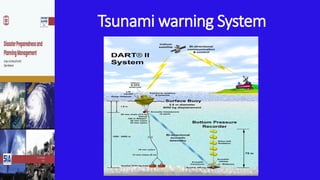
 Tsunami monitoring : Pressure sensor & Surface Buoy
Tsunami – Warning System
 Tragic Tsunami on Dec-26th
,2004 caused by an earth
quake in the Indian Ocean (worst catastrophic event in
recent times).
 1.5 lakh people died
 many more missing.
 Due to lack of Tsunami warning
System.
 As a mitigation measure a
Warning system is established by
INCOIS, Hyderabad
Tsunami warning System
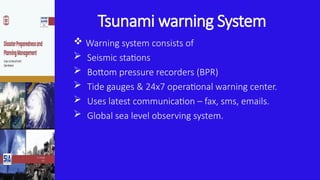
 Warning system consists of
 Seismic stations
 Bottom pressure recorders (BPR)
 Tide gauges & 24x7 operational warning center.
 Uses latest communication – fax, sms, emails.
 Global sea level observing system.
Tsunami warning System
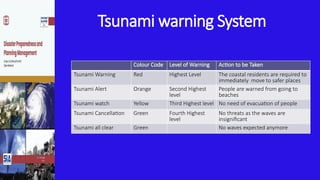
Colour Code Level of Warning Action to be Taken
Tsunami Warning Red Highest Level The coastal residents are required to
immediately move to safer places
Tsunami Alert Orange Second Highest
level
People are warned from going to
beaches
Tsunami watch Yellow Third Highest level No need of evacuation of people
Tsunami Cancellation Green Fourth Highest
level
No threats as the waves are
insignificant
Tsunami all clear Green No waves expected anymore
Advanced warning systems
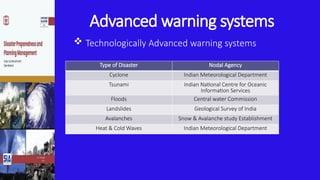
 Technologically Advanced warning systems
Type of Disaster Nodal Agency
Cyclone Indian Meteorological Department
Tsunami Indian National Centre for Oceanic
Information Services
Floods Central water Commission
Landslides Geological Survey of India
Avalanches Snow & Avalanche study Establishment
Heat & Cold Waves Indian Meteorological Department
Post Disaster Environmental Response
 Post a disaster activities undertaken as relief programs
– water, sanitation, food safety, waste management,
disease control, security, communications.
1. Water availability:
 Ensure safe supply of drinking water for houses
 Use boiled or treated water only
 Water can be disinfected using disinfectant (chlorine
bleach).
Post Disaster Environmental Response
2. Sanitation facility:
 Provide sanitation facilities to disaster victims.
 Provide safe disposal of human excreta & refuse.
3. Food safety:
 Avoid improperly refrigerated food
 Avoid Food with unacceptable colour, smell
 Avoid food mixed with contaminated water.
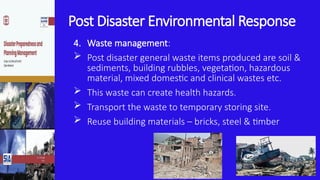
Post Disaster Environmental Response
4. Waste management:
 Post disaster general waste items produced are soil &
sediments, building rubbles, vegetation, hazardous
material, mixed domestic and clinical wastes etc.
 This waste can create health hazards.
 Transport the waste to temporary storing site.
 Reuse building materials – bricks, steel & timber
Post Disaster Environmental Response
5. Disease Control:
 The main cause of morbidity are
 Acute respiratory illness
 Diarrhea, hepatitis A & E, leptospirosis.
 Infections due to wounds & injuries.
 Take preventive measures to treat the victims
Post Disaster Environmental Response
6. Communication efforts:
 Timely and effective communication is essential.
 Use social media platforms for communication and
educate the victims.
Roles & Responsibilities
1. Government:
 The rescue, relief & rehabilitation measures in the
event of environmental hazards & disaster is the
responsibility of government.
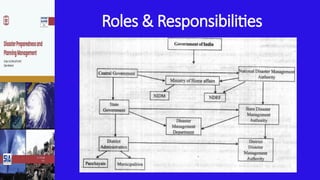
a. National level organization:
 All the activities are coordinated by nodal ministry at
the national level.
 Central government is responsible for providing
logistics, financial support & other resources.
 The ministry of home affair take over disaster
management.
Roles & Responsibilities
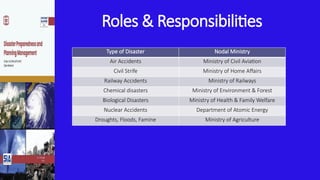
Type of Disaster Nodal Ministry
Air Accidents Ministry of Civil Aviation
Civil Strife Ministry of Home Affairs
Railway Accidents Ministry of Railways
Chemical disasters Ministry of Environment & Forest
Biological Disasters Ministry of Health & Family Welfare
Nuclear Accidents Department of Atomic Energy
Droughts, Floods, Famine Ministry of Agriculture
Roles & Responsibilities
b. State level organization:
 Relief commissioner of a state is responsible to take
over relief measures.
 Or chief secretary in absence of Relief commissioner.
 Every state has a State Crisis Management Group
(SCMG) with Chief secretary/ Relief commissioner as
Chairman.
 This group has senior officers of from all the
departments – revenue, civil supplies, irrigation,
panchayat, rural development etc.
Roles & Responsibilities
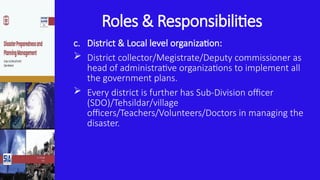
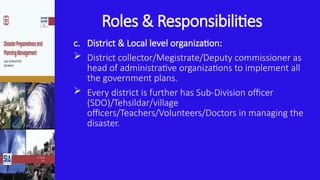
c. District & Local level organization:
 District collector/Megistrate/Deputy commissioner as
head of administrative organizations to implement all
the government plans.
 Every district is further has Sub-Division officer
(SDO)/Tehsildar/village
officers/Teachers/Volunteers/Doctors in managing the
disaster.
Roles & Responsibilities
c. District & Local level organization:
 District collector/Megistrate/Deputy commissioner as
head of administrative organizations to implement all
the government plans.
 Every district is further has Sub-Division officer
(SDO)/Tehsildar/village
officers/Teachers/Volunteers/Doctors in managing the
disaster.
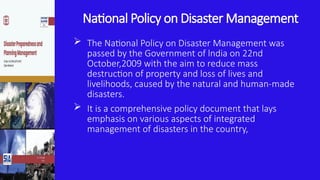
National Policy on Disaster Management
 The National Policy on Disaster Management was
passed by the Government of lndia on 22nd
October,2009 with the aim to reduce mass
destruction of property and loss of lives and
livelihoods, caused by the natural and human-made
disasters.
 It is a comprehensive policy document that lays
emphasis on various aspects of integrated
management of disasters in the country,
National Policy on Disaster Management
 The main aim of India's national policy on Disaster
Management are :
 To encourage prevention & preparedness from
disaster through awareness and education.
 To strengthen the measures related mitigation of
disasters using technology, traditional wisdom and
environmental sustainability.
 Channelize the management of disasters into
developmental planning process.
 Setup institutional and techno legal frameworks.
National Policy on Disaster Management
 Establish an efficient mechanism of disaster risk
reduction.
 Develop resources/technology in forecasting and early
warning systems.
 To assure proper response and relief in the event of a
disaster and take proper care of the vulnerable
sections of the society,
 Take up reconstruction of disaster resistant structures
to rebuild the lives of the victims.
THANK YOU

UNIT IV_DPPM_PPT as per JNTUH syllabus..

  • 1.
    DISASTER PREPAREDNESS & PLANNINGMANAGEMENT III YEAR B.Tech II SEM COMPUTER SECIENCE ENGINEERING J NARESH Department of Civil Engineering VIGNAN institute of Technology & Science
  • 2.
    UNIT-4 DISASTER RISK REUDCTION DisasterManagement Cycle  “Is an ongoing process of managing resources to confront a potential disaster, coordinate with various organizations to reduce the impact of disaster”  Phases of management cycle 1. Disaster phase/phase of catastrophe 2. Response phase 3. Recovery or rehabilitation phase 4. Mitigation phase or Risk diminution phase 5. Preparedness phase or phase of readiness.
  • 3.
  • 4.
    Disaster Management Cycle 1.Disaster phase: phase at which crisis occurs causing damage to life, property, environment. The affected people are in a state of profound shock. 2. Response phase: in this phase efforts are put forth to minimize the problems a disaster.  Providing assistance to the effected people.  Providing food, water, shelter and temporary repairs to infrastructure.  The main objective is to meet the basic need of the people.
  • 5.
    Disaster Management Cycle 3.Recovery or Rehabilitation phase: phase at which crisis occurs causing damage to life, property, environment. The affected people are in a state of profound shock. 4. Response phase: in this phase efforts are put forth to minimize the problems a disaster.  Providing assistance to the effected people.  Providing food, water, shelter and temporary repairs to infrastructure.  The main objective is to meet the basic need of the people.
  • 6.
    Stages of DisasterManagement Stages of Disaster 1. Pre disaster stage Preparedness Mitigation Phase 2. Emergency stage 3. Post disaster stage
  • 7.
    Stages of DisasterManagement Stages of Disaster 1. Pre disaster stage Preparedness:  This phase involves in planning to respond immediately in anticipation of disaster.  Includes awareness about emergency exercises.  Installation of disaster warning systems.  Storage of food, equipment, medicine must be maintained.
  • 8.
    Stages of DisasterManagement Preparedness:  Also involves in  Hazard zone mapping  Hazard forecasting, warning and prediction  Disaster preparedness plan  Emergency operations plan (EOP) document
  • 9.
    Stages of DisasterManagement Mitigation Phase:  This is second aspect of pre-disaster stage.  Construction of disaster resistant houses.  Decreasing population in hazard sensitive zones.  Awareness to public about do’s and don’ts at the time of disaster.  Land use control.  Strengthening the important existing buildings.
  • 10.
    Stages of DisasterManagement 2. Emergency stage:  This is the stage at which crisis occurs.  All the efforts are put forth to minimize the problems created by a disaster.  Providing assistance to affected population with transportation, food & shelter.  Objective of this phase is meet the basic needs of the affected population.
  • 11.
    Stages of DisasterManagement 3. Post Disaster stage:  This phase includes recovery and rehabilitation.  Reconstruction of damaged infrastructure.  Educating people about health and safety, post trauma counseling to volunteers.
  • 12.
    Approaches involved inDisaster Management Approaches involved in disaster management:  Landscape approach  Ecosystem approach  Perception approach
  • 13.
    RISK REDUCTION PLAN Stepsinvolved in risk reduction plan:  Disaster prevention and mitigation  Disaster preparedness  Disaster response  Disaster rehabilitation and recovery
  • 14.
    RISK REDUCTION PLAN Structural & Non – Structural measures of Disaster Risk Reduction (DRR).  Structural Mitigation measures. 1. Reservoirs for storing monsoon flows. 2. Preventing overbank spilling by constructing embankments & flood walls. 3. Construction of proper flow channels. 4. Improving drainage.
  • 15.
    RISK REDUCTION PLAN Structural & Non – Structural measures of Disaster Risk Reduction (DRR).  Non- Structural Mitigation measures. 1. Managing flood plains by flood plain zoning, flood proofing. 2. Wetland management. 3. Pre disaster management such as relief, flood fighting, education. 4. Post disaster management measure such as search, rescue, medical psychiatric assistance and flood insurance.
  • 16.
    Strategies used inDisaster Management  Strategies for Disaster Management include. 1. Monitoring & Mapping of Hazards 2. Risk & Vulnerability Assessment 3. Prediction & Forecasting 4. Preparation of Building Guidelines 5. Retrofitting of existing unsafe structures & buildings
  • 17.
    Strategies used inDisaster Management  Strategies for Disaster Management include. 1. Monitoring & Mapping of Hazards:  Hazard monitoring is an important step in the preparedness stage of disaster.  The regions vulnerable to natural disasters must be mapped accurately using latest techniques via RS & GIS.  Assess the parameters like soil type, mineral forming rocks, water resources, vegetation and climate etc.
  • 19.
    Strategies used inDisaster Management 2. Risk and Vulnerability Assessment:  Identification of risks involved and the potential consequences of hazards, as well as impacts on life and property.  Vulnerability indicators • Improper design and building construction. • Insufficient care for the assets. • Lack of awareness among public. • Insufficient preparedness.
  • 20.
    Strategies used inDisaster Management 3. Prediction & Forecasting:  Methods to predict natural disasters. 1. Fractal method: a mathematical formula to identify disasters 2. Dilatancy theory: prediction of earthquake by observation on rock samples. 3. Scientific method: advanced meteorological and satellite systems is used to predict hurricanes, tornadoes and cyclones. 4. Animal Behavior : behavior pattern of animals, birds and insects change before impending disaster.
  • 21.
    Strategies used inDisaster Management 4. Preparation of Building Guidelines:  Follow the building codes to improve the quality of new construction materials to resist disaster.  Follow ethics in engineering to prevent adverse effects. 5. Retrofitting of existing unsafe structures and buildings  All the important structures should be repaired.  Strengthen the structures using latest techniques.
  • 22.
    Mitigation measures- Earthquake Mitigation measures  Avoid construction of houses in earthquake areas (ganga plains, western parts of Rajasthan)  The ground should be stable and rocky.  Use seismic retrofitting in structures.  Avoid dumping of waste fluids in deep wells.  Stop digging excessive bore wells.  Minimize nuclear blasts.  Educate people living earthquake prone areas.
  • 23.
    Mitigation measures- Earthquake Minimize the impact of earthquake  The houses should be securely attached to their foundations.  The water heaters and gas appliances should fixed to walls to avoid accidents during earthquakes.  Book cases, tall furniture and showcases should be bolted to walls.  Heavy items such as pictures and mirrors should be away from beds.  Overhead light fixtures should be fixed properly.  Hazardous chemical should stored in closed cabinets.
  • 24.
    Flood Control Measures Controlling measures 1. River engineering:  Construction of large reservoirs dams.  Construction of embankments.  Desilting and dredging of rivers.  Widening and deepening of rivers channels.  Protection to river bank erosions. 2. Afforestation: planting trees will absorb moisture and controlls the soil erosion.
  • 25.
    Flood Control Measures Controlling measures 3. Planned urban development:  Raising plinth area of the beams.  Use of flood resistant buildings  Use stainless or galvanized iron to avoid rusting of important things.  Base of the house must be water proof and proper sealing should be done.  Placing sand bags against the floods.
  • 26.
    Cyclone Mitigation Measures Cyclone mitigation measures 1. Structural mitigation measures: a. Construction of sea wall &embankment b. Coastal bio shield: plant vegetation cover. c. Multipurpose cyclone shelters with basic amenities d. Cyclone resisting housing & infrastructure.
  • 27.
    Cyclone Mitigation Measures Cyclone mitigation measures 2. Non- structural Mitigation measures a. Early warning systems b. Awareness & education c. Community participation
  • 28.
    Volcanic eruptions  Methodsto reduce the impact Volcanic eruption  Avoid construction activities near the areas.  Construction of RCC barrier wall to stop lava flow.  Cooling lava with sea water.  Construction of lava diversion channels.  Digging of trenches away from residential areas.  Always be informed about volcanic eruption.  Provide awareness on such disasters.
  • 29.
    LAND SLIDES  Mitigationmeasures  Avoid exploration of natural resources.  Promote afforestation  Soil erosion is avoided in steep slope areas.  Construct embankments and walls at bottom of hill.  Planting trees on steep slopes.  Use robots which can prevent landslides.  Stabilization of unsafe rocks & boulders
  • 30.
  • 31.
    Toxic chemicals  Typesof toxic chemicals 1. Carcinogens: cancer causing chemicals – arsenic, benzene, formaldehyde, radiation, vinyl chloride. 2. Mutagens: cause changes in the DNA molecules – nitrous acid, preservatives in food. 3. Teratogens: cause birth defects – lead, mercury, benzene, formaldehyde.
  • 32.
    Toxic chemicals  Toxicchemicals mitigation measures  Inventory management  Alteration in the production process  Recovery and reuse of chemical wastes.  Designing sustainable products.
  • 33.
    Toxic chemicals  Toxicchemicals mitigation measures  Inventory management  Alteration in the production process  Recovery and reuse of chemical wastes.  Designing sustainable products.
  • 34.
    Methods to control& Monitor Hazards  Monitoring & control of environmental hazards  Remote sensing instruments  Arial photography  Colour infrared film (CIR)  Thermal infrared multispectral scanner (TIMS)  Airnorne Oceanographic Lidar (AOL)  Synthetic Aperture Radar (SAR)  Magnetic Resonance Imaging (MRI) &X-Ray  Geostationary satellites – INSAT & GOES
  • 35.
    Methods to control& Monitor Hazards  Monitoring & control of environmental hazards  Monitoring Famine  Femine can be forecast by satellite observations of the rainfall data.  The Femine Early Warning System Network (FEWSNET)  Advanced very high Resolution radiometer (AVHRR)  Moderate Resolution Imaging Spectroradiometer (MODIS)
  • 36.
    Methods to control& Monitor Hazards  Monitoring & control of environmental hazards  Monitoring Floods  Floods & rainfall can be monitored by the Tropical Rainfall Monitoring Mission Satellite.  Sentinel Asia consists of a team of 51 organizations for 18 countries to provide early warning & flood damage assessment.  Fire Mapping : Uses remote sensing technology  Earthquake monitoring: by IMD, new Delhi  Cyclone monitoring: uses kalpana-I and INSAT-3A  Tsunami monitoring : Pressure sensor & Surface Buoy
  • 37.
    Tsunami – WarningSystem  Tragic Tsunami on Dec-26th ,2004 caused by an earth quake in the Indian Ocean (worst catastrophic event in recent times).  1.5 lakh people died  many more missing.  Due to lack of Tsunami warning System.  As a mitigation measure a Warning system is established by INCOIS, Hyderabad
  • 38.
    Tsunami warning System Warning system consists of  Seismic stations  Bottom pressure recorders (BPR)  Tide gauges & 24x7 operational warning center.  Uses latest communication – fax, sms, emails.  Global sea level observing system.
  • 39.
  • 40.
    Tsunami warning System ColourCode Level of Warning Action to be Taken Tsunami Warning Red Highest Level The coastal residents are required to immediately move to safer places Tsunami Alert Orange Second Highest level People are warned from going to beaches Tsunami watch Yellow Third Highest level No need of evacuation of people Tsunami Cancellation Green Fourth Highest level No threats as the waves are insignificant Tsunami all clear Green No waves expected anymore
  • 41.
    Advanced warning systems Technologically Advanced warning systems Type of Disaster Nodal Agency Cyclone Indian Meteorological Department Tsunami Indian National Centre for Oceanic Information Services Floods Central water Commission Landslides Geological Survey of India Avalanches Snow & Avalanche study Establishment Heat & Cold Waves Indian Meteorological Department
  • 42.
    Post Disaster EnvironmentalResponse  Post a disaster activities undertaken as relief programs – water, sanitation, food safety, waste management, disease control, security, communications. 1. Water availability:  Ensure safe supply of drinking water for houses  Use boiled or treated water only  Water can be disinfected using disinfectant (chlorine bleach).
  • 43.
    Post Disaster EnvironmentalResponse 2. Sanitation facility:  Provide sanitation facilities to disaster victims.  Provide safe disposal of human excreta & refuse. 3. Food safety:  Avoid improperly refrigerated food  Avoid Food with unacceptable colour, smell  Avoid food mixed with contaminated water.
  • 44.
    Post Disaster EnvironmentalResponse 4. Waste management:  Post disaster general waste items produced are soil & sediments, building rubbles, vegetation, hazardous material, mixed domestic and clinical wastes etc.  This waste can create health hazards.  Transport the waste to temporary storing site.  Reuse building materials – bricks, steel & timber
  • 45.
    Post Disaster EnvironmentalResponse 5. Disease Control:  The main cause of morbidity are  Acute respiratory illness  Diarrhea, hepatitis A & E, leptospirosis.  Infections due to wounds & injuries.  Take preventive measures to treat the victims
  • 46.
    Post Disaster EnvironmentalResponse 6. Communication efforts:  Timely and effective communication is essential.  Use social media platforms for communication and educate the victims.
  • 47.
    Roles & Responsibilities 1.Government:  The rescue, relief & rehabilitation measures in the event of environmental hazards & disaster is the responsibility of government. a. National level organization:  All the activities are coordinated by nodal ministry at the national level.  Central government is responsible for providing logistics, financial support & other resources.  The ministry of home affair take over disaster management.
  • 48.
    Roles & Responsibilities Typeof Disaster Nodal Ministry Air Accidents Ministry of Civil Aviation Civil Strife Ministry of Home Affairs Railway Accidents Ministry of Railways Chemical disasters Ministry of Environment & Forest Biological Disasters Ministry of Health & Family Welfare Nuclear Accidents Department of Atomic Energy Droughts, Floods, Famine Ministry of Agriculture
  • 49.
    Roles & Responsibilities b.State level organization:  Relief commissioner of a state is responsible to take over relief measures.  Or chief secretary in absence of Relief commissioner.  Every state has a State Crisis Management Group (SCMG) with Chief secretary/ Relief commissioner as Chairman.  This group has senior officers of from all the departments – revenue, civil supplies, irrigation, panchayat, rural development etc.
  • 50.
    Roles & Responsibilities c.District & Local level organization:  District collector/Megistrate/Deputy commissioner as head of administrative organizations to implement all the government plans.  Every district is further has Sub-Division officer (SDO)/Tehsildar/village officers/Teachers/Volunteers/Doctors in managing the disaster.
  • 51.
  • 52.
    Roles & Responsibilities c.District & Local level organization:  District collector/Megistrate/Deputy commissioner as head of administrative organizations to implement all the government plans.  Every district is further has Sub-Division officer (SDO)/Tehsildar/village officers/Teachers/Volunteers/Doctors in managing the disaster.
  • 53.
    National Policy onDisaster Management  The National Policy on Disaster Management was passed by the Government of lndia on 22nd October,2009 with the aim to reduce mass destruction of property and loss of lives and livelihoods, caused by the natural and human-made disasters.  It is a comprehensive policy document that lays emphasis on various aspects of integrated management of disasters in the country,
  • 54.
    National Policy onDisaster Management  The main aim of India's national policy on Disaster Management are :  To encourage prevention & preparedness from disaster through awareness and education.  To strengthen the measures related mitigation of disasters using technology, traditional wisdom and environmental sustainability.  Channelize the management of disasters into developmental planning process.  Setup institutional and techno legal frameworks.
  • 55.
    National Policy onDisaster Management  Establish an efficient mechanism of disaster risk reduction.  Develop resources/technology in forecasting and early warning systems.  To assure proper response and relief in the event of a disaster and take proper care of the vulnerable sections of the society,  Take up reconstruction of disaster resistant structures to rebuild the lives of the victims.
  • 56.