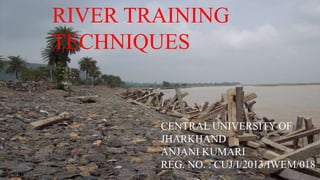
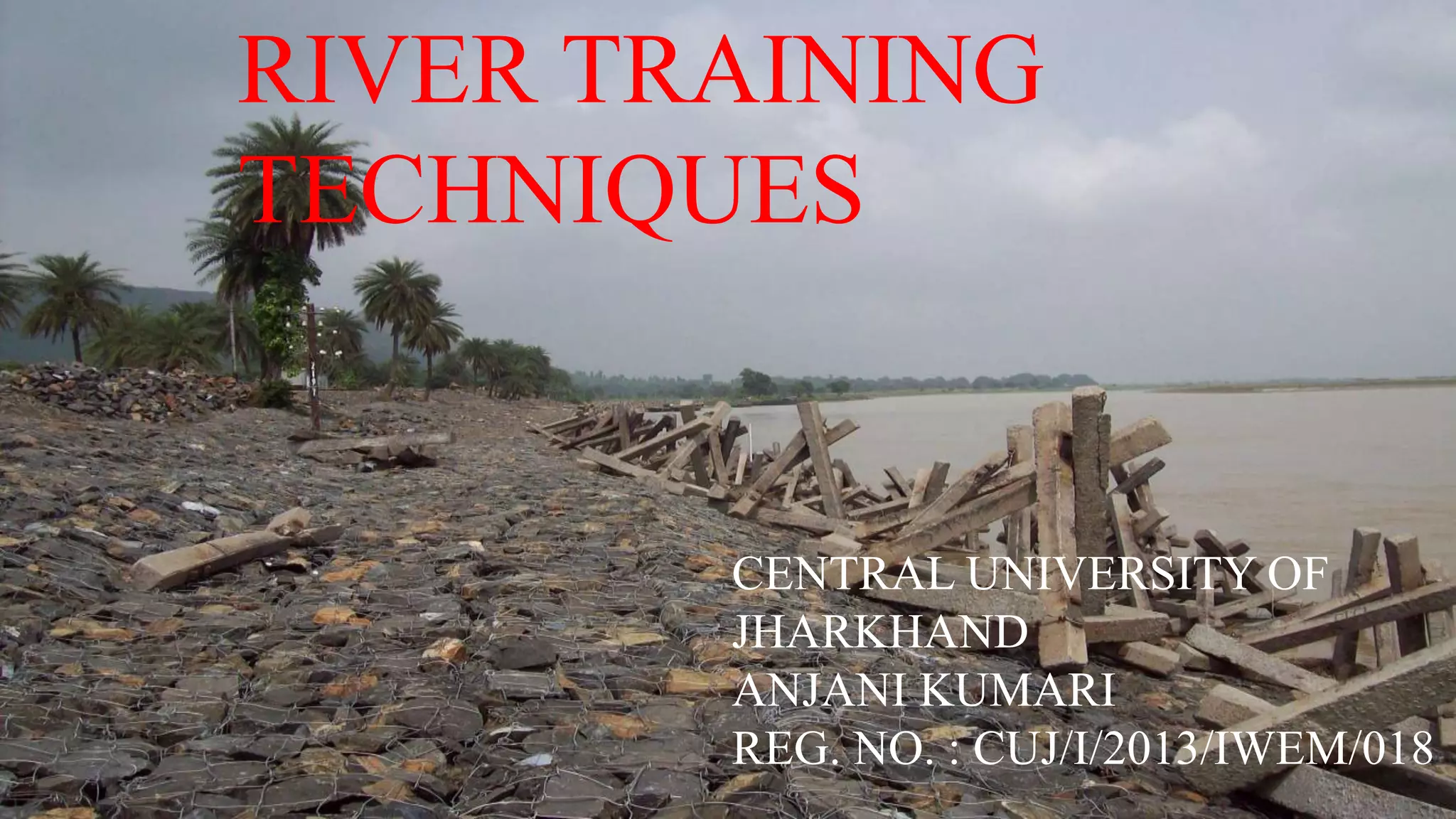
RIVER TRAINING
TECHNIQUES
CENTRAL UNIVERSITY OF
JHARKHAND
ANJANI KUMARI
REG. NO. : CUJ/I/2013/IWEM/018
INTRODUCTION
• River training is an art to protect the bank from erosion, changing the course,
flood, and sediment control etc.
• Most of the rivers have meandering behavior and rarely does a river follow a
straight path. due to excessive meandering and hence erosion in the outer bank,
some rivers tend to shift their course while others tend to follow a completely
new path. Various measures have been taken to control river bank and in-stream
erosion by constructing river training works such as submerged vanes, bank
pitching, spurs, Groynes, guide vanes, etc. Due to rising cost of these
conventional river training works, developing countries like India have been
adopting economic measures of river training. permeable structures tend to be the
least expensive to construction. Bandalling, board fencing, jack-jetty systems and
tetrahedral frames are some of these cost-effective methods used for river
training.
PERMEABLE STRUCTURE
Permeable structures are a cost effective alternative to the bank protection works
with impermeable stone spurs, making the projects more economical.
Permeable screens, spurs and dampeners are the main types of permeable
structures.
The permeable structures can be used either independently or with a support of
other impermeable stone structures or river training and bank protection
measures. depending up on the purpose to serve, the permeable structures are
constructed in transverse or parallel to the direction of flow.
FUNCTION OF PERMEABLE MEMBER:
• Training the river along a desired course.
• Reducing the intensity of flow at the point of river attack.
• Creating a slack flow to induce siltation in the vicinity of the permeable
structures and in the downstream reach.
• Providing protection to the bank by reducing the velocity of flow along the bank.
• Dissipating energy downstream of spurs through production of turbulence.
• The basic principle behind the permeable structure is to reduce the velocity by
providing partial obstruction to the flow and thereby induce deposition of the
sediment
• CLASSIFICATION OF PERMEABLE STRUCTURES
• According to function served, namely, diverting and dampening, sedimenting.
• According to the method and material of construction, namely, bamboo, tree and
willow structures.
• According to the conditions encountered, namely, submerged and non-
submerged.
• According to the type of structure provided, namely, spur type, screen type or
dampeners (revetment) type.
PORCUPINE
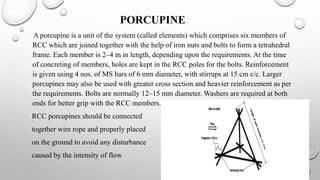
A porcupine is a unit of the system (called elements) which comprises six members of
RCC which are joined together with the help of iron nuts and bolts to form a tetrahedral
frame. Each member is 2–4 m in length, depending upon the requirements. At the time
of concreting of members, holes are kept in the RCC poles for the bolts. Reinforcement
is given using 4 nos. of MS bars of 6 mm diameter, with stirrups at 15 cm c/c. Larger
porcupines may also be used with greater cross section and heavier reinforcement as per
the requirements. Bolts are normally 12–15 mm diameter. Washers are required at both
ends for better grip with the RCC members.
RCC porcupines should be connected
together wire rope and properly placed
on the ground to avoid any disturbance
caused by the intensity of flow
STRUCTURAL ELEMENTS
The elements used in the RCC porcupine screens/spurs are as under:
• (a) members: the porcupines are made of RCC, casted in-situ at the site or
location near the site. six members are used to construct one porcupine. the size
of one member is kept as 3mx0.1mx0.1m or 2mx0.1mx0.1m. these members are
joined with the help of nails.
• (b) nails: standard commercially available nails of length 100 mm to 150 mm are
used to join the porcupine members.
• (c) GI wire: 4 to 5 strands of 4 mm GI wire should be used for inter-connecting
the porcupines and may be anchored with the ground. alternatively,
• use of nylon ropes instead of GI wires may also be tried. but these are susceptible
to disintegration in presence of UV rays. in view of this, UV stabilized nylon
ropes may be tried instead of GI wires due to their better usability and flexibility
and non-corrosive behavior.
PRINCIPLE
• The basic principle of porcupine protecting river bank is the decelerating effect
of member bars which offer resistance to flow and hence cause reduction in
velocity.
• The turbulence characteristics of flows passing through a porcupine and that it
reduces the probability of sediment entrainment by retarding the flow and
reducing the boundary shear stress. (lu et al. (2011) ). In addition, it may induce
sediment deposition in a sediment laden flow by changing the flow direction and
increasing the energy dissipation.
• In addition to providing riverbank protection, porcupines can also be used for
protection of bridge piers against scouring .
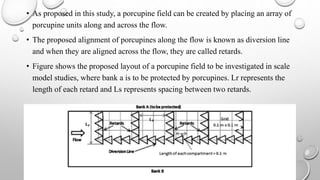
• As proposed in this study, a porcupine field can be created by placing an array of
porcupine units along and across the flow.
• The proposed alignment of porcupines along the flow is known as diversion line
and when they are aligned across the flow, they are called retards.
• Figure shows the proposed layout of a porcupine field to be investigated in scale
model studies, where bank a is to be protected by porcupines. Lr represents the
length of each retard and Ls represents spacing between two retards.
DESIGN DATA
Following are the important hydraulic data required for the design.
• Hydrology of the river, nature of floods (flashy or sustained), duration of floods,
cross section of river, etc.
• Design discharge (peak flood discharge of 25 years return period) with
corresponding HFL, bank level and maximum velocity of the flow, maximum
depth of flow.
• Lowest discharge, corresponding water level, depth of flow during lean period at
the site.
• Soil properties of the bank, characteristics of the formation of the bank,
particularly the existence of stiff clay layer resistant to erosion, its location.
• Sediment load in the river and in the channel under consideration at different
stages of flood.
• The porcupines (comprising of six members of size 3mx0.1mx0.1m) are laid in a row
across the river bank protruding into the river at spacing generally adopted as 3m c/c. if
size of member is 2m x 0.1m x 0.1m, then spacing between the porcupines may be kept as
2m c/c.
• Each porcupine spur is made up of 3 to 7 rows of porcupines (higher rows for higher
flow). the spacing of rows is kept at same as spacing of each porcupine in each row (3 m
or 2 m c/c depending upon size of the member).
• If the flow depth is more than 6 m, RCC porcupine spurs may be provided in double
vertical layers.
• On a straight reach, RCC porcupine spurs are placed at 3 to 5 times the length of spur. on a
curved channel, the spacing can be kept as 2 to 4 times the length of spur.
PORCUPINE SPUR
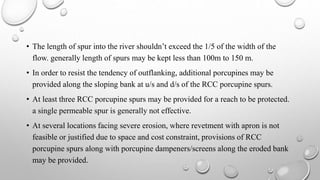
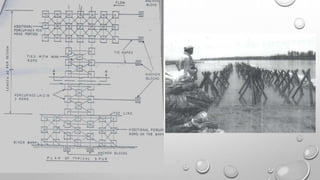
• The length of spur into the river shouldn’t exceed the 1/5 of the width of the
flow. generally length of spurs may be kept less than 100m to 150 m.
• In order to resist the tendency of outflanking, additional porcupines may be
provided along the sloping bank at u/s and d/s of the RCC porcupine spurs.
• At least three RCC porcupine spurs may be provided for a reach to be protected.
a single permeable spur is generally not effective.
• At several locations facing severe erosion, where revetment with apron is not
feasible or justified due to space and cost constraint, provisions of RCC
porcupine spurs along with porcupine dampeners/screens along the eroded bank
may be provided.
THE RCC PORCUPINE DAMPENERS
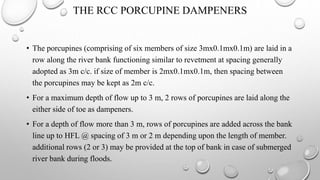
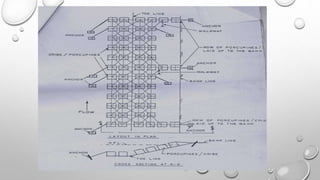
• The porcupines (comprising of six members of size 3mx0.1mx0.1m) are laid in a
row along the river bank functioning similar to revetment at spacing generally
adopted as 3m c/c. if size of member is 2mx0.1mx0.1m, then spacing between
the porcupines may be kept as 2m c/c.
• For a maximum depth of flow up to 3 m, 2 rows of porcupines are laid along the
either side of toe as dampeners.
• For a depth of flow more than 3 m, rows of porcupines are added across the bank
line up to HFL @ spacing of 3 m or 2 m depending upon the length of member.
additional rows (2 or 3) may be provided at the top of bank in case of submerged
river bank during floods.
RCC PORCUPINE SCREENS
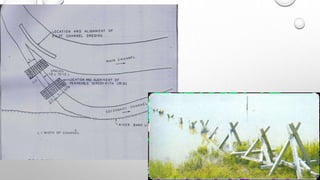
• The rcc porcupine screens are used to block the secondary channels.
• Each porcupine screen is made up of 5 to 9 rows of porcupines (higher rows for
higher flow). the spacing of rows is kept as same.(3 m or 2 m c/c depending upon
size of the member).
• At least two screens are provided to block the secondary channel. a single screen
is generally not found effective.
• One screen is normally provided at the entrance of the secondary channel. the
second screen is provided at a distance of 1 to 1.5 times width of the secondary
channel.
• The screens are constructed covering a part or the whole width of secondary
channel. if the screen covers the whole width, the screens are extended on both
banks for a length 1/3rd of the channel width.
PORCUPINE IN INDIA
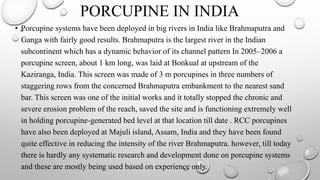
• Porcupine systems have been deployed in big rivers in India like Brahmaputra and
Ganga with fairly good results. Brahmaputra is the largest river in the Indian
subcontinent which has a dynamic behavior of its channel pattern In 2005–2006 a
porcupine screen, about 1 km long, was laid at Bonkual at upstream of the
Kaziranga, India. This screen was made of 3 m porcupines in three numbers of
staggering rows from the concerned Brahmaputra embankment to the nearest sand
bar. This screen was one of the initial works and it totally stopped the chronic and
severe erosion problem of the reach, saved the site and is functioning extremely well
in holding porcupine-generated bed level at that location till date . RCC porcupines
have also been deployed at Majuli island, Assam, India and they have been found
quite effective in reducing the intensity of the river Brahmaputra. however, till today
there is hardly any systematic research and development done on porcupine systems
and these are mostly being used based on experience only.
Porcupine

Porcupine

  • 1.
    RIVER TRAINING TECHNIQUES CENTRAL UNIVERSITYOF JHARKHAND ANJANI KUMARI REG. NO. : CUJ/I/2013/IWEM/018
  • 2.
    INTRODUCTION • River trainingis an art to protect the bank from erosion, changing the course, flood, and sediment control etc. • Most of the rivers have meandering behavior and rarely does a river follow a straight path. due to excessive meandering and hence erosion in the outer bank, some rivers tend to shift their course while others tend to follow a completely new path. Various measures have been taken to control river bank and in-stream erosion by constructing river training works such as submerged vanes, bank pitching, spurs, Groynes, guide vanes, etc. Due to rising cost of these conventional river training works, developing countries like India have been adopting economic measures of river training. permeable structures tend to be the least expensive to construction. Bandalling, board fencing, jack-jetty systems and tetrahedral frames are some of these cost-effective methods used for river training.
  • 3.
    PERMEABLE STRUCTURE Permeable structuresare a cost effective alternative to the bank protection works with impermeable stone spurs, making the projects more economical. Permeable screens, spurs and dampeners are the main types of permeable structures. The permeable structures can be used either independently or with a support of other impermeable stone structures or river training and bank protection measures. depending up on the purpose to serve, the permeable structures are constructed in transverse or parallel to the direction of flow.
  • 4.
    FUNCTION OF PERMEABLEMEMBER: • Training the river along a desired course. • Reducing the intensity of flow at the point of river attack. • Creating a slack flow to induce siltation in the vicinity of the permeable structures and in the downstream reach. • Providing protection to the bank by reducing the velocity of flow along the bank. • Dissipating energy downstream of spurs through production of turbulence. • The basic principle behind the permeable structure is to reduce the velocity by providing partial obstruction to the flow and thereby induce deposition of the sediment
  • 5.
    • CLASSIFICATION OFPERMEABLE STRUCTURES • According to function served, namely, diverting and dampening, sedimenting. • According to the method and material of construction, namely, bamboo, tree and willow structures. • According to the conditions encountered, namely, submerged and non- submerged. • According to the type of structure provided, namely, spur type, screen type or dampeners (revetment) type.
  • 6.
    PORCUPINE A porcupine isa unit of the system (called elements) which comprises six members of RCC which are joined together with the help of iron nuts and bolts to form a tetrahedral frame. Each member is 2–4 m in length, depending upon the requirements. At the time of concreting of members, holes are kept in the RCC poles for the bolts. Reinforcement is given using 4 nos. of MS bars of 6 mm diameter, with stirrups at 15 cm c/c. Larger porcupines may also be used with greater cross section and heavier reinforcement as per the requirements. Bolts are normally 12–15 mm diameter. Washers are required at both ends for better grip with the RCC members. RCC porcupines should be connected together wire rope and properly placed on the ground to avoid any disturbance caused by the intensity of flow
  • 7.
    STRUCTURAL ELEMENTS The elementsused in the RCC porcupine screens/spurs are as under: • (a) members: the porcupines are made of RCC, casted in-situ at the site or location near the site. six members are used to construct one porcupine. the size of one member is kept as 3mx0.1mx0.1m or 2mx0.1mx0.1m. these members are joined with the help of nails. • (b) nails: standard commercially available nails of length 100 mm to 150 mm are used to join the porcupine members. • (c) GI wire: 4 to 5 strands of 4 mm GI wire should be used for inter-connecting the porcupines and may be anchored with the ground. alternatively, • use of nylon ropes instead of GI wires may also be tried. but these are susceptible to disintegration in presence of UV rays. in view of this, UV stabilized nylon ropes may be tried instead of GI wires due to their better usability and flexibility and non-corrosive behavior.
  • 8.
    PRINCIPLE • The basicprinciple of porcupine protecting river bank is the decelerating effect of member bars which offer resistance to flow and hence cause reduction in velocity. • The turbulence characteristics of flows passing through a porcupine and that it reduces the probability of sediment entrainment by retarding the flow and reducing the boundary shear stress. (lu et al. (2011) ). In addition, it may induce sediment deposition in a sediment laden flow by changing the flow direction and increasing the energy dissipation. • In addition to providing riverbank protection, porcupines can also be used for protection of bridge piers against scouring .
  • 9.
    • As proposedin this study, a porcupine field can be created by placing an array of porcupine units along and across the flow. • The proposed alignment of porcupines along the flow is known as diversion line and when they are aligned across the flow, they are called retards. • Figure shows the proposed layout of a porcupine field to be investigated in scale model studies, where bank a is to be protected by porcupines. Lr represents the length of each retard and Ls represents spacing between two retards.
  • 10.
    DESIGN DATA Following arethe important hydraulic data required for the design. • Hydrology of the river, nature of floods (flashy or sustained), duration of floods, cross section of river, etc. • Design discharge (peak flood discharge of 25 years return period) with corresponding HFL, bank level and maximum velocity of the flow, maximum depth of flow. • Lowest discharge, corresponding water level, depth of flow during lean period at the site. • Soil properties of the bank, characteristics of the formation of the bank, particularly the existence of stiff clay layer resistant to erosion, its location. • Sediment load in the river and in the channel under consideration at different stages of flood.
  • 11.
    • The porcupines(comprising of six members of size 3mx0.1mx0.1m) are laid in a row across the river bank protruding into the river at spacing generally adopted as 3m c/c. if size of member is 2m x 0.1m x 0.1m, then spacing between the porcupines may be kept as 2m c/c. • Each porcupine spur is made up of 3 to 7 rows of porcupines (higher rows for higher flow). the spacing of rows is kept at same as spacing of each porcupine in each row (3 m or 2 m c/c depending upon size of the member). • If the flow depth is more than 6 m, RCC porcupine spurs may be provided in double vertical layers. • On a straight reach, RCC porcupine spurs are placed at 3 to 5 times the length of spur. on a curved channel, the spacing can be kept as 2 to 4 times the length of spur. PORCUPINE SPUR
  • 12.
    • The lengthof spur into the river shouldn’t exceed the 1/5 of the width of the flow. generally length of spurs may be kept less than 100m to 150 m. • In order to resist the tendency of outflanking, additional porcupines may be provided along the sloping bank at u/s and d/s of the RCC porcupine spurs. • At least three RCC porcupine spurs may be provided for a reach to be protected. a single permeable spur is generally not effective. • At several locations facing severe erosion, where revetment with apron is not feasible or justified due to space and cost constraint, provisions of RCC porcupine spurs along with porcupine dampeners/screens along the eroded bank may be provided.
  • 14.
    THE RCC PORCUPINEDAMPENERS • The porcupines (comprising of six members of size 3mx0.1mx0.1m) are laid in a row along the river bank functioning similar to revetment at spacing generally adopted as 3m c/c. if size of member is 2mx0.1mx0.1m, then spacing between the porcupines may be kept as 2m c/c. • For a maximum depth of flow up to 3 m, 2 rows of porcupines are laid along the either side of toe as dampeners. • For a depth of flow more than 3 m, rows of porcupines are added across the bank line up to HFL @ spacing of 3 m or 2 m depending upon the length of member. additional rows (2 or 3) may be provided at the top of bank in case of submerged river bank during floods.
  • 16.
    RCC PORCUPINE SCREENS •The rcc porcupine screens are used to block the secondary channels. • Each porcupine screen is made up of 5 to 9 rows of porcupines (higher rows for higher flow). the spacing of rows is kept as same.(3 m or 2 m c/c depending upon size of the member). • At least two screens are provided to block the secondary channel. a single screen is generally not found effective. • One screen is normally provided at the entrance of the secondary channel. the second screen is provided at a distance of 1 to 1.5 times width of the secondary channel. • The screens are constructed covering a part or the whole width of secondary channel. if the screen covers the whole width, the screens are extended on both banks for a length 1/3rd of the channel width.
  • 18.
    PORCUPINE IN INDIA •Porcupine systems have been deployed in big rivers in India like Brahmaputra and Ganga with fairly good results. Brahmaputra is the largest river in the Indian subcontinent which has a dynamic behavior of its channel pattern In 2005–2006 a porcupine screen, about 1 km long, was laid at Bonkual at upstream of the Kaziranga, India. This screen was made of 3 m porcupines in three numbers of staggering rows from the concerned Brahmaputra embankment to the nearest sand bar. This screen was one of the initial works and it totally stopped the chronic and severe erosion problem of the reach, saved the site and is functioning extremely well in holding porcupine-generated bed level at that location till date . RCC porcupines have also been deployed at Majuli island, Assam, India and they have been found quite effective in reducing the intensity of the river Brahmaputra. however, till today there is hardly any systematic research and development done on porcupine systems and these are mostly being used based on experience only.