By Luis Vazquez
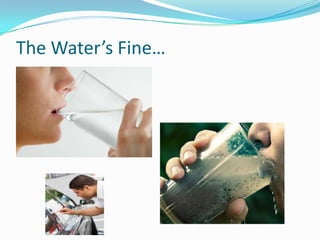
The Water’s Fine…
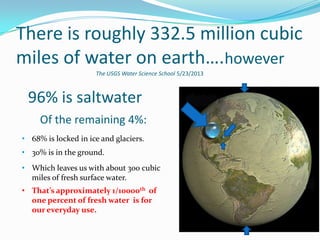
There is roughly 332.5 million cubic
miles of water on earth….
The USGS Water Science School 5/23/2013
96% is saltwater
Of the remaining 4%:
• 30% is in the ground.
• Which leaves us with about 300 cubic
miles of fresh surface water.
• 68% is locked in ice and glaciers.
however
• That’s approximately 1/10000th of
one percent of fresh water is for
our everyday use.
How many water systems are there
in the U.S.? http://water.epa.gov/infrastructure/drinkingwater/pws/factoids.cfm
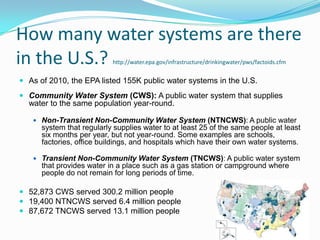
ď‚— As of 2010, the EPA listed 155K public water systems in the U.S.
ď‚— Community Water System (CWS): A public water system that supplies
water to the same population year-round.
ď‚— Non-Transient Non-Community Water System (NTNCWS): A public water
system that regularly supplies water to at least 25 of the same people at least
six months per year, but not year-round. Some examples are schools,
factories, office buildings, and hospitals which have their own water systems.
ď‚— Transient Non-Community Water System (TNCWS): A public water system
that provides water in a place such as a gas station or campground where
people do not remain for long periods of time.
ď‚— 52,873 CWS served 300.2 million people
ď‚— 19,400 NTNCWS served 6.4 million people
ď‚— 87,672 TNCWS served 13.1 million people
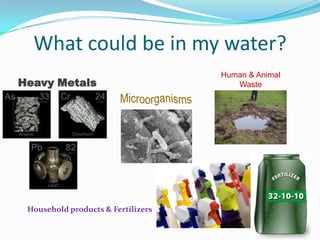
What could be in my water?
Heavy Metals
Human & Animal
Waste
Household products & Fertilizers
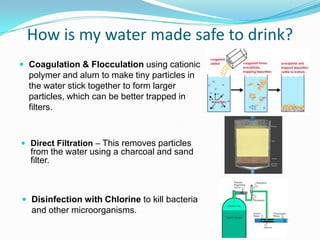
How is my water made safe to drink?
ď‚— Coagulation & Flocculation using cationic
polymer and alum to make tiny particles in
the water stick together to form larger
particles, which can be better trapped in
filters.
 Direct Filtration – This removes particles
from the water using a charcoal and sand
filter.
ď‚— Disinfection with Chlorine to kill bacteria
and other microorganisms.
Water Trivia
Can you guess how much water was treated for
Worcester County in 2012?
A. 840,000 gallons
B. 8,400,000 gallons
C. 8,400,000,000 gallons
That’s 2.3 million gallons of water per day for only
806,163 people!
http://www.worcesterma.gov/uploads/ee/65/ee652dd4088a6d00f23c3756f13d7d87/water-quality-report.pdf
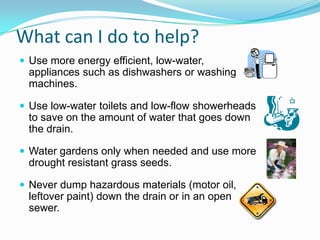
What can I do to help?
ď‚— Use more energy efficient, low-water,
appliances such as dishwashers or washing
machines.
ď‚— Use low-water toilets and low-flow showerheads
to save on the amount of water that goes down
the drain.
ď‚— Water gardens only when needed and use more
drought resistant grass seeds.
ď‚— Never dump hazardous materials (motor oil,
leftover paint) down the drain or in an open
sewer.
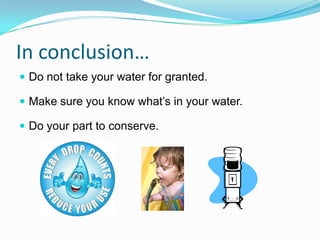
In conclusion…
ď‚— Do not take your water for granted.
 Make sure you know what’s in your water.
ď‚— Do your part to conserve.
Thank You

Powerpoint water supply

  • 1.
  • 2.
  • 3.
    There is roughly332.5 million cubic miles of water on earth…. The USGS Water Science School 5/23/2013 96% is saltwater Of the remaining 4%: • 30% is in the ground. • Which leaves us with about 300 cubic miles of fresh surface water. • 68% is locked in ice and glaciers. however • That’s approximately 1/10000th of one percent of fresh water is for our everyday use.
  • 4.
    How many watersystems are there in the U.S.? http://water.epa.gov/infrastructure/drinkingwater/pws/factoids.cfm ď‚— As of 2010, the EPA listed 155K public water systems in the U.S. ď‚— Community Water System (CWS): A public water system that supplies water to the same population year-round. ď‚— Non-Transient Non-Community Water System (NTNCWS): A public water system that regularly supplies water to at least 25 of the same people at least six months per year, but not year-round. Some examples are schools, factories, office buildings, and hospitals which have their own water systems. ď‚— Transient Non-Community Water System (TNCWS): A public water system that provides water in a place such as a gas station or campground where people do not remain for long periods of time. ď‚— 52,873 CWS served 300.2 million people ď‚— 19,400 NTNCWS served 6.4 million people ď‚— 87,672 TNCWS served 13.1 million people
  • 5.
    What could bein my water? Heavy Metals Human & Animal Waste Household products & Fertilizers
  • 6.
    How is mywater made safe to drink?  Coagulation & Flocculation using cationic polymer and alum to make tiny particles in the water stick together to form larger particles, which can be better trapped in filters.  Direct Filtration – This removes particles from the water using a charcoal and sand filter.  Disinfection with Chlorine to kill bacteria and other microorganisms.
  • 7.
    Water Trivia Can youguess how much water was treated for Worcester County in 2012? A. 840,000 gallons B. 8,400,000 gallons C. 8,400,000,000 gallons That’s 2.3 million gallons of water per day for only 806,163 people! http://www.worcesterma.gov/uploads/ee/65/ee652dd4088a6d00f23c3756f13d7d87/water-quality-report.pdf
  • 8.
    What can Ido to help? ď‚— Use more energy efficient, low-water, appliances such as dishwashers or washing machines. ď‚— Use low-water toilets and low-flow showerheads to save on the amount of water that goes down the drain. ď‚— Water gardens only when needed and use more drought resistant grass seeds. ď‚— Never dump hazardous materials (motor oil, leftover paint) down the drain or in an open sewer.
  • 9.
    In conclusion…  Donot take your water for granted.  Make sure you know what’s in your water.  Do your part to conserve.
  • 10.