COMPOSITION OF SOLID WASTE
Sources,Types,Composition,Sampling
and Characteristics of Solid Waste
Prof.Vaibhav D.Kamble
BE(Civil), ME(Civil- Environmental Engineering)
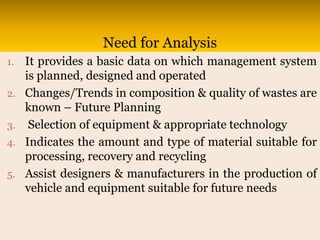
Need for Analysis
1. It provides a basic data on which management system
is planned, designed and operated
2. Changes/Trends in composition & quality of wastes are
known – Future Planning
3. Selection of equipment & appropriate technology
4. Indicates the amount and type of material suitable for
processing, recovery and recycling
5. Assist designers & manufacturers in the production of
vehicle and equipment suitable for future needs
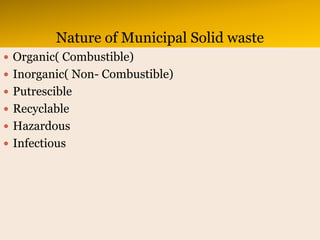
Nature of Municipal Solid waste
 Organic( Combustible)
 Inorganic( Non- Combustible)
 Putrescible
 Recyclable
 Hazardous
 Infectious
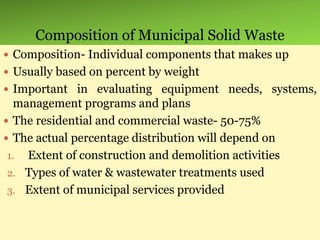
Composition of Municipal Solid Waste
 Composition- Individual components that makes up
 Usually based on percent by weight
 Important in evaluating equipment needs, systems,
management programs and plans
 The residential and commercial waste- 50-75%
 The actual percentage distribution will depend on
1. Extent of construction and demolition activities
2. Types of water & wastewater treatments used
3. Extent of municipal services provided
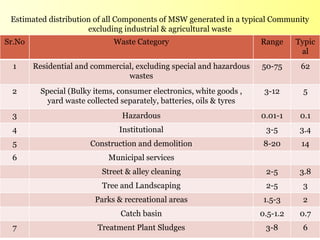
Estimated distribution of all Components of MSW generated in a typical Community
excluding industrial & agricultural waste
Sr.No Waste Category Range Typic
al
1 Residential and commercial, excluding special and hazardous
wastes
50-75 62
2 Special (Bulky items, consumer electronics, white goods ,
yard waste collected separately, batteries, oils & tyres
3-12 5
3 Hazardous 0.01-1 0.1
4 Institutional 3-5 3.4
5 Construction and demolition 8-20 14
6 Municipal services
Street & alley cleaning 2-5 3.8
Tree and Landscaping 2-5 3
Parks & recreational areas 1.5-3 2
Catch basin 0.5-1.2 0.7
7 Treatment Plant Sludges 3-8 6
Typical Physical Composition of Residential
MSW excluding recycled materials and food
wastes discharged with Wastewater
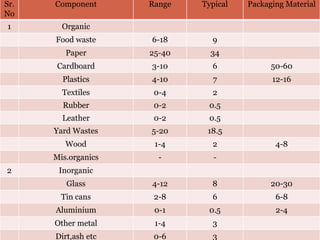
Sr.
No
Component Range Typical Packaging Material
1 Organic
Food waste 6-18 9
Paper 25-40 34
Cardboard 3-10 6 50-60
Plastics 4-10 7 12-16
Textiles 0-4 2
Rubber 0-2 0.5
Leather 0-2 0.5
Yard Wastes 5-20 18.5
Wood 1-4 2 4-8
Mis.organics - -
2 Inorganic
Glass 4-12 8 20-30
Tin cans 2-8 6 6-8
Aluminium 0-1 0.5 2-4
Other metal 1-4 3
Dirt,ash etc 0-6 3
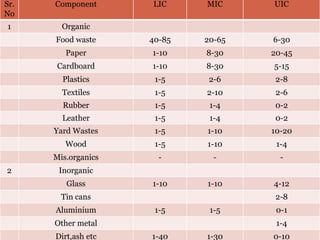
Typical Distribution of Components in
residential MSW for Low, middle & upper
income countries excluding recycled
materials
Sr.
No
Component LIC MIC UIC
1 Organic
Food waste 40-85 20-65 6-30
Paper 1-10 8-30 20-45
Cardboard 1-10 8-30 5-15
Plastics 1-5 2-6 2-8
Textiles 1-5 2-10 2-6
Rubber 1-5 1-4 0-2
Leather 1-5 1-4 0-2
Yard Wastes 1-5 1-10 10-20
Wood 1-5 1-10 1-4
Mis.organics - - -
2 Inorganic
Glass 1-10 1-10 4-12
Tin cans 2-8
Aluminium 1-5 1-5 0-1
Other metal 1-4
Dirt,ash etc 1-40 1-30 0-10
Field of the composition of MSW in the field/Investigations/Determination of
percentage distribution of waste components in the field
 Heterogeneous nature – composition not an easy task
 Field investigations – obtaining data on solid waste
1. Weighing of vehicle at the disposal site
2. Sorting of waste at disposal site
3. Visiting institutional and Industrial sites
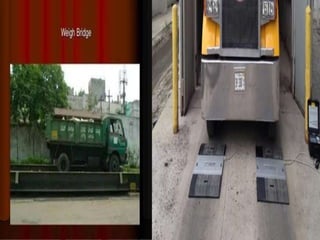
1.Weighing of vehicle at the disposal site
 Weighing of loaded & unloaded vehicle with a weighing
scale or weighbridge-20,000kg
 Weighing – carried out daily at the disposal site to
determine the average weight
 Shift system
 The waste measured at the disposal site do not include
1. Waste salvaged at the site of generation
2. Waste disposed off in unauthorized places
3. Waste salvaged by the collectors
4. Waste salvaged at the disposal site
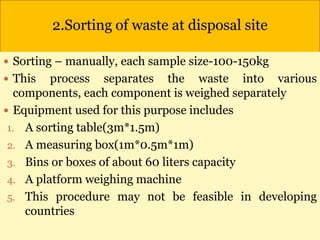
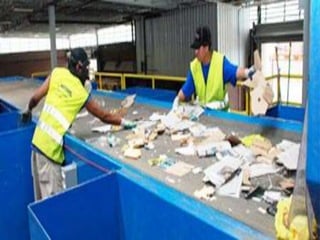
2.Sorting of waste at disposal site
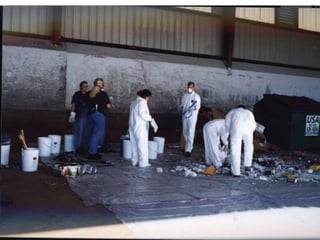
 Sorting – manually, each sample size-100-150kg
 This process separates the waste into various
components, each component is weighed separately
 Equipment used for this purpose includes
1. A sorting table(3m*1.5m)
2. A measuring box(1m*0.5m*1m)
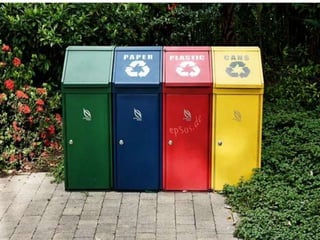
3. Bins or boxes of about 60 liters capacity
4. A platform weighing machine
5. This procedure may not be feasible in developing
countries
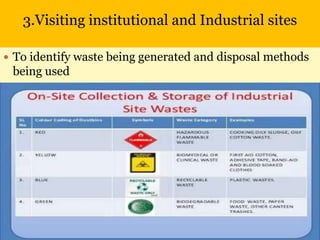
3.Visiting institutional and Industrial sites
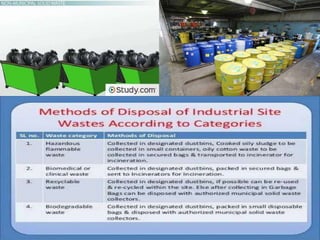
 To identify waste being generated and disposal methods
being used
Composition Studies
 Materials Flow
 Manual Sorting
Manual Sorting Methodology
 Study Planning
 Sample Plan
 Sampling Procedure
 Data Interpretation
Sample Plan
 Load Selection
 Number of Samples
Sampling Procedure
 Vehicle Unloading
 Sample Selection and Retrieval
 Container Preparation
 Sample Placement
 Sorting
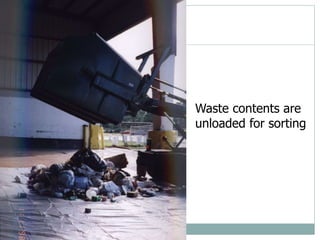
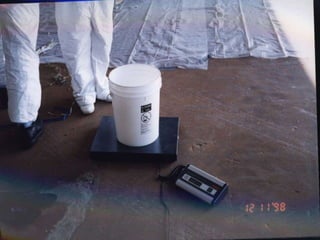
Waste contents are
unloaded for sorting
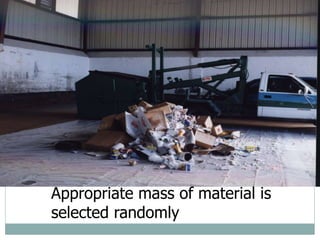
Appropriate mass of material is
selected randomly
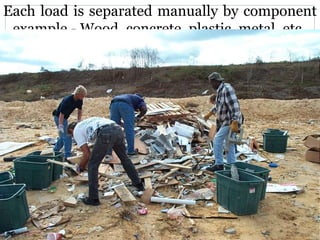
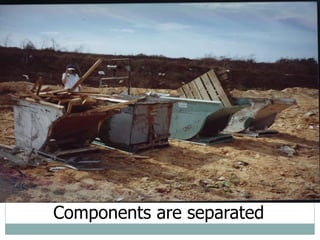
Each load is separated manually by component
example - Wood, concrete, plastic, metal, etc.
Components are separated
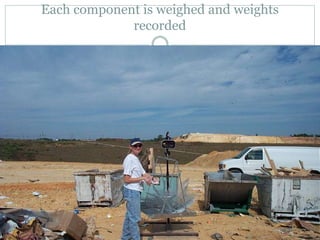
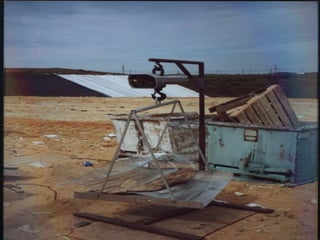
Each component is weighed and weights
recorded
Data Interpretation
 Weighted Average based on Source
Composition/Distribution
 Collection of data
Number of samples to be collected
 Solid waste- heterogeneous
 Samples obtained from the same sampling point in a day
(24Hr)-variation
 Hence the method by which sample is collected & the
number of sample collected is important
 Large number of sample- waste of resources
 Small number of samples – decreases the accuracy
Number of samples to be collected
 A method of determining number of samples – suggested
by – Dennis E. Carruth & Albert J. Klee(1969)
Number of samples to be collected
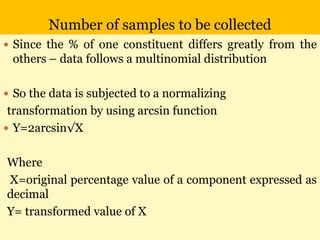
 Since the % of one constituent differs greatly from the
others – data follows a multinomial distribution
 So the data is subjected to a normalizing
transformation by using arcsin function
 Y=2arcsin√X
Where
X=original percentage value of a component expressed as
decimal
Y= transformed value of X
Number of samples to be collected
 To determine the number of samples required for
composition analysis following formula is used
 N=(ZSδ)²
 Where N=number of samples
Z= standard normal deviate for confidence level desired
(normally 95%)
S= estimated standard deviation ( transformed basis)
δ= sensitivity (transformed basis)
δ=[2arcsin √X- 2arcsin√X+-∆]
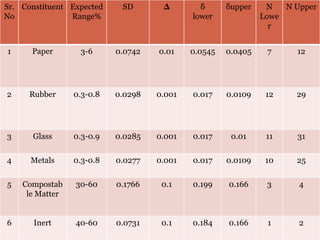
Samples to be collected for various constituents
Sr.
No
Constituent Expected
Range%
SD ∆ δ
lower
δupper N
Lowe
r
N Upper
1 Paper 3-6 0.0742 0.01 0.0545 0.0405 7 12
2 Rubber 0.3-0.8 0.0298 0.001 0.017 0.0109 12 29
3 Glass 0.3-0.9 0.0285 0.001 0.017 0.01 11 31
4 Metals 0.3-0.8 0.0277 0.001 0.017 0.0109 10 25
5 Compostab
le Matter
30-60 0.1766 0.1 0.199 0.166 3 4
6 Inert 40-60 0.0731 0.1 0.184 0.166 1 2
 The number of samples for any chemical parameter can
be determined by using this method
 Collection of sample basic aim- the sample size –
economy and precision
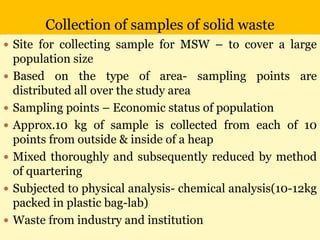
Collection of samples of solid waste
 Site for collecting sample for MSW – to cover a large
population size
 Based on the type of area- sampling points are
distributed all over the study area
 Sampling points – Economic status of population
 Approx.10 kg of sample is collected from each of 10
points from outside & inside of a heap
 Mixed thoroughly and subsequently reduced by method
of quartering
 Subjected to physical analysis- chemical analysis(10-12kg
packed in plastic bag-lab)
 Waste from industry and institution
Types of Materials recovered from MSW
1. Aluminium-Aluminum can,secondary aluminium
2. Paper-old newspaper, cardboard,high grade paper &
mixed paper
3. Plastics
4. Glass-container glass, flat glass, pressed or amber or
green glass most common in MSW
5. Ferrous metals(Iron & steel)
6. Non Ferrous metals-
7. Yard waste collected separately – composting of
organic fraction- becoming more popular
8. Construction and demolition waste
Future changes in waste composition
 4 waste components that have an important influence on
the composition of waste-
1. Food waste,
2. Paper and cardboard,
3. Yard waste and
4. Plastic

Composition of solid waste management 2

  • 1.
    COMPOSITION OF SOLIDWASTE Sources,Types,Composition,Sampling and Characteristics of Solid Waste Prof.Vaibhav D.Kamble BE(Civil), ME(Civil- Environmental Engineering)
  • 2.
    Need for Analysis 1.It provides a basic data on which management system is planned, designed and operated 2. Changes/Trends in composition & quality of wastes are known – Future Planning 3. Selection of equipment & appropriate technology 4. Indicates the amount and type of material suitable for processing, recovery and recycling 5. Assist designers & manufacturers in the production of vehicle and equipment suitable for future needs
  • 3.
    Nature of MunicipalSolid waste  Organic( Combustible)  Inorganic( Non- Combustible)  Putrescible  Recyclable  Hazardous  Infectious
  • 4.
    Composition of MunicipalSolid Waste  Composition- Individual components that makes up  Usually based on percent by weight  Important in evaluating equipment needs, systems, management programs and plans  The residential and commercial waste- 50-75%  The actual percentage distribution will depend on 1. Extent of construction and demolition activities 2. Types of water & wastewater treatments used 3. Extent of municipal services provided
  • 5.
    Estimated distribution ofall Components of MSW generated in a typical Community excluding industrial & agricultural waste Sr.No Waste Category Range Typic al 1 Residential and commercial, excluding special and hazardous wastes 50-75 62 2 Special (Bulky items, consumer electronics, white goods , yard waste collected separately, batteries, oils & tyres 3-12 5 3 Hazardous 0.01-1 0.1 4 Institutional 3-5 3.4 5 Construction and demolition 8-20 14 6 Municipal services Street & alley cleaning 2-5 3.8 Tree and Landscaping 2-5 3 Parks & recreational areas 1.5-3 2 Catch basin 0.5-1.2 0.7 7 Treatment Plant Sludges 3-8 6
  • 6.
    Typical Physical Compositionof Residential MSW excluding recycled materials and food wastes discharged with Wastewater
  • 7.
    Sr. No Component Range TypicalPackaging Material 1 Organic Food waste 6-18 9 Paper 25-40 34 Cardboard 3-10 6 50-60 Plastics 4-10 7 12-16 Textiles 0-4 2 Rubber 0-2 0.5 Leather 0-2 0.5 Yard Wastes 5-20 18.5 Wood 1-4 2 4-8 Mis.organics - - 2 Inorganic Glass 4-12 8 20-30 Tin cans 2-8 6 6-8 Aluminium 0-1 0.5 2-4 Other metal 1-4 3 Dirt,ash etc 0-6 3
  • 8.
    Typical Distribution ofComponents in residential MSW for Low, middle & upper income countries excluding recycled materials
  • 9.
    Sr. No Component LIC MICUIC 1 Organic Food waste 40-85 20-65 6-30 Paper 1-10 8-30 20-45 Cardboard 1-10 8-30 5-15 Plastics 1-5 2-6 2-8 Textiles 1-5 2-10 2-6 Rubber 1-5 1-4 0-2 Leather 1-5 1-4 0-2 Yard Wastes 1-5 1-10 10-20 Wood 1-5 1-10 1-4 Mis.organics - - - 2 Inorganic Glass 1-10 1-10 4-12 Tin cans 2-8 Aluminium 1-5 1-5 0-1 Other metal 1-4 Dirt,ash etc 1-40 1-30 0-10
  • 10.
    Field of thecomposition of MSW in the field/Investigations/Determination of percentage distribution of waste components in the field  Heterogeneous nature – composition not an easy task  Field investigations – obtaining data on solid waste 1. Weighing of vehicle at the disposal site 2. Sorting of waste at disposal site 3. Visiting institutional and Industrial sites
  • 11.
    1.Weighing of vehicleat the disposal site  Weighing of loaded & unloaded vehicle with a weighing scale or weighbridge-20,000kg  Weighing – carried out daily at the disposal site to determine the average weight  Shift system  The waste measured at the disposal site do not include 1. Waste salvaged at the site of generation 2. Waste disposed off in unauthorized places 3. Waste salvaged by the collectors 4. Waste salvaged at the disposal site
  • 13.
    2.Sorting of wasteat disposal site  Sorting – manually, each sample size-100-150kg  This process separates the waste into various components, each component is weighed separately  Equipment used for this purpose includes 1. A sorting table(3m*1.5m) 2. A measuring box(1m*0.5m*1m) 3. Bins or boxes of about 60 liters capacity 4. A platform weighing machine 5. This procedure may not be feasible in developing countries
  • 16.
    3.Visiting institutional andIndustrial sites  To identify waste being generated and disposal methods being used
  • 18.
    Composition Studies  MaterialsFlow  Manual Sorting
  • 19.
    Manual Sorting Methodology Study Planning  Sample Plan  Sampling Procedure  Data Interpretation
  • 20.
    Sample Plan  LoadSelection  Number of Samples
  • 21.
    Sampling Procedure  VehicleUnloading  Sample Selection and Retrieval  Container Preparation  Sample Placement  Sorting
  • 22.
  • 23.
    Appropriate mass ofmaterial is selected randomly
  • 24.
    Each load isseparated manually by component example - Wood, concrete, plastic, metal, etc.
  • 25.
  • 27.
    Each component isweighed and weights recorded
  • 30.
    Data Interpretation  WeightedAverage based on Source Composition/Distribution  Collection of data
  • 31.
    Number of samplesto be collected  Solid waste- heterogeneous  Samples obtained from the same sampling point in a day (24Hr)-variation  Hence the method by which sample is collected & the number of sample collected is important  Large number of sample- waste of resources  Small number of samples – decreases the accuracy
  • 32.
    Number of samplesto be collected  A method of determining number of samples – suggested by – Dennis E. Carruth & Albert J. Klee(1969)
  • 33.
    Number of samplesto be collected  Since the % of one constituent differs greatly from the others – data follows a multinomial distribution  So the data is subjected to a normalizing transformation by using arcsin function  Y=2arcsin√X Where X=original percentage value of a component expressed as decimal Y= transformed value of X
  • 34.
    Number of samplesto be collected  To determine the number of samples required for composition analysis following formula is used  N=(ZSδ)²  Where N=number of samples Z= standard normal deviate for confidence level desired (normally 95%) S= estimated standard deviation ( transformed basis) δ= sensitivity (transformed basis) δ=[2arcsin √X- 2arcsin√X+-∆]
  • 35.
    Samples to becollected for various constituents Sr. No Constituent Expected Range% SD ∆ δ lower δupper N Lowe r N Upper 1 Paper 3-6 0.0742 0.01 0.0545 0.0405 7 12 2 Rubber 0.3-0.8 0.0298 0.001 0.017 0.0109 12 29 3 Glass 0.3-0.9 0.0285 0.001 0.017 0.01 11 31 4 Metals 0.3-0.8 0.0277 0.001 0.017 0.0109 10 25 5 Compostab le Matter 30-60 0.1766 0.1 0.199 0.166 3 4 6 Inert 40-60 0.0731 0.1 0.184 0.166 1 2
  • 36.
     The numberof samples for any chemical parameter can be determined by using this method  Collection of sample basic aim- the sample size – economy and precision
  • 37.
    Collection of samplesof solid waste  Site for collecting sample for MSW – to cover a large population size  Based on the type of area- sampling points are distributed all over the study area  Sampling points – Economic status of population  Approx.10 kg of sample is collected from each of 10 points from outside & inside of a heap  Mixed thoroughly and subsequently reduced by method of quartering  Subjected to physical analysis- chemical analysis(10-12kg packed in plastic bag-lab)  Waste from industry and institution
  • 38.
    Types of Materialsrecovered from MSW 1. Aluminium-Aluminum can,secondary aluminium 2. Paper-old newspaper, cardboard,high grade paper & mixed paper 3. Plastics 4. Glass-container glass, flat glass, pressed or amber or green glass most common in MSW 5. Ferrous metals(Iron & steel) 6. Non Ferrous metals- 7. Yard waste collected separately – composting of organic fraction- becoming more popular 8. Construction and demolition waste
  • 42.
    Future changes inwaste composition  4 waste components that have an important influence on the composition of waste- 1. Food waste, 2. Paper and cardboard, 3. Yard waste and 4. Plastic