Presentation on
“conceyance & distribution of water”
By
Prof. Vilas N Nikam
Sandip Polytechnic, nashik
Email: vilas5151@gmail.com
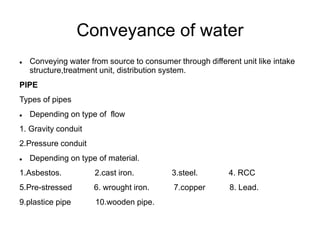
Conveyance of water
 Conveying water from source to consumer through different unit like intake
structure,treatment unit, distribution system.
PIPE
Types of pipes
 Depending on type of flow
1. Gravity conduit
2.Pressure conduit
 Depending on type of material.
1.Asbestos. 2.cast iron. 3.steel. 4. RCC
5.Pre-stressed 6. wrought iron. 7.copper 8. Lead.
9.plastice pipe 10.wooden pipe.
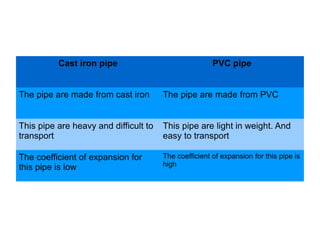
Cast iron pipe PVC pipe
The pipe are made from cast iron The pipe are made from PVC
This pipe are heavy and difficult to
transport
This pipe are light in weight. And
easy to transport
The coefficient of expansion for
this pipe is low
The coefficient of expansion for this pipe is
high
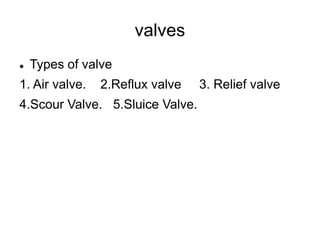
valves
 Types of valve
1. Air valve. 2.Reflux valve 3. Relief valve
4.Scour Valve. 5.Sluice Valve.
Air valve
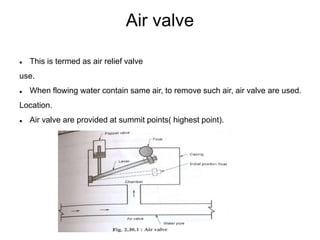
 This is termed as air relief valve
use.
 When flowing water contain same air, to remove such air, air valve are used.
Location.
 Air valve are provided at summit points( highest point).
Reflux valve
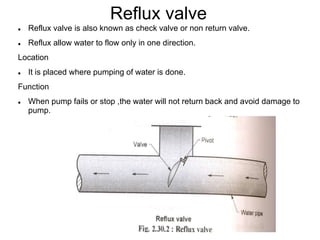
 Reflux valve is also known as check valve or non return valve.
 Reflux allow water to flow only in one direction.
Location
 It is placed where pumping of water is done.
Function
 When pump fails or stop ,the water will not return back and avoid damage to
pump.
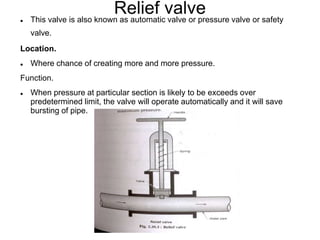
Relief valve This valve is also known as automatic valve or pressure valve or safety
valve.
Location.
 Where chance of creating more and more pressure.
Function.
 When pressure at particular section is likely to be exceeds over
predetermined limit, the valve will operate automatically and it will save
bursting of pipe.
Sluice valve
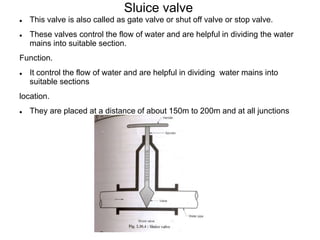
 This valve is also called as gate valve or shut off valve or stop valve.
 These valves control the flow of water and are helpful in dividing the water
mains into suitable section.
Function.
 It control the flow of water and are helpful in dividing water mains into
suitable sections
location.
 They are placed at a distance of about 150m to 200m and at all junctions
Methods of distribution of water
 Gravity system
 Pumping system.
 Combined gravity and pumping
Gravity system
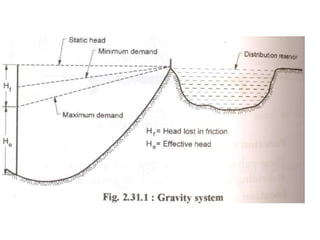
 In this system water flows under gravity.
 It is suitable when source is at a higher level than distribution area.
Advantages.
 Simple and economical.
 Pumping is not req.
 It is reliable system.
 Less maintenance
 Less leakage and wastage.
 Reduction in pipe size
Disadvantages.
 Not suitable when source is not at suitable elevation to cause gravity flow.
 Can not create high pressure.
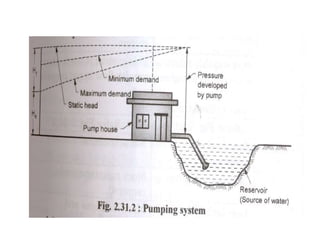
Pumping system
 In this system water is pumped in the distribution mains.
 This system is used when gravity flow is not possible.
Advantages.
 Sufficient pressure is available in distribution main.
 Large quantity of water available in case of fire.
 Suitable for ant type of topography.
Disadvantages.
 Sufficient water is required.
 Not economical
 More losses and wastage.
 It could not work in case of power failure.
 More maintenance is required.
Combined gravity and pumping
 In this system water is pumped into elevated storage reservoir and from ESR
water flows under gravity.
Advantages.
 This system is more economical, reliable and efficient.
 Failure of power supply does not affect.
 Pumping is with constant speed.
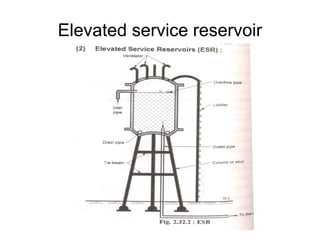
Service reservoir
 The reservoir which is generally provided in distribution system to store the
clear water before it is dispatched to the consumers, such reservoirs are
known as service reservoir.
Function
 Pumps can be operated at uniform speed.
 Fluctuation in demand and supply can be balanced.
 Water can be supplied during emergency.
 Constant pressure can be maintained in mains.
 Distribution mains of smaller size are used.
Classification of reservoir
 According to position.
1. surface reservoir. 2.elevated reservoir.
 According to shape.
1. circular 2. rectangular.
 According to materials of construction.
1. steel. 2.R.C.C.
3.Masonry 4.Prestressed concrete.
Elevated service reservoir
Layout of distribution system
 Classification of distribution system.
1.Dead end system 2.Grid iron system.
3.Circular system 4.Radial system.
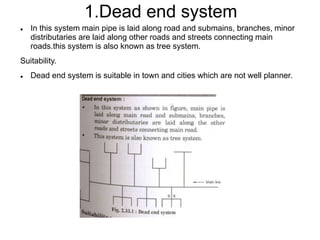
1.Dead end system
 In this system main pipe is laid along road and submains, branches, minor
distributaries are laid along other roads and streets connecting main
roads.this system is also known as tree system.
Suitability.
 Dead end system is suitable in town and cities which are not well planner.
Advantages of Dead end system
 Cheap in initial cost.
 Easy determination of pipe size.
 Laying of pipe is simple.
 Less number of valves are required.
Disadvantages.
 Due to stagnation , water get polluted.
 In case of repair the whole locality beyond that point get affected.
 This system can not meet fire requirement.
2.Grid iron system
 A main pipe is laid along main roads and submains, branches are laid along
inner roads and interconnected so that water remainsin circulationand there
is no dead ends.
 This is also known as interlaced system or reticulation system.
Suitability.
 Grid iron system is suitable for well planed cities, where the roads are at
right angle to each other.
Advantages.
 There is no dead ends so water is not stagnated.
 Very small area is affected at the time of repairs.
 Size of pipe is reduced.
 In case of fire, water can be diverted from other direction.
Disadvantages.
 More number of valves are req.
 Longer length of pipe req.
 Costly.
3.Circular system
 This method is also known as ring system.
 The area is divided into block.
 Water mains are laid around the blocks from all sides.
 The branches, submains are then taken along inner roads and
interconnected.
Suitability.
 This system suitable for well planed city.
Advantages.
 The water reaches at a particular point from two routes or direction.
 Water is available for fire demand.
 During repair water supply can be done from other submains.
 Designing pipe is simple an easy.
4.Radial system
 The system consist of laying pipe lines radially,ending at periphery.
 In each zone elevated storage reservoir is placed at its center, from
where water is admitted to these radially laid pipes known a
branches.
 The water is then pumped into these service reservoir through mains
and water is withdrawn through radially laid branches for consumers
during supply hr.
suitability.
 This system is suitable for locality having radial pattern road.
Advantages.
 Water is supplied to the consumer with high pressure.
 Designing pipe sizes is simple.
 There is quick an efficient supply of water.
Disadvantages.
 As every zone require a separate service reservoir, number of
reservoirs req. are more and hence the system becomes costly.

Conveyence and distribution

  • 1.
    Presentation on “conceyance &distribution of water” By Prof. Vilas N Nikam Sandip Polytechnic, nashik Email: vilas5151@gmail.com
  • 2.
    Conveyance of water Conveying water from source to consumer through different unit like intake structure,treatment unit, distribution system. PIPE Types of pipes  Depending on type of flow 1. Gravity conduit 2.Pressure conduit  Depending on type of material. 1.Asbestos. 2.cast iron. 3.steel. 4. RCC 5.Pre-stressed 6. wrought iron. 7.copper 8. Lead. 9.plastice pipe 10.wooden pipe.
  • 3.
    Cast iron pipePVC pipe The pipe are made from cast iron The pipe are made from PVC This pipe are heavy and difficult to transport This pipe are light in weight. And easy to transport The coefficient of expansion for this pipe is low The coefficient of expansion for this pipe is high
  • 4.
    valves  Types ofvalve 1. Air valve. 2.Reflux valve 3. Relief valve 4.Scour Valve. 5.Sluice Valve.
  • 5.
    Air valve  Thisis termed as air relief valve use.  When flowing water contain same air, to remove such air, air valve are used. Location.  Air valve are provided at summit points( highest point).
  • 6.
    Reflux valve  Refluxvalve is also known as check valve or non return valve.  Reflux allow water to flow only in one direction. Location  It is placed where pumping of water is done. Function  When pump fails or stop ,the water will not return back and avoid damage to pump.
  • 7.
    Relief valve Thisvalve is also known as automatic valve or pressure valve or safety valve. Location.  Where chance of creating more and more pressure. Function.  When pressure at particular section is likely to be exceeds over predetermined limit, the valve will operate automatically and it will save bursting of pipe.
  • 8.
    Sluice valve  Thisvalve is also called as gate valve or shut off valve or stop valve.  These valves control the flow of water and are helpful in dividing the water mains into suitable section. Function.  It control the flow of water and are helpful in dividing water mains into suitable sections location.  They are placed at a distance of about 150m to 200m and at all junctions
  • 9.
    Methods of distributionof water  Gravity system  Pumping system.  Combined gravity and pumping
  • 10.
    Gravity system  Inthis system water flows under gravity.  It is suitable when source is at a higher level than distribution area. Advantages.  Simple and economical.  Pumping is not req.  It is reliable system.  Less maintenance  Less leakage and wastage.  Reduction in pipe size Disadvantages.  Not suitable when source is not at suitable elevation to cause gravity flow.  Can not create high pressure.
  • 12.
    Pumping system  Inthis system water is pumped in the distribution mains.  This system is used when gravity flow is not possible. Advantages.  Sufficient pressure is available in distribution main.  Large quantity of water available in case of fire.  Suitable for ant type of topography. Disadvantages.  Sufficient water is required.  Not economical  More losses and wastage.  It could not work in case of power failure.  More maintenance is required.
  • 14.
    Combined gravity andpumping  In this system water is pumped into elevated storage reservoir and from ESR water flows under gravity. Advantages.  This system is more economical, reliable and efficient.  Failure of power supply does not affect.  Pumping is with constant speed.
  • 15.
    Service reservoir  Thereservoir which is generally provided in distribution system to store the clear water before it is dispatched to the consumers, such reservoirs are known as service reservoir. Function  Pumps can be operated at uniform speed.  Fluctuation in demand and supply can be balanced.  Water can be supplied during emergency.  Constant pressure can be maintained in mains.  Distribution mains of smaller size are used.
  • 16.
    Classification of reservoir According to position. 1. surface reservoir. 2.elevated reservoir.  According to shape. 1. circular 2. rectangular.  According to materials of construction. 1. steel. 2.R.C.C. 3.Masonry 4.Prestressed concrete.
  • 17.
  • 18.
    Layout of distributionsystem  Classification of distribution system. 1.Dead end system 2.Grid iron system. 3.Circular system 4.Radial system.
  • 19.
    1.Dead end system In this system main pipe is laid along road and submains, branches, minor distributaries are laid along other roads and streets connecting main roads.this system is also known as tree system. Suitability.  Dead end system is suitable in town and cities which are not well planner.
  • 20.
    Advantages of Deadend system  Cheap in initial cost.  Easy determination of pipe size.  Laying of pipe is simple.  Less number of valves are required. Disadvantages.  Due to stagnation , water get polluted.  In case of repair the whole locality beyond that point get affected.  This system can not meet fire requirement.
  • 21.
    2.Grid iron system A main pipe is laid along main roads and submains, branches are laid along inner roads and interconnected so that water remainsin circulationand there is no dead ends.  This is also known as interlaced system or reticulation system. Suitability.  Grid iron system is suitable for well planed cities, where the roads are at right angle to each other. Advantages.  There is no dead ends so water is not stagnated.  Very small area is affected at the time of repairs.  Size of pipe is reduced.  In case of fire, water can be diverted from other direction.
  • 22.
    Disadvantages.  More numberof valves are req.  Longer length of pipe req.  Costly.
  • 23.
    3.Circular system  Thismethod is also known as ring system.  The area is divided into block.  Water mains are laid around the blocks from all sides.  The branches, submains are then taken along inner roads and interconnected. Suitability.  This system suitable for well planed city. Advantages.  The water reaches at a particular point from two routes or direction.  Water is available for fire demand.  During repair water supply can be done from other submains.  Designing pipe is simple an easy.
  • 24.
    4.Radial system  Thesystem consist of laying pipe lines radially,ending at periphery.  In each zone elevated storage reservoir is placed at its center, from where water is admitted to these radially laid pipes known a branches.  The water is then pumped into these service reservoir through mains and water is withdrawn through radially laid branches for consumers during supply hr. suitability.  This system is suitable for locality having radial pattern road. Advantages.  Water is supplied to the consumer with high pressure.  Designing pipe sizes is simple.  There is quick an efficient supply of water. Disadvantages.  As every zone require a separate service reservoir, number of reservoirs req. are more and hence the system becomes costly.