Group Members:
Sharmistha, 151
Shikshita, 152
Shrijan, 153
Shubham, 154
Siddhi, 155
Sital, 156
Tutor:
Asst. Prof. Shukra Raj
Paudel
Department of Civil
Engineering
IOE, Tribhuvan University
2018-07-30
4.0 SEWER APPURTENANCES
2
Objectives of the Presentation
To be familiar with various sewer appurtenances
To know about the working of sewer appurtenances
3Presentation outlines
1. Definition of Sewer Appurtenances
2. Necessity of Sewer Appurtenances
3. Manhole
4. Drop manhole
5. Lamp hole
6. Street inlets
7. Catch basin
8. Flushing device
9. Sand, grease and oil traps
10.Inverted siphon
11.Sewer outlet
12.Ventilating shaft
Sewer appurtenances
Definition:
Sewer appurtenances are the various essential
accessories or devices for the proper maintenances
& efficient operation of sewerage system.
4
1. Necessity of sewer appurtenances
1. To inspect the sewer.
2. To help in cleaning the sewers.
Source: http://www.surrey.ca/city-services/17499.aspx
Fig. Inspection of sewer
89
5
1. Manhole
Fig. Manhole
Source: http://dirtyfluid.blogspot.com/search/label/Sewer%20Appurtenances
89
6
1. Manhole
1. It permits inspection and cleaning as well as repair of sewers, and
removal of any obstructions; and, also they allow sampling and flow
measurement.
2. Most manholes are circular in shape, with the inside diameter of 4 ft
(1.25 m) has been widely adopted.
3. These are provided at every bend, junction, change of gradient or
change of diameter of the sewer.
4. The sewer line between the two manholes is laid straight with even
gradient.
5. It consists of working chamber, an access shaft & a strong cover on
the top.
6. The lower portion of a deep manhole is known as a working chamber
and it provides a working space to carry out cleaning and inspection of
sewer line.
7. Access shaft provides access to the working chamber.
8. The manhole cover of RCC is provide to cover the opening.
7
2. Drop manhole
1. When it is uneconomical or impracticable to arrange
the connection with 60 cm of invert of the sewer and
manhole, then vertical shaft is constructed outside the
manhole chamber through which the sewage of branch
sewer is allowed to enter the manhole.
2. Such a manholes which drop the level of invert of the
incoming sewer by providing a vertical shaft are called
drop manhole.
3. The main purpose of drop manhole is to avoid the
splashing of sewage on the man work.
8
2. Drop manhole
Fig. Drop Manhole
Source: http://dirtyfluid.blogspot.com/search/label/Sewer%20Appurtenances
9
3. Lamp hole
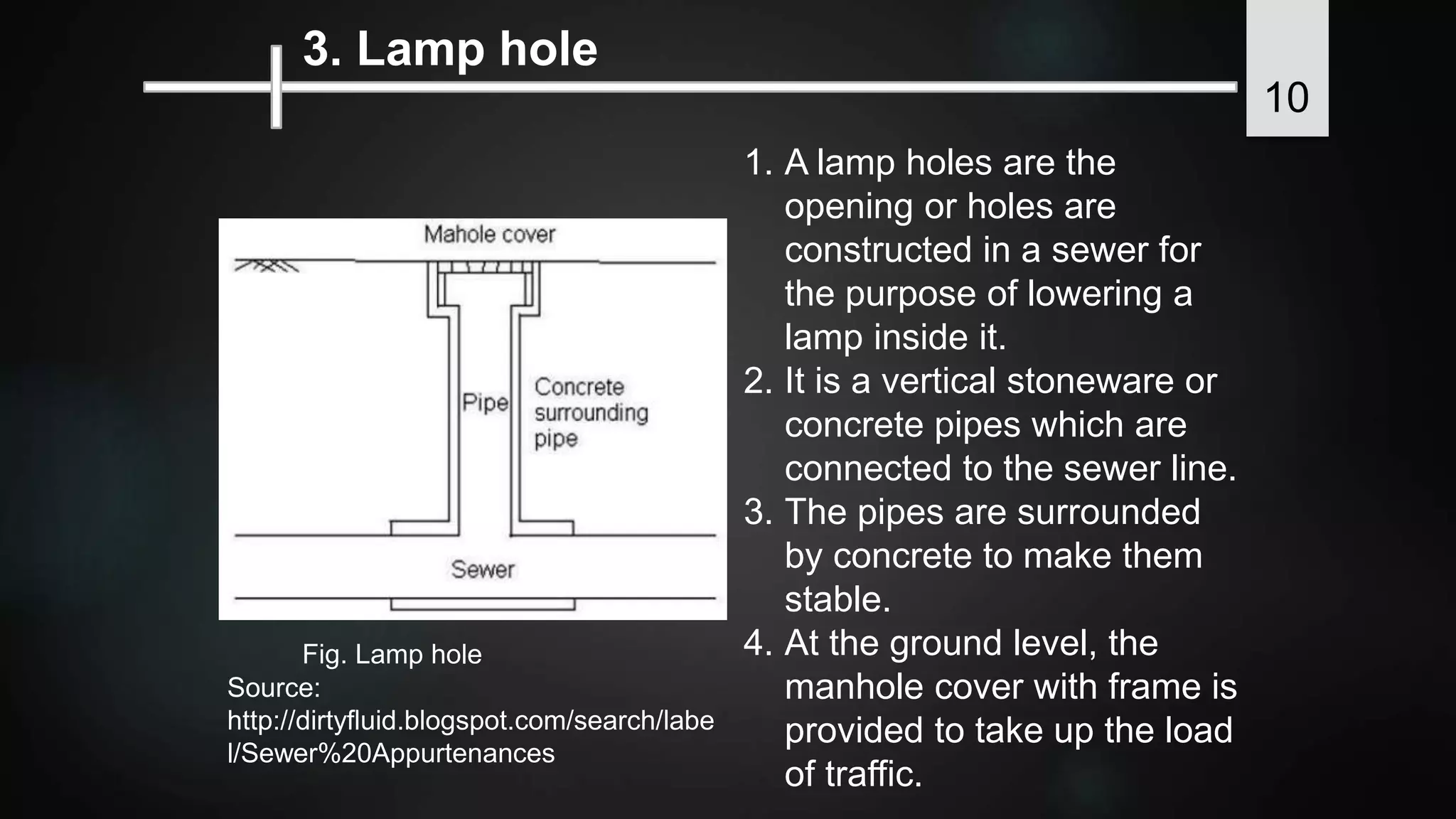
1. A lamp holes are the
opening or holes are
constructed in a sewer for
the purpose of lowering a
lamp inside it.
2. It is a vertical stoneware or
concrete pipes which are
connected to the sewer line.
3. The pipes are surrounded
by concrete to make them
stable.
4. At the ground level, the
manhole cover with frame is
provided to take up the load
of traffic.
Fig. Lamp hole
Source:
http://dirtyfluid.blogspot.com/search/labe
l/Sewer%20Appurtenances
10
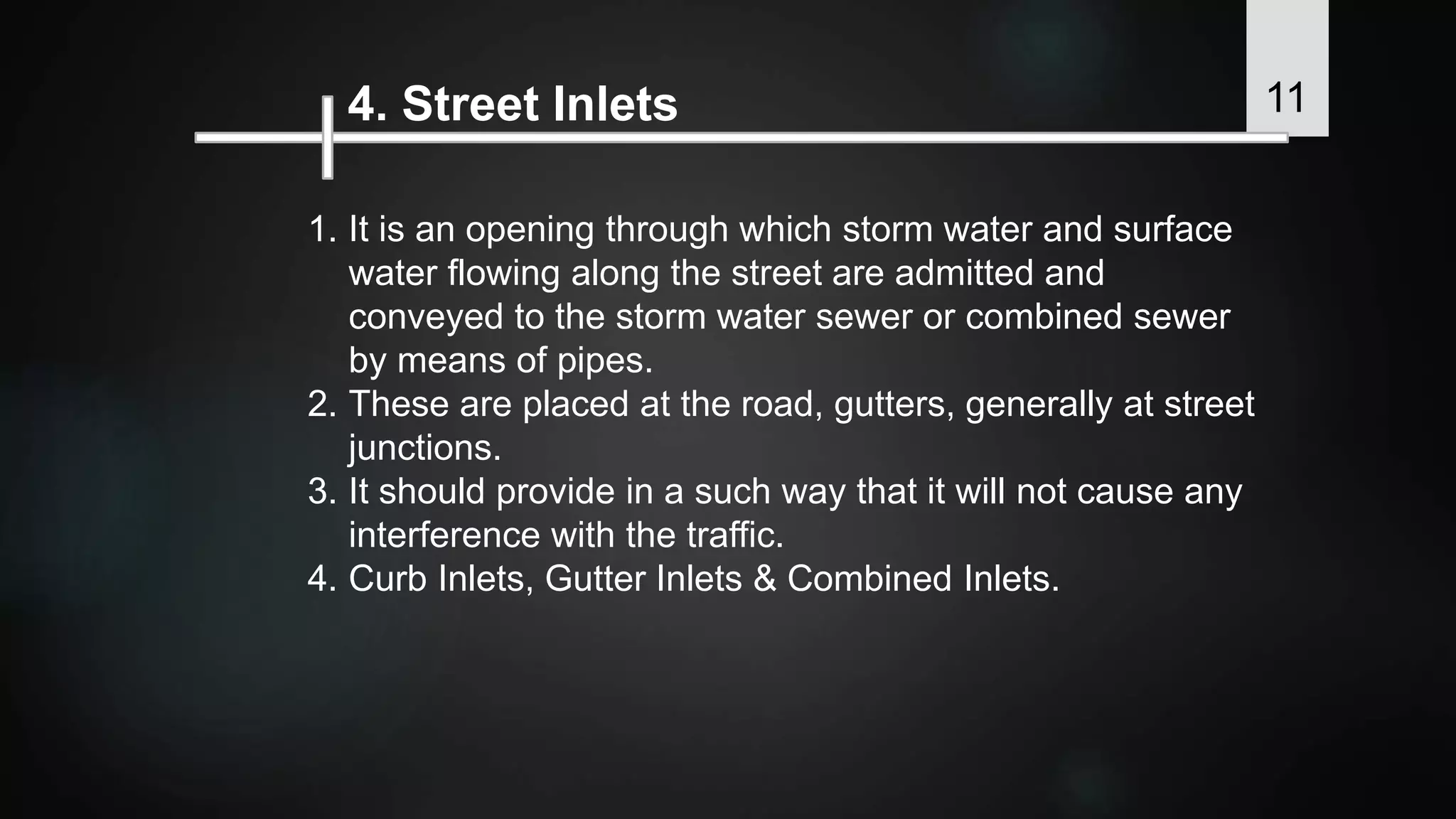
4. Street Inlets
1. It is an opening through which storm water and surface
water flowing along the street are admitted and
conveyed to the storm water sewer or combined sewer
by means of pipes.
2. These are placed at the road, gutters, generally at street
junctions.
3. It should provide in a such way that it will not cause any
interference with the traffic.
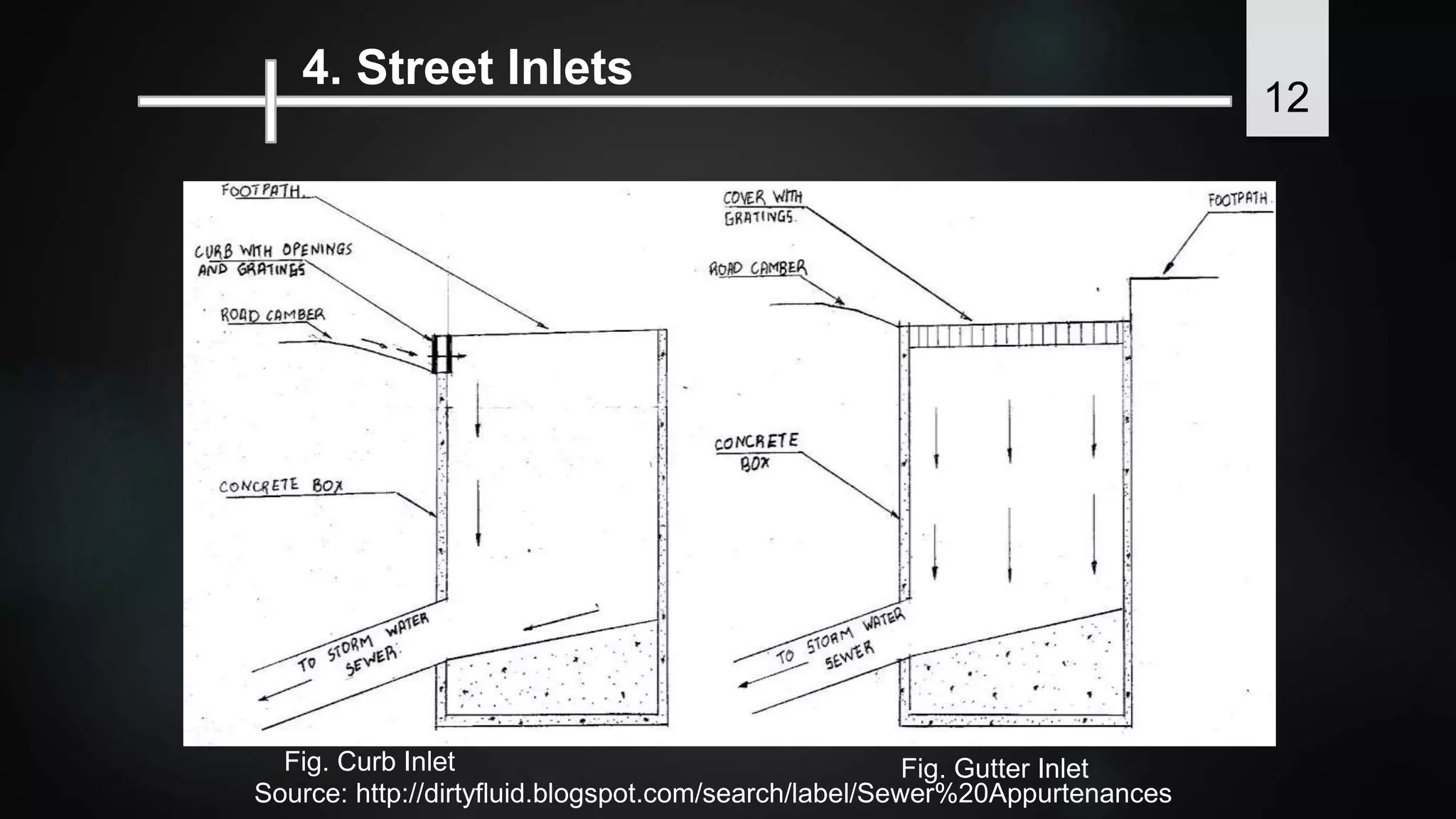
4. Curb Inlets, Gutter Inlets & Combined Inlets.
11
4. Street Inlets
Fig. Curb Inlet Fig. Gutter Inlet
Source: http://dirtyfluid.blogspot.com/search/label/Sewer%20Appurtenances
12
5. Catch Basins
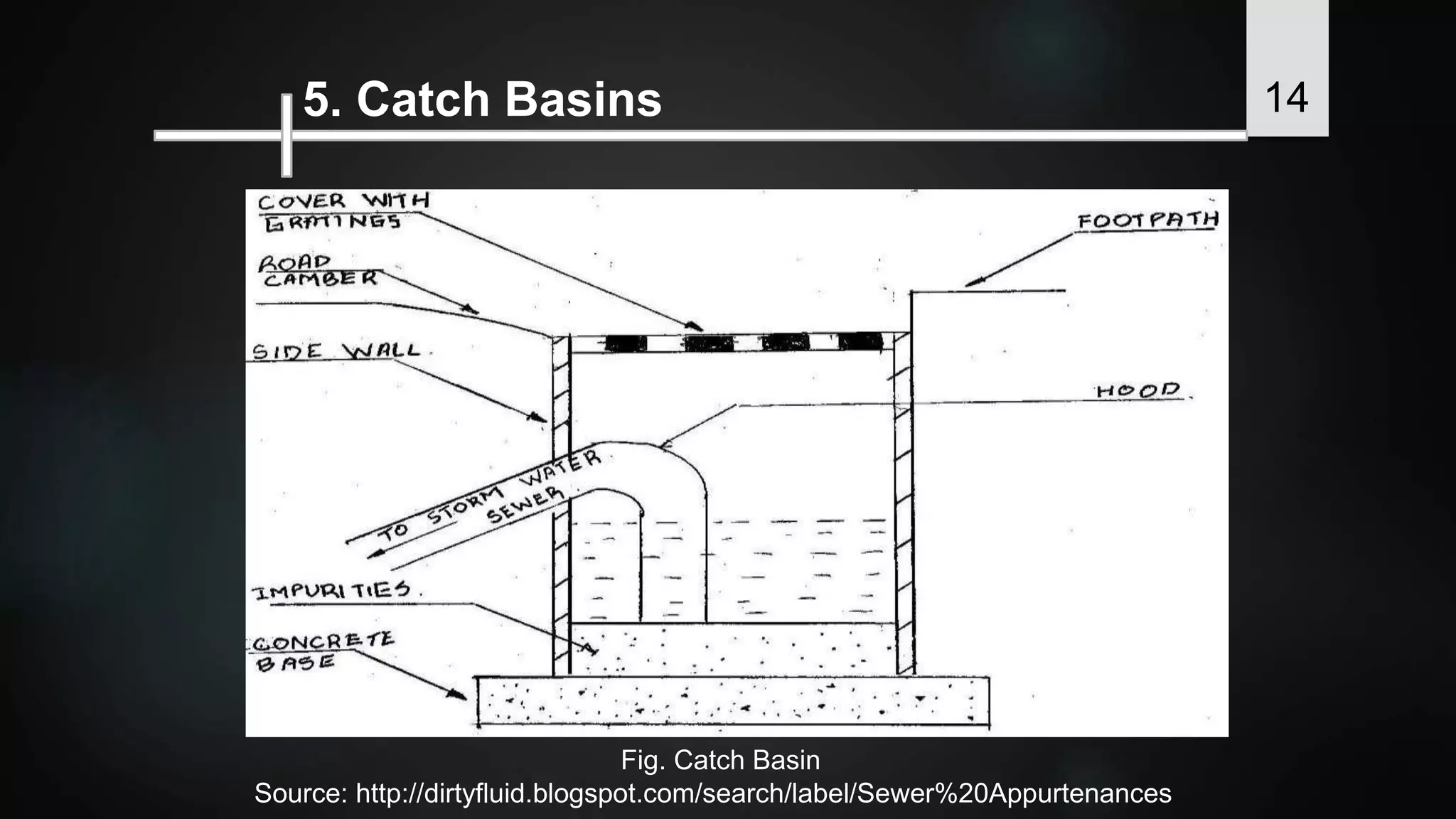
1. Catch basins are used to interrupt the flow of sewage
before it enters the sewer, causing deposition of
suspended grit and sludge and the detention of
floating rubbish which could enter and clog the sewer.
2. However, their use is discouraged because of the
nuisance due to mosquito breeding apart from posing
substantial maintenance problems.
3. At the bottom of the basin space is provided for the
accumulation of impurities.
4. Perforated cover is provided at the top of the basin to
admit rain water into the basin.
13
5. Catch Basins
Fig. Catch Basin
Source: http://dirtyfluid.blogspot.com/search/label/Sewer%20Appurtenances
14
6. Flushing Device
1. Arrangement which holds water and then throws it
into sewer for flushing it.
2. Sewers need flushing when certain reaches of sewer
have unfavorable combination of low slope and low
tributary sewage flow i.e. have chances of blockage
also placed at dead end point of sewer.
3. Two methods of flushing
• hand operated flushing operation
• automatic flushing tanks
15
6. Flushing Device
Fig. Automatic Flushing
DeviceSource: http://dirtyfluid.blogspot.com/search/label/Sewer%20Appurtenances
16
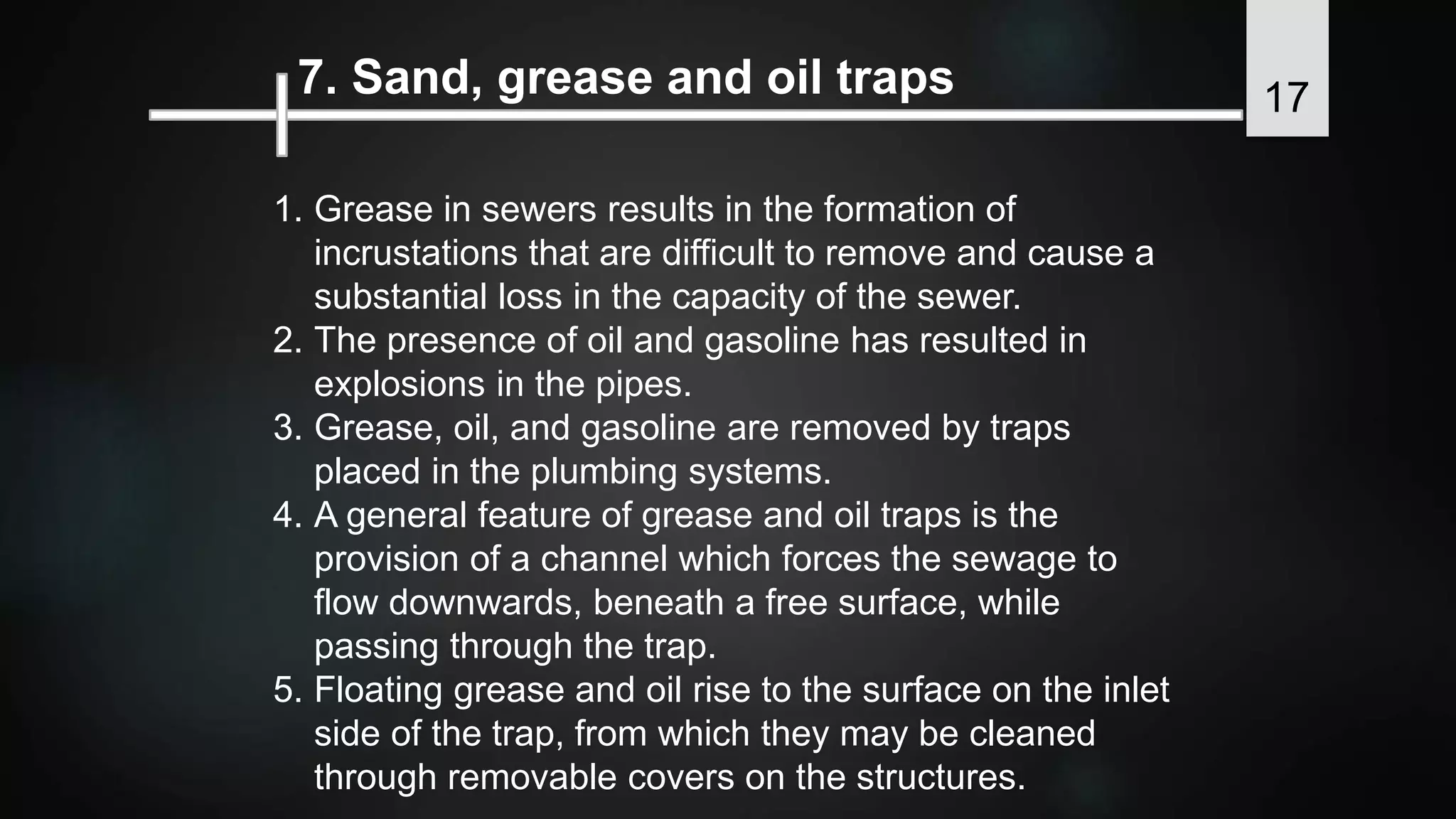
7. Sand, grease and oil traps
1. Grease in sewers results in the formation of
incrustations that are difficult to remove and cause a
substantial loss in the capacity of the sewer.
2. The presence of oil and gasoline has resulted in
explosions in the pipes.
3. Grease, oil, and gasoline are removed by traps
placed in the plumbing systems.
4. A general feature of grease and oil traps is the
provision of a channel which forces the sewage to
flow downwards, beneath a free surface, while
passing through the trap.
5. Floating grease and oil rise to the surface on the inlet
side of the trap, from which they may be cleaned
through removable covers on the structures.
17
7. Sand, grease and oil traps
Source: https://www.septicmedicaz.com/sand-oil-grit-trap-interceptors.html
17
8. Inverted Siphon
1. A sewer line has sometimes to be laid across a
stream, a highway cut, or any other similar
obstruction, either below or' above the ground level.
When the profile laid below the ground, that portion of
the sewer is known as inverted siphon (or, a
depressed sewer).
2. This section of sewer lies below the hydraulic grade
line, flowing full and under pressure.
Source: http://www.engineeringenotes.com/sanitary-engineering/design-of-
inverted-siphon-with-diagram-sewer-sanitary-engineering/17143
19
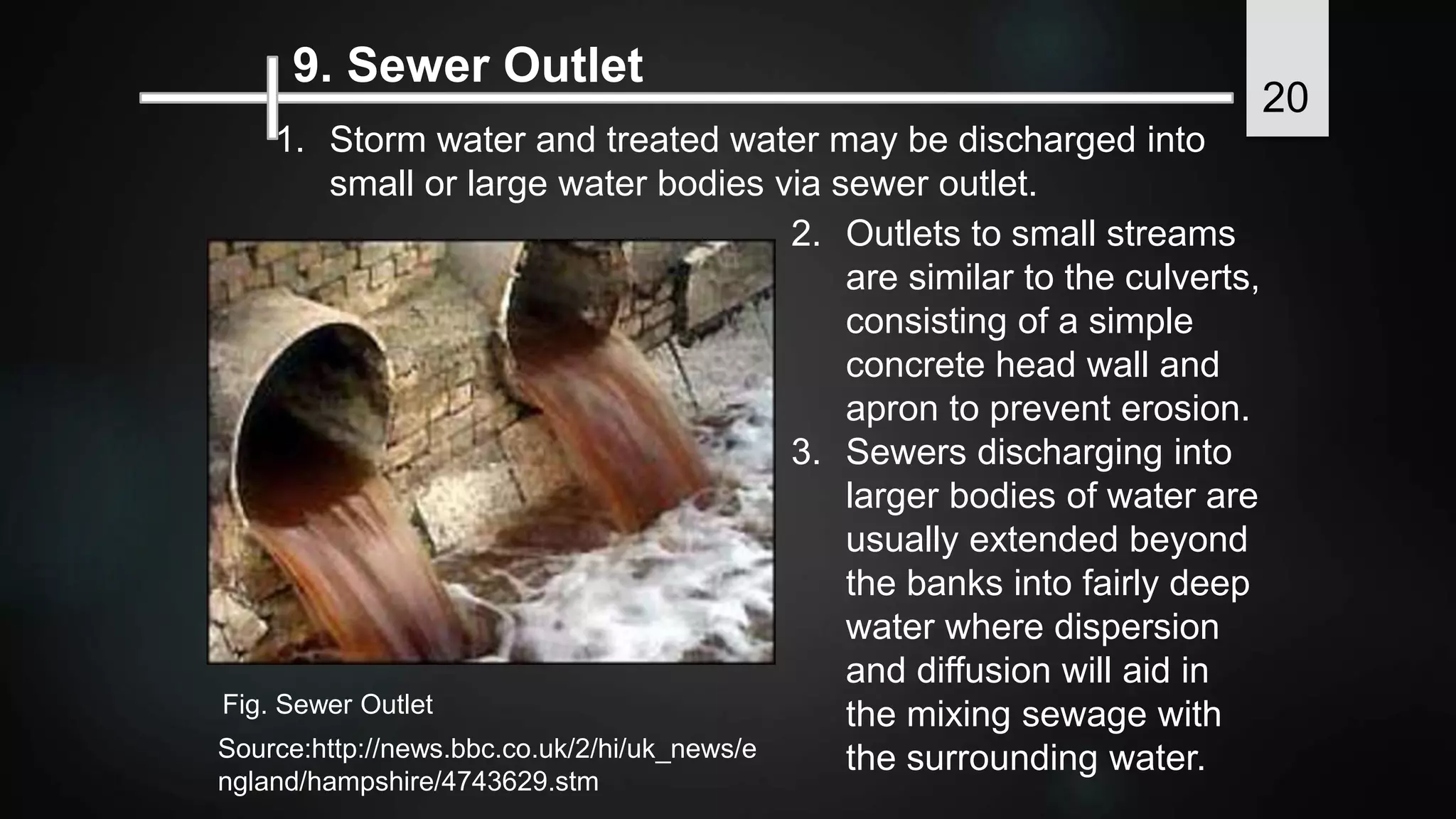
9. Sewer Outlet
1. Storm water and treated water may be discharged into
small or large water bodies via sewer outlet.
2. Outlets to small streams
are similar to the culverts,
consisting of a simple
concrete head wall and
apron to prevent erosion.
3. Sewers discharging into
larger bodies of water are
usually extended beyond
the banks into fairly deep
water where dispersion
and diffusion will aid in
the mixing sewage with
the surrounding water.Source:http://news.bbc.co.uk/2/hi/uk_news/e
ngland/hampshire/4743629.stm
Fig. Sewer Outlet
20
10. Ventilating shaft
1. The ventilating shaft is desirable
to prevent the accumulation of
dangerous explosive or corrosive
gases.
2. The ventilating shaft prevents the
creation of pressures (above or
below atmospheric) that may
break water seal in plumbing
traps.
3. In case of stormwater, this can be
done by providing ventilating
manhole covers.
Source: http://www.historywebsite.co.uk/listed/pipecodsall.htm
Fig. Ventilating Shaft
21
22

Sewer appurtenances

  • 1.
    Group Members: Sharmistha, 151 Shikshita,152 Shrijan, 153 Shubham, 154 Siddhi, 155 Sital, 156 Tutor: Asst. Prof. Shukra Raj Paudel Department of Civil Engineering IOE, Tribhuvan University 2018-07-30 4.0 SEWER APPURTENANCES
  • 2.
    2 Objectives of thePresentation To be familiar with various sewer appurtenances To know about the working of sewer appurtenances
  • 3.
    3Presentation outlines 1. Definitionof Sewer Appurtenances 2. Necessity of Sewer Appurtenances 3. Manhole 4. Drop manhole 5. Lamp hole 6. Street inlets 7. Catch basin 8. Flushing device 9. Sand, grease and oil traps 10.Inverted siphon 11.Sewer outlet 12.Ventilating shaft
  • 4.
    Sewer appurtenances Definition: Sewer appurtenancesare the various essential accessories or devices for the proper maintenances & efficient operation of sewerage system. 4
  • 5.
    1. Necessity ofsewer appurtenances 1. To inspect the sewer. 2. To help in cleaning the sewers. Source: http://www.surrey.ca/city-services/17499.aspx Fig. Inspection of sewer 89 5
  • 6.
    1. Manhole Fig. Manhole Source:http://dirtyfluid.blogspot.com/search/label/Sewer%20Appurtenances 89 6
  • 7.
    1. Manhole 1. Itpermits inspection and cleaning as well as repair of sewers, and removal of any obstructions; and, also they allow sampling and flow measurement. 2. Most manholes are circular in shape, with the inside diameter of 4 ft (1.25 m) has been widely adopted. 3. These are provided at every bend, junction, change of gradient or change of diameter of the sewer. 4. The sewer line between the two manholes is laid straight with even gradient. 5. It consists of working chamber, an access shaft & a strong cover on the top. 6. The lower portion of a deep manhole is known as a working chamber and it provides a working space to carry out cleaning and inspection of sewer line. 7. Access shaft provides access to the working chamber. 8. The manhole cover of RCC is provide to cover the opening. 7
  • 8.
    2. Drop manhole 1.When it is uneconomical or impracticable to arrange the connection with 60 cm of invert of the sewer and manhole, then vertical shaft is constructed outside the manhole chamber through which the sewage of branch sewer is allowed to enter the manhole. 2. Such a manholes which drop the level of invert of the incoming sewer by providing a vertical shaft are called drop manhole. 3. The main purpose of drop manhole is to avoid the splashing of sewage on the man work. 8
  • 9.
    2. Drop manhole Fig.Drop Manhole Source: http://dirtyfluid.blogspot.com/search/label/Sewer%20Appurtenances 9
  • 10.
    3. Lamp hole 1.A lamp holes are the opening or holes are constructed in a sewer for the purpose of lowering a lamp inside it. 2. It is a vertical stoneware or concrete pipes which are connected to the sewer line. 3. The pipes are surrounded by concrete to make them stable. 4. At the ground level, the manhole cover with frame is provided to take up the load of traffic. Fig. Lamp hole Source: http://dirtyfluid.blogspot.com/search/labe l/Sewer%20Appurtenances 10
  • 11.
    4. Street Inlets 1.It is an opening through which storm water and surface water flowing along the street are admitted and conveyed to the storm water sewer or combined sewer by means of pipes. 2. These are placed at the road, gutters, generally at street junctions. 3. It should provide in a such way that it will not cause any interference with the traffic. 4. Curb Inlets, Gutter Inlets & Combined Inlets. 11
  • 12.
    4. Street Inlets Fig.Curb Inlet Fig. Gutter Inlet Source: http://dirtyfluid.blogspot.com/search/label/Sewer%20Appurtenances 12
  • 13.
    5. Catch Basins 1.Catch basins are used to interrupt the flow of sewage before it enters the sewer, causing deposition of suspended grit and sludge and the detention of floating rubbish which could enter and clog the sewer. 2. However, their use is discouraged because of the nuisance due to mosquito breeding apart from posing substantial maintenance problems. 3. At the bottom of the basin space is provided for the accumulation of impurities. 4. Perforated cover is provided at the top of the basin to admit rain water into the basin. 13
  • 14.
    5. Catch Basins Fig.Catch Basin Source: http://dirtyfluid.blogspot.com/search/label/Sewer%20Appurtenances 14
  • 15.
    6. Flushing Device 1.Arrangement which holds water and then throws it into sewer for flushing it. 2. Sewers need flushing when certain reaches of sewer have unfavorable combination of low slope and low tributary sewage flow i.e. have chances of blockage also placed at dead end point of sewer. 3. Two methods of flushing • hand operated flushing operation • automatic flushing tanks 15
  • 16.
    6. Flushing Device Fig.Automatic Flushing DeviceSource: http://dirtyfluid.blogspot.com/search/label/Sewer%20Appurtenances 16
  • 17.
    7. Sand, greaseand oil traps 1. Grease in sewers results in the formation of incrustations that are difficult to remove and cause a substantial loss in the capacity of the sewer. 2. The presence of oil and gasoline has resulted in explosions in the pipes. 3. Grease, oil, and gasoline are removed by traps placed in the plumbing systems. 4. A general feature of grease and oil traps is the provision of a channel which forces the sewage to flow downwards, beneath a free surface, while passing through the trap. 5. Floating grease and oil rise to the surface on the inlet side of the trap, from which they may be cleaned through removable covers on the structures. 17
  • 18.
    7. Sand, greaseand oil traps Source: https://www.septicmedicaz.com/sand-oil-grit-trap-interceptors.html 17
  • 19.
    8. Inverted Siphon 1.A sewer line has sometimes to be laid across a stream, a highway cut, or any other similar obstruction, either below or' above the ground level. When the profile laid below the ground, that portion of the sewer is known as inverted siphon (or, a depressed sewer). 2. This section of sewer lies below the hydraulic grade line, flowing full and under pressure. Source: http://www.engineeringenotes.com/sanitary-engineering/design-of- inverted-siphon-with-diagram-sewer-sanitary-engineering/17143 19
  • 20.
    9. Sewer Outlet 1.Storm water and treated water may be discharged into small or large water bodies via sewer outlet. 2. Outlets to small streams are similar to the culverts, consisting of a simple concrete head wall and apron to prevent erosion. 3. Sewers discharging into larger bodies of water are usually extended beyond the banks into fairly deep water where dispersion and diffusion will aid in the mixing sewage with the surrounding water.Source:http://news.bbc.co.uk/2/hi/uk_news/e ngland/hampshire/4743629.stm Fig. Sewer Outlet 20
  • 21.
    10. Ventilating shaft 1.The ventilating shaft is desirable to prevent the accumulation of dangerous explosive or corrosive gases. 2. The ventilating shaft prevents the creation of pressures (above or below atmospheric) that may break water seal in plumbing traps. 3. In case of stormwater, this can be done by providing ventilating manhole covers. Source: http://www.historywebsite.co.uk/listed/pipecodsall.htm Fig. Ventilating Shaft 21
  • 22.