UNIT 2
Distribution system, pipe and appurtenances
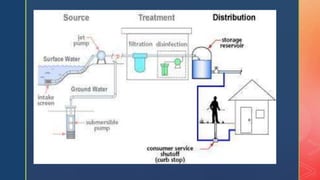
• Distribution system is the part of the water works which receives
the water from pumping station or from conduits and delivers it
throughout the community.
• It includes:
1. Reservoirs for purposes of storage
2. Equalizing pressures
3. Pipe lines
4. Other appurtenances
• Distribution system is used to describe collectively the facilities
used to supply water from its source to the point of usage.
Requirements of good distribution system
• Water quality should not get disturbed in the
distribution pipes.
• It should be capable of supplying water at all the
intended places with sufficient pressure head.
• It should be capable of supplying requisite amount
of water during fire fighting.
Requirements of good distribution system
• The layout should be such that no consumer
would be without water supply, during the repair
of any section of them.
• All the distribution pipes should be preferably laid
one metre away or above the sewer lines.
• It should be fairly water-tight as to keep losses due
to leakage to minimum.
z
• Distribution pipes are generally laid below the road
pavements, and as such layouts generally follow the layouts
of roads.
• There are four different types of layouts:
1. Dead end system
2. Grid iron system
3. Circle or ring system
4. Radial system
Layouts of distribution system
z
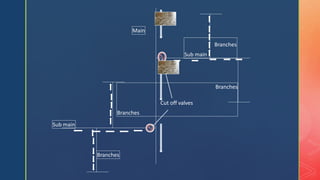
DEAD END OR TREE SYSTEM
• This system is suitable for irregular developed towns or cities.
• In this system water flows in one direction only into sub mains and
branches.
• The diameter of pipe decreases at every tree branch
Main
Branches
Sub main
Sub main
Branches
Cut off valves
Branches
Branches
z
ADVANT
AGES
• Discharge and pressure at any point in the distribution system is calculated easily
• The valves required in this system of layout are comparatively less in number.
• The diameter of pipes used are smaller and hence the system is cheap and economical
• The laying of water pipes is used are simple.
DISADVANTAGES
• There is stagnation water at dead ends of pipes causing contamination.
• During repairs of pipes or valves at any point the entire down stream end are deprived
of supply
• The water available for fire fighting will be limited in quantity
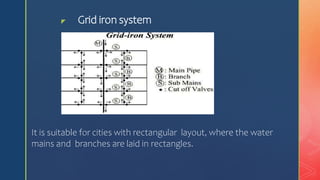
z Grid iron system
It is suitable for cities with rectangular layout, where the water
mains and branches are laid in rectangles.
z
Grid iron system
• It is an improvement over the dead end
system.
• Here no dead ends, so water can
circulates freely throughout the system.
• Mains running on main roads in one
direction and sub-mains also running alike
on minor roads and streets.
z
ADVANT
AGES
• In the case of repairs a very small portion of distribution will be affected
• Every point receives supply from two directions and with higher pressure
• Additional water from the other branches are available for fire fighting
• There is free circulation of water and hence it is not liable for pollution due to stagnation.
DISADVANTAGES
• More length of pipes and number of valves are needed and hence there is increased cost
of construction
• Calculation of sizes of pipes and working out pressures at various points in the distribution
system is laborious , complicated and difficult.
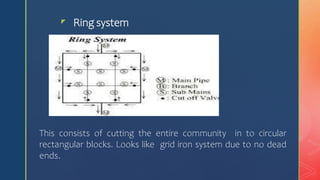
z Ring system
This consists of cutting the entire community in to circular
rectangular blocks. Looks like grid iron system due to no dead
ends.
z
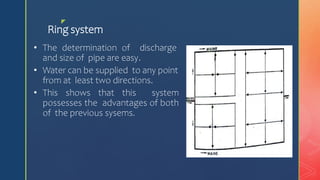
Ring system
• The determination of discharge
and size of pipe are easy.
• Water can be supplied to any point
from at least two directions.
• This shows that this system
possesses the advantages of both
of the previous sysems.
z
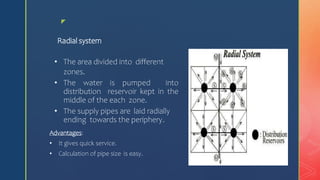
Radial system
• The area divided into different
zones.
• The water is pumped into
distribution reservoir kept in the
middle of the each zone.
• The supply pipes are laid radially
ending towards the periphery.
Advantages:
• It gives quick service.
• Calculation of pipe size is easy.
z
METHODS OF WATERDISTRIBUTION
For efficient distribution system adequate water pressure required at
various points.
Depending upon the level of source, topography of the area and other
local conditions, the water may be forced into distribution system by
following ways –
 Gravity System
 Pumping System
 Combined gravity and pumping system
z
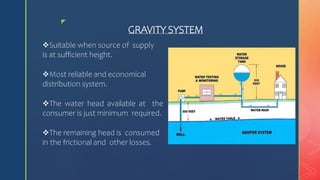
GRAVITY SYSTEM
Suitable when source of supply
is at sufficient height.
Most reliable and economical
distribution system.
The water head available at the
consumer is just minimum required.
The remaining head is consumed
in the frictional and other losses.
z
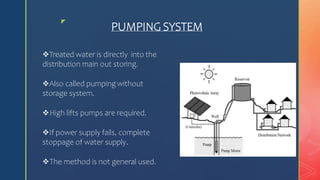
PUMPING SYSTEM
Treated water is directly into the
distribution main out storing.
Also called pumping without
storage system.
High lifts pumps are required.
If power supply fails, complete
stoppage of water supply.
The method is not general used.
z
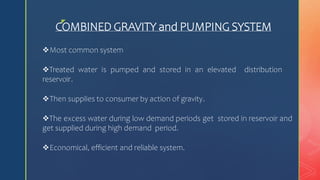
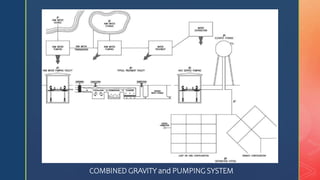
COMBINED GRAVITY and PUMPING SYSTEM
Most common system
Treated water is pumped and stored in an elevated distribution
reservoir.
Then supplies to consumer by action of gravity.
The excess water during low demand periods get stored in reservoir and
get supplied during high demand period.
Economical, efficient and reliable system.
COMBINED GRAVITY and PUMPING SYSTEM
z
Pressure in Distribution System
Head :- head can be measured by the height to which water rises in a column when directly
open to the water
Head loss :- water head lost due to friction in pipes , at entrance of reducer,
Due to valves bends , meters etc . Till consumer tap.
The static head of a pump is the maximum height (pressure) it candeliver
Velocity head is due to the bulk motion of a fluid (kinetic energy).
Elevation head is due to the fluid's weight, the gravitational force acting on a column of
fluid.
Pressure head is due to the static pressure, the internal molecular motion of
a fluid that exerts a force on its container.
Resistance head (or friction head or Head Loss) is due to the frictional
forces acting against a
fluid's motion by the container.

UNIT 2.pptx

  • 1.
    UNIT 2 Distribution system,pipe and appurtenances
  • 3.
    • Distribution systemis the part of the water works which receives the water from pumping station or from conduits and delivers it throughout the community. • It includes: 1. Reservoirs for purposes of storage 2. Equalizing pressures 3. Pipe lines 4. Other appurtenances • Distribution system is used to describe collectively the facilities used to supply water from its source to the point of usage.
  • 4.
    Requirements of gooddistribution system • Water quality should not get disturbed in the distribution pipes. • It should be capable of supplying water at all the intended places with sufficient pressure head. • It should be capable of supplying requisite amount of water during fire fighting.
  • 5.
    Requirements of gooddistribution system • The layout should be such that no consumer would be without water supply, during the repair of any section of them. • All the distribution pipes should be preferably laid one metre away or above the sewer lines. • It should be fairly water-tight as to keep losses due to leakage to minimum.
  • 6.
    z • Distribution pipesare generally laid below the road pavements, and as such layouts generally follow the layouts of roads. • There are four different types of layouts: 1. Dead end system 2. Grid iron system 3. Circle or ring system 4. Radial system Layouts of distribution system
  • 7.
    z DEAD END ORTREE SYSTEM • This system is suitable for irregular developed towns or cities. • In this system water flows in one direction only into sub mains and branches. • The diameter of pipe decreases at every tree branch
  • 8.
  • 9.
    z ADVANT AGES • Discharge andpressure at any point in the distribution system is calculated easily • The valves required in this system of layout are comparatively less in number. • The diameter of pipes used are smaller and hence the system is cheap and economical • The laying of water pipes is used are simple. DISADVANTAGES • There is stagnation water at dead ends of pipes causing contamination. • During repairs of pipes or valves at any point the entire down stream end are deprived of supply • The water available for fire fighting will be limited in quantity
  • 10.
    z Grid ironsystem It is suitable for cities with rectangular layout, where the water mains and branches are laid in rectangles.
  • 11.
    z Grid iron system •It is an improvement over the dead end system. • Here no dead ends, so water can circulates freely throughout the system. • Mains running on main roads in one direction and sub-mains also running alike on minor roads and streets.
  • 12.
    z ADVANT AGES • In thecase of repairs a very small portion of distribution will be affected • Every point receives supply from two directions and with higher pressure • Additional water from the other branches are available for fire fighting • There is free circulation of water and hence it is not liable for pollution due to stagnation. DISADVANTAGES • More length of pipes and number of valves are needed and hence there is increased cost of construction • Calculation of sizes of pipes and working out pressures at various points in the distribution system is laborious , complicated and difficult.
  • 13.
    z Ring system Thisconsists of cutting the entire community in to circular rectangular blocks. Looks like grid iron system due to no dead ends.
  • 14.
    z Ring system • Thedetermination of discharge and size of pipe are easy. • Water can be supplied to any point from at least two directions. • This shows that this system possesses the advantages of both of the previous sysems.
  • 15.
    z Radial system • Thearea divided into different zones. • The water is pumped into distribution reservoir kept in the middle of the each zone. • The supply pipes are laid radially ending towards the periphery. Advantages: • It gives quick service. • Calculation of pipe size is easy.
  • 16.
    z METHODS OF WATERDISTRIBUTION Forefficient distribution system adequate water pressure required at various points. Depending upon the level of source, topography of the area and other local conditions, the water may be forced into distribution system by following ways –  Gravity System  Pumping System  Combined gravity and pumping system
  • 17.
    z GRAVITY SYSTEM Suitable whensource of supply is at sufficient height. Most reliable and economical distribution system. The water head available at the consumer is just minimum required. The remaining head is consumed in the frictional and other losses.
  • 18.
    z PUMPING SYSTEM Treated wateris directly into the distribution main out storing. Also called pumping without storage system. High lifts pumps are required. If power supply fails, complete stoppage of water supply. The method is not general used.
  • 19.
    z COMBINED GRAVITY andPUMPING SYSTEM Most common system Treated water is pumped and stored in an elevated distribution reservoir. Then supplies to consumer by action of gravity. The excess water during low demand periods get stored in reservoir and get supplied during high demand period. Economical, efficient and reliable system.
  • 20.
    COMBINED GRAVITY andPUMPING SYSTEM
  • 21.
    z Pressure in DistributionSystem Head :- head can be measured by the height to which water rises in a column when directly open to the water Head loss :- water head lost due to friction in pipes , at entrance of reducer, Due to valves bends , meters etc . Till consumer tap. The static head of a pump is the maximum height (pressure) it candeliver Velocity head is due to the bulk motion of a fluid (kinetic energy). Elevation head is due to the fluid's weight, the gravitational force acting on a column of fluid. Pressure head is due to the static pressure, the internal molecular motion of a fluid that exerts a force on its container. Resistance head (or friction head or Head Loss) is due to the frictional forces acting against a fluid's motion by the container.