LAYOUTS OF DISTRIBUTION SYSTEM:
• Dead End or Tree system
• Grid Iron system
• Circular or Ring system
• Radial system
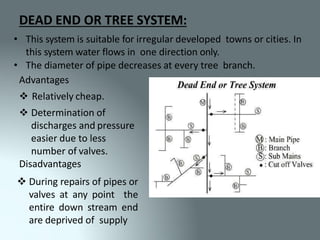
DEAD END OR TREE SYSTEM:
• This system is suitable for irregular developed towns or cities. In
this system water flows in one direction only.
• The diameter of pipe decreases at every tree branch.
Advantages
 Relatively cheap.
 Determination of
discharges and pressure
easier due to less
number of valves.
Disadvantages
 During repairs of pipes or
valves at any point the
entire down stream end
are deprived of supply
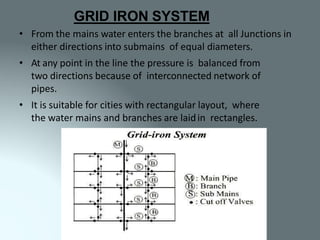
GRID IRON SYSTEM
• From the mains water enters the branches at all Junctions in
either directions into submains of equal diameters.
• At any point in the line the pressure is balanced from
two directions because of interconnected network of
pipes.
• It is suitable for cities with rectangular layout, where
the water mains and branches are laidin rectangles.
Advantages
• In the case of repairs a very small portion of
distribution are a will be affected
• Every point receives supply from two directions and with
higher pressure
• Additional water from the other branches are available
for fire fighting
• There is free circulation of water and hence it is not liable for
pollution due to stagnation.
Disadvantages
• More length of pipes and number of valves are needed and
hence there is increased cost of construction
• Calculation of sizes of pipes and working out pressures at various
points in the distribution system is complicated.
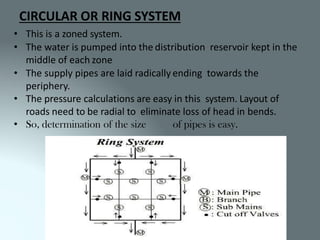
CIRCULAR OR RING SYSTEM
• This is a zoned system.
• The water is pumped into the distribution reservoir kept in the
middle of each zone
• The supply pipes are laid radically ending towards the
periphery.
• The pressure calculations are easy in this system. Layout of
roads need to be radial to eliminate loss of head in bends.
• So, determination of the size of pipes is easy.
Advantages
Water can be supplied to any point from at
least two directions.
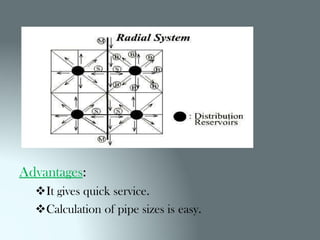
Advantages:
It gives quick service.
Calculation of pipe sizes is easy.
The water may be supplied to the consumers
by either of the two systems.
1. CONTINUOUS SYSTEM
This is the best system and water is supplied for all
24 hours.
In this system sample of water is always available
for fire fighting and due to continuous circulation
water always remains fresh.
In this system less diameter of pipes are required
and rusting of pipes will be less. Losses will be more
if there are leakages in the system.
2. INTERMITTENTSYSTEM
If plenty of water is not available, the supply of
water is divided into zones and each zone is
supplied with water for fixed hours in a day or on
alternate days. As the water is supplied after
intervals, it is called intermittent system.
The system has following disadvantages:
• Pipelines are likely to rust faster due to alternate
wetting and drying.
• More wastage of water due to the tendency of the
people to store more water than required quantity
and to waste the excess to collect fresh water each
time.
• The repair work can be easily done in the non-
supply hours.

water supply system L-2,3.pdf

  • 1.
    LAYOUTS OF DISTRIBUTIONSYSTEM: • Dead End or Tree system • Grid Iron system • Circular or Ring system • Radial system
  • 2.
    DEAD END ORTREE SYSTEM: • This system is suitable for irregular developed towns or cities. In this system water flows in one direction only. • The diameter of pipe decreases at every tree branch. Advantages  Relatively cheap.  Determination of discharges and pressure easier due to less number of valves. Disadvantages  During repairs of pipes or valves at any point the entire down stream end are deprived of supply
  • 3.
    GRID IRON SYSTEM •From the mains water enters the branches at all Junctions in either directions into submains of equal diameters. • At any point in the line the pressure is balanced from two directions because of interconnected network of pipes. • It is suitable for cities with rectangular layout, where the water mains and branches are laidin rectangles.
  • 4.
    Advantages • In thecase of repairs a very small portion of distribution are a will be affected • Every point receives supply from two directions and with higher pressure • Additional water from the other branches are available for fire fighting • There is free circulation of water and hence it is not liable for pollution due to stagnation. Disadvantages • More length of pipes and number of valves are needed and hence there is increased cost of construction • Calculation of sizes of pipes and working out pressures at various points in the distribution system is complicated.
  • 5.
    CIRCULAR OR RINGSYSTEM • This is a zoned system. • The water is pumped into the distribution reservoir kept in the middle of each zone • The supply pipes are laid radically ending towards the periphery. • The pressure calculations are easy in this system. Layout of roads need to be radial to eliminate loss of head in bends. • So, determination of the size of pipes is easy.
  • 6.
    Advantages Water can besupplied to any point from at least two directions.
  • 7.
    Advantages: It gives quickservice. Calculation of pipe sizes is easy.
  • 8.
    The water maybe supplied to the consumers by either of the two systems. 1. CONTINUOUS SYSTEM This is the best system and water is supplied for all 24 hours. In this system sample of water is always available for fire fighting and due to continuous circulation water always remains fresh. In this system less diameter of pipes are required and rusting of pipes will be less. Losses will be more if there are leakages in the system.
  • 9.
    2. INTERMITTENTSYSTEM If plentyof water is not available, the supply of water is divided into zones and each zone is supplied with water for fixed hours in a day or on alternate days. As the water is supplied after intervals, it is called intermittent system. The system has following disadvantages: • Pipelines are likely to rust faster due to alternate wetting and drying. • More wastage of water due to the tendency of the people to store more water than required quantity and to waste the excess to collect fresh water each time. • The repair work can be easily done in the non- supply hours.