Water
                W t application
                          li ti
                methods (Part – II)
                       WRE – I
                       UNIT- VI
Prof
P f S S JAHAGIRDAR
BE (CIVIL), ME(ENV.),PhD(persuing)
NK Orchid college of Engg and Tech , Solapur
                     Engg.    Tech.
Contents

Drip irrigation
Sprinkler irrigation
1] Drip irrigation
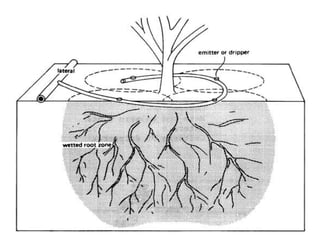
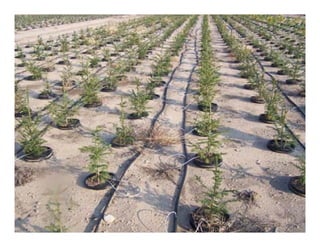
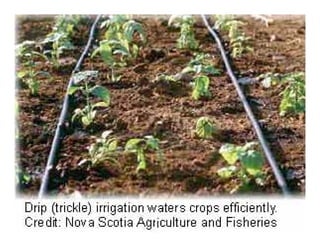
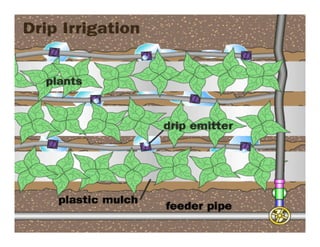
Also known as trickle irrigation
Drip irrigation refers to
application of water i small
   li ti      f t in         ll
quantity at the rate of mostly less
than 12 Lit/hr as drops to the
zone of the plants through a
       f h l        h     h
network of plastic pipes fitted
with emitters.
Components
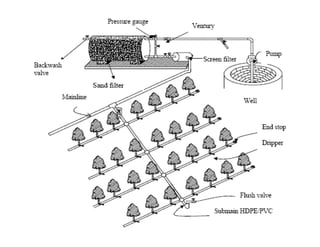
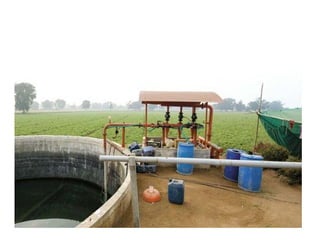
i) HEAD EQUIPMENTS
  a. Water source - Subsurface tank
                          b f         k
  b. Pump - Suction, monoblock pump,
  delivery non return valve, gate valve
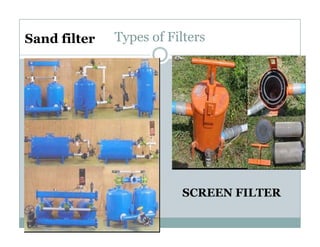
  c. Filt station - S d filter, screen
      Filter t ti      Sand filt
  filter, manifold and pressure gauge
  d. Fertiliser application - Fertiliser
  tank and ventury assembly
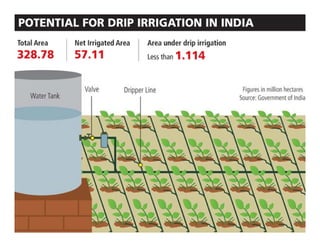
ii) DISTRIBUTION SYSTEM

e. Conveyance line - Main line sub
                              line,
main, laterals, minor tubes and end caps.
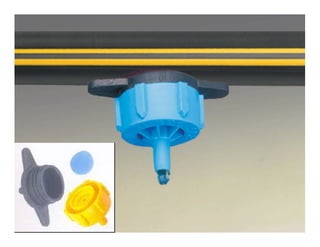
f. Drippers - P
f D i           Pressure corresponding
                                    di
drippers.
 g. Valves - Non-return valve (NRV), Ball
valves,
valves Air release valve (ARV), flush
                         (ARV)
valves
h.
h Water meter - If necessary
                     f
Sand filter   Types of Filters


                         SCREEN FILTER
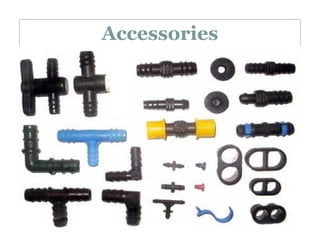
Accessories
MERITS
1. Increased water use efficiency
2. Better crop yield
3. U if
3 Uniform and b tt quality of
                d better    lit f
the crops
        p
4. Efficient and economic use or
fertilizer through fertigation
5. L
   Less weed growth
             d      th
6. Minimum damage to the soil
structure
7
7. Avoidance of leaf burn due to
saline soil
8. U
8 Usage i undulating areas and l
          in d l ti             d less
p
permeable soil
9. Labour saving
10. High uniformity suitable for
automization
11. No over irrigation
11. Nutrients preservation
               p
12. No soil erosion
13. Suitable for any topography.
14. Increase in net irrigable area
15. Cultivation of cash crops
       l          f    h
16. Variation in application
 6 V i ti i          li ti
rate.
rate
DEMERITS

1. Clogging of d i
    l   i    f drippers
2. Ch i l precipitation
   Chemical       i it ti
3.
3 Salt accumulation at wetting
front
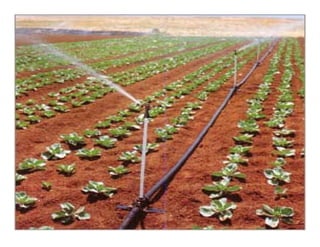
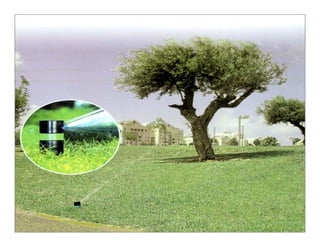
1] Sprinkler irrigation
In the sprinkler method of irrigation
                           irrigation,
water is sprayed into the air and
allowed to f ll on the ground surface
 ll    d   fall     h       d     f
somewhat resembling rainfall. The
                      g
spray is developed by the flow of
water under pressure through small
orifices or nozzles. The pressure is
usually obtained by pumping.
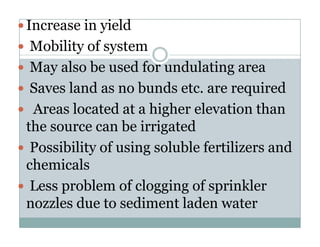
Advantages of sprinkler irrigation
Elimination of the channels for conveyance,
therefore no conveyance loss
 Suitable to all types of soil except heavy clay
 Suitable for irrigating crops where the plant
population per unit area i very hi h It i most
      l ti          it      is     high. is      t
suitable for oil seeds and vegetable crops
 Water saving
 Closer control of water application
                            pp
convenient for giving light and frequent
irrigation and
higher water application efficiency
Increase in yield
 Mobility of system
 May also be used for undulating area
 Saves land as no bunds etc. are required
 Areas located at a higher elevation than
the source can be irrigated
 Possibility of using soluble fertilizers and
chemicals
 Less problem of clogging of sprinkler
nozzles due to sediment laden water
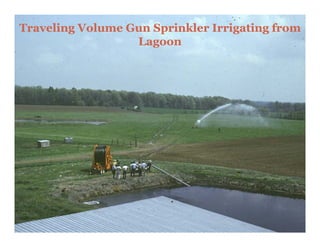
Traveling Volume Gun Sprinkler Irrigating from
                  Lagoon
                     g
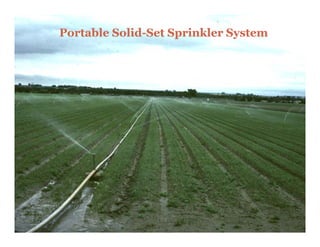
Portable Solid-Set Sprinkler System
         Solid-
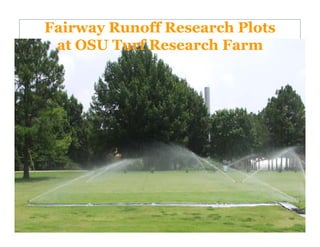
Fairway Runoff Research Plots
 at OSU Turf Research Farm
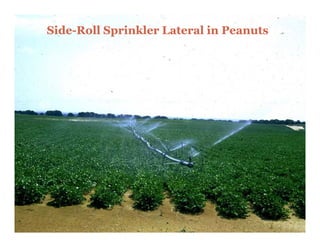
Side-
Side-Roll Sprinkler Lateral in Peanuts
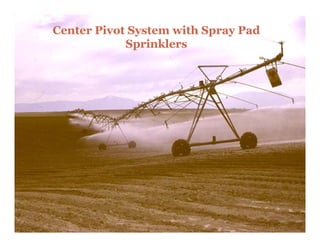
Center Pivot System with Spray Pad
            Sprinklers
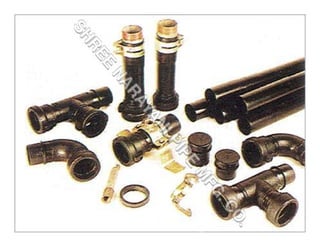
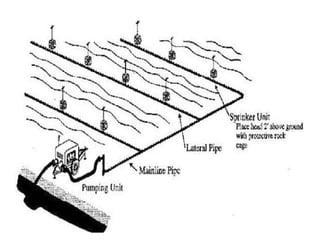
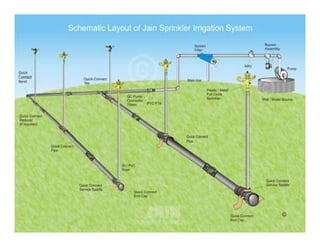
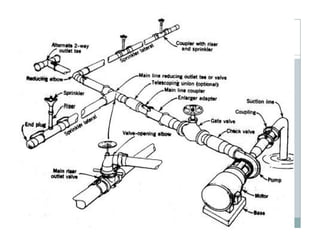
Components
(i) A pump unit
(ii) Tubings - main/ sub mains and
  laterals
  l t l
( )
(iii) Couplers
         p
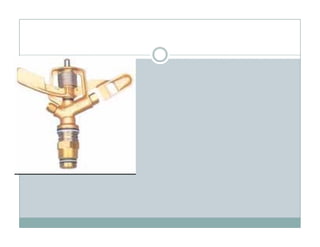
(iv) Sprinkler head
(v) O h
( ) Other accessories such as valves,
                   i      h     l
  bends, plugs and risers.
Constraints in application of
  sprinkler irrigation (Demerits)
(i)
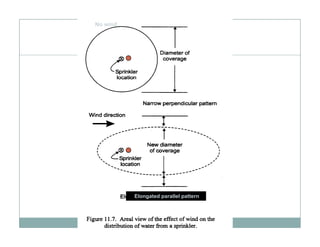
( ) Uneven water distribution due to
  high winds.
(ii) E
     Evaporation l
              ti loss when operating
                           h     ti
  under high temperatures.
           g        p
(iii) Highly impermeable soils are not
  suitable.
     it bl
(iv) Initial cost is high.
No wind


          Elongated parallel pattern
(viii) More water requirement as
 compared to drip irrigation.
           d d i i i i
(ix) High water pressure
 required in sprinkler (>2.5
 kg/cm  2).

(x) Difficulty in irrigation during
 wind in sprinkler .
   i di       i kl
UNIVERSITY
Q
QUESTIONS
•Write detailed note on drip irrigation. Also
draw layout of drip irrigation system showing
different components.
 (Nov
 (N 2008 N 2007 8 marks, M 2007 N
             Nov 2007,8      k May         Nov
2006 ,10 marks)
•Write detailed note on Sprinkler method of
irrigation. Also draw layout of sprinkler
irrigation system showing different components.
(May 2006 ,8 marks)
•Draw and discuss layout of a drip irrigation
system with its suitability
                suitability.
(Nov 2009, 6 marks)
•Discuss the drip irrigation and sprinkler
irrigation methods with their suitability
                                  suitability.
(May 2009, 7 marks)
•Discuss the sprinkler irrigation system in
details with layout, advantages, limitations
and                               suitability.
(May 2010,
(M 2010 7 marks)  k)
•Discuss the sprinkler irrigation system in
               p           g       y
details with their advantages and
disadvantages.
disadvantages
  (Nov 2010, 8 marks)
Water application methods (part – ii)

Water application methods (part – ii)

  • 1.
    Water W t application li ti methods (Part – II) WRE – I UNIT- VI Prof P f S S JAHAGIRDAR BE (CIVIL), ME(ENV.),PhD(persuing) NK Orchid college of Engg and Tech , Solapur Engg. Tech.
  • 2.
  • 3.
    1] Drip irrigation Alsoknown as trickle irrigation Drip irrigation refers to application of water i small li ti f t in ll quantity at the rate of mostly less than 12 Lit/hr as drops to the zone of the plants through a f h l h h network of plastic pipes fitted with emitters.
  • 4.
    Components i) HEAD EQUIPMENTS a. Water source - Subsurface tank b f k b. Pump - Suction, monoblock pump, delivery non return valve, gate valve c. Filt station - S d filter, screen Filter t ti Sand filt filter, manifold and pressure gauge d. Fertiliser application - Fertiliser tank and ventury assembly
  • 5.
    ii) DISTRIBUTION SYSTEM e.Conveyance line - Main line sub line, main, laterals, minor tubes and end caps. f. Drippers - P f D i Pressure corresponding di drippers. g. Valves - Non-return valve (NRV), Ball valves, valves Air release valve (ARV), flush (ARV) valves h. h Water meter - If necessary f
  • 9.
    Sand filter Types of Filters SCREEN FILTER
  • 10.
  • 16.
    MERITS 1. Increased wateruse efficiency 2. Better crop yield 3. U if 3 Uniform and b tt quality of d better lit f the crops p 4. Efficient and economic use or fertilizer through fertigation 5. L Less weed growth d th
  • 17.
    6. Minimum damageto the soil structure 7 7. Avoidance of leaf burn due to saline soil 8. U 8 Usage i undulating areas and l in d l ti d less p permeable soil 9. Labour saving 10. High uniformity suitable for automization 11. No over irrigation
  • 18.
    11. Nutrients preservation p 12. No soil erosion 13. Suitable for any topography. 14. Increase in net irrigable area 15. Cultivation of cash crops l f h 16. Variation in application 6 V i ti i li ti rate. rate
  • 19.
    DEMERITS 1. Clogging ofd i l i f drippers 2. Ch i l precipitation Chemical i it ti 3. 3 Salt accumulation at wetting front
  • 20.
    1] Sprinkler irrigation Inthe sprinkler method of irrigation irrigation, water is sprayed into the air and allowed to f ll on the ground surface ll d fall h d f somewhat resembling rainfall. The g spray is developed by the flow of water under pressure through small orifices or nozzles. The pressure is usually obtained by pumping.
  • 21.
    Advantages of sprinklerirrigation Elimination of the channels for conveyance, therefore no conveyance loss Suitable to all types of soil except heavy clay Suitable for irrigating crops where the plant population per unit area i very hi h It i most l ti it is high. is t suitable for oil seeds and vegetable crops Water saving Closer control of water application pp convenient for giving light and frequent irrigation and higher water application efficiency
  • 22.
    Increase in yield Mobility of system May also be used for undulating area Saves land as no bunds etc. are required Areas located at a higher elevation than the source can be irrigated Possibility of using soluble fertilizers and chemicals Less problem of clogging of sprinkler nozzles due to sediment laden water
  • 26.
    Traveling Volume GunSprinkler Irrigating from Lagoon g
  • 27.
  • 28.
    Fairway Runoff ResearchPlots at OSU Turf Research Farm
  • 29.
  • 30.
    Center Pivot Systemwith Spray Pad Sprinklers
  • 31.
    Components (i) A pumpunit (ii) Tubings - main/ sub mains and laterals l t l ( ) (iii) Couplers p (iv) Sprinkler head (v) O h ( ) Other accessories such as valves, i h l bends, plugs and risers.
  • 36.
    Constraints in applicationof sprinkler irrigation (Demerits) (i) ( ) Uneven water distribution due to high winds. (ii) E Evaporation l ti loss when operating h ti under high temperatures. g p (iii) Highly impermeable soils are not suitable. it bl (iv) Initial cost is high.
  • 37.
    No wind Elongated parallel pattern
  • 38.
    (viii) More waterrequirement as compared to drip irrigation. d d i i i i (ix) High water pressure required in sprinkler (>2.5 kg/cm 2). (x) Difficulty in irrigation during wind in sprinkler . i di i kl
  • 39.
  • 40.
    •Write detailed noteon drip irrigation. Also draw layout of drip irrigation system showing different components. (Nov (N 2008 N 2007 8 marks, M 2007 N Nov 2007,8 k May Nov 2006 ,10 marks) •Write detailed note on Sprinkler method of irrigation. Also draw layout of sprinkler irrigation system showing different components. (May 2006 ,8 marks) •Draw and discuss layout of a drip irrigation system with its suitability suitability. (Nov 2009, 6 marks)
  • 41.
    •Discuss the dripirrigation and sprinkler irrigation methods with their suitability suitability. (May 2009, 7 marks) •Discuss the sprinkler irrigation system in details with layout, advantages, limitations and suitability. (May 2010, (M 2010 7 marks) k) •Discuss the sprinkler irrigation system in p g y details with their advantages and disadvantages. disadvantages (Nov 2010, 8 marks)