



21. Sprayers
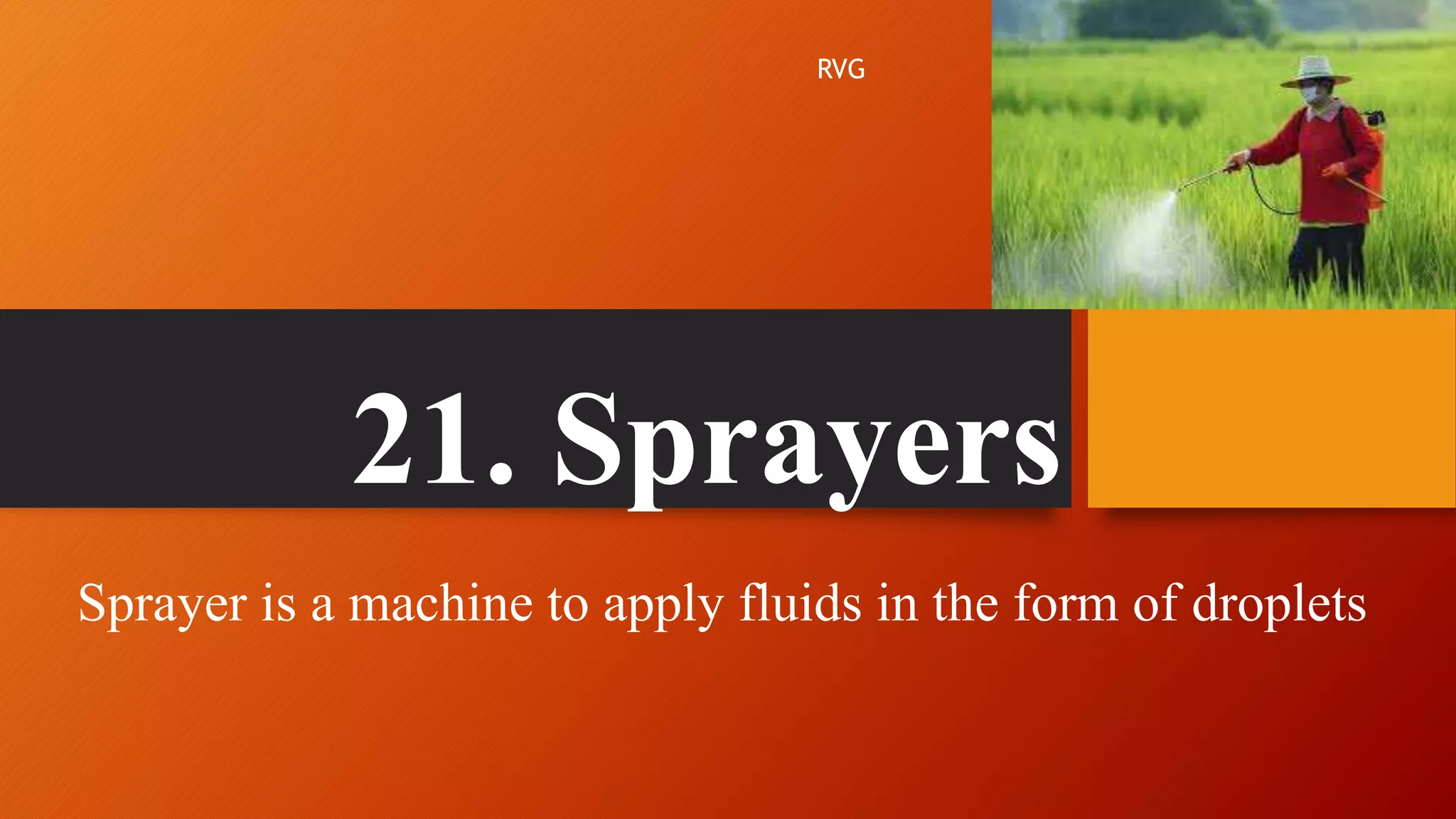
Sprayer is a machine to apply fluids in the form of droplets
RVG
RVG
RVG
• Insect pests and weeds cause considerable damage to the commercial crops. If not controlled
in time, the entire crop gets lost and, therefore, farmers are likely to suffer in many ways.
Among the important methods of weed control and plant protection systems, the following
methods have been recognized as the effective and economical ones under different
situations:
• a) Mechanical control
• b) Chemical control
• c) Biological control
• d) Agronomical methods
• e) Bio-physical methods
• f) Fire as control
• The mechanical control of weeds is most widely used in India and in many
developing countries due to the availability of farm labour at relatively low
rates of wages. Whereas, the chemical method of plant protection has been
universally accepted due to saving of time, labour and its effectiveness with
relatively low expenditure.
• In developing countries, combination of chemical and mechanical methods
of weed control has been successfully accepted.
• The chemicals for protecting the plants from various injurious or organisms
need to be applied on plant surfaces in the form of sprays, dusts, mist etc.
Sprayers and dusters are available in many forms for this purpose.
Sprayers
• Sprayer is a machine to apply fluids in the form of droplets. Sprayer is used for the
following purpose:
• (i) application of fungicides to minimize fungal diseases,
• (ii) application of insecticides to control insect pests,
• (iii) application of herbicides to remove weeds
• (iv) application of micronutrients on the plants.
• The main functions of sprayer are:
• (i) to break the liquid into droplets of effective size,
• (ii) to distribute them uniformly over the plants, and
• (iii) to regulate the amount of liquid to avoid excessive application
Sprayer’s classification Based on power source,
sprayers may be classified as:
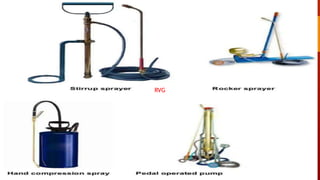
• (i) Hand operated machines – suitable for small holdings. They are
operated at pressure ranging from 1 to 7 kg/cm2.
• (ii) Power operated machines – suitable for treating a large area. They
are operated at pressure ranging from 20 to 55 kg/cm2.
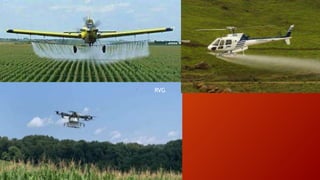
• (iii) Air planes – suitable for large scale work.
RVG
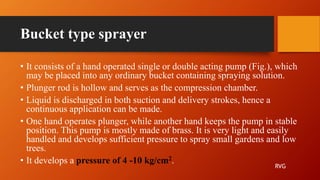
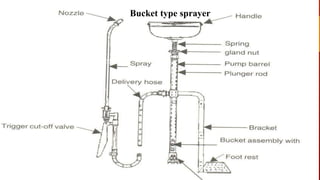
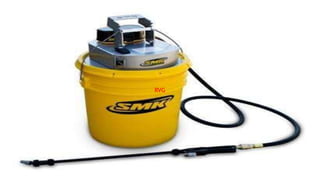
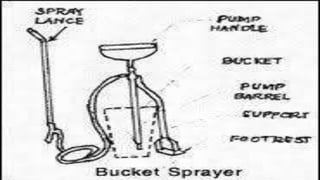
Bucket type sprayer
• It consists of a hand operated single or double acting pump (Fig.), which
may be placed into any ordinary bucket containing spraying solution.
• Plunger rod is hollow and serves as the compression chamber.
• Liquid is discharged in both suction and delivery strokes, hence a
continuous application can be made.
• One hand operates plunger, while another hand keeps the pump in stable
position. This pump is mostly made of brass. It is very light and easily
handled and develops sufficient pressure to spray small gardens and low
trees.
• It develops a pressure of 4 -10 kg/cm2.
RVG
Bucket type sprayer
RVG
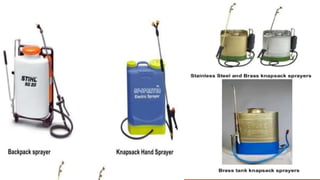
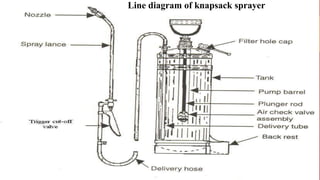
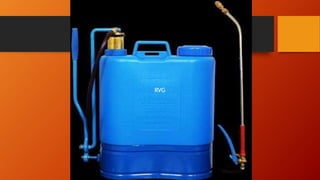
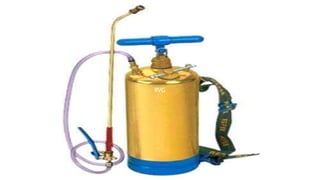
Knapsack sprayer
• It is very common type of sprayer, is provided with a pump and a large air chamber permanently
mounted in a 9 to 22.5 lts tank.
• The handle of the pump extending over the shoulder or under the arm of operator, which makes it
possible to pump with one hand and spray with other hand.
• Spray liquid is delivered through the delivery system, consisting of lance and nozzle, which is
connected with the pump by a flexible hose.
• A uniform pressure can be maintained by keeping the pump in operation. It is generally carried on
the back of the operator.
• It is quite useful for spraying small trees, shrubs and row crops up to 2.5 m height. These
sprayers are useful because of their simplicity in operation, durability and for diverse use including
spraying bushes of tea and coffee (Fig.).
• One man can spray about 0.4 – 0.5 ha in a day, thus spraying about 90 lts of spray liquid.
• A pressure of 3 -5 kg/cm2 is maintained in the pressure chamber.
Line diagram of knapsack sprayer
RVG
RVG
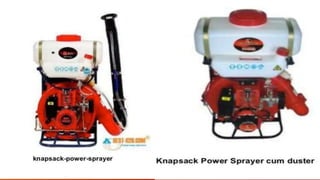
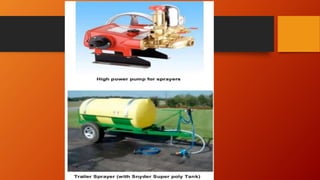
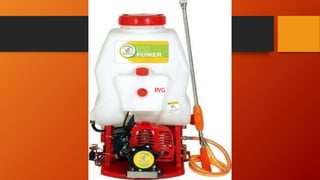
Power sprayers
• Power sprayers are operated usually with IC engines. The prime mower capacity varies
from 1 to 5 hp.
• The pressure pump is operated by a small power unit ensuring a constant steady pressure.
These sprayers are essentially high volume sprayers and operated at pressure ranges
from 20 to 55 kg/cm2.
• These machines are usually portable type. Sometimes, power sprayers are operated by the
PTO shaft of the tractor. Power sprayers can cover much larger area, and do the job
efficiently.
•
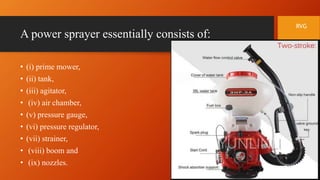
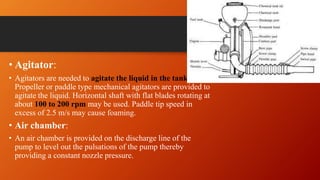
A power sprayer essentially consists of:
• (i) prime mower,
• (ii) tank,
• (iii) agitator,
• (iv) air chamber,
• (v) pressure gauge,
• (vi) pressure regulator,
• (vii) strainer,
• (viii) boom and
• (ix) nozzles.
RVG
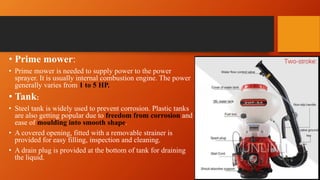
• Prime mower:
• Prime mower is needed to supply power to the power
sprayer. It is usually internal combustion engine. The power
generally varies from 1 to 5 HP.
• Tank:
• Steel tank is widely used to prevent corrosion. Plastic tanks
are also getting popular due to freedom from corrosion and
ease of moulding into smooth shape.
• A covered opening, fitted with a removable strainer is
provided for easy filling, inspection and cleaning.
• A drain plug is provided at the bottom of tank for draining
the liquid.
• Agitator:
• Agitators are needed to agitate the liquid in the tank.
Propeller or paddle type mechanical agitators are provided to
agitate the liquid. Horizontal shaft with flat blades rotating at
about 100 to 200 rpm may be used. Paddle tip speed in
excess of 2.5 m/s may cause foaming.
• Air chamber:
• An air chamber is provided on the discharge line of the
pump to level out the pulsations of the pump thereby
providing a constant nozzle pressure.
• Pressure gauge:
• It is provided on the discharge line to guide the operator regarding spray pressure. It
should be under specified limit.
• Strainer:
• It is provided in the suction line between the tank and the pump to remove dust, dirt and
other foreign materials.
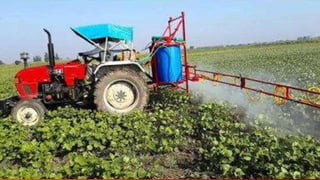
• Boom:
• It is driven by a tractor, has a long boom in a horizontal plane on which nozzles are fixed
at specified spacing. The boom can be adjusted vertically to suit the height of plants in
different fields.
• Nozzle:
• It is used to break the liquid into the desired spray and deliver it to plants.
Care and maintenance of sprayer
•(i) All washers and packings should be soaked in oil or
water before use.
• (ii) The ends of the nozzle should be unscrewed and cleaned
before starting the work.
• (iii) When spraying is over, the sprayer should be operated
for sometime with clean water to remove sediments from the
pressure vessel and the discharge tube.
(iv) Special attention has to be paid in case of
power sprayers for the following:
• (a) Lubricating oil of the engine should be changed for every 100 working
hours unless otherwise advised by the manufacturers.
• (b) Do not disturb the packing until a leak is observed.
• (c) The spray pump should not be worked at more than recommended
pressure.
• (d) Oil level in the pump of the engine should be checked every time and all
grease points should be greased once in a day.
• (e) Recommended oils and fuels should always be used in the engine.
• (f) Nozzle should be thoroughly cleaned after use by blowing air through it.
RVG
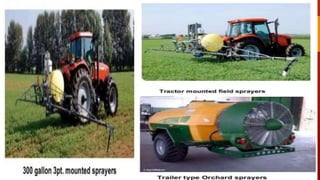
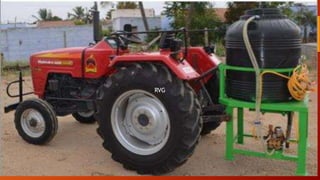
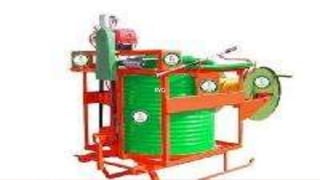
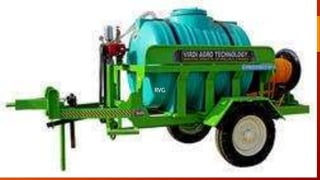
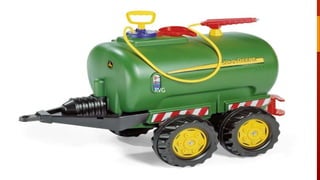
Tractor operated sprayer
• Operated by Tractor PTO ( Power take off shaft )
RVG
RVG
RVG
RVG
Duster
• Duster is a machine to apply chemical in dust form.
• Dusters make use of air streams to carry pesticides in finely
divided dry form on the plants.
• A duster essentially consists of:
• (a) hopper, (b) agitator,
• (c) feed control, (d) fan or blower and (e) delivery nozzle.
Types of dusters
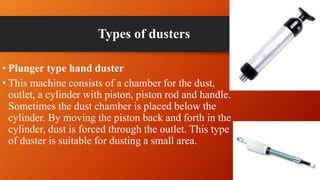
• Plunger type hand duster
• This machine consists of a chamber for the dust,
outlet, a cylinder with piston, piston rod and handle.
Sometimes the dust chamber is placed below the
cylinder. By moving the piston back and forth in the
cylinder, dust is forced through the outlet. This type
of duster is suitable for dusting a small area.
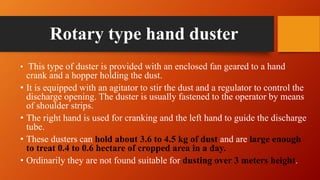
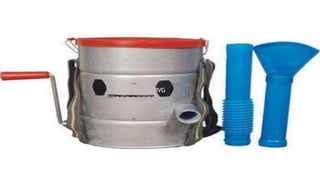
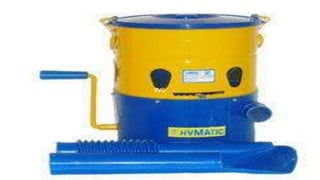
Rotary type hand duster
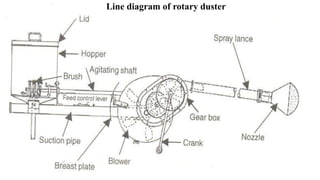
• This type of duster is provided with an enclosed fan geared to a hand
crank and a hopper holding the dust.
• It is equipped with an agitator to stir the dust and a regulator to control the
discharge opening. The duster is usually fastened to the operator by means
of shoulder strips.
• The right hand is used for cranking and the left hand to guide the discharge
tube.
• These dusters can hold about 3.6 to 4.5 kg of dust and are large enough
to treat 0.4 to 0.6 hectare of cropped area in a day.
• Ordinarily they are not found suitable for dusting over 3 meters height.
Line diagram of rotary duster
RVG
RVG
RVG
Power duster
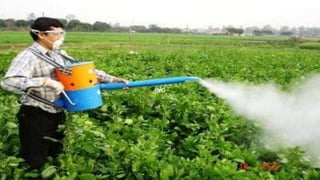
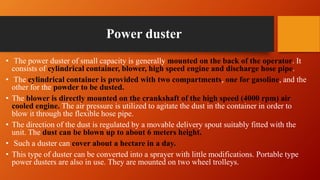
• The power duster of small capacity is generally mounted on the back of the operator. It
consists of cylindrical container, blower, high speed engine and discharge hose pipe.
• The cylindrical container is provided with two compartments, one for gasoline, and the
other for the powder to be dusted.
• The blower is directly mounted on the crankshaft of the high speed (4000 rpm) air
cooled engine. The air pressure is utilized to agitate the dust in the container in order to
blow it through the flexible hose pipe.
• The direction of the dust is regulated by a movable delivery spout suitably fitted with the
unit. The dust can be blown up to about 6 meters height.
• Such a duster can cover about a hectare in a day.
• This type of duster can be converted into a sprayer with little modifications. Portable type
power dusters are also in use. They are mounted on two wheel trolleys.
Care and maintenance of dusters
• (i) Duster should be thoroughly cleaned before and after use with a suitable brush.
• (ii) The hopper should be filled with dust about half of its capacity.
• (iii) The lid of the hopper should be closed during the operation.
• (iv) In rotary dusters, the handle should be cranked at 30 to 35 rpm for efficient
performance.
• (v) Before and after use of the duster, the dust from the fan box, suction pipe and hopper
should be thoroughly blown out.
• (vi) Pieces of paper, gunny bag and other foreign materials should be prevented from
getting into the hopper.
• (vii) The agitator parts and dust feed should be occasionally checked for blockage by
foreign matter.
Thank you
RVG

Sprayers types

  • 1.
    21. Sprayers Sprayer isa machine to apply fluids in the form of droplets RVG
  • 3.
  • 7.
  • 8.
    • Insect pestsand weeds cause considerable damage to the commercial crops. If not controlled in time, the entire crop gets lost and, therefore, farmers are likely to suffer in many ways. Among the important methods of weed control and plant protection systems, the following methods have been recognized as the effective and economical ones under different situations: • a) Mechanical control • b) Chemical control • c) Biological control • d) Agronomical methods • e) Bio-physical methods • f) Fire as control
  • 9.
    • The mechanicalcontrol of weeds is most widely used in India and in many developing countries due to the availability of farm labour at relatively low rates of wages. Whereas, the chemical method of plant protection has been universally accepted due to saving of time, labour and its effectiveness with relatively low expenditure. • In developing countries, combination of chemical and mechanical methods of weed control has been successfully accepted. • The chemicals for protecting the plants from various injurious or organisms need to be applied on plant surfaces in the form of sprays, dusts, mist etc. Sprayers and dusters are available in many forms for this purpose.
  • 10.
    Sprayers • Sprayer isa machine to apply fluids in the form of droplets. Sprayer is used for the following purpose: • (i) application of fungicides to minimize fungal diseases, • (ii) application of insecticides to control insect pests, • (iii) application of herbicides to remove weeds • (iv) application of micronutrients on the plants. • The main functions of sprayer are: • (i) to break the liquid into droplets of effective size, • (ii) to distribute them uniformly over the plants, and • (iii) to regulate the amount of liquid to avoid excessive application
  • 11.
    Sprayer’s classification Basedon power source, sprayers may be classified as: • (i) Hand operated machines – suitable for small holdings. They are operated at pressure ranging from 1 to 7 kg/cm2. • (ii) Power operated machines – suitable for treating a large area. They are operated at pressure ranging from 20 to 55 kg/cm2. • (iii) Air planes – suitable for large scale work. RVG
  • 12.
    Bucket type sprayer •It consists of a hand operated single or double acting pump (Fig.), which may be placed into any ordinary bucket containing spraying solution. • Plunger rod is hollow and serves as the compression chamber. • Liquid is discharged in both suction and delivery strokes, hence a continuous application can be made. • One hand operates plunger, while another hand keeps the pump in stable position. This pump is mostly made of brass. It is very light and easily handled and develops sufficient pressure to spray small gardens and low trees. • It develops a pressure of 4 -10 kg/cm2. RVG
  • 13.
  • 14.
  • 16.
    Knapsack sprayer • Itis very common type of sprayer, is provided with a pump and a large air chamber permanently mounted in a 9 to 22.5 lts tank. • The handle of the pump extending over the shoulder or under the arm of operator, which makes it possible to pump with one hand and spray with other hand. • Spray liquid is delivered through the delivery system, consisting of lance and nozzle, which is connected with the pump by a flexible hose. • A uniform pressure can be maintained by keeping the pump in operation. It is generally carried on the back of the operator. • It is quite useful for spraying small trees, shrubs and row crops up to 2.5 m height. These sprayers are useful because of their simplicity in operation, durability and for diverse use including spraying bushes of tea and coffee (Fig.). • One man can spray about 0.4 – 0.5 ha in a day, thus spraying about 90 lts of spray liquid. • A pressure of 3 -5 kg/cm2 is maintained in the pressure chamber.
  • 17.
    Line diagram ofknapsack sprayer
  • 18.
  • 19.
  • 20.
    Power sprayers • Powersprayers are operated usually with IC engines. The prime mower capacity varies from 1 to 5 hp. • The pressure pump is operated by a small power unit ensuring a constant steady pressure. These sprayers are essentially high volume sprayers and operated at pressure ranges from 20 to 55 kg/cm2. • These machines are usually portable type. Sometimes, power sprayers are operated by the PTO shaft of the tractor. Power sprayers can cover much larger area, and do the job efficiently. •
  • 21.
    A power sprayeressentially consists of: • (i) prime mower, • (ii) tank, • (iii) agitator, • (iv) air chamber, • (v) pressure gauge, • (vi) pressure regulator, • (vii) strainer, • (viii) boom and • (ix) nozzles. RVG
  • 22.
    • Prime mower: •Prime mower is needed to supply power to the power sprayer. It is usually internal combustion engine. The power generally varies from 1 to 5 HP. • Tank: • Steel tank is widely used to prevent corrosion. Plastic tanks are also getting popular due to freedom from corrosion and ease of moulding into smooth shape. • A covered opening, fitted with a removable strainer is provided for easy filling, inspection and cleaning. • A drain plug is provided at the bottom of tank for draining the liquid.
  • 23.
    • Agitator: • Agitatorsare needed to agitate the liquid in the tank. Propeller or paddle type mechanical agitators are provided to agitate the liquid. Horizontal shaft with flat blades rotating at about 100 to 200 rpm may be used. Paddle tip speed in excess of 2.5 m/s may cause foaming. • Air chamber: • An air chamber is provided on the discharge line of the pump to level out the pulsations of the pump thereby providing a constant nozzle pressure.
  • 24.
    • Pressure gauge: •It is provided on the discharge line to guide the operator regarding spray pressure. It should be under specified limit. • Strainer: • It is provided in the suction line between the tank and the pump to remove dust, dirt and other foreign materials. • Boom: • It is driven by a tractor, has a long boom in a horizontal plane on which nozzles are fixed at specified spacing. The boom can be adjusted vertically to suit the height of plants in different fields. • Nozzle: • It is used to break the liquid into the desired spray and deliver it to plants.
  • 25.
    Care and maintenanceof sprayer •(i) All washers and packings should be soaked in oil or water before use. • (ii) The ends of the nozzle should be unscrewed and cleaned before starting the work. • (iii) When spraying is over, the sprayer should be operated for sometime with clean water to remove sediments from the pressure vessel and the discharge tube.
  • 26.
    (iv) Special attentionhas to be paid in case of power sprayers for the following: • (a) Lubricating oil of the engine should be changed for every 100 working hours unless otherwise advised by the manufacturers. • (b) Do not disturb the packing until a leak is observed. • (c) The spray pump should not be worked at more than recommended pressure. • (d) Oil level in the pump of the engine should be checked every time and all grease points should be greased once in a day. • (e) Recommended oils and fuels should always be used in the engine. • (f) Nozzle should be thoroughly cleaned after use by blowing air through it.
  • 27.
  • 28.
    Tractor operated sprayer •Operated by Tractor PTO ( Power take off shaft )
  • 29.
  • 31.
  • 32.
  • 33.
  • 34.
    Duster • Duster isa machine to apply chemical in dust form. • Dusters make use of air streams to carry pesticides in finely divided dry form on the plants. • A duster essentially consists of: • (a) hopper, (b) agitator, • (c) feed control, (d) fan or blower and (e) delivery nozzle.
  • 35.
    Types of dusters •Plunger type hand duster • This machine consists of a chamber for the dust, outlet, a cylinder with piston, piston rod and handle. Sometimes the dust chamber is placed below the cylinder. By moving the piston back and forth in the cylinder, dust is forced through the outlet. This type of duster is suitable for dusting a small area.
  • 36.
    Rotary type handduster • This type of duster is provided with an enclosed fan geared to a hand crank and a hopper holding the dust. • It is equipped with an agitator to stir the dust and a regulator to control the discharge opening. The duster is usually fastened to the operator by means of shoulder strips. • The right hand is used for cranking and the left hand to guide the discharge tube. • These dusters can hold about 3.6 to 4.5 kg of dust and are large enough to treat 0.4 to 0.6 hectare of cropped area in a day. • Ordinarily they are not found suitable for dusting over 3 meters height.
  • 37.
    Line diagram ofrotary duster
  • 38.
  • 39.
  • 40.
  • 41.
    Power duster • Thepower duster of small capacity is generally mounted on the back of the operator. It consists of cylindrical container, blower, high speed engine and discharge hose pipe. • The cylindrical container is provided with two compartments, one for gasoline, and the other for the powder to be dusted. • The blower is directly mounted on the crankshaft of the high speed (4000 rpm) air cooled engine. The air pressure is utilized to agitate the dust in the container in order to blow it through the flexible hose pipe. • The direction of the dust is regulated by a movable delivery spout suitably fitted with the unit. The dust can be blown up to about 6 meters height. • Such a duster can cover about a hectare in a day. • This type of duster can be converted into a sprayer with little modifications. Portable type power dusters are also in use. They are mounted on two wheel trolleys.
  • 42.
    Care and maintenanceof dusters • (i) Duster should be thoroughly cleaned before and after use with a suitable brush. • (ii) The hopper should be filled with dust about half of its capacity. • (iii) The lid of the hopper should be closed during the operation. • (iv) In rotary dusters, the handle should be cranked at 30 to 35 rpm for efficient performance. • (v) Before and after use of the duster, the dust from the fan box, suction pipe and hopper should be thoroughly blown out. • (vi) Pieces of paper, gunny bag and other foreign materials should be prevented from getting into the hopper. • (vii) The agitator parts and dust feed should be occasionally checked for blockage by foreign matter.
  • 43.