Micro Irrigation, Conservation
Agricultureand Water
Productivity
Dr Shiv Prakash Singh
Ex. Team Leader,
Food and Agriculture Organization of the
United Nations, Lucknow
2.
Micro Irrigation
Micro irrigationis a modern
method of irrigation; where
water is irrigated through
drippers, sprinklers, foggers and
by other emitters on surface or
subsurface of the land.
Micro-irrigation, also called
localized irrigation, low
volume irrigation, low-
flow irrigation, or trickle
irrigation, is
an irrigation method with lower
pressure and flow than a
traditional sprinkler system
3.
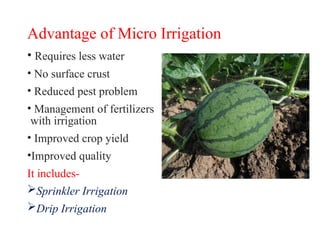
Advantage of MicroIrrigation
• Requires less water
• No surface crust
• Reduced pest problem
• Management of fertilizers
with irrigation
• Improved crop yield
•Improved quality
It includes-
Sprinkler Irrigation
Drip Irrigation
4.
Sprinkler Irrigation
Sprinklerirrigation is a method of applying
irrigation water which is similar to natural
rainfall. Water is distributed through pipes and
sprayed into the air by way of sprinklers and water
drops fall on ground like natural rainfall but in
controlled manner.
Sprinkler irrigation system allows application of
water under high pressure with the help of a pump.
Sprinkler irrigation was also known as overhead
irrigation.
Sprinkler can be used to irrigate agricultural crops,
lawns, landscapes, golf courses, and other areas.
5.
Components of SprinklerIrrigation
•Water pump unit.
•Tubings- Main/submains
and laterals
•Couplers
•Sprinkler heads
•Water meter
• Pump Controller
• Valve box
•Riser pump
• Backflow Prevention
device
• End cap
6.
Functional Specifications ofSprinkler
Irrigation
A minimum of 1.0 kg/cm
2
pressure needed to operate
one sprinkler head to cover a diameter of 12 m
Owing to the non economy of operating one sprinkler
head, a pressure range of 4-5 kg/cm
2
is normally needed
for operating 4 sprinkler heads at a time.
It is better to operate under wind speed less than 15
KMPH to avoid drift loss in normal field holdings.
Use of sprinkler early in the morning and late in the
evening is preferable to minimize the evaporation
losses.
Approximate cost is Rs 40,000 to 50,000 /ha.
7.
Advantage of SprinklerIrrigation
Suitable for all types of field condition.
It can be used in unlevelled (undulating) lands.
No loss of cultivated area due to channel construction.
Uniform distribution of water with high efficiency.
Less land loss provides more land area for cultivation.
Loss of water is minimum (efficiency around 80%)
Accurate and easy measurement of distributed water.
Plant protection chemicals and soluble fertilizers can be
sprayed.
Easy mechanization and automation
Better crop yield
8.
Response of VariousCrops Sprinkler
Irrigation
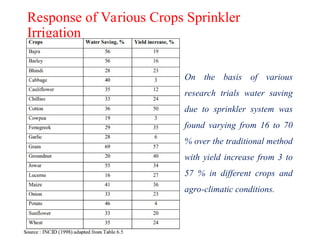
On the basis of various
research trials water saving
due to sprinkler system was
found varying from 16 to 70
% over the traditional method
with yield increase from 3 to
57 % in different crops and
agro-climatic conditions.
9.
Disadvantage of SprinklerIrrigation
• Evaporation and wind drift issue in speedy wind
•A stable water supply is needed.
• Requires high and continuous power supply.
• Saline water (soluble salts >7 millimhos/cm) may cause problem.
• Water must be free from sand, debris etc.
• Cannot be used in windy climate.
• Suitable only for close spacing crops.
• Cannot be used on crops susceptible to foliar diseases.
• Flower blossom can get loss due to high pressure of water drifts.
•Not suitable for the crops, requiring deep water depth
10.
Constraints of SprinklerIrrigation
• It requires high initial
investment.
•High operation cost
• Small land holding size
• It is not suitable for heavy
soils.
• In dryland agriculture, it
has no use.
• It is relatively better for
close spacing crops like
soybean, groundnut, urd,
cotton, lucerne, tea, barley
etc
11.
Drip Irrigation
DripIrrigation System is a type of micro-irrigation method.
The first experimental system of this type was established in
1959 in Israel.
Drip irrigation is a technique in which water flows through
a filter into special drip pipes, with emitters located at
different spacing. Water is distributed through the emitters
directly into the soil near the roots through a special slow-
release device.
Drip system that has the potential to save water and
nutrients by allowing water to drip slowly to the roots of
plants.
The goal is to place water directly into the root zone and
minimize evaporation
12.
Drip Irrigation
Thedrip irrigation system can be
placed above the soil surface or
buried below the surface.
Water is released 2-20 ltrs per hour
into the soil through drippers or
emitters.
The water savings that can be made
using drip irrigation are the
reductions in deep percolation,
surface runoff and evaporation from
the soil.
The primary goal of drip irrigation is
to apply water at the time when
plants need it most and in rates
needed for proper plant growth.
13.
Type of DripIrrigation
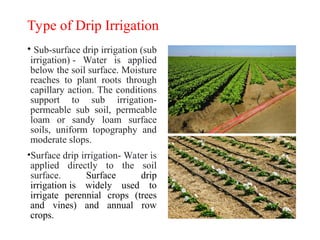
• Sub-surface drip irrigation (sub
irrigation) - Water is applied
below the soil surface. Moisture
reaches to plant roots through
capillary action. The conditions
support to sub irrigation-
permeable sub soil, permeable
loam or sandy loam surface
soils, uniform topography and
moderate slops.
•Surface drip irrigation- Water is
applied directly to the soil
surface. Surface drip
irrigation is widely used to
irrigate perennial crops (trees
and vines) and annual row
crops.
14.
Wetting Pattern inDrip Irigation
• The wetting patterns which
develop from dripping water
onto the soil depend on
discharge and soil type.
•Drip irrigation does not save
water by reducing the
amount used by the crop.
Crop water use is not
changed by the method of
applying water. Crops just
require the right amount for
good growth.
15.
Drip Irrigation SystemNetwork
The layout of drip irrigation is as below-
(a)Pumping unit
It takes water from the source and supplies pressurized
water to the control head,
Pumps used in drip irrigation includes centrifugal,
submersible and turbine pumps,
Pumps can be driven by an electric motor or an internal
combustion engine,
Efficiently designed irrigation system has a pumping
capacity closely matched to the system demand.
Contd-----
16.
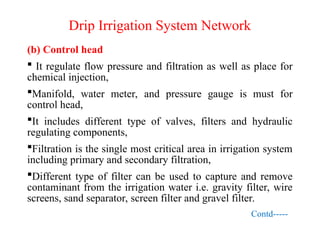
Drip Irrigation SystemNetwork
(b) Control head
It regulate flow pressure and filtration as well as place for
chemical injection,
Manifold, water meter, and pressure gauge is must for
control head,
It includes different type of valves, filters and hydraulic
regulating components,
Filtration is the single most critical area in irrigation system
including primary and secondary filtration,
Different type of filter can be used to capture and remove
contaminant from the irrigation water i.e. gravity filter, wire
screens, sand separator, screen filter and gravel filter.
Contd-----
17.
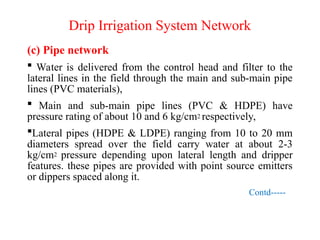
Drip Irrigation SystemNetwork
(c) Pipe network
Water is delivered from the control head and filter to the
lateral lines in the field through the main and sub-main pipe
lines (PVC materials),
Main and sub-main pipe lines (PVC & HDPE) have
pressure rating of about 10 and 6 kg/cm2 respectively,
Lateral pipes (HDPE & LDPE) ranging from 10 to 20 mm
diameters spread over the field carry water at about 2-3
kg/cm2 pressure depending upon lateral length and dripper
features. these pipes are provided with point source emitters
or dippers spaced along it.
Contd-----
18.
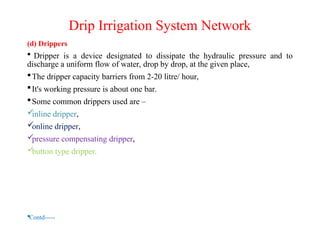
Drip Irrigation SystemNetwork
(d) Drippers
Dripper is a device designated to dissipate the hydraulic pressure and to
discharge a uniform flow of water, drop by drop, at the given place,
The dripper capacity barriers from 2-20 litre/ hour,
It's working pressure is about one bar.
Some common drippers used are –
inline dripper,
online dripper,
pressure compensating dripper,
button type dripper.
Contd-----
19.
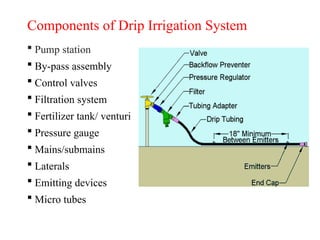
Components of DripIrrigation System
Pump station
By-pass assembly
Control valves
Filtration system
Fertilizer tank/ venturi
Pressure gauge
Mains/submains
Laterals
Emitting devices
Micro tubes
21.
Accessories related toDrip Irrigation
System
Hydraulic connections: used to connect pipes like tee joint ,
elbow, bend, connectors etc.
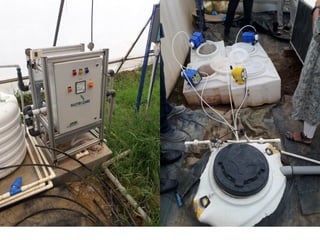
Fertilise applicators: Fertilizer tank (a metallic tank,
connected to main irrigation line by means of a py-pass line);
Venturi injector (to create a suction effect, which allows entry
of the liquid fertilizer in to the system); Fertiliser injector (it
draws fertiliser from a tank and pumps under pressure in to the
irrigation system with precise control).
Pressure / Flow regulators: They are control valves to
regulate flow and pressure either manually or electro-
hydraulically.
Controllers: Automatic- mostly micro-processor based-
devices are used to provide stop/start signals (may be either
time or volume) to pump and valves/regulators. In advance
technological modes, these gadgets are controlled by soil
moisture sensors placed in the plant root zone.
Functional Specifications ofDrip Irrigation
System
Drip irrigation systems are generally designed to operate
in the pressure range of 10 to 30 pounds per square inch
(psi), but domestic water is usually delivered to house-
holds at pressures above 30 psi.
A drip irrigation system consists essentially of mainline,
sub mains, lateral, drippers, filters and other small fittings
and accessories like valves, pressure regulators, pressure
gauge, fertilizer application components etc.
Drip irrigation involves dripping water onto the soil at very
low rates (2-20 litres/hour).
A good rule of thumb is to place a drip emitter evenly
spaced along the plant line and a minimum of six inches
from the base of the plant.
Efficiency of drip irrigation is more than 90%
24.
Guidelines for Planningand Designing of DIS
Work out number of connectors,
Plants in sunny areas usually require more water,
Soil type affects the water requirement for different area of
farm e.g. heavy clay soil may need more water pressure,
Select drip emitters considering to water requirement,
Rain switches and soil moisture sensors are highly
recommended for high rainfall area,
To hold the piping in place, a 10 cm deep trench will be
adequate, though sandy soils may require deeper trench,
Make it easier to connects joints, heat the end of piping to
soften to make it more flexible,
Make sure drip emitters are installed above ground so that
they don't become cogged by dirt.
25.
Advantages of DripIrrigation System
Marginal and undulating land can be irrigated.
Drip irrigation is suited to all type of soils.
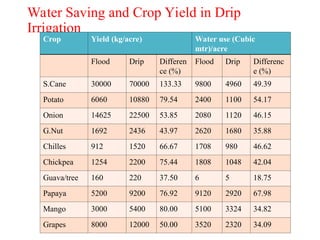
Needs 30-50 % less water than the conventional method.
Less/minimum weed infestation.
Relatively less problem of diseases/pests.
Requires less labour for irrigation, weeding and other activities.
Fertilizer saving
Loss of fertilizer is minimized.
Better aeration in soil results in vigorous growth of plants.
Early maturity.
Better crop yield.
Quality produce.
26.
Limitations of DripIrrigation System
High initial cost.
Filtration is must, other wise clogging is possible.
Cannot be use unless plant germinates.
Limited reserved water in soil, can harm any mistake.
A lot of work in beginning and end of season.
Sun heat affects tubes, sometimes they get broken for
excessive heat production
Require water that is under pressure (need a pump).
Requires some skill to operate it.
Post season clean up required.
Method is not suitable for closely planted crops e.g. wheat.
27.
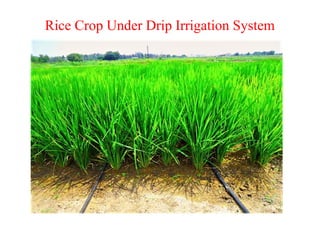
Advantage of DripIrrg. in Rice Crop
• Can grow a larger number of crops/area with less water
• Can save 40-60 per-cent water
• Easy to provide the necessary nutrients and fertilizers
• Less chance of weeds to grow
• Can avoid waterlogging as with traditional irrigation
methods.
• Easily adaptable to various types of soil, and sizes of fields
and on any topography
• Reduction in manual labor works like weeding and herbicide
application
• Saving cost on cultivation
• Prevents soil erosion
•Yield enhancement nearly 14-20 per-cent
Promotion of MicroIrrigation System
Subsidy on Sprinkler/Drip Irrigation System under “per
drop more crop” scheme
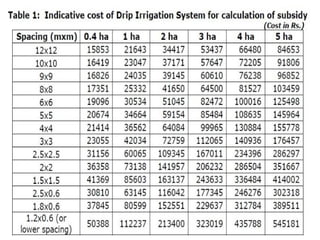
Unit cost for 01
ha (Rs 27,823 –
1,46,626
Govt. of India Govt of UP Total
Marginal/Small
Farmers
55 % 35% 90%
Other Farmers 45% 35% 80%
35.
Criteria of Suitabilityfor Micro Irrigation System
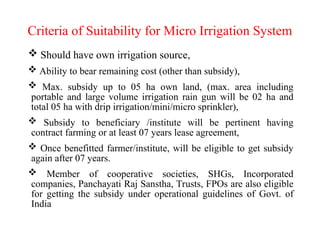
Should have own irrigation source,
Ability to bear remaining cost (other than subsidy),
Max. subsidy up to 05 ha own land, (max. area including
portable and large volume irrigation rain gun will be 02 ha and
total 05 ha with drip irrigation/mini/micro sprinkler),
Subsidy to beneficiary /institute will be pertinent having
contract farming or at least 07 years lease agreement,
Once benefitted farmer/institute, will be eligible to get subsidy
again after 07 years.
Member of cooperative societies, SHGs, Incorporated
companies, Panchayati Raj Sanstha, Trusts, FPOs are also eligible
for getting the subsidy under operational guidelines of Govt. of
India
Conservation Agriculture
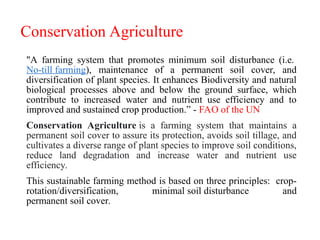
"A farmingsystem that promotes minimum soil disturbance (i.e.
No-till farming), maintenance of a permanent soil cover, and
diversification of plant species. It enhances Biodiversity and natural
biological processes above and below the ground surface, which
contribute to increased water and nutrient use efficiency and to
improved and sustained crop production.” - FAO of the UN
Conservation Agriculture is a farming system that maintains a
permanent soil cover to assure its protection, avoids soil tillage, and
cultivates a diverse range of plant species to improve soil conditions,
reduce land degradation and increase water and nutrient use
efficiency.
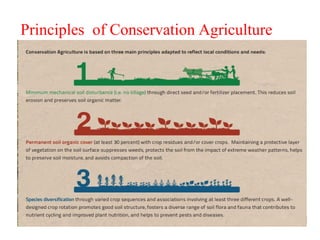
This sustainable farming method is based on three principles: crop-
rotation/diversification, minimal soil disturbance and
permanent soil cover.
38.
Advantage of ConservationAgriculture
• Environmental protection/ conservation of bio-diversity;
• Better water conservation;
• Conserving, improving, and making more efficient use of their
natural resources" (FAO 2006);
• CA is shown to have even higher yields and higher outputs than
conventional agriculture;
• Increase in organic matter;
• Improvement of soil structure and rooting zone;
• No burning of crop residues;
• Saves 30-40% time and labour and
Contd-----
39.
Advantage of ConservationAgriculture
• Integrated disease and pest management;
• Reducing air and water pollution;
• Managing and protecting watersheds and wetlands;
• Preventing soil erosion and improving soil quality;
• Soils are a renewable resource, which means that whatever is
taken out of the soil can be put back over time (New Standard, 1992;
• Better availability of nutrients (Organic molecules in the soil break
down into phosphates, nitrates and other beneficial elements which are thus
better absorbed by plants);
• Reducing the negative impacts of flooding;
• Improving resilience to drought and invasive species;
• Helping to sequester greenhouse gases.
Principles of ConservationAgriculture
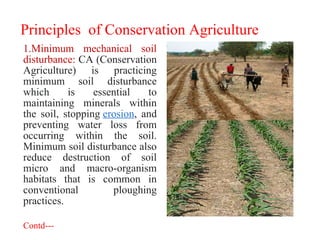
1.Minimum mechanical soil
disturbance: CA (Conservation
Agriculture) is practicing
minimum soil disturbance
which is essential to
maintaining minerals within
the soil, stopping erosion, and
preventing water loss from
occurring within the soil.
Minimum soil disturbance also
reduce destruction of soil
micro and macro-organism
habitats that is common in
conventional ploughing
practices.
Contd---
42.
Principles of ConservationAgriculture
2. Permanent soil organic cover:
The principle of managing the
top soil to create a permanent
organic soil cover can allow for
growth of organisms within the
soil structure. The breaking
down of this mulch will produce
a high organic matter level
which will act as a fertilizer for
the soil surface. The presence of
mulching also reduce the
velocity of runoff and soil
erosion. Organic ground cover
also maintain the temperature
and moisture levels.
Contd---
43.
Principles of ConservationAgriculture
Diverse crop rotations: Crop
rotation will not allow pests such as
insects and weeds to be set into a
rotation with specific crops.
Rotational crops will act as a natural
insecticide and herbicide against
specific crops. Not allowing insects or
weeds to establish a pattern will help
to eliminate problems with yield
reduction and infestations within
fields. Establishing crops in a rotation
allows for an extensive build-up of
rooting zones which will allow for
better water infiltration. Organic
molecules in the soil break down into
phosphates, nitrates and other
beneficial elements which are thus
better absorbed by plants