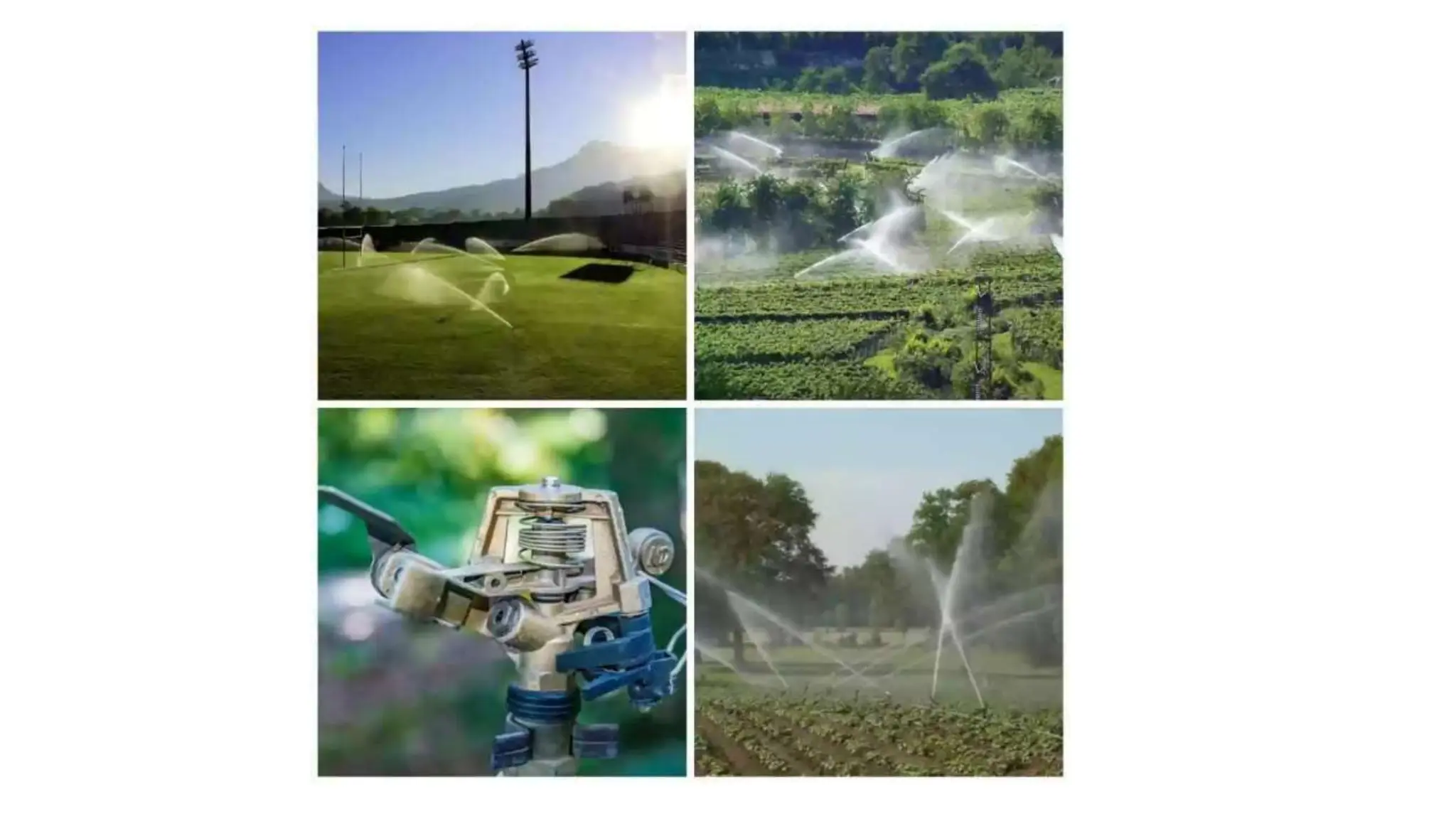
SPRINKLER IRRIGATION
Dr Chandrashekar S Y
Professor(Horticulture)
AHRS, Madikeri
9448255873
Introduction:
 Water is a key factor in increasing agricultural production, in such
case irrigation is most important factor.
 One such method of modern irrigation is sprinkler irrigation system
which is becoming more and more popular among the farmers across
the developed country.
SPRINKLER IRRIGATION
• water is carried through a network of pipes under medium to high
pressure and is forced through a nozzle of small diameter and sprayed on
the ground or crop like a rain.
• It tends to simulate the rainfall but in a way such that the run-off and deep
percolation losses are avoided.
• Irrigation is given under controlled conditions up to the root depth.
• It is possible to apply the required quantity of water at the required time.
The current status of the sprinkler irrigation
system in India
• The total area under sprinkler irrigation is about 3.59 million hectares,
which is less than 2.5% of the total area under irrigation.
• The leading states in sprinkler irrigation are Rajasthan, Haryana,
Punjab, and Maharashtra.
• The sprinkler irrigation system is a more efficient way to irrigate crops
than traditional methods, such as surface irrigation. It can save up to
30-50% of water.
Advantages of sprinkler irrigation
• Water conservation
• Soil conservation and effective use of land
• Healthy growth of crops
• Less labour
• Seed Germination
• Application of fertilizers
Cont.,
• Application of insecticides and weedicides
• Soil amendments
• Frost protection
• Cooling of crops
• Water saving
Disadvantages of sprinkler irrigation system
• Wind effect
• Impact on fruits
• Impact on flowering
• Systems cost
• Energy needs
• Adverse soil condition
• Evaporation loss
• Uniformity
Classification of sprinkler irrigation system
Based on
method of
water
application
Based on
portability
Based on
precipitation
rates
Based on
principle of
operation
Based on
movement
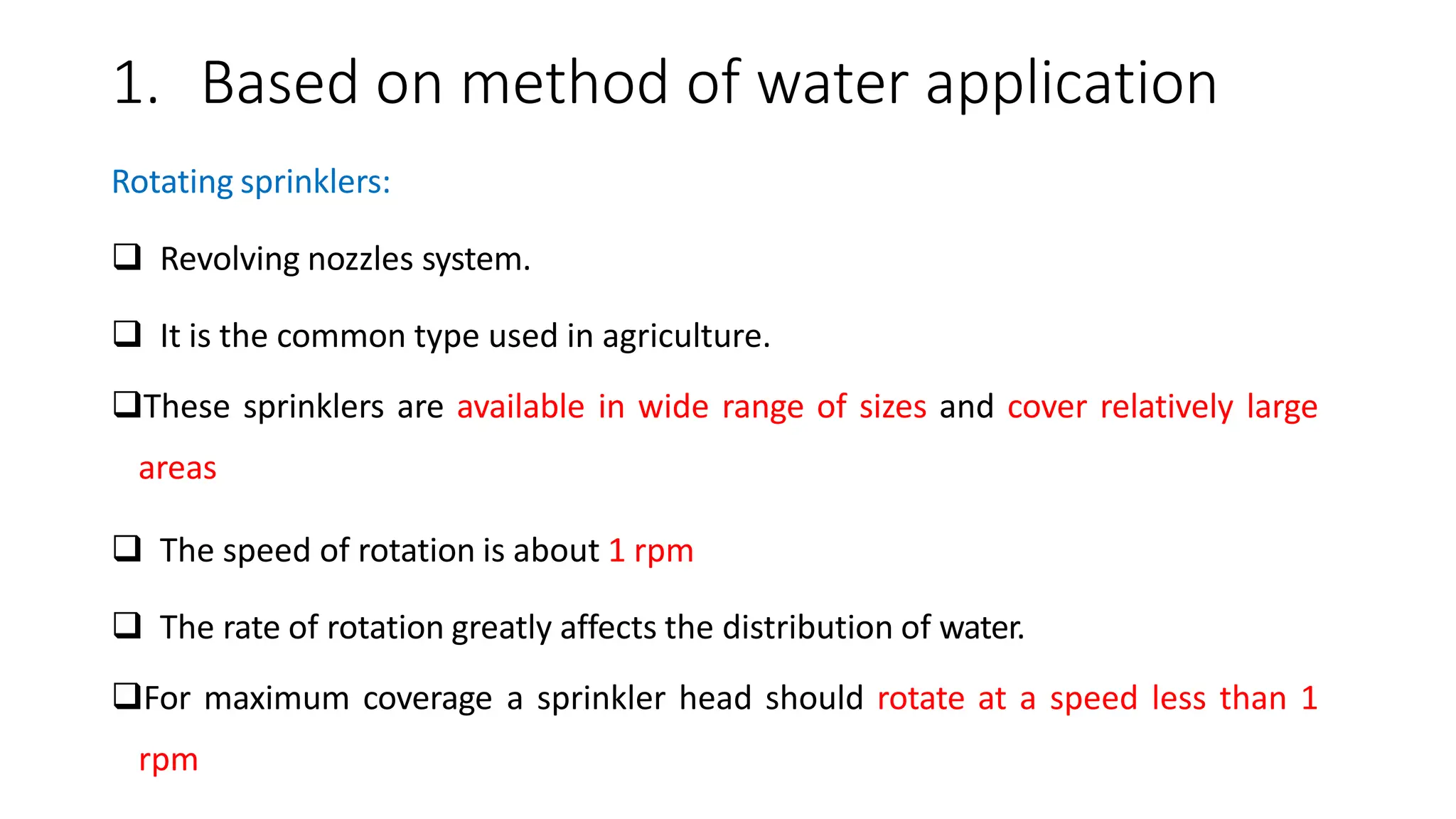
1. Based on method of water application
Rotating sprinklers:
 Revolving nozzles system.
 It is the common type used in agriculture.
These sprinklers are available in wide range of sizes and cover relatively large
areas
 The speed of rotation is about 1 rpm
 The rate of rotation greatly affects the distribution of water.
For maximum coverage a sprinkler head should rotate at a speed less than 1
rpm
Rotating sprinklers:
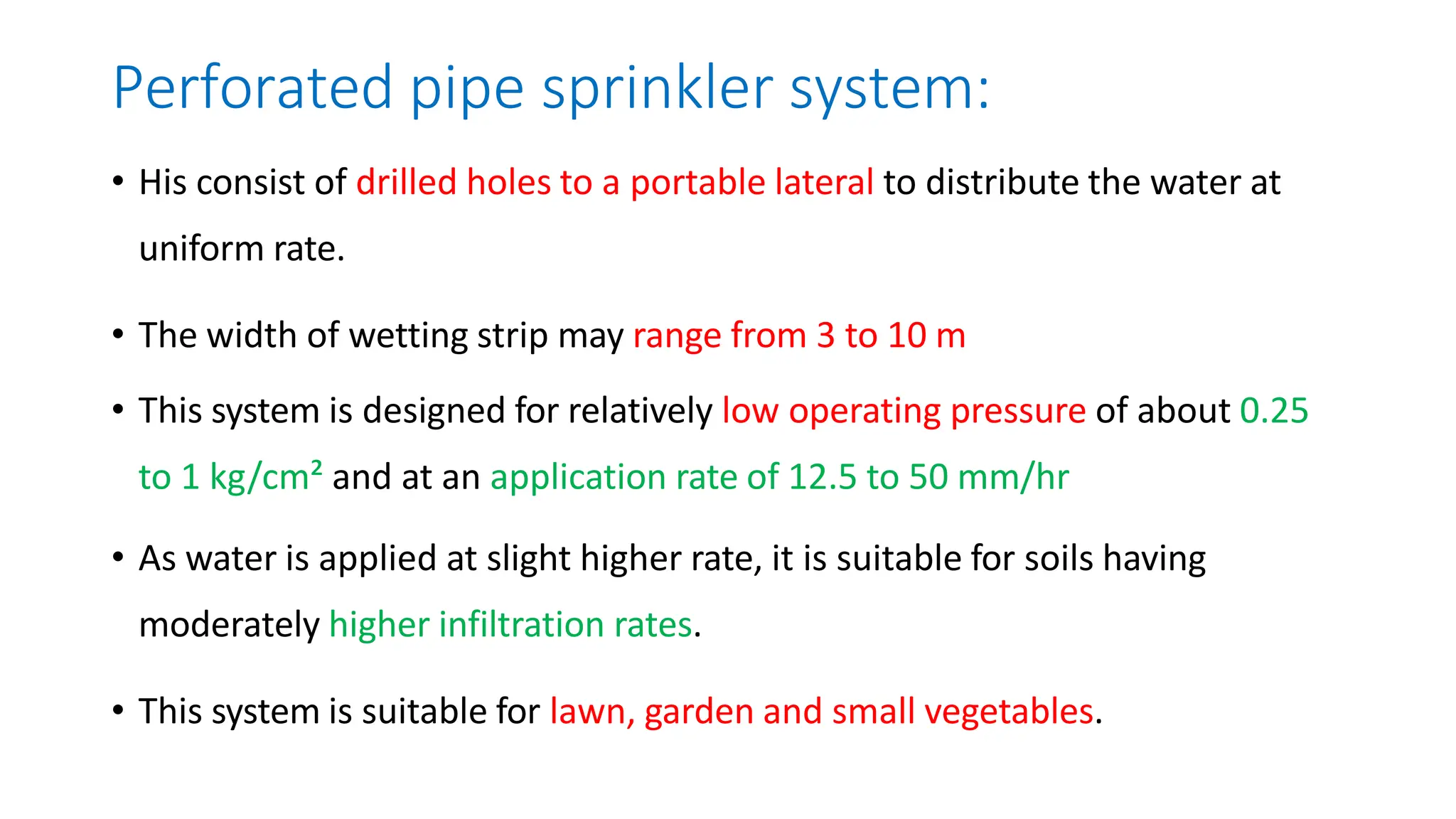
Perforated pipe sprinkler system:
• His consist of drilled holes to a portable lateral to distribute the water at
uniform rate.
• The width of wetting strip may range from 3 to 10 m
• This system is designed for relatively low operating pressure of about 0.25
to 1 kg/cm² and at an application rate of 12.5 to 50 mm/hr
• As water is applied at slight higher rate, it is suitable for soils having
moderately higher infiltration rates.
• This system is suitable for lawn, garden and small vegetables.
Perforated pipe sprinkler system:
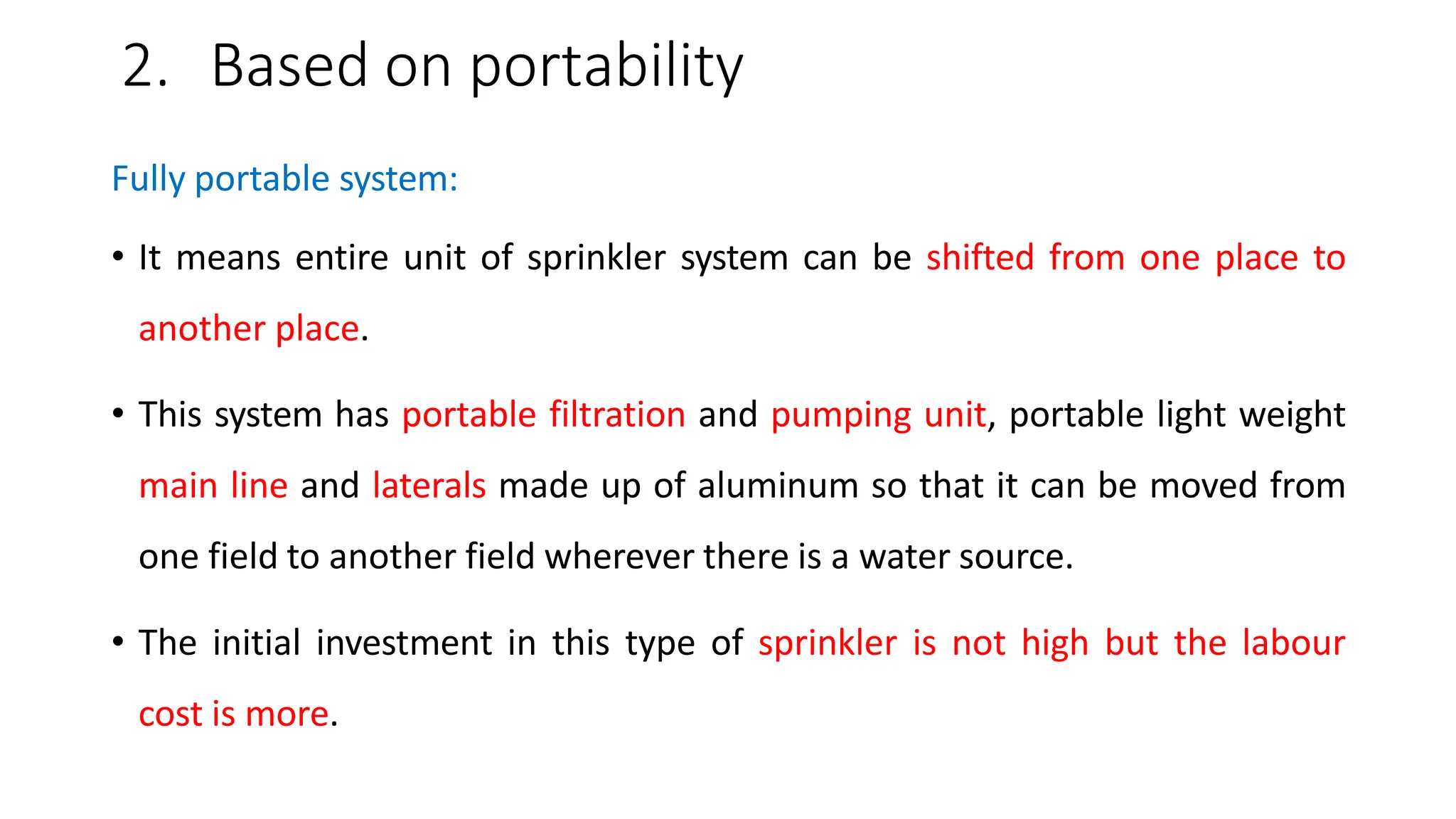
2. Based on portability
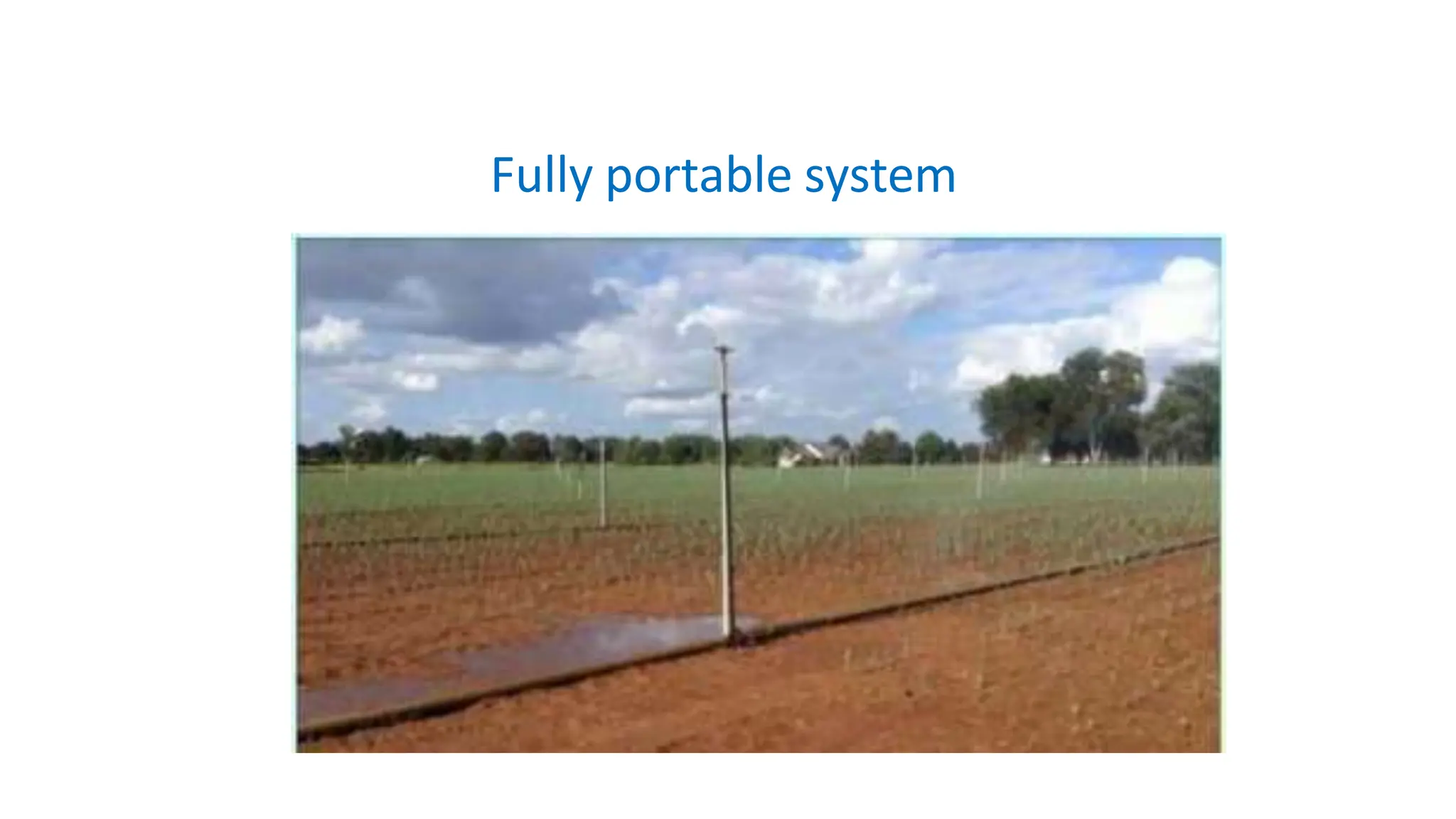
Fully portable system:
• It means entire unit of sprinkler system can be shifted from one place to
another place.
• This system has portable filtration and pumping unit, portable light weight
main line and laterals made up of aluminum so that it can be moved from
one field to another field wherever there is a water source.
• The initial investment in this type of sprinkler is not high but the labour
cost is more.
Fully portable system
Semi-portable system:
• It is similar to the fully portable system except that the location of
filtration unit and pumping plant is fixed near the water source.
• This system may be used on different fields whenever there is
extended mainline but it is not possible to use on more than one farm
unless there are additional pumping plants.
• The initial investment on this type of system is higher than fully
portable system and labor cost is comparatively less.
Semi-permanent system:
• This system has permanent mainline, submain, filtration unit,
pumping plant with stationary water source.
• Only the lightweight laterals and sprinklers head are portable.
• In this system, the mainline and submain are usually buried below
plough depth to avoid interference with cultivation practices.
Fully permanent sprinkler system:
• It has permanent filtration unit, mainline, submains, laterals and
pump plant.
• The mainline, submain and lateral are buried in the ground at about
60 to 90 cm depth so that, there should not be any interference of
the system with cultivation practices.
• In this, sprinkler head is permanently located on the riser pipes.
3. Based on precipitation rate
Low volume sprinkler:
Precipitation rate will be less than 13 mm/hr.
Medium volume sprinkler:
 Precipitation rate will be between 13 to 25 mm/hr.
High volume sprinkler:
 Precipitation rate will be more than 25 mm/hr.
4. Based on principle of operation
Whirling sprinkler:
Jet of water is emitted from the end of arm results in a rotary
movement in the reverse direction and at high speed.
Its construction is simple and operates and requires low pressure
only.
The diameter of coverage is small and is mainly used for orchards
and gardens.
Whirling sprinkler
Cont.,
Turbo hammer-sprinkler:
In this type the water jet operates a wheel, which
activates the hammer and causes the sprinkler to
turn.
It has low discharge and used for irrigating orchards
and gardens.
Cont.,
Propeller sprinkler:
The water jet strikes the propeller which rotates at high speed around its
shaft and causes a circular motion of the sprinkler.
The propeller breaks up the jet very fine drops resulting in low irrigation
intensity.
It is manufactured with few components most of which are made up of
plastic.
 It is used in solid set system for field crops
Propeller sprinkler
Cont.,
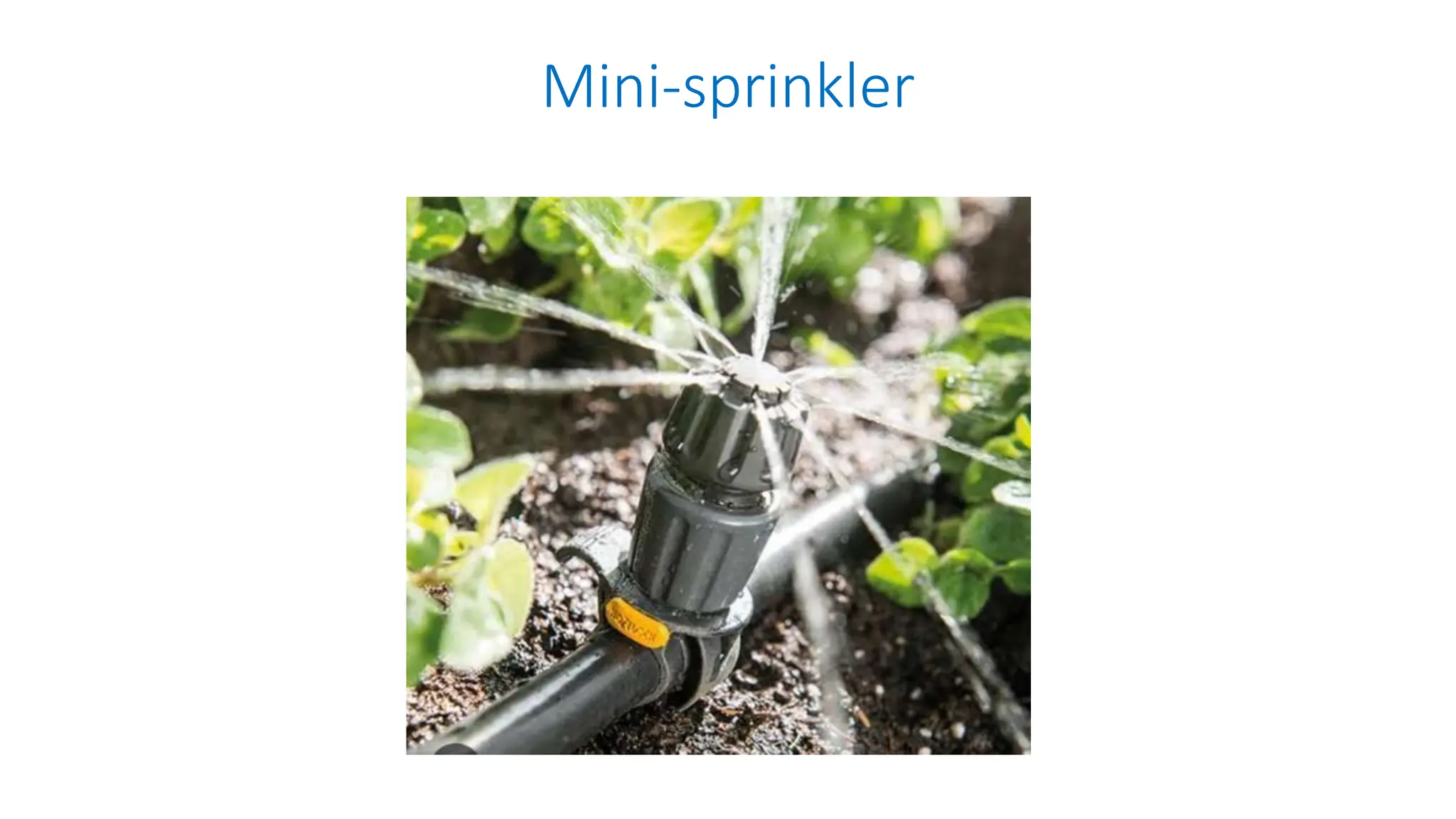
Mini-sprinkler:
The water jet strikes a bearing that possess one or two channels
causing the mini sprinklers to rotate quickly and distribute water.
It is manufactured from plastic materials and used in solid sets in
orchards and gardens.
It gives low discharge at operating pressure of about 1.5 to 2.0
kg/cm².
Mini-sprinkler
5. Based on movement
Set-move irrigation system:
• This system can be moved from one set position to another by hand
or mechanically.
• The set move systems have single main line laid through the center of
the field with one or more laterals on each side of main line.
Solid set system:
• It has sufficient laterals and sprinkler heads to irrigate entire field
simultaneously.
• The laterals are laid in the field early in the crop season and remain
for the entire season.
• This system is used for crops requiring short and frequent irrigations.
Cont.,
Continuous move system:
continuous move systems have laterals and sprinklers that remain
connected to the mainline and moved continuously as water is
supplied.
These systems are popular in areas where the labours are costly or
there is shortage of labour for moving lateral and sprinklers from one
place to another.
Suitable slopes :
• Sprinkler irrigation is adaptable to any farmable slope, whether
uniform or undulating.
• The lateral pipes supplying water to the sprinklers should always be
laid out along the land contour whenever possible.
• This will minimize the pressure changes at the sprinklers and provide
a uniform irrigation.
Suitable soils
 Best suited to sandy soils with high infiltration rates although they
are adaptable to most soils.
The average application rate from the sprinklers (in mm/hour) is
always chosen to be less than the basic infiltration rate of the soil so
that surface ponding and runoff can be avoided.
 Sprinklers are not suitable for soils which easily form a crust.
Suitable irrigation water
• A good clean supply of water, free of suspended sediments, is
required to avoid problems of sprinkler nozzle blockage and spoiling
the crop by coating it with sediment
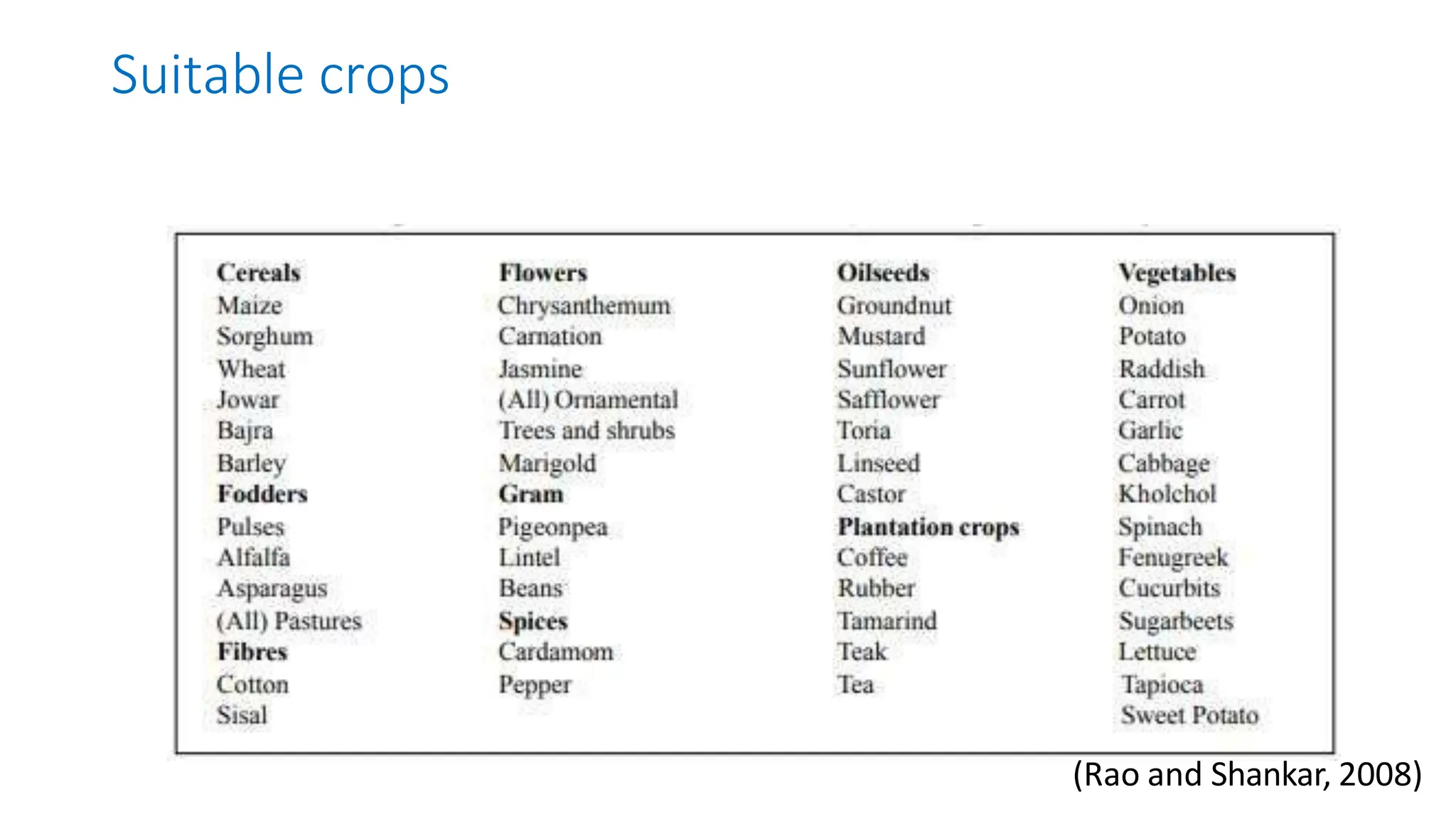
Suitable crops
(Rao and Shankar, 2008)
Sprinkler drop sizes
• As water sprays from a sprinkler it breaks up into small drops
between 0.5 and 4.0 mm in size.
• The small drops fall close to the sprinkler whereas the larger ones fall
close to the edge of the wetted circle.
• Large drops can damage delicate crops and soils and so in such
conditions it is best to use the smaller sprinklers.
• Drop size is also controlled by pressure and nozzle size.
Components of sprinkler irrigation
1. A pump unit
2. Tubing's-main / submains and lateral
3. Couplers
4. Sprinkler head
5. Fittings and accessories
1. Pumping Unit
 Sprinkler irrigation systems distribute water by spraying it over the
fields.
 The water is pumped under pressure to the fields.
 The pressure forces the water through sprinklers or through nozzles
in pipelines and then forms a spray.
 A high speed centrifugal or turbine pump can be used for operating
sprinkler irrigation for individual fields.
Cont.,
• Centrifugal pump is used when the distance from the pump inlet to
the water surface is less than eight meters.
• For pumping water from deep wells or more than eight meters, a
turbine pump is suggested.
• The driving unit may be either an electric motor or an internal
combustion engine.
2. Tubing's
 The tubing's consist of mainline, submains and laterals.
 Main line conveys water from the source and distributes it to the
submains.
 The submains convey water to the laterals which in turn supply water
to the sprinklers.
 Aluminum or PVC pipes are generally used for portable systems, while
steel pipes are usually used for center-pivot laterals.
3. Couplers
Couplers are used for connecting two pipes and uncoupling quickly
and easily.
 Essentially a coupler should provide
a) a reuse and flexible connection
b) not leak at the joint
c) be simple and easy to couple and uncouple
d) be light, non-corrosive, durable.
4. Sprinkler Head
Sprinkler head distribute water uniformly over the field without runoff or
excessive loss due to deep percolation.
 Different types of sprinklers are available.
 They are either rotating or fixed type.
The rotating type can be adapted for a wide range of application rates and
spacing.
They are effective with pressure of about 10 to 70 m head at the sprinkler.
Pressures ranging from 16 to 40 m head are considered the most practical for
most farmers.
Cont.,
• Sprinkler head Fixed head sprinklers are commonly used to irrigate
small lawns and gardens.
• Perforated lateral lines are sometimes used as sprinklers.
• They require less pressure than rotating sprinklers.
• They release more water per unit area than rotating sprinklers.
• Hence fixed head sprinklers are adaptable for soils
high intake rate.
with
Sprinkler Head
5. Fittings and accessories
The following are some of the important fittings and accessories used
in sprinkler system.
(a) Water meters: It is used to measure the volume of water delivered.
(b) Flange and couplings used for proper connection to the pump,
suction and delivery.
(c) Pressure gauge
(d) Bend, tees, reducers, elbows, hydrants, butterfly valve and plugs.
(e) Fertilizer applicator
growth of area under sprinkler
Reasons-slow
irrigation
 High capital cost
 Subsidy is not easily available for farmers
 Poor awareness about the importance
 Not suitable for marginal and small farmers following subsistence farming
 After sale service is not satisfactory
 Free electricity and low price of canal water
Cont.,
 Fear about system clogging among the farmers
 Promotional schemes are not available in many states
 Poor extension and training facilities to farmers
 Lack of technical knowhow
(Sivanappan, 1987)
General rules for sprinkler system design
 Main should be laid up and down hill
 Lateral should be laid across the slope or nearly on the contour
 For multiple lateral operation, lateral pipe sizes should not be more
than two diameter.
 Water supply source should be nearest to the center of the area
Cont.,
 Layout should facilitate and minimize lateral movement during the season
 Booster pump should be considered where small portion of field would
require high pressure at the pump
 Layout should be modified to apply different rates and amounts of water
where soils are greatly different in the design area.
Selecting the most appropriate sprinkler systems
• While selecting a sprinkler system, the most important physical
parameters to be considered are:
1. The crop or crops to be cultivated.
2. The shape and size (acres) of the field.
3. The topography of the field.
4. The amount of time and labor required to operate the system.
Selecting sprinkler system capacity
• A sprinkler system must be designed to apply water uniformly without
runoff or erosion.
• The application rate of the sprinkler system must be matched to the
infiltration rate of the most restrictive soil in the field.
• If the application rate exceeds the soil intake rate, the water will runoff the
field or relocate within the field resulting in over and under watered areas.
• The sprinkler system capacity is the flow rate needed to adequately irrigate
area and is expressed in liters per minute per acre.
Cont.,
• The system capacity depends upon on the: Peak crop water
requirements during the growing season; effective crop rooting
depth; texture and infiltration rate of the soil; the available water
holding capacity of the soil; pumping capacity of the well.
Maintenance
1. Pipes and fittings
(a) clean any dirt or sand
- Any accumulation of dirt or sand will affect the performance of the
rubber sealing ring.
(b) Keep all nuts and bolts tight.
(c)Do not lay pipes on new damp concrete or on piles of fertilizer. Do
not lay fertilizer sacks on the pipe.
2. Sprinkler heads
(a) When moving the sprinkler lines, make sure that the sprinklers are
not damaged or pushed into the soil.
(b) Do not apply oil, grease or any lubricant to the sprinklers.
(c)Sprinklers usually have a sealed bearing and at the bottom of the
bearing there are washers. Check the washers for wear once a season
or every six months which is especially important where water is sandy.
Replace the washers if worn.
Storage
• The following points are to be observed while storing the sprinkler
equipment during the off season:
(a) Remove the sprinklers and store in a cool, dry place.
(b) Remove the rubber sealing rings from the couplers them in a cool, dark
place.
(c)The pipes can be stored outdoors in which case they should be placed in
racks with one end higher than the other.
- Do not store pipes along with fertilizer.
Cont.,
(d) Disconnect the suction.
(e)Protect the electric motor from the ingress of dust, dampness and
rodents.
Troubles in the sprinkler systems
• The following are the general guidelines to identify and remove the
common troubles in the sprinkler systems:
1. Pump does not prime or develop pressure
(a) Check that the suction lift is within the limits. If not, get the pump
closer to the water.
(b) Check the suction pipeline and all connections for air leaks. All
connections and flanges should be air tight.
Cont.,
(c) Check that the strainer on the foot valve is not blocked.
(d)Check that the gate valve on the delivery pipe is fully closed during
priming and opens fully when the pump is running.
2. Sprinklers do not turn
(a) Check pressure.
(b) Check that the nozzle is not blocked.
(c)Check the condition of washers at the bottom of the bearing and
replace them if worn or damaged.
(d) Check that the swing arm moves freely
3. Leakage from coupler or fittings
• The sealing rings in the couplers and fittings are usually designed to
drain the water from the pipes when the pressure is turned off.
• This ensures that the pipes are automatically drained and ready to be
moved.
• With full pressure in the system the couplers and fittings will be
effectively leak-free.
• If, however, there is a leakage, check the following
Cont.,
(a) There is no accumulation of dirt or sand in the groove in the
coupler in which the sealing ring fits. Clean out any dirt or sand and
refit the sealing ring.
(b) The end of the pipe going inside the coupler is smooth, clean and
not distorted.
Sprinkler irrigation system cost per acre
• Water tank cost- 8,000 INR
• Motor pump cost- 8,000 INR
• Pressure gauge- 800 INR
• Control valve- 5,000 INR
• Water filter- 2,000 INR
• Supply pipeline- 5,000 INR
• Lateral pipe- 9,000 INR
• Sprinklers head- 8,000 INR
Cont.,
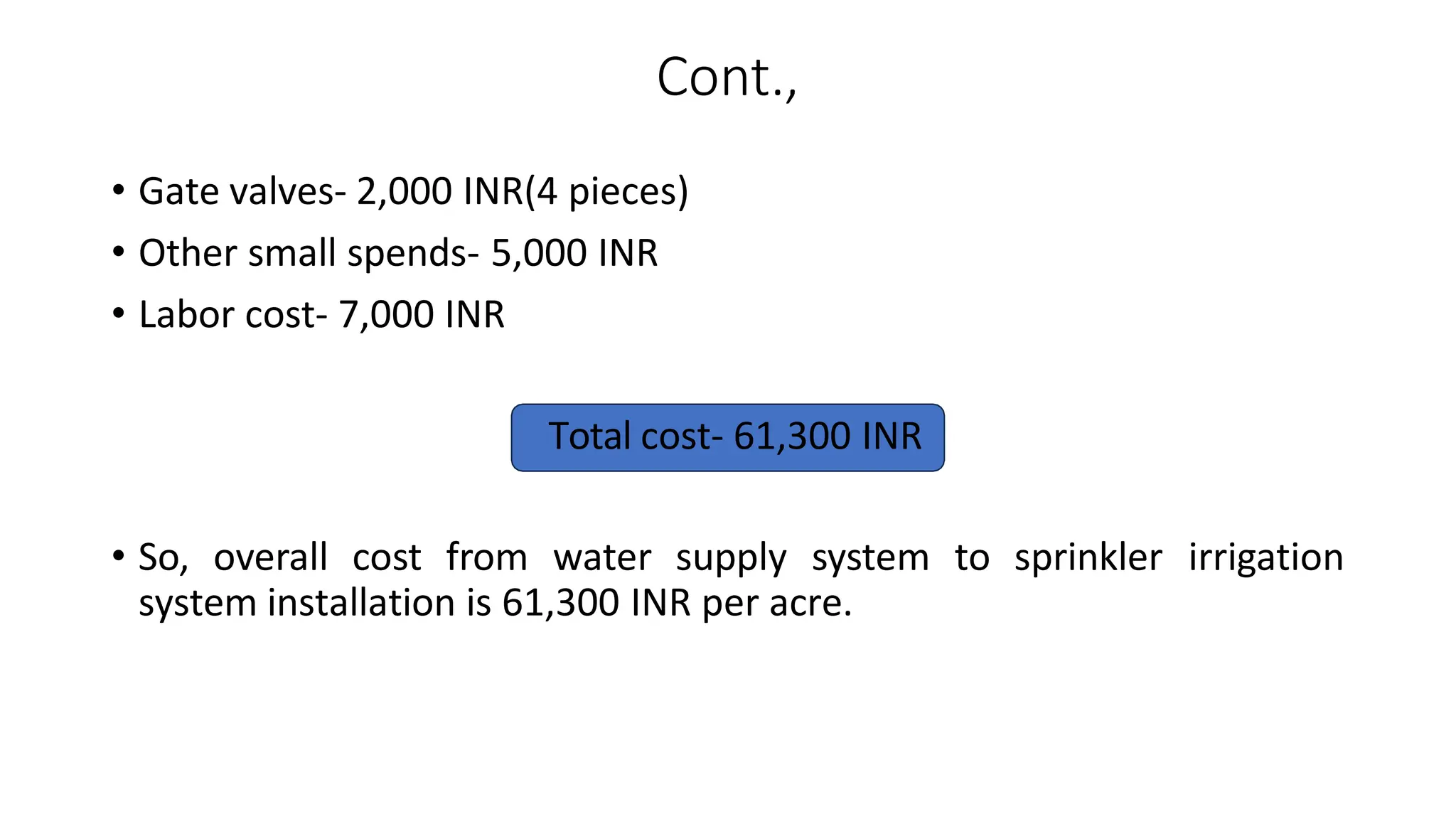
• Gate valves- 2,000 INR(4 pieces)
• Other small spends- 5,000 INR
• Labor cost- 7,000 INR
Total cost- 61,300 INR
• So, overall cost from water supply system to sprinkler irrigation
system installation is 61,300 INR per acre.
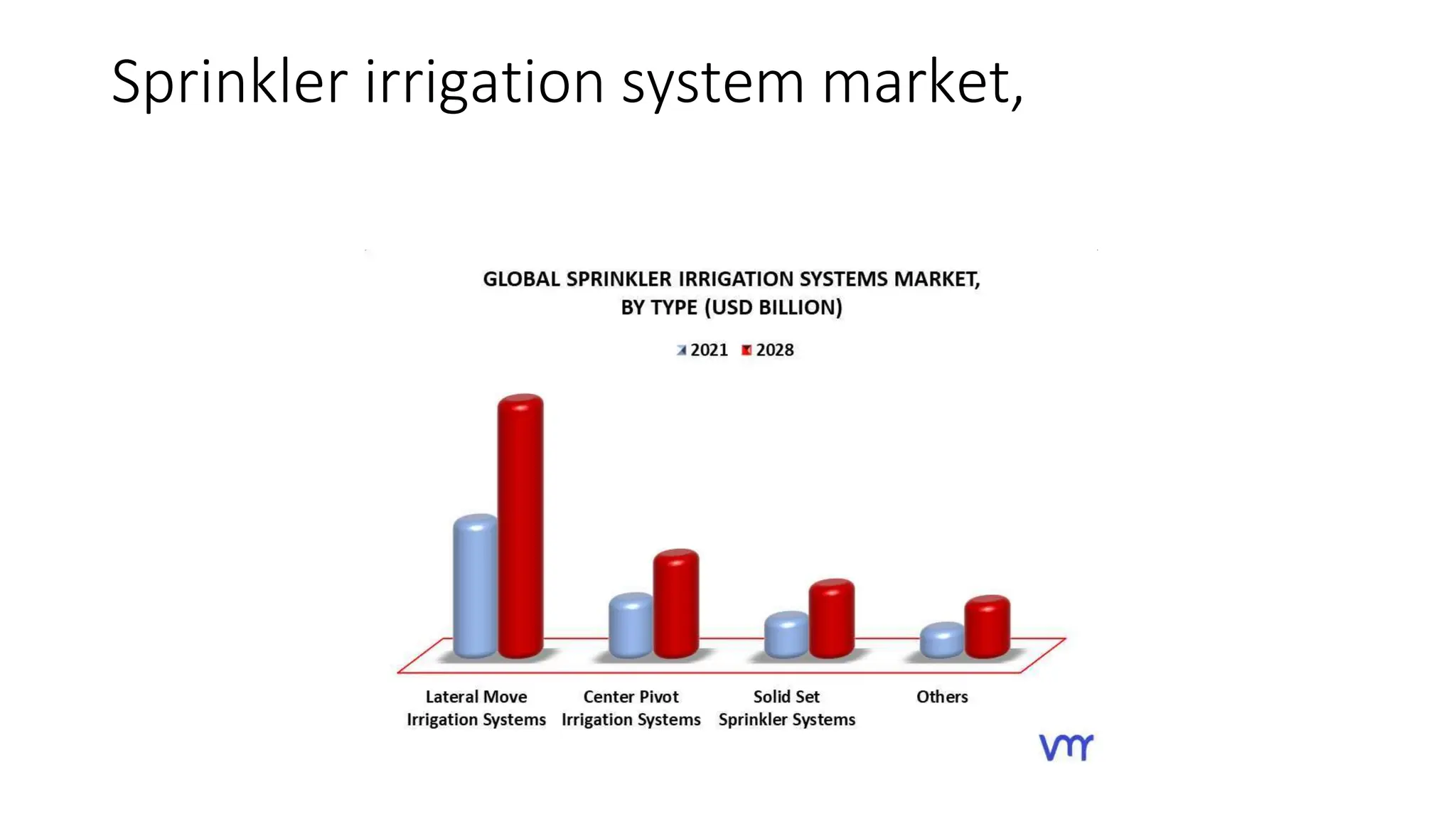
Sprinkler irrigation system market,
Cont.,
• Malhotra (1984) compared sprinkler irrigation with surface method
for various crops and calculated water savings by individual corps
REFERENCE:
• Sprinkler Irrigation – An Asset in Water Scarce and Undulating Areas
M. SHIVA SHANKAR, A.V. RAMANJANEYULU, T.L. NEELIMA AND ANUP
DAS.
• https://www.thefarminghouse.com/2022/05/sprinkler-irrigation-
system-cost-per-acre.html
• https://www.fao.org/3/S8684E/s8684e06.htm

Sprinkler irrigation ppt for education purpose only

  • 1.
    SPRINKLER IRRIGATION Dr ChandrashekarS Y Professor(Horticulture) AHRS, Madikeri 9448255873
  • 2.
    Introduction:  Water isa key factor in increasing agricultural production, in such case irrigation is most important factor.  One such method of modern irrigation is sprinkler irrigation system which is becoming more and more popular among the farmers across the developed country.
  • 3.
    SPRINKLER IRRIGATION • wateris carried through a network of pipes under medium to high pressure and is forced through a nozzle of small diameter and sprayed on the ground or crop like a rain. • It tends to simulate the rainfall but in a way such that the run-off and deep percolation losses are avoided. • Irrigation is given under controlled conditions up to the root depth. • It is possible to apply the required quantity of water at the required time.
  • 4.
    The current statusof the sprinkler irrigation system in India • The total area under sprinkler irrigation is about 3.59 million hectares, which is less than 2.5% of the total area under irrigation. • The leading states in sprinkler irrigation are Rajasthan, Haryana, Punjab, and Maharashtra. • The sprinkler irrigation system is a more efficient way to irrigate crops than traditional methods, such as surface irrigation. It can save up to 30-50% of water.
  • 5.
    Advantages of sprinklerirrigation • Water conservation • Soil conservation and effective use of land • Healthy growth of crops • Less labour • Seed Germination • Application of fertilizers
  • 6.
    Cont., • Application ofinsecticides and weedicides • Soil amendments • Frost protection • Cooling of crops • Water saving
  • 7.
    Disadvantages of sprinklerirrigation system • Wind effect • Impact on fruits • Impact on flowering • Systems cost • Energy needs • Adverse soil condition • Evaporation loss • Uniformity
  • 8.
    Classification of sprinklerirrigation system Based on method of water application Based on portability Based on precipitation rates Based on principle of operation Based on movement
  • 10.
    1. Based onmethod of water application Rotating sprinklers:  Revolving nozzles system.  It is the common type used in agriculture. These sprinklers are available in wide range of sizes and cover relatively large areas  The speed of rotation is about 1 rpm  The rate of rotation greatly affects the distribution of water. For maximum coverage a sprinkler head should rotate at a speed less than 1 rpm
  • 11.
  • 12.
    Perforated pipe sprinklersystem: • His consist of drilled holes to a portable lateral to distribute the water at uniform rate. • The width of wetting strip may range from 3 to 10 m • This system is designed for relatively low operating pressure of about 0.25 to 1 kg/cm² and at an application rate of 12.5 to 50 mm/hr • As water is applied at slight higher rate, it is suitable for soils having moderately higher infiltration rates. • This system is suitable for lawn, garden and small vegetables.
  • 13.
  • 14.
    2. Based onportability Fully portable system: • It means entire unit of sprinkler system can be shifted from one place to another place. • This system has portable filtration and pumping unit, portable light weight main line and laterals made up of aluminum so that it can be moved from one field to another field wherever there is a water source. • The initial investment in this type of sprinkler is not high but the labour cost is more.
  • 15.
  • 16.
    Semi-portable system: • Itis similar to the fully portable system except that the location of filtration unit and pumping plant is fixed near the water source. • This system may be used on different fields whenever there is extended mainline but it is not possible to use on more than one farm unless there are additional pumping plants. • The initial investment on this type of system is higher than fully portable system and labor cost is comparatively less.
  • 17.
    Semi-permanent system: • Thissystem has permanent mainline, submain, filtration unit, pumping plant with stationary water source. • Only the lightweight laterals and sprinklers head are portable. • In this system, the mainline and submain are usually buried below plough depth to avoid interference with cultivation practices.
  • 18.
    Fully permanent sprinklersystem: • It has permanent filtration unit, mainline, submains, laterals and pump plant. • The mainline, submain and lateral are buried in the ground at about 60 to 90 cm depth so that, there should not be any interference of the system with cultivation practices. • In this, sprinkler head is permanently located on the riser pipes.
  • 19.
    3. Based onprecipitation rate Low volume sprinkler: Precipitation rate will be less than 13 mm/hr. Medium volume sprinkler:  Precipitation rate will be between 13 to 25 mm/hr. High volume sprinkler:  Precipitation rate will be more than 25 mm/hr.
  • 20.
    4. Based onprinciple of operation Whirling sprinkler: Jet of water is emitted from the end of arm results in a rotary movement in the reverse direction and at high speed. Its construction is simple and operates and requires low pressure only. The diameter of coverage is small and is mainly used for orchards and gardens.
  • 21.
  • 22.
    Cont., Turbo hammer-sprinkler: In thistype the water jet operates a wheel, which activates the hammer and causes the sprinkler to turn. It has low discharge and used for irrigating orchards and gardens.
  • 23.
    Cont., Propeller sprinkler: The waterjet strikes the propeller which rotates at high speed around its shaft and causes a circular motion of the sprinkler. The propeller breaks up the jet very fine drops resulting in low irrigation intensity. It is manufactured with few components most of which are made up of plastic.  It is used in solid set system for field crops
  • 24.
  • 25.
    Cont., Mini-sprinkler: The water jetstrikes a bearing that possess one or two channels causing the mini sprinklers to rotate quickly and distribute water. It is manufactured from plastic materials and used in solid sets in orchards and gardens. It gives low discharge at operating pressure of about 1.5 to 2.0 kg/cm².
  • 26.
  • 27.
    5. Based onmovement Set-move irrigation system: • This system can be moved from one set position to another by hand or mechanically. • The set move systems have single main line laid through the center of the field with one or more laterals on each side of main line.
  • 28.
    Solid set system: •It has sufficient laterals and sprinkler heads to irrigate entire field simultaneously. • The laterals are laid in the field early in the crop season and remain for the entire season. • This system is used for crops requiring short and frequent irrigations.
  • 29.
    Cont., Continuous move system: continuousmove systems have laterals and sprinklers that remain connected to the mainline and moved continuously as water is supplied. These systems are popular in areas where the labours are costly or there is shortage of labour for moving lateral and sprinklers from one place to another.
  • 30.
    Suitable slopes : •Sprinkler irrigation is adaptable to any farmable slope, whether uniform or undulating. • The lateral pipes supplying water to the sprinklers should always be laid out along the land contour whenever possible. • This will minimize the pressure changes at the sprinklers and provide a uniform irrigation.
  • 31.
    Suitable soils  Bestsuited to sandy soils with high infiltration rates although they are adaptable to most soils. The average application rate from the sprinklers (in mm/hour) is always chosen to be less than the basic infiltration rate of the soil so that surface ponding and runoff can be avoided.  Sprinklers are not suitable for soils which easily form a crust.
  • 32.
    Suitable irrigation water •A good clean supply of water, free of suspended sediments, is required to avoid problems of sprinkler nozzle blockage and spoiling the crop by coating it with sediment
  • 33.
  • 34.
    Sprinkler drop sizes •As water sprays from a sprinkler it breaks up into small drops between 0.5 and 4.0 mm in size. • The small drops fall close to the sprinkler whereas the larger ones fall close to the edge of the wetted circle. • Large drops can damage delicate crops and soils and so in such conditions it is best to use the smaller sprinklers. • Drop size is also controlled by pressure and nozzle size.
  • 35.
    Components of sprinklerirrigation 1. A pump unit 2. Tubing's-main / submains and lateral 3. Couplers 4. Sprinkler head 5. Fittings and accessories
  • 36.
    1. Pumping Unit Sprinkler irrigation systems distribute water by spraying it over the fields.  The water is pumped under pressure to the fields.  The pressure forces the water through sprinklers or through nozzles in pipelines and then forms a spray.  A high speed centrifugal or turbine pump can be used for operating sprinkler irrigation for individual fields.
  • 37.
    Cont., • Centrifugal pumpis used when the distance from the pump inlet to the water surface is less than eight meters. • For pumping water from deep wells or more than eight meters, a turbine pump is suggested. • The driving unit may be either an electric motor or an internal combustion engine.
  • 38.
    2. Tubing's  Thetubing's consist of mainline, submains and laterals.  Main line conveys water from the source and distributes it to the submains.  The submains convey water to the laterals which in turn supply water to the sprinklers.  Aluminum or PVC pipes are generally used for portable systems, while steel pipes are usually used for center-pivot laterals.
  • 39.
    3. Couplers Couplers areused for connecting two pipes and uncoupling quickly and easily.  Essentially a coupler should provide a) a reuse and flexible connection b) not leak at the joint c) be simple and easy to couple and uncouple d) be light, non-corrosive, durable.
  • 40.
    4. Sprinkler Head Sprinklerhead distribute water uniformly over the field without runoff or excessive loss due to deep percolation.  Different types of sprinklers are available.  They are either rotating or fixed type. The rotating type can be adapted for a wide range of application rates and spacing. They are effective with pressure of about 10 to 70 m head at the sprinkler. Pressures ranging from 16 to 40 m head are considered the most practical for most farmers.
  • 41.
    Cont., • Sprinkler headFixed head sprinklers are commonly used to irrigate small lawns and gardens. • Perforated lateral lines are sometimes used as sprinklers. • They require less pressure than rotating sprinklers. • They release more water per unit area than rotating sprinklers. • Hence fixed head sprinklers are adaptable for soils high intake rate. with
  • 42.
  • 43.
    5. Fittings andaccessories The following are some of the important fittings and accessories used in sprinkler system. (a) Water meters: It is used to measure the volume of water delivered. (b) Flange and couplings used for proper connection to the pump, suction and delivery. (c) Pressure gauge (d) Bend, tees, reducers, elbows, hydrants, butterfly valve and plugs. (e) Fertilizer applicator
  • 45.
    growth of areaunder sprinkler Reasons-slow irrigation  High capital cost  Subsidy is not easily available for farmers  Poor awareness about the importance  Not suitable for marginal and small farmers following subsistence farming  After sale service is not satisfactory  Free electricity and low price of canal water
  • 46.
    Cont.,  Fear aboutsystem clogging among the farmers  Promotional schemes are not available in many states  Poor extension and training facilities to farmers  Lack of technical knowhow (Sivanappan, 1987)
  • 47.
    General rules forsprinkler system design  Main should be laid up and down hill  Lateral should be laid across the slope or nearly on the contour  For multiple lateral operation, lateral pipe sizes should not be more than two diameter.  Water supply source should be nearest to the center of the area
  • 48.
    Cont.,  Layout shouldfacilitate and minimize lateral movement during the season  Booster pump should be considered where small portion of field would require high pressure at the pump  Layout should be modified to apply different rates and amounts of water where soils are greatly different in the design area.
  • 49.
    Selecting the mostappropriate sprinkler systems • While selecting a sprinkler system, the most important physical parameters to be considered are: 1. The crop or crops to be cultivated. 2. The shape and size (acres) of the field. 3. The topography of the field. 4. The amount of time and labor required to operate the system.
  • 50.
    Selecting sprinkler systemcapacity • A sprinkler system must be designed to apply water uniformly without runoff or erosion. • The application rate of the sprinkler system must be matched to the infiltration rate of the most restrictive soil in the field. • If the application rate exceeds the soil intake rate, the water will runoff the field or relocate within the field resulting in over and under watered areas. • The sprinkler system capacity is the flow rate needed to adequately irrigate area and is expressed in liters per minute per acre.
  • 51.
    Cont., • The systemcapacity depends upon on the: Peak crop water requirements during the growing season; effective crop rooting depth; texture and infiltration rate of the soil; the available water holding capacity of the soil; pumping capacity of the well.
  • 52.
    Maintenance 1. Pipes andfittings (a) clean any dirt or sand - Any accumulation of dirt or sand will affect the performance of the rubber sealing ring. (b) Keep all nuts and bolts tight. (c)Do not lay pipes on new damp concrete or on piles of fertilizer. Do not lay fertilizer sacks on the pipe.
  • 53.
    2. Sprinkler heads (a)When moving the sprinkler lines, make sure that the sprinklers are not damaged or pushed into the soil. (b) Do not apply oil, grease or any lubricant to the sprinklers. (c)Sprinklers usually have a sealed bearing and at the bottom of the bearing there are washers. Check the washers for wear once a season or every six months which is especially important where water is sandy. Replace the washers if worn.
  • 54.
    Storage • The followingpoints are to be observed while storing the sprinkler equipment during the off season: (a) Remove the sprinklers and store in a cool, dry place. (b) Remove the rubber sealing rings from the couplers them in a cool, dark place. (c)The pipes can be stored outdoors in which case they should be placed in racks with one end higher than the other. - Do not store pipes along with fertilizer.
  • 55.
    Cont., (d) Disconnect thesuction. (e)Protect the electric motor from the ingress of dust, dampness and rodents.
  • 56.
    Troubles in thesprinkler systems • The following are the general guidelines to identify and remove the common troubles in the sprinkler systems: 1. Pump does not prime or develop pressure (a) Check that the suction lift is within the limits. If not, get the pump closer to the water. (b) Check the suction pipeline and all connections for air leaks. All connections and flanges should be air tight.
  • 57.
    Cont., (c) Check thatthe strainer on the foot valve is not blocked. (d)Check that the gate valve on the delivery pipe is fully closed during priming and opens fully when the pump is running.
  • 58.
    2. Sprinklers donot turn (a) Check pressure. (b) Check that the nozzle is not blocked. (c)Check the condition of washers at the bottom of the bearing and replace them if worn or damaged. (d) Check that the swing arm moves freely
  • 59.
    3. Leakage fromcoupler or fittings • The sealing rings in the couplers and fittings are usually designed to drain the water from the pipes when the pressure is turned off. • This ensures that the pipes are automatically drained and ready to be moved. • With full pressure in the system the couplers and fittings will be effectively leak-free. • If, however, there is a leakage, check the following
  • 60.
    Cont., (a) There isno accumulation of dirt or sand in the groove in the coupler in which the sealing ring fits. Clean out any dirt or sand and refit the sealing ring. (b) The end of the pipe going inside the coupler is smooth, clean and not distorted.
  • 61.
    Sprinkler irrigation systemcost per acre • Water tank cost- 8,000 INR • Motor pump cost- 8,000 INR • Pressure gauge- 800 INR • Control valve- 5,000 INR • Water filter- 2,000 INR • Supply pipeline- 5,000 INR • Lateral pipe- 9,000 INR • Sprinklers head- 8,000 INR
  • 62.
    Cont., • Gate valves-2,000 INR(4 pieces) • Other small spends- 5,000 INR • Labor cost- 7,000 INR Total cost- 61,300 INR • So, overall cost from water supply system to sprinkler irrigation system installation is 61,300 INR per acre.
  • 63.
  • 64.
    Cont., • Malhotra (1984)compared sprinkler irrigation with surface method for various crops and calculated water savings by individual corps
  • 65.
    REFERENCE: • Sprinkler Irrigation– An Asset in Water Scarce and Undulating Areas M. SHIVA SHANKAR, A.V. RAMANJANEYULU, T.L. NEELIMA AND ANUP DAS. • https://www.thefarminghouse.com/2022/05/sprinkler-irrigation- system-cost-per-acre.html • https://www.fao.org/3/S8684E/s8684e06.htm