MSW to Energy Using Thermal Conversion
Process
Presented By
Alam, Md Tanvir
ID: 2015311947
Introduction
What is MSW ?
Definition:
Waste generally means “something unwanted”.
A material is considered as waste until it is considered as
beneficial again. Thus a solid material considered as solid
waste in the eye of producer when it loses its worth to
them and is discarded.
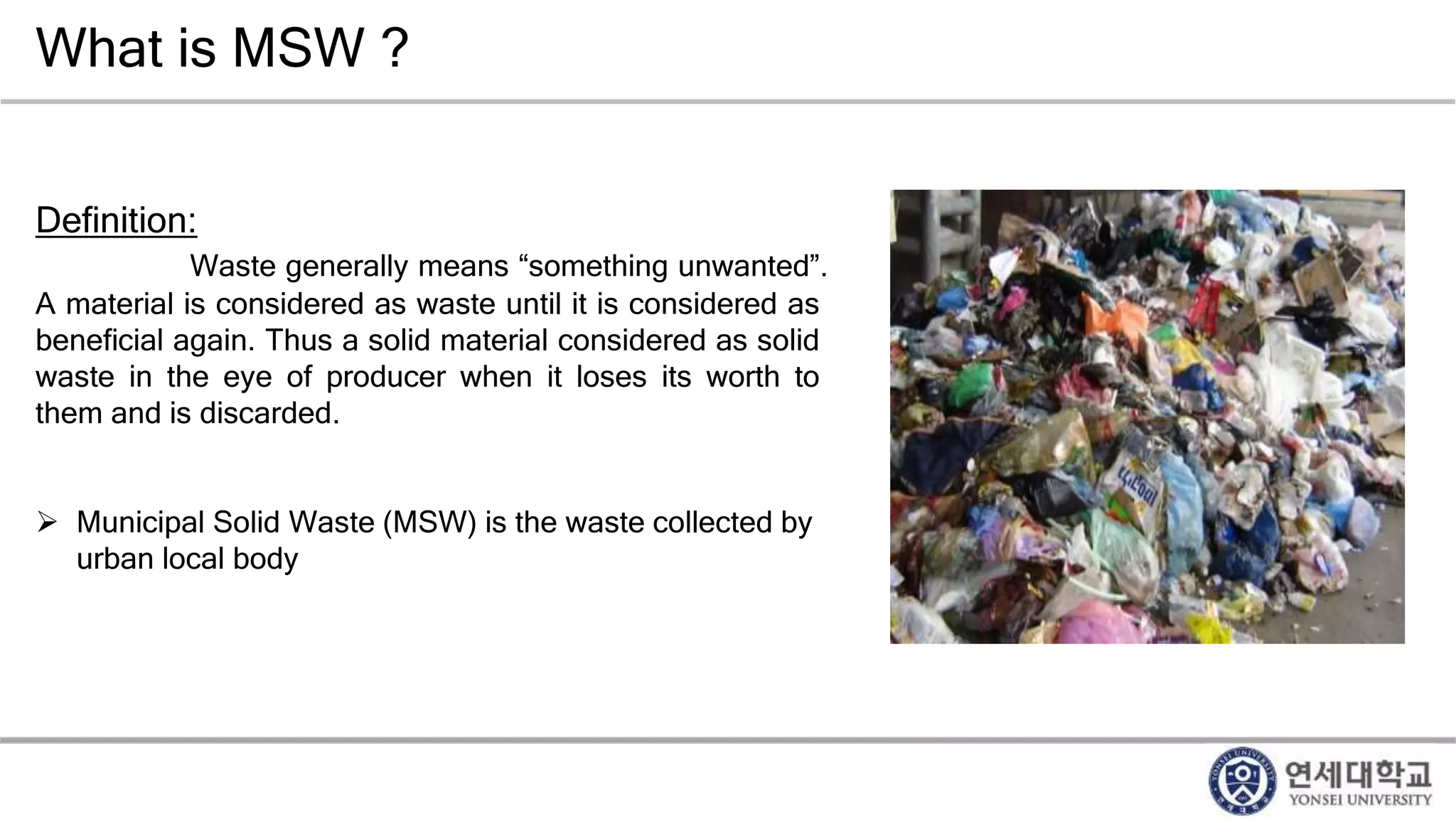
 Municipal Solid Waste (MSW) is the waste collected by
urban local body
Composition of MSW
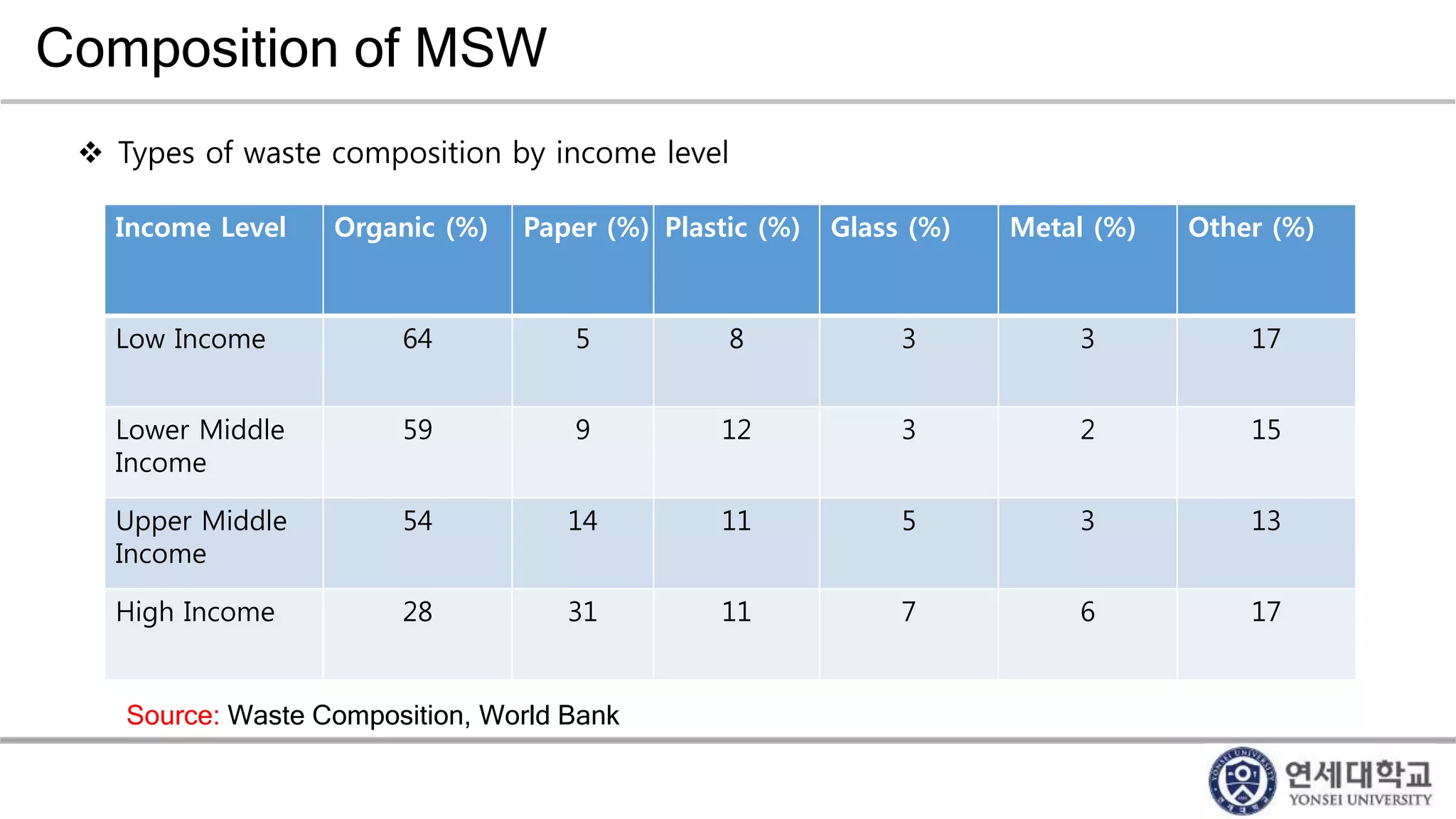
Income Level Organic (%) Paper (%) Plastic (%) Glass (%) Metal (%) Other (%)
Low Income 64 5 8 3 3 17
Lower Middle
Income
59 9 12 3 2 15
Upper Middle
Income
54 14 11 5 3 13
High Income 28 31 11 7 6 17
 Types of waste composition by income level
Source: Waste Composition, World Bank
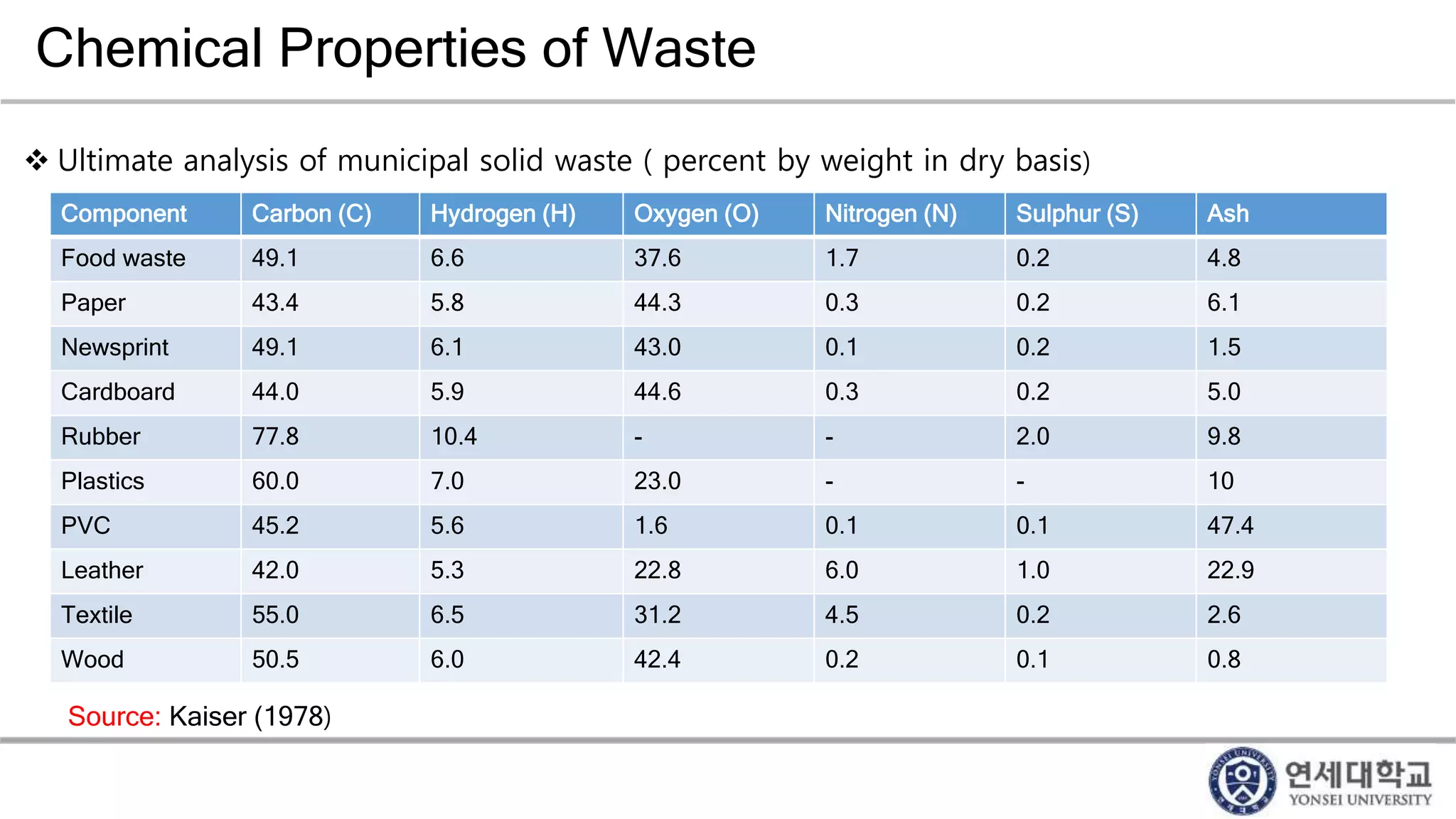
Chemical Properties of Waste
 Ultimate analysis of municipal solid waste ( percent by weight in dry basis)
Component Carbon (C) Hydrogen (H) Oxygen (O) Nitrogen (N) Sulphur (S) Ash
Food waste 49.1 6.6 37.6 1.7 0.2 4.8
Paper 43.4 5.8 44.3 0.3 0.2 6.1
Newsprint 49.1 6.1 43.0 0.1 0.2 1.5
Cardboard 44.0 5.9 44.6 0.3 0.2 5.0
Rubber 77.8 10.4 - - 2.0 9.8
Plastics 60.0 7.0 23.0 - - 10
PVC 45.2 5.6 1.6 0.1 0.1 47.4
Leather 42.0 5.3 22.8 6.0 1.0 22.9
Textile 55.0 6.5 31.2 4.5 0.2 2.6
Wood 50.5 6.0 42.4 0.2 0.1 0.8
Source: Kaiser (1978)
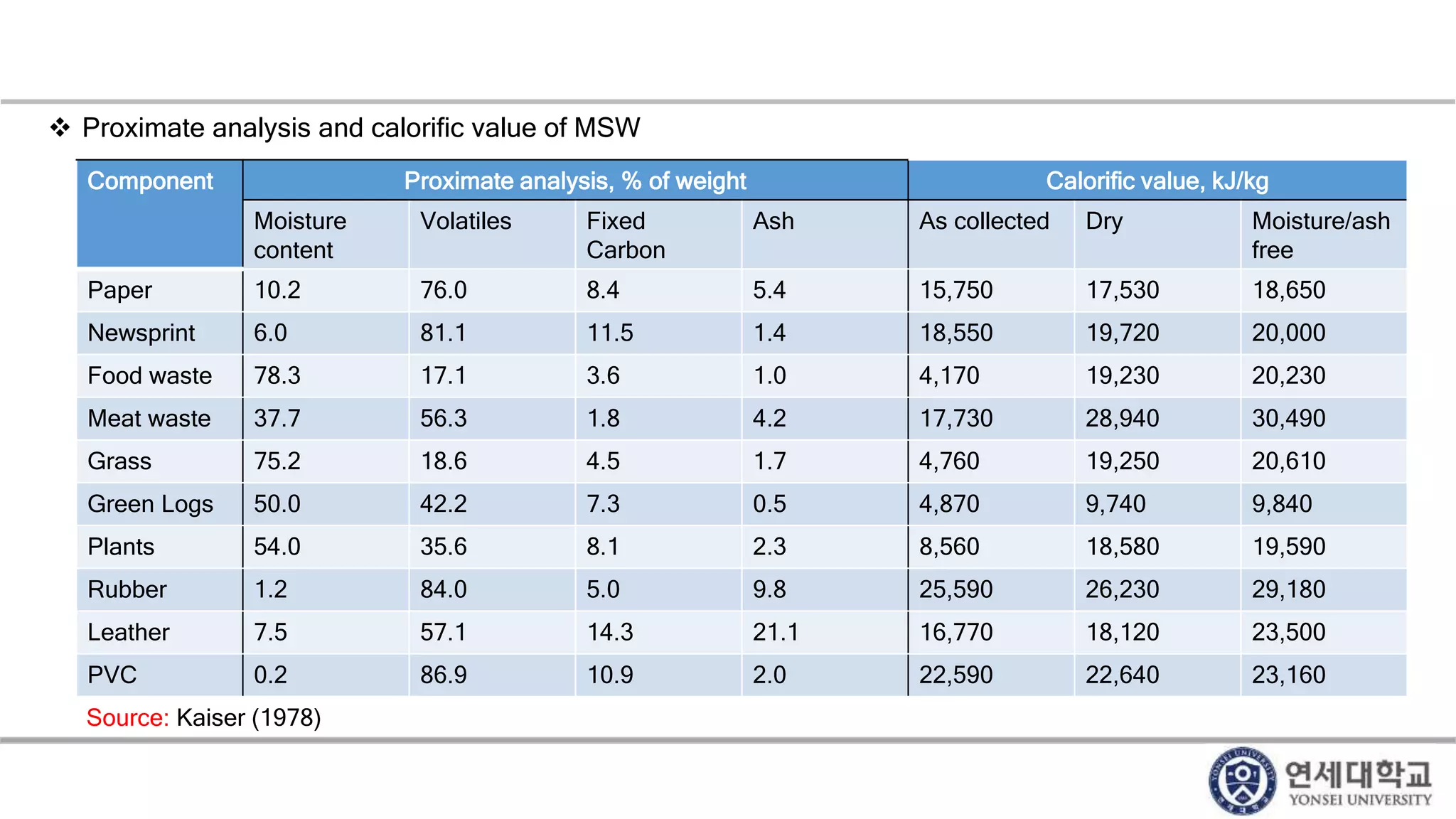
 Proximate analysis and calorific value of MSW
Component Proximate analysis, % of weight Calorific value, kJ/kg
Moisture
content
Volatiles Fixed
Carbon
Ash As collected Dry Moisture/ash
free
Paper 10.2 76.0 8.4 5.4 15,750 17,530 18,650
Newsprint 6.0 81.1 11.5 1.4 18,550 19,720 20,000
Food waste 78.3 17.1 3.6 1.0 4,170 19,230 20,230
Meat waste 37.7 56.3 1.8 4.2 17,730 28,940 30,490
Grass 75.2 18.6 4.5 1.7 4,760 19,250 20,610
Green Logs 50.0 42.2 7.3 0.5 4,870 9,740 9,840
Plants 54.0 35.6 8.1 2.3 8,560 18,580 19,590
Rubber 1.2 84.0 5.0 9.8 25,590 26,230 29,180
Leather 7.5 57.1 14.3 21.1 16,770 18,120 23,500
PVC 0.2 86.9 10.9 2.0 22,590 22,640 23,160
Source: Kaiser (1978)
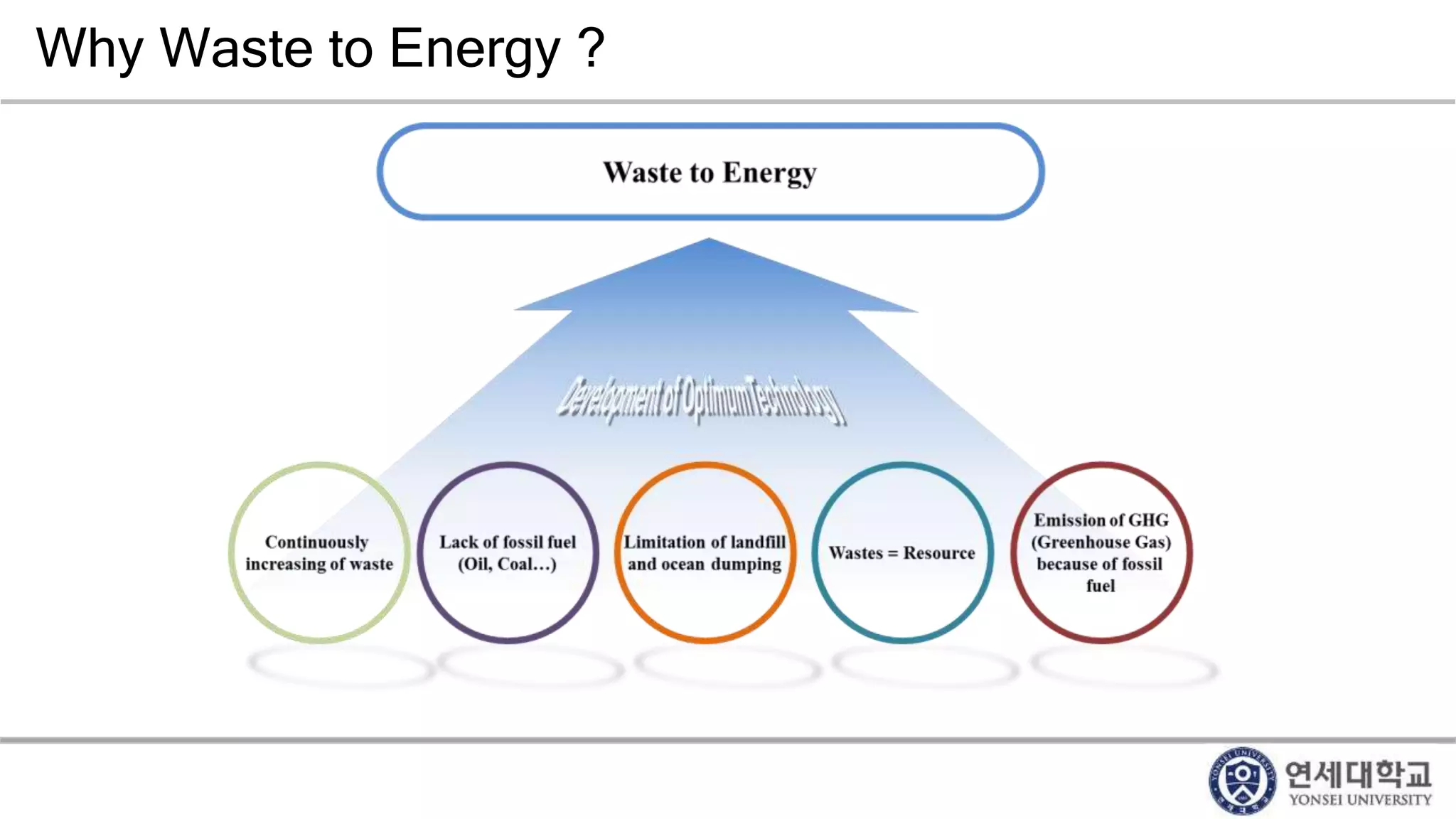
Why Waste to Energy ?
MSW to Energy Conversion Processes
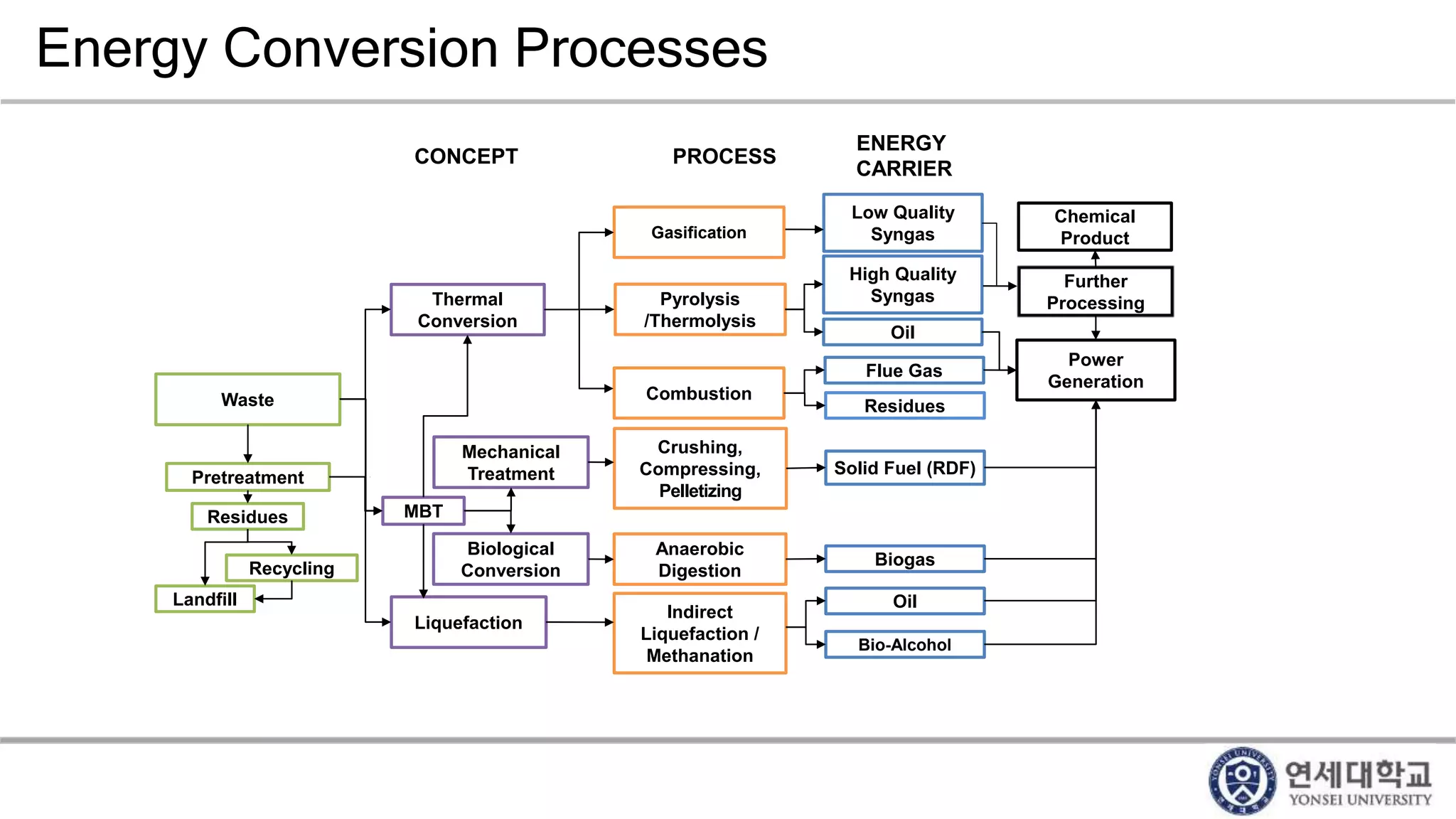
Energy Conversion Processes
Waste
MBT
Mechanical
Treatment
Thermal
Conversion
Biological
Conversion
Gasification
Combustion
Pyrolysis
/Thermolysis
Anaerobic
Digestion
Liquefaction
Indirect
Liquefaction /
Methanation
Biogas
Oil
Bio-Alcohol
Low Quality
Syngas
Flue Gas
Crushing,
Compressing,
Pelletizing
Pretreatment
Residues
Landfill
Recycling
Residues
High Quality
Syngas
Oil
Solid Fuel (RDF)
Power
Generation
Further
Processing
Chemical
Product
CONCEPT PROCESS
ENERGY
CARRIER
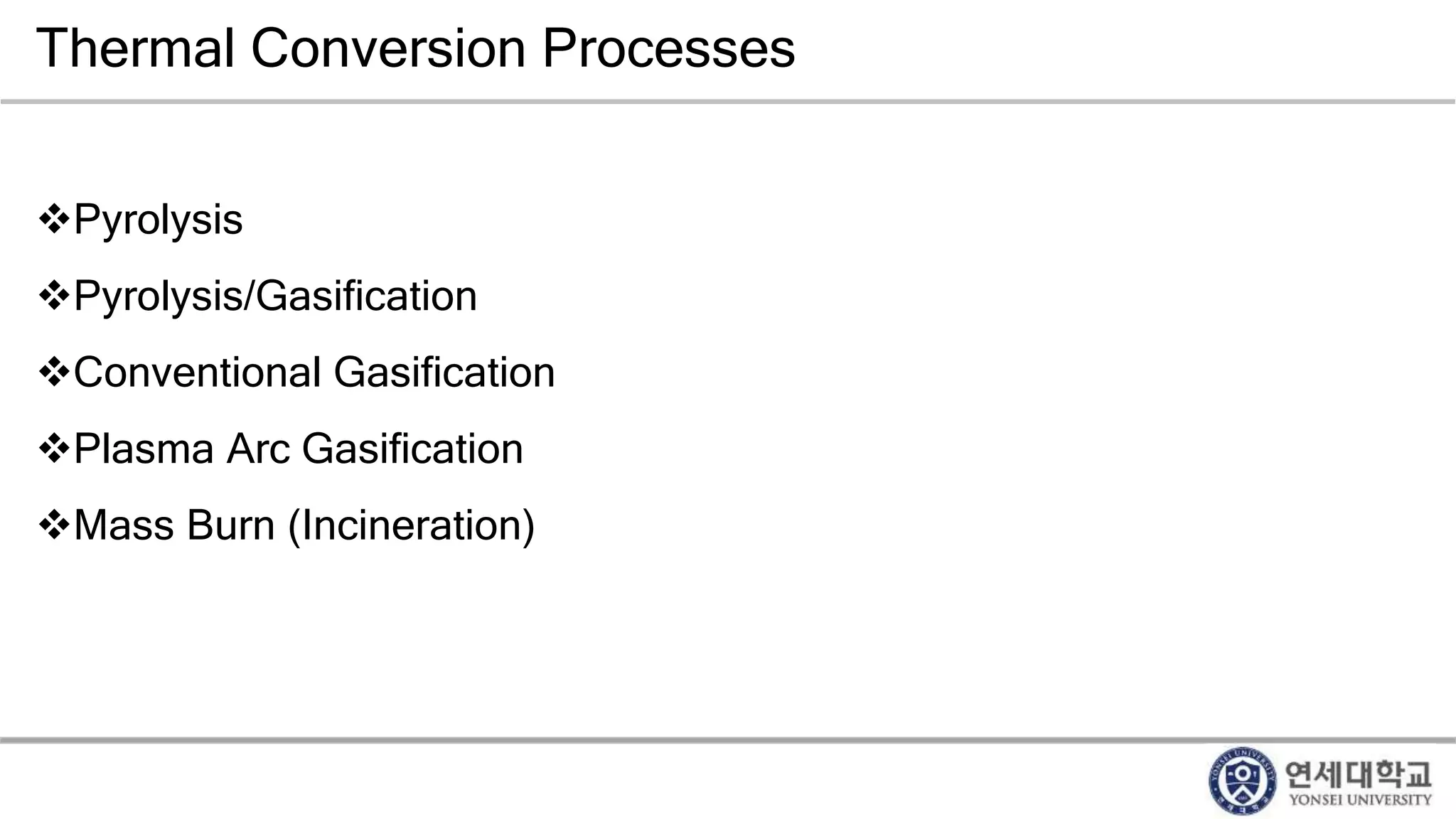
Thermal Conversion Processes
Pyrolysis
Pyrolysis/Gasification
Conventional Gasification
Plasma Arc Gasification
Mass Burn (Incineration)
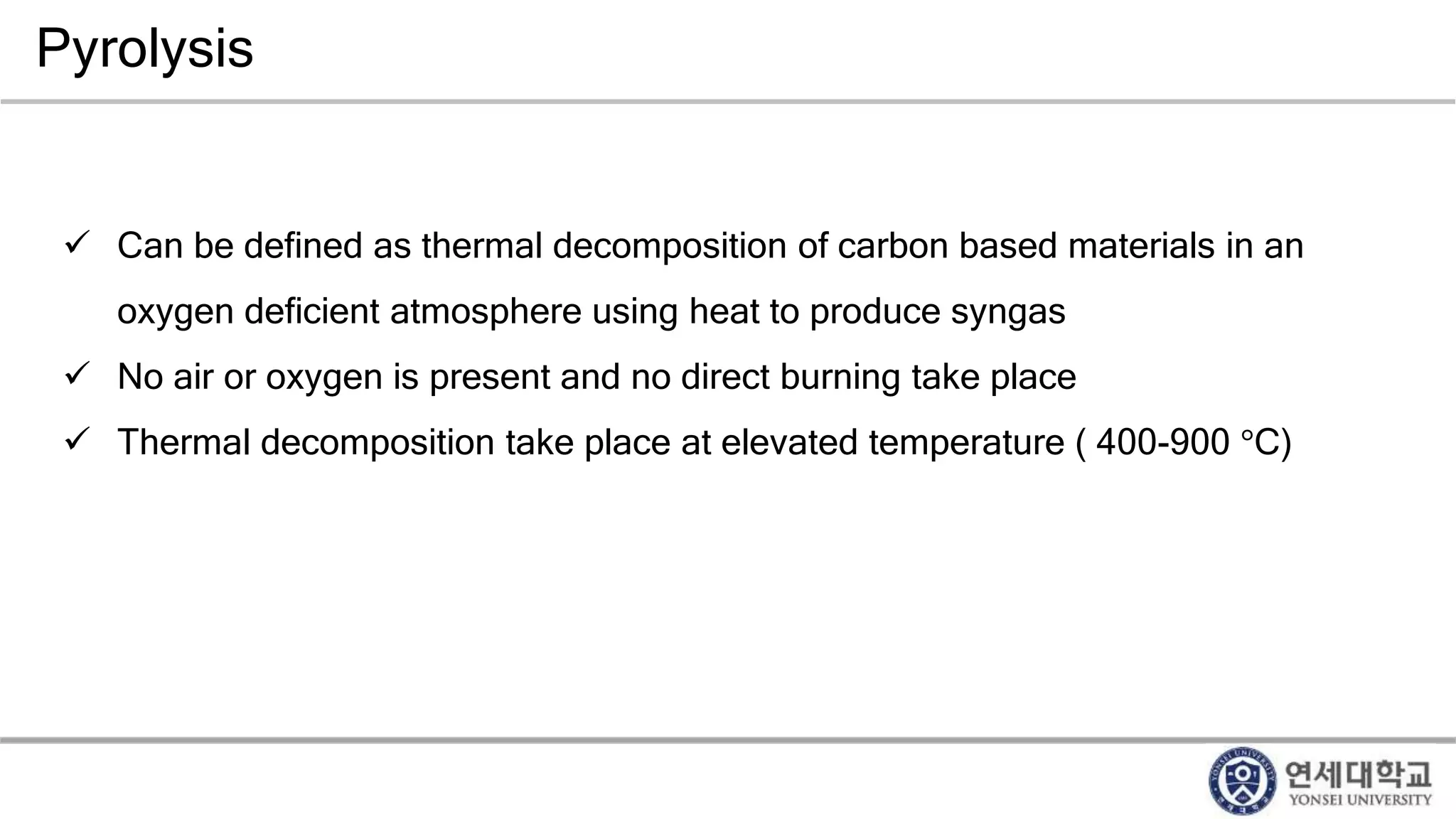
Pyrolysis
 Can be defined as thermal decomposition of carbon based materials in an
oxygen deficient atmosphere using heat to produce syngas
 No air or oxygen is present and no direct burning take place
 Thermal decomposition take place at elevated temperature ( 400-900 °C)
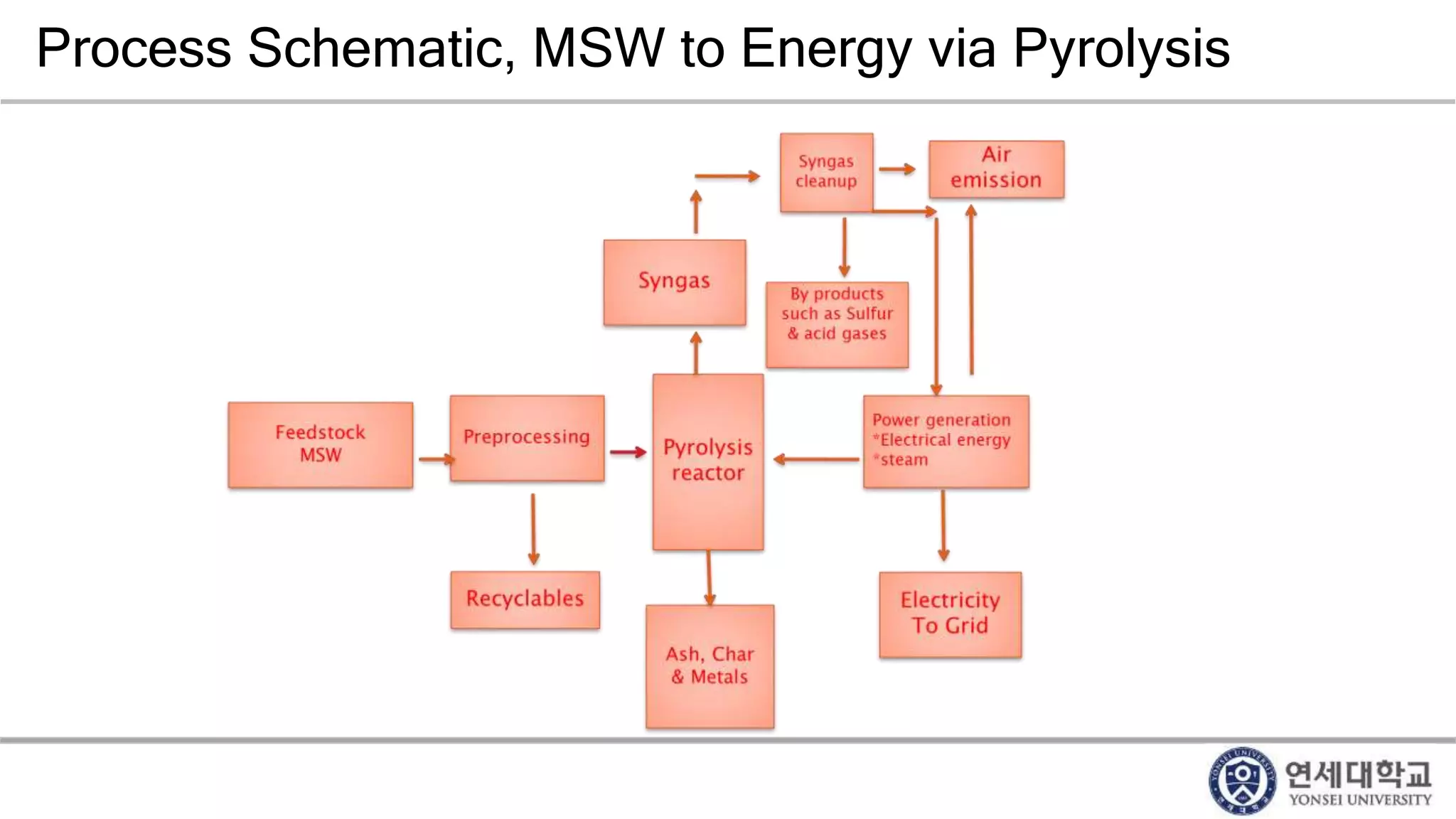
Process Schematic, MSW to Energy via Pyrolysis
Conventional Gasification
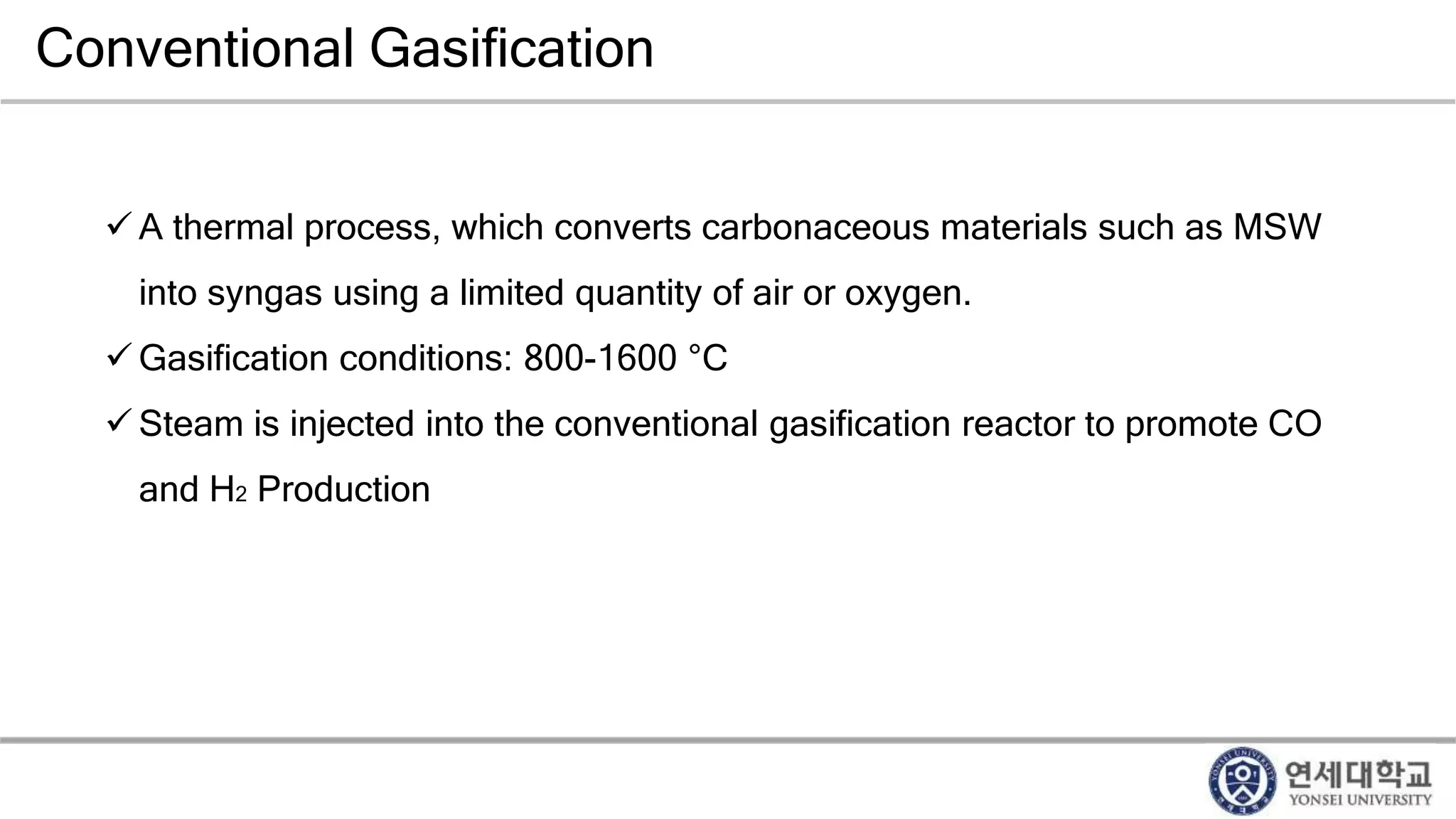
 A thermal process, which converts carbonaceous materials such as MSW
into syngas using a limited quantity of air or oxygen.
 Gasification conditions: 800-1600 °C
 Steam is injected into the conventional gasification reactor to promote CO
and H2 Production
Chemical Reactions
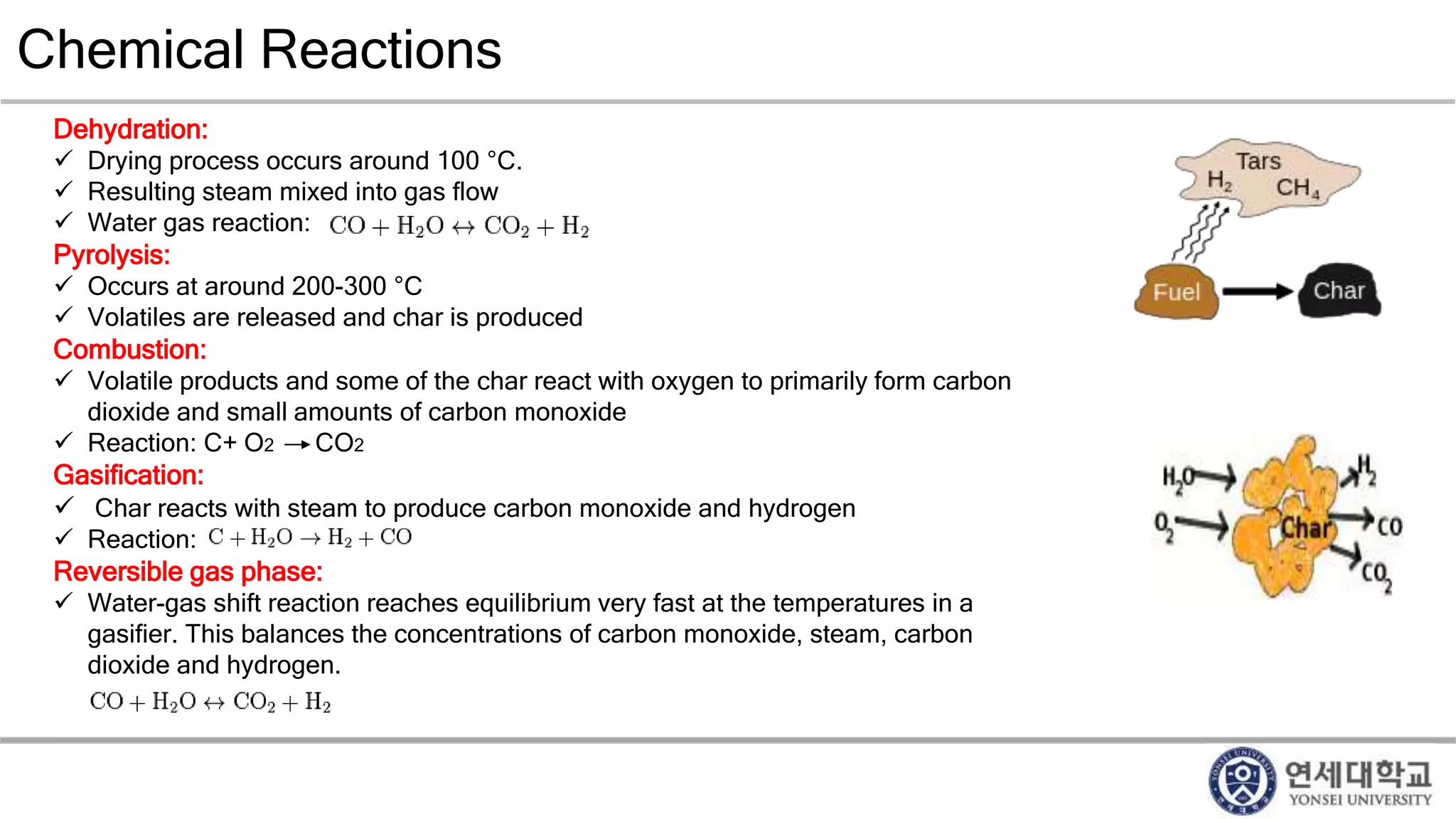
Dehydration:
 Drying process occurs around 100 °C.
 Resulting steam mixed into gas flow
 Water gas reaction:
Pyrolysis:
 Occurs at around 200-300 °C
 Volatiles are released and char is produced
Combustion:
 Volatile products and some of the char react with oxygen to primarily form carbon
dioxide and small amounts of carbon monoxide
 Reaction: C+ O2 CO2
Gasification:
 Char reacts with steam to produce carbon monoxide and hydrogen
 Reaction:
Reversible gas phase:
 Water-gas shift reaction reaches equilibrium very fast at the temperatures in a
gasifier. This balances the concentrations of carbon monoxide, steam, carbon
dioxide and hydrogen.
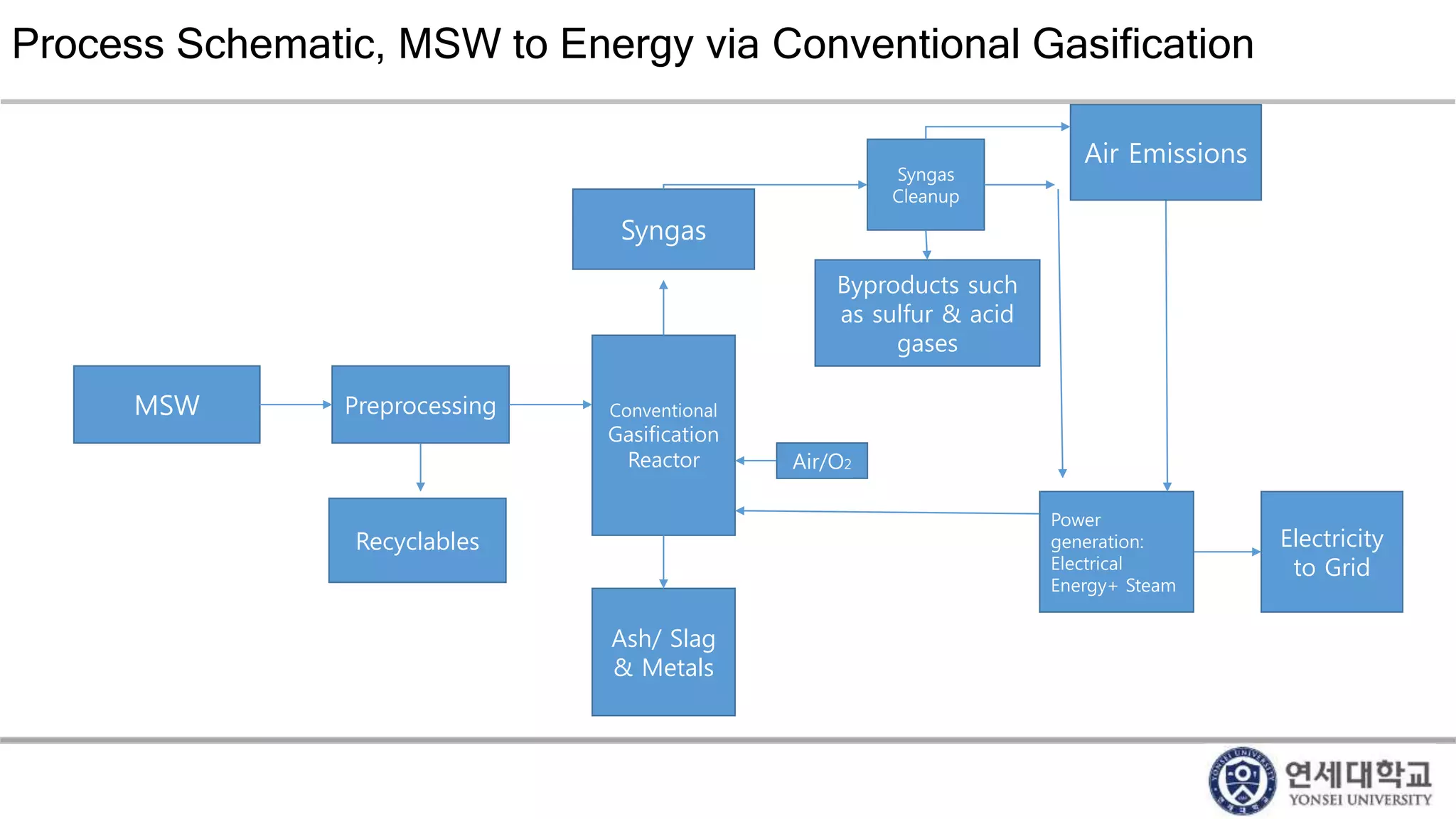
Process Schematic, MSW to Energy via Conventional Gasification
MSW Preprocessing Conventional
Gasification
Reactor
Ash/ Slag
& Metals
Recyclables
Syngas
Syngas
Cleanup
Byproducts such
as sulfur & acid
gases
Air/O2
Power
generation:
Electrical
Energy+ Steam
Air Emissions
Electricity
to Grid
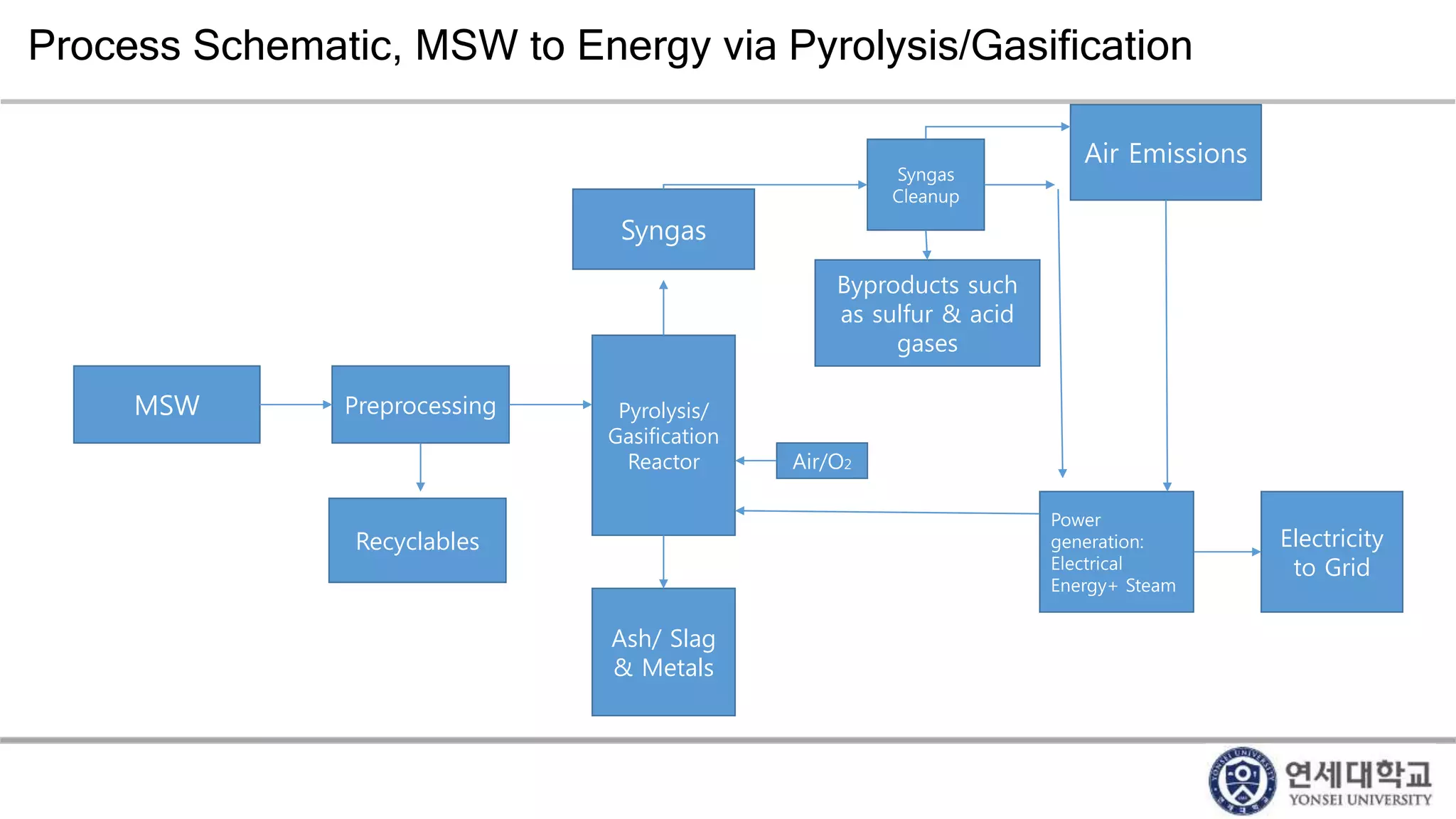
Pyrolysis/Gasification
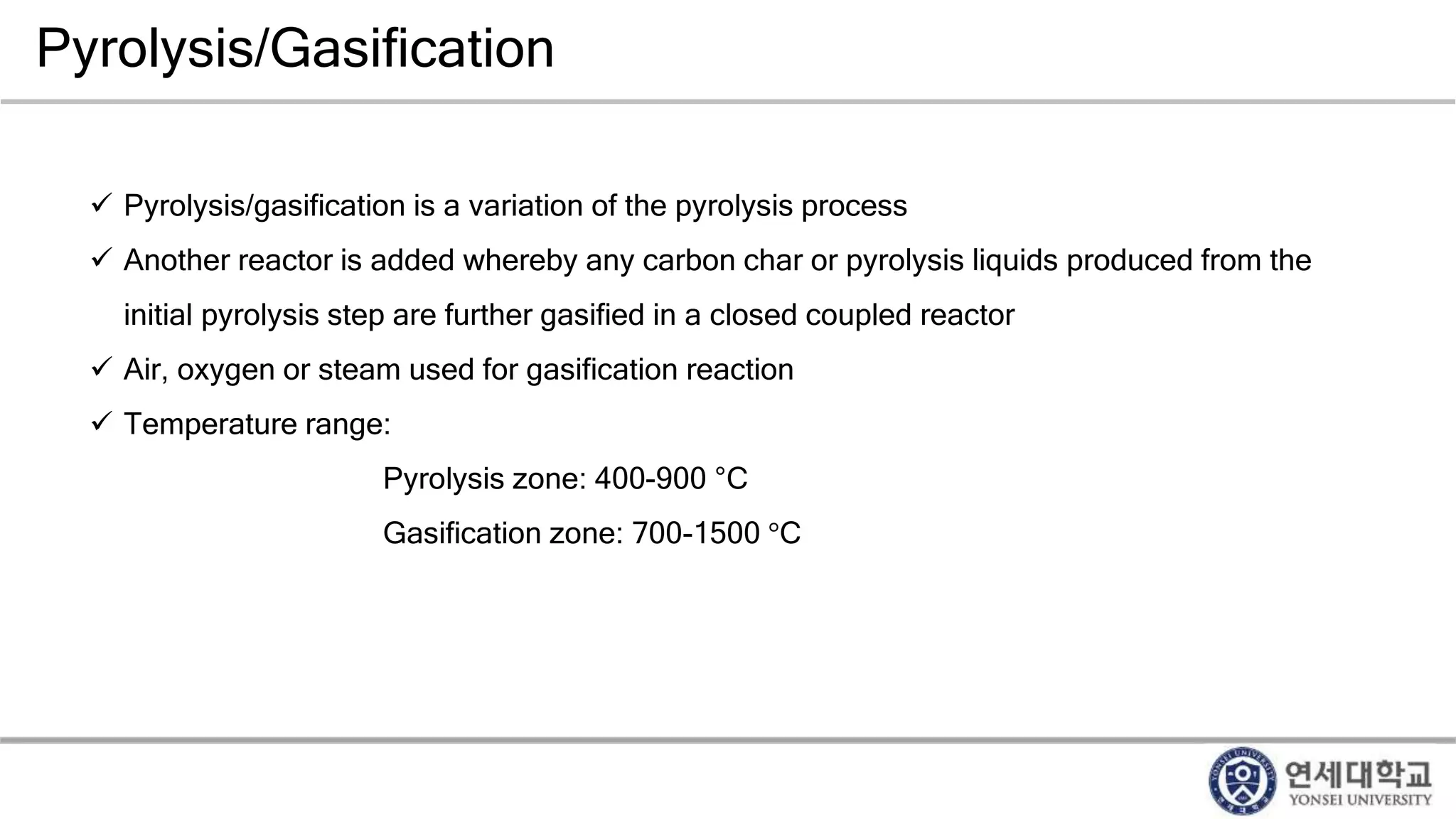
 Pyrolysis/gasification is a variation of the pyrolysis process
 Another reactor is added whereby any carbon char or pyrolysis liquids produced from the
initial pyrolysis step are further gasified in a closed coupled reactor
 Air, oxygen or steam used for gasification reaction
 Temperature range:
Pyrolysis zone: 400-900 °C
Gasification zone: 700-1500 °C
Process Schematic, MSW to Energy via Pyrolysis/Gasification
MSW Preprocessing Pyrolysis/
Gasification
Reactor
Ash/ Slag
& Metals
Recyclables
Syngas
Syngas
Cleanup
Byproducts such
as sulfur & acid
gases
Air/O2
Air Emissions
Power
generation:
Electrical
Energy+ Steam
Electricity
to Grid
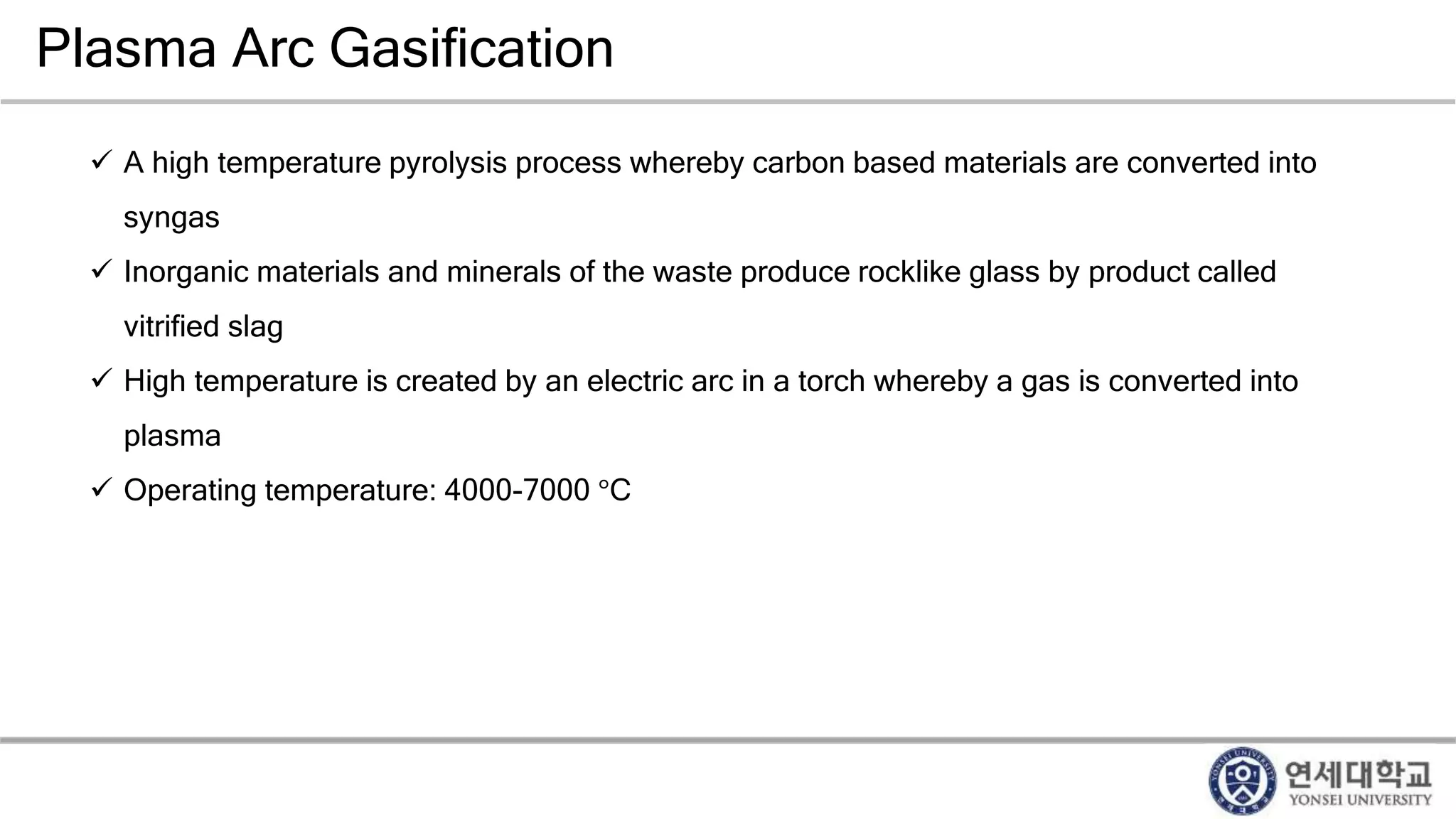
Plasma Arc Gasification
 A high temperature pyrolysis process whereby carbon based materials are converted into
syngas
 Inorganic materials and minerals of the waste produce rocklike glass by product called
vitrified slag
 High temperature is created by an electric arc in a torch whereby a gas is converted into
plasma
 Operating temperature: 4000-7000 °C
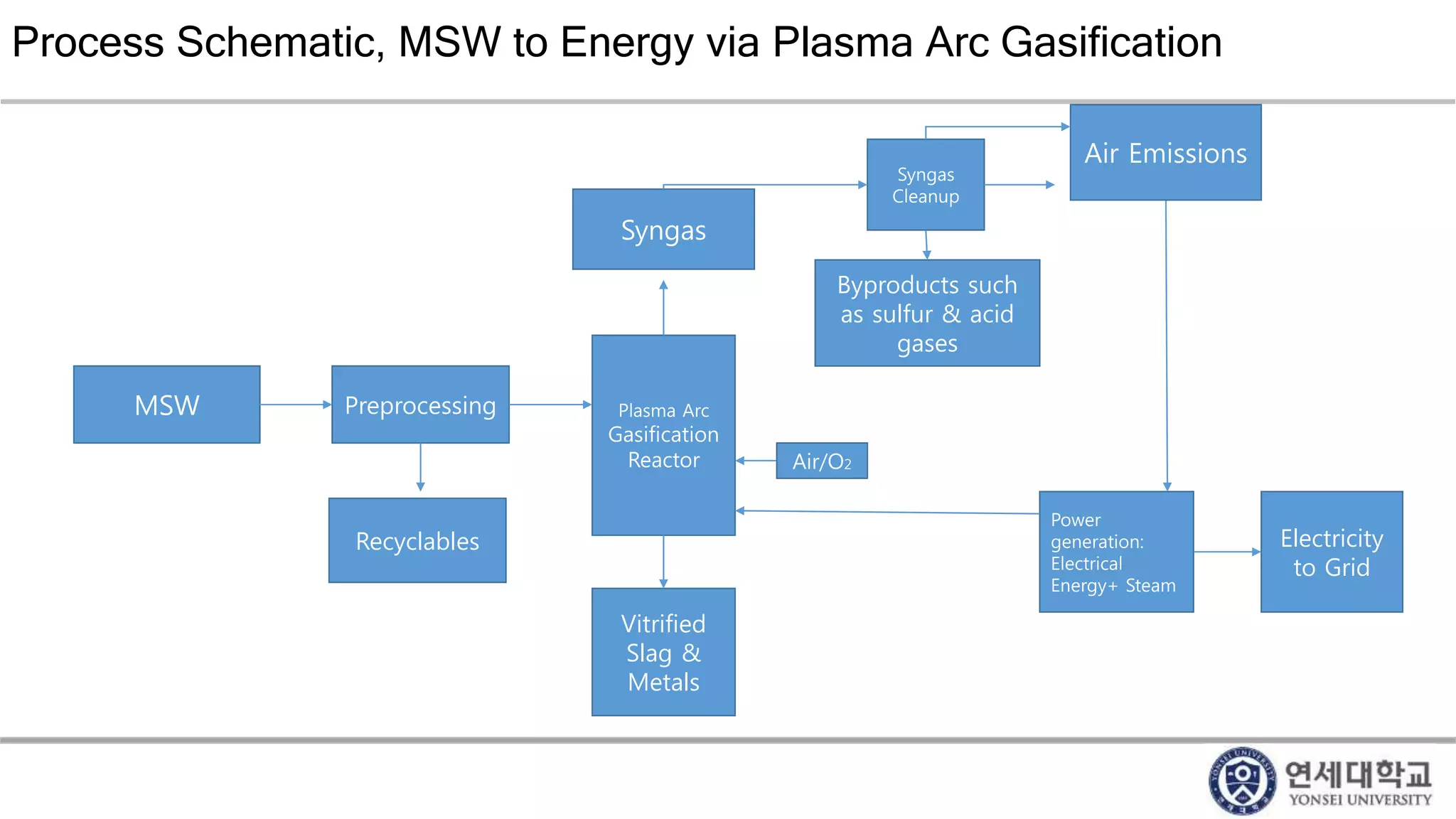
Process Schematic, MSW to Energy via Plasma Arc Gasification
MSW Preprocessing Plasma Arc
Gasification
Reactor
Vitrified
Slag &
Metals
Recyclables
Syngas
Syngas
Cleanup
Byproducts such
as sulfur & acid
gases
Air/O2
Power
generation:
Electrical
Energy+ Steam
Electricity
to Grid
Air Emissions
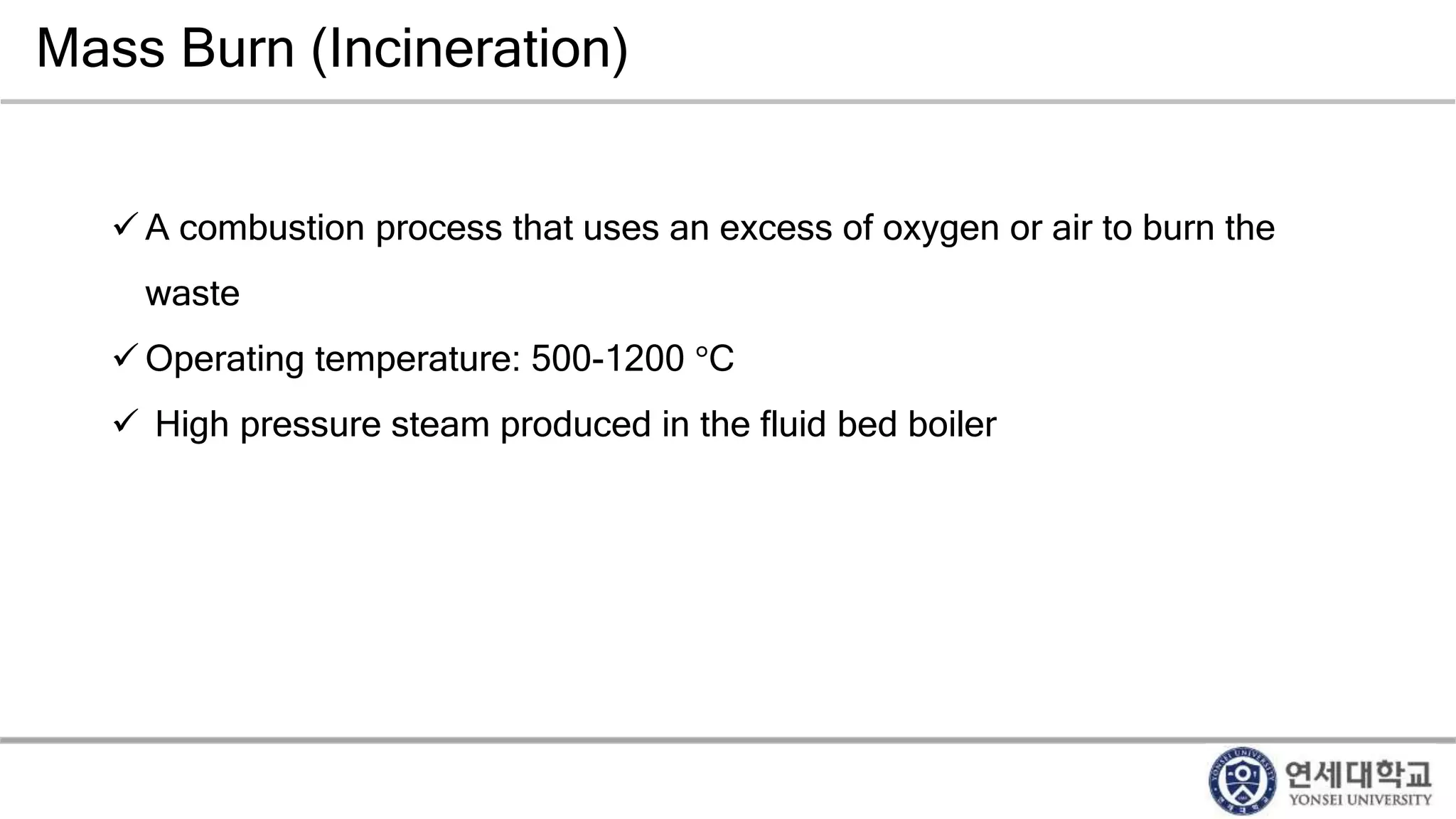
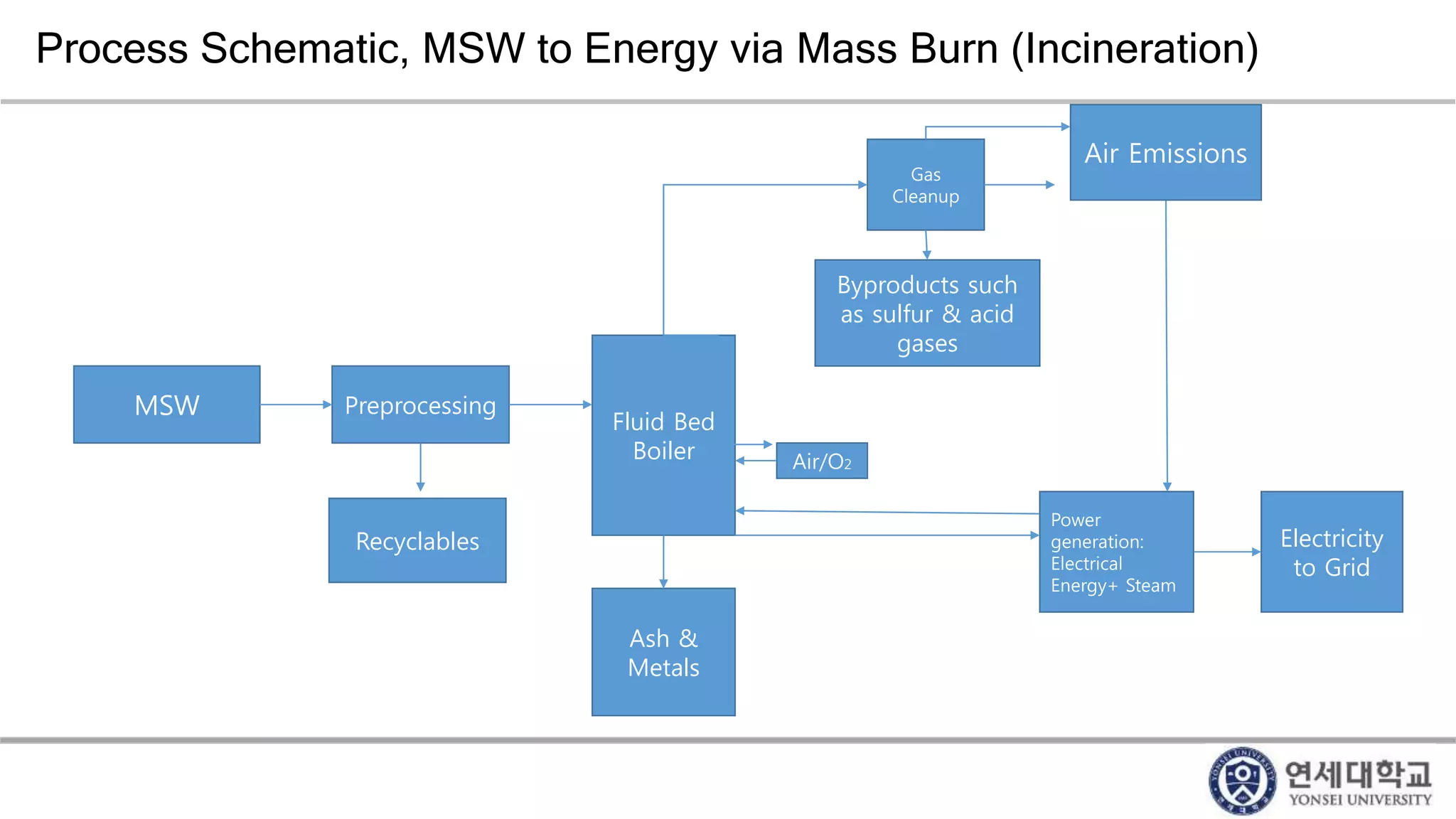
Mass Burn (Incineration)
 A combustion process that uses an excess of oxygen or air to burn the
waste
 Operating temperature: 500-1200 °C
 High pressure steam produced in the fluid bed boiler
Process Schematic, MSW to Energy via Mass Burn (Incineration)
MSW Preprocessing
Fluid Bed
Boiler
Ash &
Metals
Recyclables
Gas
Cleanup
Byproducts such
as sulfur & acid
gases
Air/O2
Power
generation:
Electrical
Energy+ Steam
Electricity
to Grid
Air Emissions
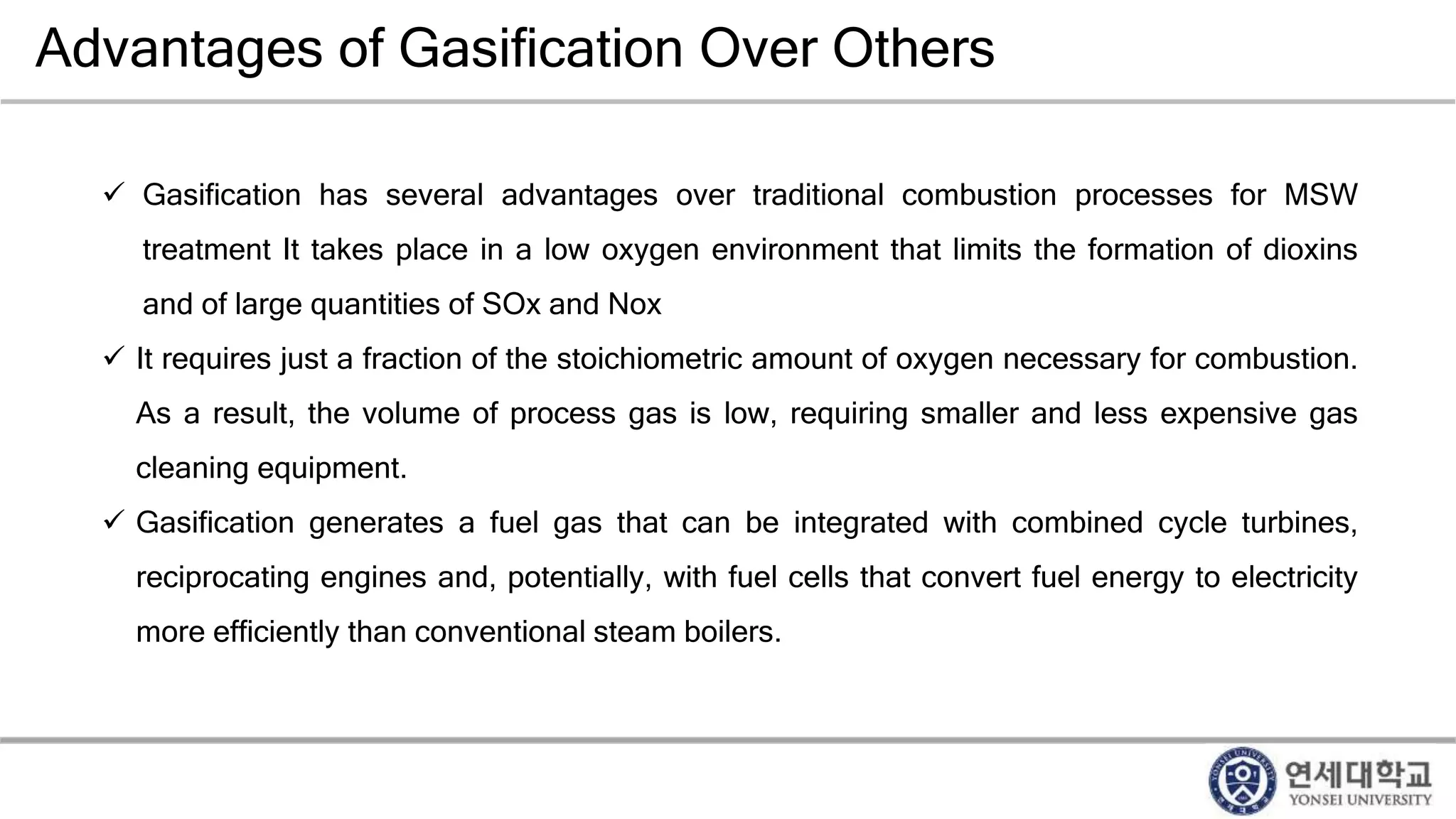
Advantages of Gasification Over Others
 Gasification has several advantages over traditional combustion processes for MSW
treatment It takes place in a low oxygen environment that limits the formation of dioxins
and of large quantities of SOx and Nox
 It requires just a fraction of the stoichiometric amount of oxygen necessary for combustion.
As a result, the volume of process gas is low, requiring smaller and less expensive gas
cleaning equipment.
 Gasification generates a fuel gas that can be integrated with combined cycle turbines,
reciprocating engines and, potentially, with fuel cells that convert fuel energy to electricity
more efficiently than conventional steam boilers.
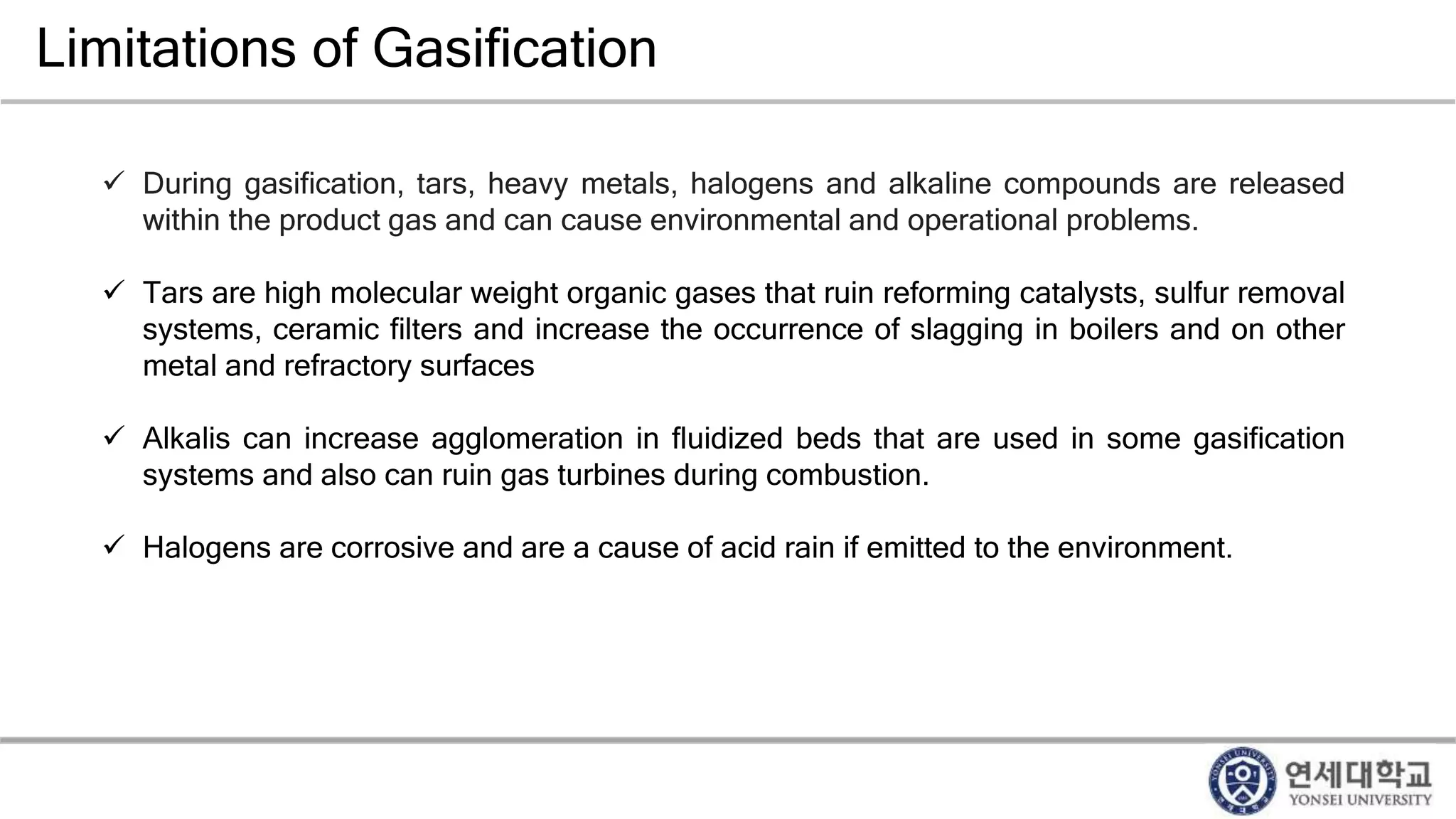
Limitations of Gasification
 During gasification, tars, heavy metals, halogens and alkaline compounds are released
within the product gas and can cause environmental and operational problems.
 Tars are high molecular weight organic gases that ruin reforming catalysts, sulfur removal
systems, ceramic filters and increase the occurrence of slagging in boilers and on other
metal and refractory surfaces
 Alkalis can increase agglomeration in fluidized beds that are used in some gasification
systems and also can ruin gas turbines during combustion.
 Halogens are corrosive and are a cause of acid rain if emitted to the environment.
Main Types of Gaisifier
 Updraft Fixed Bed
 Downdraft Fixed Bed
 Fluidized Bed
 Entrained Bed
Updraft Fixed Bed
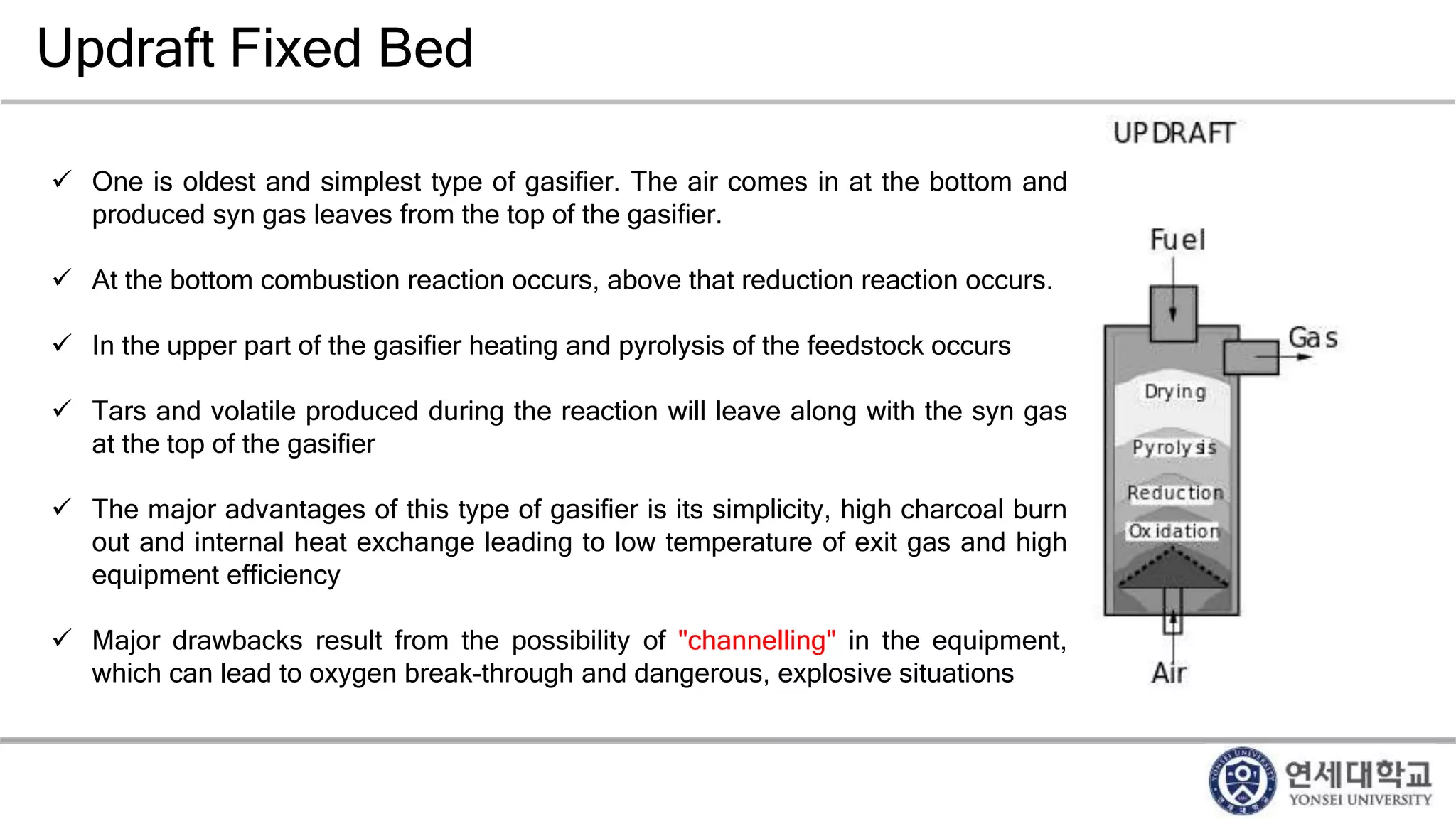
 One is oldest and simplest type of gasifier. The air comes in at the bottom and
produced syn gas leaves from the top of the gasifier.
 At the bottom combustion reaction occurs, above that reduction reaction occurs.
 In the upper part of the gasifier heating and pyrolysis of the feedstock occurs
 Tars and volatile produced during the reaction will leave along with the syn gas
at the top of the gasifier
 The major advantages of this type of gasifier is its simplicity, high charcoal burn
out and internal heat exchange leading to low temperature of exit gas and high
equipment efficiency
 Major drawbacks result from the possibility of "channelling" in the equipment,
which can lead to oxygen break-through and dangerous, explosive situations
Downdraft Fixed Bed
 In updraft gasifier there is a problem of tar entrainment in the product gas leaving
stream
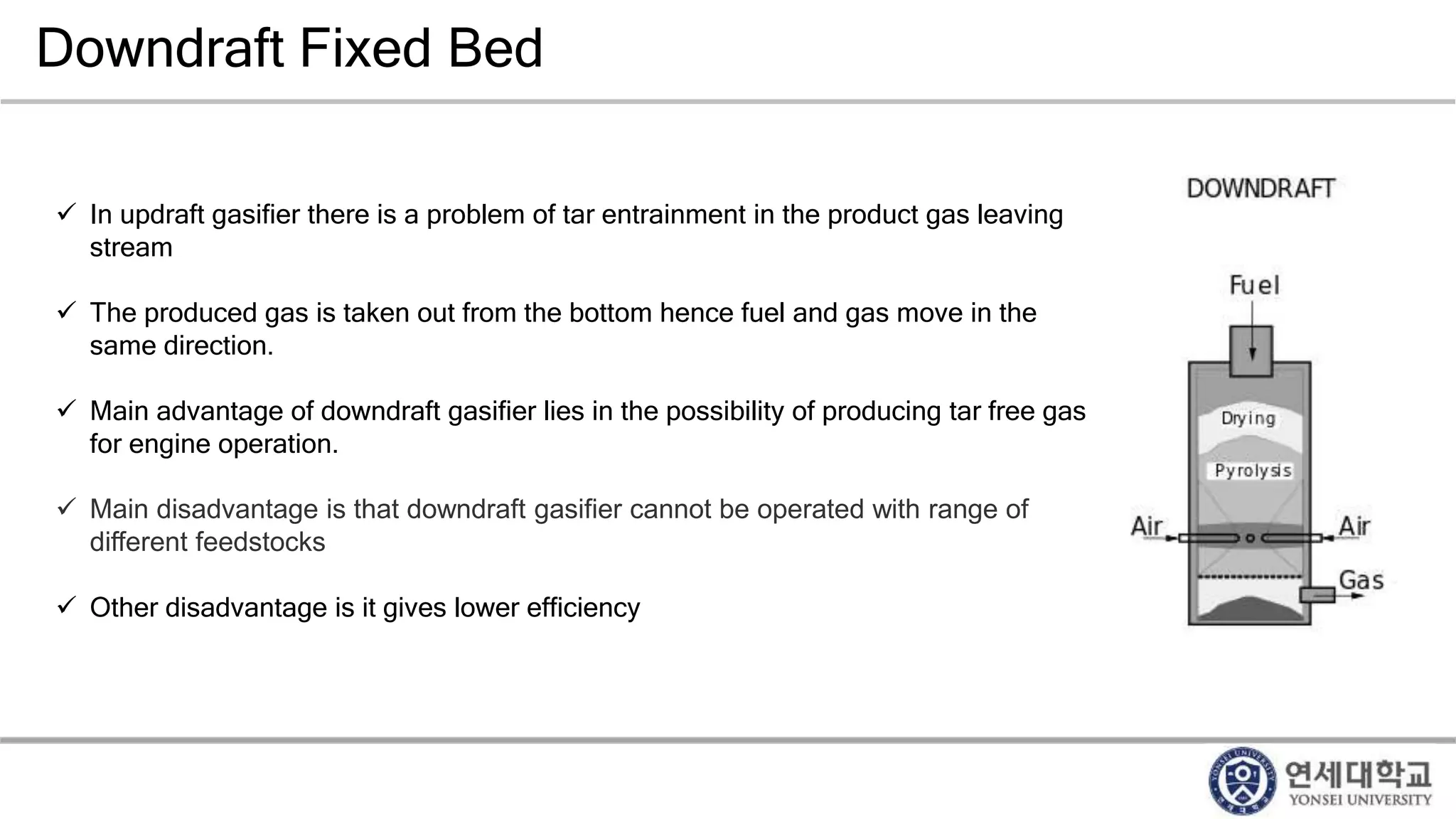
 The produced gas is taken out from the bottom hence fuel and gas move in the
same direction.
 Main advantage of downdraft gasifier lies in the possibility of producing tar free gas
for engine operation.
 Main disadvantage is that downdraft gasifier cannot be operated with range of
different feedstocks
 Other disadvantage is it gives lower efficiency
Fluidized Bed
 Both up and downdraught gasifiers is influenced by the morphological, physical
and chemical properties of the fuel. Problems commonly encountered are: lack of
bunker flow, slagging and extreme pressure drop over the gasifier
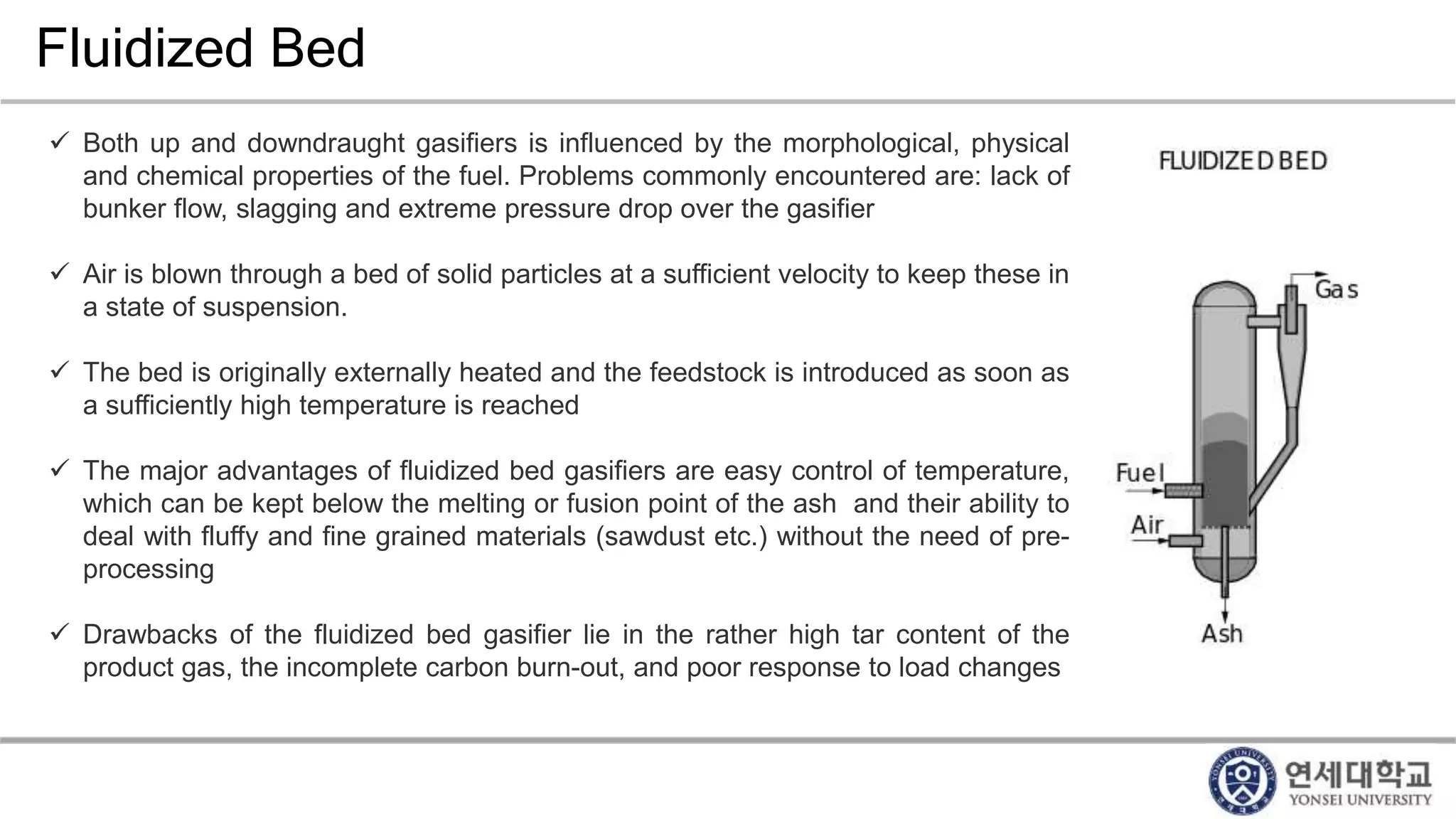
 Air is blown through a bed of solid particles at a sufficient velocity to keep these in
a state of suspension.
 The bed is originally externally heated and the feedstock is introduced as soon as
a sufficiently high temperature is reached
 The major advantages of fluidized bed gasifiers are easy control of temperature,
which can be kept below the melting or fusion point of the ash and their ability to
deal with fluffy and fine grained materials (sawdust etc.) without the need of pre-
processing
 Drawbacks of the fluidized bed gasifier lie in the rather high tar content of the
product gas, the incomplete carbon burn-out, and poor response to load changes
Entrained Bed
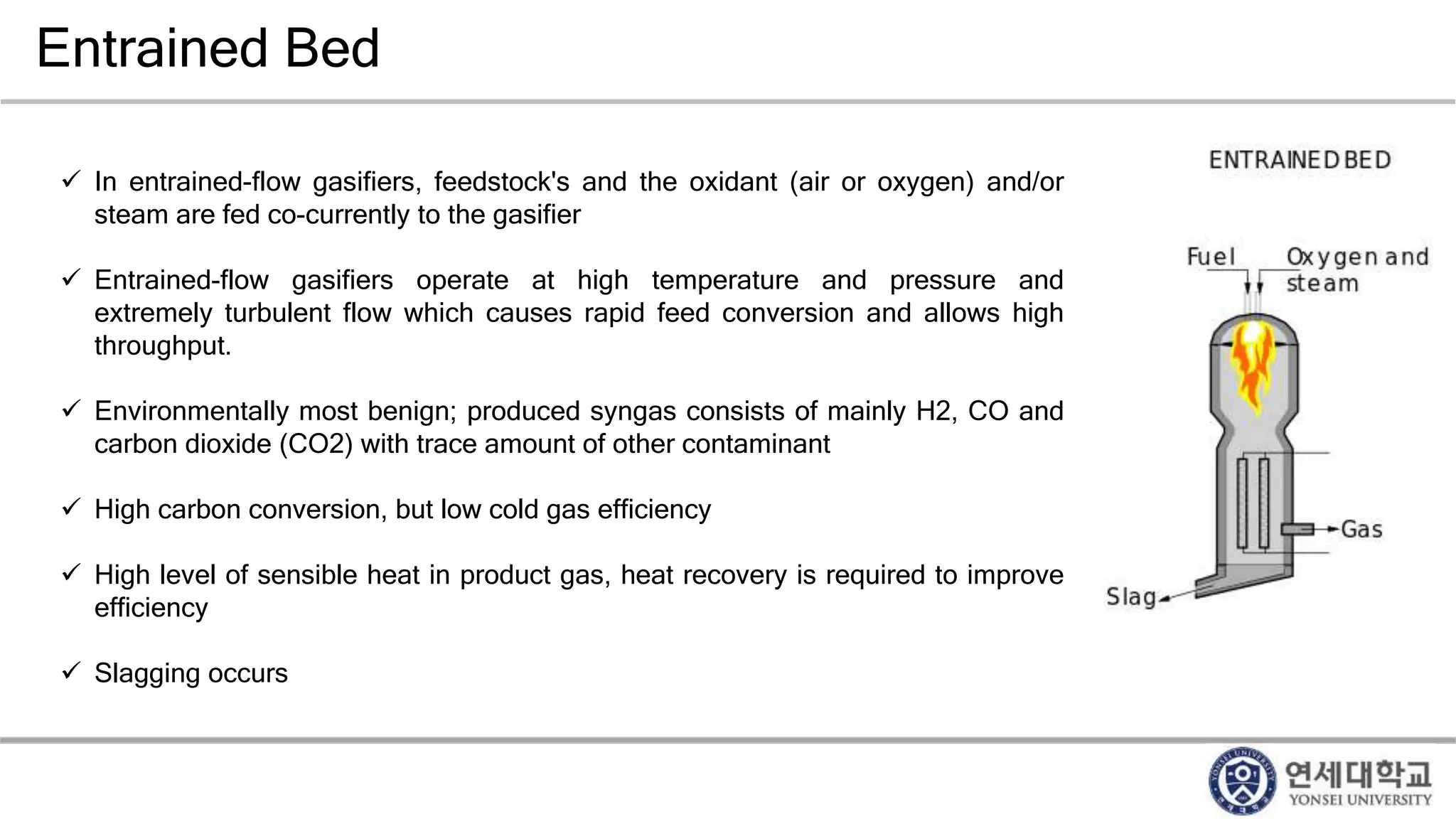
 In entrained-flow gasifiers, feedstock's and the oxidant (air or oxygen) and/or
steam are fed co-currently to the gasifier
 Entrained-flow gasifiers operate at high temperature and pressure and
extremely turbulent flow which causes rapid feed conversion and allows high
throughput.
 Environmentally most benign; produced syngas consists of mainly H2, CO and
carbon dioxide (CO2) with trace amount of other contaminant
 High carbon conversion, but low cold gas efficiency
 High level of sensible heat in product gas, heat recovery is required to improve
efficiency
 Slagging occurs
THANK YOU!
감사합니다!
ধন্যবাদ!

MSW to Energy Using Thermal Conversion Process

  • 1.
    MSW to EnergyUsing Thermal Conversion Process Presented By Alam, Md Tanvir ID: 2015311947
  • 2.
  • 3.
    What is MSW? Definition: Waste generally means “something unwanted”. A material is considered as waste until it is considered as beneficial again. Thus a solid material considered as solid waste in the eye of producer when it loses its worth to them and is discarded.  Municipal Solid Waste (MSW) is the waste collected by urban local body
  • 4.
    Composition of MSW IncomeLevel Organic (%) Paper (%) Plastic (%) Glass (%) Metal (%) Other (%) Low Income 64 5 8 3 3 17 Lower Middle Income 59 9 12 3 2 15 Upper Middle Income 54 14 11 5 3 13 High Income 28 31 11 7 6 17  Types of waste composition by income level Source: Waste Composition, World Bank
  • 5.
    Chemical Properties ofWaste  Ultimate analysis of municipal solid waste ( percent by weight in dry basis) Component Carbon (C) Hydrogen (H) Oxygen (O) Nitrogen (N) Sulphur (S) Ash Food waste 49.1 6.6 37.6 1.7 0.2 4.8 Paper 43.4 5.8 44.3 0.3 0.2 6.1 Newsprint 49.1 6.1 43.0 0.1 0.2 1.5 Cardboard 44.0 5.9 44.6 0.3 0.2 5.0 Rubber 77.8 10.4 - - 2.0 9.8 Plastics 60.0 7.0 23.0 - - 10 PVC 45.2 5.6 1.6 0.1 0.1 47.4 Leather 42.0 5.3 22.8 6.0 1.0 22.9 Textile 55.0 6.5 31.2 4.5 0.2 2.6 Wood 50.5 6.0 42.4 0.2 0.1 0.8 Source: Kaiser (1978)
  • 6.
     Proximate analysisand calorific value of MSW Component Proximate analysis, % of weight Calorific value, kJ/kg Moisture content Volatiles Fixed Carbon Ash As collected Dry Moisture/ash free Paper 10.2 76.0 8.4 5.4 15,750 17,530 18,650 Newsprint 6.0 81.1 11.5 1.4 18,550 19,720 20,000 Food waste 78.3 17.1 3.6 1.0 4,170 19,230 20,230 Meat waste 37.7 56.3 1.8 4.2 17,730 28,940 30,490 Grass 75.2 18.6 4.5 1.7 4,760 19,250 20,610 Green Logs 50.0 42.2 7.3 0.5 4,870 9,740 9,840 Plants 54.0 35.6 8.1 2.3 8,560 18,580 19,590 Rubber 1.2 84.0 5.0 9.8 25,590 26,230 29,180 Leather 7.5 57.1 14.3 21.1 16,770 18,120 23,500 PVC 0.2 86.9 10.9 2.0 22,590 22,640 23,160 Source: Kaiser (1978)
  • 7.
    Why Waste toEnergy ?
  • 8.
    MSW to EnergyConversion Processes
  • 9.
    Energy Conversion Processes Waste MBT Mechanical Treatment Thermal Conversion Biological Conversion Gasification Combustion Pyrolysis /Thermolysis Anaerobic Digestion Liquefaction Indirect Liquefaction/ Methanation Biogas Oil Bio-Alcohol Low Quality Syngas Flue Gas Crushing, Compressing, Pelletizing Pretreatment Residues Landfill Recycling Residues High Quality Syngas Oil Solid Fuel (RDF) Power Generation Further Processing Chemical Product CONCEPT PROCESS ENERGY CARRIER
  • 10.
    Thermal Conversion Processes Pyrolysis Pyrolysis/Gasification ConventionalGasification Plasma Arc Gasification Mass Burn (Incineration)
  • 11.
    Pyrolysis  Can bedefined as thermal decomposition of carbon based materials in an oxygen deficient atmosphere using heat to produce syngas  No air or oxygen is present and no direct burning take place  Thermal decomposition take place at elevated temperature ( 400-900 °C)
  • 12.
    Process Schematic, MSWto Energy via Pyrolysis
  • 13.
    Conventional Gasification  Athermal process, which converts carbonaceous materials such as MSW into syngas using a limited quantity of air or oxygen.  Gasification conditions: 800-1600 °C  Steam is injected into the conventional gasification reactor to promote CO and H2 Production
  • 14.
    Chemical Reactions Dehydration:  Dryingprocess occurs around 100 °C.  Resulting steam mixed into gas flow  Water gas reaction: Pyrolysis:  Occurs at around 200-300 °C  Volatiles are released and char is produced Combustion:  Volatile products and some of the char react with oxygen to primarily form carbon dioxide and small amounts of carbon monoxide  Reaction: C+ O2 CO2 Gasification:  Char reacts with steam to produce carbon monoxide and hydrogen  Reaction: Reversible gas phase:  Water-gas shift reaction reaches equilibrium very fast at the temperatures in a gasifier. This balances the concentrations of carbon monoxide, steam, carbon dioxide and hydrogen.
  • 15.
    Process Schematic, MSWto Energy via Conventional Gasification MSW Preprocessing Conventional Gasification Reactor Ash/ Slag & Metals Recyclables Syngas Syngas Cleanup Byproducts such as sulfur & acid gases Air/O2 Power generation: Electrical Energy+ Steam Air Emissions Electricity to Grid
  • 16.
    Pyrolysis/Gasification  Pyrolysis/gasification isa variation of the pyrolysis process  Another reactor is added whereby any carbon char or pyrolysis liquids produced from the initial pyrolysis step are further gasified in a closed coupled reactor  Air, oxygen or steam used for gasification reaction  Temperature range: Pyrolysis zone: 400-900 °C Gasification zone: 700-1500 °C
  • 17.
    Process Schematic, MSWto Energy via Pyrolysis/Gasification MSW Preprocessing Pyrolysis/ Gasification Reactor Ash/ Slag & Metals Recyclables Syngas Syngas Cleanup Byproducts such as sulfur & acid gases Air/O2 Air Emissions Power generation: Electrical Energy+ Steam Electricity to Grid
  • 18.
    Plasma Arc Gasification A high temperature pyrolysis process whereby carbon based materials are converted into syngas  Inorganic materials and minerals of the waste produce rocklike glass by product called vitrified slag  High temperature is created by an electric arc in a torch whereby a gas is converted into plasma  Operating temperature: 4000-7000 °C
  • 19.
    Process Schematic, MSWto Energy via Plasma Arc Gasification MSW Preprocessing Plasma Arc Gasification Reactor Vitrified Slag & Metals Recyclables Syngas Syngas Cleanup Byproducts such as sulfur & acid gases Air/O2 Power generation: Electrical Energy+ Steam Electricity to Grid Air Emissions
  • 20.
    Mass Burn (Incineration) A combustion process that uses an excess of oxygen or air to burn the waste  Operating temperature: 500-1200 °C  High pressure steam produced in the fluid bed boiler
  • 21.
    Process Schematic, MSWto Energy via Mass Burn (Incineration) MSW Preprocessing Fluid Bed Boiler Ash & Metals Recyclables Gas Cleanup Byproducts such as sulfur & acid gases Air/O2 Power generation: Electrical Energy+ Steam Electricity to Grid Air Emissions
  • 22.
    Advantages of GasificationOver Others  Gasification has several advantages over traditional combustion processes for MSW treatment It takes place in a low oxygen environment that limits the formation of dioxins and of large quantities of SOx and Nox  It requires just a fraction of the stoichiometric amount of oxygen necessary for combustion. As a result, the volume of process gas is low, requiring smaller and less expensive gas cleaning equipment.  Gasification generates a fuel gas that can be integrated with combined cycle turbines, reciprocating engines and, potentially, with fuel cells that convert fuel energy to electricity more efficiently than conventional steam boilers.
  • 23.
    Limitations of Gasification During gasification, tars, heavy metals, halogens and alkaline compounds are released within the product gas and can cause environmental and operational problems.  Tars are high molecular weight organic gases that ruin reforming catalysts, sulfur removal systems, ceramic filters and increase the occurrence of slagging in boilers and on other metal and refractory surfaces  Alkalis can increase agglomeration in fluidized beds that are used in some gasification systems and also can ruin gas turbines during combustion.  Halogens are corrosive and are a cause of acid rain if emitted to the environment.
  • 24.
    Main Types ofGaisifier  Updraft Fixed Bed  Downdraft Fixed Bed  Fluidized Bed  Entrained Bed
  • 25.
    Updraft Fixed Bed One is oldest and simplest type of gasifier. The air comes in at the bottom and produced syn gas leaves from the top of the gasifier.  At the bottom combustion reaction occurs, above that reduction reaction occurs.  In the upper part of the gasifier heating and pyrolysis of the feedstock occurs  Tars and volatile produced during the reaction will leave along with the syn gas at the top of the gasifier  The major advantages of this type of gasifier is its simplicity, high charcoal burn out and internal heat exchange leading to low temperature of exit gas and high equipment efficiency  Major drawbacks result from the possibility of "channelling" in the equipment, which can lead to oxygen break-through and dangerous, explosive situations
  • 26.
    Downdraft Fixed Bed In updraft gasifier there is a problem of tar entrainment in the product gas leaving stream  The produced gas is taken out from the bottom hence fuel and gas move in the same direction.  Main advantage of downdraft gasifier lies in the possibility of producing tar free gas for engine operation.  Main disadvantage is that downdraft gasifier cannot be operated with range of different feedstocks  Other disadvantage is it gives lower efficiency
  • 27.
    Fluidized Bed  Bothup and downdraught gasifiers is influenced by the morphological, physical and chemical properties of the fuel. Problems commonly encountered are: lack of bunker flow, slagging and extreme pressure drop over the gasifier  Air is blown through a bed of solid particles at a sufficient velocity to keep these in a state of suspension.  The bed is originally externally heated and the feedstock is introduced as soon as a sufficiently high temperature is reached  The major advantages of fluidized bed gasifiers are easy control of temperature, which can be kept below the melting or fusion point of the ash and their ability to deal with fluffy and fine grained materials (sawdust etc.) without the need of pre- processing  Drawbacks of the fluidized bed gasifier lie in the rather high tar content of the product gas, the incomplete carbon burn-out, and poor response to load changes
  • 28.
    Entrained Bed  Inentrained-flow gasifiers, feedstock's and the oxidant (air or oxygen) and/or steam are fed co-currently to the gasifier  Entrained-flow gasifiers operate at high temperature and pressure and extremely turbulent flow which causes rapid feed conversion and allows high throughput.  Environmentally most benign; produced syngas consists of mainly H2, CO and carbon dioxide (CO2) with trace amount of other contaminant  High carbon conversion, but low cold gas efficiency  High level of sensible heat in product gas, heat recovery is required to improve efficiency  Slagging occurs
  • 29.