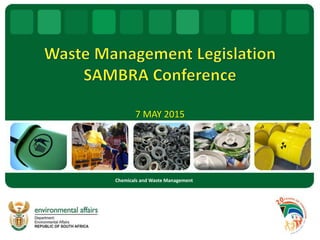
7 MAY 2015
Chemicals and Waste Management
Presentation Outline
• Legislative Background
• NEM: Waste Act, 2008
• Applicable provisions, norms
and standards and
Regulations
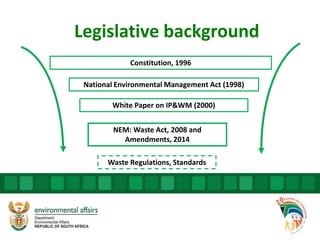
Legislative background
Constitution, 1996
National Environmental Management Act (1998)
NEM: Waste Act, 2008 and
Amendments, 2014
Waste Regulations, Standards
White Paper on IP&WM (2000)
CURRENT STATUS
• Waste Act came into effect on 1 July 2009
• Delayed section (s);
– 28 (7)(a)- voluntary Industry WMPs.
– 46- appointment of persons to manage license
applications
• Waste Act Amendments came into effect
2 June 2014
NEM:WA APPROACH
• Regulate waste management in order to protect health and the
environment
• Provide reasonable measures for the prevention of pollution and
ecological degradation and securing ecologically sustainable development
• Acknowledges that waste management practices in many areas in the
country is not conducive to a healthy environment
• Waste; under certain circumstances, can be a resource and offers
economic opportunities
NEM:WA APPROACH
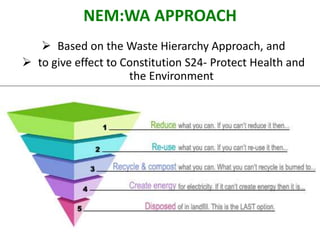
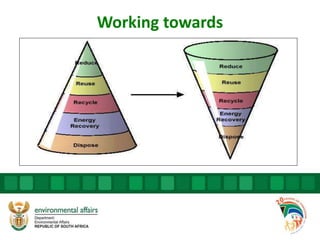
 Based on the Waste Hierarchy Approach, and
 to give effect to Constitution S24- Protect Health and
the Environment
General duty of the holders of waste
• Avoid the generation of waste in the production process
• Minimise the toxicity and amounts generated
• Reduce, recycle and recover
• Ensure waste is treated and disposed in an environmentally
sound manner
• Manage waste in a manner that does not endanger the health
or the environment or cause nuisance- odour or visual
impacts
• Cease, modify or control any process causing pollution
• Eliminate any source of pollution
Listing of waste activities
• Section 19 provides for the Minister to publish a list of activities that have
or are likely to have a detrimental effect on the environment.
• WMA List (GN 921) – Published in terms of section 19(2) of the Act on 29
November 2013- An Amendment to Government Notice 718 of 3 July
2009.
 No person may commence, undertake or conduct a listed waste
management activity except in accordance with:
o a waste management licence
o requirements or standards determined by the Minister, if a licence is
not required
 Category (A- Basic Assessment), (B- Scoping & EIA) and (C- Standards)
 Licensing process is done in accordance with EIA Regulations
Licensing Authorities
• Licensing of waste management activities (Part 4)
• The Act outlines who the licensing authority is:
 National Department of Environmental Affairs: Hazardous
Waste
 Provincial Departments of Environment: General Waste
General requirements for Storage
• Any person who stores waste must take steps to ensure that:
 the containers in which any waste is stored, are intact and not
corroded or in any other way rendered unfit for the safe
storage of waste;
 adequate measures are taken to prevent accidental spillage or
leaking;
 the waste cannot be blown away;
 nuisances such as odour, visual impacts and breeding of
vectors do not arise;
 pollution of the environment and harm to health are
prevented.
General requirements for Storage
• Any person who generates waste which is collected by the
Municipality must:
 Place waste in containers approved by the Municipality and
place it in an area authorised
 Separate waste for reuse, recycling or recovery in an
appropriate container
 Comply with municipal by-laws on waste management i.t.o.
Frequency of collection, demarcated storage area etc
 Comply with National Norms and Standards for Storage of
waste, 2013
Prohibition of Unauthorised disposal
• No person may –
 dispose waste or knowingly or negligently cause or
permit waste to be disposed of, in any land,
waterbody or at any facility unless the disposal is
authorized by law
 Dispose of waste in a manner that is likely to cause
pollution of the environment or harm to health and
well being
Transportation of waste
• Any person engaged in transportation of
waste must: -
 take all reasonable steps to prevent any
spillage of waste or littering from the vehicle
Before offloading the waste from the vehicle
for disposal purposes, ensure that the facility
is authorized to accept such waste
Waste Classification and management
Regulations, 2013
• Provides for the generators of waste to classify waste,
unless listed in Annexure A
• Labeling of waste
• Waste Treatment
• Waste disposal restrictions
• Waste disposal to landfill
• Waste manifest systems to track waste from the
generator to the waste management facility
Waste Information Regulations, 2012
• Provides for generators of hazardous waste in
excess of 20kg per day (calculated monthly as
daily average) to register in the Waste
Information System
• Once off registration for generators, no
requirement for reporting.
Working towards
Ms Khashiwe Masinga
Directorate: Chemicals & Waste Policy &
Information Management
E-mail: kmasinga@environment.gov.za
Visit:
www.environment.gov.za
http://sawic.environment.gov.za

Waste Management: Overview

  • 1.
    7 MAY 2015 Chemicalsand Waste Management
  • 2.
    Presentation Outline • LegislativeBackground • NEM: Waste Act, 2008 • Applicable provisions, norms and standards and Regulations
  • 3.
    Legislative background Constitution, 1996 NationalEnvironmental Management Act (1998) NEM: Waste Act, 2008 and Amendments, 2014 Waste Regulations, Standards White Paper on IP&WM (2000)
  • 4.
    CURRENT STATUS • WasteAct came into effect on 1 July 2009 • Delayed section (s); – 28 (7)(a)- voluntary Industry WMPs. – 46- appointment of persons to manage license applications • Waste Act Amendments came into effect 2 June 2014
  • 5.
    NEM:WA APPROACH • Regulatewaste management in order to protect health and the environment • Provide reasonable measures for the prevention of pollution and ecological degradation and securing ecologically sustainable development • Acknowledges that waste management practices in many areas in the country is not conducive to a healthy environment • Waste; under certain circumstances, can be a resource and offers economic opportunities
  • 6.
    NEM:WA APPROACH  Basedon the Waste Hierarchy Approach, and  to give effect to Constitution S24- Protect Health and the Environment
  • 7.
    General duty ofthe holders of waste • Avoid the generation of waste in the production process • Minimise the toxicity and amounts generated • Reduce, recycle and recover • Ensure waste is treated and disposed in an environmentally sound manner • Manage waste in a manner that does not endanger the health or the environment or cause nuisance- odour or visual impacts • Cease, modify or control any process causing pollution • Eliminate any source of pollution
  • 8.
    Listing of wasteactivities • Section 19 provides for the Minister to publish a list of activities that have or are likely to have a detrimental effect on the environment. • WMA List (GN 921) – Published in terms of section 19(2) of the Act on 29 November 2013- An Amendment to Government Notice 718 of 3 July 2009.  No person may commence, undertake or conduct a listed waste management activity except in accordance with: o a waste management licence o requirements or standards determined by the Minister, if a licence is not required  Category (A- Basic Assessment), (B- Scoping & EIA) and (C- Standards)  Licensing process is done in accordance with EIA Regulations
  • 9.
    Licensing Authorities • Licensingof waste management activities (Part 4) • The Act outlines who the licensing authority is:  National Department of Environmental Affairs: Hazardous Waste  Provincial Departments of Environment: General Waste
  • 10.
    General requirements forStorage • Any person who stores waste must take steps to ensure that:  the containers in which any waste is stored, are intact and not corroded or in any other way rendered unfit for the safe storage of waste;  adequate measures are taken to prevent accidental spillage or leaking;  the waste cannot be blown away;  nuisances such as odour, visual impacts and breeding of vectors do not arise;  pollution of the environment and harm to health are prevented.
  • 11.
    General requirements forStorage • Any person who generates waste which is collected by the Municipality must:  Place waste in containers approved by the Municipality and place it in an area authorised  Separate waste for reuse, recycling or recovery in an appropriate container  Comply with municipal by-laws on waste management i.t.o. Frequency of collection, demarcated storage area etc  Comply with National Norms and Standards for Storage of waste, 2013
  • 12.
    Prohibition of Unauthoriseddisposal • No person may –  dispose waste or knowingly or negligently cause or permit waste to be disposed of, in any land, waterbody or at any facility unless the disposal is authorized by law  Dispose of waste in a manner that is likely to cause pollution of the environment or harm to health and well being
  • 13.
    Transportation of waste •Any person engaged in transportation of waste must: -  take all reasonable steps to prevent any spillage of waste or littering from the vehicle Before offloading the waste from the vehicle for disposal purposes, ensure that the facility is authorized to accept such waste
  • 14.
    Waste Classification andmanagement Regulations, 2013 • Provides for the generators of waste to classify waste, unless listed in Annexure A • Labeling of waste • Waste Treatment • Waste disposal restrictions • Waste disposal to landfill • Waste manifest systems to track waste from the generator to the waste management facility
  • 15.
    Waste Information Regulations,2012 • Provides for generators of hazardous waste in excess of 20kg per day (calculated monthly as daily average) to register in the Waste Information System • Once off registration for generators, no requirement for reporting.
  • 16.
  • 17.
    Ms Khashiwe Masinga Directorate:Chemicals & Waste Policy & Information Management E-mail: kmasinga@environment.gov.za Visit: www.environment.gov.za http://sawic.environment.gov.za