Solid Waste Management
Gulshan Kumar
Civil engg.
Roll no.-
What Are Waste ?
• “ Substances or objects which are disposed of or are
intended to be disposed of or are required to be
disposed of by the provisions of the law”
• Disposal means
“Any operation which may lead to resource recovery,
recycling, reclamation, direct re-use or alternative
uses.”
Classification
• Domestic waste
• Factory waste
• Waste from oil factory
• E-waste
• Construction waste
• Agricultural waste
• Food processing waste
• Bio-medical waste
• Nuclear waste
Solid Waste
Classification of Wastes
• Solid waste- vegetable waste, kitchen waste, household
waste etc.
• E-waste- discarded electronic devices like computer, TV,
music systems etc.
• Liquid waste- water used for different industries eg
tanneries, distillaries, thermal power plants
• Plastic waste- plastic bags, bottles, buckets etc.
• Metal waste- unused metal sheet, metal scraps etc.
• Nuclear waste- unused materials from nuclear power
plants
Classification of Waste a/c to their properties
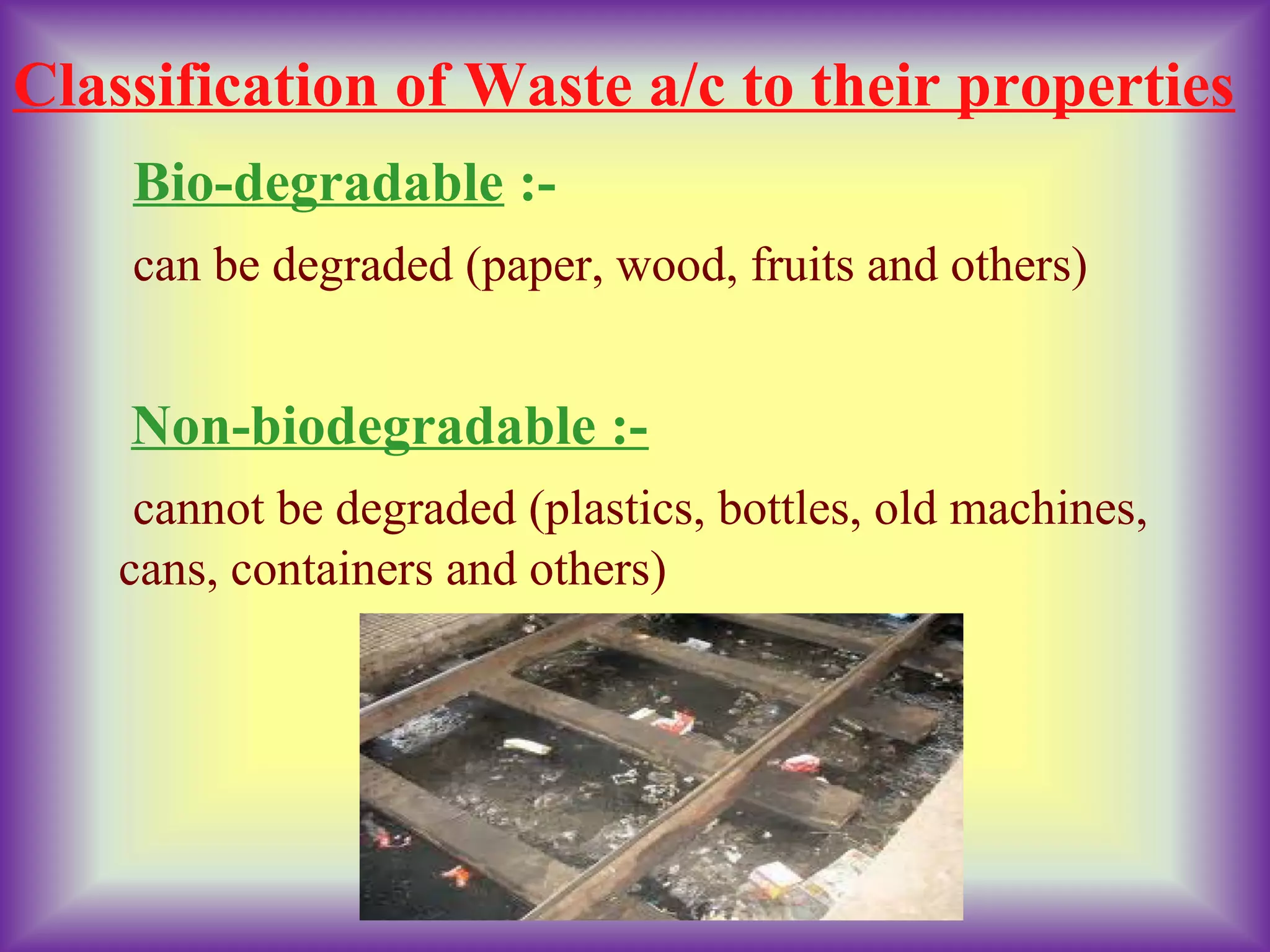
Bio-degradable :-
can be degraded (paper, wood, fruits and others)
Non-biodegradable :-
cannot be degraded (plastics, bottles, old machines,
cans, containers and others)
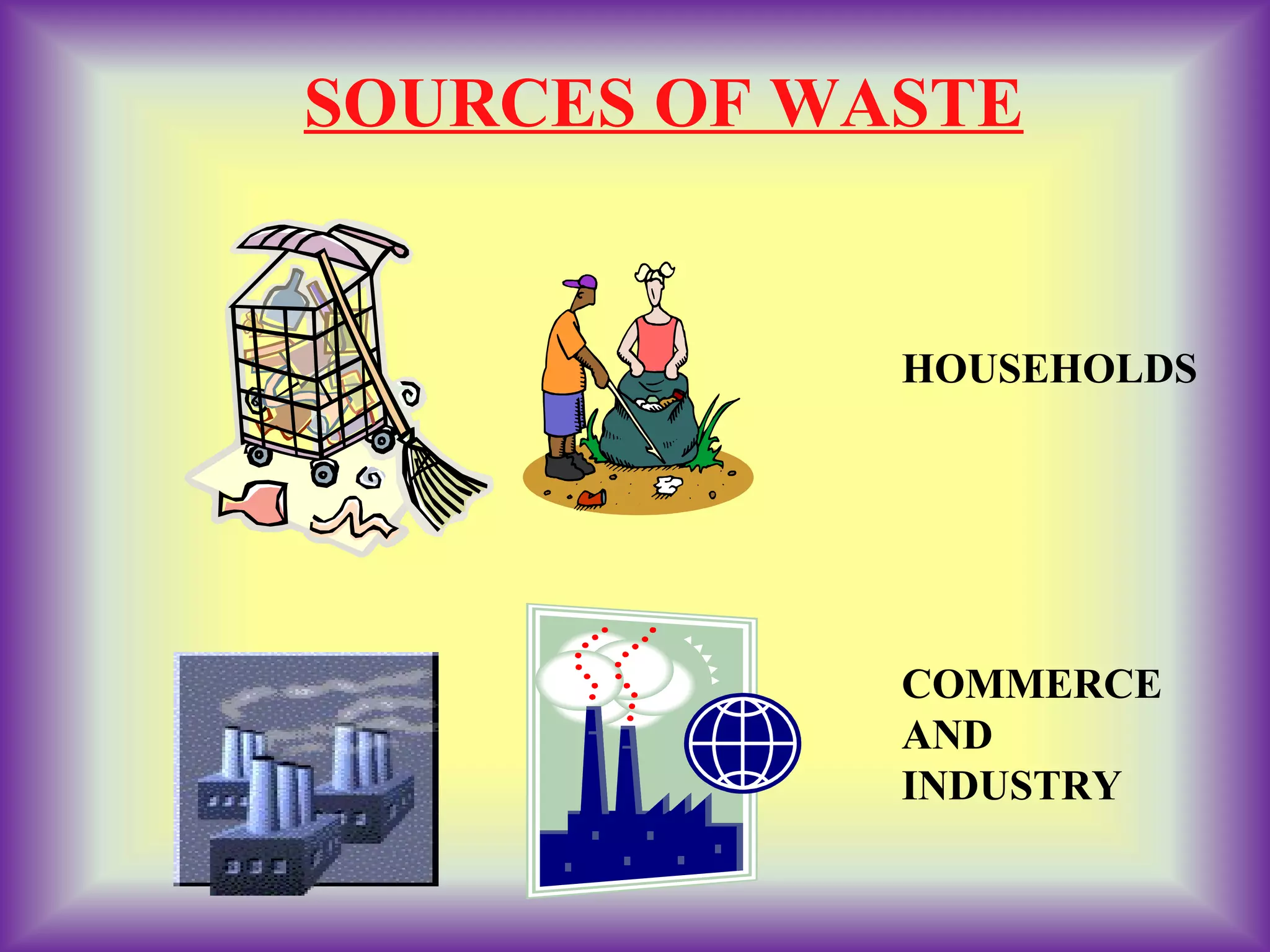
SOURCES OF WASTE
HOUSEHOLDS
COMMERCE
AND
INDUSTRY
SOURCES OF WASTE
Agriculture
Fisheries
Solid Waste in India
• 7.2 million tonnes of hazardous waste
• One Sq. km of additional landfill area every-year
• Rs 1600 crore for treatment & disposal of these wastes
• In addition to this industries discharge about 150 million
tonnes of high volume low hazard waste every year,
which is mostly dumped on open low lying land areas.
Source: Estimate of Ministry of Environment & Forest
Growth of Solid Waste In India
• Waste is growing every year
• In 1981-91, population of Mumbai increased from 8.2
million to 12.3 million
• During the same period, municipal solid waste has grown
from 3200 tonnes to 5355 tonne, an increase of 67%
• Waste collection is very low for all Indian cities
• City like Bangalore produces 2000 tonnes of waste per
annum, the ever increasing waste has put pressure on
hygienic condition of the city
Source: The Energy & Resources Institute, New Delhi
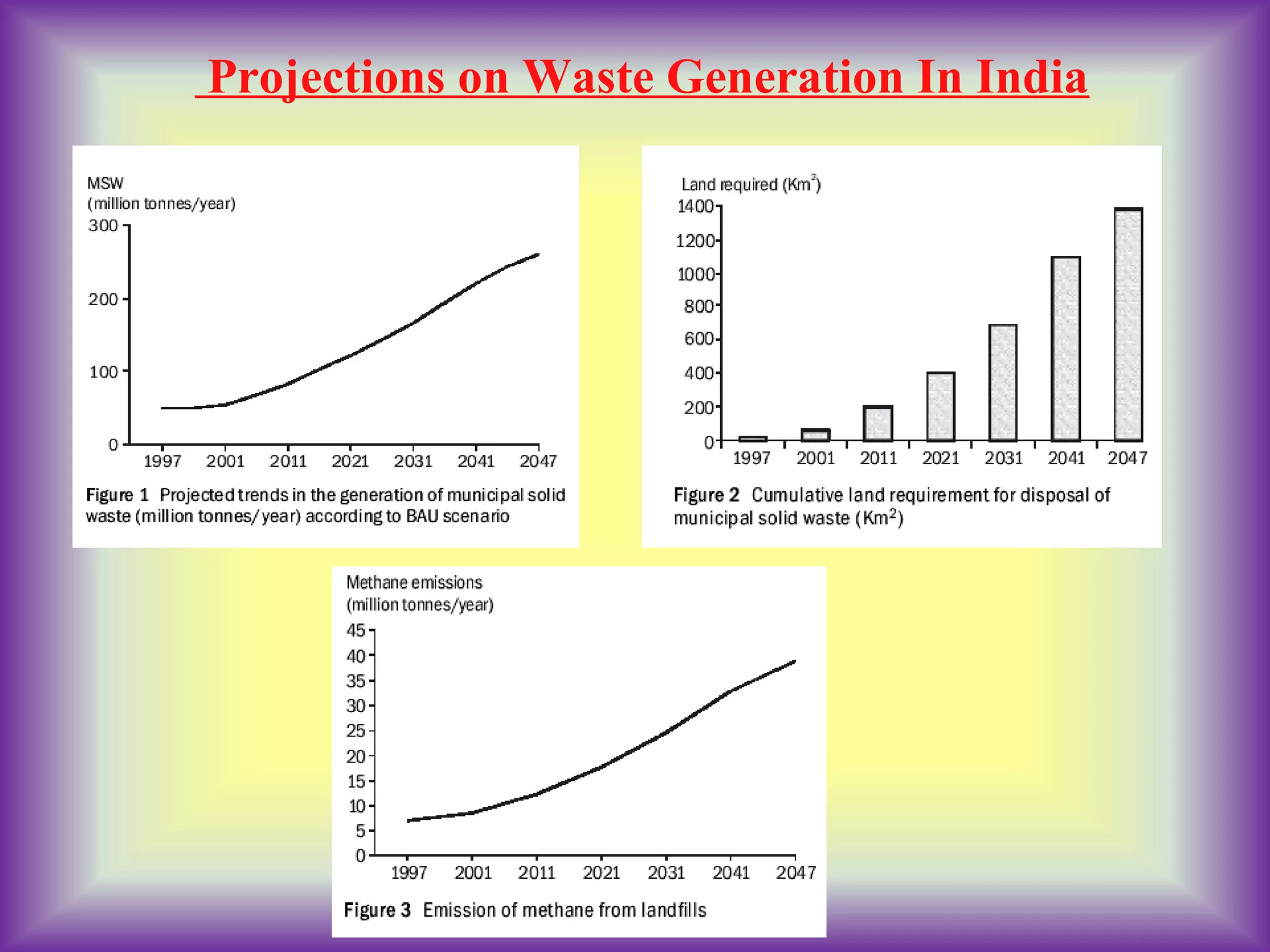
Projections on Waste Generation In India
Waste Collection in India
• Primarily by the city municipality :-
- No gradation of waste product e.g. - bio-degradable,
glasses, polybags, paper shreds etc.
- Dumps these wastes to the city outskirts
• Local raddiwala / kabadiwala (Rag pickers) :-
- Collecting small iron pieces by magnets
- Collecting glass bottles
- Collecting paper for recycling
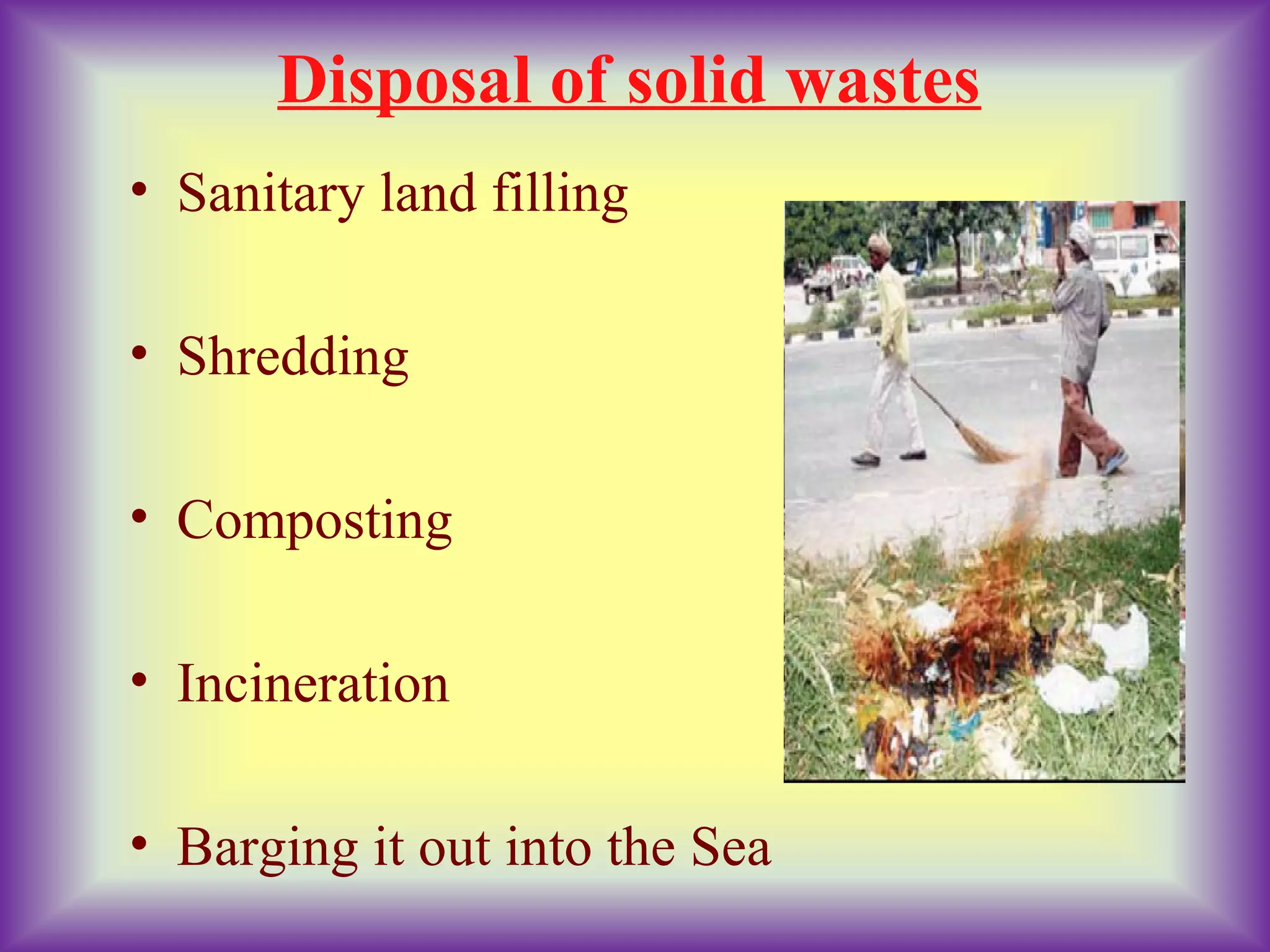
Disposal of solid wastes
• Sanitary land filling
• Shredding
• Composting
• Incineration
• Barging it out into the Sea
Managing Waste
Recycling
Benefits of recycling :-
- Reduce environmental degradation
- Making money out of waste
- Save energy that would have gone into waste handling &
product manufacture
Saving through recycling :-
- Making paper from waste saves 50% energy
- Every tonne of recycled glass saves energy equivalent to
100 litres of oil
Managing Waste
• Reduce Waste :-
- Reduce office paper waste
- Improve product design to use less materials.
- Redesign packaging to eliminate excess material while
maintaining strength.
- Work with customers to design and implement a packaging
return program.
- Switch to reusable transport containers.
Managing Waste
Reuse :-
- Reuse office furniture and supplies, such as interoffice
envelopes, file folders, and paper.
- Use durable towels, tablecloths, napkins, dishes, cups,
and glasses.
- Use incoming packaging materials for outgoing
shipments.
- Encourage employees to reuse office materials rather
than purchase new ones.
Managing Waste
Donate/Exchange :-
- old books
- old clothes
- old computers
- excess building materials
- old equipment to local organizations
Hazardous / Toxic Waste & Dumping Site
• Industrialized countries have waste management
problems
• Developed countries have strict environment
regulation norms
• Most attractive option for them- to dump into
developing countries
Collection & Recycling of Waste Materials
Recycling not a solution to all problems !
- Recycling is not a solution to managing
every kind of waste material
- For many items recycling technologies are
unavailable or unsafe
- In some cases, cost of recycling is too high
Solution : More Profit With Zero Waste
• Exchanging output that are considered waste
• Waste of one could be input or raw material for
others
Problems in Dealing With Solid Waste
• Education
• Collection of waste
• Technological interventions
• Institutions & regulatory framework
• Absence of mandatory standards for waste reduction
• Market action for waste reduction
Source: The Energy & Resources Institute
• Effects our health
• Affects our socio-economics condition
• Affects our costal and marine environment
• Affects our climate
EFFECT OF WASTE IF NOT MANAGED WISELY
Thank You

seminar presentation ppt on solid waste management

  • 1.
    Solid Waste Management GulshanKumar Civil engg. Roll no.-
  • 2.
    What Are Waste? • “ Substances or objects which are disposed of or are intended to be disposed of or are required to be disposed of by the provisions of the law” • Disposal means “Any operation which may lead to resource recovery, recycling, reclamation, direct re-use or alternative uses.”
  • 3.
    Classification • Domestic waste •Factory waste • Waste from oil factory • E-waste • Construction waste • Agricultural waste • Food processing waste • Bio-medical waste • Nuclear waste
  • 4.
  • 5.
    Classification of Wastes •Solid waste- vegetable waste, kitchen waste, household waste etc. • E-waste- discarded electronic devices like computer, TV, music systems etc. • Liquid waste- water used for different industries eg tanneries, distillaries, thermal power plants • Plastic waste- plastic bags, bottles, buckets etc. • Metal waste- unused metal sheet, metal scraps etc. • Nuclear waste- unused materials from nuclear power plants
  • 6.
    Classification of Wastea/c to their properties Bio-degradable :- can be degraded (paper, wood, fruits and others) Non-biodegradable :- cannot be degraded (plastics, bottles, old machines, cans, containers and others)
  • 7.
  • 8.
  • 9.
    Solid Waste inIndia • 7.2 million tonnes of hazardous waste • One Sq. km of additional landfill area every-year • Rs 1600 crore for treatment & disposal of these wastes • In addition to this industries discharge about 150 million tonnes of high volume low hazard waste every year, which is mostly dumped on open low lying land areas. Source: Estimate of Ministry of Environment & Forest
  • 10.
    Growth of SolidWaste In India • Waste is growing every year • In 1981-91, population of Mumbai increased from 8.2 million to 12.3 million • During the same period, municipal solid waste has grown from 3200 tonnes to 5355 tonne, an increase of 67% • Waste collection is very low for all Indian cities • City like Bangalore produces 2000 tonnes of waste per annum, the ever increasing waste has put pressure on hygienic condition of the city Source: The Energy & Resources Institute, New Delhi
  • 11.
    Projections on WasteGeneration In India
  • 12.
    Waste Collection inIndia • Primarily by the city municipality :- - No gradation of waste product e.g. - bio-degradable, glasses, polybags, paper shreds etc. - Dumps these wastes to the city outskirts • Local raddiwala / kabadiwala (Rag pickers) :- - Collecting small iron pieces by magnets - Collecting glass bottles - Collecting paper for recycling
  • 13.
    Disposal of solidwastes • Sanitary land filling • Shredding • Composting • Incineration • Barging it out into the Sea
  • 14.
    Managing Waste Recycling Benefits ofrecycling :- - Reduce environmental degradation - Making money out of waste - Save energy that would have gone into waste handling & product manufacture Saving through recycling :- - Making paper from waste saves 50% energy - Every tonne of recycled glass saves energy equivalent to 100 litres of oil
  • 15.
    Managing Waste • ReduceWaste :- - Reduce office paper waste - Improve product design to use less materials. - Redesign packaging to eliminate excess material while maintaining strength. - Work with customers to design and implement a packaging return program. - Switch to reusable transport containers.
  • 16.
    Managing Waste Reuse :- -Reuse office furniture and supplies, such as interoffice envelopes, file folders, and paper. - Use durable towels, tablecloths, napkins, dishes, cups, and glasses. - Use incoming packaging materials for outgoing shipments. - Encourage employees to reuse office materials rather than purchase new ones.
  • 17.
    Managing Waste Donate/Exchange :- -old books - old clothes - old computers - excess building materials - old equipment to local organizations
  • 18.
    Hazardous / ToxicWaste & Dumping Site • Industrialized countries have waste management problems • Developed countries have strict environment regulation norms • Most attractive option for them- to dump into developing countries
  • 19.
    Collection & Recyclingof Waste Materials
  • 20.
    Recycling not asolution to all problems ! - Recycling is not a solution to managing every kind of waste material - For many items recycling technologies are unavailable or unsafe - In some cases, cost of recycling is too high
  • 21.
    Solution : MoreProfit With Zero Waste • Exchanging output that are considered waste • Waste of one could be input or raw material for others
  • 22.
    Problems in DealingWith Solid Waste • Education • Collection of waste • Technological interventions • Institutions & regulatory framework • Absence of mandatory standards for waste reduction • Market action for waste reduction Source: The Energy & Resources Institute
  • 23.
    • Effects ourhealth • Affects our socio-economics condition • Affects our costal and marine environment • Affects our climate EFFECT OF WASTE IF NOT MANAGED WISELY
  • 24.