3/10/2014
1
Warehouse management
(Manajemen Pergudangan)
Week 5
Storage Fundamentals in Inventory
Strategy4-37
PLANNING
ORGANIZING
CONTROLLING
Transport Strategy
• Transport fundamentals
• Transport decisions
Customer
service goals
• The product
• Logistics service
• Ord . proc. & info. sys.
Inventory Strategy
• Forecasting
• Inventory decisions
• Purchasing and supply
scheduling decisions
• Storage fundamentals
• Storage decisions
Location Strategy
• Location decisions
• The network planning process
PLANNING
ORGANIZING
CONTROLLING
Transport Strategy
• Transport fundamentals
• Transport decisions
Customer
service goals
• The product
• Logistics service
• Ord . proc. & info. sys.
Inventory Strategy
• Forecasting
• Inventory decisions
• Purchasing and supply
scheduling decisions
• Storage fundamentals
• Storage decisions
Location Strategy
• Location decisions
• The network planning process
3/10/2014
2
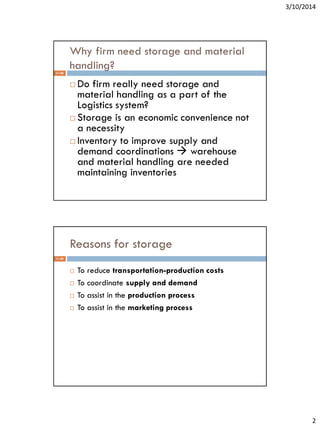
Why firm need storage and material
handling?11-38
 Do firm really need storage and
material handling as a part of the
Logistics system?
 Storage is an economic convenience not
a necessity
 Inventory to improve supply and
demand coordinations  warehouse
and material handling are needed
maintaining inventories
Reasons for storage
11-39
 To reduce transportation-production costs
 To coordinate supply and demand
 To assist in the production process
 To assist in the marketing process
3/10/2014
3
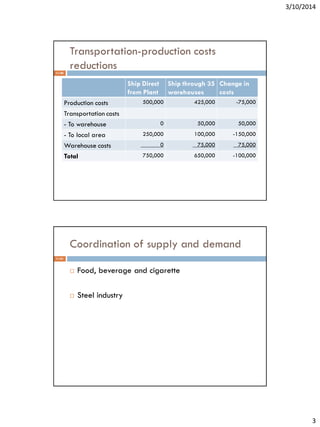
Transportation-production costs
reductions11-40
Ship Direct
from Plant
Ship through 35
warehouses
Change in
costs
Production costs 500,000 425,000 -75,000
Transportation costs
- To warehouse 0 50,000 50,000
- To local area 250,000 100,000 -150,000
Warehouse costs 0 75,000 75,000
Total 750,000 650,000 -100,000
Coordination of supply and demand
 Food, beverage and cigarette
 Steel industry
11-41
3/10/2014
4
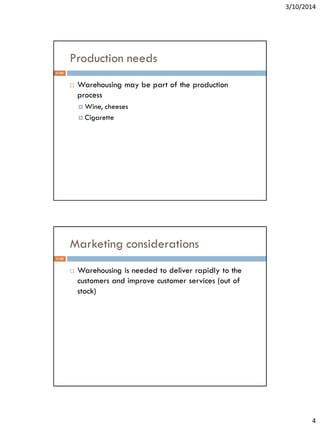
Production needs
 Warehousing may be part of the production
process
 Wine, cheeses
 Cigarette
11-42
Marketing considerations
 Warehousing is needed to deliver rapidly to the
customers and improve customer services (out of
stock)
11-43
3/10/2014
5
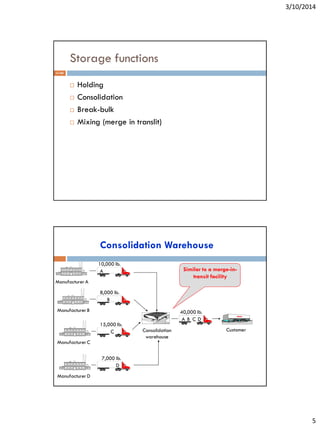
Storage functions
 Holding
 Consolidation
 Break-bulk
 Mixing (merge in translit)
11-44
Consolidation
warehouse
A
A B C D
B
C
D
Manufacturer A
Manufacturer B
Manufacturer C
Manufacturer D
10,000 lb.
8,000 lb.
15,000 lb.
7,000 lb.
40,000 lb.
Customer
Consolidation Warehouse
Similar to a merge-in-
transit facility
3/10/2014
6
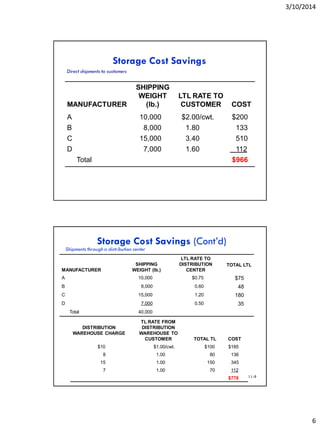
Storage Cost Savings
Direct shipments to customers
MANUFACTURER
SHIPPING
WEIGHT
(lb.)
LTL RATE TO
CUSTOMER COST
A 10,000 $2.00/cwt. $200
B 8,000 1.80 133
C 15,000 3.40 510
D 7,000 1.60 112
Total $966
Storage Cost Savings (Cont’d)
Shipments through a distribution center
MANUFACTURER
SHIPPING
WEIGHT (lb.)
LTL RATE TO
DISTRIBUTION
CENTER
TOTAL LTL
A 10,000 $0.75 $75
B 8,000 0.60 48
C 15,000 1.20 180
D 7,000 0.50 35
Total 40,000
DISTRIBUTION
WAREHOUSE CHARGE
TL RATE FROM
DISTRIBUTION
WAREHOUSE TO
CUSTOMER TOTAL TL COST
$10 $1.00/cwt. $100 $185
8 1.00 80 136
15 1.00 150 345
7 1.00 70 112
$778 11-9
3/10/2014
7
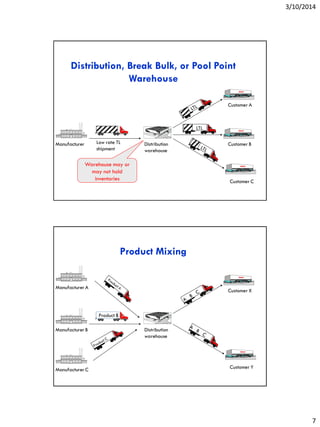
Distribution
warehouse
Manufacturer Customer B
Customer C
Customer A
Low rate TL
shipment
LTL
Distribution, Break Bulk, or Pool Point
Warehouse
Warehouse may or
may not hold
inventories
Distribution
warehouse
Manufacturer B
Customer Y
Customer X
Product B
Product Mixing
Manufacturer A
Manufacturer C
3/10/2014
8
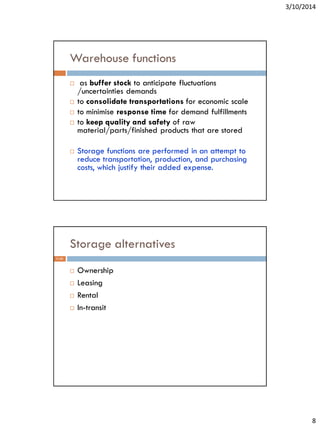
Warehouse functions
 as buffer stock to anticipate fluctuations
/uncertainties demands
 to consolidate transportations for economic scale
 to minimise response time for demand fulfillments
 to keep quality and safety of raw
material/parts/finished products that are stored
 Storage functions are performed in an attempt to
reduce transportation, production, and purchasing
costs, which justify their added expense.
Storage alternatives
 Ownership
 Leasing
 Rental
 In-transit
11-51
3/10/2014
9
Types of Warehouse (types of products)
• raw materials
• finished goods
• supplies
• repair/spare parts
Arnold and Chapman 2008
Types of Warehouse (types of level)
• Main warehouse
 Consumable Item Storage
 Critical item storage
 Cool room
• Secondary warehouse
 Customs Process Storage
 Empty basket storage
 Chemical Storage
 Temporary storage
 Lube oil storage
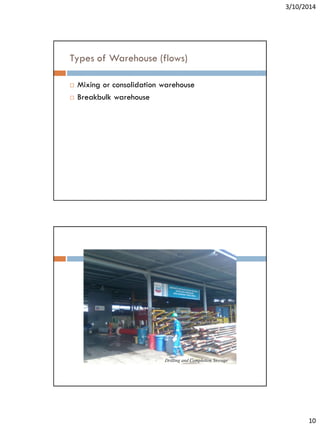
 Drilling and Completion Storage
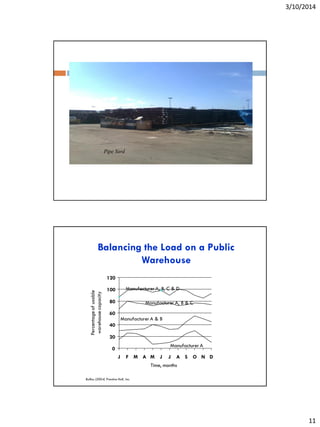
 Pipe yard
Case in oil company
3/10/2014
10
Types of Warehouse (flows)
 Mixing or consolidation warehouse
 Breakbulk warehouse
Drilling and Completion Storage
3/10/2014
11
Pipe Yard
Manufacturer A
Manufacturer A & B
Manufacturer A, B & C
Manufacturer A, B, C & D
Percentageofusable
warehousecapacity
Time, months
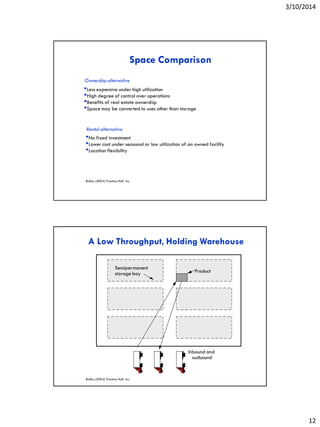
Balancing the Load on a Public
Warehouse
0
20
40
60
80
100
120
J F M A M J J A S O N D
Ballou (2004) Prentice Hall, Inc.
3/10/2014
12
Space Comparison
Ownership alternative
•Less expensive under high utilization
•High degree of control over operations
•Benefits of real estate ownership
•Space may be converted to uses other than storage
Rental alternative
•No fixed investment
•Lower cost under seasonal or low utilization of an owned facility
•Location flexibility
Ballou (2004) Prentice Hall, Inc.
A Low Throughput, Holding Warehouse
Semipermanent
storage bay Product
Inbound and
outbound
3/10/2014
13
Semi-permanent
storage bay
Product
Order picking and product mixing bays
Inbound
Outbound
A
B
C
D
C A
Replenishment
Order-picking
route
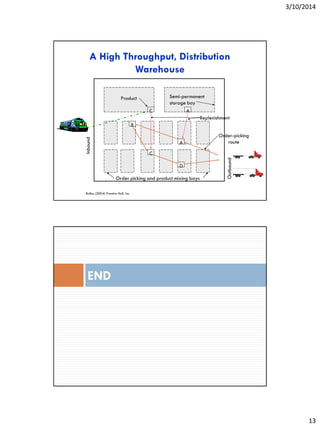
A High Throughput, Distribution
Warehouse
Ballou (2004) Prentice Hall, Inc.
END

warehouse

  • 1.
    3/10/2014 1 Warehouse management (Manajemen Pergudangan) Week5 Storage Fundamentals in Inventory Strategy4-37 PLANNING ORGANIZING CONTROLLING Transport Strategy • Transport fundamentals • Transport decisions Customer service goals • The product • Logistics service • Ord . proc. & info. sys. Inventory Strategy • Forecasting • Inventory decisions • Purchasing and supply scheduling decisions • Storage fundamentals • Storage decisions Location Strategy • Location decisions • The network planning process PLANNING ORGANIZING CONTROLLING Transport Strategy • Transport fundamentals • Transport decisions Customer service goals • The product • Logistics service • Ord . proc. & info. sys. Inventory Strategy • Forecasting • Inventory decisions • Purchasing and supply scheduling decisions • Storage fundamentals • Storage decisions Location Strategy • Location decisions • The network planning process
  • 2.
    3/10/2014 2 Why firm needstorage and material handling?11-38  Do firm really need storage and material handling as a part of the Logistics system?  Storage is an economic convenience not a necessity  Inventory to improve supply and demand coordinations  warehouse and material handling are needed maintaining inventories Reasons for storage 11-39  To reduce transportation-production costs  To coordinate supply and demand  To assist in the production process  To assist in the marketing process
  • 3.
    3/10/2014 3 Transportation-production costs reductions11-40 Ship Direct fromPlant Ship through 35 warehouses Change in costs Production costs 500,000 425,000 -75,000 Transportation costs - To warehouse 0 50,000 50,000 - To local area 250,000 100,000 -150,000 Warehouse costs 0 75,000 75,000 Total 750,000 650,000 -100,000 Coordination of supply and demand  Food, beverage and cigarette  Steel industry 11-41
  • 4.
    3/10/2014 4 Production needs  Warehousingmay be part of the production process  Wine, cheeses  Cigarette 11-42 Marketing considerations  Warehousing is needed to deliver rapidly to the customers and improve customer services (out of stock) 11-43
  • 5.
    3/10/2014 5 Storage functions  Holding Consolidation  Break-bulk  Mixing (merge in translit) 11-44 Consolidation warehouse A A B C D B C D Manufacturer A Manufacturer B Manufacturer C Manufacturer D 10,000 lb. 8,000 lb. 15,000 lb. 7,000 lb. 40,000 lb. Customer Consolidation Warehouse Similar to a merge-in- transit facility
  • 6.
    3/10/2014 6 Storage Cost Savings Directshipments to customers MANUFACTURER SHIPPING WEIGHT (lb.) LTL RATE TO CUSTOMER COST A 10,000 $2.00/cwt. $200 B 8,000 1.80 133 C 15,000 3.40 510 D 7,000 1.60 112 Total $966 Storage Cost Savings (Cont’d) Shipments through a distribution center MANUFACTURER SHIPPING WEIGHT (lb.) LTL RATE TO DISTRIBUTION CENTER TOTAL LTL A 10,000 $0.75 $75 B 8,000 0.60 48 C 15,000 1.20 180 D 7,000 0.50 35 Total 40,000 DISTRIBUTION WAREHOUSE CHARGE TL RATE FROM DISTRIBUTION WAREHOUSE TO CUSTOMER TOTAL TL COST $10 $1.00/cwt. $100 $185 8 1.00 80 136 15 1.00 150 345 7 1.00 70 112 $778 11-9
  • 7.
    3/10/2014 7 Distribution warehouse Manufacturer Customer B CustomerC Customer A Low rate TL shipment LTL Distribution, Break Bulk, or Pool Point Warehouse Warehouse may or may not hold inventories Distribution warehouse Manufacturer B Customer Y Customer X Product B Product Mixing Manufacturer A Manufacturer C
  • 8.
    3/10/2014 8 Warehouse functions  asbuffer stock to anticipate fluctuations /uncertainties demands  to consolidate transportations for economic scale  to minimise response time for demand fulfillments  to keep quality and safety of raw material/parts/finished products that are stored  Storage functions are performed in an attempt to reduce transportation, production, and purchasing costs, which justify their added expense. Storage alternatives  Ownership  Leasing  Rental  In-transit 11-51
  • 9.
    3/10/2014 9 Types of Warehouse(types of products) • raw materials • finished goods • supplies • repair/spare parts Arnold and Chapman 2008 Types of Warehouse (types of level) • Main warehouse  Consumable Item Storage  Critical item storage  Cool room • Secondary warehouse  Customs Process Storage  Empty basket storage  Chemical Storage  Temporary storage  Lube oil storage  Drilling and Completion Storage  Pipe yard Case in oil company
  • 10.
    3/10/2014 10 Types of Warehouse(flows)  Mixing or consolidation warehouse  Breakbulk warehouse Drilling and Completion Storage
  • 11.
    3/10/2014 11 Pipe Yard Manufacturer A ManufacturerA & B Manufacturer A, B & C Manufacturer A, B, C & D Percentageofusable warehousecapacity Time, months Balancing the Load on a Public Warehouse 0 20 40 60 80 100 120 J F M A M J J A S O N D Ballou (2004) Prentice Hall, Inc.
  • 12.
    3/10/2014 12 Space Comparison Ownership alternative •Lessexpensive under high utilization •High degree of control over operations •Benefits of real estate ownership •Space may be converted to uses other than storage Rental alternative •No fixed investment •Lower cost under seasonal or low utilization of an owned facility •Location flexibility Ballou (2004) Prentice Hall, Inc. Ballou (2004) Prentice Hall, Inc. A Low Throughput, Holding Warehouse Semipermanent storage bay Product Inbound and outbound
  • 13.
    3/10/2014 13 Semi-permanent storage bay Product Order pickingand product mixing bays Inbound Outbound A B C D C A Replenishment Order-picking route A High Throughput, Distribution Warehouse Ballou (2004) Prentice Hall, Inc. END