Warehouse Management
Is it only a storage facility?
 A warehouse is typically viewed as a place to
  store inventory.

 However, in many logistical system designs,
  the role of the warehouse is more properly
  viewed as a switching facility as contrasted
  to a storage facility.


                                                  2
Benefits of Warehousing
Consolidation
 Shipment consolidation is an economic benefit of
  warehousing.
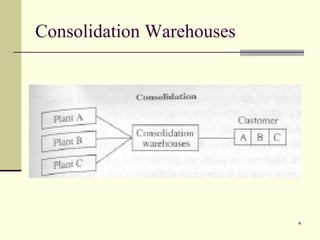
 With this arrangement, the consolidating warehouse
  receives and consolidates materials from a number of
  manufacturing plants destined to a specific customer
  on a single transportation shipment.
 The benefits are the realization of the lowest possible
  transportation rate and reduced congestion at a
  customer's receiving dock.


                                                        3
Consolidation Warehouses


                           4
Consolidation Warehouses…
 The primary benefit of consolidation is that it
  combines the logistical flow of several small
  shipments to a specific market area.

 Consolidation warehousing may be used by a single
  firm, or a number of firms may join together and use
  a for-hire consolidation service.

 Through the use of such a program, each individual
  manufacturer or shipper can enjoy lower total
  distribution cost than could be realized on a direct
  shipment basis individually.
                                                         5
Break bulk warehouses
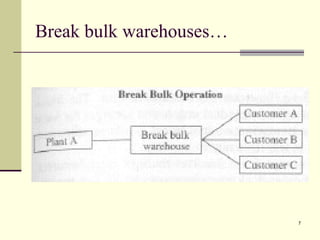
 Break bulk warehouse operations are similar to
  consolidation except that no storage is performed.
 A break bulk operation receives combined customer
  orders from manufacturers and ships them to
  individual customers.
 The break bulk warehouse sorts or splits individual
  orders and arranges for local delivery.
 Because the long-distance transportation movement
  is a large shipment, transport costs are lower and
  there is less difficulty in tracking.


                                                        6
Break bulk warehouses…


                         7
Processing/Postponement
 Warehouses can also be used to postpone, or delay,
  production by performing processing and light
  manufacturing activities.

 A warehouse with packaging or labeling capability
  allows postponement of final production until actual
  demand is known.

 For example, vegetables can be processed and
  canned in "brights" at the manufacturer.

 Brights are cans with no pre-attached labels.
                                                         8
Processing/Postponement…
 The use of brights for a private label product
  means that the item does not have to be
  committed to a specific customer or package
  configuration at the manufacturer's plant.

 Once a specific customer order is received,
  the warehouse can complete final processing
  by adding the label and finalizing the
  packaging.

                                                   9
Processing/Postponement…
 Processing and postponement provide two economic
  benefits:

 First, risk is minimized because final packaging is not
  completed until an order for a specific label and
  package has been received.

 Second, the required level of total inventory can be
  reduced by using the basic product (brights) for a
  variety of labeling and packaging configurations.

                                                         10
Stockpiling
 The economic benefit of stockpiling comes from the
    need of seasonal storage.
   For example, lawn furniture and toys are produced
    year-round and primarily sold during a very short
    marketing period.
   In contrast, agricultural products are harvested at
    specific times with subsequent consumption
    occurring throughout the year.
   Both situations require warehouse stockpiling to
    support marketing efforts.
   Stockpiling provides an inventory buffer, which allows
    production efficiencies within the constraints imposed
    by material sources and the customer.

                                                         11
Service Benefits
 Five basic service benefits are achieved
  through warehousing:
     spot stock,
     assortment,
     mixing,
     production support, and
     market presence.


                                             12
Spot Stock
 Under spot stocking, a selected amount of a firm's
  product line is placed or "spot stocked" in a
  warehouse to fill customer orders during a critical
  marketing period.
 In particular, manufacturers with limited or highly
  seasonal product lines are partial to this service.

 Rather than placing inventories in warehouse
  facilities on a year-round basis or shipping directly
  from manufacturing plants, delivery time can be
  substantially reduced by advanced inventory
  commitment to strategic markets.

                                                          13
Spot Stock…
 Utilizing warehouse facilities for stock spotting allows
  inventories to be placed in a variety of markets
  adjacent to key customers just prior to a maximum
  period of seasonal sales.
 Suppliers of agricultural products to farmers often use
  spot stocking to position their products closer to a
  service-sensitive market during the growing season.

 Following the sales season, the remaining inventory
  is withdrawn to a central warehouse.
                                                         14
Assortment
 An assortment warehouse stocks product
  combinations in anticipation of customer orders.
 The assortments may represent multiple products
  from different manufacturers or special assortments
  as specified by customers.
 In the first case, for example, an athletic wholesaler
  would stock products from a number of clothing
  suppliers so that customers can be offered
  assortments.
 In the second case, the wholesaler would create a
  specific team uniform including shirt, pants, and
  shoes.
                                                           15
Assortment vs. Spot Stock
 The differential between stock spotting and complete
  line assortment is the degree and duration of
  warehouse utilization.
 A firm following a stock spotting would typically
  warehouse a narrow product assortment and place
  stocks in a large number of small warehouses
  dedicated to specific markets for a limited time
  period.
 Distribution assortment warehouse usually has a
  broad product line, is limited to a few strategic
  locations, and is functional year-round.
 The combined assortments also allow larger
  shipment quantities, which in turn reduce
  transportation cost.
                                                      16
Mixing
 In a typical mixing situation, truckloads of products
  are shipped from manufacturing plants to
  warehouses.
 Each large shipment enjoys the lowest possible
  transportation rate.
 Upon arrival at the mixing warehouse, factory
  shipments are unloaded and the desired
  combination of each product for each customer or
  market is selected.
 When plants are geographically separated, overall
  transportation charges and warehouse requirements
  can be reduced by mixing.

                                                          17
Production Support
 Production support warehousing provides a steady
  supply of components and materials to assembly
  plants.

 Safety stocks on items purchased from outside
  vendors may be justified because of long lead times
  or significant variations in usage.

 The operation of a production support warehouse is
  to supply or "feed" processed materials, components,
  and subassemblies into the assembly plant in an
  economic and timely manner.
                                                        18
Market Presence
 While a market presence benefit may not be so
  obvious, it is often cited by marketing managers as a
  major advantage of local warehouses.

 The market presence factor is based on the
  perception or belief that local warehouses can be
  more responsive to customer needs and offer quicker
  delivery than more distant warehouses.

 As a result, it is also thought that a local warehouse
  will enhance market share and potentially increase
  profitability.
                                                           19
Warehouse Operating Principles
 Once it has been determined to use a
  warehouse, the next step is designing it.
 Whether the warehouse is a small manual
  operation or a large automated facility, the
  following three principles are relevant:
      Design criteria,
      Handling technology, and
      Storage plan.


                                                 20
Design Criteria
 Warehouse design criteria address physical
  facility characteristics and product movement.
 Three factors to be considered in the design
  process are:
     the number of stories in the facility,
     height utilization, and
     product flow.


                                               21
Number of stories in the facility
 The ideal warehouse design is limited to a single
  story so that product does not have to be moved up
  and down.
 The use of elevators to move product from one floor
  to the next requires time and energy.
 The elevator is also often a bottleneck in product flow
  since many material handlers are usually competing
  for a limited number of elevators.
 While it is not always possible, particularly in central
  business districts where land is restricted or
  expensive, warehouses should be limited to a single
  story.

                                                         22
Height utilization
 Regardless of facility size, the design should
  maximize the usage of the available cubic space by
  allowing for the greatest use of height on each floor.
 Most warehouses have 20- to 30-foot ceilings,
  although modern automated and high-rise facilities
  can effectively use ceiling heights up to 100 feet.
 Through the use of racking or other hardware, it
  should be possible to store products up to the
  building's ceiling.
 Maximum effective warehouse height is limited by the
  safe lifting capabilities of material-handling
  equipment, such as forklifts.


                                                       23
Product flow
 Warehouse design should also allow for straight
  product flow through the facility whether items are
  stored or not.

 In general, this means that product should be
  received at one end of the building, stored in the
  middle, and then shipped from the other end.

 Straight-line product flow minimizes congestion and
  confusion.

                                                        24
Handling technology

 The second principle focuses on the
  effectiveness and efficiency of material-
  handling technology.

 The elements of this principle concern:
     movement continuity and
     movement scale economies.


                                              25
Movement continuity
 Movement continuity means that it is better for a
  material handler or piece of handling equipment to
  make a longer move than to have a number of
  handlers make numerous, individual, short segments
  of the same move.

 Exchanging the product between handlers or moving
  it from one piece of equipment to another wastes
  time and increases the potential for damage.

 Thus, as a general rule, fewer longer movements in
  the warehouse are preferred.
                                                       26
Movement scale economies
 Movement scale economies imply that all warehouse
  activities should handle or move the largest quantities
  possible.
 Instead of moving individual cases, warehouse
  activities should be designed to move groups of
  cases such as pallets or containers.
 This grouping or batching might mean that multiple
  products or orders must be moved or selected at the
  same time.
 While this might increase the complexity of an
  individual's activities since multiple products or orders
  must be considered, the principle reduces the
  number of activities and the resulting cost.

                                                          27
Storage Plan
 According to the third principle, a warehouse design
    should consider product characteristics, particularly
    those pertaining to volume, weight, and storage.
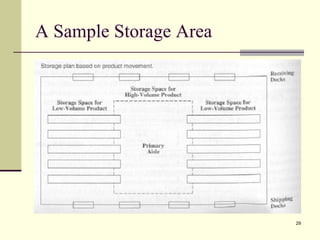
   Product volume is the major concern when defining a
    warehouse storage plan.
   High-volume sales or throughput product should be
    stored in a location that minimizes the distance it is
    moved, such as near primary aisles and in low
    storage racks.
   Such a location minimizes travel distance and the
    need for extended lifting.
   Conversely, low-volume product can be assigned
    locations that are distant from primary aisles or
    higher up in storage racks.
                                                         28
A Sample Storage Area


                        29
Storage Plan…
 Similarly, the plan should include a specific strategy
    for products dependent on weight and storage
    characteristics.
   Relatively heavy items should be assigned to
    locations low to the ground to minimize the effort and
    risk of heavy lifting.
   Bulky or low-density products require extensive
    storage volume, so open floor space or high-level
    racks can be used for them.
   On the other hand, smaller items may require storage
    shelves or drawers.
   The integrated storage plan must consider and
    address the specific characteristics of each product.

                                                           30
Alternative Warehouse Strategies
 Warehouse alternatives include:
    (1) Private warehouses,
    (2) Public warehouses, and
    (3) Contract warehouses.
 A private warehouse facility is owned and managed
  by the same enterprise that owns the merchandise
  handled and stored at the facility.
 A public warehouse, in contrast, is operated as an
  independent business offering a range of services
  -such as storage, handling, and transportation- on the
  basis of a fixed or variable fee.
  Public warehouse operators generally offer relatively
  standardized services to all clients.

                                                       31
Alternative Warehouse Strategies...
 Contract warehousing, which is evolving from the public
  warehouse segment, provides benefits of both the private
  and public alternatives.

  Contract warehousing is a long term, mutually beneficial
  arrangement which provides unique and specially tailored
  warehousing and logistics services exclusively to one
  client, where the vendor and client share the risks
  associated with the operation.

 Important dimensions that differentiate contract
  warehousing operators from public warehouse operators
  are the extended time frame of the service
  relationship, tailored services, exclusivity, and shared
  risk.                                                   32
Private Warehouses
 A private warehouse is operated by the firm owning
  the product.

 The actual facility, however, may be owned or
  leased.

 The decision as to which strategy best fits an
  individual firm is essentially financial.

 Often it is not possible to find a warehouse for lease
  that fits the exact requirements of a firm.

                                                           33
Private Warehouses…
 The major benefits of private warehousing include
  control, flexibility, cost, and other intangible benefits.

 Private warehouses provide more control since the
  enterprise has absolute decision-making authority
  over all activities and priorities in the facility.

 This control facilitates the ability to integrate
  warehouse operations with the rest of the firm's
  internal logistics process.

                                                               34
Private Warehouses…
 Private warehousing is usually considered less costly
    than public warehousing because private facility costs
    do not have a profit markup.
   This perceived benefit, however, may be misleading
    since public warehouses often are more efficient or
    may operate at lower wage scales.
   Private warehousing has also some intangible
    benefits, particularly with respect to market presence.
   A private warehouse with a firm's name on it may
    produce customer perceptions of responsiveness and
    stability.
   This perception sometimes provides a firm with a
    marketing advantage over other enterprises.

                                                         35
Public Warehouses
 On the basis of the range of specialized operations
  performed, public warehouses are classified as

      (1) general merchandise,
      (2) refrigerated,
      (3) special commodity,
      (4) bonded, and
      (5) household goods and furniture.

 Each warehouse type differs in its material handling
  and storage technology as a result of the product and
  environmental characteristics.
                                                         36
Public Warehouses…
 General merchandise warehouses are designed to
  handIe general package commodities such as paper,
  small appliances, and household supplies.

 Refrigerated warehouses (either frozen or chilled)
  handle and maintain food, medical items, and
  chemical products with special temperature
  requirements.

 Commodity warehouses are designed to handle
  bulk material or items with special handling
  considerations, such as tires or clothing.
                                                       37
Public Warehouses…
 Bonded warehouses are licensed by the
  government to store goods prior to payment of taxes
  or duties.
 They exert very tight control over all movements in
  and out of the facility since government documents
  must be filed with each move.

 For example, cigarettes are often stored in bonded
  warehouses prior to having the tax stamp applied.
 This tactic saves the firm money by delaying tax
  payments; it also reduces inventory value
  substantially.
                                                       38
Public Warehouses…

 Finally, a household goods or furniture
  warehouse is designed to handle and store
  large, bulky items such as appliances and
  furniture.

 Of course, many public warehouses offer
  combinations of these operations.


                                              39
Public Warehouses…
 From a financial perspective, public warehousing may
  have a lower variable cost than comparable privately
  operated facilities.
 The lower variable cost may be the result of lower
  pay scales, better productivity, or economy of scale.
 Public warehouses certainly result in lower capital
  costs.
 When management performance is judged according
  to return on investment (ROI), the use of public
  warehousing can substantially increase enterprise
  return.
                                                      40
Public Warehouses…
 Public warehousing offers flexibility in that it is easy
  to change the location, size, and number of facilities,
  allowing a firm to quickly respond to supplier,
  customer, and seasonal demands.
 Private warehouses are relatively fixed and difficult to
  change because buildings have to be constructed or
  sold.
 Public warehousing can also offer significant scale
  economies since the volume for each customer is
  leveraged with that of other users.
 This results in high-volume operations that can
  spread fixed costs and justify more efficient handling
  equipment.

                                                             41
Public Warehouses…
 A public warehouse can also leverage
  transportation by providing delivery of loads
  that represent many public warehouse
  customers.

 For example, rather than have vendor A and
  vendor B each deliver to a retail store from
  their own warehouse, a public warehouse
  serving both vendors could deliver a single
  combined load more efficiently.

                                                  42
Public Warehouses…
 A public warehouse charges clients a basic fee for
    handling and storage.
   In the case of handling, the charge is based on the
    number of cases or kgs handled.
   For storage, the charge is assessed on the number
    of cases or weight in storage during the month.
   Such charges normally exceed the cost of private
    warehousing if adequate private facility volume
    exists.
   However, when economies of scale are not possible
    in a private facility, public warehousing may be a low-
    cost alternative.
                                                          43
Contract Warehouses
 Contract warehousing combines the best
  characteristics of both private and public operations.

 The long-term relationship and shared risk result in
  lower cost than typical public warehouse
  arrangements.

 Contract warehouse operations can provide benefits
  of expertise, flexibility, and economies of scale by
  sharing management, labor, equipment, and
  information resources across a number of clients.
                                                           44
Contract Warehouses…
 Although it is common for contract warehouse
  operators to share resources across clients in the
  same industry such as grocery products, it is not
  common that direct competitors will want to share
  resources.

 Contract warehouse operators are also expanding
  the scope of their services to include other logistics
  activities such as transportation, inventory control,
  order processing, customer service, and returns
  processing.

                                                           45
Contract Warehouses…
 For example, Rich Products, a frozen food
  manufacturer in Buffalo, New York, has increasingly
  utilized contract warehousing.

 Since 1992, Rich has had a long term commitment
  with a refrigerated warehousing and distribution
  company, Christian Salvesen, for storage, handling,
  and distribution services at its facilities in New York.

 The nature of the arrangement benefits both parties
  and allows Rich to expand its distribution network
  without incurring any fixed facility cost.
                                                             46
Contract Warehouses…
 Rich is assured that there will always be storage
  space for its products.

 Christian Salvesen doesn't have to be concerned with
  filling space in its warehouses and can focus on
  providing service.

 Moreover, the longer Rich Products utilizes Christian
  Salvesen's services, the better the contract
  warehousing firm will be able to understand Rich's
  business needs and provide customized services.
                                                          47
Warehousing Strategy
 Many firms utilize a combination of private, public,
  and contract facilities.
 A private or contract facility may be used to cover
  basic year round requirements, while public facilities
  are used to handle peak seasons.
 In other situations, central warehouses may be
  private, while market area or field warehouses are
  public facilities.

 Each use of warehouse combinations will be
  discussed now.
                                                           48
Warehousing Strategy…
 Full warehouse utilization throughout a year is a
  remote possibility.
 As a planning rule, a warehouse designed for full-
  capacity utilization will in fact be fully utilized between
  75 and 85 percent of the time.
 Thus from 15 to 25 percent of the time, the space
  needed to meet peak requirements is not utilized.
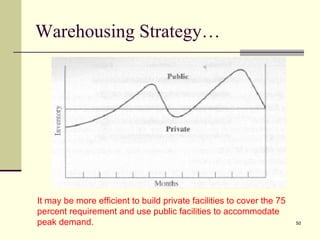
 In such situations, it may be more efficient to build
  private facilities to cover the 75 percent requirement
  and use public facilities to accommodate peak
  demand.
                                                            49
Warehousing Strategy…


It may be more efficient to build private facilities to cover the 75
percent requirement and use public facilities to accommodate
peak demand.                                                           50
Warehousing Strategy…
 The second form of combined public warehousing
  may result from market requirements.

 A firm may find that private warehousing is justified at
  specific locations on the basis of distribution volume.

 In other markets, public facilities may be the least-
  cost option.

 In logistical system design the objective is to
  determine whatever combination of warehouse
  strategies most economically meets customer service
  objectives.
                                                            51
Warehousing Strategy…
 An integrated warehouse strategy focuses on two
  questions.
 The first concerns how many warehouses should be
  employed.
 The second question concerns which warehouse
  types should be used to meet market requirements.

 For many firms, the answer is a combination that can
  be differentiated by customer and product.
 Specifically, some customer groups may be served
  best from a private warehouse, while a public
  warehouse may be appropriate for others.
                                                     52
Warehousing Strategy…
Other qualitative factors that should be considered
  include:

   (1) presence synergies,
   (2) industry synergies,
   (3) operating flexibility,
   (4) location flexibility, and
   (5) scale economies.


Each consideration and its rationale will be discussed.

                                                          53
Presence synergies
 Presence synergies refer to the marketing benefits
  of having inventory located nearby in a building that
  is clearly affiliated with the enterprise (e.g., the
  building has the firm's name on the door).

 It is widely thought that customers are more
  comfortable when suppliers maintain inventory in
  nearby locations.

 Products and customers that benefit from local
  presence should be served from private or contract
  facilities.
                                                          54
Industry synergies
 Industry synergies refer to the operating benefits of
  combining with other firms serving the same industry.

 For example, firms in the grocery business often
  receive substantial benefits when they share public
  warehouse facilities with other suppliers serving the
  same industry.
 Reduced transportation cost is the major benefit
  since joint use of the same public warehouse allows
  frequent delivery of consolidated loads from multiple
  suppliers.
 Public and contract warehousing increase the
  potential for industry synergy.

                                                          55
Operating flexibility
 Operating flexibility refers to the ability to adjust
  internal policies and procedures to meet product and
  customer needs.

 Since private warehouses operate under the
  complete control of the enterprise, they are usually
  perceived to demonstrate more operating flexibility.
 On the other hand, a public warehouse often employs
  policies and procedures that are consistent across its
  clients to minimize operating confusion.
 There are many public and contract warehouse
  operations that have demonstrated substantial
  flexibility and responsiveness.

                                                          56
Location flexibility
 Location flexibility refers to the ability to quickly
  adjust warehouse location and number in accordance
  with seasonal or permanent demand changes.

 For example, in-season demand for agricultural
  chemicals requires that warehouses be located near
  markets that allow customer pickup.
 Outside the growing season, however, these local
  warehouses are unnecessary.
 Thus, the desirable strategy is to be able to open and
  close local facilities seasonally.
 Public and contract warehouses offer the location
  flexibility to accomplish such requirements.

                                                          57
Scale economies
 Scale economies refer to the ability to reduce
  material-handling and storage through application of
  advanced technologies.

 High-volume warehouses generally have greater
  opportunity to achieve these benefits because they can
  spread technology's fixed cost over larger volumes.
 In addition, capital investment in automated equipment
  can reduce direct variable cost.
 Public and contract warehouses are generally
  perceived to offer better scale economies since they
  are able to design operations and facilities to meet
  higher volumes of multiple clients.
                                                         58
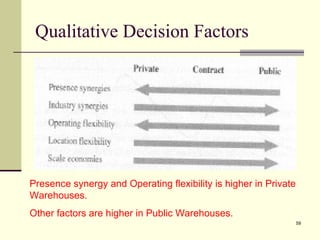
Qualitative Decision Factors


Presence synergy and Operating flexibility is higher in Private
Warehouses.
Other factors are higher in Public Warehouses.
                                                                  59
Planning the Distribution Warehouse
 The initial decisions of warehousing are related to
  planning.

 A master plan of the layout, space requirements, and
  material-handling design should be developed first
  and a specific site for the warehouse selected.

 These decisions establish the character of the
  warehouse, which, in turn determines the degree of
  attainable handling efficiency.

                                                        60
Site Selection
 Location analysis techniques are available to assist in
  selecting a general area for warehouse location.
 Once location analysis is completed, a specific
  building site must be selected.
 Three areas in a community may be considered for
  location:
      1) commercial zones, 2) outlying areas served by
       motor truck only, and 3) central or downtown areas.
 The primary factors in site selection are the
  availability of services and cost.
 The cost of procurement is the most important factor
  governing site selection.
                                                             61
Site Selection…
 A warehouse need not be located in a major
  industrial area.

 In many cities, one observes warehouses among
  industrial plants and in areas zoned for light or heavy
  industry.

 Interestingly, this is not a legal necessity because
  most warehouses can operate under the restrictions
  placed on commercial property.

                                                         62
Site Selection…
 Beyond procurement cost, setup and operating
  expenses such as rail sidings, utility expenses, taxes,
  insurance rates, and highway access require
  evaluation.
 These expenses vary between sites.


 For example, a food distribution firm recently rejected
  what otherwise appeared to be a totally satisfactory
  site because of insurance rates.

 The site was located near the end of a water main.
                                                         63
Site Selection…
 During most of the day, adequate water supplies
  were available to handle operational and emergency
  requirements.
 The only possible water problem occurred during two
  short periods each day.
 From 6:30 to 8:30 in the morning and from 5 to 7 in
  the evening, the demand for water along the line was
  so great that a sufficient supply was not available to
  handle emergencies.
 Because of this deficiency, abnormally high insurance
  rates were required and the site was rejected.


                                                      64
Site Selection…
 Several other requirements must be satisfied
  before a site is purchased.
 The location must offer adequate room for
  expansion.
 Necessary utilities must be available.
 The soil must be capable of supporting the
  structure, and the site must be sufficiently
  high to afford proper drainage.


                                                 65
Product-Mix Considerations
 The design and operation of a warehouse are related
  directly to the character of the product mix.

 Each product should be analyzed in terms of annual sales,
  stability of demand, weight, and packaging.

 It is also desirable to determine the total size and weight
  of the average order processed through the warehouse.

 These data provide necessary information for determining
  requirements in warehouse space, design and layout,
  material-handling equipment operating procedures, and
  controls.
                                                                66
Expansion
 Future expansion is often neglected when an
  enterprise consider initial establishment of its
  warehouse facilities.
 Inclusion of a warehouse into the logistical system
  should be based partially on estimated requirements
  for future operations.
 Well-managed organizations often establish five- to
  ten-year expansion plans.
 Such expansion considerations may require purchase
  or option of a site three to five times the size of the
  initial structure.
                                                       67
Expansion…
 Special construction is often considered to
  ease expansion without seriously affecting
  normal operations.

 Some walls may be constructed of semi-
  permanent materials to allow easy removal.

 Floor areas, designed to support heavy
  movements, are extended to these walls in a
  manner that facilitates expansion.
                                                68
Selection of Material-Handling System
 A material-handling system is one of the initial
  considerations of warehouse planning.

 Movement is the main function within a warehouse.

 Consequently, the warehouse is viewed as a
  structure designed to facilitate maximum product
  flow.

 It is important to stress that the material-handling
  system should be selected early in the warehouse
  design stage.
                                                         69
Warehouse Layout
 Layout of a warehouse depends on the proposed
  material handling system and requires development
  of a floor plan to facilitate product flow.

 It is difficult to generalize about warehouse layouts
  since they must be refined to fit specific needs.

 If pallets are to be utilized, the first step is to
  determine the pallet size.
 A pallet of nonstandard size may be desirable for
  specialized products, but whenever possible,
  standardized pallets should be used because of their
  lower cost.

                                                          70
Warehouse Layout…
 The most common sizes are 40 by 48 inches and 32
  by 40 inches.

 In general, the larger the pallet load, the lower the
  cost of movement per package over a given distance.

 The packages to be placed on the pallet and the
  related patterns will determine, to a certain extent,
  the size of pallet best suited to the operation.

 Regardless of the size finally selected, management
  should adopt one size for the total operation.
                                                          71
Warehouse Layout…
 The second step in planning a layout involves the
  pallet positioning.

 The basic method of positioning pallets in a
  mechanized warehouse is a ninety-degree, or
  square, placement.

 Square placement means that the pallet is positioned
  perpendicular to the aisle.

 The square method is widely used because of layout
  ease.
                                                       72
Pilferage Protection
 Protection against theft of merchandise has become
  a major factor in warehouse operations.
 Such protection is required as a result of the
  increased vulnerability of firms to riots and civil
  disturbances.
 All normal precautions employed throughout the
  enterprise should be strictly enforced at each
  warehouse.

 Security begins at the fence.
 As standard procedure, only authorized personnel
  should be permitted into the facility and surrounding
  grounds and entry to the warehouse yard should be
  controlled through a single gate.
                                                          73
Pilferage Protection…
 Without exception, no private automobile-regardless
  of management rank or customer status-should be
  allowed to penetrate the yard adjacent to the
  warehouse.

 To illustrate the importance of the stated guidelines,
  the following actual experience may be helpful.
 A particular firm enforced the rule that no private
  vehicles should be permitted in the warehouse yard.
 Exceptions were made for two handicapped office
  employees.
                                                           74
Pilferage Protection…
 One night after work, one of these employees
  accidentally discovered a bundle taped under one
  fender of his car.

 Subsequent checking revealed that the car was
  literally a delivery truck.
 The matter was promptly reported to security, which
  informed the employee not to alter any packages
  taped to the car and to continue parking inside the
  yard.
 Over the next several days, the situation was fully
  uncovered, with the ultimate arrest and conviction of
  several warehouse employees who confessed to
  stealing over $100,000 of company merchandise.
                                                          75
Pilferage Protection…
 The firm would have been better off purchasing a
  small vehicle to provide transportation for the
  handicapped employees from the regular parking lots
  to the office.

 Shortages are always a major consideration in
  warehouse operations.
 Many are honest mistakes in order selection and
  shipment, but the purpose of security is to restrict
  theft from all angles.

 The majority of thefts occur during normal working
  hours.

                                                         76
Pilferage Protection…
 Computerized inventory control and order processing
  systems help protect merchandise from being carried
  out of the warehouse doors.

 No items should be released from the warehouse
  unless accompanied by a computer release
  document.

 If samples are authorized for use by salespersons,
  the merchandise should be separate from other
  inventory.
                                                       77
Pilferage Protection…
 Not all pilferage occurs on an individual basis.

 Numerous instances have been discovered where
  organized efforts between warehouse personnel and
  truck drivers resulted in deliberate over-picking or
  high-for-low-value product substitution in order to
  move unauthorized merchandise out of the
  warehouse.

 Employee rotation, total case counts, and occasional
  complete line-item checks can reduce vulnerability to
  such collaboration.
                                                         78
Product Deterioration
 Within the warehouse, a number of factors can
  reduce a product or material to a non-usable or non-
  marketable state.

 The most obvious form of product deterioration is
  damage from careless transfer or storage.

 Another major form of deterioration is non-
  compatibility of products stored in the same facility.


                                                           79
Product Deterioration…
 The primary concern is deterioration that results from
  improper warehouse work procedures.

 A constant concern is the carelessness of warehouse
  employees.

 In this respect, the forklift truck may well be
  management's worst enemy.

 Regardless of how often operators are warned
  against carrying overloads, some still attempt such
  shortcuts when not properly supervised.
                                                        80
Product Deterioration…
 In one situation, a stack of four pallets was dropped
  off a forklift truck at the receiving dock of a food
  warehouse.
 Standard procedure was to move two pallets per
  load.
 The value of the damaged merchandise exceeded
  the average daily profit of two supermarkets.

 Product deterioration from careless handling within
  the warehouse is a form of loss that cannot be
  insured against and constitutes a 100 percent cost
  with no compensating revenue.
                                                          81

10 warehouse management

  • 1.
  • 2.
    Is it onlya storage facility?  A warehouse is typically viewed as a place to store inventory.  However, in many logistical system designs, the role of the warehouse is more properly viewed as a switching facility as contrasted to a storage facility. 2
  • 3.
    Benefits of Warehousing Consolidation Shipment consolidation is an economic benefit of warehousing.  With this arrangement, the consolidating warehouse receives and consolidates materials from a number of manufacturing plants destined to a specific customer on a single transportation shipment.  The benefits are the realization of the lowest possible transportation rate and reduced congestion at a customer's receiving dock. 3
  • 4.
  • 5.
    Consolidation Warehouses…  Theprimary benefit of consolidation is that it combines the logistical flow of several small shipments to a specific market area.  Consolidation warehousing may be used by a single firm, or a number of firms may join together and use a for-hire consolidation service.  Through the use of such a program, each individual manufacturer or shipper can enjoy lower total distribution cost than could be realized on a direct shipment basis individually. 5
  • 6.
    Break bulk warehouses Break bulk warehouse operations are similar to consolidation except that no storage is performed.  A break bulk operation receives combined customer orders from manufacturers and ships them to individual customers.  The break bulk warehouse sorts or splits individual orders and arranges for local delivery.  Because the long-distance transportation movement is a large shipment, transport costs are lower and there is less difficulty in tracking. 6
  • 7.
  • 8.
    Processing/Postponement  Warehouses canalso be used to postpone, or delay, production by performing processing and light manufacturing activities.  A warehouse with packaging or labeling capability allows postponement of final production until actual demand is known.  For example, vegetables can be processed and canned in "brights" at the manufacturer.  Brights are cans with no pre-attached labels. 8
  • 9.
    Processing/Postponement…  The useof brights for a private label product means that the item does not have to be committed to a specific customer or package configuration at the manufacturer's plant.  Once a specific customer order is received, the warehouse can complete final processing by adding the label and finalizing the packaging. 9
  • 10.
    Processing/Postponement…  Processing andpostponement provide two economic benefits:  First, risk is minimized because final packaging is not completed until an order for a specific label and package has been received.  Second, the required level of total inventory can be reduced by using the basic product (brights) for a variety of labeling and packaging configurations. 10
  • 11.
    Stockpiling  The economicbenefit of stockpiling comes from the need of seasonal storage.  For example, lawn furniture and toys are produced year-round and primarily sold during a very short marketing period.  In contrast, agricultural products are harvested at specific times with subsequent consumption occurring throughout the year.  Both situations require warehouse stockpiling to support marketing efforts.  Stockpiling provides an inventory buffer, which allows production efficiencies within the constraints imposed by material sources and the customer. 11
  • 12.
    Service Benefits  Fivebasic service benefits are achieved through warehousing:  spot stock,  assortment,  mixing,  production support, and  market presence. 12
  • 13.
    Spot Stock  Underspot stocking, a selected amount of a firm's product line is placed or "spot stocked" in a warehouse to fill customer orders during a critical marketing period.  In particular, manufacturers with limited or highly seasonal product lines are partial to this service.  Rather than placing inventories in warehouse facilities on a year-round basis or shipping directly from manufacturing plants, delivery time can be substantially reduced by advanced inventory commitment to strategic markets. 13
  • 14.
    Spot Stock…  Utilizingwarehouse facilities for stock spotting allows inventories to be placed in a variety of markets adjacent to key customers just prior to a maximum period of seasonal sales.  Suppliers of agricultural products to farmers often use spot stocking to position their products closer to a service-sensitive market during the growing season.  Following the sales season, the remaining inventory is withdrawn to a central warehouse. 14
  • 15.
    Assortment  An assortmentwarehouse stocks product combinations in anticipation of customer orders.  The assortments may represent multiple products from different manufacturers or special assortments as specified by customers.  In the first case, for example, an athletic wholesaler would stock products from a number of clothing suppliers so that customers can be offered assortments.  In the second case, the wholesaler would create a specific team uniform including shirt, pants, and shoes. 15
  • 16.
    Assortment vs. SpotStock  The differential between stock spotting and complete line assortment is the degree and duration of warehouse utilization.  A firm following a stock spotting would typically warehouse a narrow product assortment and place stocks in a large number of small warehouses dedicated to specific markets for a limited time period.  Distribution assortment warehouse usually has a broad product line, is limited to a few strategic locations, and is functional year-round.  The combined assortments also allow larger shipment quantities, which in turn reduce transportation cost. 16
  • 17.
    Mixing  In atypical mixing situation, truckloads of products are shipped from manufacturing plants to warehouses.  Each large shipment enjoys the lowest possible transportation rate.  Upon arrival at the mixing warehouse, factory shipments are unloaded and the desired combination of each product for each customer or market is selected.  When plants are geographically separated, overall transportation charges and warehouse requirements can be reduced by mixing. 17
  • 18.
    Production Support  Productionsupport warehousing provides a steady supply of components and materials to assembly plants.  Safety stocks on items purchased from outside vendors may be justified because of long lead times or significant variations in usage.  The operation of a production support warehouse is to supply or "feed" processed materials, components, and subassemblies into the assembly plant in an economic and timely manner. 18
  • 19.
    Market Presence  Whilea market presence benefit may not be so obvious, it is often cited by marketing managers as a major advantage of local warehouses.  The market presence factor is based on the perception or belief that local warehouses can be more responsive to customer needs and offer quicker delivery than more distant warehouses.  As a result, it is also thought that a local warehouse will enhance market share and potentially increase profitability. 19
  • 20.
    Warehouse Operating Principles Once it has been determined to use a warehouse, the next step is designing it.  Whether the warehouse is a small manual operation or a large automated facility, the following three principles are relevant:  Design criteria,  Handling technology, and  Storage plan. 20
  • 21.
    Design Criteria  Warehousedesign criteria address physical facility characteristics and product movement.  Three factors to be considered in the design process are:  the number of stories in the facility,  height utilization, and  product flow. 21
  • 22.
    Number of storiesin the facility  The ideal warehouse design is limited to a single story so that product does not have to be moved up and down.  The use of elevators to move product from one floor to the next requires time and energy.  The elevator is also often a bottleneck in product flow since many material handlers are usually competing for a limited number of elevators.  While it is not always possible, particularly in central business districts where land is restricted or expensive, warehouses should be limited to a single story. 22
  • 23.
    Height utilization  Regardlessof facility size, the design should maximize the usage of the available cubic space by allowing for the greatest use of height on each floor.  Most warehouses have 20- to 30-foot ceilings, although modern automated and high-rise facilities can effectively use ceiling heights up to 100 feet.  Through the use of racking or other hardware, it should be possible to store products up to the building's ceiling.  Maximum effective warehouse height is limited by the safe lifting capabilities of material-handling equipment, such as forklifts. 23
  • 24.
    Product flow  Warehousedesign should also allow for straight product flow through the facility whether items are stored or not.  In general, this means that product should be received at one end of the building, stored in the middle, and then shipped from the other end.  Straight-line product flow minimizes congestion and confusion. 24
  • 25.
    Handling technology  Thesecond principle focuses on the effectiveness and efficiency of material- handling technology.  The elements of this principle concern:  movement continuity and  movement scale economies. 25
  • 26.
    Movement continuity  Movementcontinuity means that it is better for a material handler or piece of handling equipment to make a longer move than to have a number of handlers make numerous, individual, short segments of the same move.  Exchanging the product between handlers or moving it from one piece of equipment to another wastes time and increases the potential for damage.  Thus, as a general rule, fewer longer movements in the warehouse are preferred. 26
  • 27.
    Movement scale economies Movement scale economies imply that all warehouse activities should handle or move the largest quantities possible.  Instead of moving individual cases, warehouse activities should be designed to move groups of cases such as pallets or containers.  This grouping or batching might mean that multiple products or orders must be moved or selected at the same time.  While this might increase the complexity of an individual's activities since multiple products or orders must be considered, the principle reduces the number of activities and the resulting cost. 27
  • 28.
    Storage Plan  Accordingto the third principle, a warehouse design should consider product characteristics, particularly those pertaining to volume, weight, and storage.  Product volume is the major concern when defining a warehouse storage plan.  High-volume sales or throughput product should be stored in a location that minimizes the distance it is moved, such as near primary aisles and in low storage racks.  Such a location minimizes travel distance and the need for extended lifting.  Conversely, low-volume product can be assigned locations that are distant from primary aisles or higher up in storage racks. 28
  • 29.
  • 30.
    Storage Plan…  Similarly,the plan should include a specific strategy for products dependent on weight and storage characteristics.  Relatively heavy items should be assigned to locations low to the ground to minimize the effort and risk of heavy lifting.  Bulky or low-density products require extensive storage volume, so open floor space or high-level racks can be used for them.  On the other hand, smaller items may require storage shelves or drawers.  The integrated storage plan must consider and address the specific characteristics of each product. 30
  • 31.
    Alternative Warehouse Strategies Warehouse alternatives include:  (1) Private warehouses,  (2) Public warehouses, and  (3) Contract warehouses.  A private warehouse facility is owned and managed by the same enterprise that owns the merchandise handled and stored at the facility.  A public warehouse, in contrast, is operated as an independent business offering a range of services -such as storage, handling, and transportation- on the basis of a fixed or variable fee. Public warehouse operators generally offer relatively standardized services to all clients. 31
  • 32.
    Alternative Warehouse Strategies... Contract warehousing, which is evolving from the public warehouse segment, provides benefits of both the private and public alternatives. Contract warehousing is a long term, mutually beneficial arrangement which provides unique and specially tailored warehousing and logistics services exclusively to one client, where the vendor and client share the risks associated with the operation.  Important dimensions that differentiate contract warehousing operators from public warehouse operators are the extended time frame of the service relationship, tailored services, exclusivity, and shared risk. 32
  • 33.
    Private Warehouses  Aprivate warehouse is operated by the firm owning the product.  The actual facility, however, may be owned or leased.  The decision as to which strategy best fits an individual firm is essentially financial.  Often it is not possible to find a warehouse for lease that fits the exact requirements of a firm. 33
  • 34.
    Private Warehouses…  Themajor benefits of private warehousing include control, flexibility, cost, and other intangible benefits.  Private warehouses provide more control since the enterprise has absolute decision-making authority over all activities and priorities in the facility.  This control facilitates the ability to integrate warehouse operations with the rest of the firm's internal logistics process. 34
  • 35.
    Private Warehouses…  Privatewarehousing is usually considered less costly than public warehousing because private facility costs do not have a profit markup.  This perceived benefit, however, may be misleading since public warehouses often are more efficient or may operate at lower wage scales.  Private warehousing has also some intangible benefits, particularly with respect to market presence.  A private warehouse with a firm's name on it may produce customer perceptions of responsiveness and stability.  This perception sometimes provides a firm with a marketing advantage over other enterprises. 35
  • 36.
    Public Warehouses  Onthe basis of the range of specialized operations performed, public warehouses are classified as  (1) general merchandise,  (2) refrigerated,  (3) special commodity,  (4) bonded, and  (5) household goods and furniture.  Each warehouse type differs in its material handling and storage technology as a result of the product and environmental characteristics. 36
  • 37.
    Public Warehouses…  Generalmerchandise warehouses are designed to handIe general package commodities such as paper, small appliances, and household supplies.  Refrigerated warehouses (either frozen or chilled) handle and maintain food, medical items, and chemical products with special temperature requirements.  Commodity warehouses are designed to handle bulk material or items with special handling considerations, such as tires or clothing. 37
  • 38.
    Public Warehouses…  Bondedwarehouses are licensed by the government to store goods prior to payment of taxes or duties.  They exert very tight control over all movements in and out of the facility since government documents must be filed with each move.  For example, cigarettes are often stored in bonded warehouses prior to having the tax stamp applied.  This tactic saves the firm money by delaying tax payments; it also reduces inventory value substantially. 38
  • 39.
    Public Warehouses…  Finally,a household goods or furniture warehouse is designed to handle and store large, bulky items such as appliances and furniture.  Of course, many public warehouses offer combinations of these operations. 39
  • 40.
    Public Warehouses…  Froma financial perspective, public warehousing may have a lower variable cost than comparable privately operated facilities.  The lower variable cost may be the result of lower pay scales, better productivity, or economy of scale.  Public warehouses certainly result in lower capital costs.  When management performance is judged according to return on investment (ROI), the use of public warehousing can substantially increase enterprise return. 40
  • 41.
    Public Warehouses…  Publicwarehousing offers flexibility in that it is easy to change the location, size, and number of facilities, allowing a firm to quickly respond to supplier, customer, and seasonal demands.  Private warehouses are relatively fixed and difficult to change because buildings have to be constructed or sold.  Public warehousing can also offer significant scale economies since the volume for each customer is leveraged with that of other users.  This results in high-volume operations that can spread fixed costs and justify more efficient handling equipment. 41
  • 42.
    Public Warehouses…  Apublic warehouse can also leverage transportation by providing delivery of loads that represent many public warehouse customers.  For example, rather than have vendor A and vendor B each deliver to a retail store from their own warehouse, a public warehouse serving both vendors could deliver a single combined load more efficiently. 42
  • 43.
    Public Warehouses…  Apublic warehouse charges clients a basic fee for handling and storage.  In the case of handling, the charge is based on the number of cases or kgs handled.  For storage, the charge is assessed on the number of cases or weight in storage during the month.  Such charges normally exceed the cost of private warehousing if adequate private facility volume exists.  However, when economies of scale are not possible in a private facility, public warehousing may be a low- cost alternative. 43
  • 44.
    Contract Warehouses  Contractwarehousing combines the best characteristics of both private and public operations.  The long-term relationship and shared risk result in lower cost than typical public warehouse arrangements.  Contract warehouse operations can provide benefits of expertise, flexibility, and economies of scale by sharing management, labor, equipment, and information resources across a number of clients. 44
  • 45.
    Contract Warehouses…  Althoughit is common for contract warehouse operators to share resources across clients in the same industry such as grocery products, it is not common that direct competitors will want to share resources.  Contract warehouse operators are also expanding the scope of their services to include other logistics activities such as transportation, inventory control, order processing, customer service, and returns processing. 45
  • 46.
    Contract Warehouses…  Forexample, Rich Products, a frozen food manufacturer in Buffalo, New York, has increasingly utilized contract warehousing.  Since 1992, Rich has had a long term commitment with a refrigerated warehousing and distribution company, Christian Salvesen, for storage, handling, and distribution services at its facilities in New York.  The nature of the arrangement benefits both parties and allows Rich to expand its distribution network without incurring any fixed facility cost. 46
  • 47.
    Contract Warehouses…  Richis assured that there will always be storage space for its products.  Christian Salvesen doesn't have to be concerned with filling space in its warehouses and can focus on providing service.  Moreover, the longer Rich Products utilizes Christian Salvesen's services, the better the contract warehousing firm will be able to understand Rich's business needs and provide customized services. 47
  • 48.
    Warehousing Strategy  Manyfirms utilize a combination of private, public, and contract facilities.  A private or contract facility may be used to cover basic year round requirements, while public facilities are used to handle peak seasons.  In other situations, central warehouses may be private, while market area or field warehouses are public facilities.  Each use of warehouse combinations will be discussed now. 48
  • 49.
    Warehousing Strategy…  Fullwarehouse utilization throughout a year is a remote possibility.  As a planning rule, a warehouse designed for full- capacity utilization will in fact be fully utilized between 75 and 85 percent of the time.  Thus from 15 to 25 percent of the time, the space needed to meet peak requirements is not utilized.  In such situations, it may be more efficient to build private facilities to cover the 75 percent requirement and use public facilities to accommodate peak demand. 49
  • 50.
    Warehousing Strategy… It maybe more efficient to build private facilities to cover the 75 percent requirement and use public facilities to accommodate peak demand. 50
  • 51.
    Warehousing Strategy…  Thesecond form of combined public warehousing may result from market requirements.  A firm may find that private warehousing is justified at specific locations on the basis of distribution volume.  In other markets, public facilities may be the least- cost option.  In logistical system design the objective is to determine whatever combination of warehouse strategies most economically meets customer service objectives. 51
  • 52.
    Warehousing Strategy…  Anintegrated warehouse strategy focuses on two questions.  The first concerns how many warehouses should be employed.  The second question concerns which warehouse types should be used to meet market requirements.  For many firms, the answer is a combination that can be differentiated by customer and product.  Specifically, some customer groups may be served best from a private warehouse, while a public warehouse may be appropriate for others. 52
  • 53.
    Warehousing Strategy… Other qualitativefactors that should be considered include: (1) presence synergies, (2) industry synergies, (3) operating flexibility, (4) location flexibility, and (5) scale economies. Each consideration and its rationale will be discussed. 53
  • 54.
    Presence synergies  Presencesynergies refer to the marketing benefits of having inventory located nearby in a building that is clearly affiliated with the enterprise (e.g., the building has the firm's name on the door).  It is widely thought that customers are more comfortable when suppliers maintain inventory in nearby locations.  Products and customers that benefit from local presence should be served from private or contract facilities. 54
  • 55.
    Industry synergies  Industrysynergies refer to the operating benefits of combining with other firms serving the same industry.  For example, firms in the grocery business often receive substantial benefits when they share public warehouse facilities with other suppliers serving the same industry.  Reduced transportation cost is the major benefit since joint use of the same public warehouse allows frequent delivery of consolidated loads from multiple suppliers.  Public and contract warehousing increase the potential for industry synergy. 55
  • 56.
    Operating flexibility  Operatingflexibility refers to the ability to adjust internal policies and procedures to meet product and customer needs.  Since private warehouses operate under the complete control of the enterprise, they are usually perceived to demonstrate more operating flexibility.  On the other hand, a public warehouse often employs policies and procedures that are consistent across its clients to minimize operating confusion.  There are many public and contract warehouse operations that have demonstrated substantial flexibility and responsiveness. 56
  • 57.
    Location flexibility  Locationflexibility refers to the ability to quickly adjust warehouse location and number in accordance with seasonal or permanent demand changes.  For example, in-season demand for agricultural chemicals requires that warehouses be located near markets that allow customer pickup.  Outside the growing season, however, these local warehouses are unnecessary.  Thus, the desirable strategy is to be able to open and close local facilities seasonally.  Public and contract warehouses offer the location flexibility to accomplish such requirements. 57
  • 58.
    Scale economies  Scaleeconomies refer to the ability to reduce material-handling and storage through application of advanced technologies.  High-volume warehouses generally have greater opportunity to achieve these benefits because they can spread technology's fixed cost over larger volumes.  In addition, capital investment in automated equipment can reduce direct variable cost.  Public and contract warehouses are generally perceived to offer better scale economies since they are able to design operations and facilities to meet higher volumes of multiple clients. 58
  • 59.
    Qualitative Decision Factors Presencesynergy and Operating flexibility is higher in Private Warehouses. Other factors are higher in Public Warehouses. 59
  • 60.
    Planning the DistributionWarehouse  The initial decisions of warehousing are related to planning.  A master plan of the layout, space requirements, and material-handling design should be developed first and a specific site for the warehouse selected.  These decisions establish the character of the warehouse, which, in turn determines the degree of attainable handling efficiency. 60
  • 61.
    Site Selection  Locationanalysis techniques are available to assist in selecting a general area for warehouse location.  Once location analysis is completed, a specific building site must be selected.  Three areas in a community may be considered for location:  1) commercial zones, 2) outlying areas served by motor truck only, and 3) central or downtown areas.  The primary factors in site selection are the availability of services and cost.  The cost of procurement is the most important factor governing site selection. 61
  • 62.
    Site Selection…  Awarehouse need not be located in a major industrial area.  In many cities, one observes warehouses among industrial plants and in areas zoned for light or heavy industry.  Interestingly, this is not a legal necessity because most warehouses can operate under the restrictions placed on commercial property. 62
  • 63.
    Site Selection…  Beyondprocurement cost, setup and operating expenses such as rail sidings, utility expenses, taxes, insurance rates, and highway access require evaluation.  These expenses vary between sites.  For example, a food distribution firm recently rejected what otherwise appeared to be a totally satisfactory site because of insurance rates.  The site was located near the end of a water main. 63
  • 64.
    Site Selection…  Duringmost of the day, adequate water supplies were available to handle operational and emergency requirements.  The only possible water problem occurred during two short periods each day.  From 6:30 to 8:30 in the morning and from 5 to 7 in the evening, the demand for water along the line was so great that a sufficient supply was not available to handle emergencies.  Because of this deficiency, abnormally high insurance rates were required and the site was rejected. 64
  • 65.
    Site Selection…  Severalother requirements must be satisfied before a site is purchased.  The location must offer adequate room for expansion.  Necessary utilities must be available.  The soil must be capable of supporting the structure, and the site must be sufficiently high to afford proper drainage. 65
  • 66.
    Product-Mix Considerations  Thedesign and operation of a warehouse are related directly to the character of the product mix.  Each product should be analyzed in terms of annual sales, stability of demand, weight, and packaging.  It is also desirable to determine the total size and weight of the average order processed through the warehouse.  These data provide necessary information for determining requirements in warehouse space, design and layout, material-handling equipment operating procedures, and controls. 66
  • 67.
    Expansion  Future expansionis often neglected when an enterprise consider initial establishment of its warehouse facilities.  Inclusion of a warehouse into the logistical system should be based partially on estimated requirements for future operations.  Well-managed organizations often establish five- to ten-year expansion plans.  Such expansion considerations may require purchase or option of a site three to five times the size of the initial structure. 67
  • 68.
    Expansion…  Special constructionis often considered to ease expansion without seriously affecting normal operations.  Some walls may be constructed of semi- permanent materials to allow easy removal.  Floor areas, designed to support heavy movements, are extended to these walls in a manner that facilitates expansion. 68
  • 69.
    Selection of Material-HandlingSystem  A material-handling system is one of the initial considerations of warehouse planning.  Movement is the main function within a warehouse.  Consequently, the warehouse is viewed as a structure designed to facilitate maximum product flow.  It is important to stress that the material-handling system should be selected early in the warehouse design stage. 69
  • 70.
    Warehouse Layout  Layoutof a warehouse depends on the proposed material handling system and requires development of a floor plan to facilitate product flow.  It is difficult to generalize about warehouse layouts since they must be refined to fit specific needs.  If pallets are to be utilized, the first step is to determine the pallet size.  A pallet of nonstandard size may be desirable for specialized products, but whenever possible, standardized pallets should be used because of their lower cost. 70
  • 71.
    Warehouse Layout…  Themost common sizes are 40 by 48 inches and 32 by 40 inches.  In general, the larger the pallet load, the lower the cost of movement per package over a given distance.  The packages to be placed on the pallet and the related patterns will determine, to a certain extent, the size of pallet best suited to the operation.  Regardless of the size finally selected, management should adopt one size for the total operation. 71
  • 72.
    Warehouse Layout…  Thesecond step in planning a layout involves the pallet positioning.  The basic method of positioning pallets in a mechanized warehouse is a ninety-degree, or square, placement.  Square placement means that the pallet is positioned perpendicular to the aisle.  The square method is widely used because of layout ease. 72
  • 73.
    Pilferage Protection  Protectionagainst theft of merchandise has become a major factor in warehouse operations.  Such protection is required as a result of the increased vulnerability of firms to riots and civil disturbances.  All normal precautions employed throughout the enterprise should be strictly enforced at each warehouse.  Security begins at the fence.  As standard procedure, only authorized personnel should be permitted into the facility and surrounding grounds and entry to the warehouse yard should be controlled through a single gate. 73
  • 74.
    Pilferage Protection…  Withoutexception, no private automobile-regardless of management rank or customer status-should be allowed to penetrate the yard adjacent to the warehouse.  To illustrate the importance of the stated guidelines, the following actual experience may be helpful.  A particular firm enforced the rule that no private vehicles should be permitted in the warehouse yard.  Exceptions were made for two handicapped office employees. 74
  • 75.
    Pilferage Protection…  Onenight after work, one of these employees accidentally discovered a bundle taped under one fender of his car.  Subsequent checking revealed that the car was literally a delivery truck.  The matter was promptly reported to security, which informed the employee not to alter any packages taped to the car and to continue parking inside the yard.  Over the next several days, the situation was fully uncovered, with the ultimate arrest and conviction of several warehouse employees who confessed to stealing over $100,000 of company merchandise. 75
  • 76.
    Pilferage Protection…  Thefirm would have been better off purchasing a small vehicle to provide transportation for the handicapped employees from the regular parking lots to the office.  Shortages are always a major consideration in warehouse operations.  Many are honest mistakes in order selection and shipment, but the purpose of security is to restrict theft from all angles.  The majority of thefts occur during normal working hours. 76
  • 77.
    Pilferage Protection…  Computerizedinventory control and order processing systems help protect merchandise from being carried out of the warehouse doors.  No items should be released from the warehouse unless accompanied by a computer release document.  If samples are authorized for use by salespersons, the merchandise should be separate from other inventory. 77
  • 78.
    Pilferage Protection…  Notall pilferage occurs on an individual basis.  Numerous instances have been discovered where organized efforts between warehouse personnel and truck drivers resulted in deliberate over-picking or high-for-low-value product substitution in order to move unauthorized merchandise out of the warehouse.  Employee rotation, total case counts, and occasional complete line-item checks can reduce vulnerability to such collaboration. 78
  • 79.
    Product Deterioration  Withinthe warehouse, a number of factors can reduce a product or material to a non-usable or non- marketable state.  The most obvious form of product deterioration is damage from careless transfer or storage.  Another major form of deterioration is non- compatibility of products stored in the same facility. 79
  • 80.
    Product Deterioration…  Theprimary concern is deterioration that results from improper warehouse work procedures.  A constant concern is the carelessness of warehouse employees.  In this respect, the forklift truck may well be management's worst enemy.  Regardless of how often operators are warned against carrying overloads, some still attempt such shortcuts when not properly supervised. 80
  • 81.
    Product Deterioration…  Inone situation, a stack of four pallets was dropped off a forklift truck at the receiving dock of a food warehouse.  Standard procedure was to move two pallets per load.  The value of the damaged merchandise exceeded the average daily profit of two supermarkets.  Product deterioration from careless handling within the warehouse is a form of loss that cannot be insured against and constitutes a 100 percent cost with no compensating revenue. 81