Warehouse
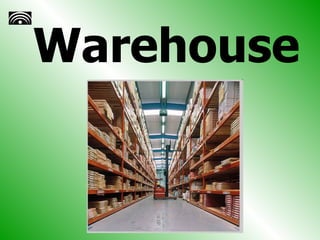
Warehouse - Definition A warehouse is a commercial building for storage of goods.
Warehouse  Main Applications Warehouses are used by: Manufacturers,  Importers, Exporters,  Wholesalers,  Transport businesses,  Customs, etc.
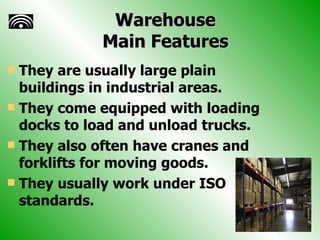
Warehouse Main Features They are usually large plain buildings in industrial areas. They come equipped with loading docks to load and unload trucks. They also often have cranes and forklifts for moving goods. They usually work under ISO standards.
Warehouse - Important Some warehouses are completely automated, with no workers working inside.  The pallets and products are moved and coordinated by programmable logic controllers and computers running logistics automation software.
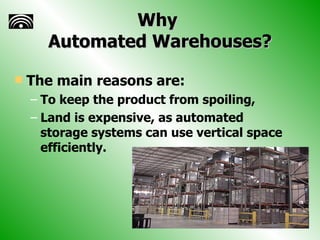
Why  Automated Warehouses? The main reasons are: To keep the product from spoiling,  Land is expensive, as automated storage systems can use vertical space efficiently.
Warehouse - WMS A warehouse management system, or WMS, is a key part of the supply chain; its goals are: to control the movement and storage of materials. To process the associated transactions, including shipping, receiving, putaway and picking.  To optimize stock putaway.
Warehouse - Nowadays Traditional warehousing has been declining since the last decades of the 20th century with the gradual introduction of Just In Time (JIT).
Warehouse - JIT Just In Time (JIT) is a technique designed to improve the return on investment of a business by reducing in-process inventory.
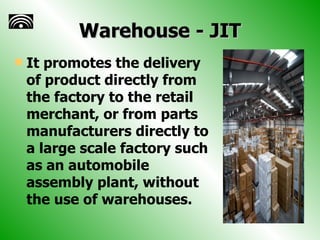
Warehouse - JIT It promotes the delivery of product directly from the factory to the retail merchant, or from parts manufacturers directly to a large scale factory such as an automobile assembly plant, without the use of warehouses.
Warehouse - JIT Important However, with the gradual implementation of offshore outsourcing the distance between the manufacturer and the retailer grew considerably, necessitating at least one warehouse per country or per region in any typical supply chain for a given range of products.
Lico Reis Consultoria  & Línguas Prof. Lico Reis www.licoreis.com [email_address]

Warehouse

  • 1.
  • 2.
    Warehouse - DefinitionA warehouse is a commercial building for storage of goods.
  • 3.
    Warehouse MainApplications Warehouses are used by: Manufacturers, Importers, Exporters, Wholesalers, Transport businesses, Customs, etc.
  • 4.
    Warehouse Main FeaturesThey are usually large plain buildings in industrial areas. They come equipped with loading docks to load and unload trucks. They also often have cranes and forklifts for moving goods. They usually work under ISO standards.
  • 5.
    Warehouse - ImportantSome warehouses are completely automated, with no workers working inside. The pallets and products are moved and coordinated by programmable logic controllers and computers running logistics automation software.
  • 6.
    Why AutomatedWarehouses? The main reasons are: To keep the product from spoiling, Land is expensive, as automated storage systems can use vertical space efficiently.
  • 7.
    Warehouse - WMSA warehouse management system, or WMS, is a key part of the supply chain; its goals are: to control the movement and storage of materials. To process the associated transactions, including shipping, receiving, putaway and picking. To optimize stock putaway.
  • 8.
    Warehouse - NowadaysTraditional warehousing has been declining since the last decades of the 20th century with the gradual introduction of Just In Time (JIT).
  • 9.
    Warehouse - JITJust In Time (JIT) is a technique designed to improve the return on investment of a business by reducing in-process inventory.
  • 10.
    Warehouse - JITIt promotes the delivery of product directly from the factory to the retail merchant, or from parts manufacturers directly to a large scale factory such as an automobile assembly plant, without the use of warehouses.
  • 11.
    Warehouse - JITImportant However, with the gradual implementation of offshore outsourcing the distance between the manufacturer and the retailer grew considerably, necessitating at least one warehouse per country or per region in any typical supply chain for a given range of products.
  • 12.
    Lico Reis Consultoria & Línguas Prof. Lico Reis www.licoreis.com [email_address]