Bischler-Napieralski Reaction
NAVEEN K
II-MSc CHEMISTRY
St. JOSEPH’S COLLEGE(AUTONOMOUS),
TRICHY-620002.
CHE-MYSTERY
SUBSCRIBE
Content
•Introduction
•Reagent and condition
•Reaction
•Mechanism
•Evidence for intermediate
•Application
•Recent literature
•Reference
Bischler-Napieralski Reaction
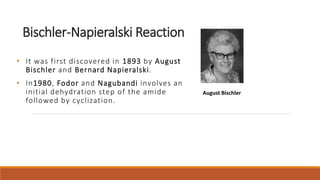
• It was first discovered in 1893 by August
Bischler and Bernard Napieralski.
• In1980, Fodor and Nagubandi involves an
initial dehydration step of the amide
followed by cyclization.
August Bischler
Reagent and condition
•This reaction is carried out in refluxing acidic conditions and requires a dehydrating agent.
•Depending on the dehydrating reagent used, the reaction temperature varies from room
temperature to 100 °C.
• Phosphoryl chloride (POCl3) is widely used and cited for this purpose.
Bischler-Napierlaski Reaction
• Cyclization of β-arylethylamides or β-arylethylcarbametes.
• It is an intramolecular electrophilic aromatic substitution reaction.
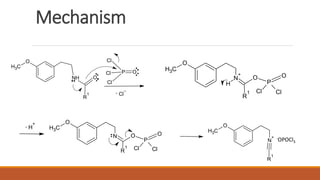
• Nitrilium salts as a intermediate.
• The reaction is mostly used in the synthesis of dihydroisoquinolines, which can be
subsequently oxidized to isoquinolines.
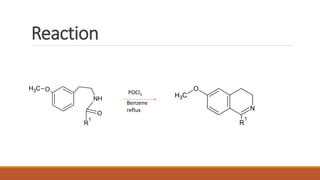
Reaction
CH3 O
NH
R
1
O
POCl3
Benzene
reflux
CH3
O
N
R
1
-OPOCl3
Mechanism
H
+
O
P
O
CH3
O
N
Cl ClR
1
-
CH3
O
N
+
R
1
-
CH3
O
NH
R
1
O
OP
Cl
Cl
Cl
Cl
–
O
P
O
CH3
O
H
N
+
Cl Cl
R
1
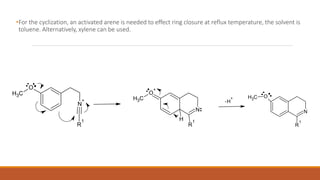
•For the cyclization, an activated arene is needed to effect ring closure at reflux temperature, the solvent is
toluene. Alternatively, xylene can be used.
CH3
O
N
+
R
1 H
CH3
O
+
N
R
1
OCH3
R
1
N
H
+
-
Evidence for intermediate
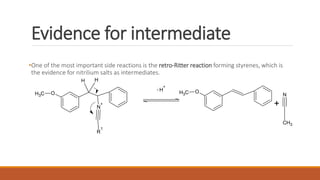
•One of the most important side reactions is the retro-Ritter reaction forming styrenes, which is
the evidence for nitrilium salts as intermediates.
H H
CH3 O
N
+
R
1
H
+
CH3
O
N
CH3
+
-
Application
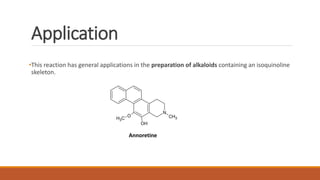
•This reaction has general applications in the preparation of alkaloids containing an isoquinoline
skeleton.
CH3CH3
O
OH
N
Annoretine
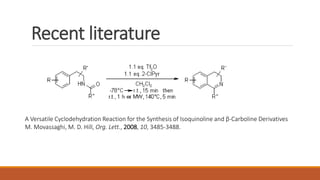
Recent literature
A Versatile Cyclodehydration Reaction for the Synthesis of Isoquinoline and β-Carboline Derivatives
M. Movassaghi, M. D. Hill, Org. Lett., 2008, 10, 3485-3488.
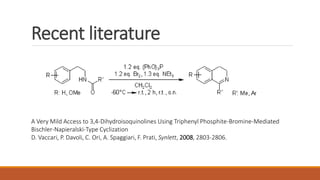
Recent literature
A Very Mild Access to 3,4-Dihydroisoquinolines Using Triphenyl Phosphite-Bromine-Mediated
Bischler-Napieralski-Type Cyclization
D. Vaccari, P. Davoli, C. Ori, A. Spaggiari, F. Prati, Synlett, 2008, 2803-2806.
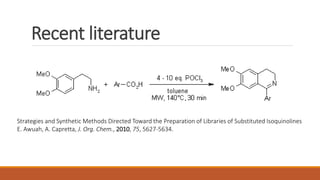
Recent literature
Strategies and Synthetic Methods Directed Toward the Preparation of Libraries of Substituted Isoquinolines
E. Awuah, A. Capretta, J. Org. Chem., 2010, 75, 5627-5634.
Reference
•Nagubandi, S., & Fodor, G. (1980). The mechanism of the bischler-napieralski reaction.
Journal of Heterocyclic Chemistry, 17(7), 1457–1463. doi:10.1002/jhet.5570170720
•M. B. Smith, J. March in March's Advanced Organic Chemistry, 5Ih ed., John Wiley and Sons,
Inc., New York, 2001, p. 721; W. M. Whaley, T. R. Govindachari, Organic Reactions 6, 12
• Heravi, M. M., Khaghaninejad, S., & Nazari, N. (2014). Bischler– Napieralski Reaction in the
Syntheses of Isoquinolines∗. Advances in Heterocyclic Chemistry, 183–
234. doi:10.1016/b978-0-12-800171-4.00005-6
•Organic chemistry portal
THANK YOU
CHE-MYSTERY
SUBSCRIBE

Bischler napieralski reaction