CH:4
Network Layer
Computer Networking by Kurose & Ross
CN
IP v4
Subnetting (Revision)
 Subnetting is the process of breaking down an IP network into
smaller sub-networks called "subnets."
 Subnetting an IP Network can be done for preservation of address
space
 Additional bits can be added to the default subnet mask for a given
Class to further subnet, or break down, a network
 Classless Inter-Domain Routing
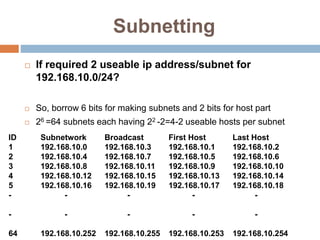
Subnetting
 If required 2 useable ip address/subnet for
192.168.10.0/24?
 So, borrow 6 bits for making subnets and 2 bits for host part
 26 =64 subnets each having 22 -2=4-2 useable hosts per subnet
ID Subnetwork Broadcast First Host Last Host
1 192.168.10.0 192.168.10.3 192.168.10.1 192.168.10.2
2 192.168.10.4 192.168.10.7 192.168.10.5 192.168.10.6
3 192.168.10.8 192.168.10.11 192.168.10.9 192.168.10.10
4 192.168.10.12 192.168.10.15 192.168.10.13 192.168.10.14
5 192.168.10.16 192.168.10.19 192.168.10.17 192.168.10.18
- - - - -
- - - - -
64 192.168.10.252 192.168.10.255 192.168.10.253 192.168.10.254
Variable Length Subnet Masking
(VLSM)
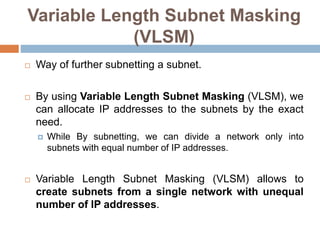
 Way of further subnetting a subnet.
 By using Variable Length Subnet Masking (VLSM), we
can allocate IP addresses to the subnets by the exact
need.
 While By subnetting, we can divide a network only into
subnets with equal number of IP addresses.
 Variable Length Subnet Masking (VLSM) allows to
create subnets from a single network with unequal
number of IP addresses.
Variable Length Subnet Masking
(VLSM)
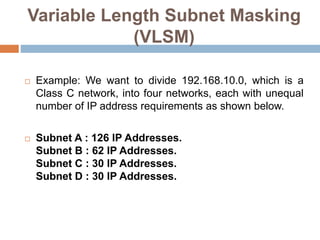
 Example: We want to divide 192.168.10.0, which is a
Class C network, into four networks, each with unequal
number of IP address requirements as shown below.
 Subnet A : 126 IP Addresses.
Subnet B : 62 IP Addresses.
Subnet C : 30 IP Addresses.
Subnet D : 30 IP Addresses.
Variable Length Subnet Masking
(VLSM)
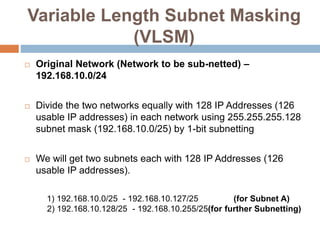
 Original Network (Network to be sub-netted) –
192.168.10.0/24
 Divide the two networks equally with 128 IP Addresses (126
usable IP addresses) in each network using 255.255.255.128
subnet mask (192.168.10.0/25) by 1-bit subnetting
 We will get two subnets each with 128 IP Addresses (126
usable IP addresses).
1) 192.168.10.0/25 - 192.168.10.127/25 (for Subnet A)
2) 192.168.10.128/25 - 192.168.10.255/25(for further Subnetting)
Variable Length Subnet Masking
(VLSM)- Second Division
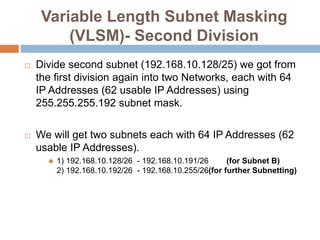
 Divide second subnet (192.168.10.128/25) we got from
the first division again into two Networks, each with 64
IP Addresses (62 usable IP Addresses) using
255.255.255.192 subnet mask.
 We will get two subnets each with 64 IP Addresses (62
usable IP Addresses).
 1) 192.168.10.128/26 - 192.168.10.191/26 (for Subnet B)
2) 192.168.10.192/26 - 192.168.10.255/26(for further Subnetting)
Variable Length Subnet Masking
(VLSM) - Third Division
 Divide 192.168.10.192/26 Network again into two
Networks, each with 32 IP Addresses (30 usable IP
addresses) using 255.255.255.224 subnet mask
 We will get two subnets each with 32 IP Addresse (30
usable IP addresses).
 1) 192.168.10.192/27 - 192.168.10.223/27
2) 192.168.10.224/27 - 192.168.10.255/27
VLSM
 Now we have split the 192.168.10.0/24 network into four subnets
using Variable Length Subnet Masking (VLSM), with unequal
number of IP addresses as shown below. Also note that when you
divide a network using Variable Length Subnet Masking (VLSM),
the subnet masks are also different.
 1) 192.168.10.0 - 255.255.255.127 (126 (128-2) usable IP Addresses)
2) 192.168.10.128 - 255.255.255.192 (62 (64-2) usable IP Addresses)
3) 192.168.10.192 - 255.255.255.224 (30 (32-2) usable IP Addresses)
4) 192.168.10.224 - 255.255.255.224 (30 (32-2) usable IP Addresses)
Problem
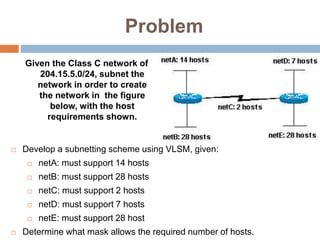
Given the Class C network of
204.15.5.0/24, subnet the
network in order to create
the network in the figure
below, with the host
requirements shown.
 Develop a subnetting scheme using VLSM, given:
 netA: must support 14 hosts
 netB: must support 28 hosts
 netC: must support 2 hosts
 netD: must support 7 hosts
 netE: must support 28 host
 Determine what mask allows the required number of hosts.
Private and Public IP Addresses
In Early network design, when global end-to-end
connectivity was envisioned for communications with all
Internet hosts, intended that IP addresses be
uniquely assigned to a particular computer or
device. However, it was found that this was not always
necessary
Computers not connected to the Internet, such as factory
machines that communicate only with each other via
TCP/IP, need not have globally unique IP addresses.
Private Addresses

Private Addresses
 Private addresses are a predefined set of IPv4 addresses that
the designers of the Internet provided for those hosts within
an organization that do not require direct access to the
Internet.
 These addresses are commonly used for home, office, and
enterprise local area networks (LANs), when globally routable
addresses are not mandatory, or are not available for the
intended network applications
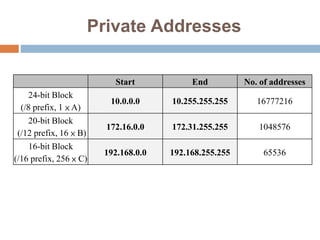
Private Addresses
Start End No. of addresses
24-bit Block
(/8 prefix, 1 × A)
10.0.0.0 10.255.255.255 16777216
20-bit Block
(/12 prefix, 16 × B)
172.16.0.0 172.31.255.255 1048576
16-bit Block
(/16 prefix, 256 × C)
192.168.0.0 192.168.255.255 65536
Private and Public IP Addresses

Public Addresses
 A unique Internet Protocol (IP) address, known as a public IP
address, is assigned to every computer that connects to the
Internet. The IP addressing scheme makes it possible for
computers to “find each other” online and exchange
information.
 Public addresses are globally unique on the Internet. In
addition, routes are programmed into the routers on the
Internet so that traffic can reach those assigned public
addresses. That is why public addresses can be reached on
the Internet.
Address Translation
 Assuming the network has Internet connectivity, the computer
connected to the digital subscriber line (DSL) modem is assigned
public IP addresses by the Internet Service Provider (ISP).
 Now the network’s router acts as a gatekeeper between the private
network and the public Internet.
 Network Address Translation (NAT) and Port Address
Translation (PAT) both map IP addresses on an internal network to
IP addresses on an external network. Which method of address
translation you use depends on the types of networks that you are
translating and the number of available IP addresses that you have.
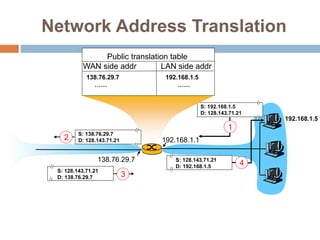
Network Address Translation
192.168.1.5
S: 192.168.1.5
D: 128.143.71.21
1
192.168.1.1
138.76.29.7
Public translation table
WAN side addr LAN side addr
138.76.29.7 192.168.1.5
…… ……
S: 128.143.71.21
D: 192.168.1.5 4
S: 138.76.29.7
D: 128.143.71.21
2
S: 128.143.71.21
D: 138.76.29.7 3
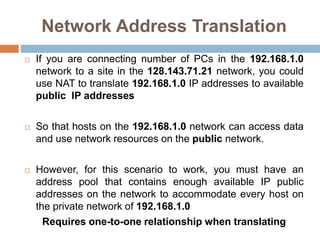
Network Address Translation
 If you are connecting number of PCs in the 192.168.1.0
network to a site in the 128.143.71.21 network, you could
use NAT to translate 192.168.1.0 IP addresses to available
public IP addresses
 So that hosts on the 192.168.1.0 network can access data
and use network resources on the public network.
 However, for this scenario to work, you must have an
address pool that contains enough available IP public
addresses on the network to accommodate every host on
the private network of 192.168.1.0
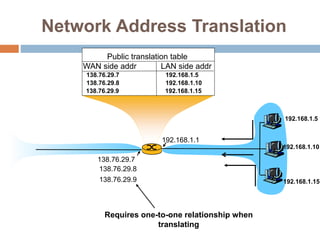
Requires one-to-one relationship when translating
Network Address Translation
192.168.1.5
192.168.1.1
138.76.29.7
Public translation table
WAN side addr LAN side addr
192.168.1.10
192.168.1.15
138.76.29.8
138.76.29.9
Requires one-to-one relationship when
translating
138.76.29.7 192.168.1.5
138.76.29.8 192.168.1.10
138.76.29.9 192.168.1.15
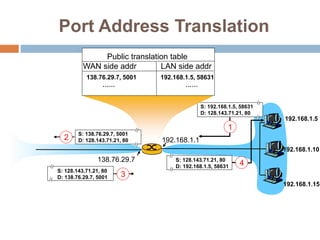
Port Address Translation
192.168.1.5
S: 192.168.1.5, 58631
D: 128.143.71.21, 80
1
192.168.1.1
138.76.29.7
Public translation table
WAN side addr LAN side addr
138.76.29.7, 5001 192.168.1.5, 58631
…… ……
S: 128.143.71.21, 80
D: 192.168.1.5, 58631 4
S: 138.76.29.7, 5001
D: 128.143.71.21, 80
2
S: 128.143.71.21, 80
D: 138.76.29.7, 5001 3
192.168.1.10
192.168.1.15
Port Address Translation
 PAT attempts to use the original source port number of the
internal host to form a unique, registered IP address and
port number combination.
 For example, two hosts that have been assigned the IP
addresses 192.168.1.5 and 192.168.1.10, respectively,
could send traffic to and receive traffic from the Internet by
using the single public IP address138.76.29.7 but unique
port number
 If that port number is already allocated, PAT searches for
an available alternate source port number.

Network Layer V.ppt

  • 1.
    CH:4 Network Layer Computer Networkingby Kurose & Ross CN IP v4
  • 2.
    Subnetting (Revision)  Subnettingis the process of breaking down an IP network into smaller sub-networks called "subnets."  Subnetting an IP Network can be done for preservation of address space  Additional bits can be added to the default subnet mask for a given Class to further subnet, or break down, a network  Classless Inter-Domain Routing
  • 3.
    Subnetting  If required2 useable ip address/subnet for 192.168.10.0/24?  So, borrow 6 bits for making subnets and 2 bits for host part  26 =64 subnets each having 22 -2=4-2 useable hosts per subnet ID Subnetwork Broadcast First Host Last Host 1 192.168.10.0 192.168.10.3 192.168.10.1 192.168.10.2 2 192.168.10.4 192.168.10.7 192.168.10.5 192.168.10.6 3 192.168.10.8 192.168.10.11 192.168.10.9 192.168.10.10 4 192.168.10.12 192.168.10.15 192.168.10.13 192.168.10.14 5 192.168.10.16 192.168.10.19 192.168.10.17 192.168.10.18 - - - - - - - - - - 64 192.168.10.252 192.168.10.255 192.168.10.253 192.168.10.254
  • 4.
    Variable Length SubnetMasking (VLSM)  Way of further subnetting a subnet.  By using Variable Length Subnet Masking (VLSM), we can allocate IP addresses to the subnets by the exact need.  While By subnetting, we can divide a network only into subnets with equal number of IP addresses.  Variable Length Subnet Masking (VLSM) allows to create subnets from a single network with unequal number of IP addresses.
  • 5.
    Variable Length SubnetMasking (VLSM)  Example: We want to divide 192.168.10.0, which is a Class C network, into four networks, each with unequal number of IP address requirements as shown below.  Subnet A : 126 IP Addresses. Subnet B : 62 IP Addresses. Subnet C : 30 IP Addresses. Subnet D : 30 IP Addresses.
  • 6.
    Variable Length SubnetMasking (VLSM)  Original Network (Network to be sub-netted) – 192.168.10.0/24  Divide the two networks equally with 128 IP Addresses (126 usable IP addresses) in each network using 255.255.255.128 subnet mask (192.168.10.0/25) by 1-bit subnetting  We will get two subnets each with 128 IP Addresses (126 usable IP addresses). 1) 192.168.10.0/25 - 192.168.10.127/25 (for Subnet A) 2) 192.168.10.128/25 - 192.168.10.255/25(for further Subnetting)
  • 7.
    Variable Length SubnetMasking (VLSM)- Second Division  Divide second subnet (192.168.10.128/25) we got from the first division again into two Networks, each with 64 IP Addresses (62 usable IP Addresses) using 255.255.255.192 subnet mask.  We will get two subnets each with 64 IP Addresses (62 usable IP Addresses).  1) 192.168.10.128/26 - 192.168.10.191/26 (for Subnet B) 2) 192.168.10.192/26 - 192.168.10.255/26(for further Subnetting)
  • 8.
    Variable Length SubnetMasking (VLSM) - Third Division  Divide 192.168.10.192/26 Network again into two Networks, each with 32 IP Addresses (30 usable IP addresses) using 255.255.255.224 subnet mask  We will get two subnets each with 32 IP Addresse (30 usable IP addresses).  1) 192.168.10.192/27 - 192.168.10.223/27 2) 192.168.10.224/27 - 192.168.10.255/27
  • 9.
    VLSM  Now wehave split the 192.168.10.0/24 network into four subnets using Variable Length Subnet Masking (VLSM), with unequal number of IP addresses as shown below. Also note that when you divide a network using Variable Length Subnet Masking (VLSM), the subnet masks are also different.  1) 192.168.10.0 - 255.255.255.127 (126 (128-2) usable IP Addresses) 2) 192.168.10.128 - 255.255.255.192 (62 (64-2) usable IP Addresses) 3) 192.168.10.192 - 255.255.255.224 (30 (32-2) usable IP Addresses) 4) 192.168.10.224 - 255.255.255.224 (30 (32-2) usable IP Addresses)
  • 10.
    Problem Given the ClassC network of 204.15.5.0/24, subnet the network in order to create the network in the figure below, with the host requirements shown.  Develop a subnetting scheme using VLSM, given:  netA: must support 14 hosts  netB: must support 28 hosts  netC: must support 2 hosts  netD: must support 7 hosts  netE: must support 28 host  Determine what mask allows the required number of hosts.
  • 11.
    Private and PublicIP Addresses In Early network design, when global end-to-end connectivity was envisioned for communications with all Internet hosts, intended that IP addresses be uniquely assigned to a particular computer or device. However, it was found that this was not always necessary Computers not connected to the Internet, such as factory machines that communicate only with each other via TCP/IP, need not have globally unique IP addresses.
  • 12.
    Private Addresses  Private Addresses Private addresses are a predefined set of IPv4 addresses that the designers of the Internet provided for those hosts within an organization that do not require direct access to the Internet.  These addresses are commonly used for home, office, and enterprise local area networks (LANs), when globally routable addresses are not mandatory, or are not available for the intended network applications
  • 13.
    Private Addresses Start EndNo. of addresses 24-bit Block (/8 prefix, 1 × A) 10.0.0.0 10.255.255.255 16777216 20-bit Block (/12 prefix, 16 × B) 172.16.0.0 172.31.255.255 1048576 16-bit Block (/16 prefix, 256 × C) 192.168.0.0 192.168.255.255 65536
  • 14.
    Private and PublicIP Addresses  Public Addresses  A unique Internet Protocol (IP) address, known as a public IP address, is assigned to every computer that connects to the Internet. The IP addressing scheme makes it possible for computers to “find each other” online and exchange information.  Public addresses are globally unique on the Internet. In addition, routes are programmed into the routers on the Internet so that traffic can reach those assigned public addresses. That is why public addresses can be reached on the Internet.
  • 15.
    Address Translation  Assumingthe network has Internet connectivity, the computer connected to the digital subscriber line (DSL) modem is assigned public IP addresses by the Internet Service Provider (ISP).  Now the network’s router acts as a gatekeeper between the private network and the public Internet.  Network Address Translation (NAT) and Port Address Translation (PAT) both map IP addresses on an internal network to IP addresses on an external network. Which method of address translation you use depends on the types of networks that you are translating and the number of available IP addresses that you have.
  • 16.
    Network Address Translation 192.168.1.5 S:192.168.1.5 D: 128.143.71.21 1 192.168.1.1 138.76.29.7 Public translation table WAN side addr LAN side addr 138.76.29.7 192.168.1.5 …… …… S: 128.143.71.21 D: 192.168.1.5 4 S: 138.76.29.7 D: 128.143.71.21 2 S: 128.143.71.21 D: 138.76.29.7 3
  • 17.
    Network Address Translation If you are connecting number of PCs in the 192.168.1.0 network to a site in the 128.143.71.21 network, you could use NAT to translate 192.168.1.0 IP addresses to available public IP addresses  So that hosts on the 192.168.1.0 network can access data and use network resources on the public network.  However, for this scenario to work, you must have an address pool that contains enough available IP public addresses on the network to accommodate every host on the private network of 192.168.1.0 Requires one-to-one relationship when translating
  • 18.
    Network Address Translation 192.168.1.5 192.168.1.1 138.76.29.7 Publictranslation table WAN side addr LAN side addr 192.168.1.10 192.168.1.15 138.76.29.8 138.76.29.9 Requires one-to-one relationship when translating 138.76.29.7 192.168.1.5 138.76.29.8 192.168.1.10 138.76.29.9 192.168.1.15
  • 19.
    Port Address Translation 192.168.1.5 S:192.168.1.5, 58631 D: 128.143.71.21, 80 1 192.168.1.1 138.76.29.7 Public translation table WAN side addr LAN side addr 138.76.29.7, 5001 192.168.1.5, 58631 …… …… S: 128.143.71.21, 80 D: 192.168.1.5, 58631 4 S: 138.76.29.7, 5001 D: 128.143.71.21, 80 2 S: 128.143.71.21, 80 D: 138.76.29.7, 5001 3 192.168.1.10 192.168.1.15
  • 20.
    Port Address Translation PAT attempts to use the original source port number of the internal host to form a unique, registered IP address and port number combination.  For example, two hosts that have been assigned the IP addresses 192.168.1.5 and 192.168.1.10, respectively, could send traffic to and receive traffic from the Internet by using the single public IP address138.76.29.7 but unique port number  If that port number is already allocated, PAT searches for an available alternate source port number.