2
NAME
Md.Tanvir Amin
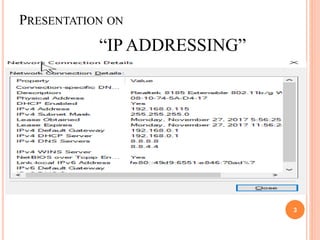
PRESENTATION ON
3
“IP ADDRESSING”
WHAT IS AN IP ADDRESS?
 A way to identify machines on a network
 A unique identifier
 A numerical label
4
IP ADDRESSING
 IANA (Internet Assigned Numbers
Authority) is responsible for global
coordination of the Internet Protocol
addressing systems.
 Currently there are two types of Internet
Protocol (IP) addresses in active use:
I. IP version 4 (IPv4)
II. IP version 6 (IPv6)
5
IP VERSION 4 (IPV4)
 IPv4 was initially deployed on 1 January
1983 and is still the most commonly used
version
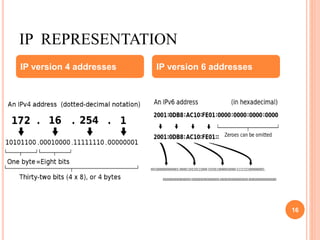
 IPv4 addresses are 32-bit numbers often
expressed as 4 octets in "dotted decimal"
notation (for example, 192.0.2.53)
6
IP VERSION 6 (IPV6)
 Deployment of the IPv6 protocol began in
1999.
 IPv6 addresses are 128-bit numbers and
are conventionally expressed using
hexadecimal strings (for example,
2001:0db8:582:ae33::29).
7
IP USAGE
 Used to connect to another computer
 Allows transfers of files and e-mail
8
WHAT IS AN INTERNET PROTOCOL?
 Protocol used for communicating data
 Across a packet-switched
9
SERVICES PROVIDED BY IP
 Addressing
 Fragmentation
10
PART OF IP ADDRESS
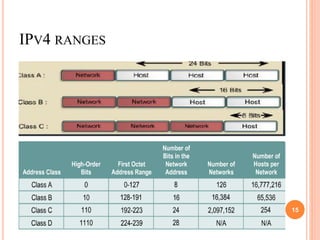
 Network Part
 Local or Host Part
11
IPV4 STRUCTURE
 IP addresses consist of four sections
 Each section is 8 bits long
 Each section can range from 0 to 255
 Written, for example, 128.35.0.72
12
IPV4 STRUCTURE
 5 Classes of IP address A, B, C, D and E
I. Class A reserved for governments
II. Class B reserved for medium companies
III. Class C reserved for small companies
IV. Class D are reserved for multicasting
V. Class E are reserved for future use
13
IPV4 RANGES
Class Address Range Supports
Class A 1.0.0.1 to 126.255.255.254 Supports 16 million hosts on each
of 127 networks.
Class B 128.1.0.1 to 191.255.255.254 Supports 65,000 hosts on each of
16,000 networks.
Class C 192.0.1.1 to 223.255.254.254 Supports 254 hosts on each of 2
million networks.
Class D 224.0.0.0 to 239.255.255.255 Reserved for multicast groups.
Class E 240.0.0.0 to 254.255.255.254 Reserved for future use, or
Research and Development
Purposes.
14
IPV4 RANGES
15
IP REPRESENTATION
16
IP version 4 addresses IP version 6 addresses
TYPES OF IPV4 ADDRESSES:
 The Internet standards define the following types of
IPv4 addresses:
 Unicast: Assigned to a single network interface
located on a specific subnet on the network and
used for one-to-one communications.
 Multicast: Assigned to one or more network
interfaces located on various subnets on the
network and used for one-to-many
communications.
 Broadcast: Assigned to all network interfaces
located on a subnet on the network and used for
one-to-everyone-on-a-subnet communications. 17
TYPES OF IP ADDRESS
 There are two types of IP Address:-
I. Static address
II. Dynamic address
18
TYPES OF IP ADDRESS
 Static IP address;
 Manually input by network administrator
 Manageable for small networks
 Requires careful checks to avoid
duplication
19
TYPES OF IP ADDRESS
 Dynamic IP address
 Examples - BOOTP, DHCP
 Assigned by server when host boots
 Derived automatically from a range of
addresses
 Duration of ‘lease’ negotiated, then
address released back to server
20
SPECIAL IP ADDRESSES:
21
 169.254.0.0 – 169.254.0.16: Link local addresses
 127.0.0.0 – 127.0.0.8: Loop-back addresses
 0.0.0.0 – 0.0.0.8: used to communicate within the
current network.
CLASSLESS IP ADDRESSING :-
 It allows us to use variable length subnet mask so also
known as VLSM (Variable Length Subnet Mask.
 Different subnet mask used in same network.
 In this there is no boundary on host id and network
id Classless Addressing also known as CIDR(classless
interdomain routing)
 There is no default subnet mask in classless routing.
 Example: BGP(Border Gateway Protocol),RIPv2
22
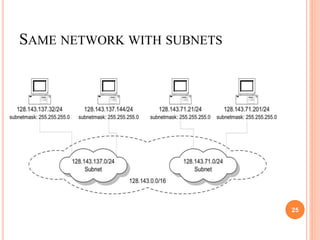
SUBNET MASK
 Indicates how much of the IP address
represents the network or subnet
 Standard (default) subnet masks:
I. Class A subnet mask is 255.0.0.0
II. Class B subnet mask is 255.255.0.0
III. Class C subnet mask is 255.255.255.0
23
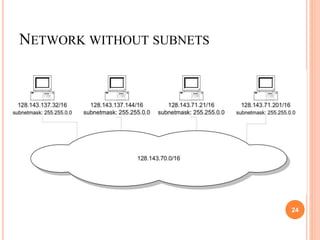
NETWORK WITHOUT SUBNETS
24
SAME NETWORK WITH SUBNETS
25
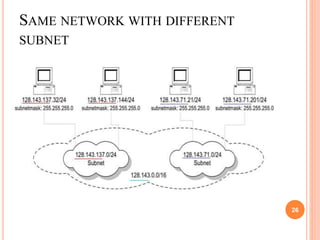
SAME NETWORK WITH DIFFERENT
SUBNET
26
27

Ip addressing

  • 2.
  • 3.
  • 4.
    WHAT IS ANIP ADDRESS?  A way to identify machines on a network  A unique identifier  A numerical label 4
  • 5.
    IP ADDRESSING  IANA(Internet Assigned Numbers Authority) is responsible for global coordination of the Internet Protocol addressing systems.  Currently there are two types of Internet Protocol (IP) addresses in active use: I. IP version 4 (IPv4) II. IP version 6 (IPv6) 5
  • 6.
    IP VERSION 4(IPV4)  IPv4 was initially deployed on 1 January 1983 and is still the most commonly used version  IPv4 addresses are 32-bit numbers often expressed as 4 octets in "dotted decimal" notation (for example, 192.0.2.53) 6
  • 7.
    IP VERSION 6(IPV6)  Deployment of the IPv6 protocol began in 1999.  IPv6 addresses are 128-bit numbers and are conventionally expressed using hexadecimal strings (for example, 2001:0db8:582:ae33::29). 7
  • 8.
    IP USAGE  Usedto connect to another computer  Allows transfers of files and e-mail 8
  • 9.
    WHAT IS ANINTERNET PROTOCOL?  Protocol used for communicating data  Across a packet-switched 9
  • 10.
    SERVICES PROVIDED BYIP  Addressing  Fragmentation 10
  • 11.
    PART OF IPADDRESS  Network Part  Local or Host Part 11
  • 12.
    IPV4 STRUCTURE  IPaddresses consist of four sections  Each section is 8 bits long  Each section can range from 0 to 255  Written, for example, 128.35.0.72 12
  • 13.
    IPV4 STRUCTURE  5Classes of IP address A, B, C, D and E I. Class A reserved for governments II. Class B reserved for medium companies III. Class C reserved for small companies IV. Class D are reserved for multicasting V. Class E are reserved for future use 13
  • 14.
    IPV4 RANGES Class AddressRange Supports Class A 1.0.0.1 to 126.255.255.254 Supports 16 million hosts on each of 127 networks. Class B 128.1.0.1 to 191.255.255.254 Supports 65,000 hosts on each of 16,000 networks. Class C 192.0.1.1 to 223.255.254.254 Supports 254 hosts on each of 2 million networks. Class D 224.0.0.0 to 239.255.255.255 Reserved for multicast groups. Class E 240.0.0.0 to 254.255.255.254 Reserved for future use, or Research and Development Purposes. 14
  • 15.
  • 16.
    IP REPRESENTATION 16 IP version4 addresses IP version 6 addresses
  • 17.
    TYPES OF IPV4ADDRESSES:  The Internet standards define the following types of IPv4 addresses:  Unicast: Assigned to a single network interface located on a specific subnet on the network and used for one-to-one communications.  Multicast: Assigned to one or more network interfaces located on various subnets on the network and used for one-to-many communications.  Broadcast: Assigned to all network interfaces located on a subnet on the network and used for one-to-everyone-on-a-subnet communications. 17
  • 18.
    TYPES OF IPADDRESS  There are two types of IP Address:- I. Static address II. Dynamic address 18
  • 19.
    TYPES OF IPADDRESS  Static IP address;  Manually input by network administrator  Manageable for small networks  Requires careful checks to avoid duplication 19
  • 20.
    TYPES OF IPADDRESS  Dynamic IP address  Examples - BOOTP, DHCP  Assigned by server when host boots  Derived automatically from a range of addresses  Duration of ‘lease’ negotiated, then address released back to server 20
  • 21.
    SPECIAL IP ADDRESSES: 21 169.254.0.0 – 169.254.0.16: Link local addresses  127.0.0.0 – 127.0.0.8: Loop-back addresses  0.0.0.0 – 0.0.0.8: used to communicate within the current network.
  • 22.
    CLASSLESS IP ADDRESSING:-  It allows us to use variable length subnet mask so also known as VLSM (Variable Length Subnet Mask.  Different subnet mask used in same network.  In this there is no boundary on host id and network id Classless Addressing also known as CIDR(classless interdomain routing)  There is no default subnet mask in classless routing.  Example: BGP(Border Gateway Protocol),RIPv2 22
  • 23.
    SUBNET MASK  Indicateshow much of the IP address represents the network or subnet  Standard (default) subnet masks: I. Class A subnet mask is 255.0.0.0 II. Class B subnet mask is 255.255.0.0 III. Class C subnet mask is 255.255.255.0 23
  • 24.
  • 25.
  • 26.
    SAME NETWORK WITHDIFFERENT SUBNET 26
  • 27.