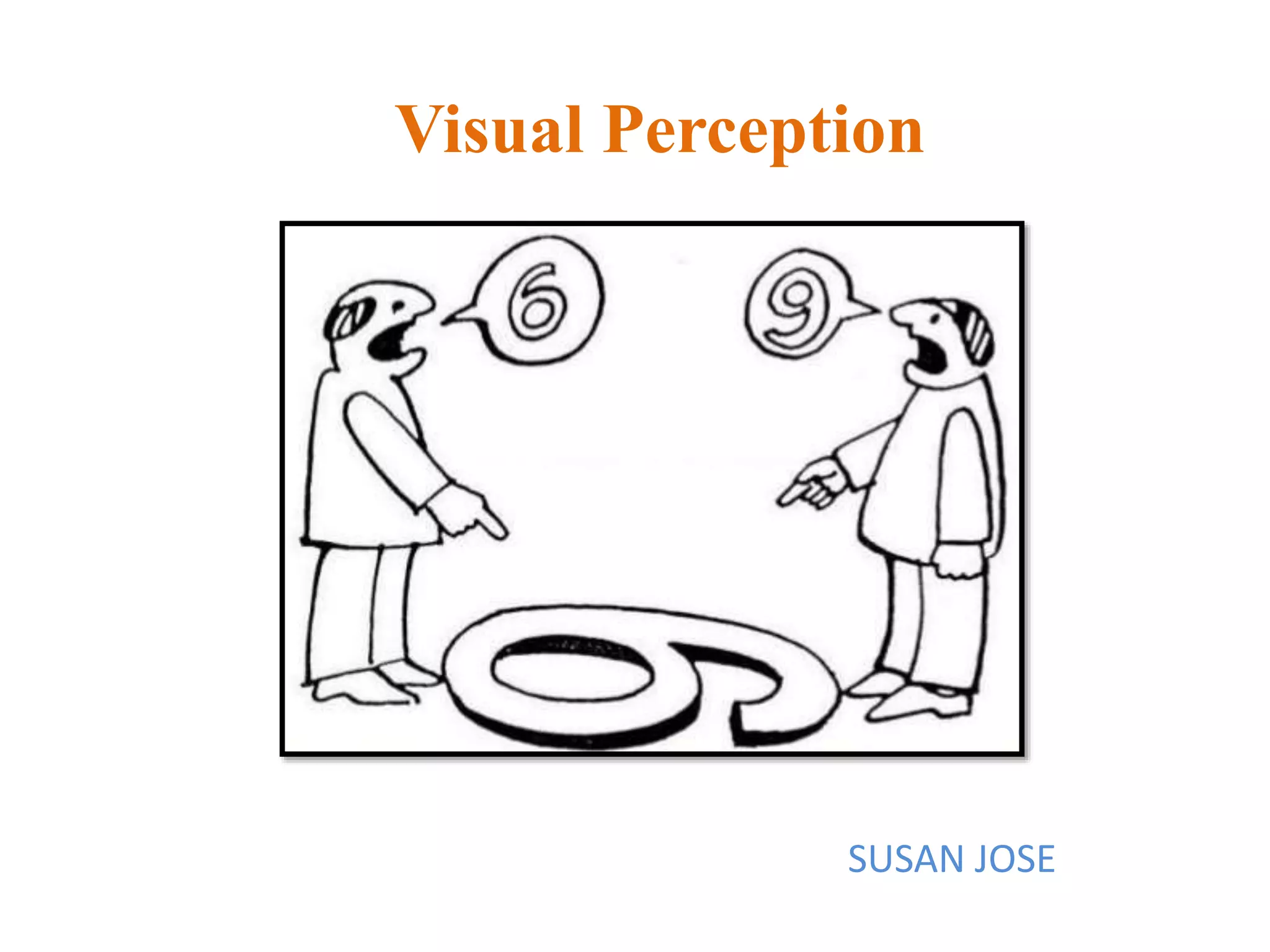
Visual Perception
SUSAN JOSE
Introduction
• Visual perception is defined as the total process of the
reception (sensory functions) and cognition (specific mental
functions) of visual stimuli.
• Visual receptive component is the process of extracting and
organizing information from the environment.
• Visual-cognitive component is the specific mental functions
that provide the capacity to organize,and interpret visual
stimuli giving meaning to what is seen.
• The vestibular -proprioceptive and tactile integration is the
base on which the visual and auditory systems start to mature
and integrate.
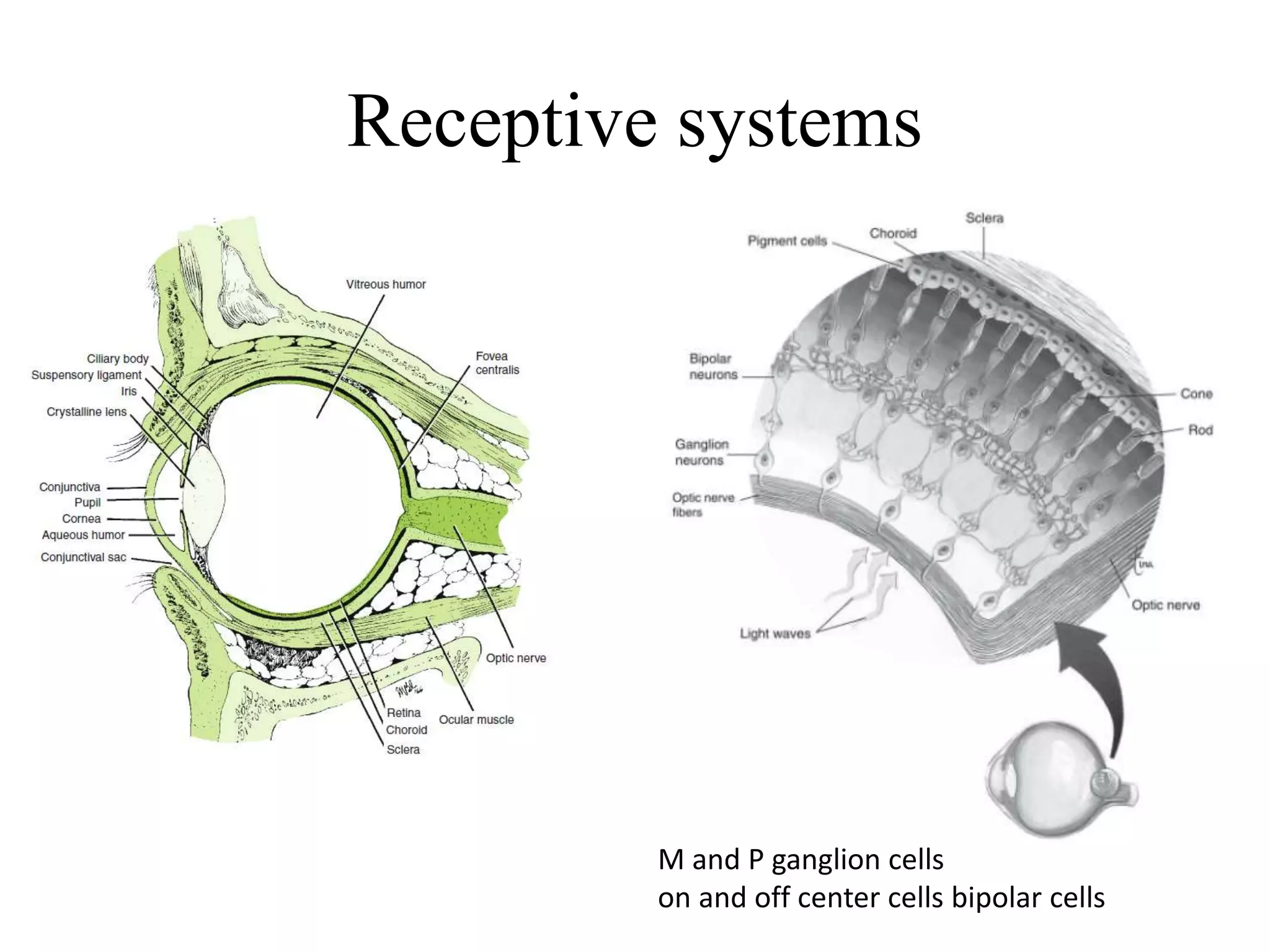
Receptive systems
M and P ganglion cells
on and off center cells bipolar cells
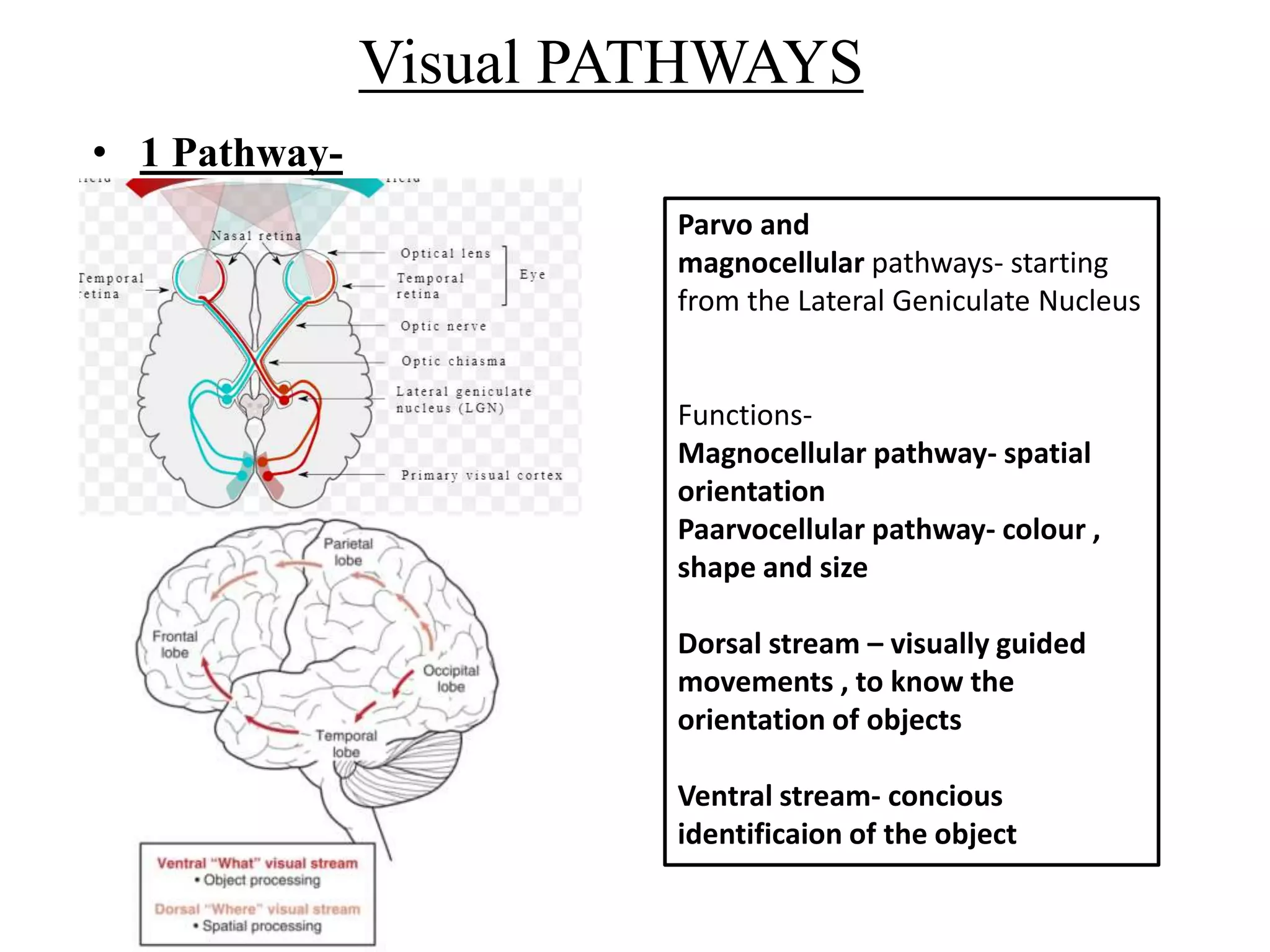
Visual PATHWAYS
• 1 Pathway-
Parvo and
magnocellular pathways- starting
from the Lateral Geniculate Nucleus
Functions-
Magnocellular pathway- spatial
orientation
Paarvocellular pathway- colour ,
shape and size
Dorsal stream – visually guided
movements , to know the
orientation of objects
Ventral stream- concious
identificaion of the object
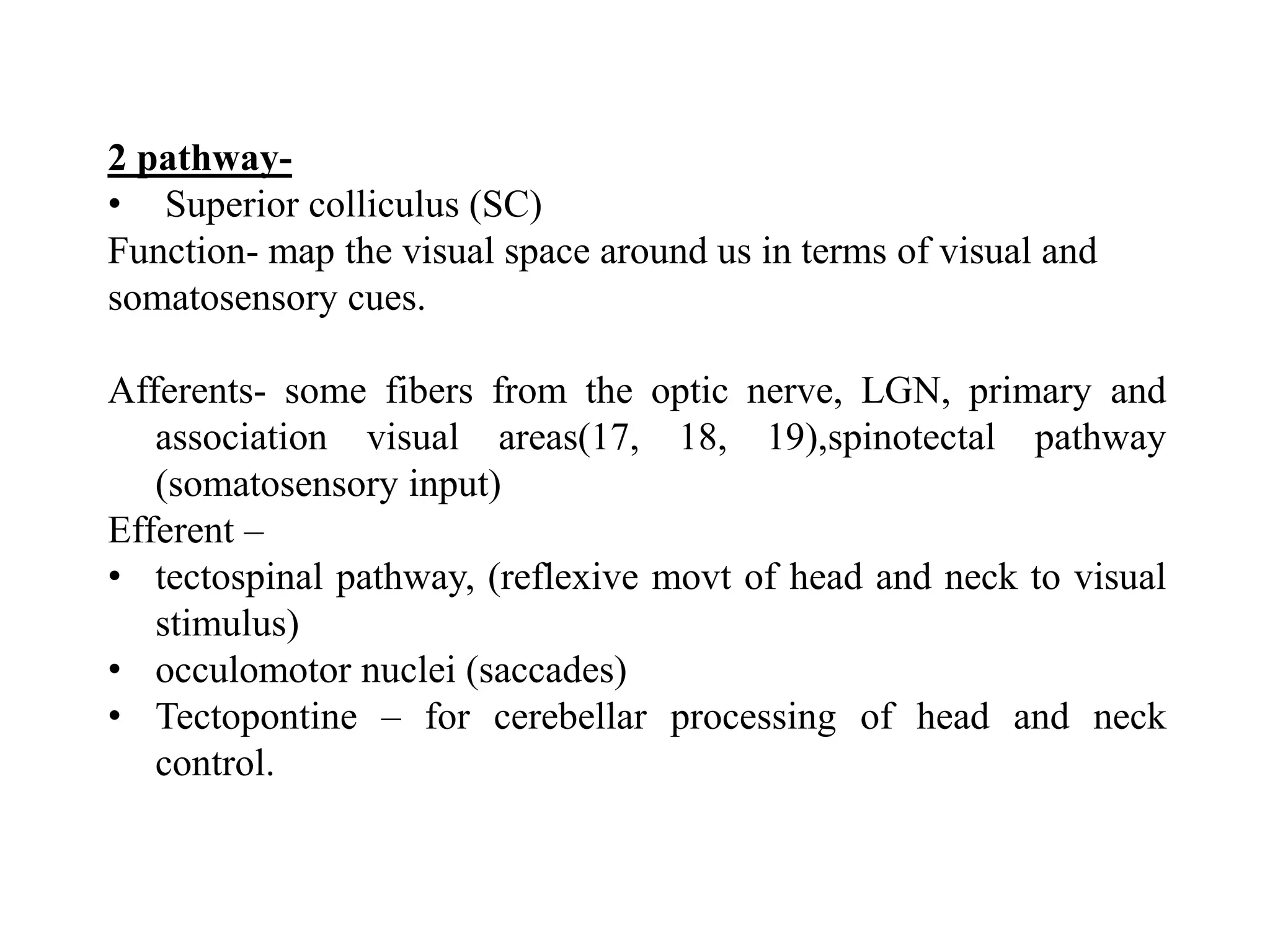
2 pathway-
• Superior colliculus (SC)
Function- map the visual space around us in terms of visual and
somatosensory cues.
Afferents- some fibers from the optic nerve, LGN, primary and
association visual areas(17, 18, 19),spinotectal pathway
(somatosensory input)
Efferent –
• tectospinal pathway, (reflexive movt of head and neck to visual
stimulus)
• occulomotor nuclei (saccades)
• Tectopontine – for cerebellar processing of head and neck
control.
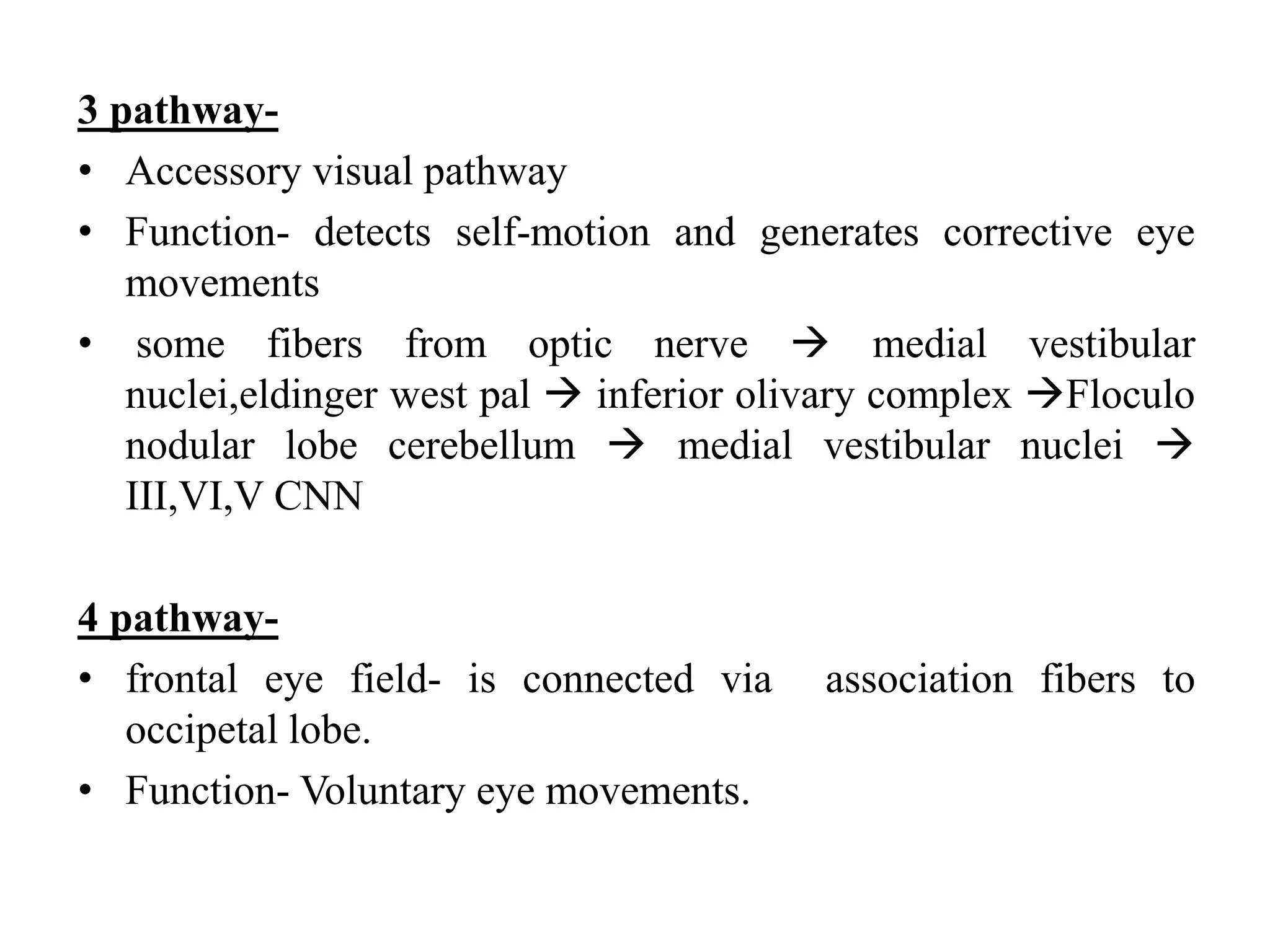
3 pathway-
• Accessory visual pathway
• Function- detects self-motion and generates corrective eye
movements
• some fibers from optic nerve  medial vestibular
nuclei,eldinger west pal  inferior olivary complex Floculo
nodular lobe cerebellum  medial vestibular nuclei 
III,VI,V CNN
4 pathway-
• frontal eye field- is connected via association fibers to
occipetal lobe.
• Function- Voluntary eye movements.
Receptive functions
• Visual fixation and conjugate eye movts are controlled by
occulomotor nerve which receives inputs from SC. Fixation
is prerequisite for scanning.
• Pursuit- it is important for visual fixation on a moving
object. Slow conjugate movements of the eyes.
• Saccades- rapid change of visual fixation. It may be
voluntary or involuntary.
• Acuity- discriminate the fine details of objects in the visual
field.
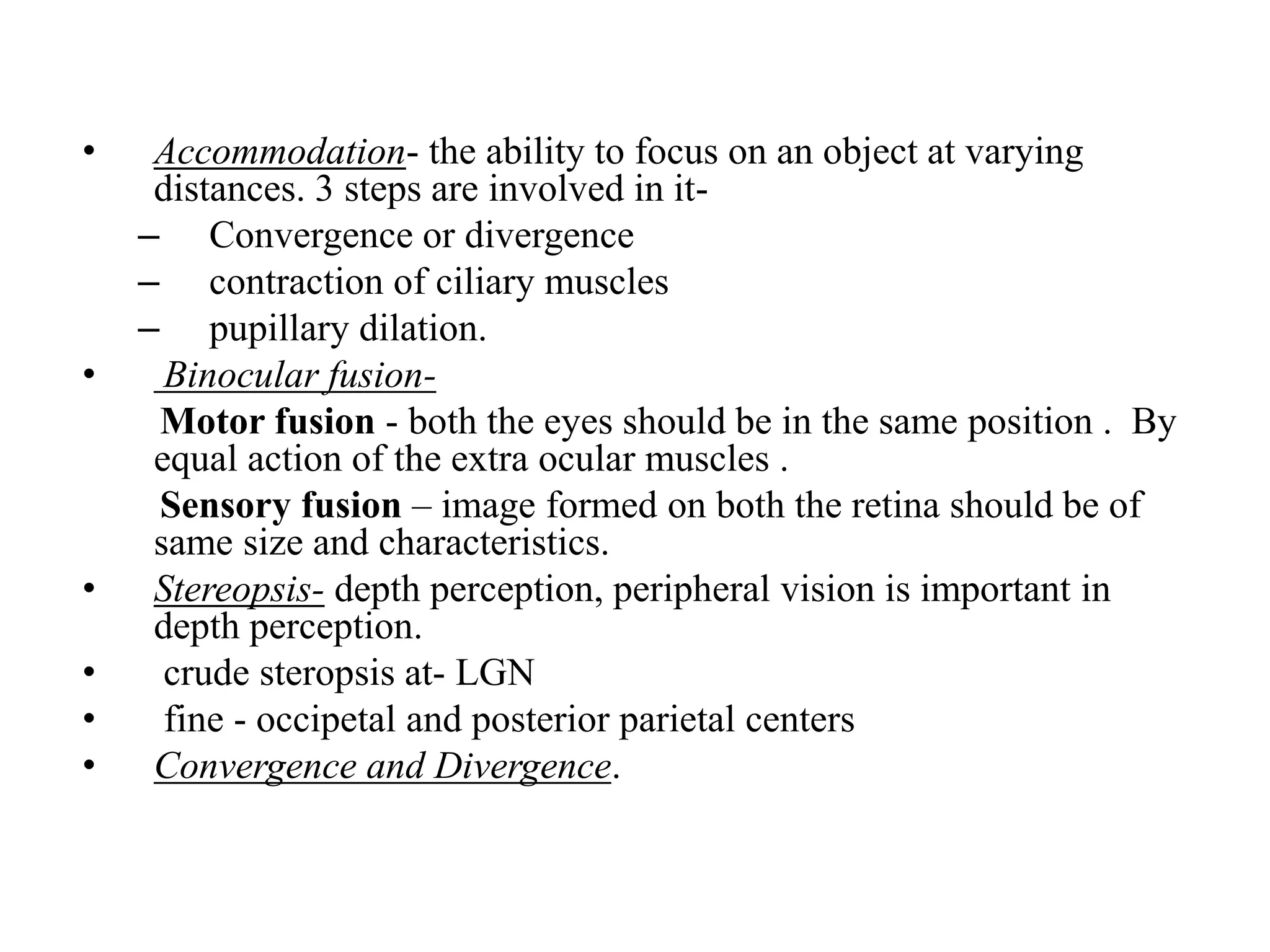
• Accommodation- the ability to focus on an object at varying
distances. 3 steps are involved in it-
– Convergence or divergence
– contraction of ciliary muscles
– pupillary dilation.
• Binocular fusion-
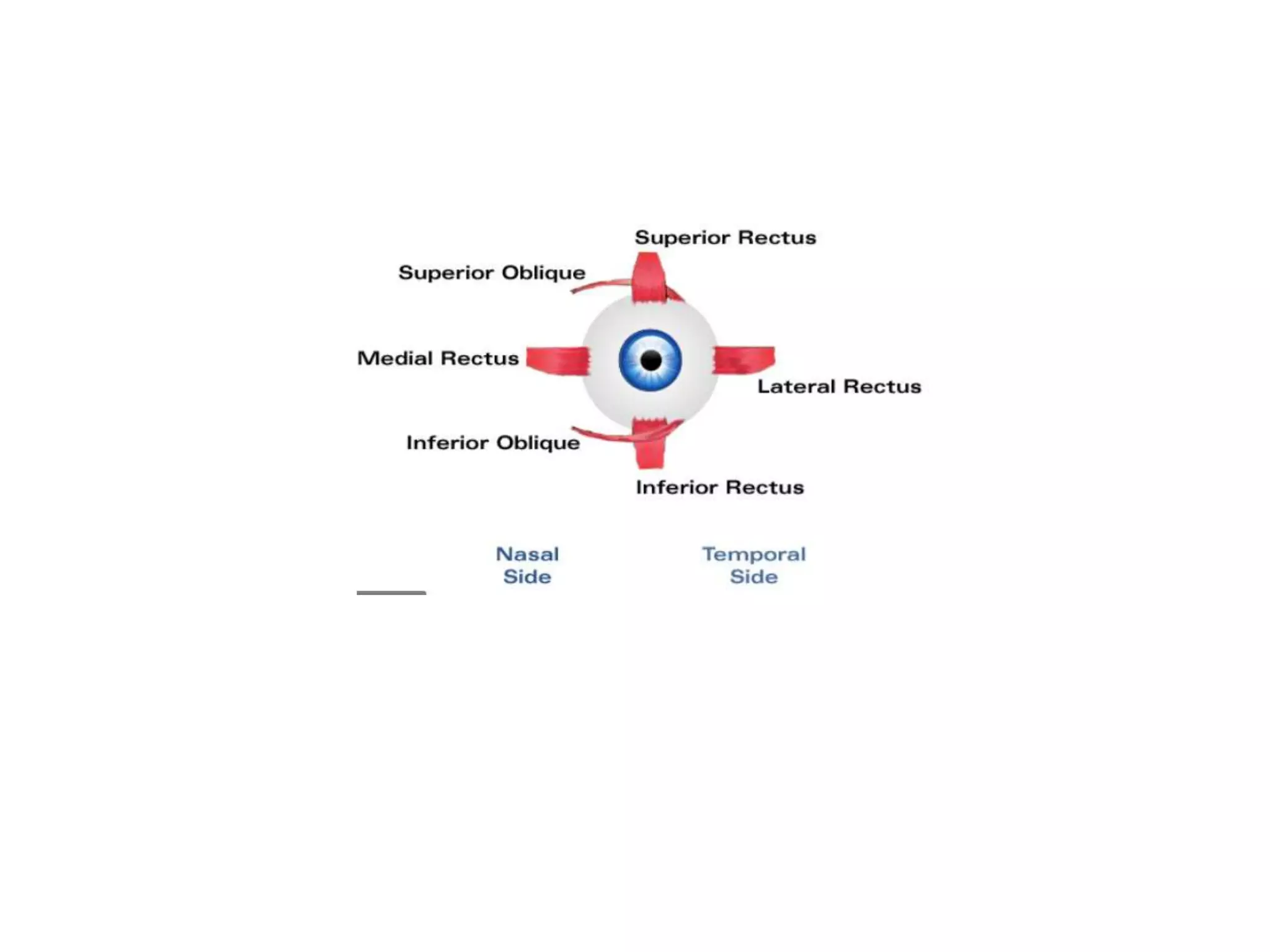
Motor fusion - both the eyes should be in the same position . By
equal action of the extra ocular muscles .
Sensory fusion – image formed on both the retina should be of
same size and characteristics.
• Stereopsis- depth perception, peripheral vision is important in
depth perception.
• crude steropsis at- LGN
• fine - occipetal and posterior parietal centers
• Convergence and Divergence.
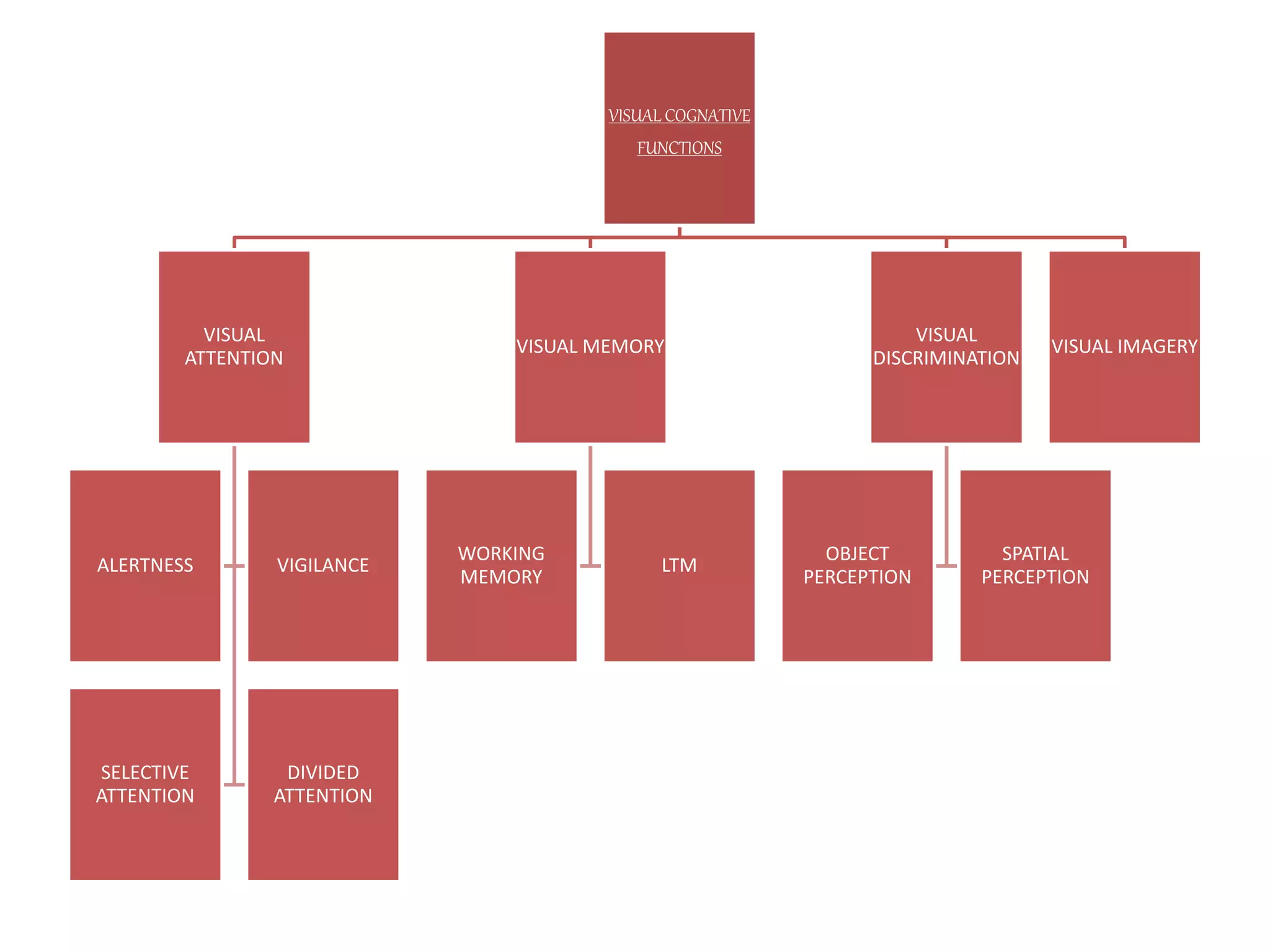
VISUAL COGNATIVE
FUNCTIONS
VISUAL
ATTENTION
ALERTNESS VIGILANCE
SELECTIVE
ATTENTION
DIVIDED
ATTENTION
VISUAL MEMORY
WORKING
MEMORY
LTM
VISUAL
DISCRIMINATION
OBJECT
PERCEPTION
SPATIAL
PERCEPTION
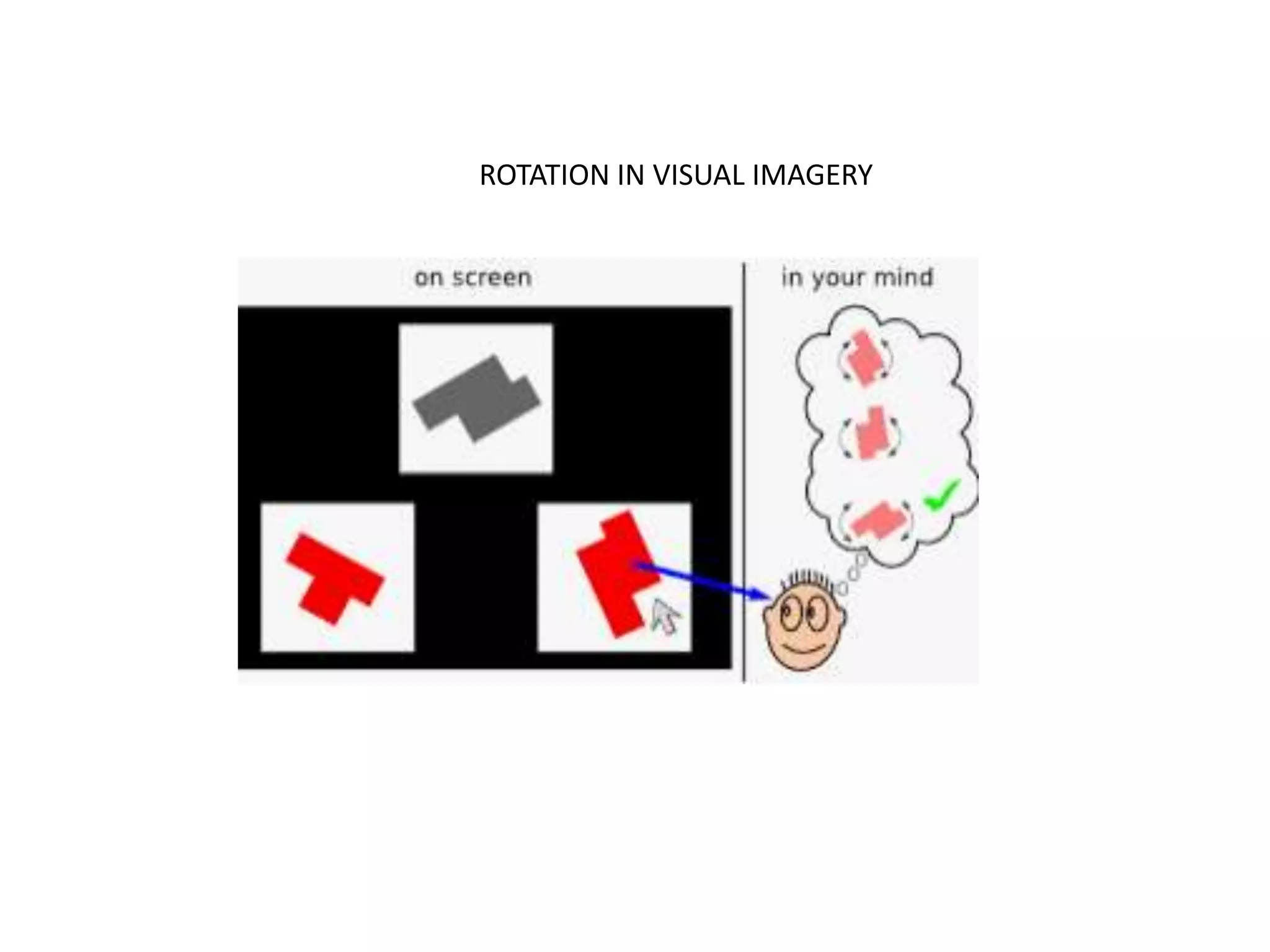
VISUAL IMAGERY
ROTATION IN VISUAL IMAGERY
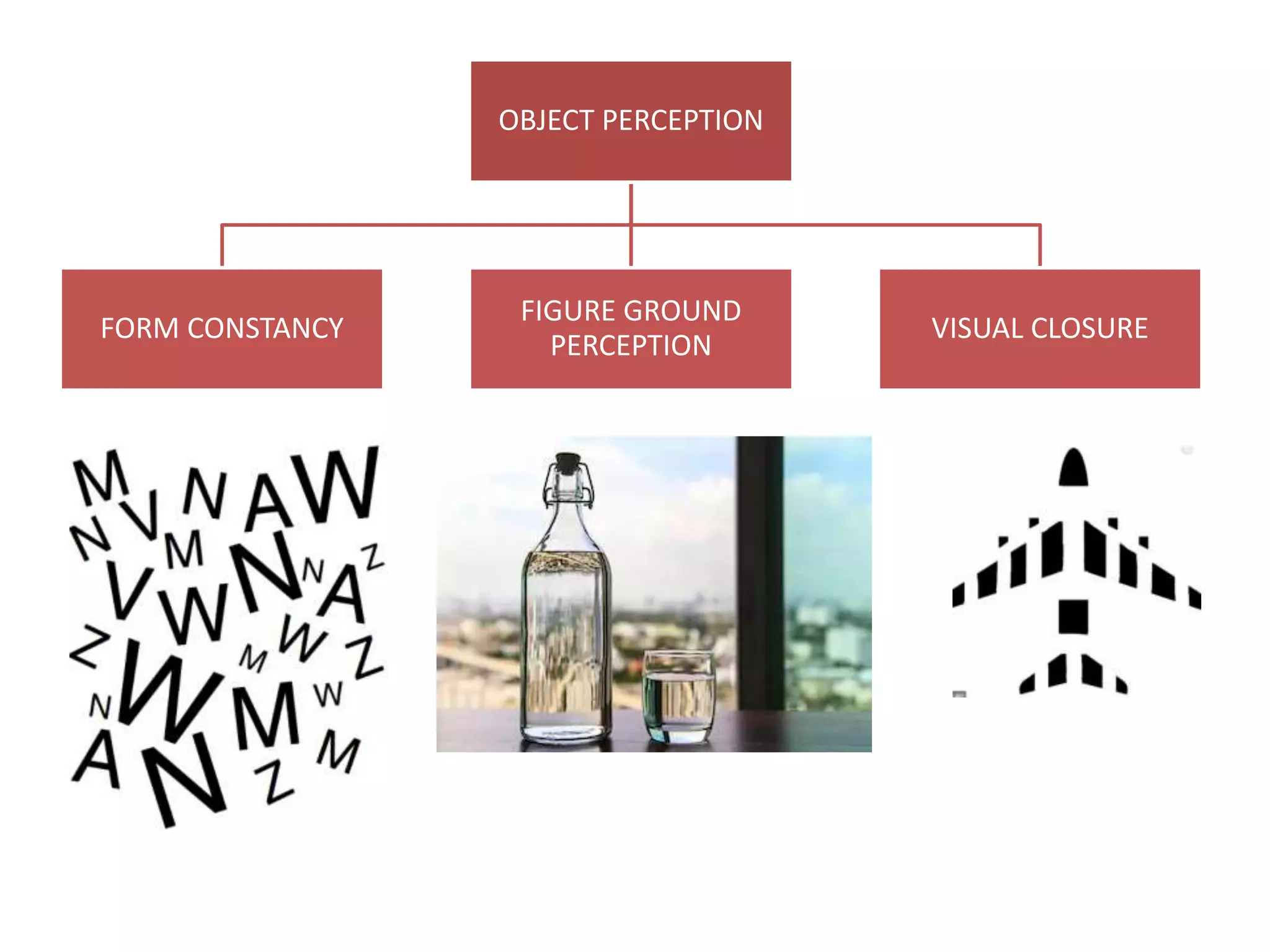
OBJECT PERCEPTION
FORM CONSTANCY
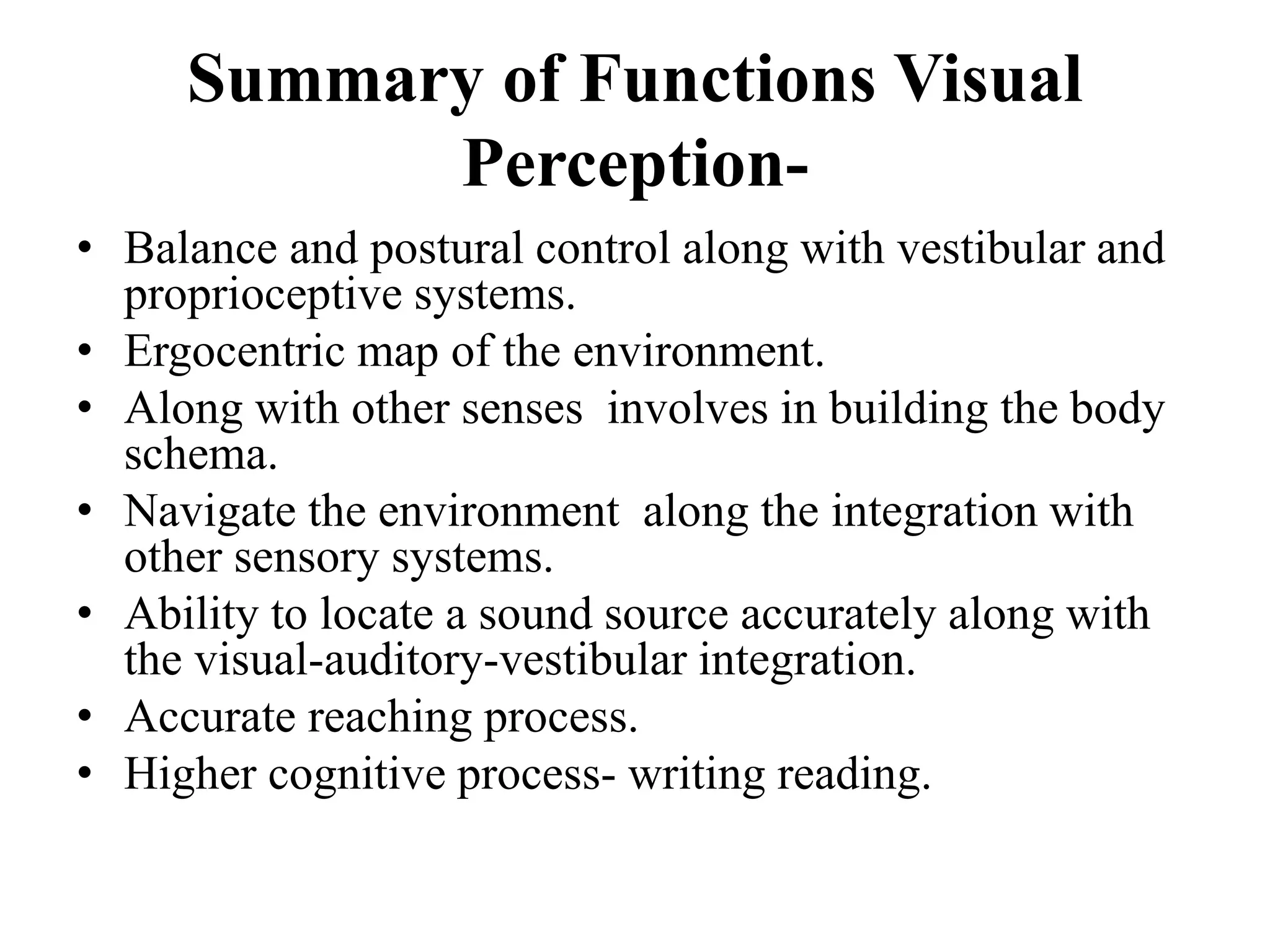
FIGURE GROUND
PERCEPTION
VISUAL CLOSURE
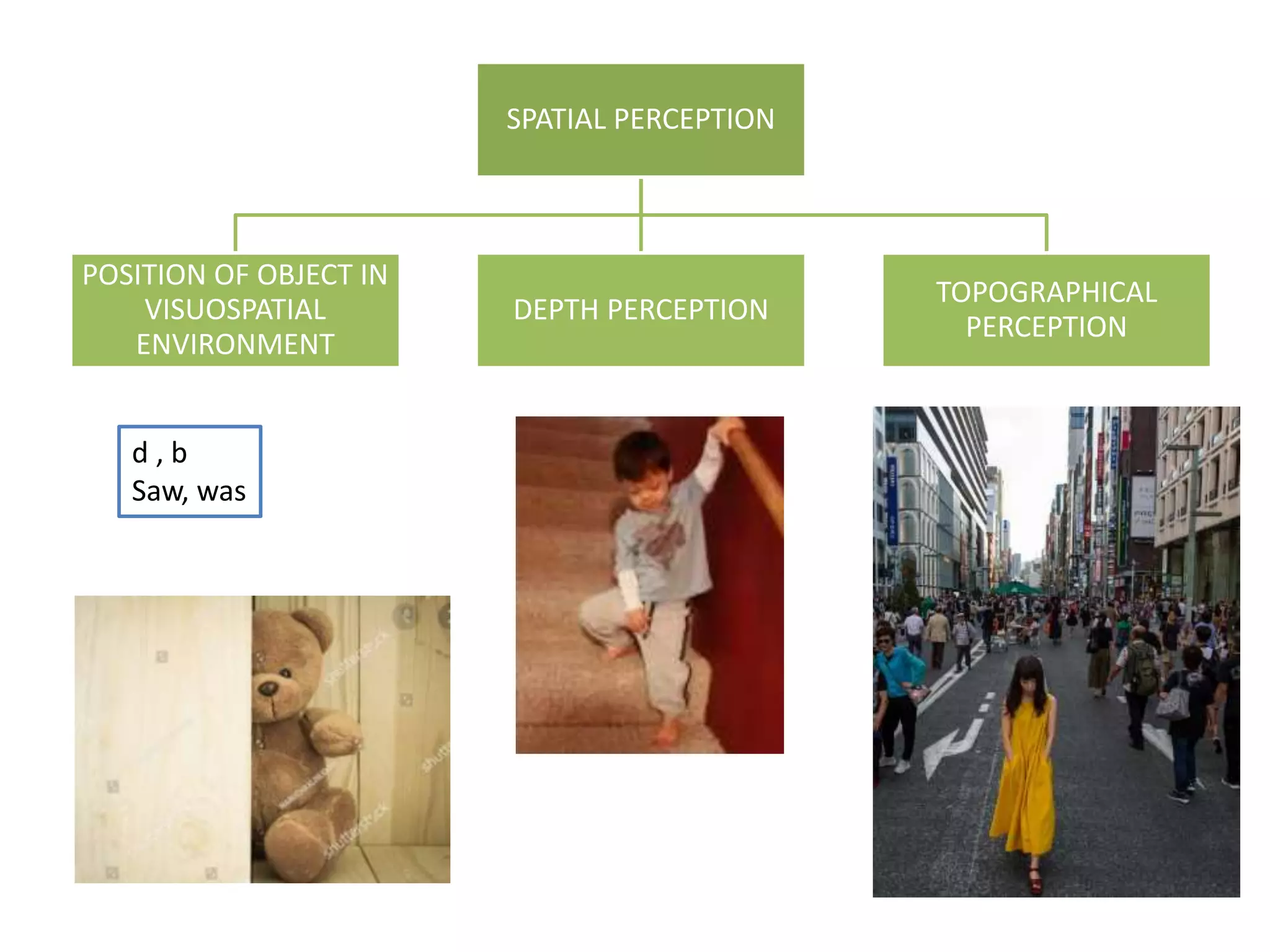
SPATIAL PERCEPTION
POSITION OF OBJECT IN
VISUOSPATIAL
ENVIRONMENT
DEPTH PERCEPTION
TOPOGRAPHICAL
PERCEPTION
d , b
Saw, was
VISION AND BODY SCHEMA
• It is an unconscious internal representation of the body
providing a postural frame of reference.
• It is always updated during movements.
• The coordinates of the body and the coordinates of the
environment should match for an efficient and coordinated
postural and movement control.
• It is important for interpreting self-motion, and to calibrate
motor actions.
• The proprioceptive-tactile-visual system contribute for
formation of Body schema.
• When in a new environment or learning new actions vision is
used to constantly update body positions until the
proprioceptive and tactile can take over the function once it is
learnt.
VISION AND BALANCE
• Vision-vestibular-prorioception important for
balance and postural control.
• Visual gives the sense of verticality with respect
to the vertical objects in the environment.
• During reactive response peripheral vision is of
particular importance. As the person holds or
places his foot during the holding or placing
reaction dependants on the ergocentric visual
map.
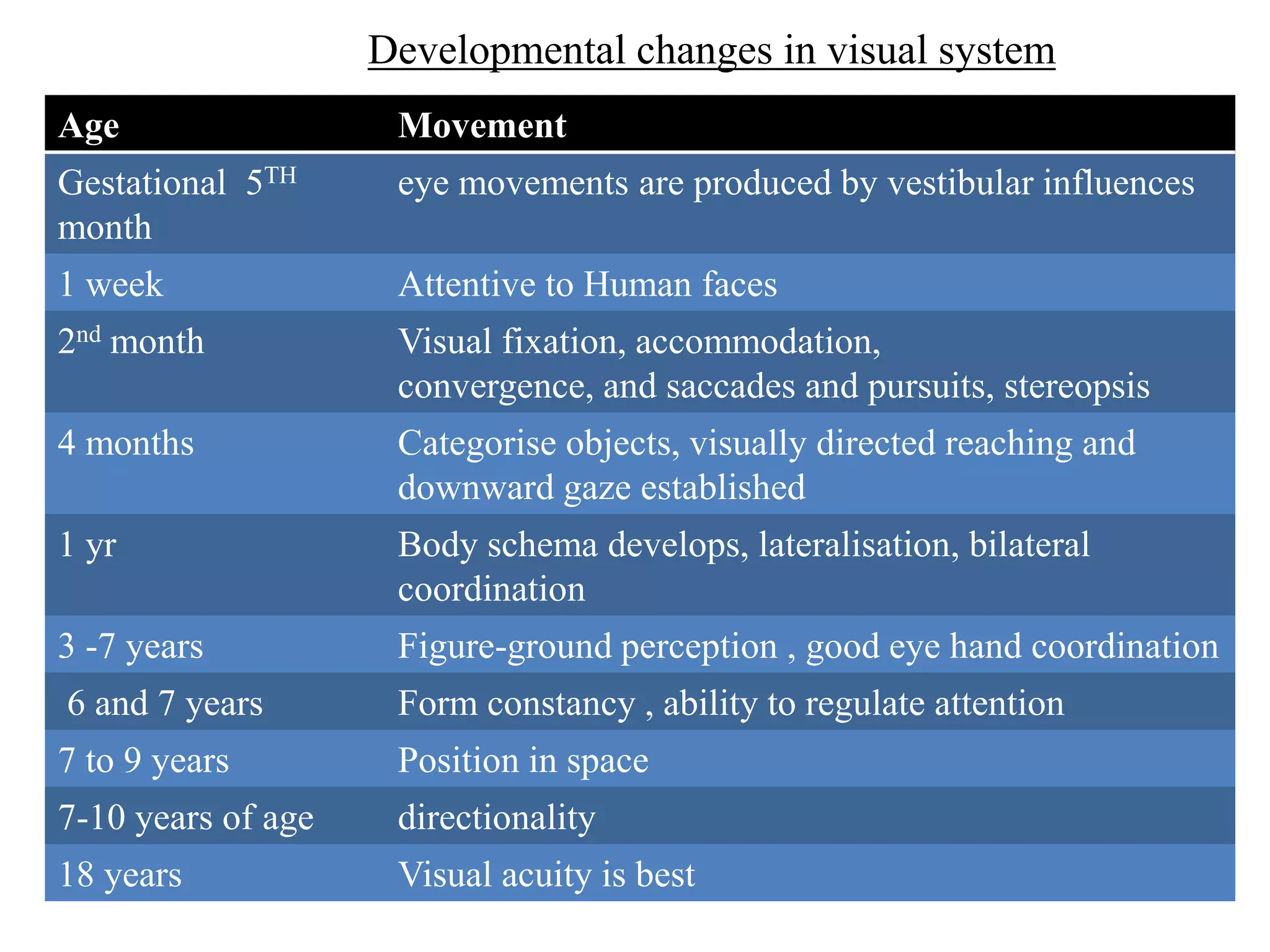
Age Movement
Gestational 5TH
month
eye movements are produced by vestibular influences
1 week Attentive to Human faces
2nd month Visual fixation, accommodation,
convergence, and saccades and pursuits, stereopsis
4 months Categorise objects, visually directed reaching and
downward gaze established
1 yr Body schema develops, lateralisation, bilateral
coordination
3 -7 years Figure-ground perception , good eye hand coordination
6 and 7 years Form constancy , ability to regulate attention
7 to 9 years Position in space
7-10 years of age directionality
18 years Visual acuity is best
Developmental changes in visual system
• Developementally control develops from horizontal eye,vertical
movements ,diagonal, and circular directions.
• Visual perception develops completely- 9 years of age
• Until that age child prefers to learn via tactile, proprioceptive systems.
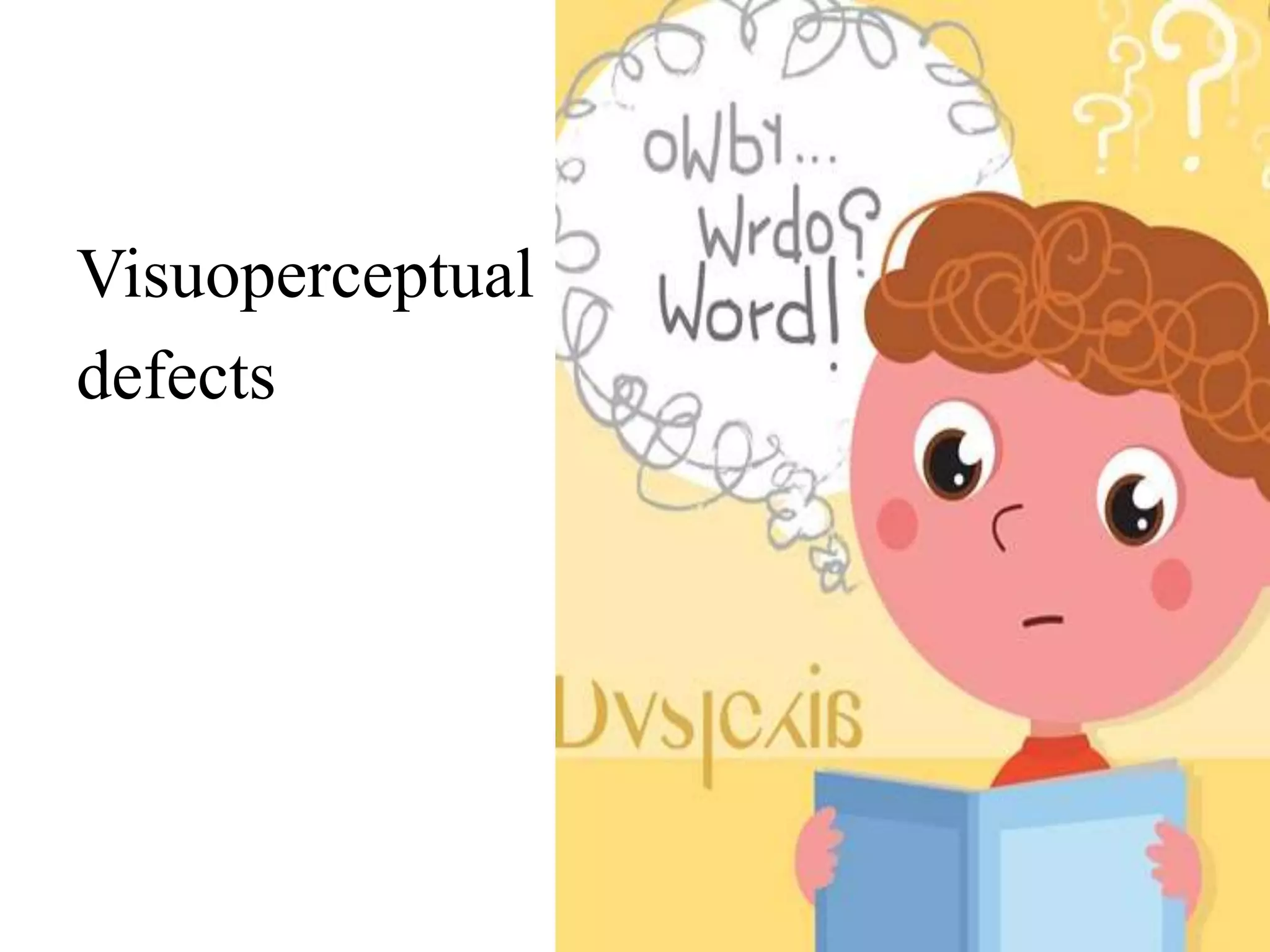
Visuoperceptual
defects
SENSORY MODULATION
• REGISTRATION –
• fails to attend to and register relevant environmental stimuli.
When CNS is working well, it knows when to “pay attention”
to a stimulus and when to “ignore" it automatically and
efficiently.
• Failure of registering life saving inputs can be dangerous.
• Because of reduced sensory inputs the child lacks the inner
drive.
• Unless there is sensory registration there will be no adaptive
behavior.
Hyporesponsive and problems with
discimination
Seeks out visual stimulation
Effects a child’s visual tracking, discrimination, and
perception
Difficulty with visual discrimination – b and d, q and p for
example
Reversals when reading – now for won, no for on, was, for
saw
Difficulty telling the differences between colors, shapes, and
sizes
Difficulty copying from a chalkboard
Inconsistent sizing or spacing when writing, doesn’t write on
the line
Hyperresponsive
Complains about bright lights, covers eyes
frequently, or may get frequent headaches from
light
Sensitive to florescent lighting
Easily distracted by visual stimuli – distracted by
movements in their periphery
Enjoys playing in the dark
Rubs eyes frequently
Decreased eye contact
Summary of Functions Visual
Perception-
• Balance and postural control along with vestibular and
proprioceptive systems.
• Ergocentric map of the environment.
• Along with other senses involves in building the body
schema.
• Navigate the environment along the integration with
other sensory systems.
• Ability to locate a sound source accurately along with
the visual-auditory-vestibular integration.
• Accurate reaching process.
• Higher cognitive process- writing reading.
Assesment
Ayers Sensory Integration And Praxis Test
Praxis on Verbal Command:
• 1-2 step verbal direction
Sequencing praxis:
• 6-step process.
Post rotary Nystagmus :
• spinning the child on a spin board 10 times over
a period of 20 seconds. Look for nystagmus
reaction. Even if present it should stop is 10
secs.
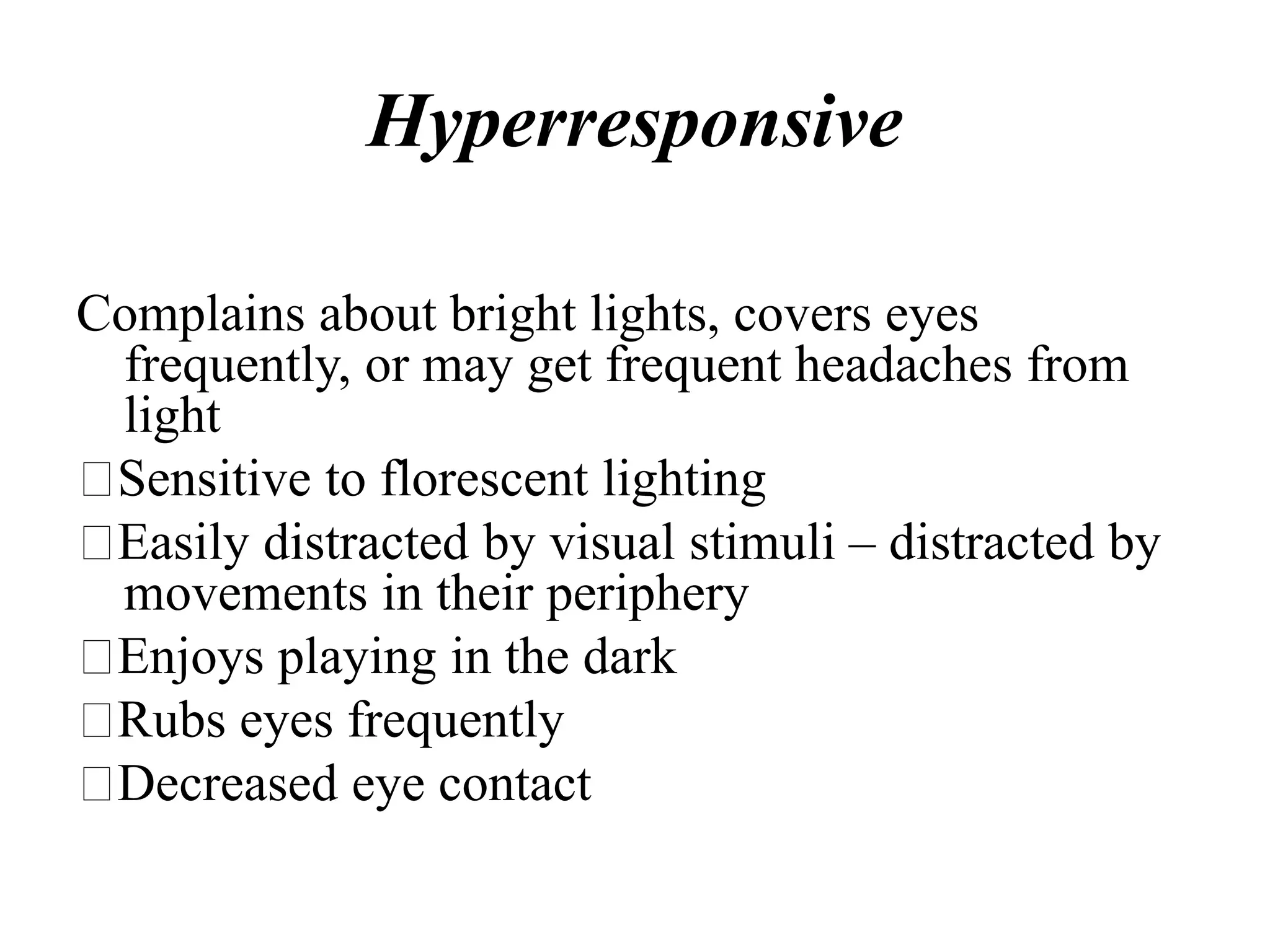
Manual form perception:
• Part I – involves identifying the visual
counterpart of a geometric form held and
manipulated in the hand.
• Part II – involves feeling a shape with one hand
and finding the matching shape among a line of
blocks manipulated with the other hand,
without the aid of vision and visual cues.
• Scoring is software mediated
Other Types-
• Bruinenski Osestery Test – 2 (BOT-2)
visuomotor test
• Test Of Visual Analysis (TVAS) - non motor
• Developmental Test Of Visual Motor
Integration.(DTVMI)
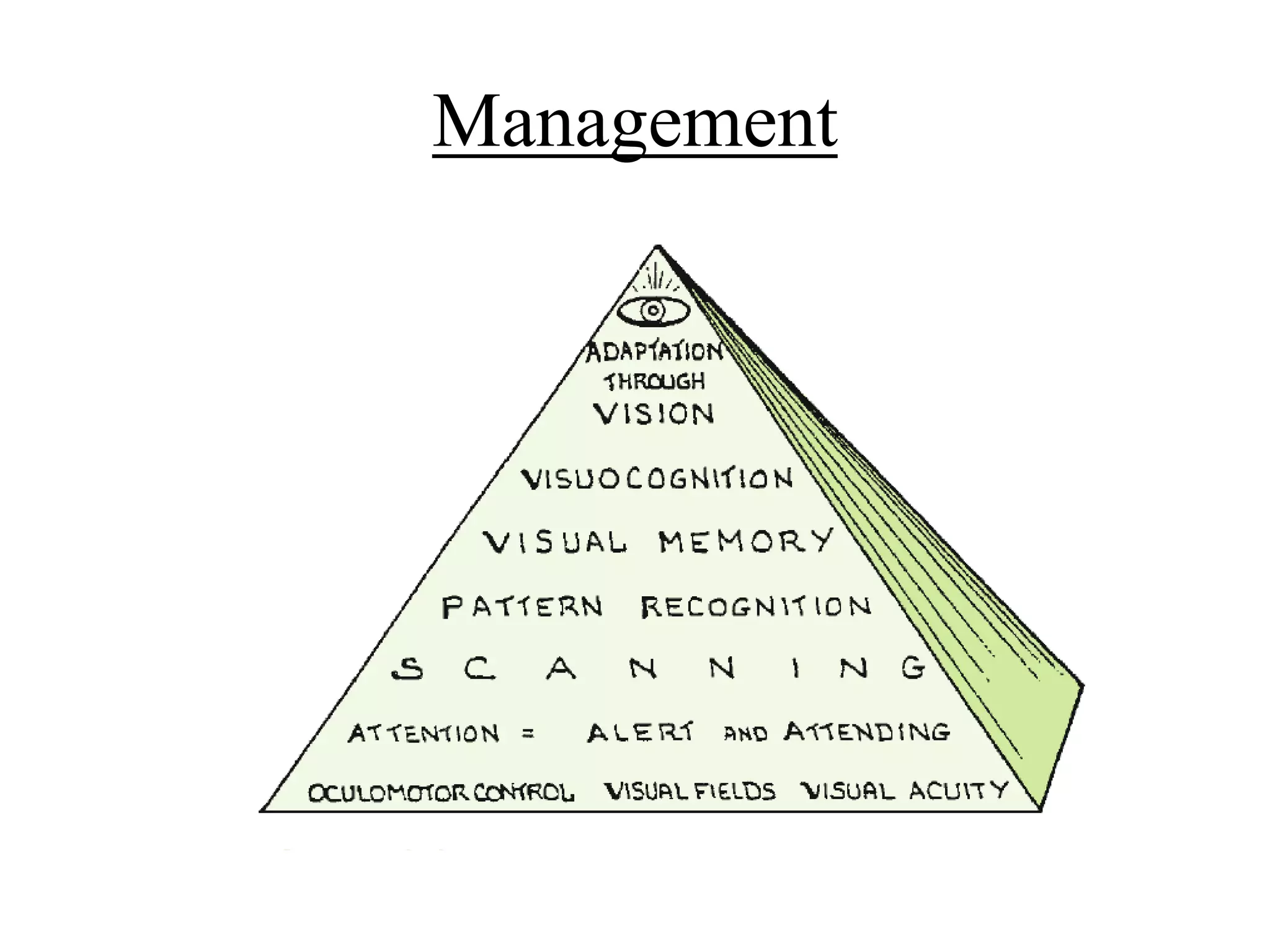
Management
Management
• Attention
• If the child has reduced arousal to perform a task then, start
with a sensory input that arouses the child and then give a
meaningful task to the child.
• Organize the workspace- if under responsive child use high
contrast colors for making and give a visually attractive
workspace.
• If hyper-responsive- organize workspace into categories.
• Give less no. of letters per page.
Memory-
• Repetition and constancy of learned items at home and school.
• When learning new items associate it with older memories and
let them know why it is different.
DISCRIMINTION-
• Use tactile and proprioceptive system for academic learning.
• Maps for topographical identification.
• Practicing imitation, identification of letters.
• For improving body schema or spatial orientation- imitation
games, holding positions and R-L discrimination games.
• Provide various positions to work so that the eyes have a
stable head and body.
ARTICLE
 Reem M. Alwhaibi, Reham S. Alsakhawi & Safaa M. ElKholi
(2019)
 Augmented Biofeedback Training with Physical Therapy
Improves Visual-Motor Integration, Visual Perception, and
Motor Coordination in Children with Spastic Hemiplegic
Cerebral Palsy: A RCT
 Physical & Occupational Therapy In Pediatrics,
10.1080/01942638.2019.1646375
• Children with spastic hemiplegia have impairments in visual-motor
integration (VMI) that affect the interaction of motor, visual perceptual, and
visual skills.
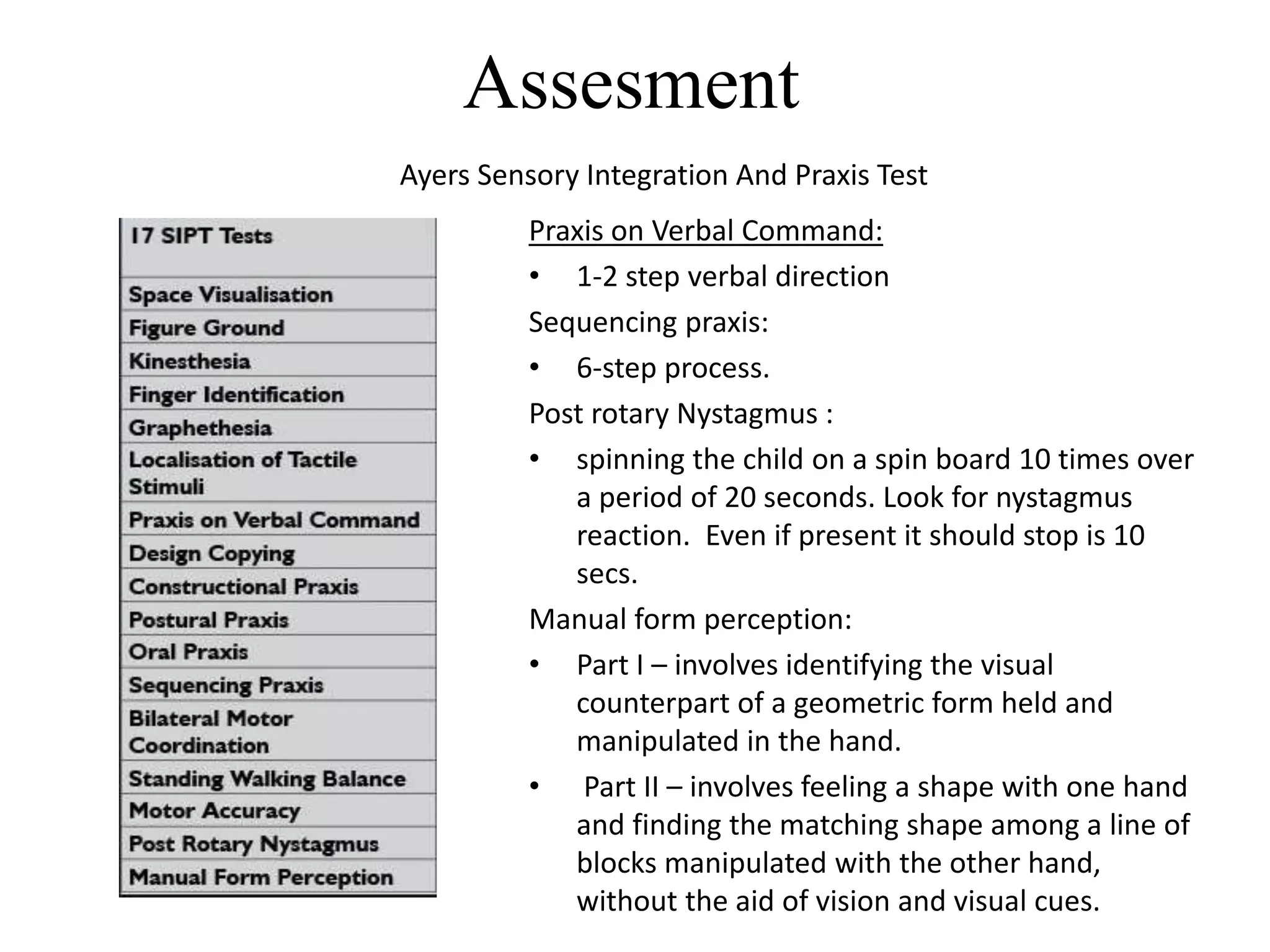
• Specific disorders of visuoconstruction, evidenced by limitations in
activities, such as reproducing spatial configurations with square blocks,
drawing from a model, and spontaneous drawing, have been demonstrated
in children with right- and left-side hemiplegia .
• Augmented feedback is defined as external information about a
performance that supplements internal sensory feedback. Theoretically,
when learning happens the controlling process changes gradually from a
closed-loop system to an open-loop system using explicit or implicit
learning.
Introduction
Inclusion
1. 5to 8yrs spastic hemi with MAS in upper limb flexor muscle
group between 1 and 1+
2. ability to handle objects independently as described for
levels I and II of the Manual Ability Classification System
3. able to understand and follow verbal commands and
instructions.
Exclusion Criteria
1. presence of visual or auditory impairments (using eye
glasses or hearing aids)
2. moderate to severe contractures; fixed deformities in the
upper limbs
3. severe spasticity
4. autism
5. severe cognitive impairment
6. epilepsy; botulinum toxin A upper extremity treatments
within the previous 6 months
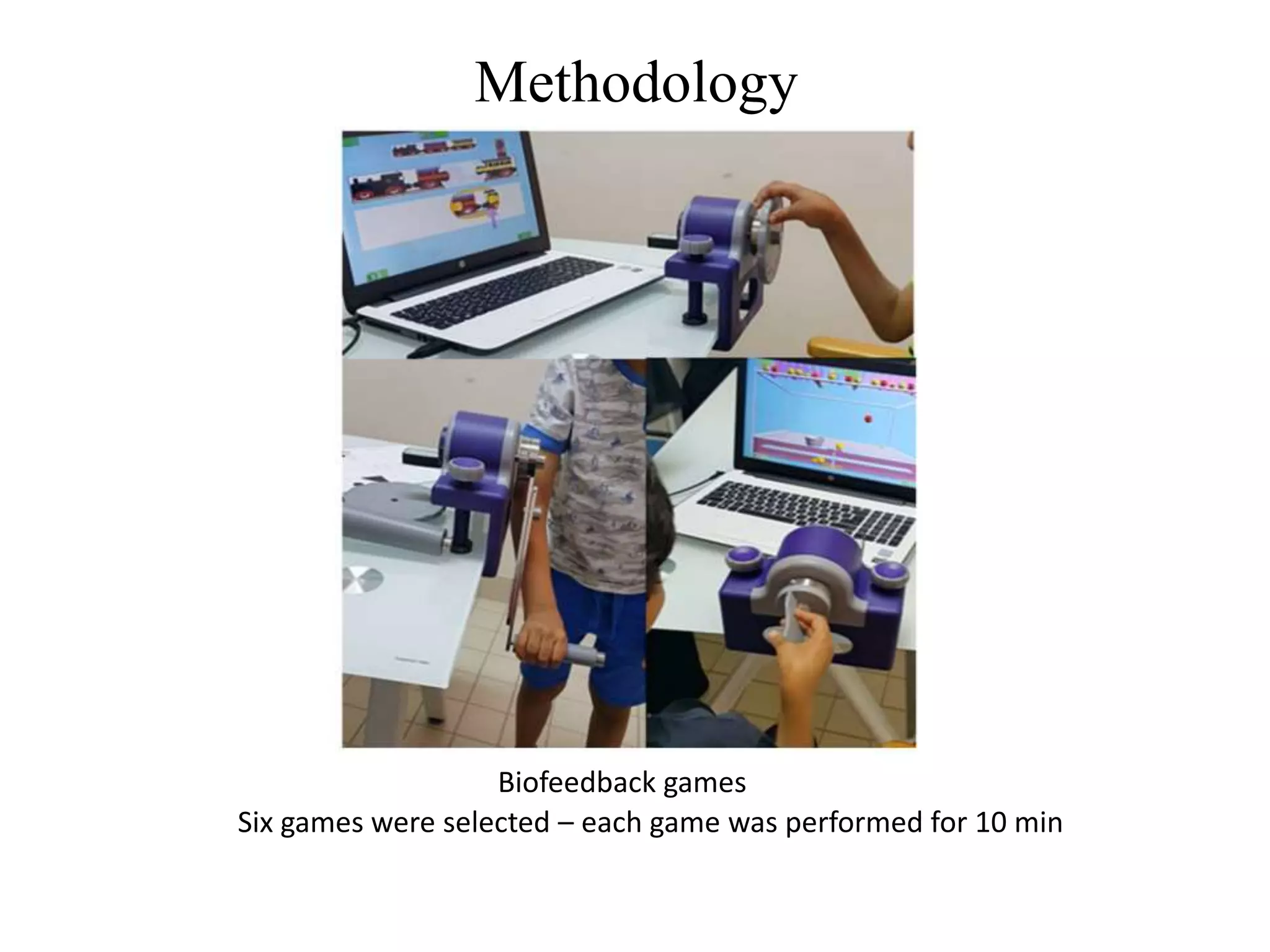
Methodology
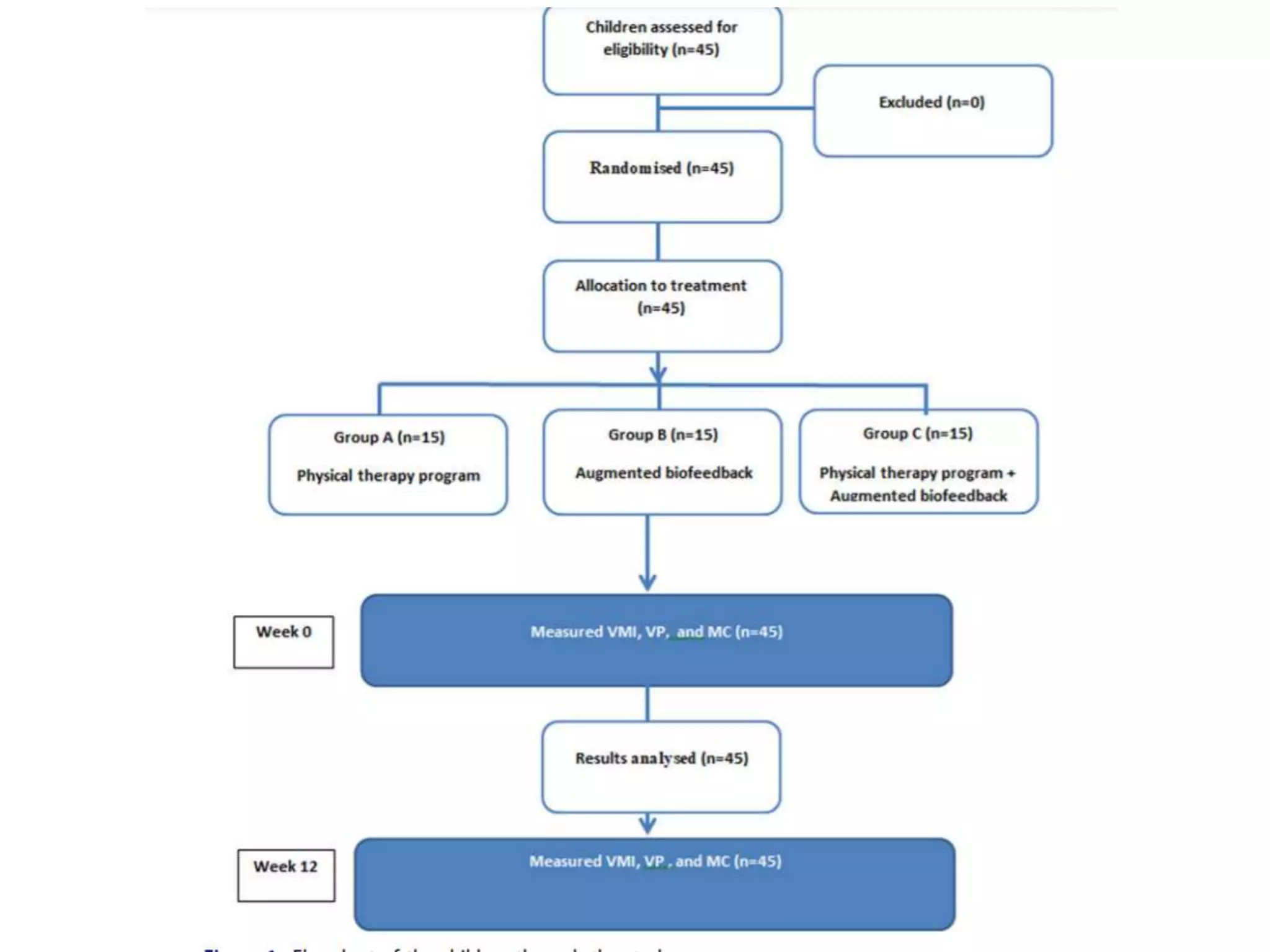
Six games were selected – each game was performed for 10 min
Biofeedback games
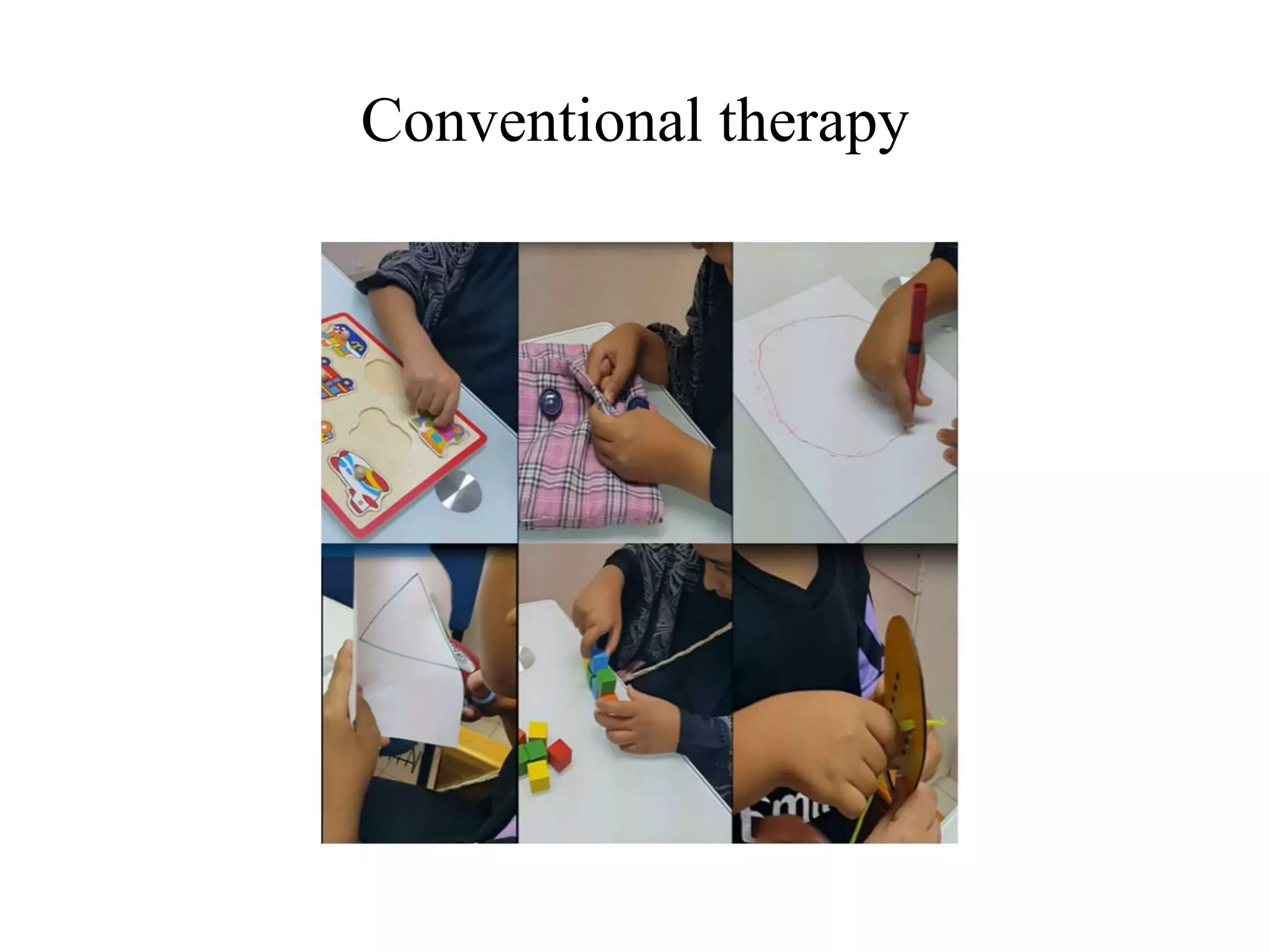
Conventional therapy
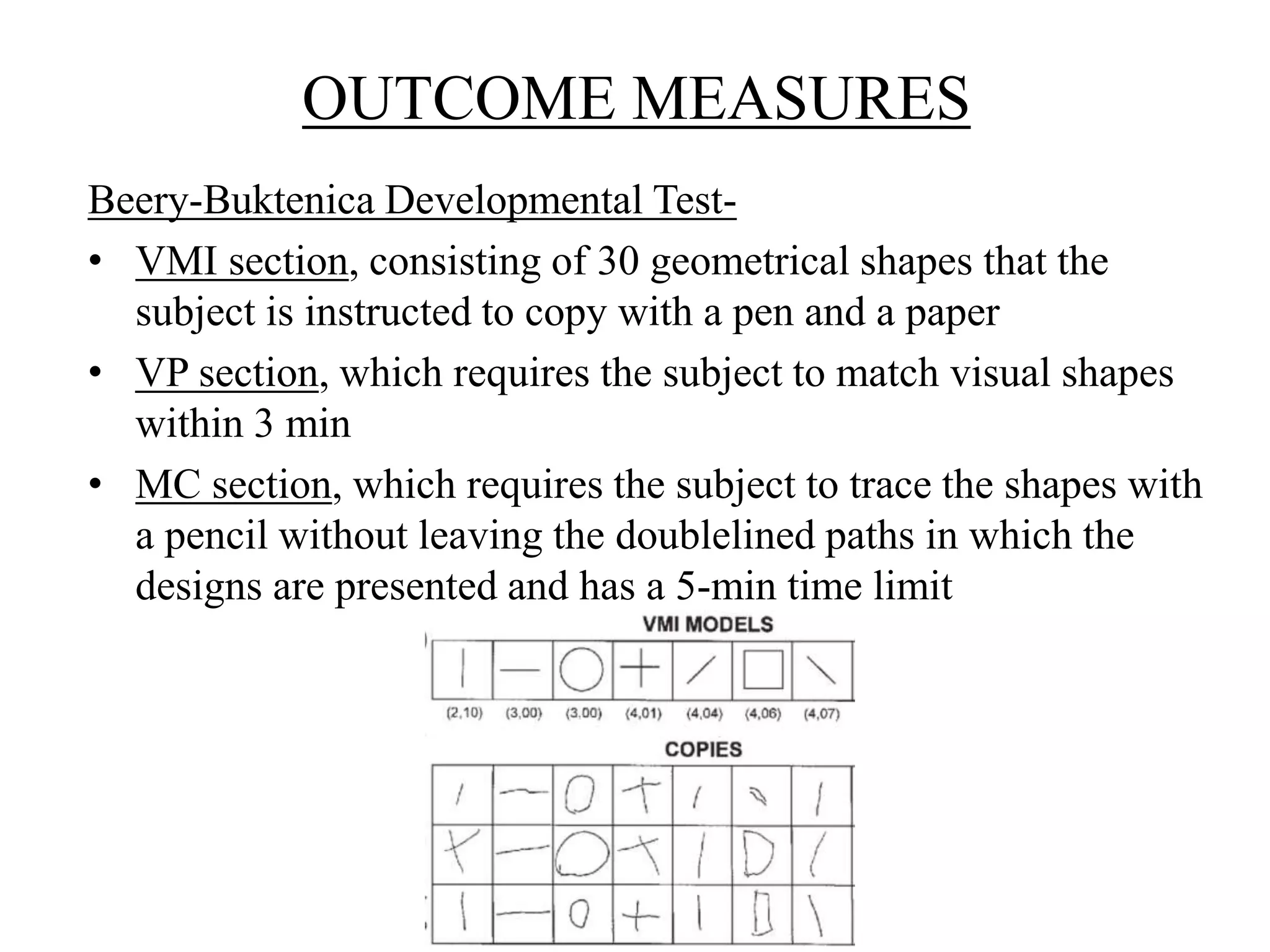
OUTCOME MEASURES
Beery-Buktenica Developmental Test-
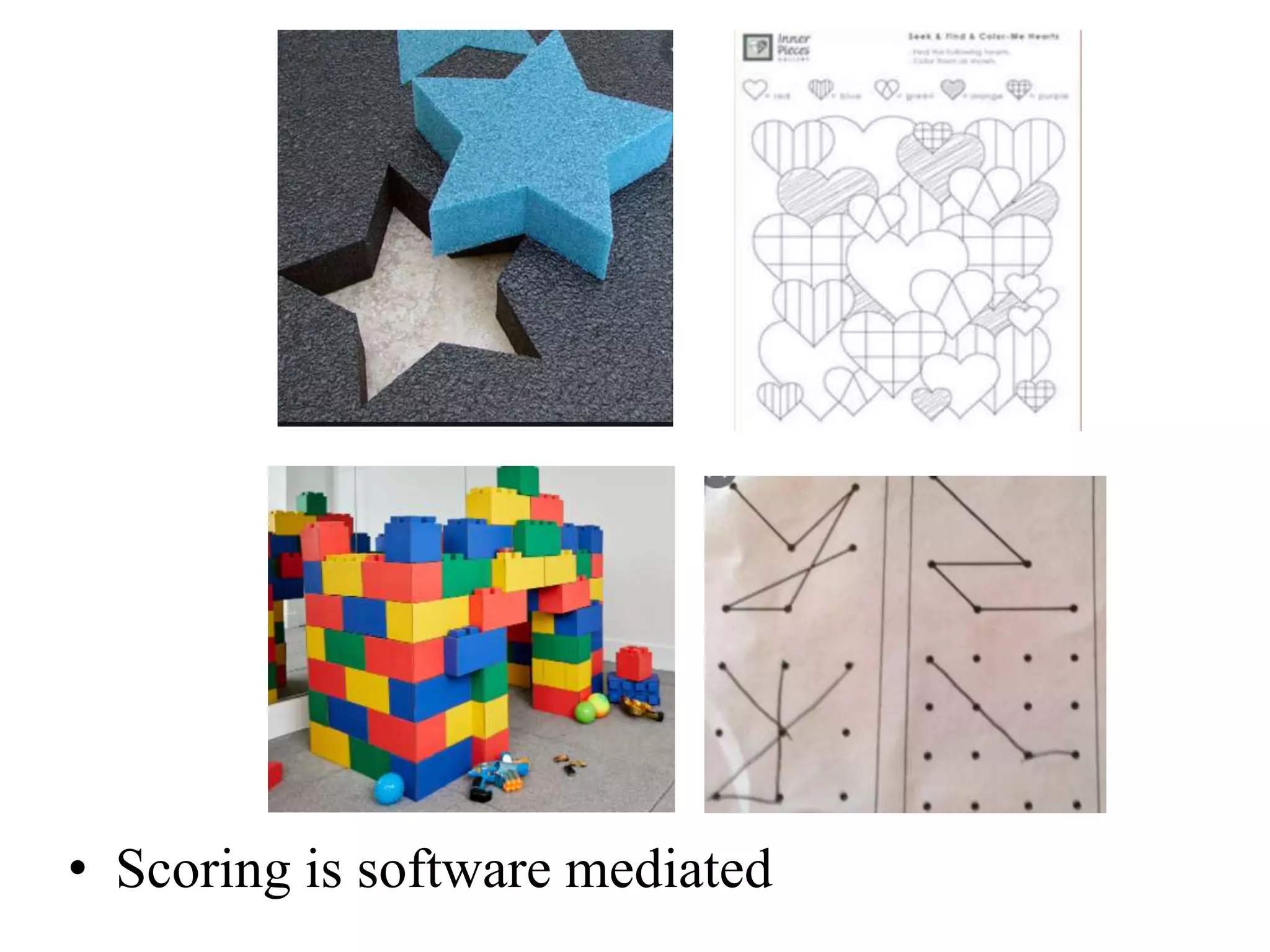
• VMI section, consisting of 30 geometrical shapes that the
subject is instructed to copy with a pen and a paper
• VP section, which requires the subject to match visual shapes
within 3 min
• MC section, which requires the subject to trace the shapes with
a pencil without leaving the doublelined paths in which the
designs are presented and has a 5-min time limit
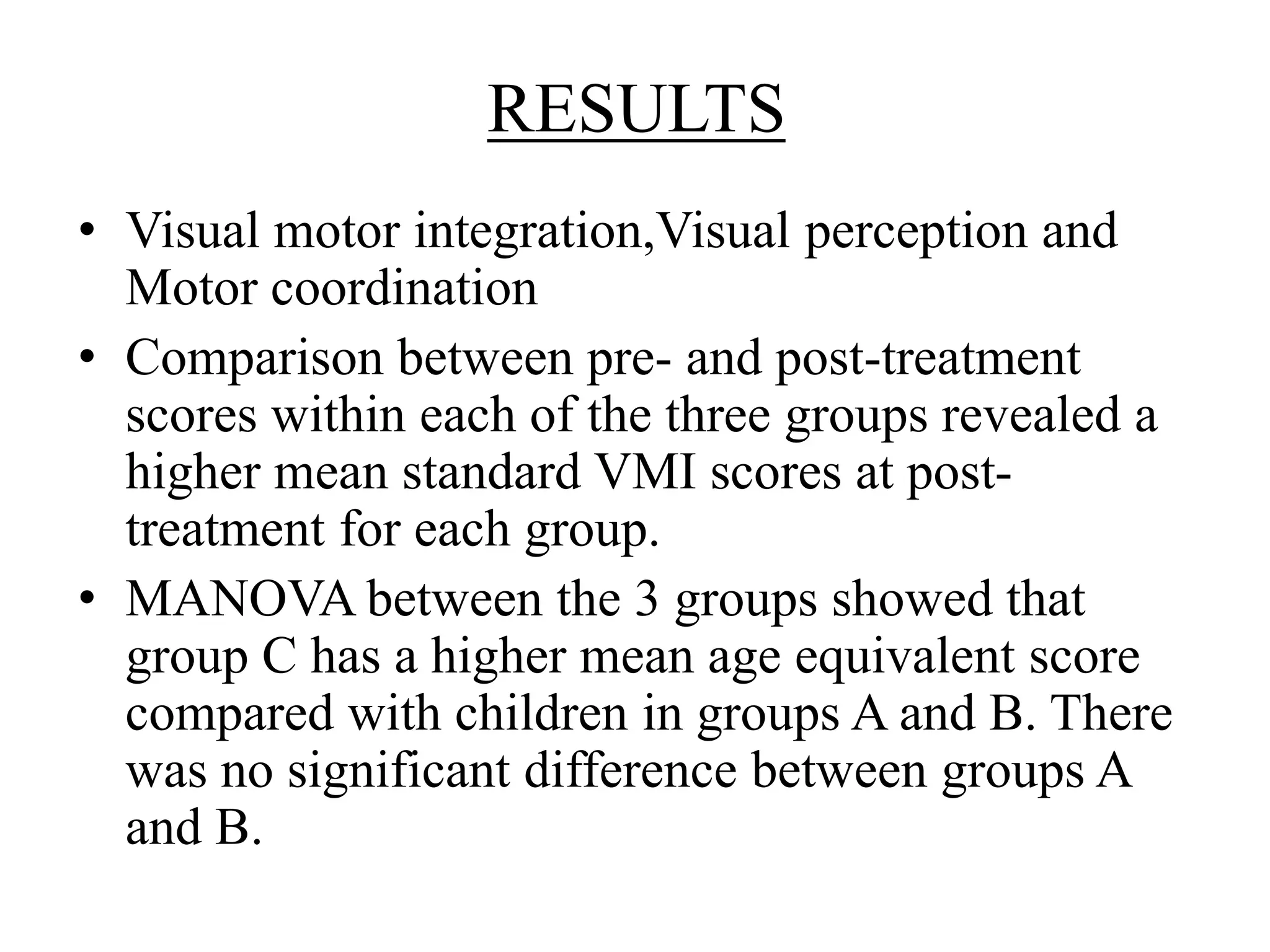
RESULTS
• Visual motor integration,Visual perception and
Motor coordination
• Comparison between pre- and post-treatment
scores within each of the three groups revealed a
higher mean standard VMI scores at post-
treatment for each group.
• MANOVA between the 3 groups showed that
group C has a higher mean age equivalent score
compared with children in groups A and B. There
was no significant difference between groups A
and B.
Discussion
• The optimal outcome of the training is that children could
use feedback to improve manual actions performed with the
affected hand, specifically actions involving fine motor
skills.
• Biofeedback has been reported to enhance treatment
programs and facilitate motor learning by engaging sensory
inputs, and it may enhance compensatory strategies
required to overcome functional losses.
• The improvement noted in the group who received
combined therapy could be related to timing of feedback
received,(i.e) within milliseconds of the movement
accomplishment.
• The children in the biofeedback group relied more on the
visual and auditory systems to process information.
• Preliminary evidence suggests that interacting with
games that are associated with visual feedback
improves the accuracy of motor actions compared
with performing the same exercises with limited
feedback or from memory.
• The use of feedback during the execution of specific
movements helps in motor skill acquisition.
• The improvements could be related to neural
plasticity and remapping of the cortical areas.
REFERENCES
• Sensory integration in children by: Anita
Bundy
• Case-Smith/O’Brien: Occupational Therapy
for Children, 6th edition

Visual perception from the point of view of Sensory Integration

  • 1.
  • 2.
    Introduction • Visual perceptionis defined as the total process of the reception (sensory functions) and cognition (specific mental functions) of visual stimuli. • Visual receptive component is the process of extracting and organizing information from the environment. • Visual-cognitive component is the specific mental functions that provide the capacity to organize,and interpret visual stimuli giving meaning to what is seen. • The vestibular -proprioceptive and tactile integration is the base on which the visual and auditory systems start to mature and integrate.
  • 3.
    Receptive systems M andP ganglion cells on and off center cells bipolar cells
  • 5.
    Visual PATHWAYS • 1Pathway- Parvo and magnocellular pathways- starting from the Lateral Geniculate Nucleus Functions- Magnocellular pathway- spatial orientation Paarvocellular pathway- colour , shape and size Dorsal stream – visually guided movements , to know the orientation of objects Ventral stream- concious identificaion of the object
  • 6.
    2 pathway- • Superiorcolliculus (SC) Function- map the visual space around us in terms of visual and somatosensory cues. Afferents- some fibers from the optic nerve, LGN, primary and association visual areas(17, 18, 19),spinotectal pathway (somatosensory input) Efferent – • tectospinal pathway, (reflexive movt of head and neck to visual stimulus) • occulomotor nuclei (saccades) • Tectopontine – for cerebellar processing of head and neck control.
  • 7.
    3 pathway- • Accessoryvisual pathway • Function- detects self-motion and generates corrective eye movements • some fibers from optic nerve  medial vestibular nuclei,eldinger west pal  inferior olivary complex Floculo nodular lobe cerebellum  medial vestibular nuclei  III,VI,V CNN 4 pathway- • frontal eye field- is connected via association fibers to occipetal lobe. • Function- Voluntary eye movements.
  • 8.
    Receptive functions • Visualfixation and conjugate eye movts are controlled by occulomotor nerve which receives inputs from SC. Fixation is prerequisite for scanning. • Pursuit- it is important for visual fixation on a moving object. Slow conjugate movements of the eyes. • Saccades- rapid change of visual fixation. It may be voluntary or involuntary. • Acuity- discriminate the fine details of objects in the visual field.
  • 9.
    • Accommodation- theability to focus on an object at varying distances. 3 steps are involved in it- – Convergence or divergence – contraction of ciliary muscles – pupillary dilation. • Binocular fusion- Motor fusion - both the eyes should be in the same position . By equal action of the extra ocular muscles . Sensory fusion – image formed on both the retina should be of same size and characteristics. • Stereopsis- depth perception, peripheral vision is important in depth perception. • crude steropsis at- LGN • fine - occipetal and posterior parietal centers • Convergence and Divergence.
  • 10.
    VISUAL COGNATIVE FUNCTIONS VISUAL ATTENTION ALERTNESS VIGILANCE SELECTIVE ATTENTION DIVIDED ATTENTION VISUALMEMORY WORKING MEMORY LTM VISUAL DISCRIMINATION OBJECT PERCEPTION SPATIAL PERCEPTION VISUAL IMAGERY
  • 11.
  • 12.
    OBJECT PERCEPTION FORM CONSTANCY FIGUREGROUND PERCEPTION VISUAL CLOSURE
  • 13.
    SPATIAL PERCEPTION POSITION OFOBJECT IN VISUOSPATIAL ENVIRONMENT DEPTH PERCEPTION TOPOGRAPHICAL PERCEPTION d , b Saw, was
  • 14.
    VISION AND BODYSCHEMA • It is an unconscious internal representation of the body providing a postural frame of reference. • It is always updated during movements. • The coordinates of the body and the coordinates of the environment should match for an efficient and coordinated postural and movement control. • It is important for interpreting self-motion, and to calibrate motor actions. • The proprioceptive-tactile-visual system contribute for formation of Body schema. • When in a new environment or learning new actions vision is used to constantly update body positions until the proprioceptive and tactile can take over the function once it is learnt.
  • 15.
    VISION AND BALANCE •Vision-vestibular-prorioception important for balance and postural control. • Visual gives the sense of verticality with respect to the vertical objects in the environment. • During reactive response peripheral vision is of particular importance. As the person holds or places his foot during the holding or placing reaction dependants on the ergocentric visual map.
  • 16.
    Age Movement Gestational 5TH month eyemovements are produced by vestibular influences 1 week Attentive to Human faces 2nd month Visual fixation, accommodation, convergence, and saccades and pursuits, stereopsis 4 months Categorise objects, visually directed reaching and downward gaze established 1 yr Body schema develops, lateralisation, bilateral coordination 3 -7 years Figure-ground perception , good eye hand coordination 6 and 7 years Form constancy , ability to regulate attention 7 to 9 years Position in space 7-10 years of age directionality 18 years Visual acuity is best Developmental changes in visual system
  • 17.
    • Developementally controldevelops from horizontal eye,vertical movements ,diagonal, and circular directions. • Visual perception develops completely- 9 years of age • Until that age child prefers to learn via tactile, proprioceptive systems.
  • 18.
  • 19.
    SENSORY MODULATION • REGISTRATION– • fails to attend to and register relevant environmental stimuli. When CNS is working well, it knows when to “pay attention” to a stimulus and when to “ignore" it automatically and efficiently. • Failure of registering life saving inputs can be dangerous. • Because of reduced sensory inputs the child lacks the inner drive. • Unless there is sensory registration there will be no adaptive behavior.
  • 20.
    Hyporesponsive and problemswith discimination Seeks out visual stimulation Effects a child’s visual tracking, discrimination, and perception Difficulty with visual discrimination – b and d, q and p for example Reversals when reading – now for won, no for on, was, for saw Difficulty telling the differences between colors, shapes, and sizes Difficulty copying from a chalkboard Inconsistent sizing or spacing when writing, doesn’t write on the line
  • 21.
    Hyperresponsive Complains about brightlights, covers eyes frequently, or may get frequent headaches from light Sensitive to florescent lighting Easily distracted by visual stimuli – distracted by movements in their periphery Enjoys playing in the dark Rubs eyes frequently Decreased eye contact
  • 22.
    Summary of FunctionsVisual Perception- • Balance and postural control along with vestibular and proprioceptive systems. • Ergocentric map of the environment. • Along with other senses involves in building the body schema. • Navigate the environment along the integration with other sensory systems. • Ability to locate a sound source accurately along with the visual-auditory-vestibular integration. • Accurate reaching process. • Higher cognitive process- writing reading.
  • 23.
    Assesment Ayers Sensory IntegrationAnd Praxis Test Praxis on Verbal Command: • 1-2 step verbal direction Sequencing praxis: • 6-step process. Post rotary Nystagmus : • spinning the child on a spin board 10 times over a period of 20 seconds. Look for nystagmus reaction. Even if present it should stop is 10 secs. Manual form perception: • Part I – involves identifying the visual counterpart of a geometric form held and manipulated in the hand. • Part II – involves feeling a shape with one hand and finding the matching shape among a line of blocks manipulated with the other hand, without the aid of vision and visual cues.
  • 24.
    • Scoring issoftware mediated
  • 25.
    Other Types- • BruinenskiOsestery Test – 2 (BOT-2) visuomotor test • Test Of Visual Analysis (TVAS) - non motor • Developmental Test Of Visual Motor Integration.(DTVMI)
  • 26.
  • 27.
    Management • Attention • Ifthe child has reduced arousal to perform a task then, start with a sensory input that arouses the child and then give a meaningful task to the child. • Organize the workspace- if under responsive child use high contrast colors for making and give a visually attractive workspace. • If hyper-responsive- organize workspace into categories. • Give less no. of letters per page.
  • 28.
    Memory- • Repetition andconstancy of learned items at home and school. • When learning new items associate it with older memories and let them know why it is different. DISCRIMINTION- • Use tactile and proprioceptive system for academic learning. • Maps for topographical identification. • Practicing imitation, identification of letters. • For improving body schema or spatial orientation- imitation games, holding positions and R-L discrimination games. • Provide various positions to work so that the eyes have a stable head and body.
  • 29.
    ARTICLE  Reem M.Alwhaibi, Reham S. Alsakhawi & Safaa M. ElKholi (2019)  Augmented Biofeedback Training with Physical Therapy Improves Visual-Motor Integration, Visual Perception, and Motor Coordination in Children with Spastic Hemiplegic Cerebral Palsy: A RCT  Physical & Occupational Therapy In Pediatrics, 10.1080/01942638.2019.1646375
  • 30.
    • Children withspastic hemiplegia have impairments in visual-motor integration (VMI) that affect the interaction of motor, visual perceptual, and visual skills. • Specific disorders of visuoconstruction, evidenced by limitations in activities, such as reproducing spatial configurations with square blocks, drawing from a model, and spontaneous drawing, have been demonstrated in children with right- and left-side hemiplegia . • Augmented feedback is defined as external information about a performance that supplements internal sensory feedback. Theoretically, when learning happens the controlling process changes gradually from a closed-loop system to an open-loop system using explicit or implicit learning. Introduction
  • 31.
    Inclusion 1. 5to 8yrsspastic hemi with MAS in upper limb flexor muscle group between 1 and 1+ 2. ability to handle objects independently as described for levels I and II of the Manual Ability Classification System 3. able to understand and follow verbal commands and instructions. Exclusion Criteria 1. presence of visual or auditory impairments (using eye glasses or hearing aids) 2. moderate to severe contractures; fixed deformities in the upper limbs 3. severe spasticity 4. autism 5. severe cognitive impairment 6. epilepsy; botulinum toxin A upper extremity treatments within the previous 6 months
  • 33.
    Methodology Six games wereselected – each game was performed for 10 min Biofeedback games
  • 34.
  • 35.
    OUTCOME MEASURES Beery-Buktenica DevelopmentalTest- • VMI section, consisting of 30 geometrical shapes that the subject is instructed to copy with a pen and a paper • VP section, which requires the subject to match visual shapes within 3 min • MC section, which requires the subject to trace the shapes with a pencil without leaving the doublelined paths in which the designs are presented and has a 5-min time limit
  • 36.
    RESULTS • Visual motorintegration,Visual perception and Motor coordination • Comparison between pre- and post-treatment scores within each of the three groups revealed a higher mean standard VMI scores at post- treatment for each group. • MANOVA between the 3 groups showed that group C has a higher mean age equivalent score compared with children in groups A and B. There was no significant difference between groups A and B.
  • 37.
    Discussion • The optimaloutcome of the training is that children could use feedback to improve manual actions performed with the affected hand, specifically actions involving fine motor skills. • Biofeedback has been reported to enhance treatment programs and facilitate motor learning by engaging sensory inputs, and it may enhance compensatory strategies required to overcome functional losses. • The improvement noted in the group who received combined therapy could be related to timing of feedback received,(i.e) within milliseconds of the movement accomplishment. • The children in the biofeedback group relied more on the visual and auditory systems to process information.
  • 38.
    • Preliminary evidencesuggests that interacting with games that are associated with visual feedback improves the accuracy of motor actions compared with performing the same exercises with limited feedback or from memory. • The use of feedback during the execution of specific movements helps in motor skill acquisition. • The improvements could be related to neural plasticity and remapping of the cortical areas.
  • 39.
    REFERENCES • Sensory integrationin children by: Anita Bundy • Case-Smith/O’Brien: Occupational Therapy for Children, 6th edition