EXECUTIVE
FUNCTION
Hashem Farhangdoost PhD in Cognitive Neuroscience
‫تخصصی‬‫کارگاه‬‫اجرایی‬‫عملکردهای‬‫توانبخشی‬
‫پاییز‬1396
Theoretical and Clinical Construct
◦ an umbrella term used for hypothesized cognitive processes,
◦ planning,
◦ working memory,
◦ attention,
◦ inhibition,
◦ self-monitoring,
◦ self-regulation,
◦ initiation
◦ carried out by prefrontal areas of the frontal lobes
Theoretical and Clinical Construct
◦ control mechanism was discussed as far back as the 1840s
◦ Phineas Gage
◦ destroyed a majority of his left frontal lobe
◦ disinhibited” or “hyperactive,”
Theoretical and Clinical Construct
◦ Donald Broadbent (1953) described differences between
◦ Automatic and controlled processes
◦ In 1975, Michael Posner coined the term “cognitive control”
◦ a branch of the attentional system responsible for focusing attention on selected
aspects of the environment
◦ Alan Baddeley proposed a model of working memory, “central executive”
◦ information to be manipulated in short-term memory.
Theoretical and Clinical Construct
◦ Lezak (1995) suggested that EF consisted of components related to
◦ volition
◦ planning
◦ purposeful action
◦ effective performance
◦ Reynolds and Horton ( 2006 ) suggested
◦ EFs are distinct from general knowledge
◦ executive functions : capacity to plan, to do things, and to perform adaptive actions,
◦ general knowledge : retention of an organized set of objective facts
◦ EF involves decision making, planning actions, and generating novel motor outputs adapted to external
demands
Theoretical and Clinical Construct
◦ Naglieri and Goldstein( 2013 ) executive function is
◦ best represented as a single phenomena,
◦ Conceptualized as the efficiency
◦ attention
◦ emotion regulation
◦ flexibility
◦ inhibitory control
◦ initiation
◦ organization
◦ planning
◦ self-monitoring
◦ working memory
Theoretical and Clinical Construct
◦Luria ( 1966 ):
◦ “…besides the disturbance of initiative and the other aforementioned behavioral
disturbances, almost all patients with a lesion of the frontal lobes have a marked
loss of their ‘critical faculty,’ i.e., a disturbance of their ability to correctly evaluate
their own behavior and the adequacy of their actions.”
Theoretical and Clinical Construct
◦Luria ( 1966 ):
◦ dysexecutive syndrome
◦ there must be some overarching system responsible for coordinating other cognitive
resources that appeared to be working inefficiently in patients with frontal lobe injuries
◦ the PFC as responsible for EF
◦ ACC
◦ DLPFC
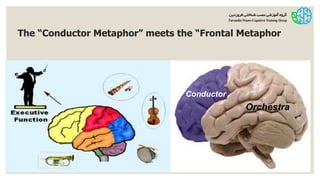
The “Conductor Metaphor” meets the “Frontal Metaphor
Conductor
Orchestra
Broadbent’s model (bottleneck theory)
◦ Donald Broadbent’s (1953) model of automatic and controlled processes
◦ Filter model,
◦ a filter serves as a buffer
◦ selects information for conscious awareness
◦ When competing stimuli, the filter determines which information must be distinguished as
relevant or irrelevant
Broadbent’s model (bottleneck theory)
◦ information will pass through the filter (as relevant)
◦ remaining information is ignored (irrelevant)
◦ “sensory store” and “sensory filter” :
◦ instrument in which processing of stimuli occurs at the preattentive level,
◦ focusing on properties such as the sex of the speaker or type of sound
◦ the processing of information could be represented with parallel lines
◦ processing is then managed with the filter
◦ resembling a bottleneck
Cognitive Control Model
◦ Posner and Snyder ( 1975 )
◦ Cognitive control is needed to manage thoughts and emotions
◦ By cognitive control, Posner refers to processes that guide behaviors,
◦ analogous to working definitions of executive functioning today
◦ cognitive control : responsible in overwriting automatic responses,
◦ illustrating the selective nature of the model as well as the inhibitory nature
◦ cognitive control allows one to adapt from situation to situation depending
upon the goals of the individual
Automatic /Controlled processes
◦ Automatic processes
◦ effortless
◦ rapid
◦ unavailable to consciousness
◦ and unavoidable
◦ Permanent connections that are developed with practice or training
◦ Without a need for active attention or active control
◦ Controlled processes
◦ slow
◦ effortful
◦ completely conscious
◦ a temporary sequence of nodes activated under control of attention
A Developmental Perspective of EF
◦ development of EF can be found in the works of Luria ( 1963 , 1966 , 1973 )
◦ stages of higher cortical maturation
◦ optimal interaction of neurological development and environmental stimuli
◦ result in more efficient cortical functioning
◦ abilities such as language, attention, memory, intelligence, and EF
A Developmental Perspective of EF
◦ Luria proposed five stages of human development
◦ Stage One:
◦ begins in the first year of life and
◦ involves development of the brain stem structures such as the reticular activating system
◦ Stage Two: (sensation)
◦ involves the activation of the primary sensory areas for vision, hearing, and tactile
perception and the primary motor
◦ areas of gross motor movement during the second year of life
◦ This is consistent with Piaget’s stage of sensorimotor operations
A Developmental Perspective of EF
◦ Stage Three: (perception)
◦ involves development of single modalities in the secondary association areas
◦ children enter their preschool years
◦ The child’s mind recognized and reproduces various symbolic materials
◦ develops the ability to model physical movement
◦ consistent with Piaget’s concept of preoperational functioning
A Developmental Perspective of EF
◦ Stage Four: (imagination)
◦ begins as the child enters first or second grade (7–8 years of age)
◦ tertiary areas of the parietal lobes are activated
◦ The tertiary parietal lobes, the temporal parietal and occipital lobes join anatomically
and involve coordination of the three major sensory input channels
◦ the child’s mind begins to make sense of sensory input and environmental stimulation
◦ important for the development of complex mental abilities
◦ fits Piaget’s concept of concrete operations
A Developmental Perspective of EF
◦ Stage Five:
◦ the brain becomes activated
◦ beginning at approximately 8 years through adolescence and adulthood
◦ This operation involves the frontal lobes
◦ Is crucial to the development of complex mental abilities
◦ abstract thinking,
◦ intentional memory
◦ execution monitoring
◦ evaluating for complex learning
◦ fits Piaget’s concept of formal operations
A Developmental Perspective of EF
◦ The executive functions managed by the third functional unit,
◦ as described by Luria,
◦ regulate the attentional processes of the first functional unit
◦ first functional unit sustaining the appropriate level of arousal and vigilance necessary for
the detection of selection of relevant details from the environment
◦ Inhibitory behavior allows a child to resist or inhibit responding to saline by irrelevant details
during a task
◦ improves task performance
◦ Response inhibition allows the child to focus over time on task-relevant features
Functional Units
◦ Primary zone in the motor strip of frontal lobe being concerned
with motor output
◦ Secondary zone is responsible for
◦ the sequencing of motor activity
◦ speech production
◦ Tertiary zone is primarily involved with behaviors typically
described as executive function
Functional Units
◦ Damage to any of several areas of the frontal regions result in
difficulties with
◦ impulse control
◦ Learning from mistakes
◦ delay of gratification
◦ efficient attention
Functional Units
◦ The frontal lobe provide
◦ programming
◦ regulation
◦ evaluation of behavior
◦ enable the child to ask questions
◦ develop strategies
◦ self-monitor
Functional Units
◦ A reciprocal relationship exists between the first and third functional units
◦ The higher cortical systems both regulate and work in collaboration with the
first functional unit
◦ receiving and processing information from the external world
◦ determining an individual’s dynamic activity
◦ Ascending and descending systems of the reticular formation enable this
relationship by transmitting impulses from lower parts of the brain to the cortex
and vice versa
◦ damage to the prefrontal area alter this reciprocal relationship
◦ brain may not be sufficiently aroused for complex behaviors requiring sustained
attention
Functional Units
◦ damage to the prefrontal area alter this reciprocal relationship
◦ brain may not be sufficiently aroused for complex behaviors
requiring sustained attention
◦ “brain’s braking system
◦ right prefrontal cortex
◦ organs at the basal ganglia such as the substantia nigra
◦ cerebellum
◦ Humans are uniquely the only species capable of simultaneously
◦ thinking,
◦ Evaluating
◦ acting
Intervention
◦ Adherence
◦ the clinician’s implementation of procedures in a stable
manner over time,
◦ which can improve with consistent contact with other
individuals to discuss the treatment application process
◦ Adherence can be dependent on
◦ setting of the interventions: schools, clinics
◦ Functional levels of the client : more extreme deficits may require the
implementation of the same treatment protocol
Intervention
◦ Agent Competence
◦ the skill, experience, and/ or knowledge of the treatment agent
◦ Preservice training and in-service training
Intervention
◦ Consider the Child’s Developmental Level
◦ Environmental Modify cations May Include Altering
◦ the Physical or Social Environment
◦ the Task
◦ the Way Adults Interact with Children to Support Weak
Executive Skills
◦ Use Incentives to Augment Instruction
Intervention
◦ For tasks the child is not very good at, the approach to take is
◦ break them down into small steps and start with either the first
step and proceed forward or the last step and proceed
backward.
◦ No new step is added until mastery at the current step is
achieved
‫تخصصی‬ ‫کارگاه‬
‫اجرایی‬ ‫عملکردهای‬ ‫توانبخشی‬
‫اریم‬‫ز‬‫سپاسگ‬
www.farvardin-group.com
@farvardin_group_channel
@neuroscience4family
@farvardin_group96

Executive function

  • 1.
    EXECUTIVE FUNCTION Hashem Farhangdoost PhDin Cognitive Neuroscience ‫تخصصی‬‫کارگاه‬‫اجرایی‬‫عملکردهای‬‫توانبخشی‬ ‫پاییز‬1396
  • 2.
    Theoretical and ClinicalConstruct ◦ an umbrella term used for hypothesized cognitive processes, ◦ planning, ◦ working memory, ◦ attention, ◦ inhibition, ◦ self-monitoring, ◦ self-regulation, ◦ initiation ◦ carried out by prefrontal areas of the frontal lobes
  • 3.
    Theoretical and ClinicalConstruct ◦ control mechanism was discussed as far back as the 1840s ◦ Phineas Gage ◦ destroyed a majority of his left frontal lobe ◦ disinhibited” or “hyperactive,”
  • 4.
    Theoretical and ClinicalConstruct ◦ Donald Broadbent (1953) described differences between ◦ Automatic and controlled processes ◦ In 1975, Michael Posner coined the term “cognitive control” ◦ a branch of the attentional system responsible for focusing attention on selected aspects of the environment ◦ Alan Baddeley proposed a model of working memory, “central executive” ◦ information to be manipulated in short-term memory.
  • 5.
    Theoretical and ClinicalConstruct ◦ Lezak (1995) suggested that EF consisted of components related to ◦ volition ◦ planning ◦ purposeful action ◦ effective performance ◦ Reynolds and Horton ( 2006 ) suggested ◦ EFs are distinct from general knowledge ◦ executive functions : capacity to plan, to do things, and to perform adaptive actions, ◦ general knowledge : retention of an organized set of objective facts ◦ EF involves decision making, planning actions, and generating novel motor outputs adapted to external demands
  • 6.
    Theoretical and ClinicalConstruct ◦ Naglieri and Goldstein( 2013 ) executive function is ◦ best represented as a single phenomena, ◦ Conceptualized as the efficiency ◦ attention ◦ emotion regulation ◦ flexibility ◦ inhibitory control ◦ initiation ◦ organization ◦ planning ◦ self-monitoring ◦ working memory
  • 7.
    Theoretical and ClinicalConstruct ◦Luria ( 1966 ): ◦ “…besides the disturbance of initiative and the other aforementioned behavioral disturbances, almost all patients with a lesion of the frontal lobes have a marked loss of their ‘critical faculty,’ i.e., a disturbance of their ability to correctly evaluate their own behavior and the adequacy of their actions.”
  • 8.
    Theoretical and ClinicalConstruct ◦Luria ( 1966 ): ◦ dysexecutive syndrome ◦ there must be some overarching system responsible for coordinating other cognitive resources that appeared to be working inefficiently in patients with frontal lobe injuries ◦ the PFC as responsible for EF ◦ ACC ◦ DLPFC
  • 9.
    The “Conductor Metaphor”meets the “Frontal Metaphor Conductor Orchestra
  • 10.
    Broadbent’s model (bottlenecktheory) ◦ Donald Broadbent’s (1953) model of automatic and controlled processes ◦ Filter model, ◦ a filter serves as a buffer ◦ selects information for conscious awareness ◦ When competing stimuli, the filter determines which information must be distinguished as relevant or irrelevant
  • 11.
    Broadbent’s model (bottlenecktheory) ◦ information will pass through the filter (as relevant) ◦ remaining information is ignored (irrelevant) ◦ “sensory store” and “sensory filter” : ◦ instrument in which processing of stimuli occurs at the preattentive level, ◦ focusing on properties such as the sex of the speaker or type of sound ◦ the processing of information could be represented with parallel lines ◦ processing is then managed with the filter ◦ resembling a bottleneck
  • 12.
    Cognitive Control Model ◦Posner and Snyder ( 1975 ) ◦ Cognitive control is needed to manage thoughts and emotions ◦ By cognitive control, Posner refers to processes that guide behaviors, ◦ analogous to working definitions of executive functioning today ◦ cognitive control : responsible in overwriting automatic responses, ◦ illustrating the selective nature of the model as well as the inhibitory nature ◦ cognitive control allows one to adapt from situation to situation depending upon the goals of the individual
  • 13.
    Automatic /Controlled processes ◦Automatic processes ◦ effortless ◦ rapid ◦ unavailable to consciousness ◦ and unavoidable ◦ Permanent connections that are developed with practice or training ◦ Without a need for active attention or active control ◦ Controlled processes ◦ slow ◦ effortful ◦ completely conscious ◦ a temporary sequence of nodes activated under control of attention
  • 14.
    A Developmental Perspectiveof EF ◦ development of EF can be found in the works of Luria ( 1963 , 1966 , 1973 ) ◦ stages of higher cortical maturation ◦ optimal interaction of neurological development and environmental stimuli ◦ result in more efficient cortical functioning ◦ abilities such as language, attention, memory, intelligence, and EF
  • 15.
    A Developmental Perspectiveof EF ◦ Luria proposed five stages of human development ◦ Stage One: ◦ begins in the first year of life and ◦ involves development of the brain stem structures such as the reticular activating system ◦ Stage Two: (sensation) ◦ involves the activation of the primary sensory areas for vision, hearing, and tactile perception and the primary motor ◦ areas of gross motor movement during the second year of life ◦ This is consistent with Piaget’s stage of sensorimotor operations
  • 16.
    A Developmental Perspectiveof EF ◦ Stage Three: (perception) ◦ involves development of single modalities in the secondary association areas ◦ children enter their preschool years ◦ The child’s mind recognized and reproduces various symbolic materials ◦ develops the ability to model physical movement ◦ consistent with Piaget’s concept of preoperational functioning
  • 17.
    A Developmental Perspectiveof EF ◦ Stage Four: (imagination) ◦ begins as the child enters first or second grade (7–8 years of age) ◦ tertiary areas of the parietal lobes are activated ◦ The tertiary parietal lobes, the temporal parietal and occipital lobes join anatomically and involve coordination of the three major sensory input channels ◦ the child’s mind begins to make sense of sensory input and environmental stimulation ◦ important for the development of complex mental abilities ◦ fits Piaget’s concept of concrete operations
  • 18.
    A Developmental Perspectiveof EF ◦ Stage Five: ◦ the brain becomes activated ◦ beginning at approximately 8 years through adolescence and adulthood ◦ This operation involves the frontal lobes ◦ Is crucial to the development of complex mental abilities ◦ abstract thinking, ◦ intentional memory ◦ execution monitoring ◦ evaluating for complex learning ◦ fits Piaget’s concept of formal operations
  • 19.
    A Developmental Perspectiveof EF ◦ The executive functions managed by the third functional unit, ◦ as described by Luria, ◦ regulate the attentional processes of the first functional unit ◦ first functional unit sustaining the appropriate level of arousal and vigilance necessary for the detection of selection of relevant details from the environment ◦ Inhibitory behavior allows a child to resist or inhibit responding to saline by irrelevant details during a task ◦ improves task performance ◦ Response inhibition allows the child to focus over time on task-relevant features
  • 20.
    Functional Units ◦ Primaryzone in the motor strip of frontal lobe being concerned with motor output ◦ Secondary zone is responsible for ◦ the sequencing of motor activity ◦ speech production ◦ Tertiary zone is primarily involved with behaviors typically described as executive function
  • 21.
    Functional Units ◦ Damageto any of several areas of the frontal regions result in difficulties with ◦ impulse control ◦ Learning from mistakes ◦ delay of gratification ◦ efficient attention
  • 22.
    Functional Units ◦ Thefrontal lobe provide ◦ programming ◦ regulation ◦ evaluation of behavior ◦ enable the child to ask questions ◦ develop strategies ◦ self-monitor
  • 23.
    Functional Units ◦ Areciprocal relationship exists between the first and third functional units ◦ The higher cortical systems both regulate and work in collaboration with the first functional unit ◦ receiving and processing information from the external world ◦ determining an individual’s dynamic activity ◦ Ascending and descending systems of the reticular formation enable this relationship by transmitting impulses from lower parts of the brain to the cortex and vice versa ◦ damage to the prefrontal area alter this reciprocal relationship ◦ brain may not be sufficiently aroused for complex behaviors requiring sustained attention
  • 24.
    Functional Units ◦ damageto the prefrontal area alter this reciprocal relationship ◦ brain may not be sufficiently aroused for complex behaviors requiring sustained attention ◦ “brain’s braking system ◦ right prefrontal cortex ◦ organs at the basal ganglia such as the substantia nigra ◦ cerebellum ◦ Humans are uniquely the only species capable of simultaneously ◦ thinking, ◦ Evaluating ◦ acting
  • 28.
    Intervention ◦ Adherence ◦ theclinician’s implementation of procedures in a stable manner over time, ◦ which can improve with consistent contact with other individuals to discuss the treatment application process ◦ Adherence can be dependent on ◦ setting of the interventions: schools, clinics ◦ Functional levels of the client : more extreme deficits may require the implementation of the same treatment protocol
  • 29.
    Intervention ◦ Agent Competence ◦the skill, experience, and/ or knowledge of the treatment agent ◦ Preservice training and in-service training
  • 32.
    Intervention ◦ Consider theChild’s Developmental Level ◦ Environmental Modify cations May Include Altering ◦ the Physical or Social Environment ◦ the Task ◦ the Way Adults Interact with Children to Support Weak Executive Skills ◦ Use Incentives to Augment Instruction
  • 33.
    Intervention ◦ For tasksthe child is not very good at, the approach to take is ◦ break them down into small steps and start with either the first step and proceed forward or the last step and proceed backward. ◦ No new step is added until mastery at the current step is achieved
  • 34.
    ‫تخصصی‬ ‫کارگاه‬ ‫اجرایی‬ ‫عملکردهای‬‫توانبخشی‬ ‫اریم‬‫ز‬‫سپاسگ‬ www.farvardin-group.com @farvardin_group_channel @neuroscience4family @farvardin_group96