Copyright © 2012 Pearson Education, Inc., publishing as Benjamin Cummings
Carl P. Gabbard
PowerPoint® Lecture Slide Presentation revised by
Alberto Cordova, University of Texas at San Antonio
Copyright © 2012 Pearson Education, Inc., publishing as Benjamin Cummings
Perception
• Gathering, monitoring, and interpreting sensory
information
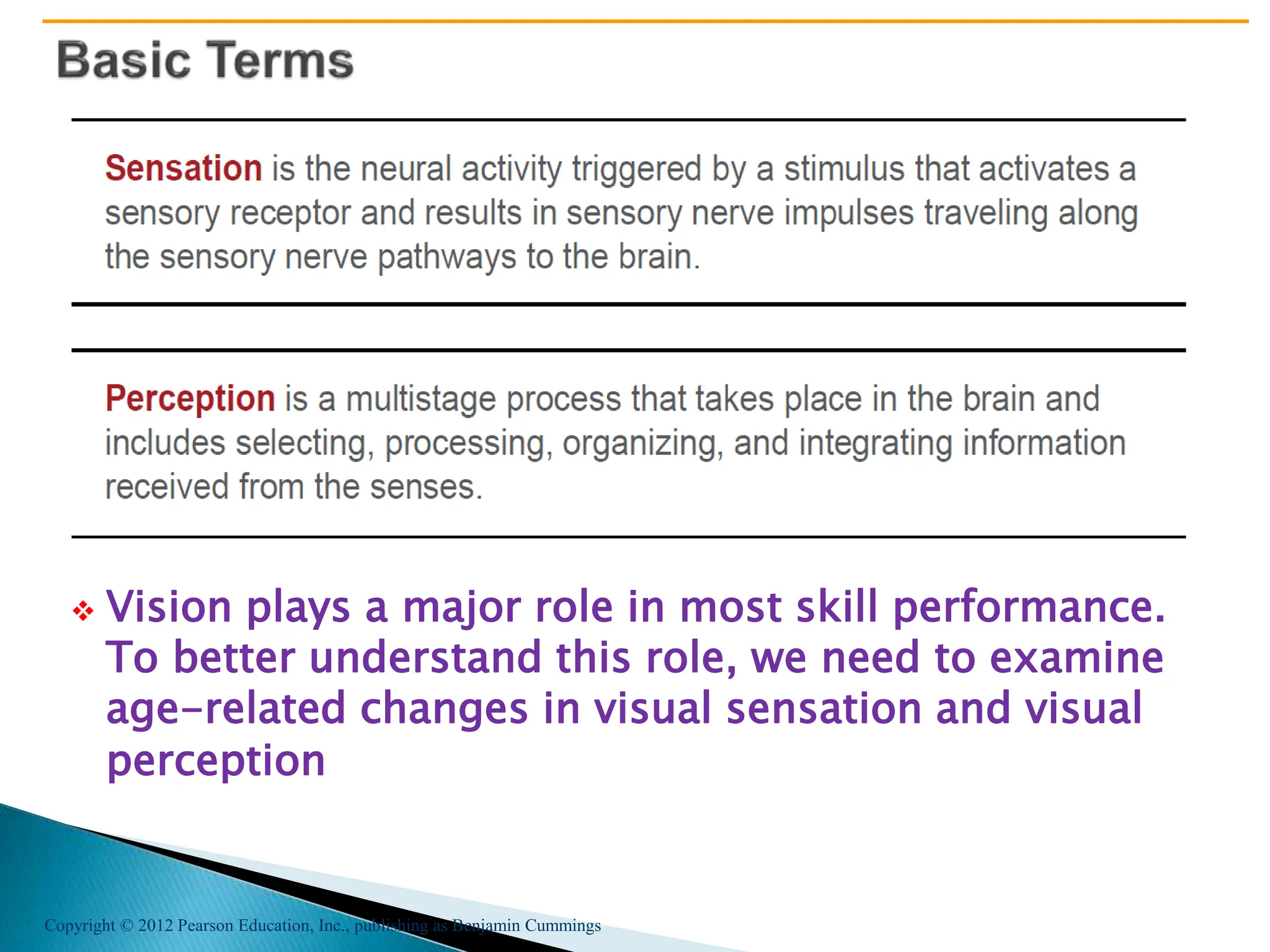
Sensation
◦ Stimulation of sensory receptors
 Vision plays a major role in most skill performance.
To better understand this role, we need to examine
age-related changes in visual sensation and visual
perception
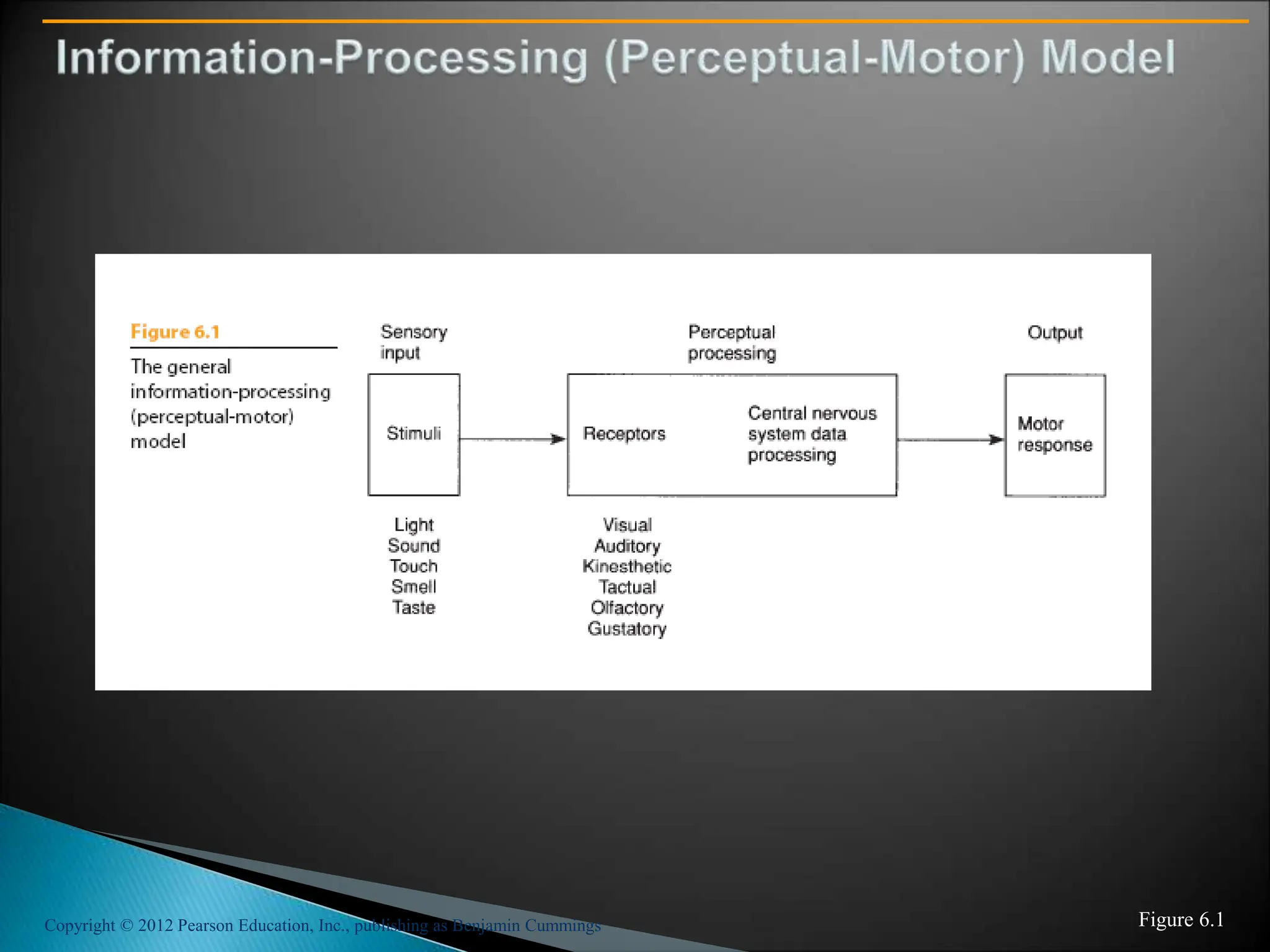
Copyright © 2012 Pearson Education, Inc., publishing as Benjamin Cummings Figure 6.1
Copyright © 2012 Pearson Education, Inc., publishing as Benjamin Cummings
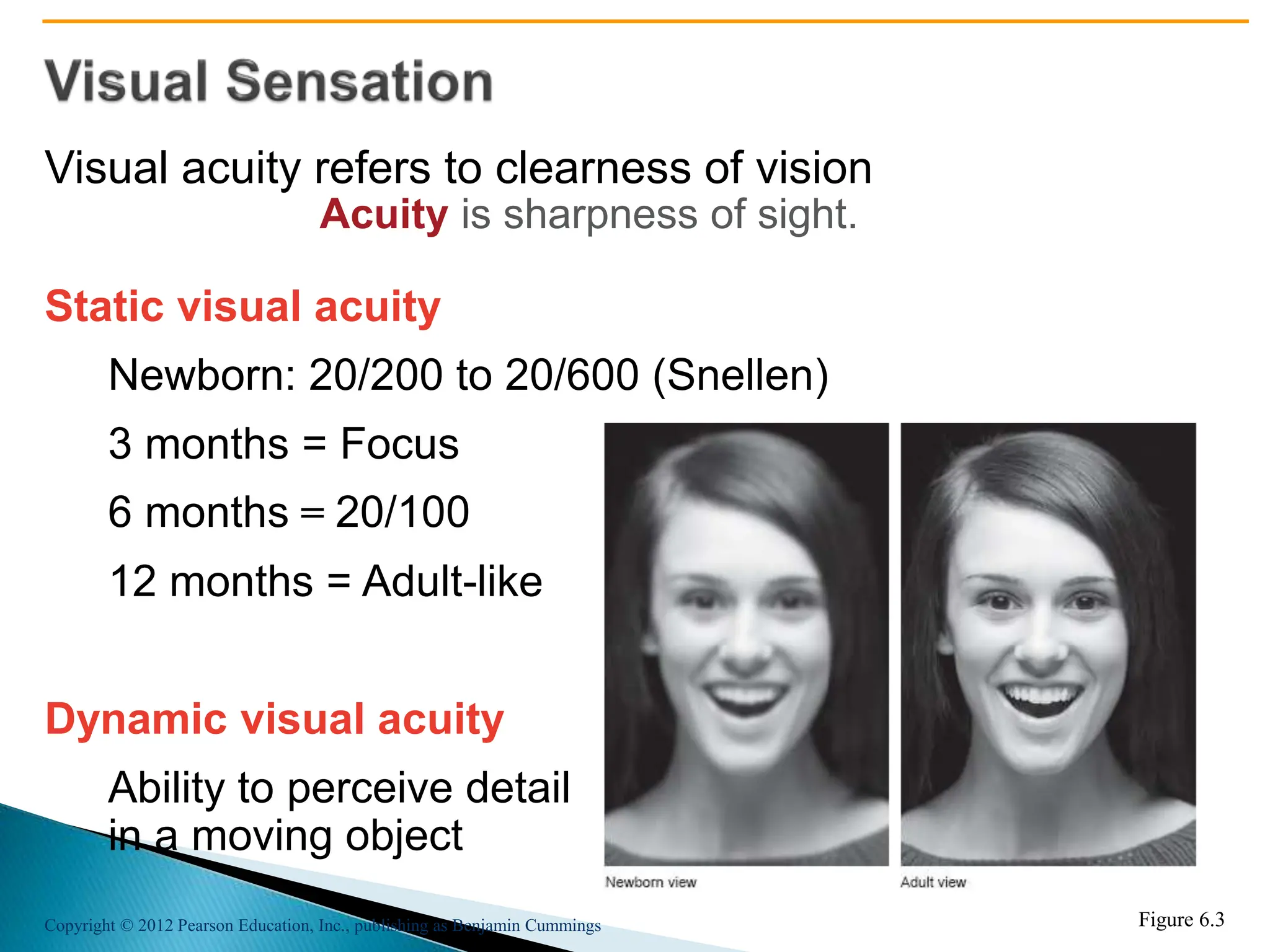
Visual acuity refers to clearness of vision
Static visual acuity
Newborn: 20/200 to 20/600 (Snellen)
3 months = Focus
6 months = 20/100
12 months = Adult-like
Dynamic visual acuity
Ability to perceive detail
in a moving object
Figure 6.3
Acuity is sharpness of sight.
Copyright © 2012 Pearson Education, Inc., publishing as Benjamin Cummings
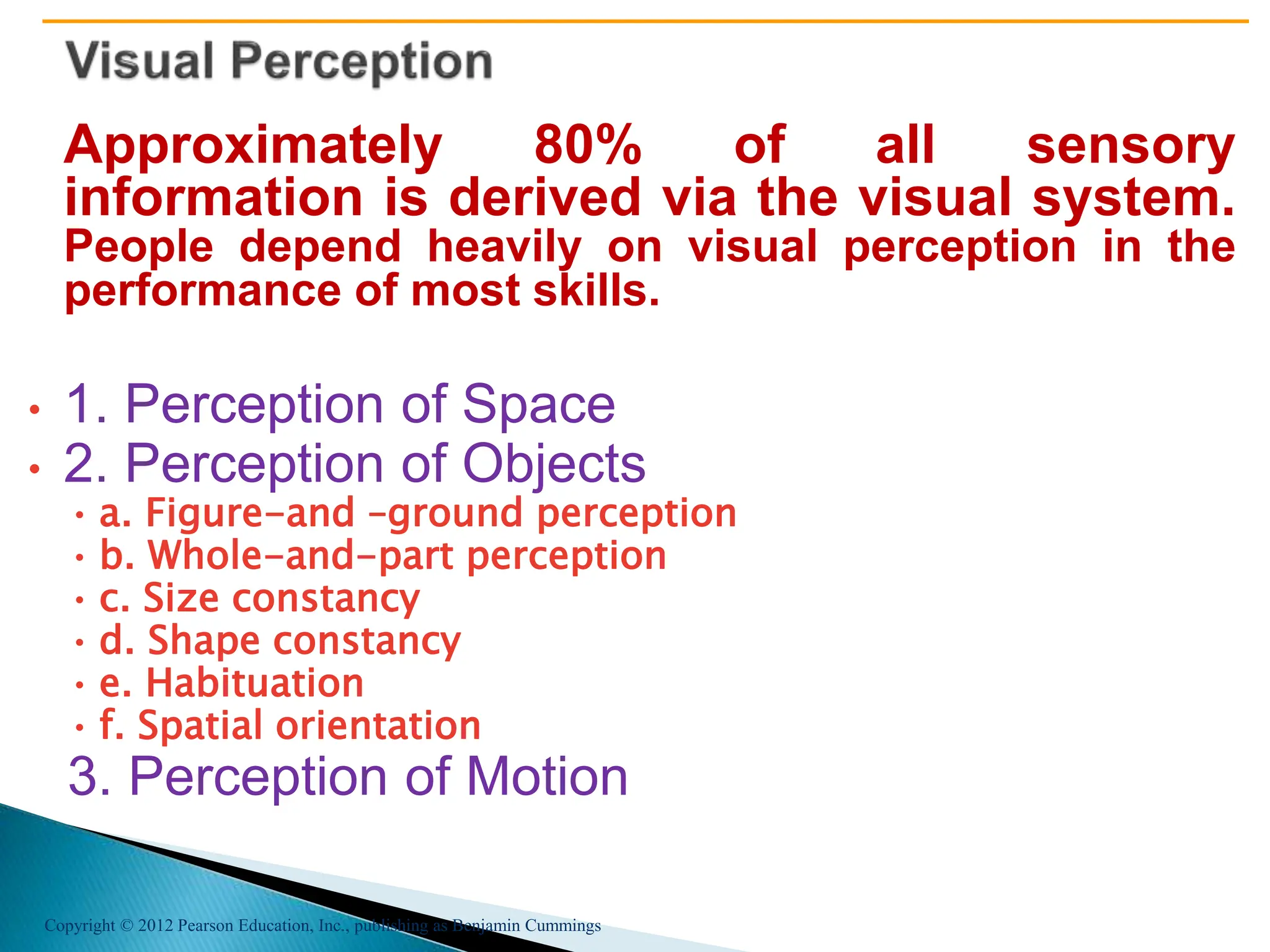
Approximately 80% of all sensory
information is derived via the visual system.
People depend heavily on visual perception in the
performance of most skills.
• 1. Perception of Space
• 2. Perception of Objects
• a. Figure-and –ground perception
• b. Whole-and-part perception
• c. Size constancy
• d. Shape constancy
• e. Habituation
• f. Spatial orientation
3. Perception of Motion
Copyright © 2012 Pearson Education, Inc., publishing as Benjamin Cummings
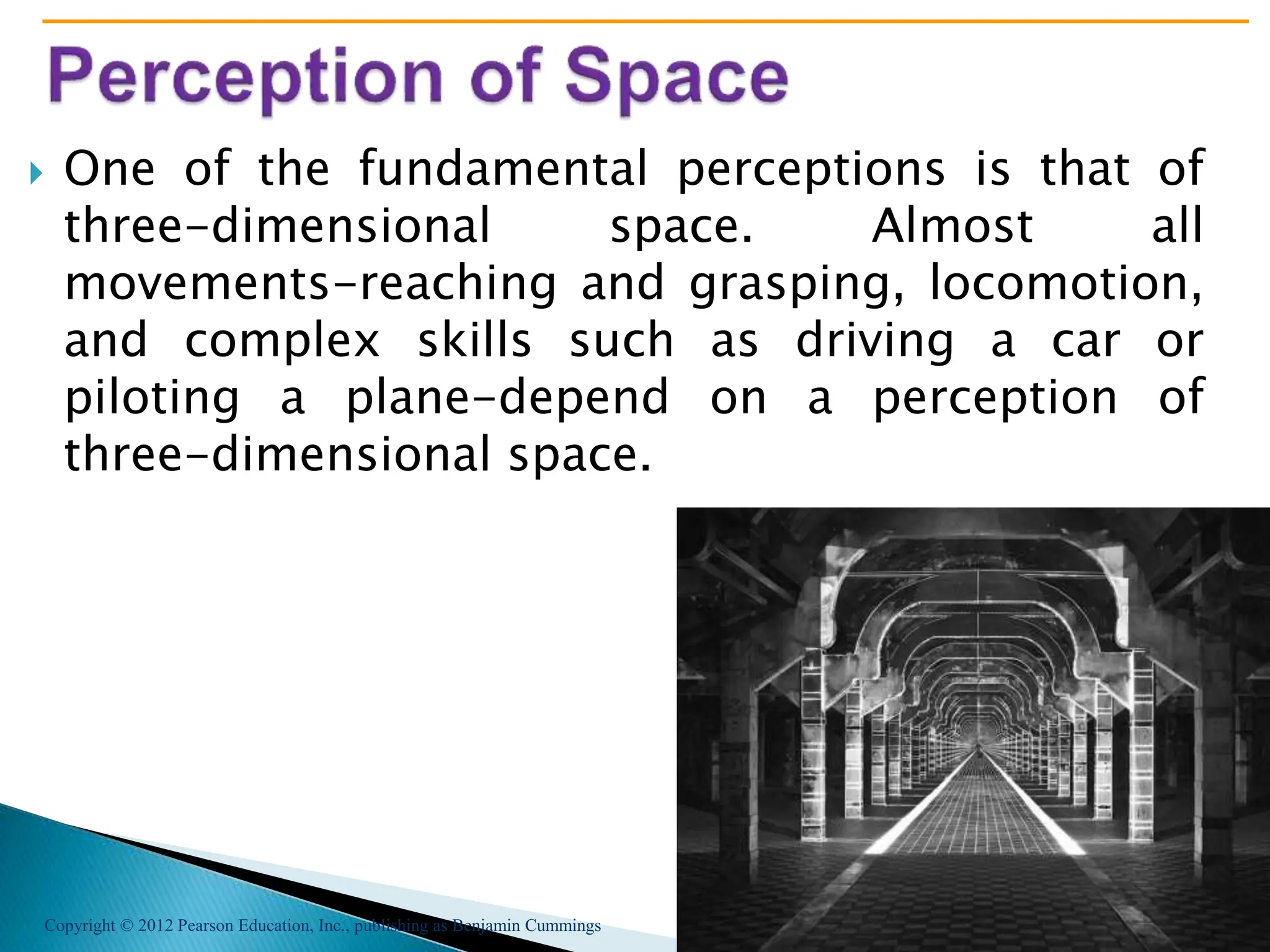
 One of the fundamental perceptions is that of
three-dimensional space. Almost all
movements-reaching and grasping, locomotion,
and complex skills such as driving a car or
piloting a plane-depend on a perception of
three-dimensional space.
Copyright © 2012 Pearson Education, Inc., publishing as Benjamin Cummings
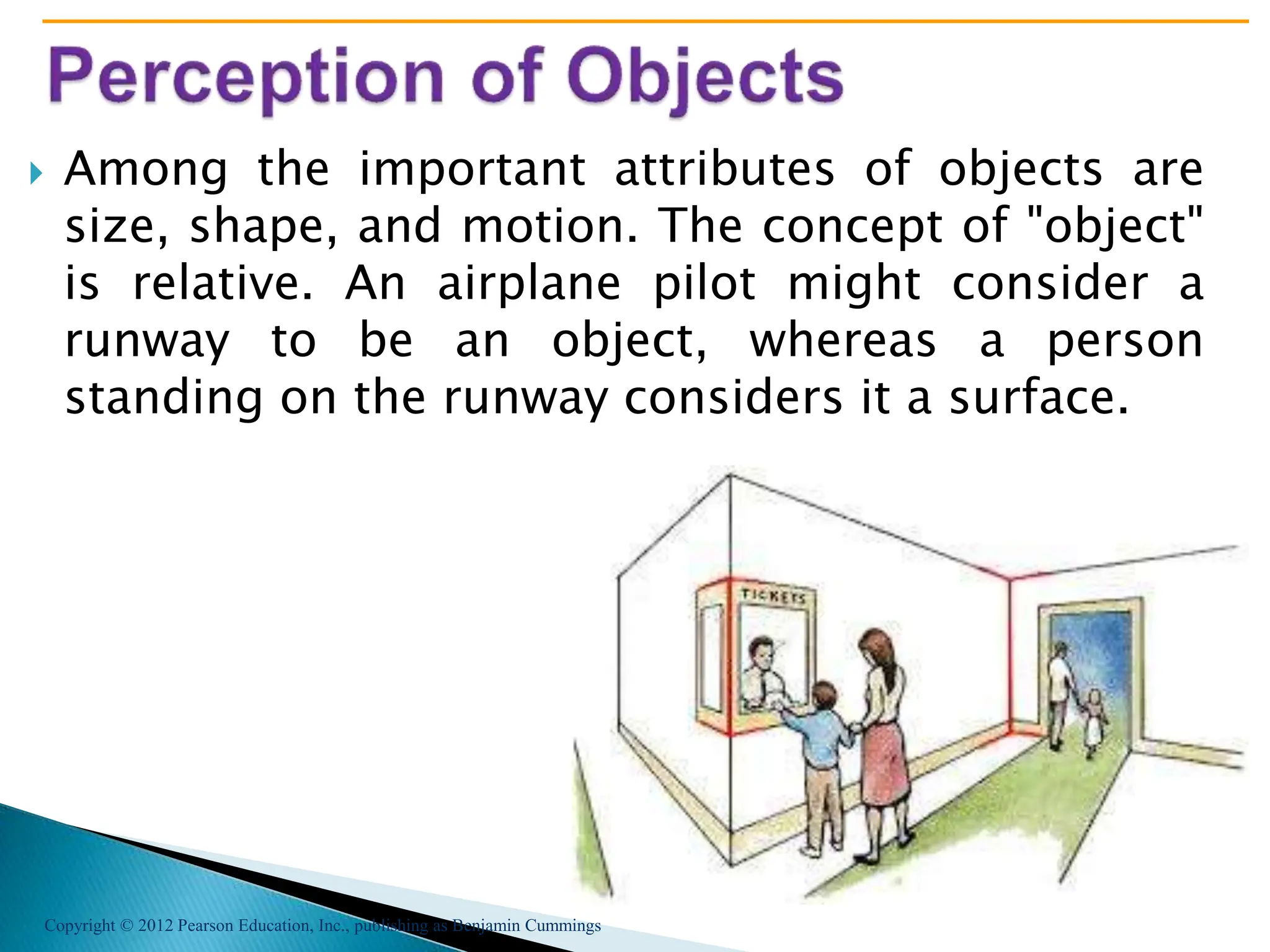
 Among the important attributes of objects are
size, shape, and motion. The concept of "object"
is relative. An airplane pilot might consider a
runway to be an object, whereas a person
standing on the runway considers it a surface.
Copyright © 2012 Pearson Education, Inc., publishing as Benjamin Cummings
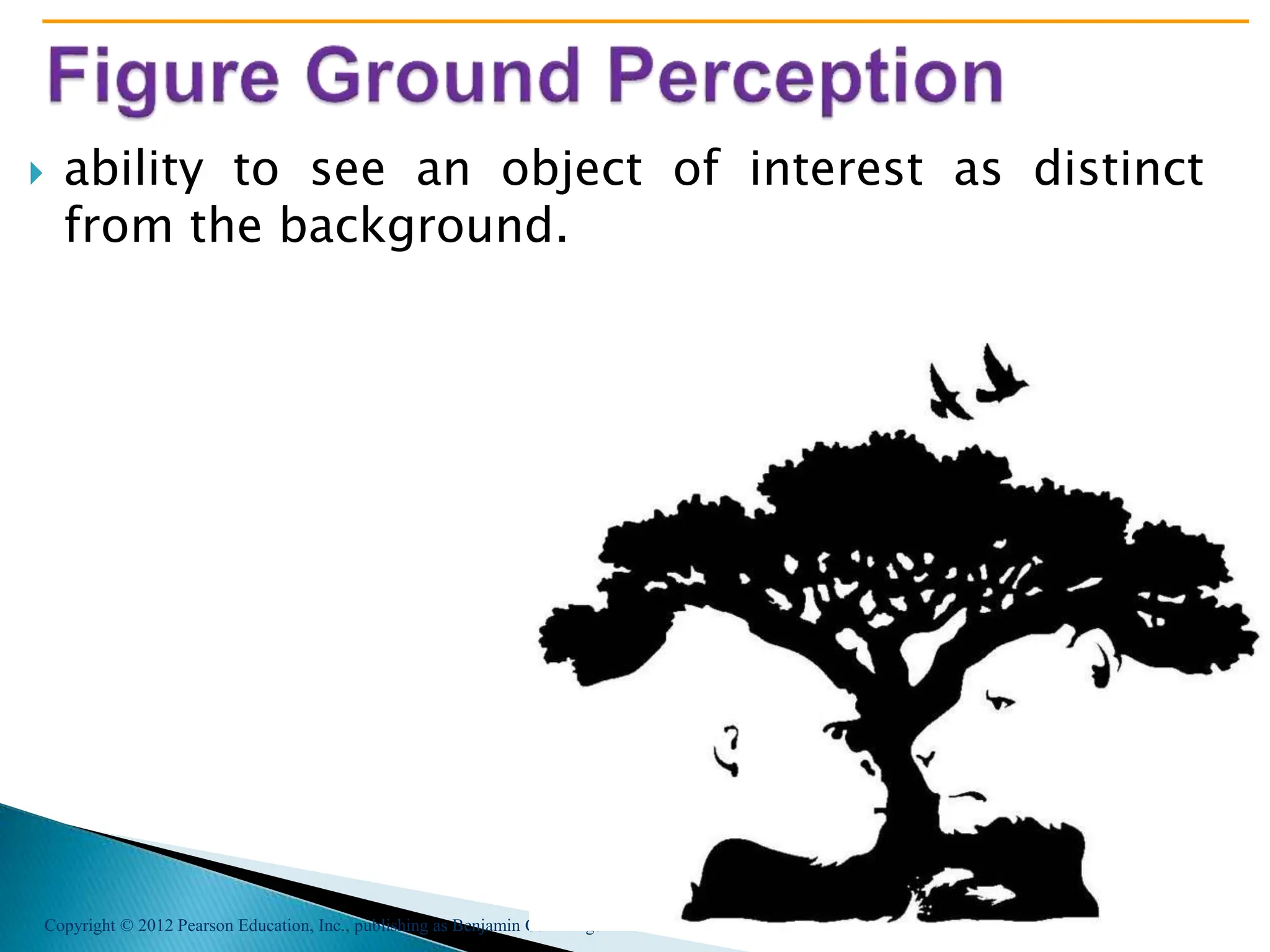
 ability to see an object of interest as distinct
from the background.
Copyright © 2012 Pearson Education, Inc., publishing as Benjamin Cummings
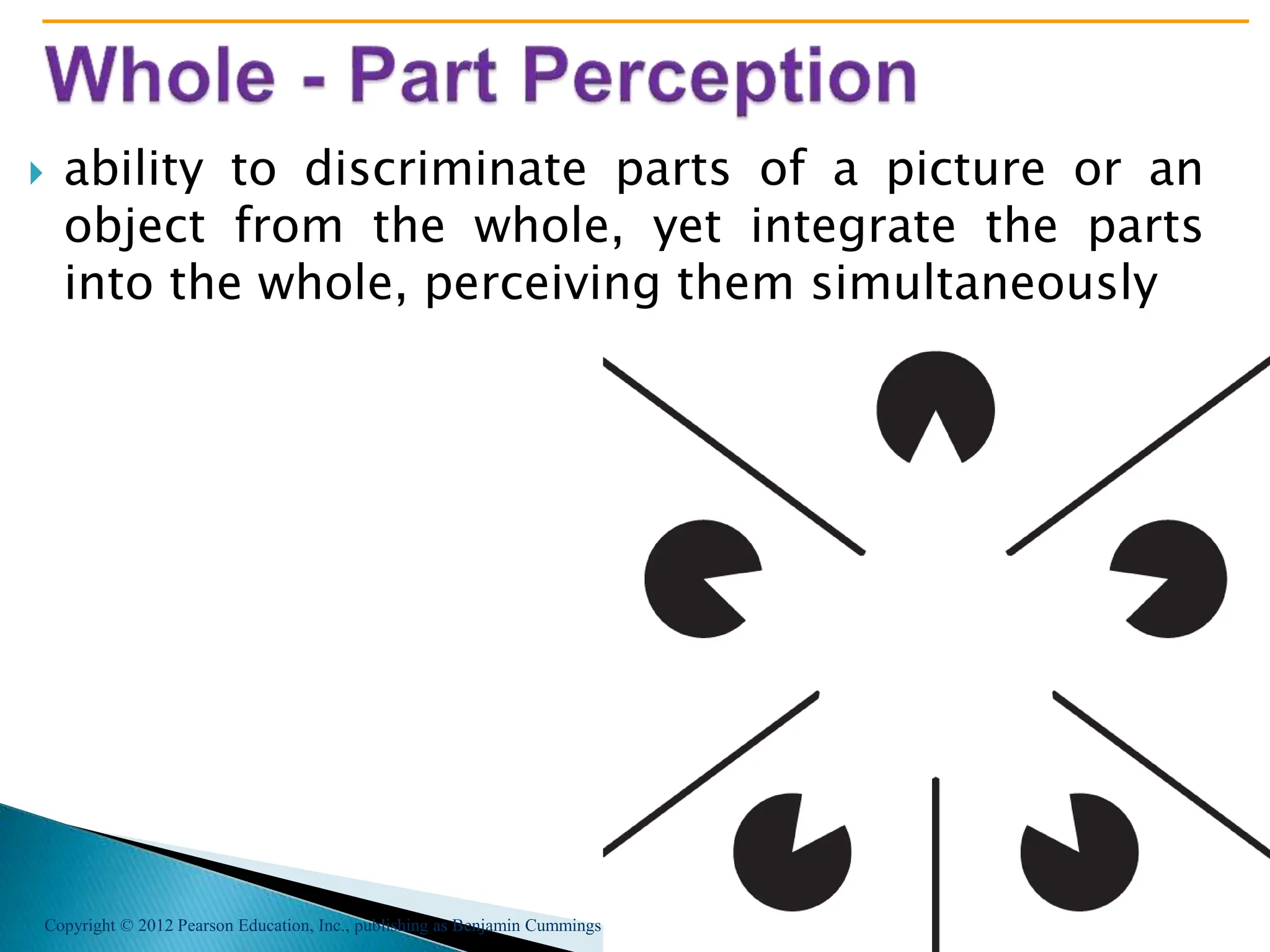
 ability to discriminate parts of a picture or an
object from the whole, yet integrate the parts
into the whole, perceiving them simultaneously
Copyright © 2012 Pearson Education, Inc., publishing as Benjamin Cummings
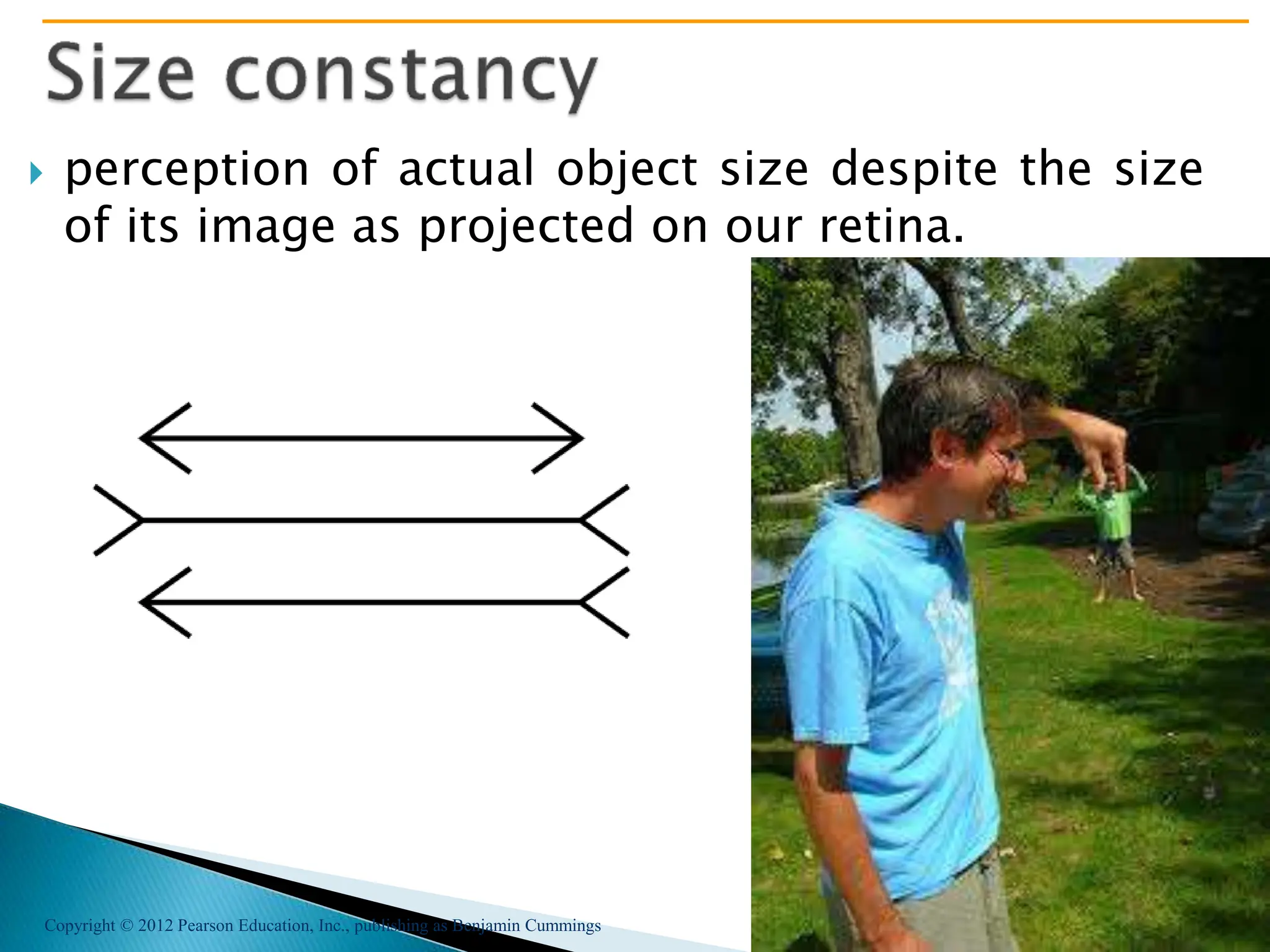
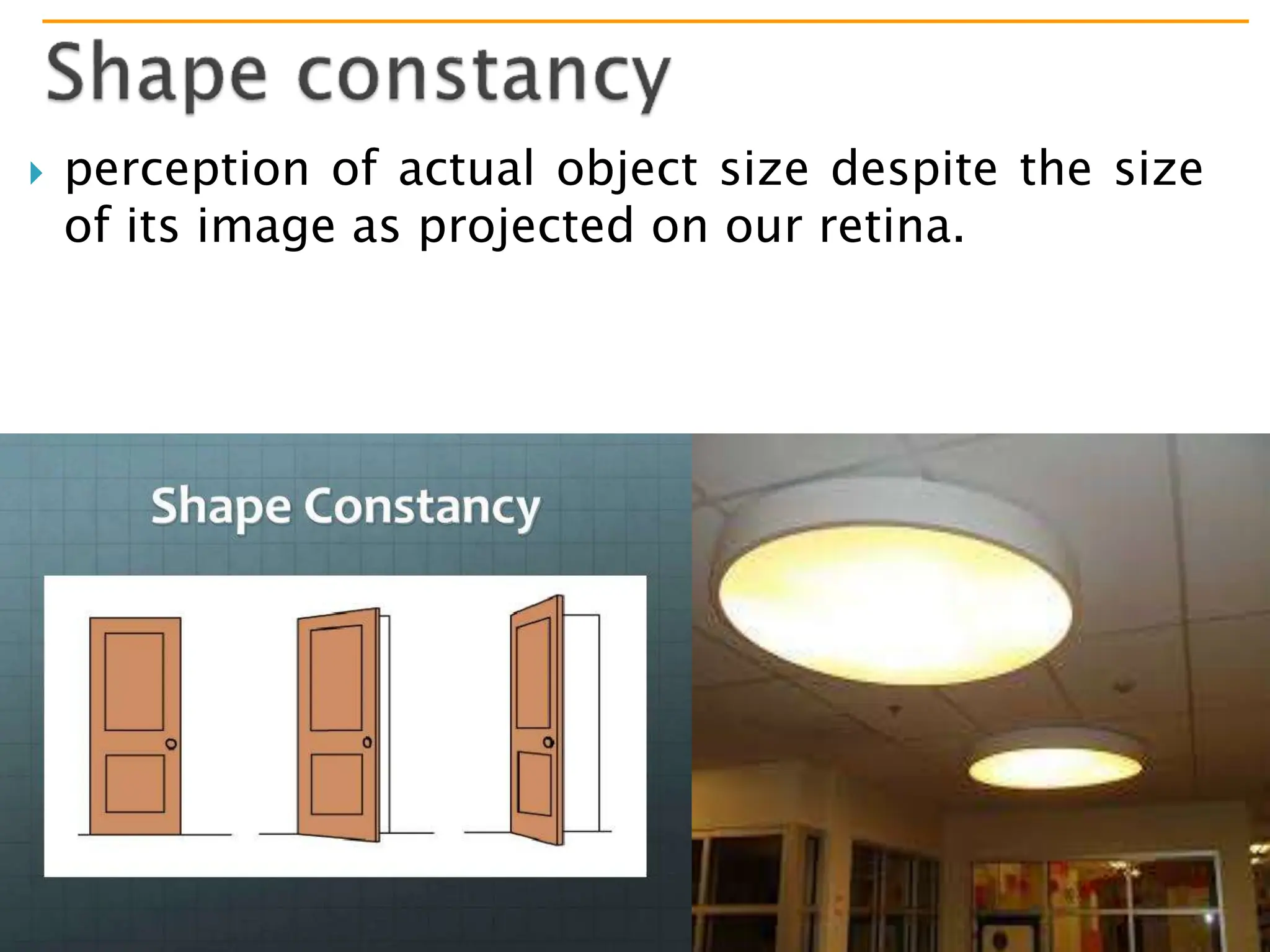
 perception of actual object size despite the size
of its image as projected on our retina.
Copyright © 2012 Pearson Education, Inc., publishing as Benjamin Cummings
 perception of actual object size despite the size
of its image as projected on our retina.
Copyright © 2012 Pearson Education, Inc., publishing as Benjamin Cummings
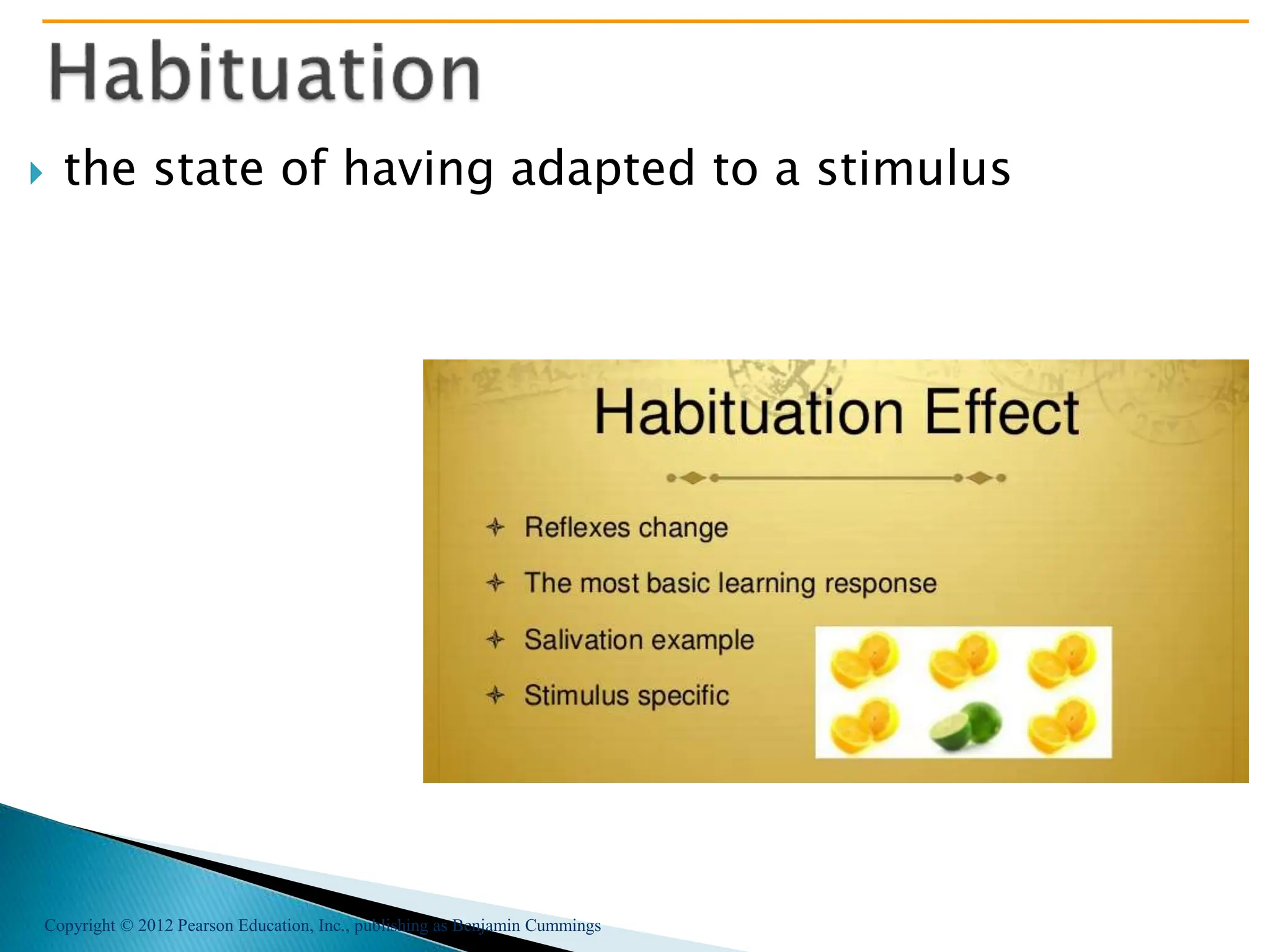
 the state of having adapted to a stimulus
Copyright © 2012 Pearson Education, Inc., publishing as Benjamin Cummings
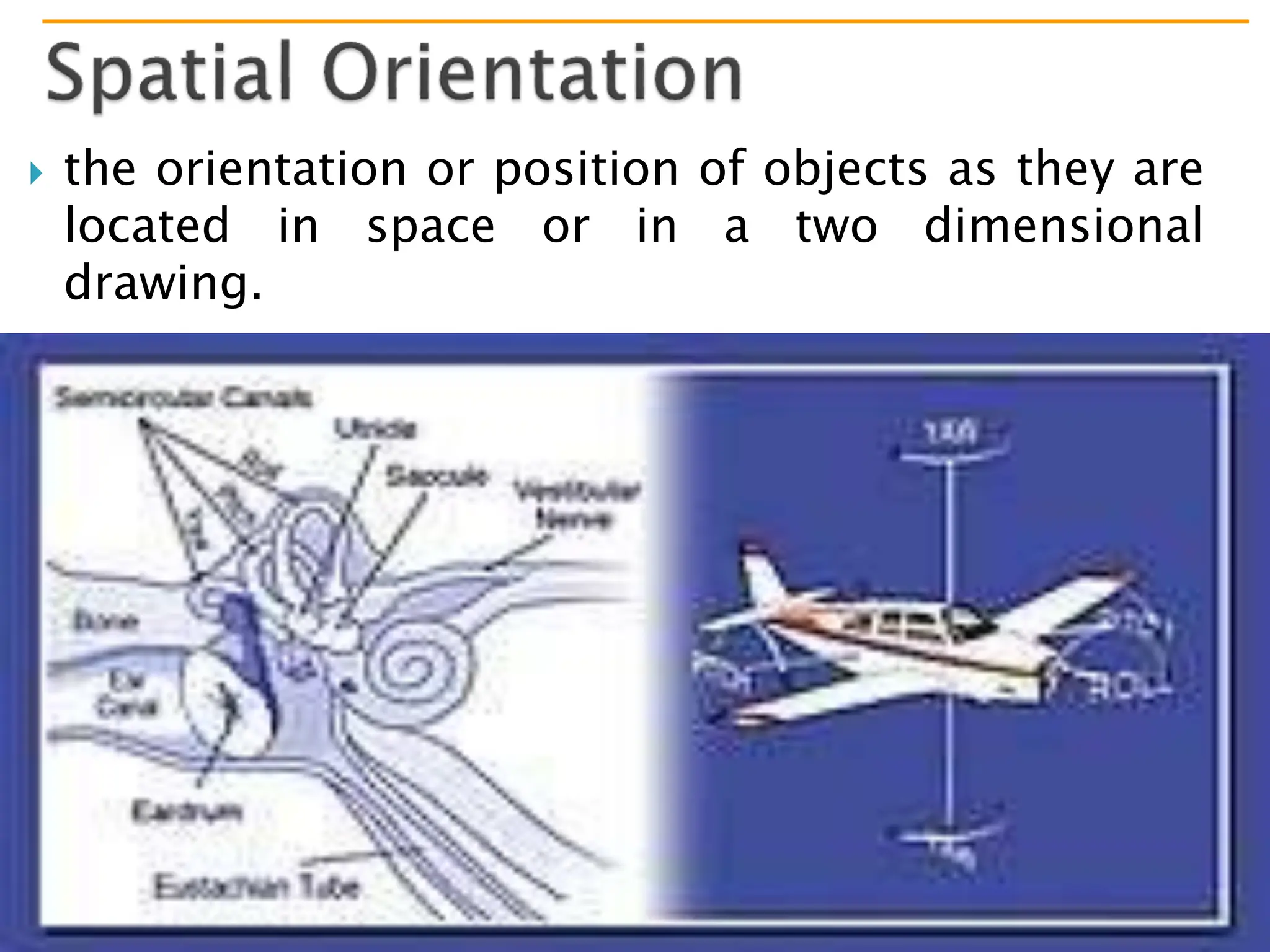
 the orientation or position of objects as they are
located in space or in a two dimensional
drawing.
Copyright © 2012 Pearson Education, Inc., publishing as Benjamin Cummings
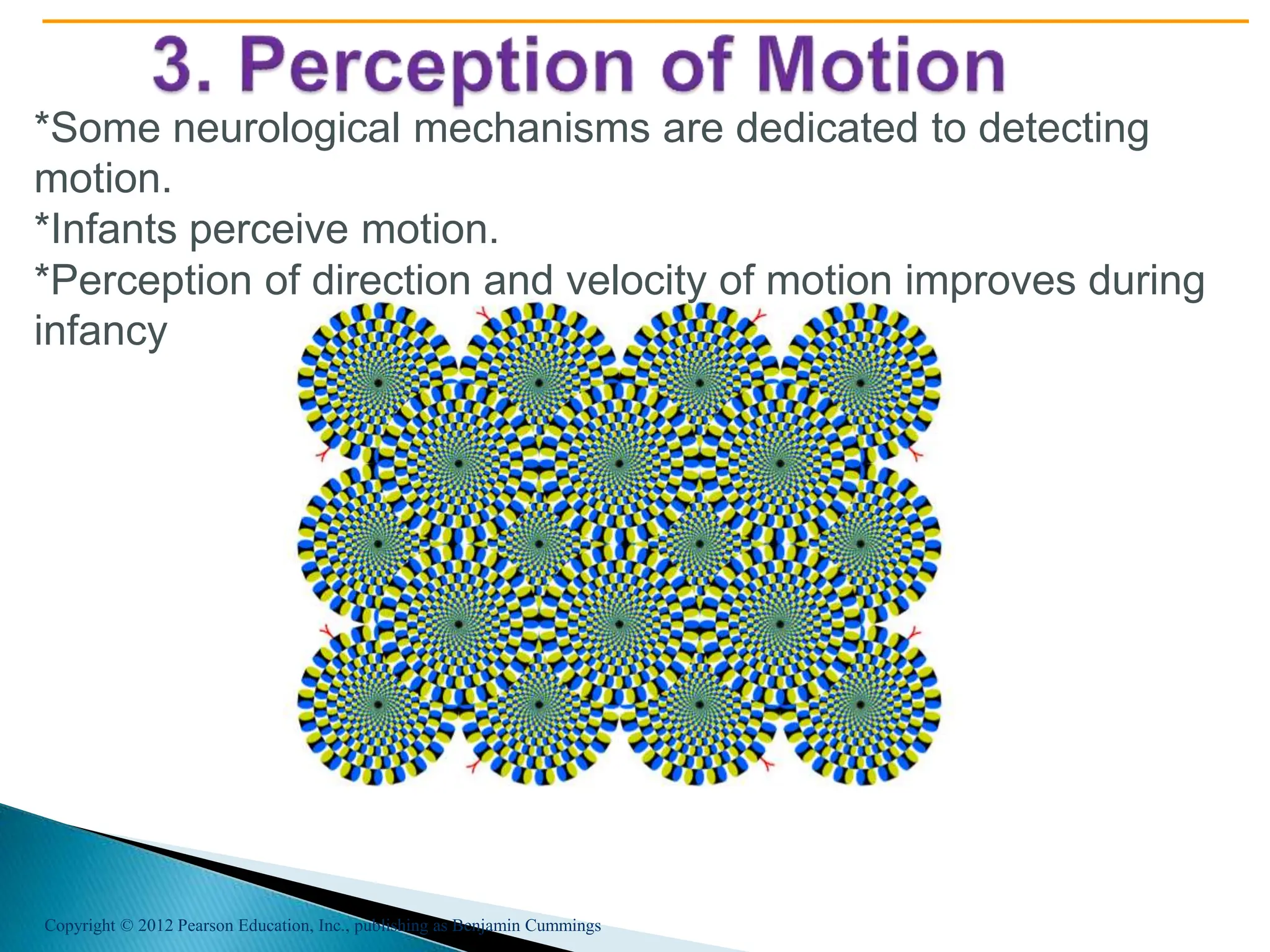
*Some neurological mechanisms are dedicated to detecting
motion.
*Infants perceive motion.
*Perception of direction and velocity of motion improves during
infancy
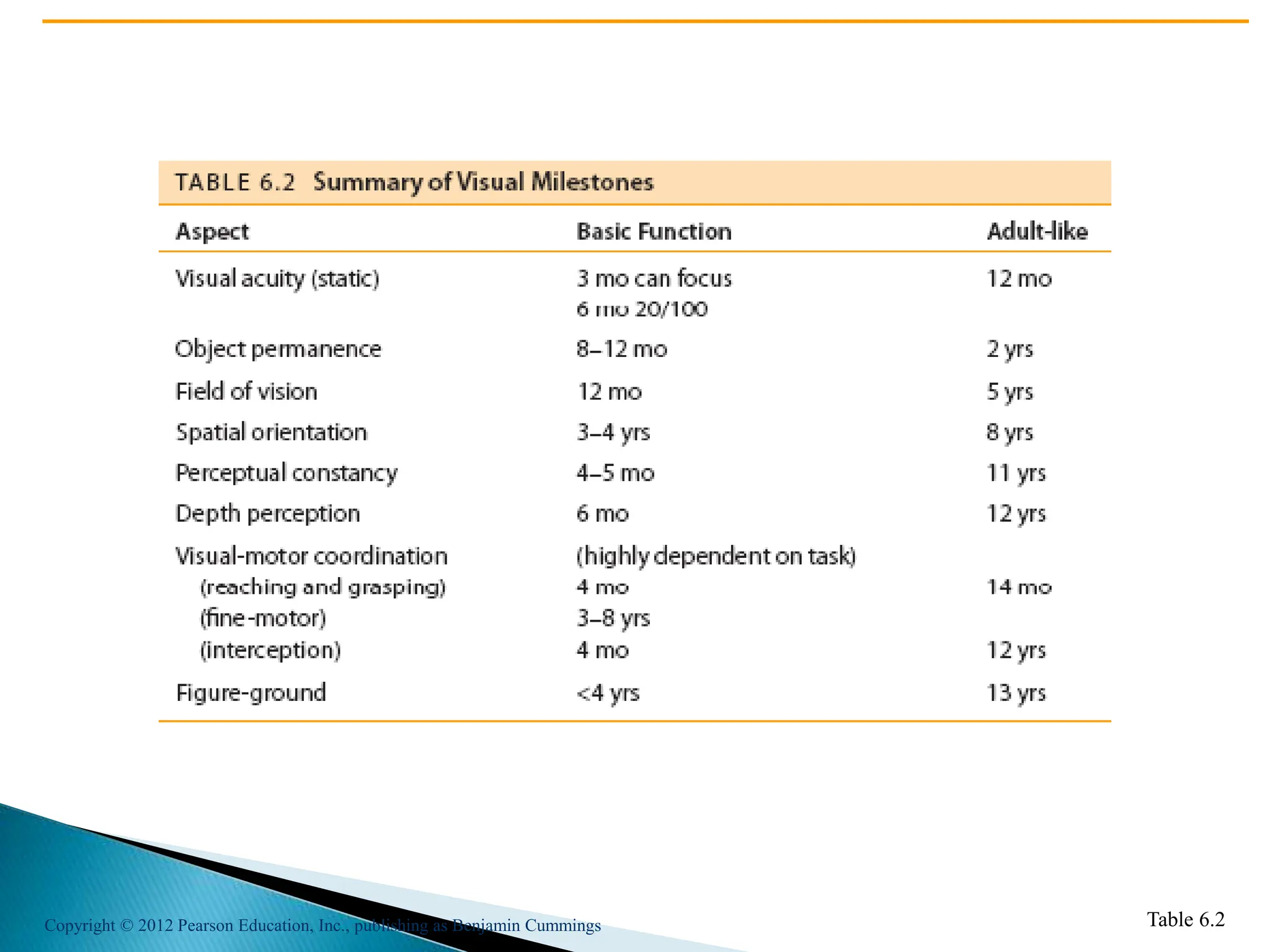
Copyright © 2012 Pearson Education, Inc., publishing as Benjamin Cummings Table 6.2
Copyright © 2012 Pearson Education, Inc., publishing as Benjamin Cummings
Kinesthesis arises from proprioceptors
The kinesthetic system might be described
as the system that gives us "body sense."
•The relative position of the body parts to each
other,
• The position of the body in space,
• The body's movements, and
•The nature of objects that the body comes into
contact with.
Copyright © 2012 Pearson Education, Inc., publishing as Benjamin Cummings
Awareness of movement and body position
• “To move” and “sensation”
• Somatosensory system
• Cutaneous / proprioceptors
Receptors
• Vestibular apparatus
• Muscle spindle receptors
• Joint receptors
• Golgi tendon organs
Copyright © 2012 Pearson Education, Inc., publishing as Benjamin Cummings
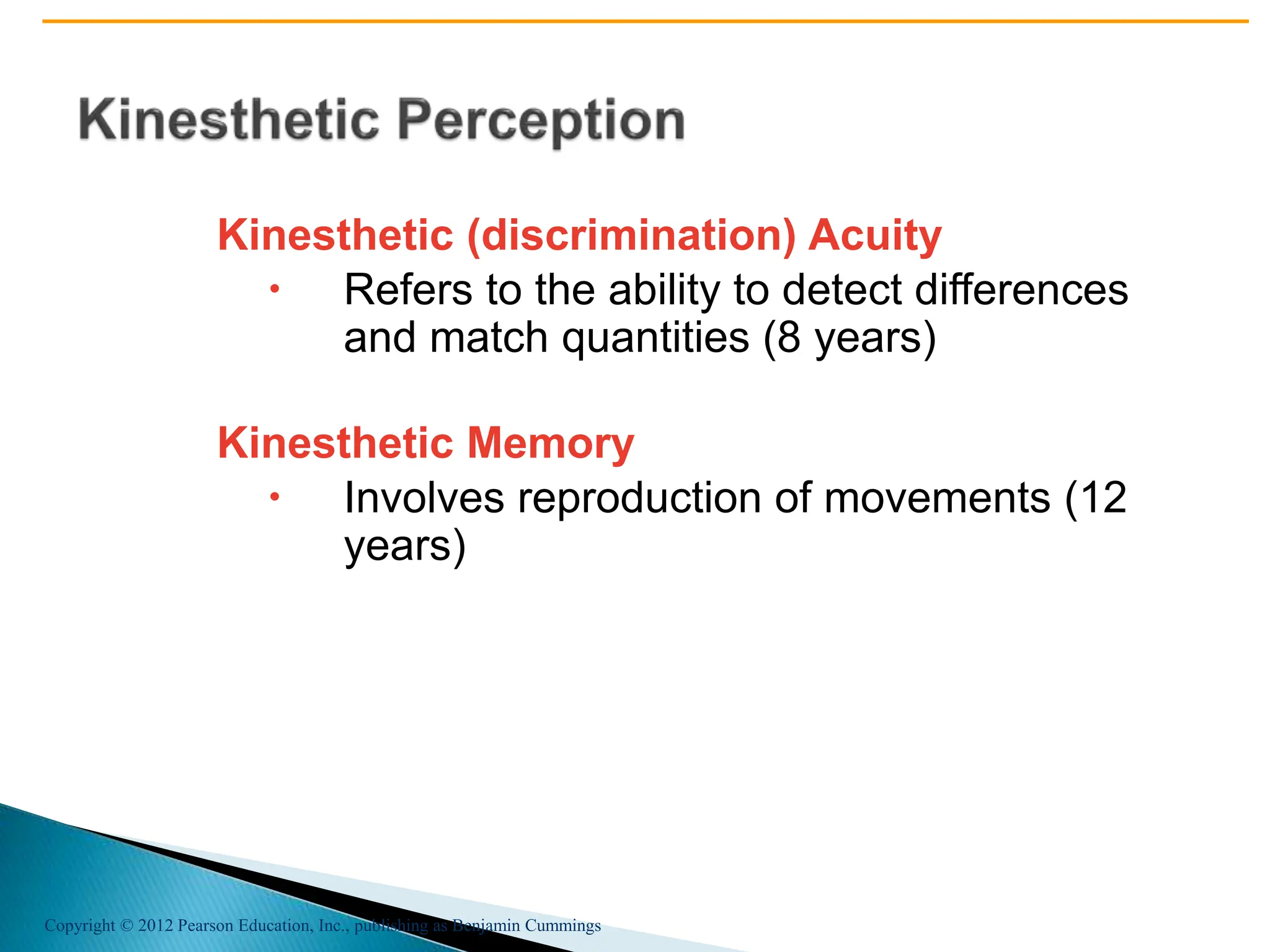
Kinesthetic (discrimination) Acuity
 Refers to the ability to detect differences
and match quantities (8 years)
Kinesthetic Memory
 Involves reproduction of movements (12
years)
Copyright © 2012 Pearson Education, Inc., publishing as Benjamin Cummings
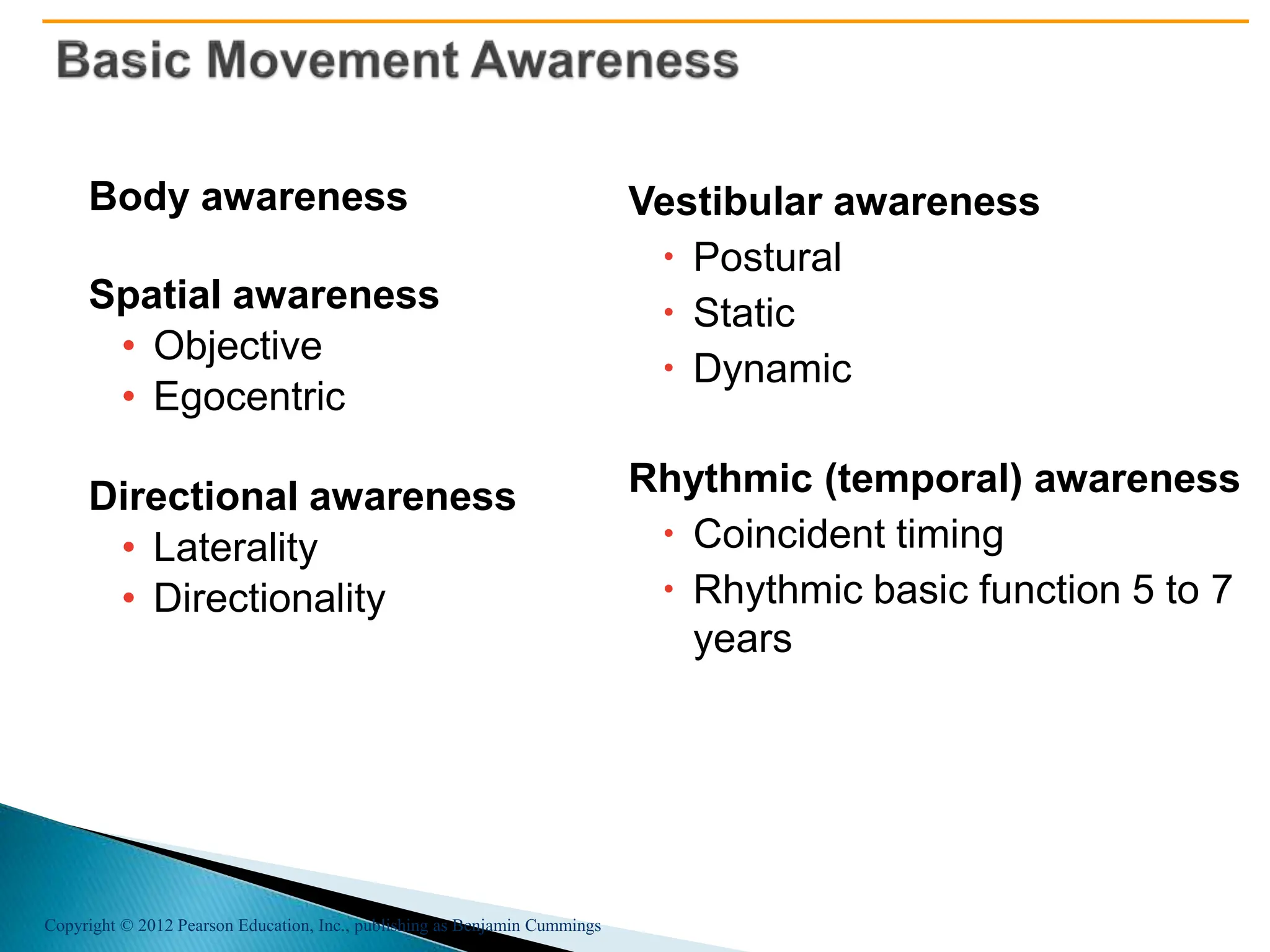
Body awareness
Spatial awareness
• Objective
• Egocentric
Directional awareness
• Laterality
• Directionality
Vestibular awareness
 Postural
 Static
 Dynamic
Rhythmic (temporal) awareness
 Coincident timing
 Rhythmic basic function 5 to 7
years
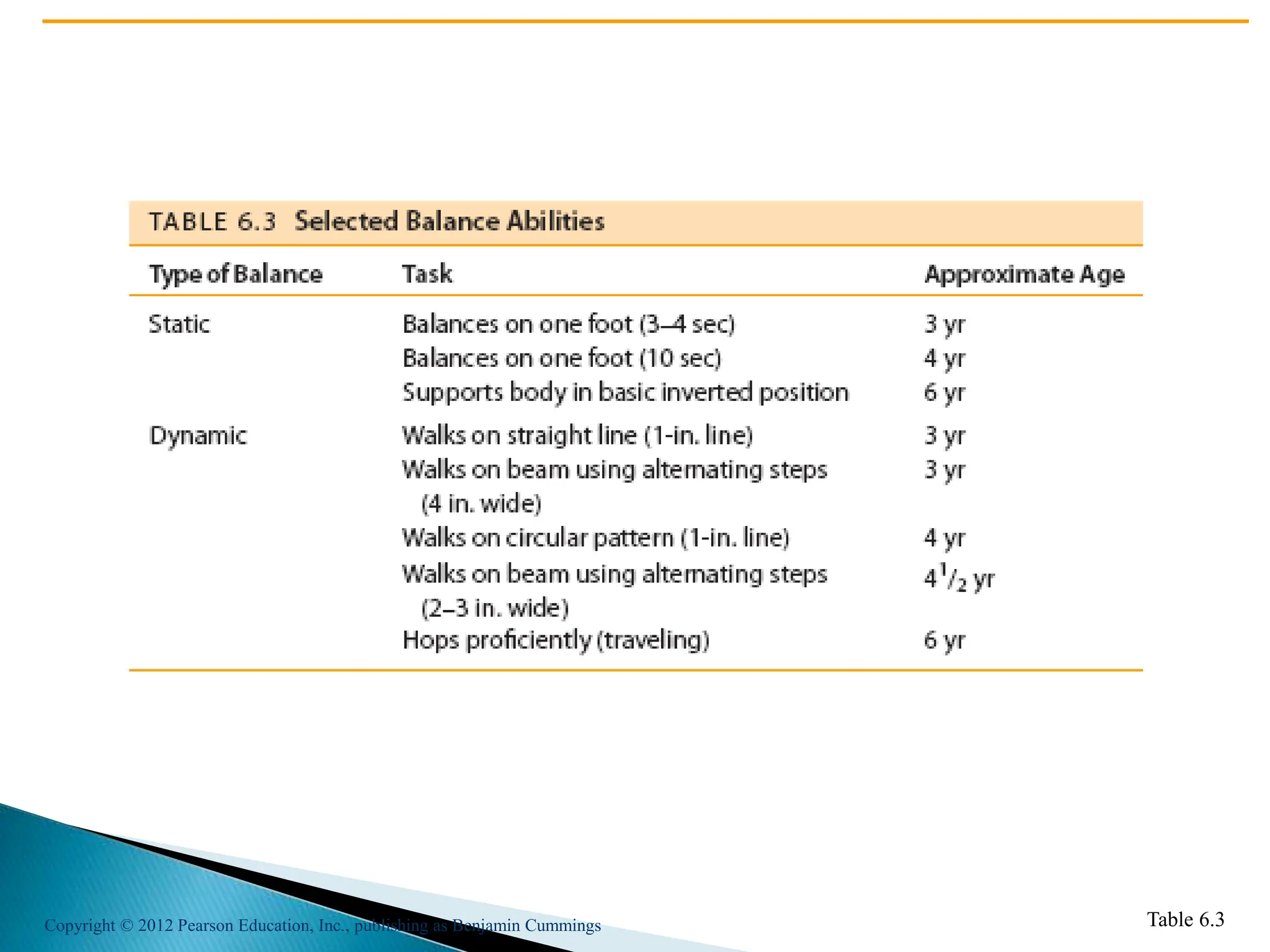
Copyright © 2012 Pearson Education, Inc., publishing as Benjamin Cummings Table 6.3
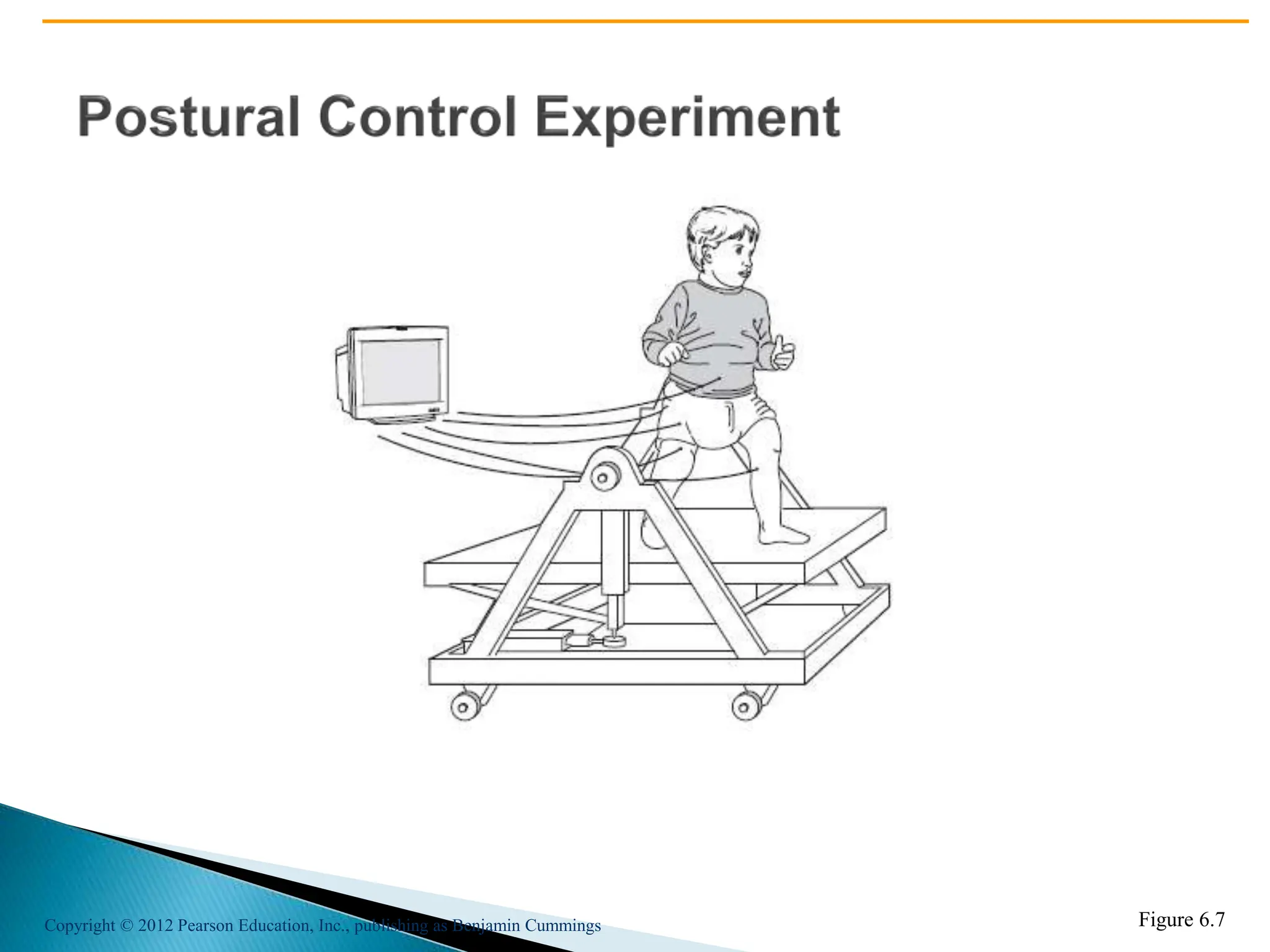
Copyright © 2012 Pearson Education, Inc., publishing as Benjamin Cummings Figure 6.7
Copyright © 2012 Pearson Education, Inc., publishing as Benjamin Cummings
 Ability to detect, discriminate, associate, and interpret
auditory stimuli
◦ Hearing present before birth
◦ Refinement from birth to 6 months—almost as sensitive
as adults
◦ Ability to localize occurs by age 3
◦ Significant improvement occurs into early teens
Copyright © 2012 Pearson Education, Inc., publishing as Benjamin Cummings
◦ Refers to the ability to detect and interpret sensory
information cutaneously (of or on the skin)
 First responses to touch are on the facial area (fetus –
newborn).
 Well developed by 5 to 8 years
 After the age of four, visual dominance is present
Copyright © 2012 Pearson Education, Inc., publishing as Benjamin Cummings
Intrasensory (individual sensory system)
Intersensory (perceptual integration)
• Simultaneous use of more than one sensory system
Copyright © 2012 Pearson Education, Inc., publishing as Benjamin Cummings
• Ability to translate (perceive) information from one modality to
another
• Recognition of a stimulus as an equivalent (match) when they
are presented to two different modalities
Visual–Kinesthetic
• 2 to 3 weeks (imitate) 5 years, recognition of objects touched
Visual–Auditory
• By 4 months infants can link VA information
Auditory-Kinesthetic (limited)
• Child selects tactually by name, adult-like by 11 to 12 years
Copyright © 2012 Pearson Education, Inc., publishing as Benjamin Cummings
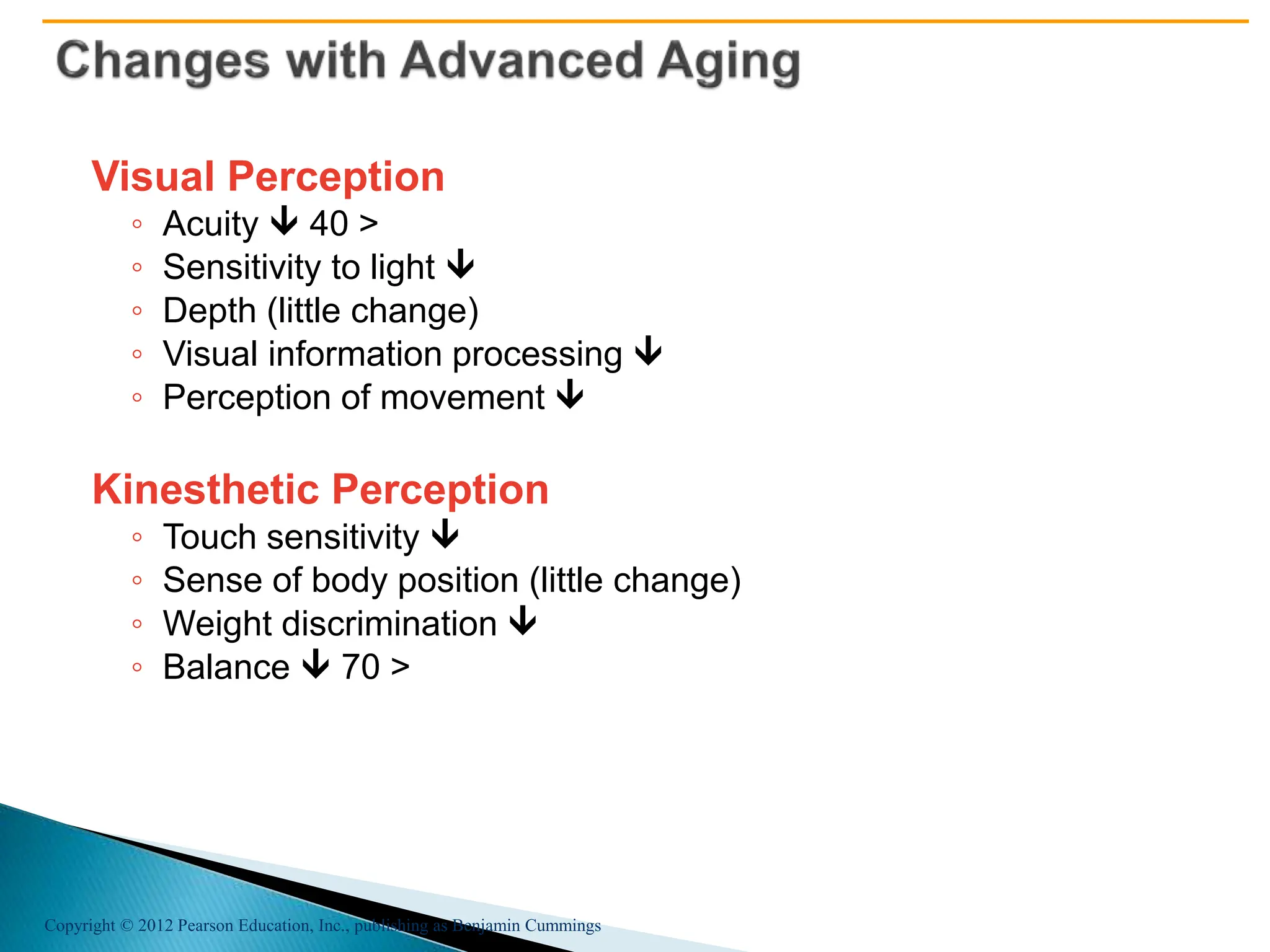
Visual Perception
◦ Acuity  40 >
◦ Sensitivity to light 
◦ Depth (little change)
◦ Visual information processing 
◦ Perception of movement 
Kinesthetic Perception
◦ Touch sensitivity 
◦ Sense of body position (little change)
◦ Weight discrimination 
◦ Balance  70 >
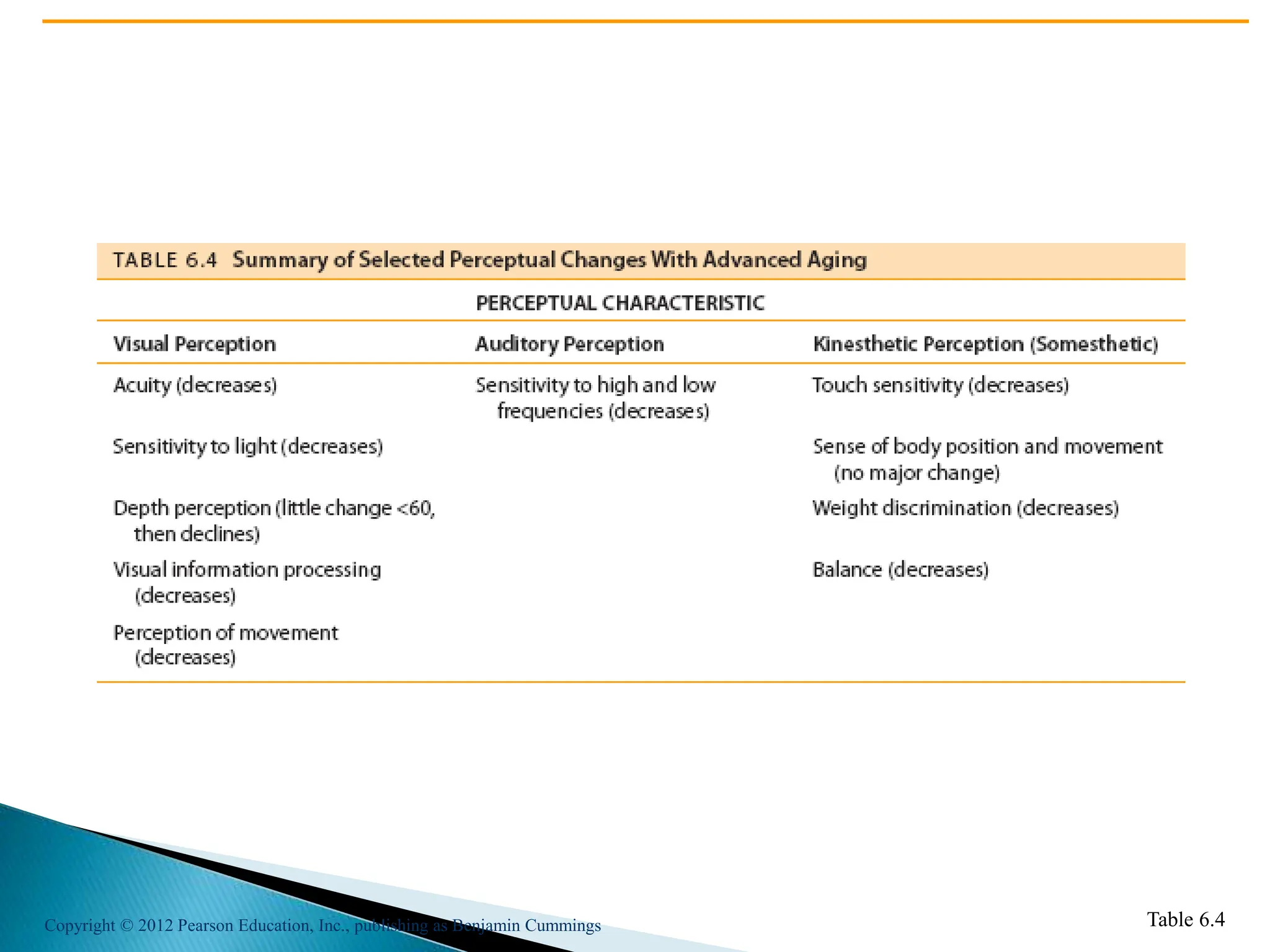
Copyright © 2012 Pearson Education, Inc., publishing as Benjamin Cummings Table 6.4

Lifespan Motor Development - Perceptionn

  • 1.
    Copyright © 2012Pearson Education, Inc., publishing as Benjamin Cummings Carl P. Gabbard PowerPoint® Lecture Slide Presentation revised by Alberto Cordova, University of Texas at San Antonio
  • 2.
    Copyright © 2012Pearson Education, Inc., publishing as Benjamin Cummings Perception • Gathering, monitoring, and interpreting sensory information Sensation ◦ Stimulation of sensory receptors  Vision plays a major role in most skill performance. To better understand this role, we need to examine age-related changes in visual sensation and visual perception
  • 3.
    Copyright © 2012Pearson Education, Inc., publishing as Benjamin Cummings Figure 6.1
  • 4.
    Copyright © 2012Pearson Education, Inc., publishing as Benjamin Cummings Visual acuity refers to clearness of vision Static visual acuity Newborn: 20/200 to 20/600 (Snellen) 3 months = Focus 6 months = 20/100 12 months = Adult-like Dynamic visual acuity Ability to perceive detail in a moving object Figure 6.3 Acuity is sharpness of sight.
  • 5.
    Copyright © 2012Pearson Education, Inc., publishing as Benjamin Cummings Approximately 80% of all sensory information is derived via the visual system. People depend heavily on visual perception in the performance of most skills. • 1. Perception of Space • 2. Perception of Objects • a. Figure-and –ground perception • b. Whole-and-part perception • c. Size constancy • d. Shape constancy • e. Habituation • f. Spatial orientation 3. Perception of Motion
  • 6.
    Copyright © 2012Pearson Education, Inc., publishing as Benjamin Cummings  One of the fundamental perceptions is that of three-dimensional space. Almost all movements-reaching and grasping, locomotion, and complex skills such as driving a car or piloting a plane-depend on a perception of three-dimensional space.
  • 7.
    Copyright © 2012Pearson Education, Inc., publishing as Benjamin Cummings  Among the important attributes of objects are size, shape, and motion. The concept of "object" is relative. An airplane pilot might consider a runway to be an object, whereas a person standing on the runway considers it a surface.
  • 8.
    Copyright © 2012Pearson Education, Inc., publishing as Benjamin Cummings  ability to see an object of interest as distinct from the background.
  • 9.
    Copyright © 2012Pearson Education, Inc., publishing as Benjamin Cummings  ability to discriminate parts of a picture or an object from the whole, yet integrate the parts into the whole, perceiving them simultaneously
  • 10.
    Copyright © 2012Pearson Education, Inc., publishing as Benjamin Cummings  perception of actual object size despite the size of its image as projected on our retina.
  • 11.
    Copyright © 2012Pearson Education, Inc., publishing as Benjamin Cummings  perception of actual object size despite the size of its image as projected on our retina.
  • 12.
    Copyright © 2012Pearson Education, Inc., publishing as Benjamin Cummings  the state of having adapted to a stimulus
  • 13.
    Copyright © 2012Pearson Education, Inc., publishing as Benjamin Cummings  the orientation or position of objects as they are located in space or in a two dimensional drawing.
  • 14.
    Copyright © 2012Pearson Education, Inc., publishing as Benjamin Cummings *Some neurological mechanisms are dedicated to detecting motion. *Infants perceive motion. *Perception of direction and velocity of motion improves during infancy
  • 15.
    Copyright © 2012Pearson Education, Inc., publishing as Benjamin Cummings Table 6.2
  • 16.
    Copyright © 2012Pearson Education, Inc., publishing as Benjamin Cummings Kinesthesis arises from proprioceptors The kinesthetic system might be described as the system that gives us "body sense." •The relative position of the body parts to each other, • The position of the body in space, • The body's movements, and •The nature of objects that the body comes into contact with.
  • 17.
    Copyright © 2012Pearson Education, Inc., publishing as Benjamin Cummings Awareness of movement and body position • “To move” and “sensation” • Somatosensory system • Cutaneous / proprioceptors Receptors • Vestibular apparatus • Muscle spindle receptors • Joint receptors • Golgi tendon organs
  • 18.
    Copyright © 2012Pearson Education, Inc., publishing as Benjamin Cummings Kinesthetic (discrimination) Acuity  Refers to the ability to detect differences and match quantities (8 years) Kinesthetic Memory  Involves reproduction of movements (12 years)
  • 19.
    Copyright © 2012Pearson Education, Inc., publishing as Benjamin Cummings Body awareness Spatial awareness • Objective • Egocentric Directional awareness • Laterality • Directionality Vestibular awareness  Postural  Static  Dynamic Rhythmic (temporal) awareness  Coincident timing  Rhythmic basic function 5 to 7 years
  • 20.
    Copyright © 2012Pearson Education, Inc., publishing as Benjamin Cummings Table 6.3
  • 21.
    Copyright © 2012Pearson Education, Inc., publishing as Benjamin Cummings Figure 6.7
  • 22.
    Copyright © 2012Pearson Education, Inc., publishing as Benjamin Cummings  Ability to detect, discriminate, associate, and interpret auditory stimuli ◦ Hearing present before birth ◦ Refinement from birth to 6 months—almost as sensitive as adults ◦ Ability to localize occurs by age 3 ◦ Significant improvement occurs into early teens
  • 23.
    Copyright © 2012Pearson Education, Inc., publishing as Benjamin Cummings ◦ Refers to the ability to detect and interpret sensory information cutaneously (of or on the skin)  First responses to touch are on the facial area (fetus – newborn).  Well developed by 5 to 8 years  After the age of four, visual dominance is present
  • 24.
    Copyright © 2012Pearson Education, Inc., publishing as Benjamin Cummings Intrasensory (individual sensory system) Intersensory (perceptual integration) • Simultaneous use of more than one sensory system
  • 25.
    Copyright © 2012Pearson Education, Inc., publishing as Benjamin Cummings • Ability to translate (perceive) information from one modality to another • Recognition of a stimulus as an equivalent (match) when they are presented to two different modalities Visual–Kinesthetic • 2 to 3 weeks (imitate) 5 years, recognition of objects touched Visual–Auditory • By 4 months infants can link VA information Auditory-Kinesthetic (limited) • Child selects tactually by name, adult-like by 11 to 12 years
  • 26.
    Copyright © 2012Pearson Education, Inc., publishing as Benjamin Cummings Visual Perception ◦ Acuity  40 > ◦ Sensitivity to light  ◦ Depth (little change) ◦ Visual information processing  ◦ Perception of movement  Kinesthetic Perception ◦ Touch sensitivity  ◦ Sense of body position (little change) ◦ Weight discrimination  ◦ Balance  70 >
  • 27.
    Copyright © 2012Pearson Education, Inc., publishing as Benjamin Cummings Table 6.4