Cortical Visual Impairment
in
RETT Syndrome, CDKL5 disorder, FOXG1 Disorder, and MECP2
Duplication
Denver 2017
Ellen Cadigan Mazel, M.Ed, CTVI
CVI Program Manager
Perkins School for the Blind
Are Children with RETT related disorders using vision in a typical way?
NO!
Do they have clear access to visual information?
Not always!
Ocular Visual Impairment
Something wrong with the eyes
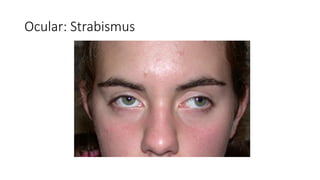
Ocular: Strabismus
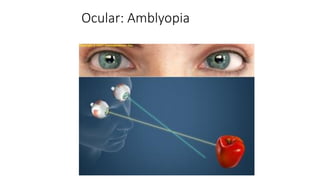
Ocular: Amblyopia
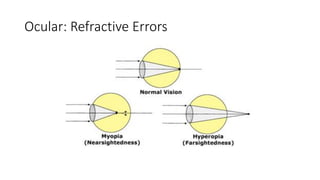
Ocular: Refractive Errors
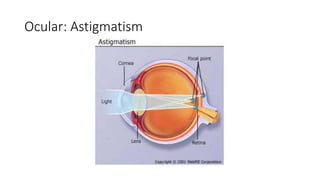
Ocular: Astigmatism
Vision is seeing and interpreting
Cortical/Cerebral Visual Impairment
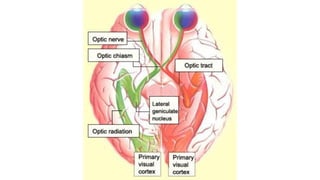
Something wrong with the visual pathways, visual processing centers
or both.
Visual Skills:
Considerations for
Learning
What is vision?
What do you need for understanding your
visual world?
• Look using central vision
• Sustain gaze
• Shift to elements
• Have previous experience with the item or items
that share salient feature.
• Understand what is seen
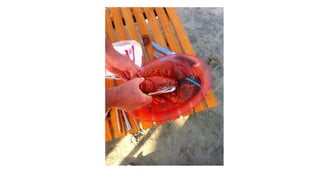
Peripheral activity
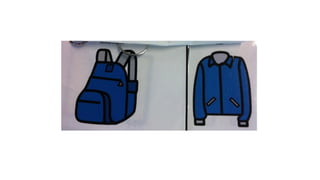
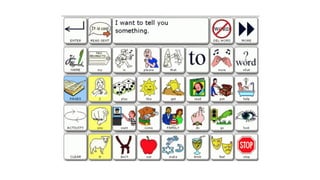
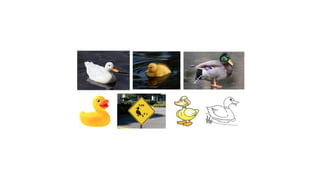
Peripheral activity: Symbols
Shifting to elements
Sustained gaze
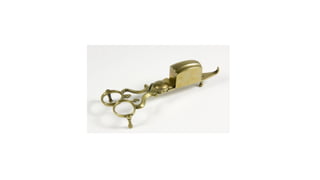
Visual Associations
• Child cannot process or understand
visual information.
• Cortical visual impairment is the leading
cause of visual impairment in children.
• CVI has the expectation of improvement.
Cortical/Cerebral Visual
Impairment
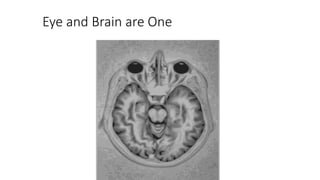
Eye and Brain are One
Brain Plasticity
• Vision happens in 40 different parts of the brain.
• With use, visual connections and associations
form.
• Using these brain areas is important: early and
often.
Different Brain Area Process:
• Color
• Shape
• Outlines and edges
• Movements of objects
• Direction of object
• Shading
• Relative motion
• Sorting backgrounds
• Depth perception
• Perspective
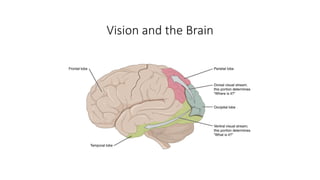
Vision and the Brain
Dorsal Stream
Where is the target?
• Tells us about the object’s orientation in space.
• Responsible for eye hand coordination.
• Give us perception of movement.
Ventral Stream
What is the target?
Recognizes:
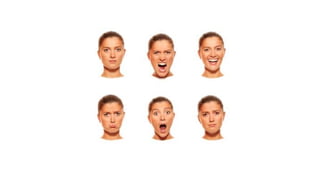
• Faces and facial expressions
• Colors
• Shapes
• Writing
• Objects
Vision Rules the Brain
Brain Based Features:
Rett Related Disorders
• Seizures
• Neuro-developmental impairment.
• Motor involvement
• Possible developmental delay
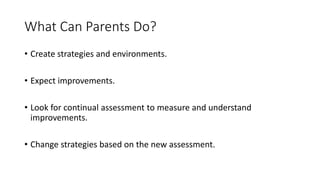
The brain’s job is to:
•Receive
information
•Interpret
information
•Decide how to
respond to this
information
Eye report is normal.
Statements from Parents:
• My child has visual inattention.
• My child looks through me.
• Something is wrong but the doctor says the eyes are healthy.
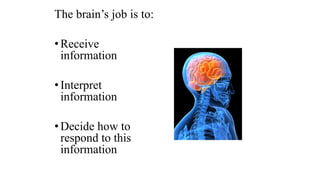
Dr. Lofti Merabet
Harvard Medical School
Ten Characteristics
1. Color
2. Movement
3. Latency
4. Visual Field
5. Complexity
6. Light Gazing
7. Distance
8. Visual Reflexive Response
9. Visual Novelty
10.Visual Motor
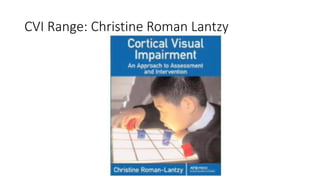
CVI Range: Christine Roman Lantzy
Ten Characteristics
• Color: Does the child look at certain colors better than others? Can
they look at multicolored materials?
• Movement: Does the child need movement to draw visual attention
or get distracted by movement around them?
Ten Characteristics
• Latency: Is there a delay to look, a delay to reach or a delay to
understand what is seen?
• Visual Field: Does the child look towards items on one visual field
more than others?
Ten Characteristics
Complexity:
• Visual Complexity: Background busyness.
• Auditory Complexity: Affect of sound on visual attention
• Positional Complexity: Looking while challenged by motor skills.
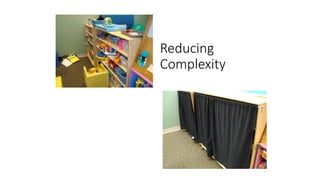
Reducing
Complexity
Ten Characteristics
• Lightgazing: Do they have an over attention to light sources?
• Distance: At what distances can the child attend?
• Visual Reflexes: Does the child blink to touch or visual threat?
Ten Characteristics
• Visual Novelty: Does the child like to look to familiar things and seem
to ignore newer items?
• Visual Motor: Does the child reach? Can they reach while looking? Do
they look while playing?
Assessment: Christine Roman-Lantzy CVI
Range
Use the CVI Range:
• Parent or Team Interview
• Observe around characteristics.
• Direct assessment
• Emma (Picture removed)
Ophthalmologist
• “Eyes are healthy.”
• “Maybe delayed visual maturation.”
• “Optic nerves might be a bit pale.”
• “See the neurologist.”
• “See a strabismus specialist. She might need
surgery”
Emma: Functional Vision Assessment
• Typical looking eyes
• Holds eyes to the left
• Alternating exotropia
• No eye contact
• No fixation
• No tracking
• No scanning
• No response to visual field testing
• No blink reflex
• No light sensitivity: stared at light
Parent statements
• “When she is in the floor she always seems to find her red toy but I
don’t see her looking for it”
• “She stares at lights all the time.”
• “She likes to watch the ceiling fan.”
• “She seems to watch me move sometimes.”
Emma: CVI Functional Vision
Assessment
Roman-Lantzy Characteristics:
• Preference for red materials.
• Movement draws her visual attention.
• Needs extra time to visually alert.
Emma: CVI Functional Vision
Assessment
• Visually locates best with simple environments
that are quiet, non-complex and if she is solidly
positioned.
• Stares at light sources and can be visually
inattentive.
• Looks only at items in near space 12-18”.
Emma: CVI Functional Vision Assessment
• Alerts to materials faster in her left visual field. Uses peripheral vision with very
brief central viewing.
• Looks at familiar items faster
• Reducing background complexity increases visual attention.
• Shows no blink to touch and no blink to threat.
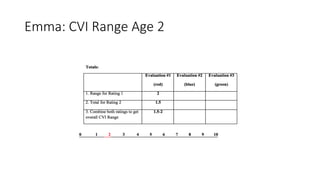
Emma: CVI Range Age 2
Emma 2015: age 14 (Picture removed)
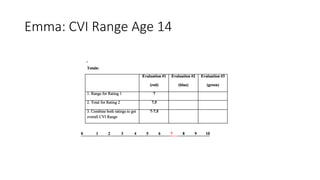
• Moved from Phase I to
early Phase III.
• Using a TOBII eye gaze
system to communicate.
Emma: CVI Range Age 14
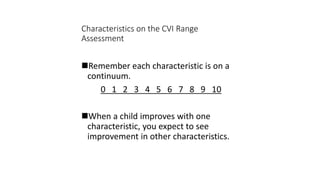
Characteristics on the CVI Range
Assessment
Remember each characteristic is on a
continuum.
0 1 2 3 4 5 6 7 8 9 10
When a child improves with one
characteristic, you expect to see
improvement in other characteristics.
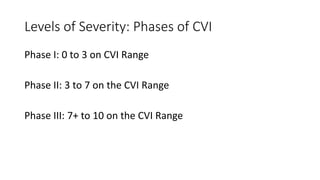
Levels of Severity: Phases of CVI
Phase I: 0 to 3 on CVI Range
Phase II: 3 to 7 on the CVI Range
Phase III: 7+ to 10 on the CVI Range
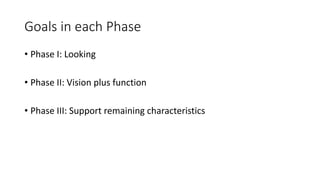
Goals in each Phase
• Phase I: Looking
• Phase II: Vision plus function
• Phase III: Support remaining characteristics
CVI Range: Christine Roman-Lantzy
• Looked at the 10 characteristics of visual behavior
• Placed behaviors into three Phases of visual severity
Information from:
• Parent interview
• Observation
• Direct assessment
Program around assessment results
• Plan using assessment results.
• Plan around each Characteristic need.
• Create strategies and adaptations across the day.
• Create needed environmental changes.
There is no “Therapy”
• You want an approach throughout the day.
• You want strategies to support and build vision use. (after
assessment).
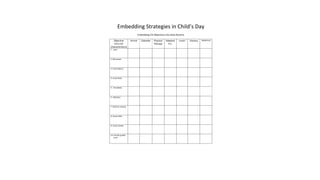
Embedding Strategies in Child’s Day
Embedding CVI Objectives into Daily Routine
Objective
(Ten CVI
Characteristics)
Arrival Calendar Physical
Therapy
Adapted
P.E.
Lunch Literacy Departure
1. Color
2. Movement
3. Visual latency
4. Visual fields
5. Complexity
6. Light gaze
7. Distance viewing
8. Visual reflex
9. Visual novelty
10. Visually guided
reach
Ava
Ava: Color
• Looks to all colors and to multicolored materials.
• Greater attention to red materials encountered in the environment.
Ava: Attention to Movement
• Helps gain visual attention at near.
• Helps facilitate a shift of gaze to use central detail vision.
• Peripheral movements distract her visual attention.
Ava: Latency
• Slight latency for looking.
• Latency increases when Ava is in complex visual or
novel, complex auditory environments.
• Delay in visual attention when physically
unsupported, when holding her breathe or when alert
state and health poor.
Ava: Visual Fields
• Full and functional in the clinic assessment (light).
• Accesses materials best at eye level.
• Greater latency to materials in upper and lower
positions.
• Lower fields show functional neglect. Needs
monitoring at changes in depth.
Ava: Complexity
Visual Complexity:
• Has a flitting gaze of 1-3 seconds.
• When complexity is reduced, maintains gaze for 10-15
seconds.
• Beginning to make more frequent eye contact but
facial recognition is in question.
• Latency of 10+ seconds to looking at her eyes in a
mirror.
• Attends faster and longer to simpler arrays, less
patterning, familiar items and to any 2D familiar
images.
Ava: Complexity
Auditory Complexity:
• When in the quieter and familiar classroom environment, shows
optimal visual skills.
• In new or louder environments, visual abilities reduce. Auditory
events can distract visual attention to learning at hand.
Ava: Complexity
Positional Complexity:
• Stable positioning needed for optimal visual skills.
• Shows longer visual regard and less attention to lights when solidly
seated.
Ava: Lightgazing
• Lightgazing especially with complexity.
• Needs reduced access to distracting light.
• Light helps draw and sustain her visual attention so backlighting is
beneficial.
Ava: Distance
• Optimal gaze to materials within 1-4 feet.
• Visually locates moving items and people up to 8-10 feet.
• Lacks distance curiosity.
Ava: Visual Reflexes
• Blinks to a touch and threat to her eyes.
• Blink reactions are slight.
Ava: Visual Novelty
• Shows increased speed and sustained gaze to familiar
materials.
• Can find things that are familiar at greater distances.
Ava: Visual Motor
(Must be considered in combination with motor difficulties)
• Reaches to obtain items against non-complex
backgrounds after a latency.
• When she does reach, she can maintain looking while
reaching.
Continued supports for best visual understanding:
• Increased response time for visual location and visual
motor.
• Increase time for visual discrimination
• Slow moving materials
• Reduce peripheral movement distractions in the
environment.
• Backlighting
• Social support to identify people and to understand
visual expressions.
• Narration of distance events
• Sound narration and exploration
• Use color highlighting.
• Learn in quieter environment
• Monitor at changes of depth
• Presentations at eye level
• Use familiar materials and familiar presentation
methods.
• Address by name before delivering a message.
• Introduce yourself and identify a salient feature.
• Solid positioning for visual skills
• Awareness of visual fatigue
• Use movement to draw visual attention to TOBII
icons.
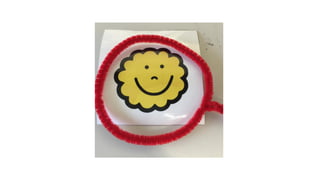
• Isolated salient features with salient feature language
used.
• Clear and representative photographs/icons
• Repeated practice and icon location, learned in
isolation
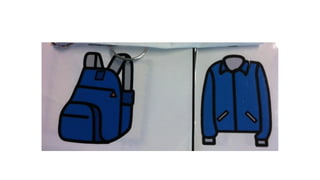
• Use icons and pictures of great dissimilarity.
RETT Syndrome Clinics
• Augmentative Communication
• Cardiology
• Dentistry
• Developmental pediatrics
• Endocrinology
• Gastroenterology
• Genetics
• Gynecology
• Neurology
• Neuropsychology
• Nutrition
• Orthopedics
• Physiatry
• Psychiatry
• Pulmonology
• Sleep medicine
Why isn’t vision assessed?
Diagnosis
• No medical test for CVI.
• No medical test to measure visual skills.
• Doctors who understand CVI can only suggest the diagnosis based on
behaviors.
Attention to Visual Skill Abilities
• Essential to look at visual abilities to build appropriate
access for learning.
• Essential to connect information through all the senses.
• Essential for communication systems.
• Essential for access to the environment.
• Essential for reading.
• Essential for autonomy and independence.
What Can Parents Do?
• Get ophthalmology evaluation.
• Learn more about CVI
• Find CVI Endorsed TVI: Perkins CVI HUB
• Advocate for assessment, adaptations and
environmental supports for CVI areas.
• Get the assessment result of visual skills
measured: CVI Range
What Can Parents Do?
• Create strategies and environments.
• Expect improvements.
• Look for continual assessment to measure and understand
improvements.
• Change strategies based on the new assessment.
My email
Ellen.Mazel@Perkins.org
To Read More:
• Christine Roman-Lantzy,Ph.D.
• Jim Jan, M.D.
• Gordon Dutton, M.D.
• Lea Hyvarinen, M.D.
• Mary Morse, Ph.D
Resources
• Cortical Visual Impairment: An Approach
to Assessment and Intervention by
Christine Roman-Lantzy
• CVI Perspectives available from APH
• American Printing House website: CVI
• Texas School for the Blind website
• Perkins Webcasts: Teaching Resources
• cviteacher.wordpress.com
Cortical Visual Impairment
in
RETT Syndrome, CDKL5 disorder, FOXG1
Disorder, and MECP2 Duplication
The End
Ellen Cadigan Mazel, M.Ed, CTVI
CVI Program Manager
Perkins School for the Blind

Cortical Vision Impairment Ellen Mazel

  • 1.
    Cortical Visual Impairment in RETTSyndrome, CDKL5 disorder, FOXG1 Disorder, and MECP2 Duplication Denver 2017 Ellen Cadigan Mazel, M.Ed, CTVI CVI Program Manager Perkins School for the Blind
  • 2.
    Are Children withRETT related disorders using vision in a typical way? NO! Do they have clear access to visual information? Not always!
  • 3.
  • 4.
  • 5.
  • 6.
  • 7.
  • 8.
    Vision is seeingand interpreting
  • 9.
    Cortical/Cerebral Visual Impairment Somethingwrong with the visual pathways, visual processing centers or both.
  • 10.
  • 12.
    What do youneed for understanding your visual world? • Look using central vision • Sustain gaze • Shift to elements • Have previous experience with the item or items that share salient feature. • Understand what is seen
  • 13.
  • 15.
  • 17.
  • 23.
  • 26.
    • Child cannotprocess or understand visual information. • Cortical visual impairment is the leading cause of visual impairment in children. • CVI has the expectation of improvement. Cortical/Cerebral Visual Impairment
  • 27.
  • 28.
    Brain Plasticity • Visionhappens in 40 different parts of the brain. • With use, visual connections and associations form. • Using these brain areas is important: early and often.
  • 29.
    Different Brain AreaProcess: • Color • Shape • Outlines and edges • Movements of objects • Direction of object • Shading • Relative motion • Sorting backgrounds • Depth perception • Perspective
  • 30.
  • 31.
    Dorsal Stream Where isthe target? • Tells us about the object’s orientation in space. • Responsible for eye hand coordination. • Give us perception of movement.
  • 32.
    Ventral Stream What isthe target? Recognizes: • Faces and facial expressions • Colors • Shapes • Writing • Objects
  • 33.
  • 34.
    Brain Based Features: RettRelated Disorders • Seizures • Neuro-developmental impairment. • Motor involvement • Possible developmental delay
  • 35.
    The brain’s jobis to: •Receive information •Interpret information •Decide how to respond to this information
  • 36.
    Eye report isnormal. Statements from Parents: • My child has visual inattention. • My child looks through me. • Something is wrong but the doctor says the eyes are healthy.
  • 37.
  • 38.
    Ten Characteristics 1. Color 2.Movement 3. Latency 4. Visual Field 5. Complexity 6. Light Gazing 7. Distance 8. Visual Reflexive Response 9. Visual Novelty 10.Visual Motor
  • 39.
  • 40.
    Ten Characteristics • Color:Does the child look at certain colors better than others? Can they look at multicolored materials? • Movement: Does the child need movement to draw visual attention or get distracted by movement around them?
  • 41.
    Ten Characteristics • Latency:Is there a delay to look, a delay to reach or a delay to understand what is seen? • Visual Field: Does the child look towards items on one visual field more than others?
  • 42.
    Ten Characteristics Complexity: • VisualComplexity: Background busyness. • Auditory Complexity: Affect of sound on visual attention • Positional Complexity: Looking while challenged by motor skills.
  • 43.
  • 46.
    Ten Characteristics • Lightgazing:Do they have an over attention to light sources? • Distance: At what distances can the child attend? • Visual Reflexes: Does the child blink to touch or visual threat?
  • 47.
    Ten Characteristics • VisualNovelty: Does the child like to look to familiar things and seem to ignore newer items? • Visual Motor: Does the child reach? Can they reach while looking? Do they look while playing?
  • 48.
    Assessment: Christine Roman-LantzyCVI Range Use the CVI Range: • Parent or Team Interview • Observe around characteristics. • Direct assessment
  • 52.
  • 53.
    Ophthalmologist • “Eyes arehealthy.” • “Maybe delayed visual maturation.” • “Optic nerves might be a bit pale.” • “See the neurologist.” • “See a strabismus specialist. She might need surgery”
  • 54.
    Emma: Functional VisionAssessment • Typical looking eyes • Holds eyes to the left • Alternating exotropia • No eye contact • No fixation • No tracking • No scanning • No response to visual field testing • No blink reflex • No light sensitivity: stared at light
  • 55.
    Parent statements • “Whenshe is in the floor she always seems to find her red toy but I don’t see her looking for it” • “She stares at lights all the time.” • “She likes to watch the ceiling fan.” • “She seems to watch me move sometimes.”
  • 56.
    Emma: CVI FunctionalVision Assessment Roman-Lantzy Characteristics: • Preference for red materials. • Movement draws her visual attention. • Needs extra time to visually alert.
  • 57.
    Emma: CVI FunctionalVision Assessment • Visually locates best with simple environments that are quiet, non-complex and if she is solidly positioned. • Stares at light sources and can be visually inattentive. • Looks only at items in near space 12-18”.

  • 58.
    Emma: CVI FunctionalVision Assessment • Alerts to materials faster in her left visual field. Uses peripheral vision with very brief central viewing. • Looks at familiar items faster • Reducing background complexity increases visual attention. • Shows no blink to touch and no blink to threat.
  • 59.
  • 60.
    Emma 2015: age14 (Picture removed) • Moved from Phase I to early Phase III. • Using a TOBII eye gaze system to communicate.
  • 61.
  • 62.
    Characteristics on theCVI Range Assessment Remember each characteristic is on a continuum. 0 1 2 3 4 5 6 7 8 9 10 When a child improves with one characteristic, you expect to see improvement in other characteristics.
  • 63.
    Levels of Severity:Phases of CVI Phase I: 0 to 3 on CVI Range Phase II: 3 to 7 on the CVI Range Phase III: 7+ to 10 on the CVI Range
  • 64.
    Goals in eachPhase • Phase I: Looking • Phase II: Vision plus function • Phase III: Support remaining characteristics
  • 65.
    CVI Range: ChristineRoman-Lantzy • Looked at the 10 characteristics of visual behavior • Placed behaviors into three Phases of visual severity Information from: • Parent interview • Observation • Direct assessment
  • 66.
    Program around assessmentresults • Plan using assessment results. • Plan around each Characteristic need. • Create strategies and adaptations across the day. • Create needed environmental changes.
  • 67.
    There is no“Therapy” • You want an approach throughout the day. • You want strategies to support and build vision use. (after assessment).
  • 68.
    Embedding Strategies inChild’s Day Embedding CVI Objectives into Daily Routine Objective (Ten CVI Characteristics) Arrival Calendar Physical Therapy Adapted P.E. Lunch Literacy Departure 1. Color 2. Movement 3. Visual latency 4. Visual fields 5. Complexity 6. Light gaze 7. Distance viewing 8. Visual reflex 9. Visual novelty 10. Visually guided reach
  • 69.
  • 70.
    Ava: Color • Looksto all colors and to multicolored materials. • Greater attention to red materials encountered in the environment.
  • 71.
    Ava: Attention toMovement • Helps gain visual attention at near. • Helps facilitate a shift of gaze to use central detail vision. • Peripheral movements distract her visual attention.
  • 72.
    Ava: Latency • Slightlatency for looking. • Latency increases when Ava is in complex visual or novel, complex auditory environments. • Delay in visual attention when physically unsupported, when holding her breathe or when alert state and health poor.
  • 73.
    Ava: Visual Fields •Full and functional in the clinic assessment (light). • Accesses materials best at eye level. • Greater latency to materials in upper and lower positions. • Lower fields show functional neglect. Needs monitoring at changes in depth.
  • 74.
    Ava: Complexity Visual Complexity: •Has a flitting gaze of 1-3 seconds. • When complexity is reduced, maintains gaze for 10-15 seconds. • Beginning to make more frequent eye contact but facial recognition is in question. • Latency of 10+ seconds to looking at her eyes in a mirror. • Attends faster and longer to simpler arrays, less patterning, familiar items and to any 2D familiar images.
  • 75.
    Ava: Complexity Auditory Complexity: •When in the quieter and familiar classroom environment, shows optimal visual skills. • In new or louder environments, visual abilities reduce. Auditory events can distract visual attention to learning at hand.
  • 76.
    Ava: Complexity Positional Complexity: •Stable positioning needed for optimal visual skills. • Shows longer visual regard and less attention to lights when solidly seated.
  • 77.
    Ava: Lightgazing • Lightgazingespecially with complexity. • Needs reduced access to distracting light. • Light helps draw and sustain her visual attention so backlighting is beneficial.
  • 78.
    Ava: Distance • Optimalgaze to materials within 1-4 feet. • Visually locates moving items and people up to 8-10 feet. • Lacks distance curiosity.
  • 79.
    Ava: Visual Reflexes •Blinks to a touch and threat to her eyes. • Blink reactions are slight.
  • 80.
    Ava: Visual Novelty •Shows increased speed and sustained gaze to familiar materials. • Can find things that are familiar at greater distances.
  • 81.
    Ava: Visual Motor (Mustbe considered in combination with motor difficulties) • Reaches to obtain items against non-complex backgrounds after a latency. • When she does reach, she can maintain looking while reaching.
  • 82.
    Continued supports forbest visual understanding: • Increased response time for visual location and visual motor. • Increase time for visual discrimination • Slow moving materials • Reduce peripheral movement distractions in the environment. • Backlighting
  • 83.
    • Social supportto identify people and to understand visual expressions. • Narration of distance events • Sound narration and exploration • Use color highlighting. • Learn in quieter environment
  • 84.
    • Monitor atchanges of depth • Presentations at eye level • Use familiar materials and familiar presentation methods. • Address by name before delivering a message. • Introduce yourself and identify a salient feature. • Solid positioning for visual skills
  • 85.
    • Awareness ofvisual fatigue • Use movement to draw visual attention to TOBII icons. • Isolated salient features with salient feature language used. • Clear and representative photographs/icons • Repeated practice and icon location, learned in isolation • Use icons and pictures of great dissimilarity.
  • 88.
    RETT Syndrome Clinics •Augmentative Communication • Cardiology • Dentistry • Developmental pediatrics • Endocrinology • Gastroenterology • Genetics • Gynecology • Neurology • Neuropsychology • Nutrition • Orthopedics • Physiatry • Psychiatry • Pulmonology • Sleep medicine
  • 89.
  • 90.
    Diagnosis • No medicaltest for CVI. • No medical test to measure visual skills. • Doctors who understand CVI can only suggest the diagnosis based on behaviors.
  • 91.
    Attention to VisualSkill Abilities • Essential to look at visual abilities to build appropriate access for learning. • Essential to connect information through all the senses. • Essential for communication systems. • Essential for access to the environment. • Essential for reading. • Essential for autonomy and independence.
  • 92.
    What Can ParentsDo? • Get ophthalmology evaluation. • Learn more about CVI • Find CVI Endorsed TVI: Perkins CVI HUB • Advocate for assessment, adaptations and environmental supports for CVI areas. • Get the assessment result of visual skills measured: CVI Range
  • 93.
    What Can ParentsDo? • Create strategies and environments. • Expect improvements. • Look for continual assessment to measure and understand improvements. • Change strategies based on the new assessment.
  • 94.
  • 95.
    To Read More: •Christine Roman-Lantzy,Ph.D. • Jim Jan, M.D. • Gordon Dutton, M.D. • Lea Hyvarinen, M.D. • Mary Morse, Ph.D
  • 96.
    Resources • Cortical VisualImpairment: An Approach to Assessment and Intervention by Christine Roman-Lantzy • CVI Perspectives available from APH • American Printing House website: CVI • Texas School for the Blind website • Perkins Webcasts: Teaching Resources • cviteacher.wordpress.com
  • 97.
    Cortical Visual Impairment in RETTSyndrome, CDKL5 disorder, FOXG1 Disorder, and MECP2 Duplication The End Ellen Cadigan Mazel, M.Ed, CTVI CVI Program Manager Perkins School for the Blind