AssessmentandInterventionofVisual
PerceptionandCognitionFollowing
BrainInjuryandtheImpactonEveryday
Functioning.
Kara Christy, MS, OTRL, CBIS
Natasha Huffine, MS, OTRL, CBIS
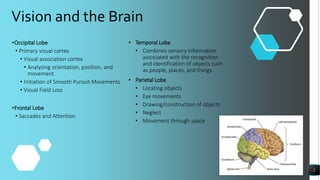
Vision and the Brain
2
• Temporal Lobe
• Combines sensory information
associated with the recognition
and identification of objects such
as people, places, and things.
• Parietal Lobe
• Locating objects
• Eye movements
• Drawing/construction of objects
• Neglect
• Movement through space
•Occipital Lobe
• Primary visual cortex
• Visual association cortex
• Analyzing orientation, position, and
movement.
• Initiation of Smooth Pursuit Movements
• Visual Field Loss
•Frontal Lobe
• Saccades and Attention
Definitions
Visual Perception is the ability to interpret, understand, and define incoming visual information.
Form Constancy is the ability to identify objects despite their variation of size, color, shape, position, or texture.
Figure ground Perception is the ability to distinguish foreground from background.
Visual Closure is the ability to accurately identify objects that are partially covered or missing.
Spatial Orientation is the ability to recognize personal position in relation to opposing positions, directions, movement of objects, and
environmental locations.
Unilateral Inattention is phenomenon that causes one to experience an inability to orient and respond to contralateral visual information.
Depth Perception is the ability to perceive relative distance in environmental objects.
Visual Memory is the ability to take in a visual stimulus, retain its details, and store for later retrieval.
Visual Motor Integration is accurate and quick communication between the eyes and hands.
Visuocognition is the ability to use visual information to solve problems, make decisions, and complete planning and organizational tasks
through mental manipulation.
Executive Functioning is the ability to reason, plan, problem solve, make inferences, and/or evaluate results of actions and decisions.
Memory is taking in new information, holding on to information, and recalling information when needed.
Information Processing is taking environmental stimulation in through the five senses, interpreting it, and responding to it.
Attention/Concentration is staying awake, alert and ready, focusing, and keeping a train of thought.
Focused
Alternating
Divided
3
Objectives
1. Improve understanding of evaluation
process for visual perception and
cognition for adolescents and adults
2. Improve understanding of treatment
techniques for visual perception and
cognition for adolescents and adults,
including bottom-up and top-down
approaches, use of technology, and shoe-
box treatment ideas
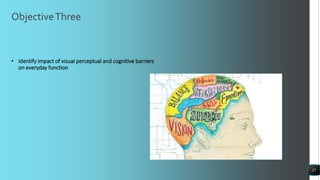
3. Identify impact of visual perceptual and
cognitive barriers on everyday function
4
Objective One
• Improve understanding of evaluation
process for visual perception and cognition
for adolescents and adults
5
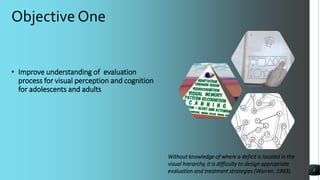
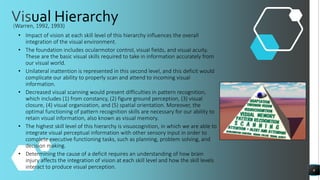
Without knowledge of where a deficit is located in the
visual hierarchy, it is difficulty to design appropriate
evaluation and treatment strategies (Warren, 1993).
Visual Hierarchy
• Impact of vision at each skill level of this hierarchy influences the overall
integration of the visual environment.
• The foundation includes ocularmotor control, visual fields, and visual acuity.
These are the basic visual skills required to take in information accurately from
our visual world.
• Unilateral inattention is represented in this second level, and this deficit would
complicate our ability to properly scan and attend to incoming visual
information.
• Decreased visual scanning would present difficulties in pattern recognition,
which includes (1) from constancy, (2) figure ground perception, (3) visual
closure, (4) visual organization, and (5) spatial orientation. Moreover, the
optimal functioning of pattern recognition skills are necessary for our ability to
retain visual information, also known as visual memory.
• The highest skill level of this hierarchy is visuocognition, in which we are able to
integrate visual perceptual information with other sensory input in order to
complete executive functioning tasks, such as planning, problem solving, and
decision making.
• Determining the cause of a deficit requires an understanding of how brain
injury affects the integration of vision at each skill level and how the skill levels
interact to produce visual perception. 6
(Warren, 1992, 1993)
Vision Screen
7
• Convergence – Coordinated movement of the two eyes
so that the image of a single point is formed on
corresponding retinal areas. Have the client follow an
object (finger, pen, etc.) in toward their nose. Note
distance from face when they cannot keep image single.
Note if one eye breaks before the other. Approximately
4 inches is normal, however many can converge to the
nose (TTN).
• Visual scanning – Coordinating eye movement in an
organized fashion (efficient search pattern) while
actively searching the environment for information (i.e.
scanning a store shelf for a specific product, reading).
• Depth perception – The ability to determine the relative
distance between objects, figures, or landmarks and the
observer (i.e. the car in front of you or beside you when
driving or parking a vehicle). Screened using the Stereo
Fly Test or similar.
• Suppression – The neurological phenomenon of the
brain’s ability to disregard information from one eye;
suppression frequently results following prolonged
double vision, and is thought a natural adaptation of the
brain to try and make sense of the information received
from the eyes. Tested through red/green activities such
as the Worth 4 Dot Test.
• Visual acuity – How clear it is. Screened using Snellen
Charts for distance and near.
• Accommodation – The automatic adjustment of the eye
for seeing at different distances. Screened using near
acuity chart (or other reading material) and moving in
until blurry.
• Diplopia – Another name for double vision. Note if this is
in one area/quadrant only, or all the time.
• Ocular pursuit – The ocular motor skill of following a
moving target with the eyes. Observe the client
following a moving object such as a pencil eraser with
their head still. Note lack of smooth movement, sluggish
movement, overshooting or undershooting the target,
and complaints of double vision or pain.
• Saccadic eye movement –quick, simultaneous
movements of both eyes in the same direction. Ask
client to alternate gaze between one object and another
rapidly. Observe for undershooting, overshooting, or
searching for the target.
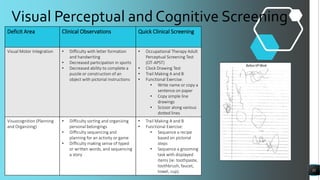
Visual Perceptual and Cognitive Screening
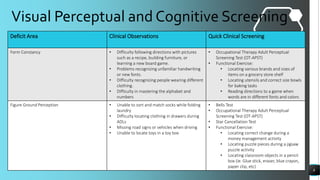
Deficit Area Clinical Observations Quick Clinical Screening
Form Constancy • Difficulty following directions with pictures
such as a recipe, building furniture, or
learning a new board game.
• Problems recognizing unfamiliar handwriting
or new fonts.
• Difficulty recognizing people wearing different
clothing.
• Difficulty in mastering the alphabet and
numbers
• Occupational Therapy Adult Perceptual
Screening Test (OT-APST)
• Functional Exercise:
• Locating various brands and sizes of
items on a grocery store shelf
• Locating utensils and correct size bowls
for baking tasks
• Reading directions to a game when
words are in different fonts and colors
Figure Ground Perception • Unable to sort and match socks while folding
laundry
• Difficulty locating clothing in drawers during
ADLs
• Missing road signs or vehicles when driving
• Unable to locate toys in a toy box
• Bells Test
• Occupational Therapy Adult Perceptual
Screening Test (OT-APST)
• Star Cancellation Test
• Functional Exercise:
• Locating correct change during a
money management activity
• Locating puzzle pieces during a jigsaw
puzzle activity
• Locating classroom objects in a pencil
box (ie. Glue stick, eraser, blue crayon,
paper clip, etc)
8
Visual Perceptual and Cognitive Screening
9
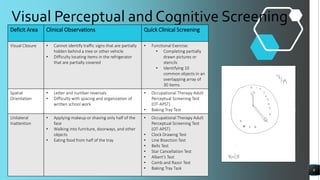
Deficit Area Clinical Observations Quick Clinical Screening
Visual Closure • Cannot identify traffic signs that are partially
hidden behind a tree or other vehicle
• Difficulty locating items in the refrigerator
that are partially covered
• Functional Exercise:
• Completing partially
drawn pictures or
stencils
• Identifying 10
common objects in an
overlapping array of
30 items
Spatial
Orientation
• Letter and number reversals
• Difficulty with spacing and organization of
written school work
• Occupational Therapy Adult
Perceptual Screening Test
(OT-APST)
• Baking Tray Test
Unilateral
Inattention
• Applying makeup or shaving only half of the
face
• Walking into furniture, doorways, and other
objects
• Eating food from half of the tray
• Occupational Therapy Adult
Perceptual Screening Test
(OT-APST)
• Clock Drawing Test
• Line Bisection Test
• Bells Test
• Star Cancellation Test
• Albert’s Test
• Comb and Razor Test
• Baking Tray Task
Visual Perceptual and Cognitive Screening
10
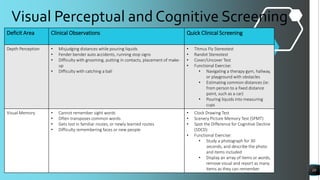
Deficit Area Clinical Observations Quick Clinical Screening
Depth Perception • Misjudging distances while pouring liquids
• Fender bender auto accidents, running stop signs
• Difficulty with grooming, putting in contacts, placement of make-
up
• Difficulty with catching a ball
• Titmus Fly Stereotest
• Randot Stereotest
• Cover/Uncover Test
• Functional Exercise:
• Navigating a therapy gym, hallway,
or playground with obstacles
• Estimating common distances (ie:
from person to a fixed distance
point, such as a car)
• Pouring liquids into measuring
cups
Visual Memory • Cannot remember sight words
• Often transposes common words
• Gets lost in familiar routes, or newly learned routes
• Difficulty remembering faces or new people
• Clock Drawing Test
• Scenery Picture Memory Test (SPMT)
• Spot the Difference for Cognitive Decline
(SDCD)
• Functional Exercise:
• Study a photograph for 30
seconds, and describe the photo
and items included
• Display an array of items or words,
remove visual and report as many
items as they can remember
Visual Perceptual and Cognitive Screening
11
Deficit Area Clinical Observations Quick Clinical Screening
Visual Motor Integration • Difficulty with letter formation
and handwriting
• Decreased participation in sports
• Decreased ability to complete a
puzzle or construction of an
object with pictorial instructions
• Occupational Therapy Adult
Perceptual Screening Test
(OT-APST)
• Clock Drawing Test
• Trail Making A and B
• Functional Exercise:
• Write name or copy a
sentence on paper
• Copy simple line
drawings
• Scissor along various
dotted lines
Visuocognition (Planning
and Organizing)
• Difficulty sorting and organizing
personal belongings
• Difficulty sequencing and
planning for an activity or game
• Difficulty making sense of typed
or written words, and sequencing
a story
• Trail Making A and B
• Functional Exercise:
• Sequence a recipe
based on pictorial
steps
• Sequence a grooming
task with displayed
items (ie: toothpaste,
toothbrush, faucet,
towel, cup).
12
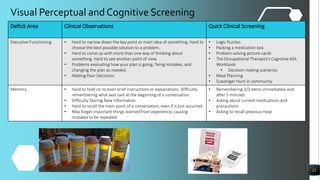
Visual Perceptual and Cognitive Screening
Deficit Area Clinical Observations Quick Clinical Screening
Executive Functioning • Hard to narrow down the key point or main idea of something. Hard to
choose the best possible solution to a problem.
• Hard to come up with more than one way of thinking about
something. Hard to see another point of view.
• Problems evaluating how your plan is going, fixing mistakes, and
changing the plan as needed.
• Making Poor Decisions
• Logic Puzzles
• Packing a medication box
• Problem solving picture cards
• The Occupational Therapist's Cognitive ADL
Workbook
• Decision making scenarios
• Meal Planning
• Scavenger Hunt in community
Memory • Hard to hold on to even brief instructions or explanations. Difficulty
remembering what was said at the beginning of a conversation.
• Difficulty Storing New Information
• Hard to recall the main point of a conversation, even if it just occurred.
• May forget important things learned from experience, causing
mistakes to be repeated.
• Remembering 3/3 items immediately and
after 5 minutes
• Asking about current medications and
precautions
• Asking to recall previous meal
13
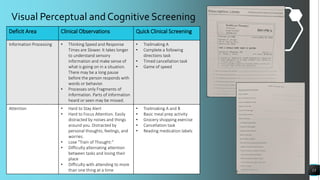
Visual Perceptual and Cognitive Screening
Deficit Area Clinical Observations Quick Clinical Screening
Information Processing • Thinking Speed and Response
Times are Slower. It takes longer
to understand sensory
information and make sense of
what is going on in a situation.
There may be a long pause
before the person responds with
words or behavior.
• Processes only Fragments of
Information. Parts of information
heard or seen may be missed.
• Trailmaking A
• Complete a following
directions task
• Timed cancellation task
• Game of speed
Attention • Hard to Stay Alert
• Hard to Focus Attention. Easily
distracted by noises and things
around you. Distracted by
personal thoughts, feelings, and
worries.
• Lose "Train of Thought:“
• Difficulty alternating attention
between tasks and losing their
place
• Difficulty with attending to more
than one thing at a time
• Trailmaking A and B
• Basic meal prep activity
• Grocery shopping exercise
• Cancellation task
• Reading medication labels
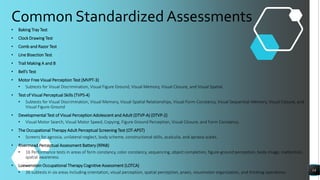
Common Standardized Assessments
• Baking Tray Test
• Clock Drawing Test
• Comb and Razor Test
• Line Bisection Test
• Trail Making A and B
• Bell’s Test
• Motor Free Visual Perception Test (MVPT-3)
• Subtests for Visual Discrimination, Visual Figure Ground, Visual Memory, Visual Closure, and Visual Spatial.
• Test of Visual Perceptual Skills (TVPS-4)
• Subtests for Visual Discrimination, Visual Memory, Visual-Spatial Relationships, Visual Form-Constancy, Visual Sequential-Memory, Visual Closure, and
Visual Figure-Ground
• Developmental Test of Visual Perception Adolescent and Adult (DTVP-A) (DTVP-2)
• Visual Motor Search, Visual Motor Speed, Copying, Figure Ground Perception, Visual Closure, and Form Constancy.
• The Occupational Therapy Adult Perceptual Screening Test (OT-APST)
• Screens for agnosia, unilateral neglect, body scheme, constructional skills, acalculia, and apraxia scales.
• Rivermead Perceptual Assessment Battery (RPAB)
• 16 Performance tests in areas of form constancy, color constancy, sequencing, object completion, figure-ground perception, body image, inattention,
spatial awareness
• Loewenstein Occupational Therapy Cognitive Assessment (LOTCA)
• 26 subtests in six areas including orientation, visual perception, spatial perception, praxis, visuomotor organization, and thinking operations. 14
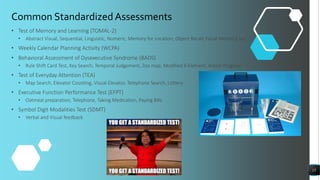
Common StandardizedAssessments
• Test of Memory and Learning (TOMAL-2)
• Abstract Visual, Sequential, Linguistic, Numeric, Memory for Location, Object Recall, Facial Memory, etc
• Weekly Calendar Planning Activity (WCPA)
• Behavioral Assessment of Dysexecutive Syndrome (BADS)
• Rule Shift Card Test, Key Search, Temporal Judgement, Zoo map, Modified 6 Element, Action Program
• Test of Everyday Attention (TEA)
• Map Search, Elevator Counting, Visual Elevator, Telephone Search, Lottery
• Executive Function Performance Test (EFPT)
• Oatmeal preparation, Telephone, Taking Medication, Paying Bills
• Symbol Digit Modalities Test (SDMT)
• Verbal and Visual feedback
15
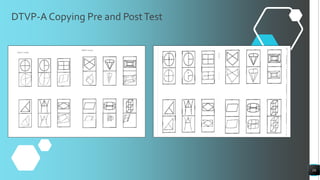
DTVP-A Copying Pre and PostTest
16
17
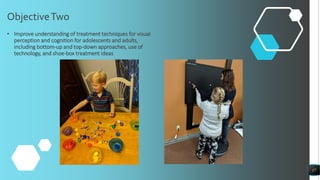
ObjectiveTwo
• Improve understanding of treatment techniques for visual
perception and cognition for adolescents and adults,
including bottom-up and top-down approaches, use of
technology, and shoe-box treatment ideas
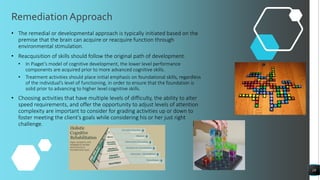
RemediationApproach
18
• The remedial or developmental approach is typically initiated based on the
premise that the brain can acquire or reacquire function through
environmental stimulation.
• Reacquisition of skills should follow the original path of development.

• In Piaget’s model of cognitive development, the lower level performance
components are acquired prior to more advanced cognitive skills.
• Treatment activities should place initial emphasis on foundational skills, regardless
of the individual’s level of functioning, in order to ensure that the foundation is
solid prior to advancing to higher level cognitive skills.
• Choosing activities that have multiple levels of difficulty, the ability to alter
speed requirements, and offer the opportunity to adjust levels of attention
complexity are important to consider for grading activities up or down to
foster meeting the client’s goals while considering his or her just right
challenge.
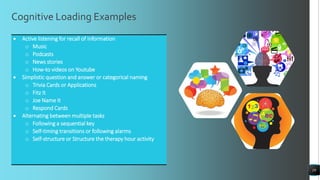
Cognitive Loading Examples
 Active listening for recall of information
o Music
o Podcasts
o News stories
o How-to videos on Youtube
 Simplistic question and answer or categorical naming
o Trivia Cards or Applications
o Fitz It
o Joe Name It
o Respond Cards
 Alternating between multiple tasks
o Following a sequential key
o Self-timing transitions or following alarms
o Self-structure or Structure the therapy hour activity
19
20
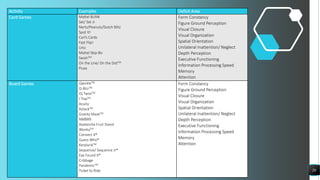
Activity Examples Deficit Area
Card Games Mattel BLINK
Set/ Set Jr
Nertz/Peanuts/Dutch Blitz
Spot It!
Carl’s Cards
Fast Flip!
Uno
Mattel Skip-Bo
SwishTM
On the Line/ On the DotTM
Fluxx
Form Constancy
Figure Ground Perception
Visual Closure
Visual Organization
Spatial Orientation
Unilateral Inattention/ Neglect
Depth Perception
Executive Functioning
Information Processing Speed
Memory
Attention
Board Games QwirkleTM
Q-BitzTM
IQ TwistTM
I TraxTM
Acuity
AztackTM
Gravity MazeTM
NMBR9
Avalanche Fruit Stand
WonkyTM
Connect 4®
Guess Who®
KerplunkTM
Sequence/ Sequence Jr®
Eye Found It®
Cribbage
PandemicTM
Ticket to Ride
Form Constancy
Figure Ground Perception
Visual Closure
Visual Organization
Spatial Orientation
Unilateral Inattention/ Neglect
Depth Perception
Executive Functioning
Information Processing Speed
Memory
Attention
21
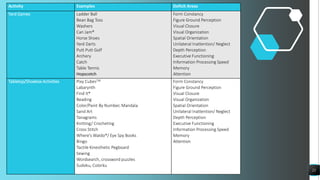
Activity Examples Deficit Areas
Yard Games Ladder Ball
Bean Bag Toss
Washers
Can Jam®
Horse Shoes
Yard Darts
Putt Putt Golf
Archery
Catch
Table Tennis
Hopscotch
Form Constancy
Figure Ground Perception
Visual Closure
Visual Organization
Spatial Orientation
Unilateral Inattention/ Neglect
Depth Perception
Executive Functioning
Information Processing Speed
Memory
Attention
Tabletop/Shoebox Activities Pixy CubesTM
Labarynth
Find It®
Beading
Color/Paint By Number, Mandala
Sand Art
Tanagrams
Knitting/ Crocheting
Cross Stitch
Where’s Waldo®/ Eye Spy Books
Bingo
Tactile Kinesthetic Pegboard
Sewing
Wordsearch, crossword puzzles
Sudoku, Colorku
Form Constancy
Figure Ground Perception
Visual Closure
Visual Organization
Spatial Orientation
Unilateral Inattention/ Neglect
Depth Perception
Executive Functioning
Information Processing Speed
Memory
Attention
22
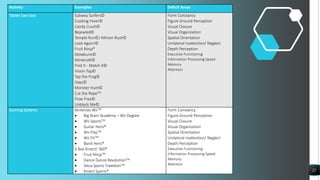
Activity Examples Deficit Areas
Tablet Exercises Subway Surfers©
Cooking Fever©
Candy Crush©
Bejewled©
Temple Run©/ Minion Rush©
Look Again!©
Fruit Ninja®
Glowburst©
Minecraft©
Find It - Match It©
Vision Tap©
Tap the Frog©
iSays©
Monster Hunt©
Cut the RopeTM
Flow Free©
Unblock Me©
Form Constancy
Figure Ground Perception
Visual Closure
Visual Organization
Spatial Orientation
Unilateral Inattention/ Neglect
Depth Perception
Executive Functioning
Information Processing Speed
Memory
Attention
Gaming Systems Nintendo WiiTM
 Big Brain Academy – Wii Degree
 Wii SportsTM
 Guitar Hero®
 Wii PlayTM
 Wii FitTM
 Band Hero®
X Box Kinect/ 360®
 Fruit NinjaTM
 Dance Dance RevolutionTM
 Deca Sports FreedomTM
 Kinect Sports®
Form Constancy
Figure Ground Perception
Visual Closure
Visual Organization
Spatial Orientation
Unilateral Inattention/ Neglect
Depth Perception
Executive Functioning
Information Processing Speed
Memory
Attention
23
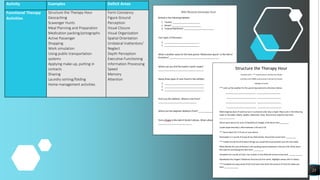
Activity Examples Deficit Areas
Functional Therapy
Activities
Structure the Therapy Hour
Geocaching
Scavenger Hunts
Meal Planning and Preparation
Medication packing/pictographs
Active Passenger
Shopping
Work simulation
Using public transportation
systems
Applying make-up, putting in
contacts
Shaving
Laundry sorting/folding
Home management activities
Form Constancy
Figure Ground
Perception
Visual Closure
Visual Organization
Spatial Orientation
Unilateral Inattention/
Neglect
Depth Perception
Executive Functioning
Information Processing
Speed
Memory
Attention
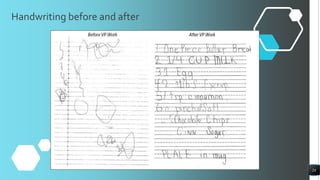
Handwriting before and after
24
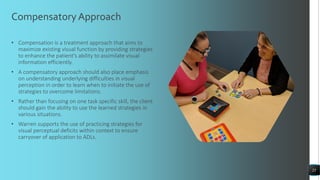
Compensatory Approach
• Compensation is a treatment approach that aims to
maximize existing visual function by providing strategies
to enhance the patient's ability to assimilate visual
information efficiently.
• A compensatory approach should also place emphasis
on understanding underlying difficulties in visual
perception in order to learn when to initiate the use of
strategies to overcome limitations.
• Rather than focusing on one task specific skill, the client
should gain the ability to use the learned strategies in
various situations.
• Warren supports the use of practicing strategies for
visual perceptual deficits within context to ensure
carryover of application to ADLs.
25
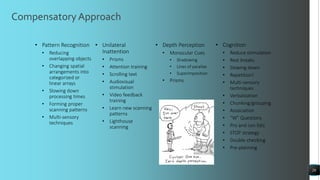
Compensatory Approach
• Pattern Recognition
• Reducing
overlapping objects
• Changing spatial
arrangements into
categorized or
linear arrays
• Slowing down
processing times
• Forming proper
scanning patterns
• Multi-sensory
techniques
• Unilateral
Inattention
• Prisms
• Attention training
• Scrolling text
• Audiovisual
stimulation
• Video feedback
training
• Learn new scanning
patterns
• Lighthouse
scanning
• Depth Perception
• Monocular Cues
• Shadowing
• Lines of parallax
• Superimposition
• Prisms
• Cognition
• Reduce stimulation
• Rest breaks
• Slowing down
• Repetition!
• Multi-sensory
techniques
• Verbalization
• Chunking/grouping
• Association
• “W” Questions
• Pro and con lists
• STOP strategy
• Double checking
• Pre-planning
26
ObjectiveThree
• Identify impact of visual perceptual and cognitive barriers
on everyday function
27
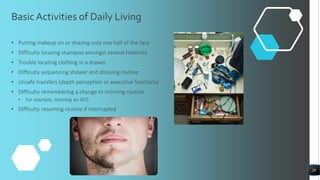
BasicActivities of Daily Living
• Putting makeup on or shaving only one half of the face
• Difficulty locating shampoo amongst several toiletries
• Trouble locating clothing in a drawer
• Difficulty sequencing shower and dressing routine
• Unsafe transfers (depth perception or executive functions)
• Difficulty remembering a change to morning routine
• For example, donning an AFO
• Difficulty resuming routine if interrupted
28
FunctionalAmbulation andTransfers
• Navigating curbs and uneven surfaces in the community
• Vehicle transfers
• Navigating stairs
• Colliding with walls and furniture
• Tripping over rugs and items on the floor
• Determining safe distance for transfers or sitting
29
Financial Management
• Difficulty locating account number on a bill
• Trouble remembering to pay bills
• Unable to follow columns while balancing a checkbook or while online banking
• Cannot recognize different coins
• Counting cash incorrectly for making payment or change
• Not able to follow a budget
30
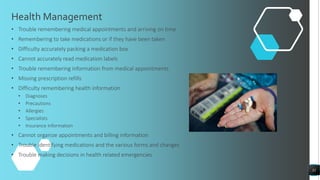
Health Management
• Trouble remembering medical appointments and arriving on time
• Remembering to take medications or if they have been taken
• Difficulty accurately packing a medication box
• Cannot accurately read medication labels
• Trouble remembering information from medical appointments
• Missing prescription refills
• Difficulty remembering health information
• Diagnoses
• Precautions
• Allergies
• Specialists
• Insurance information
• Cannot organize appointments and billing information
• Trouble identifying medications and the various forms and changes
• Trouble making decisions in health related emergencies
31
Shopping
• Trouble locating items in the store
• Bumping into displays while shopping
• Gets overstimulated in public
• Cannot remember where vehicle is parked
• Backtracking in the store due to poor organization and planning
• Unable to locate stores in the mall
• Overspending in the store
• Impulsively buying unneeded items
• Only attending to one side of aisle
32
Meal Planning and Preparation
• Difficulty pouring liquid ingredients
• Unable to identify appropriate utensils for use
• Cannot identify an appropriate weekly meal plan and grocery list
• Unsafe with heat surfaces and sharps especially when in the field of visual inattention
• Inability to sequence a recipe
• Forgetting to turn the stove or oven off
• Overcooking and burning food
• Not utilizing full baking sheet when making cookies
33
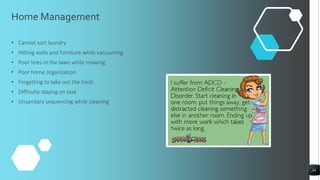
Home Management
• Cannot sort laundry
• Hitting walls and furniture while vacuuming
• Poor lines in the lawn while mowing
• Poor home organization
• Forgetting to take out the trash
• Difficulty staying on task
• Unsanitary sequencing while cleaning
34
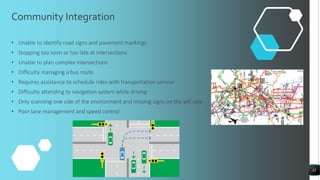
Community Integration
• Unable to identify road signs and pavement markings
• Stopping too soon or too late at intersections
• Unable to plan complex intersections
• Difficulty managing a bus route
• Requires assistance to schedule rides with transportation service
• Difficulty attending to navigation system while driving
• Only scanning one side of the environment and missing signs on the left side
• Poor lane management and speed control
35
Communication Management/Accessing Resources
• Difficulty scanning for information on phone book pages or websites
• Unable to identify appropriate search terms to locate information
• Cannot remember contact information for personal needs
• Unable to attend to a phone conversation and take notes
• Difficulty sequencing apps on your phone
• Decreased ability to identify the most appropriate professional to contact for person needs
36
Vocation and School
• Difficulty with alternating between projects, phone calls, e-mails,
etc.
• Difficulty learning a new job task or role
• Unable to scan for and identify jobsite hazards
• Increased headaches from visual stimulation and lighting
• Difficulty reading small print text
• Cannot maintain organization of work space or school
supplies/homework
• Decreased developmental progression of visual perceptual and
cognitive processes impacting school performance
• Increased visual strain with screen time requirements
• Decreased ability to sequence and prioritize tasks
• Unable to multitask and retain information from meetings or
conference calls
37
Questions?
ThankYou
References
• 1. Berryhill ME, Fendrich R, & Olson, IR. Impaired Distance Perception and Size Constancy Following Bilateral Occipitoparietal Damage. Exp Brain Res. 2009;194(3):381–393. Doi:10.1007/s00221-009-1707-7
• 2. American Occupational Therapy Association. Occupational Therapy Practice Framework: Domain and Process. 3rd ed. 2014
• 3. Warren M. A hierarchical model for evaluation and treatment of visual perceptual dysfunction in adult acquired brain injury, part 1. Am J Occup Ther. 1993;47(1):42-54. doi:10.5014/ajot.47.1.42
• 4. Brown T, Elliott S, Bourne R, et al. The discriminative validity of three visual perception tests. N Z J Occup Ther. 2011;58(2):14-22. Accessed May 8, 2018.
• 5. Brown T, Elliot S, Bourne R, et al. The convergent validity of the developmental test of visual perception-adolescent and adult, motor-free visual perception test-third edition and test of visual perception skills (non-motor)-third edition when used with adults. Br J Occup
Ther. 2012;75(3):134-143. doi:10.4276/030802212X13311219571783
• 6. Jung H, Woo Y, Kang J, Choi Y, Kim K. Visual perception of ADHD children with sensory processing disorder. Psychiatry Investig. 2014;11(2): 119-123. doi:10.4306/pi.2014.11.2.119
• 7. Cooke DM, McKenna K, Flemming, J. Development of a standardized occupational therapy screening tool for visual perception in adults. Scand J Occup Ther. 2005;12(2):59-71. doi:10.1080/11038120410020683-
• 8. Geldof C, Wassenaer AV, Kieviet JD, Kok J, Oosterlaan J. Visual perception and visual-motor integration in very preterm and/ or very low birth weight children: a meta-analysis. Res Dev Disabil. 2012;33(2):726-736. doi: 10.1016/j.ridd.2011.08.025.
• 9. Menon-Nair A, Korner-Bitensky N, Ogourtsova T. Occupational therapists' identification, assessment, and treatment of unilateral spatial neglect during stroke rehabilitation in Canada. Stroke. 2007;38(9):2556-2562. doi:10.1161/STROKEAHA.107.484857
• 10. Pieker I, David N, Schneider TR, Nolte G, Schottle D, Engel AK. Perceptual integration deficits in autism spectrum disorders are associated with reduced interhemispheric gamma-band coherence. J Neurosci. 2015; 35(50): 16352-16361. doi:10.1523/jneurosci.1442-
15.2015
• 11. Poole JL, Nakamoto T, McNulty T, et al. Dexterity, visual perception, and activities of daily living in persons with multiple sclerosis. Occup Ther Health Care. 2010;24(2):159-70. doi:10.3109/07380571003681202
• 12. Ego A, Lidzba K, Brovedani P, et al. Visual-perceptual impairment in children with cerebral palsy: a systematic review. Dev Med Child Neurol. 2015; 57(2):46-51. doi:10.1111/dmcn.12687
• 13. Cho M, Kim D, Yang Y. Effects of visual perceptual intervention on visual-motor integration and activities of daily living performance of children with cerebral palsy. J Phys Ther Sci. 2015;27(2):411-413. doi:10.1589/jpts.27.411
• 14. Auld M, Boyd R, Moseley G, Johnston L. Seeing the gaps: a systematic review of visual perception tools for children with hemiplegia. Disabil Rehabil. 2003;33(19):1854-1865. doi:10.3109/19638288.549896
• 15. Vasileva, N. Dynamics of the complex forms of visual perception in children of pre-school age (a neuropsychological analysis). J Spec Educ Rehabil. 2015;16(3-4):52-70. doi:10.1515/JSER-2015-0011
• 16. Reynolds CR, Pearson NA, Voress JK. Developmental Test of Visual Perception Adolescent and Adult Examiners Manual. Austin, TX: pro-ed; 2002.
• 17. Richmond J, Holland K. Correlating the developmental test of visual perception-2 (DTVP-2) and the test of visual perceptual skills revised (TVPS-R) as assessment tools for learners with learning difficulties. S Afr J Occup Ther. 2011;41(1): 33-37. Accessed April 11, 2018.
• 18. Zoltan B. Vision, Perception, and Cognition . 4th ed. Thorofare, NJ: SLACK Incorporated; 2007.
• 19. Brown GT, Gaboury I. The Measurement Properties and Factor Structure of the Test of Visual-Perceptual Skills-Revised: Implication for Occupational Therapy Assessment and Practice. Am J Occup Ther. 2006:60(2): 182-193. doi:10.5014/ajot.60.2.182.
• 20. Cote CA. Levels of processing in visual perception tasks. Am J Occup Ther. 2011;18(3). Accessed May 10, 2018.
• 21. Feder K, Majnemer A. Handwriting development, competency, and intervention. Dev Med Child Neurol. 2007;49(4):312-317. doi:10.1111/j.1469-8749.2007.00312.x
• 22. Possin K. Visual spatial cognition in neurodegenerative disease. Neurocase. 2010;16(6): 466-487. doi:10.1080/13554791003730600
• 23. Blake R, Rizzo M, McEnvoy S. Aging and perception of visual form from temporal structure. Psychol Aging. 2008:23(1), 181-189. doi:10:10.1037/0882-7974.23.1.181
• 24. Uhlhaas P, Pantel J, Lanfermann H, et al. Visual Perceptual Organization Deficits in Alzheimer's Dementia. Dement Geriatr Cog Dis. 2008; 25: 465-475. doi:10.1159/0000125671
39
References Continued
• 25. Wagemans J, Elder J, Kubovy M, et al. A century of Gestalt psychology in visual perception: I. Perceptual grouping and figure-ground organization. Psychol Bull. 2012;138(6):1172-1217. doi:10.1037/a0029333
• 26. Torfs K, Vancleef K, Lafosse C, Wagemans J, De-Wit L. The Leuven perceptual organization screening test (L-POST), an online test to assess mid-level visual perception. Beh Res Methods. 2014;46: 472-487. doi:10.3758/s13428-013-0382-6
• 27. Duquette J. Spatial orientation in adolescents with visual impairment: related factors and avenues for assessment. Institut Nazareth et Louis-Braille. 2012. Accessed April 11, 2018.


• 28. Padula, W., Munitz, R., & Magrun, M. Neuro-Visual Processing Rehabilitation: An Interdisciplinary Approach. Santa Ana, CA: Optometric Extension Program Foundation, Inc; 2012
• 29. Ancona C, Stoppani M, Odazio V, La Spina C, Corradetti G, Bandello F. Stereo tests as a screening tool for strabismus: Which is the best choice?. Clin ophthal. 2014; (8): 2221-2227. doi:10.2147/OPTH.S67488.
• 30. Christy K, Huffine N, Hannah T, DeLeion M. Outcomes after cognitive perceptual motor retraining (CPM) of patients with acquired brain injury (abi). Open J Occup Ther. 2016; 4(1). doi:10.15453/2168-6408.1076
• 31. Westfall T, Moore K, Bernardo de Leon M, Kulkarni M, Cook E. Cognitive perceptual motor retraining: remediation of deficits following brain injury. The J Cog Rehabil. 2005;5-11. Accessed April 11, 2018.
• 32. Deutsch J, Borbely M, Filler J, Huhn K, Guarrera-Bowlby P. Use of a low-cost, commercially available gaming console (Wii) for rehabilitation of an adolescent with cerebral palsy. Phys Ther. 2008;88(10), 1196-1207. doi:10.2522/ptj.20080062
• 33. Chen M, Tsai H, Wang C, Wuang, Y. The effectiveness of racket-sport intervention on visual perception and executive functions in children with mild intellectual disabilities and borderline intellectual disabilities. Neuropsycho Dis Treat. 2015; 11, 2287-2297.
doi:209.133.111.226
• 34. Berger S, Kaldenberg J, Selmane R, Carlo S. Effectiveness of interventions to address visual and visual-perceptual impairments to improve occupational performance in adults with traumatic brain injury: a systematic review. Am J Occup Ther. 2016; 70(3), 1-15.
doi:10.5014/ajot.2016.020875
• 35. Lee Y, Lee C, Hwang B. Effects of computer-aided cognitive rehabilitation training and balance exercise on cognitive and visual perception ability of the elderly. J Phys Ther Sci. 2012;24(9), 885-887. Accessed April 11, 2018.
• 36. Jo K, Yu J, Jung J. Effects of virtual reality-based rehabilitation on upper extremity function and visual perception in stroke patients: a randomized clinical trial. J Phys Ther Sci. 2012;14(11):1205-1208. Accessed September 7, 2018.
• 37. Prifitis K, Passarini L, Pilosia C, Meneghello F, Pitteri M. Visual scanning training, limb activation treatment, and prism adaptation for rehabilitation left neglect: who is the winner? Front Hum Neurosci. 2013; 360 (7), 1-12. doi:10.3389/fnhum.2013.00360
• 38. Toglia J. Visual perception of objects: An approach to assessment and intervention. Am J Occup Ther 1989;43(9), 587-595. doi:10.5014/ajot.43.9.587
• 39. Chan DYW, Man DWK. Unilateral neglect in stroke. Top Geriatr Rehabil. 2013;29(2):136-134. doi:10.1097/TGR.0b013e31827ea7c9
• 40. Tham K, Ginsburg E, Fisher A, Tegner R. Training to improve awareness of disabilities in clients with unilateral neglect. Am J Occup Ther. 2001;55(1), 46-54. doi:10.5014/ajot.55.1.46
• 41. Fox R. A rationale for the use of prisms in the vision therapy room. J Behav Opt. 2011,22(5), 126-129. Accessed April 11, 2018.
• 42. Kortte KB, Hillis AE. Recent trends in rehabilitation interventions for visual neglect and anosognosia for hemiplegia following right hemisphere stroke. Future Neruol. 2011; 6(1), 33-43. doi:10.2217/fnl.10.79
• 43. Wilcox D, Chronister C, Savage M. Methods for prism placement for hemianopic visual field loss in adults with low vision. J Vis Impair Blind. 2016;110(4), 276. Accessed April 11, 2018.
• 44. Quintana L. Optimizing vision, visual perception, and praxis abilities. In M. V. Radomski and C. Trombly Latham (Eds.), Occupational Therapy for Physical Dysfunction (6th ed.) (728-747). Location: Baltimore, MD and Philadelphia, PA;2008
• 45. Swan, L. Unilateral Spatial Neglect. Phys Ther. 2001; 81(9), 1572-1580. Accessed April 11, 2018.
• 46. Butter CM, Kirsch N. Combined and separate effects of eye patching and visual stimulation on unilateral neglect following stroke. Arch Phys Med Rehabil. 1992; 73(12): 1133-1139. Accessed September 7, 2018.
• 47. Walker R, Young AW, Lincoln NB. Eye patching and the rehabilitation of visual neglect. Neuropsycho Rehabil. 1996;6(3): 219-231. doi:10.1080/713755508
• 48. Houston KE, Barrett AM. Patching for diplopia contraindicated in patients with brain injury? Optom Vis Sci. 2017; 94(1), 120. doi:10.1097/OPX.0000000000000976
40
References Continued
• 49. Tinelli F, Cioni G, Purpura G. Development and implementation of a new telerehabilitation system for audiovisual stimulation training in hemianopia. Front Neurol. 2017;8(621), 1-10. doi:10.3389/fneur.2017.00621
• 50. Frassinetti F, Bolognini N, Bottari D, Bonora A, Ladavas E. Audiovisual integration in patients with visual deficit. J Cogn Neurosci. 2005; 17(9), 1442-1452. doi:10.1162/0898929054985446
• 51. Makovski T. The open-object illusion: Size perception is greatly influenced by object boundaries. Atten Percept Psychophys. 2017; 79, 1282-1289. doi:10.3758/s13414-017-1326-5
• 52. Kalloniatis M, Luu C. The Perception of Depth. 2005 May 1 [Updated 2007 Jun 6]. In: Kolb H, Fernandez E, Nelson R, editors. Webvision: The Organization of the Retina and Visual System [Internet]. Salt Lake City (UT): University of Utah Health Sciences Center; 1995.
Accessed July 26, 2018.
• 53. Gillen G. Cognitive and perceptual rehabilitation: optimizing function. St. Louis, MO.: Mosby/ELSEVIER; 2009.
• 54. Appelros P, Karlsson GM, Thorwalls A, Tham K, Nydevik I. Unilateral neglect: further validation of the baking tray task. J Rehabil Med. 2004;36(6):258-261. Retrieved September 7, 2018. doi:10.1080/16501970410029852
• 55. Bailey M, Riddoch J, Crome P. Test-retest stability of three tests for unilateral visual neglect in patients with stroke: Star Cancellation, Line Bisection, and Baking Tray Task. Neurospychol Rehabil, 2004; 14(4), 403-419. doi:10.1080/09602010343000282
• 56. Allen D, Thaler N, Ringdahl EN, Mayfield J. Comprehensive trail making test performance in children and adolescents with traumatic brain injury. Psychol Assess. 2011; (24): 556-564. doi:10.1037/a0026263
• 57. Desrosiers G, Kavanagh D. Cognitive assessment in closed head injury: stability, validity, and parallel forms for two neuropsychological measures of recovery. Int J Clin Neuorpsychol. 1987; 9(4), 162-173. Retrieved July 26, 2018.
• 58. Sanchez-Cubillo, I, Perianez, J, Adrover-Roig, D, et al. Construct validity of the Trail Making Test: role of task-switching, working memory, inhibition/interference control, and visuomotor abilities. J Int Neuropsychol Soc. 2009;15(3), 438. doi:10.1017/S1355617709090626
• 59. Gauthier L, Dehaut F, Joanette Y. The Bells Test: a quantitative and qualitative test for visual neglect. Int J Clin Neuropsychol, 1989;(11), 49-54. Retrieved July 26, 2018.
• 60. Ferber S, Karnath HO. How to assess spatial neglect–Line Bisection or Cancellation Tests? J Clin Expl Neuropsychol, 2001;(23), 599-607. doi:10.1076/jcen.23.5.599.1243
• 61. Brown TG, Rodger S, Davis A. Motor-Free Visual Perception Test – Revised: An overview and critique. British Journal of Occupational Therapy. 2003;66(4), 159-167. doi:10.1177/030802260306600405
• 62. McKenna K, Cooke D, Fleming J, Jefferson A, Ogden S. The incidence of visual perceptual impairment in patients with severe traumatic brain injury. Brain Inj. 2006;20(5), 507-518. doi:10.1080/02699050600664368
• 63. Cooke DM, McKenna K, Fleming J, Darnell.R. Criterion validity of the Occupational Therapy Adult Perceptual Screening Test (OT-APST). Scand J Occup Ther. 2006;13(1), 38-48, doi:10.1080/11038120500363006
• 64. Cooke DM, McKenna K, Fleming J, Darnell R. Australlian normative data for the occupational therapy adult perceptual screening test. Aust Occup Ther J. 2006; (53), 325-336. doi:10.1111/j.1440-1630.2006.00597.x
• 65. Friedman PJ, Leong L. The rivermead perceptual assessment battery in acute stroke. Br J Occup Ther. 1992;55(6): 233-237. doi:10.1177/030802269205500608
41

Assessment_and_Intervention_of_Visual_Perception_and_Cognition3.pdf

  • 1.
  • 2.
    Vision and theBrain 2 • Temporal Lobe • Combines sensory information associated with the recognition and identification of objects such as people, places, and things. • Parietal Lobe • Locating objects • Eye movements • Drawing/construction of objects • Neglect • Movement through space •Occipital Lobe • Primary visual cortex • Visual association cortex • Analyzing orientation, position, and movement. • Initiation of Smooth Pursuit Movements • Visual Field Loss •Frontal Lobe • Saccades and Attention
  • 3.
    Definitions Visual Perception isthe ability to interpret, understand, and define incoming visual information. Form Constancy is the ability to identify objects despite their variation of size, color, shape, position, or texture. Figure ground Perception is the ability to distinguish foreground from background. Visual Closure is the ability to accurately identify objects that are partially covered or missing. Spatial Orientation is the ability to recognize personal position in relation to opposing positions, directions, movement of objects, and environmental locations. Unilateral Inattention is phenomenon that causes one to experience an inability to orient and respond to contralateral visual information. Depth Perception is the ability to perceive relative distance in environmental objects. Visual Memory is the ability to take in a visual stimulus, retain its details, and store for later retrieval. Visual Motor Integration is accurate and quick communication between the eyes and hands. Visuocognition is the ability to use visual information to solve problems, make decisions, and complete planning and organizational tasks through mental manipulation. Executive Functioning is the ability to reason, plan, problem solve, make inferences, and/or evaluate results of actions and decisions. Memory is taking in new information, holding on to information, and recalling information when needed. Information Processing is taking environmental stimulation in through the five senses, interpreting it, and responding to it. Attention/Concentration is staying awake, alert and ready, focusing, and keeping a train of thought. Focused Alternating Divided 3
  • 4.
    Objectives 1. Improve understandingof evaluation process for visual perception and cognition for adolescents and adults 2. Improve understanding of treatment techniques for visual perception and cognition for adolescents and adults, including bottom-up and top-down approaches, use of technology, and shoe- box treatment ideas 3. Identify impact of visual perceptual and cognitive barriers on everyday function 4
  • 5.
    Objective One • Improveunderstanding of evaluation process for visual perception and cognition for adolescents and adults 5 Without knowledge of where a deficit is located in the visual hierarchy, it is difficulty to design appropriate evaluation and treatment strategies (Warren, 1993).
  • 6.
    Visual Hierarchy • Impactof vision at each skill level of this hierarchy influences the overall integration of the visual environment. • The foundation includes ocularmotor control, visual fields, and visual acuity. These are the basic visual skills required to take in information accurately from our visual world. • Unilateral inattention is represented in this second level, and this deficit would complicate our ability to properly scan and attend to incoming visual information. • Decreased visual scanning would present difficulties in pattern recognition, which includes (1) from constancy, (2) figure ground perception, (3) visual closure, (4) visual organization, and (5) spatial orientation. Moreover, the optimal functioning of pattern recognition skills are necessary for our ability to retain visual information, also known as visual memory. • The highest skill level of this hierarchy is visuocognition, in which we are able to integrate visual perceptual information with other sensory input in order to complete executive functioning tasks, such as planning, problem solving, and decision making. • Determining the cause of a deficit requires an understanding of how brain injury affects the integration of vision at each skill level and how the skill levels interact to produce visual perception. 6 (Warren, 1992, 1993)
  • 7.
    Vision Screen 7 • Convergence– Coordinated movement of the two eyes so that the image of a single point is formed on corresponding retinal areas. Have the client follow an object (finger, pen, etc.) in toward their nose. Note distance from face when they cannot keep image single. Note if one eye breaks before the other. Approximately 4 inches is normal, however many can converge to the nose (TTN). • Visual scanning – Coordinating eye movement in an organized fashion (efficient search pattern) while actively searching the environment for information (i.e. scanning a store shelf for a specific product, reading). • Depth perception – The ability to determine the relative distance between objects, figures, or landmarks and the observer (i.e. the car in front of you or beside you when driving or parking a vehicle). Screened using the Stereo Fly Test or similar. • Suppression – The neurological phenomenon of the brain’s ability to disregard information from one eye; suppression frequently results following prolonged double vision, and is thought a natural adaptation of the brain to try and make sense of the information received from the eyes. Tested through red/green activities such as the Worth 4 Dot Test. • Visual acuity – How clear it is. Screened using Snellen Charts for distance and near. • Accommodation – The automatic adjustment of the eye for seeing at different distances. Screened using near acuity chart (or other reading material) and moving in until blurry. • Diplopia – Another name for double vision. Note if this is in one area/quadrant only, or all the time. • Ocular pursuit – The ocular motor skill of following a moving target with the eyes. Observe the client following a moving object such as a pencil eraser with their head still. Note lack of smooth movement, sluggish movement, overshooting or undershooting the target, and complaints of double vision or pain. • Saccadic eye movement –quick, simultaneous movements of both eyes in the same direction. Ask client to alternate gaze between one object and another rapidly. Observe for undershooting, overshooting, or searching for the target.
  • 8.
    Visual Perceptual andCognitive Screening Deficit Area Clinical Observations Quick Clinical Screening Form Constancy • Difficulty following directions with pictures such as a recipe, building furniture, or learning a new board game. • Problems recognizing unfamiliar handwriting or new fonts. • Difficulty recognizing people wearing different clothing. • Difficulty in mastering the alphabet and numbers • Occupational Therapy Adult Perceptual Screening Test (OT-APST) • Functional Exercise: • Locating various brands and sizes of items on a grocery store shelf • Locating utensils and correct size bowls for baking tasks • Reading directions to a game when words are in different fonts and colors Figure Ground Perception • Unable to sort and match socks while folding laundry • Difficulty locating clothing in drawers during ADLs • Missing road signs or vehicles when driving • Unable to locate toys in a toy box • Bells Test • Occupational Therapy Adult Perceptual Screening Test (OT-APST) • Star Cancellation Test • Functional Exercise: • Locating correct change during a money management activity • Locating puzzle pieces during a jigsaw puzzle activity • Locating classroom objects in a pencil box (ie. Glue stick, eraser, blue crayon, paper clip, etc) 8
  • 9.
    Visual Perceptual andCognitive Screening 9 Deficit Area Clinical Observations Quick Clinical Screening Visual Closure • Cannot identify traffic signs that are partially hidden behind a tree or other vehicle • Difficulty locating items in the refrigerator that are partially covered • Functional Exercise: • Completing partially drawn pictures or stencils • Identifying 10 common objects in an overlapping array of 30 items Spatial Orientation • Letter and number reversals • Difficulty with spacing and organization of written school work • Occupational Therapy Adult Perceptual Screening Test (OT-APST) • Baking Tray Test Unilateral Inattention • Applying makeup or shaving only half of the face • Walking into furniture, doorways, and other objects • Eating food from half of the tray • Occupational Therapy Adult Perceptual Screening Test (OT-APST) • Clock Drawing Test • Line Bisection Test • Bells Test • Star Cancellation Test • Albert’s Test • Comb and Razor Test • Baking Tray Task
  • 10.
    Visual Perceptual andCognitive Screening 10 Deficit Area Clinical Observations Quick Clinical Screening Depth Perception • Misjudging distances while pouring liquids • Fender bender auto accidents, running stop signs • Difficulty with grooming, putting in contacts, placement of make- up • Difficulty with catching a ball • Titmus Fly Stereotest • Randot Stereotest • Cover/Uncover Test • Functional Exercise: • Navigating a therapy gym, hallway, or playground with obstacles • Estimating common distances (ie: from person to a fixed distance point, such as a car) • Pouring liquids into measuring cups Visual Memory • Cannot remember sight words • Often transposes common words • Gets lost in familiar routes, or newly learned routes • Difficulty remembering faces or new people • Clock Drawing Test • Scenery Picture Memory Test (SPMT) • Spot the Difference for Cognitive Decline (SDCD) • Functional Exercise: • Study a photograph for 30 seconds, and describe the photo and items included • Display an array of items or words, remove visual and report as many items as they can remember
  • 11.
    Visual Perceptual andCognitive Screening 11 Deficit Area Clinical Observations Quick Clinical Screening Visual Motor Integration • Difficulty with letter formation and handwriting • Decreased participation in sports • Decreased ability to complete a puzzle or construction of an object with pictorial instructions • Occupational Therapy Adult Perceptual Screening Test (OT-APST) • Clock Drawing Test • Trail Making A and B • Functional Exercise: • Write name or copy a sentence on paper • Copy simple line drawings • Scissor along various dotted lines Visuocognition (Planning and Organizing) • Difficulty sorting and organizing personal belongings • Difficulty sequencing and planning for an activity or game • Difficulty making sense of typed or written words, and sequencing a story • Trail Making A and B • Functional Exercise: • Sequence a recipe based on pictorial steps • Sequence a grooming task with displayed items (ie: toothpaste, toothbrush, faucet, towel, cup).
  • 12.
    12 Visual Perceptual andCognitive Screening Deficit Area Clinical Observations Quick Clinical Screening Executive Functioning • Hard to narrow down the key point or main idea of something. Hard to choose the best possible solution to a problem. • Hard to come up with more than one way of thinking about something. Hard to see another point of view. • Problems evaluating how your plan is going, fixing mistakes, and changing the plan as needed. • Making Poor Decisions • Logic Puzzles • Packing a medication box • Problem solving picture cards • The Occupational Therapist's Cognitive ADL Workbook • Decision making scenarios • Meal Planning • Scavenger Hunt in community Memory • Hard to hold on to even brief instructions or explanations. Difficulty remembering what was said at the beginning of a conversation. • Difficulty Storing New Information • Hard to recall the main point of a conversation, even if it just occurred. • May forget important things learned from experience, causing mistakes to be repeated. • Remembering 3/3 items immediately and after 5 minutes • Asking about current medications and precautions • Asking to recall previous meal
  • 13.
    13 Visual Perceptual andCognitive Screening Deficit Area Clinical Observations Quick Clinical Screening Information Processing • Thinking Speed and Response Times are Slower. It takes longer to understand sensory information and make sense of what is going on in a situation. There may be a long pause before the person responds with words or behavior. • Processes only Fragments of Information. Parts of information heard or seen may be missed. • Trailmaking A • Complete a following directions task • Timed cancellation task • Game of speed Attention • Hard to Stay Alert • Hard to Focus Attention. Easily distracted by noises and things around you. Distracted by personal thoughts, feelings, and worries. • Lose "Train of Thought:“ • Difficulty alternating attention between tasks and losing their place • Difficulty with attending to more than one thing at a time • Trailmaking A and B • Basic meal prep activity • Grocery shopping exercise • Cancellation task • Reading medication labels
  • 14.
    Common Standardized Assessments •Baking Tray Test • Clock Drawing Test • Comb and Razor Test • Line Bisection Test • Trail Making A and B • Bell’s Test • Motor Free Visual Perception Test (MVPT-3) • Subtests for Visual Discrimination, Visual Figure Ground, Visual Memory, Visual Closure, and Visual Spatial. • Test of Visual Perceptual Skills (TVPS-4) • Subtests for Visual Discrimination, Visual Memory, Visual-Spatial Relationships, Visual Form-Constancy, Visual Sequential-Memory, Visual Closure, and Visual Figure-Ground • Developmental Test of Visual Perception Adolescent and Adult (DTVP-A) (DTVP-2) • Visual Motor Search, Visual Motor Speed, Copying, Figure Ground Perception, Visual Closure, and Form Constancy. • The Occupational Therapy Adult Perceptual Screening Test (OT-APST) • Screens for agnosia, unilateral neglect, body scheme, constructional skills, acalculia, and apraxia scales. • Rivermead Perceptual Assessment Battery (RPAB) • 16 Performance tests in areas of form constancy, color constancy, sequencing, object completion, figure-ground perception, body image, inattention, spatial awareness • Loewenstein Occupational Therapy Cognitive Assessment (LOTCA) • 26 subtests in six areas including orientation, visual perception, spatial perception, praxis, visuomotor organization, and thinking operations. 14
  • 15.
    Common StandardizedAssessments • Testof Memory and Learning (TOMAL-2) • Abstract Visual, Sequential, Linguistic, Numeric, Memory for Location, Object Recall, Facial Memory, etc • Weekly Calendar Planning Activity (WCPA) • Behavioral Assessment of Dysexecutive Syndrome (BADS) • Rule Shift Card Test, Key Search, Temporal Judgement, Zoo map, Modified 6 Element, Action Program • Test of Everyday Attention (TEA) • Map Search, Elevator Counting, Visual Elevator, Telephone Search, Lottery • Executive Function Performance Test (EFPT) • Oatmeal preparation, Telephone, Taking Medication, Paying Bills • Symbol Digit Modalities Test (SDMT) • Verbal and Visual feedback 15
  • 16.
    DTVP-A Copying Preand PostTest 16
  • 17.
    17 ObjectiveTwo • Improve understandingof treatment techniques for visual perception and cognition for adolescents and adults, including bottom-up and top-down approaches, use of technology, and shoe-box treatment ideas
  • 18.
    RemediationApproach 18 • The remedialor developmental approach is typically initiated based on the premise that the brain can acquire or reacquire function through environmental stimulation. • Reacquisition of skills should follow the original path of development. • In Piaget’s model of cognitive development, the lower level performance components are acquired prior to more advanced cognitive skills. • Treatment activities should place initial emphasis on foundational skills, regardless of the individual’s level of functioning, in order to ensure that the foundation is solid prior to advancing to higher level cognitive skills. • Choosing activities that have multiple levels of difficulty, the ability to alter speed requirements, and offer the opportunity to adjust levels of attention complexity are important to consider for grading activities up or down to foster meeting the client’s goals while considering his or her just right challenge.
  • 19.
    Cognitive Loading Examples Active listening for recall of information o Music o Podcasts o News stories o How-to videos on Youtube  Simplistic question and answer or categorical naming o Trivia Cards or Applications o Fitz It o Joe Name It o Respond Cards  Alternating between multiple tasks o Following a sequential key o Self-timing transitions or following alarms o Self-structure or Structure the therapy hour activity 19
  • 20.
    20 Activity Examples DeficitArea Card Games Mattel BLINK Set/ Set Jr Nertz/Peanuts/Dutch Blitz Spot It! Carl’s Cards Fast Flip! Uno Mattel Skip-Bo SwishTM On the Line/ On the DotTM Fluxx Form Constancy Figure Ground Perception Visual Closure Visual Organization Spatial Orientation Unilateral Inattention/ Neglect Depth Perception Executive Functioning Information Processing Speed Memory Attention Board Games QwirkleTM Q-BitzTM IQ TwistTM I TraxTM Acuity AztackTM Gravity MazeTM NMBR9 Avalanche Fruit Stand WonkyTM Connect 4® Guess Who® KerplunkTM Sequence/ Sequence Jr® Eye Found It® Cribbage PandemicTM Ticket to Ride Form Constancy Figure Ground Perception Visual Closure Visual Organization Spatial Orientation Unilateral Inattention/ Neglect Depth Perception Executive Functioning Information Processing Speed Memory Attention
  • 21.
    21 Activity Examples DeficitAreas Yard Games Ladder Ball Bean Bag Toss Washers Can Jam® Horse Shoes Yard Darts Putt Putt Golf Archery Catch Table Tennis Hopscotch Form Constancy Figure Ground Perception Visual Closure Visual Organization Spatial Orientation Unilateral Inattention/ Neglect Depth Perception Executive Functioning Information Processing Speed Memory Attention Tabletop/Shoebox Activities Pixy CubesTM Labarynth Find It® Beading Color/Paint By Number, Mandala Sand Art Tanagrams Knitting/ Crocheting Cross Stitch Where’s Waldo®/ Eye Spy Books Bingo Tactile Kinesthetic Pegboard Sewing Wordsearch, crossword puzzles Sudoku, Colorku Form Constancy Figure Ground Perception Visual Closure Visual Organization Spatial Orientation Unilateral Inattention/ Neglect Depth Perception Executive Functioning Information Processing Speed Memory Attention
  • 22.
    22 Activity Examples DeficitAreas Tablet Exercises Subway Surfers© Cooking Fever© Candy Crush© Bejewled© Temple Run©/ Minion Rush© Look Again!© Fruit Ninja® Glowburst© Minecraft© Find It - Match It© Vision Tap© Tap the Frog© iSays© Monster Hunt© Cut the RopeTM Flow Free© Unblock Me© Form Constancy Figure Ground Perception Visual Closure Visual Organization Spatial Orientation Unilateral Inattention/ Neglect Depth Perception Executive Functioning Information Processing Speed Memory Attention Gaming Systems Nintendo WiiTM  Big Brain Academy – Wii Degree  Wii SportsTM  Guitar Hero®  Wii PlayTM  Wii FitTM  Band Hero® X Box Kinect/ 360®  Fruit NinjaTM  Dance Dance RevolutionTM  Deca Sports FreedomTM  Kinect Sports® Form Constancy Figure Ground Perception Visual Closure Visual Organization Spatial Orientation Unilateral Inattention/ Neglect Depth Perception Executive Functioning Information Processing Speed Memory Attention
  • 23.
    23 Activity Examples DeficitAreas Functional Therapy Activities Structure the Therapy Hour Geocaching Scavenger Hunts Meal Planning and Preparation Medication packing/pictographs Active Passenger Shopping Work simulation Using public transportation systems Applying make-up, putting in contacts Shaving Laundry sorting/folding Home management activities Form Constancy Figure Ground Perception Visual Closure Visual Organization Spatial Orientation Unilateral Inattention/ Neglect Depth Perception Executive Functioning Information Processing Speed Memory Attention
  • 24.
  • 25.
    Compensatory Approach • Compensationis a treatment approach that aims to maximize existing visual function by providing strategies to enhance the patient's ability to assimilate visual information efficiently. • A compensatory approach should also place emphasis on understanding underlying difficulties in visual perception in order to learn when to initiate the use of strategies to overcome limitations. • Rather than focusing on one task specific skill, the client should gain the ability to use the learned strategies in various situations. • Warren supports the use of practicing strategies for visual perceptual deficits within context to ensure carryover of application to ADLs. 25
  • 26.
    Compensatory Approach • PatternRecognition • Reducing overlapping objects • Changing spatial arrangements into categorized or linear arrays • Slowing down processing times • Forming proper scanning patterns • Multi-sensory techniques • Unilateral Inattention • Prisms • Attention training • Scrolling text • Audiovisual stimulation • Video feedback training • Learn new scanning patterns • Lighthouse scanning • Depth Perception • Monocular Cues • Shadowing • Lines of parallax • Superimposition • Prisms • Cognition • Reduce stimulation • Rest breaks • Slowing down • Repetition! • Multi-sensory techniques • Verbalization • Chunking/grouping • Association • “W” Questions • Pro and con lists • STOP strategy • Double checking • Pre-planning 26
  • 27.
    ObjectiveThree • Identify impactof visual perceptual and cognitive barriers on everyday function 27
  • 28.
    BasicActivities of DailyLiving • Putting makeup on or shaving only one half of the face • Difficulty locating shampoo amongst several toiletries • Trouble locating clothing in a drawer • Difficulty sequencing shower and dressing routine • Unsafe transfers (depth perception or executive functions) • Difficulty remembering a change to morning routine • For example, donning an AFO • Difficulty resuming routine if interrupted 28
  • 29.
    FunctionalAmbulation andTransfers • Navigatingcurbs and uneven surfaces in the community • Vehicle transfers • Navigating stairs • Colliding with walls and furniture • Tripping over rugs and items on the floor • Determining safe distance for transfers or sitting 29
  • 30.
    Financial Management • Difficultylocating account number on a bill • Trouble remembering to pay bills • Unable to follow columns while balancing a checkbook or while online banking • Cannot recognize different coins • Counting cash incorrectly for making payment or change • Not able to follow a budget 30
  • 31.
    Health Management • Troubleremembering medical appointments and arriving on time • Remembering to take medications or if they have been taken • Difficulty accurately packing a medication box • Cannot accurately read medication labels • Trouble remembering information from medical appointments • Missing prescription refills • Difficulty remembering health information • Diagnoses • Precautions • Allergies • Specialists • Insurance information • Cannot organize appointments and billing information • Trouble identifying medications and the various forms and changes • Trouble making decisions in health related emergencies 31
  • 32.
    Shopping • Trouble locatingitems in the store • Bumping into displays while shopping • Gets overstimulated in public • Cannot remember where vehicle is parked • Backtracking in the store due to poor organization and planning • Unable to locate stores in the mall • Overspending in the store • Impulsively buying unneeded items • Only attending to one side of aisle 32
  • 33.
    Meal Planning andPreparation • Difficulty pouring liquid ingredients • Unable to identify appropriate utensils for use • Cannot identify an appropriate weekly meal plan and grocery list • Unsafe with heat surfaces and sharps especially when in the field of visual inattention • Inability to sequence a recipe • Forgetting to turn the stove or oven off • Overcooking and burning food • Not utilizing full baking sheet when making cookies 33
  • 34.
    Home Management • Cannotsort laundry • Hitting walls and furniture while vacuuming • Poor lines in the lawn while mowing • Poor home organization • Forgetting to take out the trash • Difficulty staying on task • Unsanitary sequencing while cleaning 34
  • 35.
    Community Integration • Unableto identify road signs and pavement markings • Stopping too soon or too late at intersections • Unable to plan complex intersections • Difficulty managing a bus route • Requires assistance to schedule rides with transportation service • Difficulty attending to navigation system while driving • Only scanning one side of the environment and missing signs on the left side • Poor lane management and speed control 35
  • 36.
    Communication Management/Accessing Resources •Difficulty scanning for information on phone book pages or websites • Unable to identify appropriate search terms to locate information • Cannot remember contact information for personal needs • Unable to attend to a phone conversation and take notes • Difficulty sequencing apps on your phone • Decreased ability to identify the most appropriate professional to contact for person needs 36
  • 37.
    Vocation and School •Difficulty with alternating between projects, phone calls, e-mails, etc. • Difficulty learning a new job task or role • Unable to scan for and identify jobsite hazards • Increased headaches from visual stimulation and lighting • Difficulty reading small print text • Cannot maintain organization of work space or school supplies/homework • Decreased developmental progression of visual perceptual and cognitive processes impacting school performance • Increased visual strain with screen time requirements • Decreased ability to sequence and prioritize tasks • Unable to multitask and retain information from meetings or conference calls 37
  • 38.
  • 39.
    References • 1. BerryhillME, Fendrich R, & Olson, IR. Impaired Distance Perception and Size Constancy Following Bilateral Occipitoparietal Damage. Exp Brain Res. 2009;194(3):381–393. Doi:10.1007/s00221-009-1707-7 • 2. American Occupational Therapy Association. Occupational Therapy Practice Framework: Domain and Process. 3rd ed. 2014 • 3. Warren M. A hierarchical model for evaluation and treatment of visual perceptual dysfunction in adult acquired brain injury, part 1. Am J Occup Ther. 1993;47(1):42-54. doi:10.5014/ajot.47.1.42 • 4. Brown T, Elliott S, Bourne R, et al. The discriminative validity of three visual perception tests. N Z J Occup Ther. 2011;58(2):14-22. Accessed May 8, 2018. • 5. Brown T, Elliot S, Bourne R, et al. The convergent validity of the developmental test of visual perception-adolescent and adult, motor-free visual perception test-third edition and test of visual perception skills (non-motor)-third edition when used with adults. Br J Occup Ther. 2012;75(3):134-143. doi:10.4276/030802212X13311219571783 • 6. Jung H, Woo Y, Kang J, Choi Y, Kim K. Visual perception of ADHD children with sensory processing disorder. Psychiatry Investig. 2014;11(2): 119-123. doi:10.4306/pi.2014.11.2.119 • 7. Cooke DM, McKenna K, Flemming, J. Development of a standardized occupational therapy screening tool for visual perception in adults. Scand J Occup Ther. 2005;12(2):59-71. doi:10.1080/11038120410020683- • 8. Geldof C, Wassenaer AV, Kieviet JD, Kok J, Oosterlaan J. Visual perception and visual-motor integration in very preterm and/ or very low birth weight children: a meta-analysis. Res Dev Disabil. 2012;33(2):726-736. doi: 10.1016/j.ridd.2011.08.025. • 9. Menon-Nair A, Korner-Bitensky N, Ogourtsova T. Occupational therapists' identification, assessment, and treatment of unilateral spatial neglect during stroke rehabilitation in Canada. Stroke. 2007;38(9):2556-2562. doi:10.1161/STROKEAHA.107.484857 • 10. Pieker I, David N, Schneider TR, Nolte G, Schottle D, Engel AK. Perceptual integration deficits in autism spectrum disorders are associated with reduced interhemispheric gamma-band coherence. J Neurosci. 2015; 35(50): 16352-16361. doi:10.1523/jneurosci.1442- 15.2015 • 11. Poole JL, Nakamoto T, McNulty T, et al. Dexterity, visual perception, and activities of daily living in persons with multiple sclerosis. Occup Ther Health Care. 2010;24(2):159-70. doi:10.3109/07380571003681202 • 12. Ego A, Lidzba K, Brovedani P, et al. Visual-perceptual impairment in children with cerebral palsy: a systematic review. Dev Med Child Neurol. 2015; 57(2):46-51. doi:10.1111/dmcn.12687 • 13. Cho M, Kim D, Yang Y. Effects of visual perceptual intervention on visual-motor integration and activities of daily living performance of children with cerebral palsy. J Phys Ther Sci. 2015;27(2):411-413. doi:10.1589/jpts.27.411 • 14. Auld M, Boyd R, Moseley G, Johnston L. Seeing the gaps: a systematic review of visual perception tools for children with hemiplegia. Disabil Rehabil. 2003;33(19):1854-1865. doi:10.3109/19638288.549896 • 15. Vasileva, N. Dynamics of the complex forms of visual perception in children of pre-school age (a neuropsychological analysis). J Spec Educ Rehabil. 2015;16(3-4):52-70. doi:10.1515/JSER-2015-0011 • 16. Reynolds CR, Pearson NA, Voress JK. Developmental Test of Visual Perception Adolescent and Adult Examiners Manual. Austin, TX: pro-ed; 2002. • 17. Richmond J, Holland K. Correlating the developmental test of visual perception-2 (DTVP-2) and the test of visual perceptual skills revised (TVPS-R) as assessment tools for learners with learning difficulties. S Afr J Occup Ther. 2011;41(1): 33-37. Accessed April 11, 2018. • 18. Zoltan B. Vision, Perception, and Cognition . 4th ed. Thorofare, NJ: SLACK Incorporated; 2007. • 19. Brown GT, Gaboury I. The Measurement Properties and Factor Structure of the Test of Visual-Perceptual Skills-Revised: Implication for Occupational Therapy Assessment and Practice. Am J Occup Ther. 2006:60(2): 182-193. doi:10.5014/ajot.60.2.182. • 20. Cote CA. Levels of processing in visual perception tasks. Am J Occup Ther. 2011;18(3). Accessed May 10, 2018. • 21. Feder K, Majnemer A. Handwriting development, competency, and intervention. Dev Med Child Neurol. 2007;49(4):312-317. doi:10.1111/j.1469-8749.2007.00312.x • 22. Possin K. Visual spatial cognition in neurodegenerative disease. Neurocase. 2010;16(6): 466-487. doi:10.1080/13554791003730600 • 23. Blake R, Rizzo M, McEnvoy S. Aging and perception of visual form from temporal structure. Psychol Aging. 2008:23(1), 181-189. doi:10:10.1037/0882-7974.23.1.181 • 24. Uhlhaas P, Pantel J, Lanfermann H, et al. Visual Perceptual Organization Deficits in Alzheimer's Dementia. Dement Geriatr Cog Dis. 2008; 25: 465-475. doi:10.1159/0000125671 39
  • 40.
    References Continued • 25.Wagemans J, Elder J, Kubovy M, et al. A century of Gestalt psychology in visual perception: I. Perceptual grouping and figure-ground organization. Psychol Bull. 2012;138(6):1172-1217. doi:10.1037/a0029333 • 26. Torfs K, Vancleef K, Lafosse C, Wagemans J, De-Wit L. The Leuven perceptual organization screening test (L-POST), an online test to assess mid-level visual perception. Beh Res Methods. 2014;46: 472-487. doi:10.3758/s13428-013-0382-6 • 27. Duquette J. Spatial orientation in adolescents with visual impairment: related factors and avenues for assessment. Institut Nazareth et Louis-Braille. 2012. Accessed April 11, 2018. • 28. Padula, W., Munitz, R., & Magrun, M. Neuro-Visual Processing Rehabilitation: An Interdisciplinary Approach. Santa Ana, CA: Optometric Extension Program Foundation, Inc; 2012 • 29. Ancona C, Stoppani M, Odazio V, La Spina C, Corradetti G, Bandello F. Stereo tests as a screening tool for strabismus: Which is the best choice?. Clin ophthal. 2014; (8): 2221-2227. doi:10.2147/OPTH.S67488. • 30. Christy K, Huffine N, Hannah T, DeLeion M. Outcomes after cognitive perceptual motor retraining (CPM) of patients with acquired brain injury (abi). Open J Occup Ther. 2016; 4(1). doi:10.15453/2168-6408.1076 • 31. Westfall T, Moore K, Bernardo de Leon M, Kulkarni M, Cook E. Cognitive perceptual motor retraining: remediation of deficits following brain injury. The J Cog Rehabil. 2005;5-11. Accessed April 11, 2018. • 32. Deutsch J, Borbely M, Filler J, Huhn K, Guarrera-Bowlby P. Use of a low-cost, commercially available gaming console (Wii) for rehabilitation of an adolescent with cerebral palsy. Phys Ther. 2008;88(10), 1196-1207. doi:10.2522/ptj.20080062 • 33. Chen M, Tsai H, Wang C, Wuang, Y. The effectiveness of racket-sport intervention on visual perception and executive functions in children with mild intellectual disabilities and borderline intellectual disabilities. Neuropsycho Dis Treat. 2015; 11, 2287-2297. doi:209.133.111.226 • 34. Berger S, Kaldenberg J, Selmane R, Carlo S. Effectiveness of interventions to address visual and visual-perceptual impairments to improve occupational performance in adults with traumatic brain injury: a systematic review. Am J Occup Ther. 2016; 70(3), 1-15. doi:10.5014/ajot.2016.020875 • 35. Lee Y, Lee C, Hwang B. Effects of computer-aided cognitive rehabilitation training and balance exercise on cognitive and visual perception ability of the elderly. J Phys Ther Sci. 2012;24(9), 885-887. Accessed April 11, 2018. • 36. Jo K, Yu J, Jung J. Effects of virtual reality-based rehabilitation on upper extremity function and visual perception in stroke patients: a randomized clinical trial. J Phys Ther Sci. 2012;14(11):1205-1208. Accessed September 7, 2018. • 37. Prifitis K, Passarini L, Pilosia C, Meneghello F, Pitteri M. Visual scanning training, limb activation treatment, and prism adaptation for rehabilitation left neglect: who is the winner? Front Hum Neurosci. 2013; 360 (7), 1-12. doi:10.3389/fnhum.2013.00360 • 38. Toglia J. Visual perception of objects: An approach to assessment and intervention. Am J Occup Ther 1989;43(9), 587-595. doi:10.5014/ajot.43.9.587 • 39. Chan DYW, Man DWK. Unilateral neglect in stroke. Top Geriatr Rehabil. 2013;29(2):136-134. doi:10.1097/TGR.0b013e31827ea7c9 • 40. Tham K, Ginsburg E, Fisher A, Tegner R. Training to improve awareness of disabilities in clients with unilateral neglect. Am J Occup Ther. 2001;55(1), 46-54. doi:10.5014/ajot.55.1.46 • 41. Fox R. A rationale for the use of prisms in the vision therapy room. J Behav Opt. 2011,22(5), 126-129. Accessed April 11, 2018. • 42. Kortte KB, Hillis AE. Recent trends in rehabilitation interventions for visual neglect and anosognosia for hemiplegia following right hemisphere stroke. Future Neruol. 2011; 6(1), 33-43. doi:10.2217/fnl.10.79 • 43. Wilcox D, Chronister C, Savage M. Methods for prism placement for hemianopic visual field loss in adults with low vision. J Vis Impair Blind. 2016;110(4), 276. Accessed April 11, 2018. • 44. Quintana L. Optimizing vision, visual perception, and praxis abilities. In M. V. Radomski and C. Trombly Latham (Eds.), Occupational Therapy for Physical Dysfunction (6th ed.) (728-747). Location: Baltimore, MD and Philadelphia, PA;2008 • 45. Swan, L. Unilateral Spatial Neglect. Phys Ther. 2001; 81(9), 1572-1580. Accessed April 11, 2018. • 46. Butter CM, Kirsch N. Combined and separate effects of eye patching and visual stimulation on unilateral neglect following stroke. Arch Phys Med Rehabil. 1992; 73(12): 1133-1139. Accessed September 7, 2018. • 47. Walker R, Young AW, Lincoln NB. Eye patching and the rehabilitation of visual neglect. Neuropsycho Rehabil. 1996;6(3): 219-231. doi:10.1080/713755508 • 48. Houston KE, Barrett AM. Patching for diplopia contraindicated in patients with brain injury? Optom Vis Sci. 2017; 94(1), 120. doi:10.1097/OPX.0000000000000976 40
  • 41.
    References Continued • 49.Tinelli F, Cioni G, Purpura G. Development and implementation of a new telerehabilitation system for audiovisual stimulation training in hemianopia. Front Neurol. 2017;8(621), 1-10. doi:10.3389/fneur.2017.00621 • 50. Frassinetti F, Bolognini N, Bottari D, Bonora A, Ladavas E. Audiovisual integration in patients with visual deficit. J Cogn Neurosci. 2005; 17(9), 1442-1452. doi:10.1162/0898929054985446 • 51. Makovski T. The open-object illusion: Size perception is greatly influenced by object boundaries. Atten Percept Psychophys. 2017; 79, 1282-1289. doi:10.3758/s13414-017-1326-5 • 52. Kalloniatis M, Luu C. The Perception of Depth. 2005 May 1 [Updated 2007 Jun 6]. In: Kolb H, Fernandez E, Nelson R, editors. Webvision: The Organization of the Retina and Visual System [Internet]. Salt Lake City (UT): University of Utah Health Sciences Center; 1995. Accessed July 26, 2018. • 53. Gillen G. Cognitive and perceptual rehabilitation: optimizing function. St. Louis, MO.: Mosby/ELSEVIER; 2009. • 54. Appelros P, Karlsson GM, Thorwalls A, Tham K, Nydevik I. Unilateral neglect: further validation of the baking tray task. J Rehabil Med. 2004;36(6):258-261. Retrieved September 7, 2018. doi:10.1080/16501970410029852 • 55. Bailey M, Riddoch J, Crome P. Test-retest stability of three tests for unilateral visual neglect in patients with stroke: Star Cancellation, Line Bisection, and Baking Tray Task. Neurospychol Rehabil, 2004; 14(4), 403-419. doi:10.1080/09602010343000282 • 56. Allen D, Thaler N, Ringdahl EN, Mayfield J. Comprehensive trail making test performance in children and adolescents with traumatic brain injury. Psychol Assess. 2011; (24): 556-564. doi:10.1037/a0026263 • 57. Desrosiers G, Kavanagh D. Cognitive assessment in closed head injury: stability, validity, and parallel forms for two neuropsychological measures of recovery. Int J Clin Neuorpsychol. 1987; 9(4), 162-173. Retrieved July 26, 2018. • 58. Sanchez-Cubillo, I, Perianez, J, Adrover-Roig, D, et al. Construct validity of the Trail Making Test: role of task-switching, working memory, inhibition/interference control, and visuomotor abilities. J Int Neuropsychol Soc. 2009;15(3), 438. doi:10.1017/S1355617709090626 • 59. Gauthier L, Dehaut F, Joanette Y. The Bells Test: a quantitative and qualitative test for visual neglect. Int J Clin Neuropsychol, 1989;(11), 49-54. Retrieved July 26, 2018. • 60. Ferber S, Karnath HO. How to assess spatial neglect–Line Bisection or Cancellation Tests? J Clin Expl Neuropsychol, 2001;(23), 599-607. doi:10.1076/jcen.23.5.599.1243 • 61. Brown TG, Rodger S, Davis A. Motor-Free Visual Perception Test – Revised: An overview and critique. British Journal of Occupational Therapy. 2003;66(4), 159-167. doi:10.1177/030802260306600405 • 62. McKenna K, Cooke D, Fleming J, Jefferson A, Ogden S. The incidence of visual perceptual impairment in patients with severe traumatic brain injury. Brain Inj. 2006;20(5), 507-518. doi:10.1080/02699050600664368 • 63. Cooke DM, McKenna K, Fleming J, Darnell.R. Criterion validity of the Occupational Therapy Adult Perceptual Screening Test (OT-APST). Scand J Occup Ther. 2006;13(1), 38-48, doi:10.1080/11038120500363006 • 64. Cooke DM, McKenna K, Fleming J, Darnell R. Australlian normative data for the occupational therapy adult perceptual screening test. Aust Occup Ther J. 2006; (53), 325-336. doi:10.1111/j.1440-1630.2006.00597.x • 65. Friedman PJ, Leong L. The rivermead perceptual assessment battery in acute stroke. Br J Occup Ther. 1992;55(6): 233-237. doi:10.1177/030802269205500608 41