GAIT ASSESSMENT
GAIT
• Defined as transalatory progression of the body as a whole produced
by the coordinated, rotatory movements of body segments.
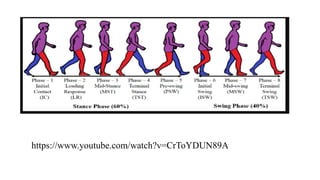
Phases of gait
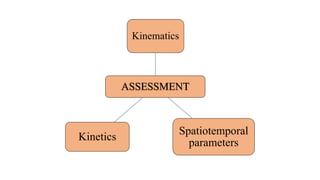
ASSESSMENT
Kinematics
Spatiotemporal
parameters
Kinetics
Kinematical Gait Assessment
• We asses the positions and motion of body segments and joints
during gait.
Methods-
1.Observational gait analysis
Vediotape in Lateral, Anterior And Posterior views observe the
movement of hip, knee ,ankle, trunk, head and arms.
• As minimal clothing as possible.
https://www.youtube.com/watch?v=CrToYDUN89A
2.Motion analysis system
• Uses IR cameras, joint marks, surface EMGs and software to
calculate both –
• Kinematic - Join angles , joint trajectories
• Kinetic parameters- GRF, muscle activity
https://www.youtube.com/watch?v=lyEfjAZLpA8
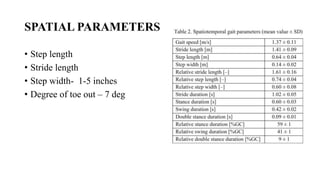
SPATIAL PARAMETERS
• Step length
• Stride length
• Step width- 1-5 inches
• Degree of toe out – 7 deg
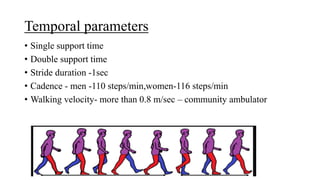
Temporal parameters
• Single support time
• Double support time
• Stride duration -1sec
• Cadence - men -110 steps/min,women-116 steps/min
• Walking velocity- more than 0.8 m/sec – community ambulator
Adaptability of gait
• Dynamic Gait index
• Less than 19 higher risk of fall
REFERENCES
• Joint Structure & Function: A Comprehensive Analysis, by Pamela K.
Levangie, Cynthia C. Norkin, et al
• Motor control- Shumway cook
• Reference values of spatiotemporal parameters, joint angles, ground reaction
forces, and plantar pressure distribution during normal gait in young women-
research gate
THANKYOU

GAIT ASSESSMENT.pptx