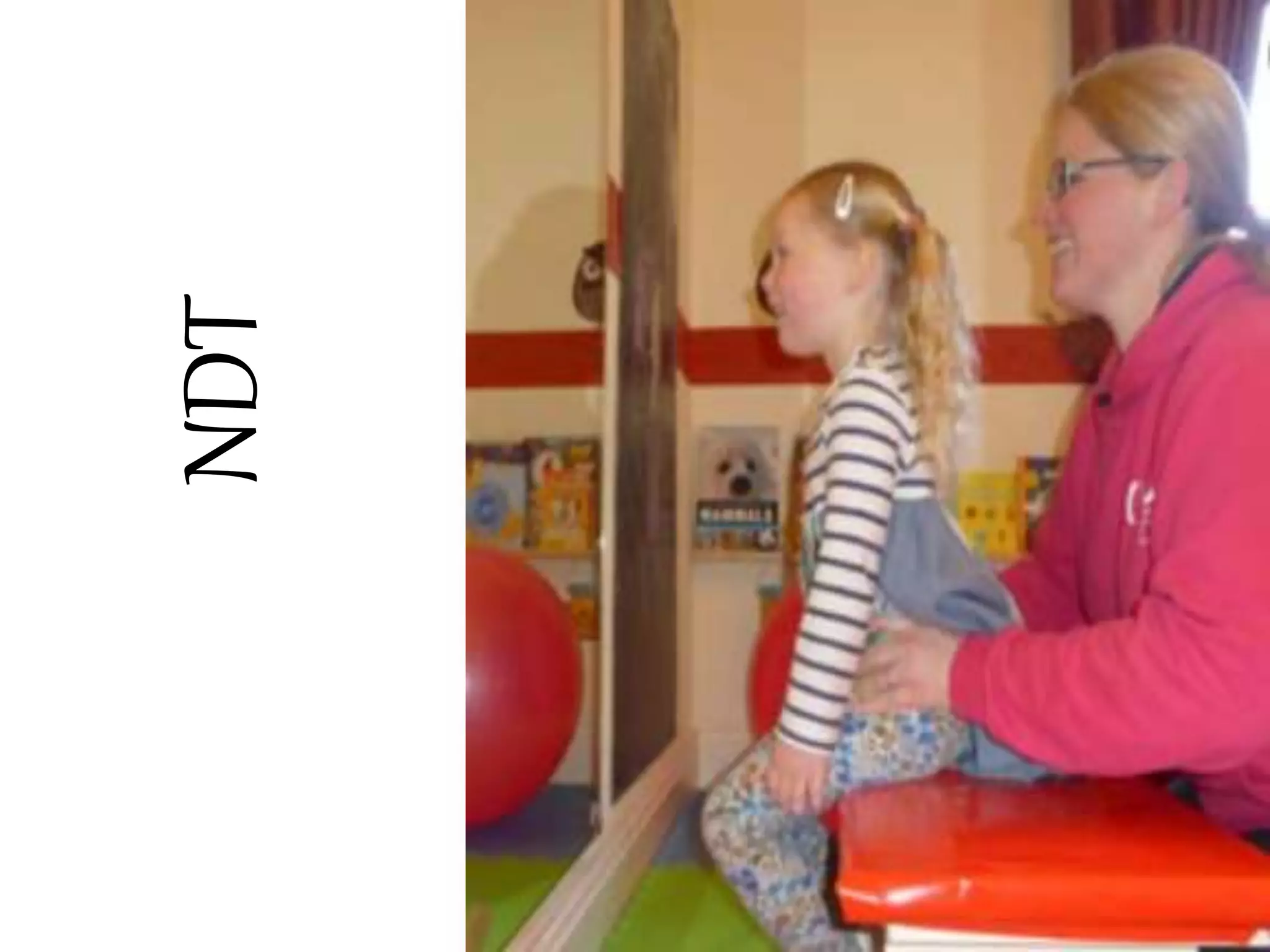
NDT
HISTORY
• Till 1900s the CP patients were
managed only by surgery and orthotics.
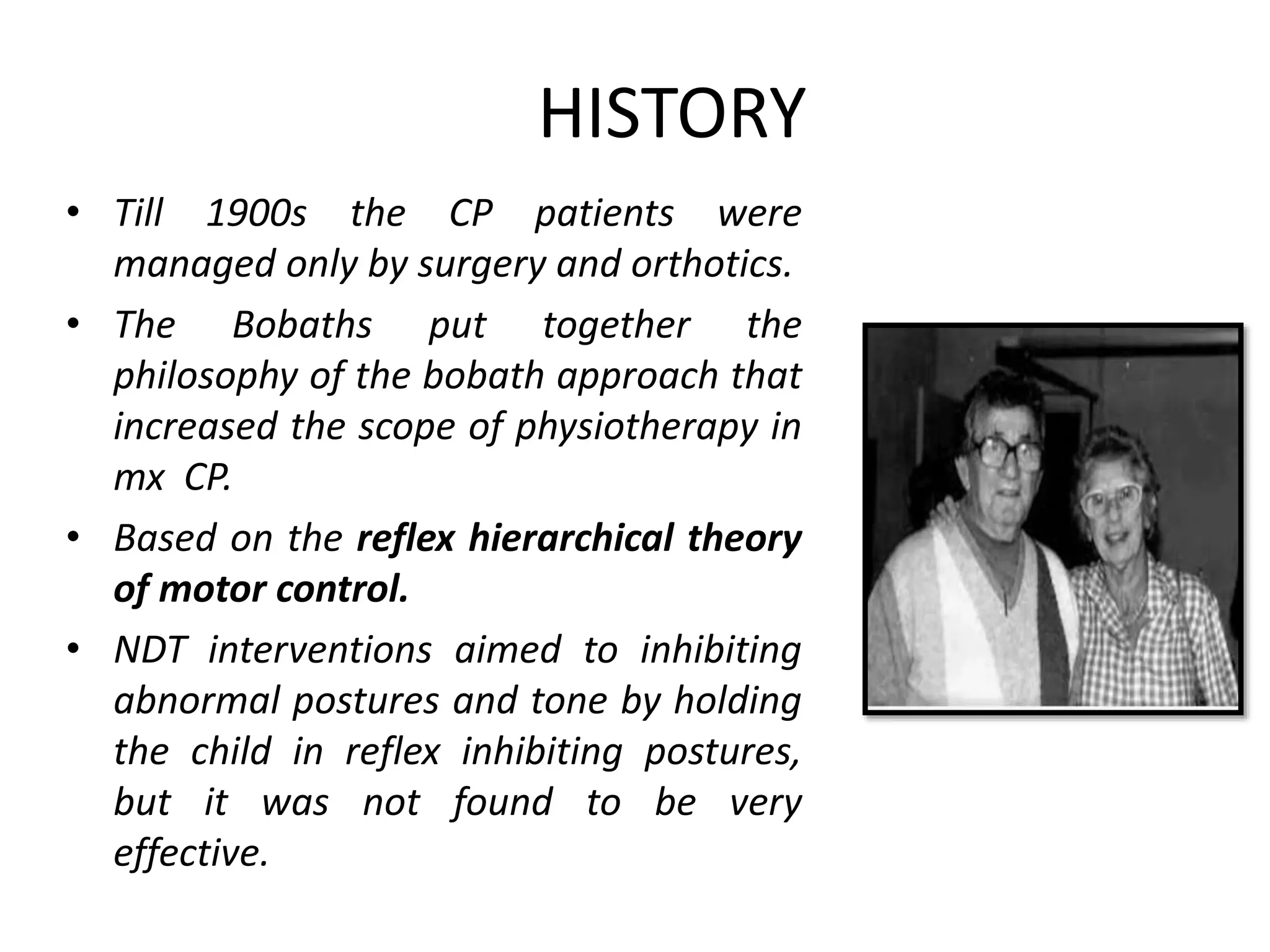
• The Bobaths put together the
philosophy of the bobath approach that
increased the scope of physiotherapy in
mx CP.
• Based on the reflex hierarchical theory
of motor control.
• NDT interventions aimed to inhibiting
abnormal postures and tone by holding
the child in reflex inhibiting postures,
but it was not found to be very
effective.
Current Principles
• The patients with CNS dysfunction have problems with
control of stability and mobility because of impaired
feedback and feed forward systems.
• Abnormal tone and abnormal movement should be inhibited,
whereas the normal tone and normal movement should be
facilitated.
• Once the patient learns the typical movement patterns he
will be able to make functional gains as he moves more
efficiently.
• For assessment the therapist should have knowledge of the
typical development and typical movement patterns. Therapist
should observe and analyze and find the missing components of
the movement.
• Create client‐ centered goals as NDT is a holistic multidisciplinary
problem solving approach.
• The therapy starts with preparatory work- stretching spastic
muscles, ROM excs, wt. bearing.
• NDT is an hands on approach in which key points of control are
used to facilitate normal alignment and movement while the
patient actively performs a task-oriented movement.
– Focus is on quality of movement and the ability to co-ordinate
movement while maintaining an appropriate postural background.
• The normal alignment should be maintained using adaptive
devices when the therapist is not maintaining the alignment.
• All principles of motor learning to be followed during therapy-
– Repetition
– Feedback
– Variability of task
• The therapist should maintain a working hypothesis and
perform continuous reexaminations.
How it might work?
• NDT uses sensory input through the key points to re‐educate
the patient's internal reference systems so that he has more
movement choices and greater efficiency of movement.
• The main is to give a sensorimotor experience because the
learning comes from movement perception.
• Feed forward is developed as the child practices the skill or
task with the therapist's guidance.
• Therapist provides less guidance and assistance as the infant
takes over and anticipates postural and motor requirements.
A systematic review of interventions for children with
cerebral palsy: state of the evidence
Aim:
Describe systematically the best available intervention
evidence for children with CP.
DISCUSSION:
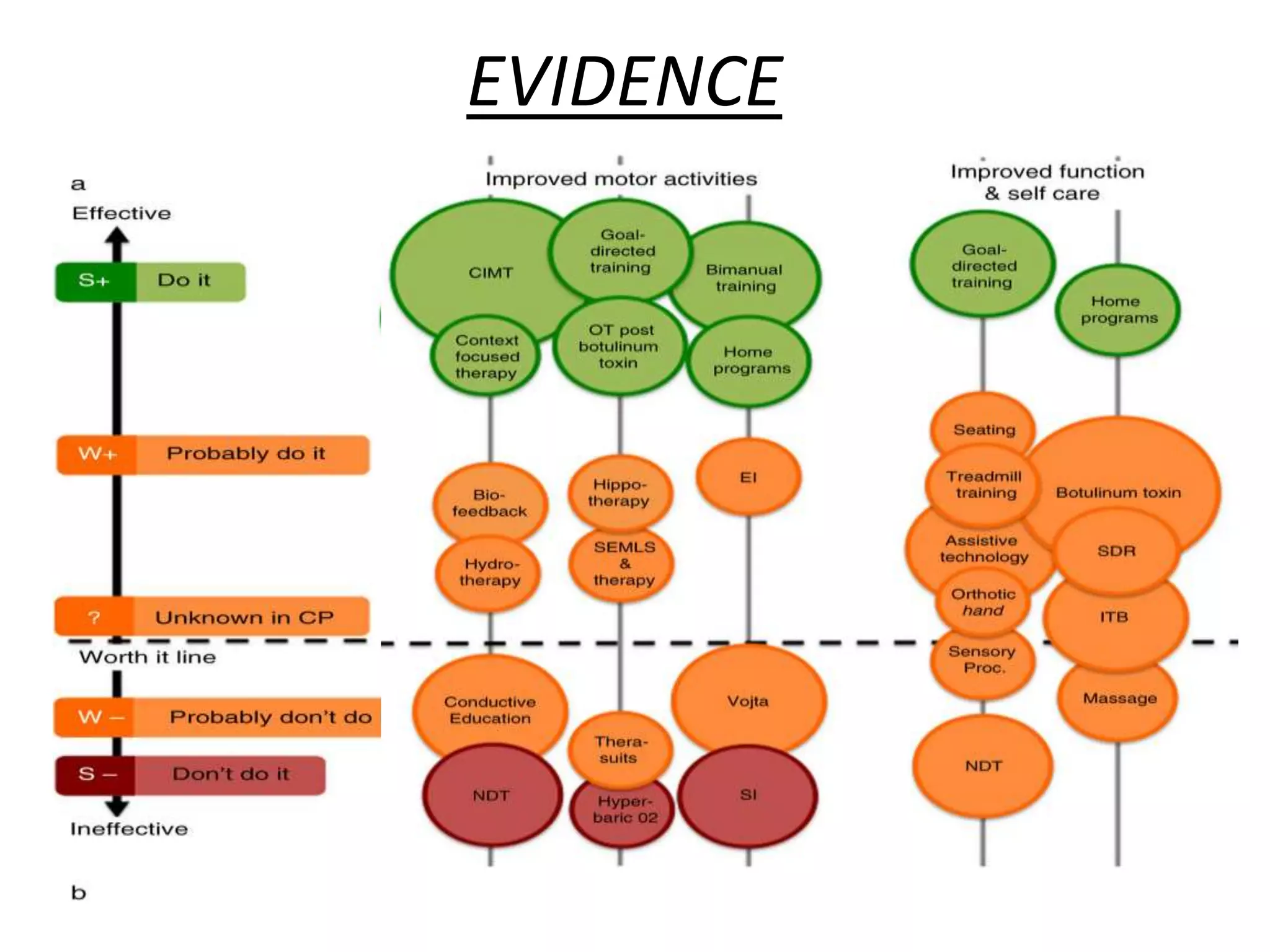
• 1 RCT showed favorable outcomes with higher-intensity
NDT. (2/weeklyx16weeks)
• Weak evidence suggest NDT improves function. As the
methodological quality of the studies were very low and only
studies with a high risk of bias found a favorable benefit from
NDT.
Novak et. Al (2013), . Developmental Medicine & Child Neurology, 55(10), 885-910.v
• NDT(a bottom-up approach),have little carryover into
functional activities.
• NDT principles have now included additional evidence-based
treatment approaches under the NDT banner (e.g. motor
learning and the philosophy of family-centred practice), and it
is difficult to filter what features of the treatment are actually
working.
CONCLUSION
• There is lack of efficacy evidence for large proportions of the
interventions in use within standard care for people with CP.
• The most evidence based approaches that improve the
activities level: bimanual training, CIMT, context-focused
therapy, goal-directed training, home programmes, and
occupational therapy after BOTOX.
EVIDENCE
TAKE HOME MESSAGE
• NDT is based on
– Facilitation of typical movements
– Inhibition of compensatory motor behavior
– an multidisciplinary management strategy
– Sensorimotor experience
– Qualitative approach
• Always use a holistic approach of
management.

Neurodevelopemental Therapy (Bobath approach)- Principles and Evidence

  • 1.
  • 2.
    HISTORY • Till 1900sthe CP patients were managed only by surgery and orthotics. • The Bobaths put together the philosophy of the bobath approach that increased the scope of physiotherapy in mx CP. • Based on the reflex hierarchical theory of motor control. • NDT interventions aimed to inhibiting abnormal postures and tone by holding the child in reflex inhibiting postures, but it was not found to be very effective.
  • 3.
    Current Principles • Thepatients with CNS dysfunction have problems with control of stability and mobility because of impaired feedback and feed forward systems. • Abnormal tone and abnormal movement should be inhibited, whereas the normal tone and normal movement should be facilitated. • Once the patient learns the typical movement patterns he will be able to make functional gains as he moves more efficiently.
  • 4.
    • For assessmentthe therapist should have knowledge of the typical development and typical movement patterns. Therapist should observe and analyze and find the missing components of the movement. • Create client‐ centered goals as NDT is a holistic multidisciplinary problem solving approach. • The therapy starts with preparatory work- stretching spastic muscles, ROM excs, wt. bearing. • NDT is an hands on approach in which key points of control are used to facilitate normal alignment and movement while the patient actively performs a task-oriented movement. – Focus is on quality of movement and the ability to co-ordinate movement while maintaining an appropriate postural background.
  • 5.
    • The normalalignment should be maintained using adaptive devices when the therapist is not maintaining the alignment. • All principles of motor learning to be followed during therapy- – Repetition – Feedback – Variability of task • The therapist should maintain a working hypothesis and perform continuous reexaminations.
  • 6.
    How it mightwork? • NDT uses sensory input through the key points to re‐educate the patient's internal reference systems so that he has more movement choices and greater efficiency of movement. • The main is to give a sensorimotor experience because the learning comes from movement perception. • Feed forward is developed as the child practices the skill or task with the therapist's guidance. • Therapist provides less guidance and assistance as the infant takes over and anticipates postural and motor requirements.
  • 7.
    A systematic reviewof interventions for children with cerebral palsy: state of the evidence Aim: Describe systematically the best available intervention evidence for children with CP. DISCUSSION: • 1 RCT showed favorable outcomes with higher-intensity NDT. (2/weeklyx16weeks) • Weak evidence suggest NDT improves function. As the methodological quality of the studies were very low and only studies with a high risk of bias found a favorable benefit from NDT. Novak et. Al (2013), . Developmental Medicine & Child Neurology, 55(10), 885-910.v
  • 8.
    • NDT(a bottom-upapproach),have little carryover into functional activities. • NDT principles have now included additional evidence-based treatment approaches under the NDT banner (e.g. motor learning and the philosophy of family-centred practice), and it is difficult to filter what features of the treatment are actually working.
  • 9.
    CONCLUSION • There islack of efficacy evidence for large proportions of the interventions in use within standard care for people with CP. • The most evidence based approaches that improve the activities level: bimanual training, CIMT, context-focused therapy, goal-directed training, home programmes, and occupational therapy after BOTOX.
  • 10.
  • 11.
    TAKE HOME MESSAGE •NDT is based on – Facilitation of typical movements – Inhibition of compensatory motor behavior – an multidisciplinary management strategy – Sensorimotor experience – Qualitative approach • Always use a holistic approach of management.