








FUNCTIONALLY
ASSESSING
& TREATING
Noor Fathimah Bt Mazani (FATHIM)
Occupational Therapist
Hospital Raja Perempuan Zainab II, Kota Bharu Kelantan
✓ Visual Processing
✓ Visual Perception
✓ Visual-motor Deficit
2
3
4
5
1 Terminologies related to the visual perceptual
Relatioship between visual & the brain
The impact on everyday function
Assessment
Intervention
OUTLINES
5
NEURO
REHABILITATION
This slide focus on
TERMINOLOGIES
RELATED TO THE VISUAL
PERCEPTUAL
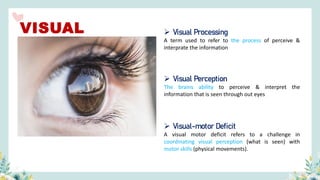
➢ Visual Perception
The brains ability to perceive & interpret the
information that is seen through out eyes
➢ Visual Processing
A term used to refer to the process of perceive &
interprate the information
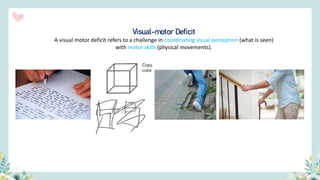
➢ Visual-motor Deficit
A visual motor deficit refers to a challenge in
coordinating visual perception (what is seen) with
motor skills (physical movements).
VISUAL
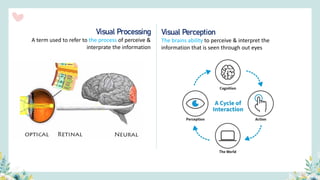
Visual Perception
The brains ability to perceive & interpret the
information that is seen through out eyes
Visual Processing
A term used to refer to the process of perceive &
interprate the information
Visual-motor Deficit
A visual motor deficit refers to a challenge in coordinating visual perception (what is seen)
with motor skills (physical movements).
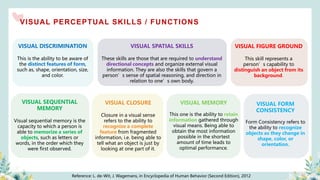
VISUAL PERCEPTUAL SKILLS / FUNCTIONS
VISUAL MEMORY
This one is the ability to retain
information gathered through
visual means. Being able to
obtain the most information
possible in the shortest
amount of time leads to
optimal performance.
VISUAL DISCRIMINATION
This is the ability to be aware of
the distinct features of form,
such as, shape, orientation, size,
and color.
VISUAL SEQUENTIAL
MEMORY
Visual sequential memory is the
capacity to which a person is
able to memorize a series of
objects, such as letters or
words, in the order which they
were first observed.
VISUAL FIGURE GROUND
This skill represents a
person’s capability to
distinguish an object from its
background.
VISUAL SPATIAL SKILLS
These skills are those that are required to understand
directional concepts and organize external visual
information. They are also the skills that govern a
person’s sense of spatial reasoning, and direction in
relation to one’s own body.
VISUAL CLOSURE
Closure in a visual sense
refers to the ability to
recognize a complete
feature from fragmented
information, i.e. being able to
tell what an object is just by
looking at one part of it.
VISUAL FORM
CONSISTENCY
Form Consistency refers to
the ability to recognize
objects as they change in
shape, color, or
orientation.
Reference: L. de-Wit, J. Wagemans, in Encyclopedia of Human Behavior (Second Edition), 2012
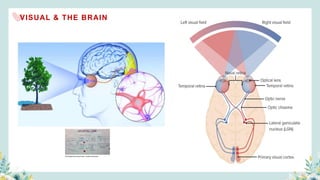
RELATIOSHIP BETWEEN
VISUAL & THE BRAIN
VISUAL & THE BRAIN
VISUAL & THE BRAIN
2
3
4
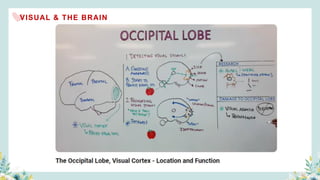
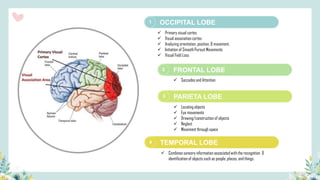
1 OCCIPITAL LOBE
FRONTAL LOBE
PARIETA LOBE
TEMPORAL LOBE
✓ Primary visual cortex
✓ Visual association cortex
✓ Analyzing orientation, position, & movement.
✓ Initiation of Smooth Pursuit Movements
✓ Visual Field Loss
✓ Saccades and Attention
✓ Locating objects
✓ Eye movements
✓ Drawing/construction of objects
✓ Neglect
✓ Movement through space
✓ Combines sensory information associated with the recognition &
identification of objects such as people, places, and things.
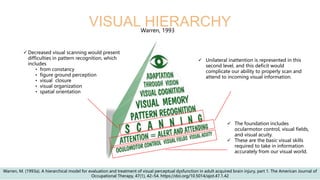
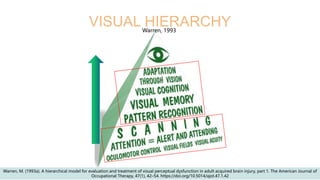
VISUAL HIERARCHY
Warren, 1993
✓ The foundation includes
ocularmotor control, visual fields,
and visual acuity.
✓ These are the basic visual skills
required to take in information
accurately from our visual world.
✓ Unilateral inattention is represented in this
second level, and this deficit would
complicate our ability to properly scan and
attend to incoming visual information.
✓ Decreased visual scanning would present
difficulties in pattern recognition, which
includes
• from constancy
• figure ground perception
• visual closure
• visual organization
• spatial orientation
Warren, M. (1993a). A hierarchical model for evaluation and treatment of visual perceptual dysfunction in adult acquired brain injury, part 1. The American Journal of
Occupational Therapy, 47(1), 42–54. https://doi.org/10.5014/ajot.47.1.42
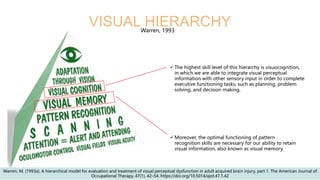
VISUAL HIERARCHY
Warren, 1993
✓ Moreover, the optimal functioning of pattern
recognition skills are necessary for our ability to retain
visual information, also known as visual memory.
✓ The highest skill level of this hierarchy is visuocognition,
in which we are able to integrate visual perceptual
information with other sensory input in order to complete
executive functioning tasks, such as planning, problem
solving, and decision making.
Warren, M. (1993a). A hierarchical model for evaluation and treatment of visual perceptual dysfunction in adult acquired brain injury, part 1. The American Journal of
Occupational Therapy, 47(1), 42–54. https://doi.org/10.5014/ajot.47.1.42
Cognitive Deficits, StatPearls, Aayush Dhakal; Bradford D. Bobrin, 2020
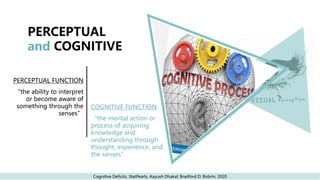
COGNITIVE FUNCTION
“the mental action or
process of acquiring
knowledge and
understanding through
thought, experience, and
the senses”
PERCEPTUAL
and COGNITIVE
PERCEPTUAL FUNCTION
“the ability to interpret
or become aware of
something through the
senses”
IMPACT OF VISUAL
PERCEPTUAL AND COGNITIVE
BARRIERS ON
EVERYDAY FUNCTION
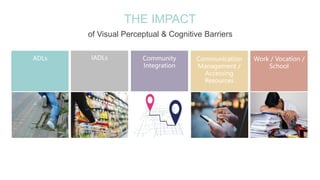
THE IMPACT
of Visual Perceptual & Cognitive Barriers
ADLs IADLs Community
Integration
Communication
Management /
Accessing
Resources
Work / Vocation /
School
THE IMPACT
of Visual Perceptual & Cognitive Barriers
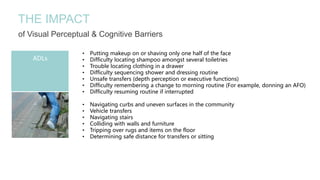
ADLs
• Putting makeup on or shaving only one half of the face
• Difficulty locating shampoo amongst several toiletries
• Trouble locating clothing in a drawer
• Difficulty sequencing shower and dressing routine
• Unsafe transfers (depth perception or executive functions)
• Difficulty remembering a change to morning routine (For example, donning an AFO)
• Difficulty resuming routine if interrupted
• Navigating curbs and uneven surfaces in the community
• Vehicle transfers
• Navigating stairs
• Colliding with walls and furniture
• Tripping over rugs and items on the floor
• Determining safe distance for transfers or sitting
THE IMPACT
of Visual Perceptual & Cognitive Barriers
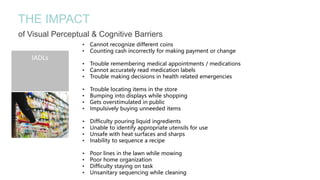
IADLs
• Cannot recognize different coins
• Counting cash incorrectly for making payment or change
• Trouble remembering medical appointments / medications
• Cannot accurately read medication labels
• Trouble making decisions in health related emergencies
• Trouble locating items in the store
• Bumping into displays while shopping
• Gets overstimulated in public
• Impulsively buying unneeded items
• Difficulty pouring liquid ingredients
• Unable to identify appropriate utensils for use
• Unsafe with heat surfaces and sharps
• Inability to sequence a recipe
• Poor lines in the lawn while mowing
• Poor home organization
• Difficulty staying on task
• Unsanitary sequencing while cleaning
THE IMPACT
of Visual Perceptual & Cognitive Barriers
Community
Integration
• Unable to identify road signs and pavement markings
• Stopping too soon or too late at intersections
• Unable to plan complex intersections
• Difficulty managing a bus route
• Requires assistance to schedule rides with transportation service
• Difficulty attending to navigation system while driving
• Only scanning one side of the environment and missing signs on the left side
• Poor lane management and speed control
THE IMPACT
of Visual Perceptual & Cognitive Barriers
Communication
Management /
Accessing
Resources
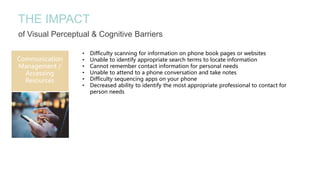
• Difficulty scanning for information on phone book pages or websites
• Unable to identify appropriate search terms to locate information
• Cannot remember contact information for personal needs
• Unable to attend to a phone conversation and take notes
• Difficulty sequencing apps on your phone
• Decreased ability to identify the most appropriate professional to contact for
person needs
THE IMPACT
of Visual Perceptual & Cognitive Barriers
Work / Vocation /
School
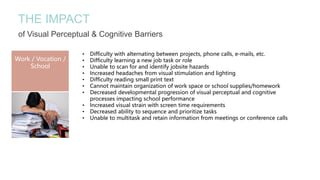
• Difficulty with alternating between projects, phone calls, e-mails, etc.
• Difficulty learning a new job task or role
• Unable to scan for and identify jobsite hazards
• Increased headaches from visual stimulation and lighting
• Difficulty reading small print text
• Cannot maintain organization of work space or school supplies/homework
• Decreased developmental progression of visual perceptual and cognitive
processes impacting school performance
• Increased visual strain with screen time requirements
• Decreased ability to sequence and prioritize tasks
• Unable to multitask and retain information from meetings or conference calls
ASSESSMENT
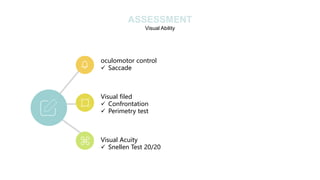
Visual Ability
ASSESSMENT
oculomotor control
✓ Saccade
Visual filed
✓ Confrontation
✓ Perimetry test
Visual Acuity
✓ Snellen Test 20/20
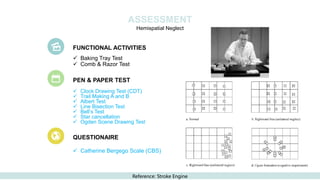
✓ Baking Tray Test
✓ Comb & Razor Test
✓ Clock Drawing Test (CDT)
✓ Trail Making A and B
✓ Albert Test
✓ Line Bisection Test
✓ Bell’s Test
✓ Star cancellation
✓ Ogden Scene Drawing Test
✓ Catherine Bergego Scale (CBS)
QUESTIONAIRE
PEN & PAPER TEST
FUNCTIONAL ACTIVITIES
Hemispatial Neglect
ASSESSMENT
Reference: Stroke Engine
Standardized Assessment - Manual & Tools
ASSESSMENT
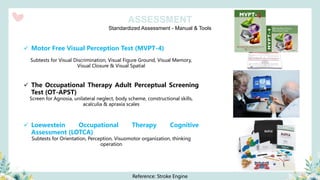
✓ Motor Free Visual Perception Test (MVPT-4)
Subtests for Visual Discrimination, Visual Figure Ground, Visual Memory,
Visual Closure & Visual Spatial
✓ The Occupational Therapy Adult Perceptual Screening
Test (OT-APST)
Screen for Agnosia, unilateral neglect, body scheme, constructional skills,
acalculia & apraxia scales
✓ Loewestein Occupational Therapy Cognitive
Assessment (LOTCA)
Subtests for Orientation, Perception, Visuomotor organization, thinking
operation
Reference: Stroke Engine
Standardized Assessment - Manual & Tools
ASSESSMENT
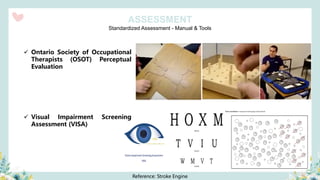
✓ Ontario Society of Occupational
Therapists (OSOT) Perceptual
Evaluation
✓ Visual Impairment Screening
Assessment (VISA)
Reference: Stroke Engine
Standardized Assessment - Manual & Tools
ASSESSMENT
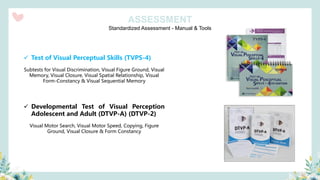
✓ Test of Visual Perceptual Skills (TVPS-4)
Subtests for Visual Discrimination, Visual Figure Ground, Visual
Memory, Visual Closure, Visual Spatial Relationship, Visual
Form-Constancy & Visual Sequential Memory
✓ Developmental Test of Visual Perception
Adolescent and Adult (DTVP-A) (DTVP-2)
Visual Motor Search, Visual Motor Speed, Copying, Figure
Ground, Visual Closure & Form Constancy
Standardized Assessment - Manual & Tools
ASSESSMENT
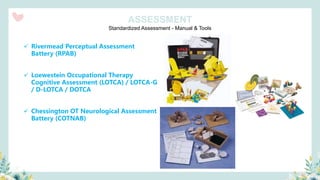
✓ Rivermead Perceptual Assessment
Battery (RPAB)
✓ Loewestein Occupational Therapy
Cognitive Assessment (LOTCA) / LOTCA-G
/ D-LOTCA / DOTCA
✓ Chessington OT Neurological Assessment
Battery (COTNAB)
ASSESSMENT
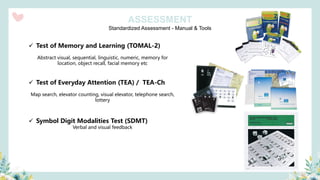
✓ Test of Memory and Learning (TOMAL-2)
Abstract visual, sequential, linguistic, numeric, memory for
location, object recall, facial memory etc
✓ Test of Everyday Attention (TEA) / TEA-Ch
Map search, elevator counting, visual elevator, telephone search,
lottery
✓ Symbol Digit Modalities Test (SDMT)
Verbal and visual feedback
Standardized Assessment - Manual & Tools
INTERVENTON
Strong evidence supports the use of scanning, limited evidence supports the use of
adaptive strategies, and mixed evidence supports the use of cognitive interventions to
improve occupational performance for adults with TBI. Evidence related to vision
therapy varies on the basis of the specific intervention implemented.
Sue Berger et al. 2016
The American Journal of
Occupational Therapy, 2016,
Vol. 70(3), 7003180010p1–
7003180010p7.
Effectiveness of Interventions to Address Visual and Visual–Perceptual Impairments
to Improve Occupational Performance in Adults With Traumatic Brain Injury:
A Systematic Review
Medline, PsycINFO, CINAHL, OTseeker, and the Cochrane Database of Systematic Reviews
were searched, and 66 full text articles were reviewed. Sixteen articles were included in the
review.
Glen Gillen et al. 2016
The American Journal of
Occupational Therapy, 2015,
Vol. 69(1), 6901180040p1–
6901180040p9.
Effectiveness of Interventions to Improve Occupational Performance of People With
Cognitive Impairments After Stroke:
An Evidence-Based Review
Forty-six articles met the inclusion criteria and were examined. Interventions for the following
impairments were reviewed: general cognitive deficits, executive dysfunction, apraxia, memory
loss, attention deficits, visual field deficits (included because of their close relationship with
neglect), and unilateral neglect.
There is insufficient evidence regarding impairments of attention and mixed evidence
regarding interventions for visual field deficits. The effective interventions have some
commonalities, including being performance focused, involving strategy training, and
using a compensatory as opposed to a remediation approach.
Hanna et al. 2017
wileyonlinelibrary.com/jounal/brb3
Brain and Behavior
The treatment methods for post-stroke visual impairment:
A systematic review
Forty-nine articles (4142 subjects) were included in the review, including an
overview of four Cochrane systematic reviews. Interventions appraised
included those for visual field loss, ocular motility deficits, reduced central
vision, and visual perceptual deficits.
Hanna et al. 2017. The treatment methods for post-stroke visual impairment:
A systematic review. wileyonlinelibrary.com/jounal/brb3.Brain and Behavior
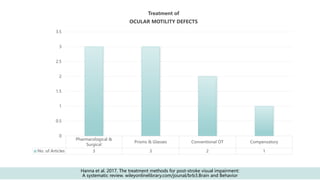
Pharmacological &
Surgical
Prisms & Glasses Conventional OT Compensatory
No. of Articles 3 3 2 1
0
0.5
1
1.5
2
2.5
3
3.5
Treatment of
OCULAR MOTILITY DEFECTS
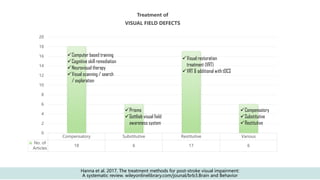
Compensatory Substitutive Restitutive Various
No. of
Articles
18 6 17 6
0
2
4
6
8
10
12
14
16
18
20
Treatment of
VISUAL FIELD DEFECTS
Hanna et al. 2017. The treatment methods for post-stroke visual impairment:
A systematic review. wileyonlinelibrary.com/jounal/brb3.Brain and Behavior
✓Computer based training
✓Cognitive skill remediation
✓Neurovisual therapy
✓Visual scanning / search
/ exploration
✓Prisms
✓Gottlieb visual field
awareness system
✓Visual restoration
treatment (VRT)
✓VRT & additional with tDCS
✓Compensatory
✓Substitutive
✓Restitutive
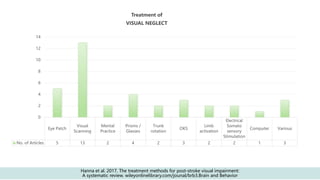
Eye Patch
Visual
Scanning
Mental
Practice
Prisms /
Glasses
Trunk
rotation
OKS
Limb
activation
Electrical
Somato
sensory
Stimulation
Computer Various
No. of Articles 5 13 2 4 2 3 2 2 1 3
0
2
4
6
8
10
12
14
Treatment of
VISUAL NEGLECT
Hanna et al. 2017. The treatment methods for post-stroke visual impairment:
A systematic review. wileyonlinelibrary.com/jounal/brb3.Brain and Behavior
Reference: Azouvi P, Jacquin-Courtois S, Luauté J. Rehabilitation of unilateral neglect: Evidence-based
medicine. Annals of Physical and Rehabilitation Medicine. 2017;60(3):191-197.
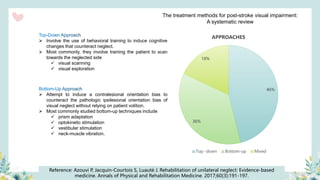
Top-Down Approach
➢ Involve the use of behavioral training to induce cognitive
changes that counteract neglect.
➢ Most commonly, they involve training the patient to scan
towards the neglected side
✓ visual scanning
✓ visual exploration
46%
36%
18%
APPROACHES
Top -down Bottom-up Mixed
Bottom-Up Approach
➢ Attempt to induce a contralesional orientation bias to
counteract the pathologic ipsilesional orientation bias of
visual neglect without relying on patient volition.
➢ Most commonly studied bottom-up techniques include
✓ prism adaptation
✓ optokinetic stimulation
✓ vestibular stimulation
✓ neck-muscle vibration.
The treatment methods for post-stroke visual impairment:
A systematic review
VISUAL HIERARCHY
Warren, M. (1993a). A hierarchical model for evaluation and treatment of visual perceptual dysfunction in adult acquired brain injury, part 1. The American Journal of
Occupational Therapy, 47(1), 42–54. https://doi.org/10.5014/ajot.47.1.42
Warren, 1993
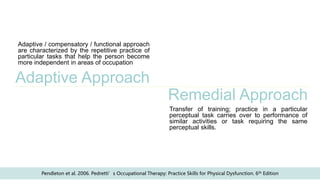
Adaptive Approach
Remedial Approach
Transfer of training; practice in a particular
perceptual task carries over to performance of
similar activities or task requiring the same
perceptual skills.
Pendleton et al. 2006. Pedretti’s Occupational Therapy: Practice Skills for Physical Dysfunction. 6th Edition
Adaptive / compensatory / functional approach
are characterized by the repetitive practice of
particular tasks that help the person become
more independent in areas of occupation
❑ Compensation is a treatment approach that aims to
maximize existing visual function by providing
strategies to enhance the patient's ability to assimilate
visual information efficiently.
❑ A compensatory approach should also place emphasis
on understanding underlying difficulties in visual
perception in order to learn when to initiate the use of
strategies to overcome limitations.
❑ Rather than focusing on one task specific skill, the
client should gain the ability to use the learned
strategies in various situations.
❑ The practicing strategies for visual perceptual deficits
within context to ensure carryover of application to
ADLs.
Adaptive /
Compensatory
Approach
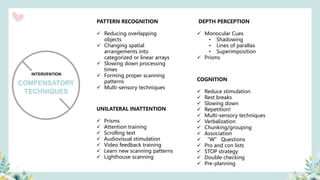
COMPENSATORY
INTERVENTION
TECHNIQUES
PATTERN RECOGNITION
✓ Reducing overlapping
objects
✓ Changing spatial
arrangements into
categorized or linear arrays
✓ Slowing down processing
times
✓ Forming proper scanning
patterns
✓ Multi-sensory techniques
UNILATERAL INATTENTION
✓ Prisms
✓ Attention training
✓ Scrolling text
✓ Audiovisual stimulation
✓ Video feedback training
✓ Learn new scanning patterns
✓ Lighthouse scanning
DEPTH PERCEPTION
✓ Monocular Cues
• Shadowing
• Lines of parallax
• Superimposition
✓ Prisms
COGNITION
✓ Reduce stimulation
✓ Rest breaks
✓ Slowing down
✓ Repetition!
✓ Multi-sensory techniques
✓ Verbalization
✓ Chunking/grouping
✓ Association
✓ “W” Questions
✓ Pro and con lists
✓ STOP strategy
✓ Double checking
✓ Pre-planning
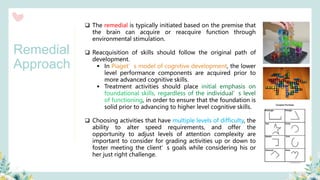
❑ The remedial is typically initiated based on the premise that
the brain can acquire or reacquire function through
environmental stimulation.
❑ Reacquisition of skills should follow the original path of
development.
▪ In Piaget’s model of cognitive development, the lower
level performance components are acquired prior to
more advanced cognitive skills.
▪ Treatment activities should place initial emphasis on
foundational skills, regardless of the individual’s level
of functioning, in order to ensure that the foundation is
solid prior to advancing to higher level cognitive skills.
❑ Choosing activities that have multiple levels of difficulty, the
ability to alter speed requirements, and offer the
opportunity to adjust levels of attention complexity are
important to consider for grading activities up or down to
foster meeting the client’s goals while considering his or
her just right challenge.
Remedial
Approach
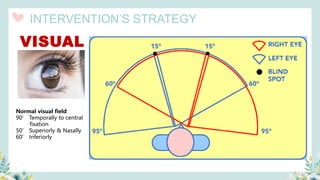
VISUAL
Normal visual field
90’ Temporally to central
fixation
50’ Superiorly & Nasally
60’ Inferiorly
INTERVENTION’S STRATEGY
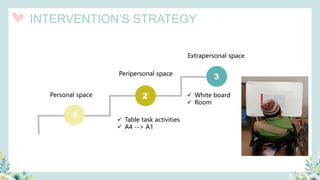
1
2
3
Personal space
Peripersonal space
Extrapersonal space
✓ Table task activities
✓ A4 --> A1
✓ White board
✓ Room
INTERVENTION’S STRATEGY
2
3
4
5
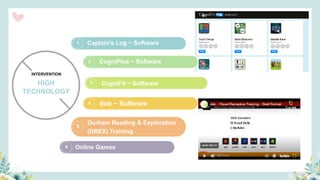
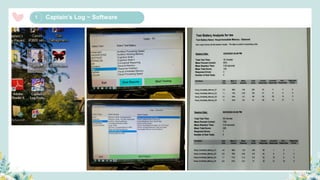
1 Captain’s Log ~ Software
CogniPlus ~ Software
dob ~ Software
Durham Reading & Exploration
(DREX) Training
HIGH
INTERVENTION
TECHNOLOGY
3 CogniFit ~ Software
6 Online Games
1 Captain’s Log ~ Software
2
3
4
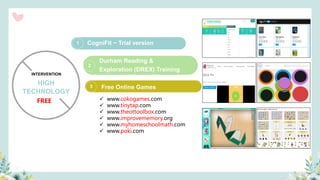
1 CogniFit ~ Trial version
Durham Reading &
Exploration (DREX) Training
HIGH
INTERVENTION
TECHNOLOGY
3 Free Online Games
FREE ✓ www.cokogames.com
✓ www.tinytap.com
✓ www.theottoolbox.com
✓ www.improvememory.org
✓ www.myhomeschoolmath.com
✓ www.poki.com
2
3
4
5
1 www.pinterest.com
www.chicagooccupationaltherapy.com
www.twinkl.my
www.tuktukdesign.com
WORKSHEET
INTERVENTION 3 www.jet.org.za / JET Education services
6 www.abbythepup.com
7 www.15worksheets.com
THANK YOU
Semoga Allah swt memberkati & merahmati kita semua

Visual Processing, Visual Perception & Visual-Motor Deficit.pdf

  • 1.
    FUNCTIONALLY ASSESSING & TREATING Noor FathimahBt Mazani (FATHIM) Occupational Therapist Hospital Raja Perempuan Zainab II, Kota Bharu Kelantan ✓ Visual Processing ✓ Visual Perception ✓ Visual-motor Deficit
  • 2.
    2 3 4 5 1 Terminologies relatedto the visual perceptual Relatioship between visual & the brain The impact on everyday function Assessment Intervention OUTLINES 5 NEURO REHABILITATION This slide focus on
  • 3.
  • 4.
    ➢ Visual Perception Thebrains ability to perceive & interpret the information that is seen through out eyes ➢ Visual Processing A term used to refer to the process of perceive & interprate the information ➢ Visual-motor Deficit A visual motor deficit refers to a challenge in coordinating visual perception (what is seen) with motor skills (physical movements). VISUAL
  • 5.
    Visual Perception The brainsability to perceive & interpret the information that is seen through out eyes Visual Processing A term used to refer to the process of perceive & interprate the information
  • 6.
    Visual-motor Deficit A visualmotor deficit refers to a challenge in coordinating visual perception (what is seen) with motor skills (physical movements).
  • 7.
    VISUAL PERCEPTUAL SKILLS/ FUNCTIONS VISUAL MEMORY This one is the ability to retain information gathered through visual means. Being able to obtain the most information possible in the shortest amount of time leads to optimal performance. VISUAL DISCRIMINATION This is the ability to be aware of the distinct features of form, such as, shape, orientation, size, and color. VISUAL SEQUENTIAL MEMORY Visual sequential memory is the capacity to which a person is able to memorize a series of objects, such as letters or words, in the order which they were first observed. VISUAL FIGURE GROUND This skill represents a person’s capability to distinguish an object from its background. VISUAL SPATIAL SKILLS These skills are those that are required to understand directional concepts and organize external visual information. They are also the skills that govern a person’s sense of spatial reasoning, and direction in relation to one’s own body. VISUAL CLOSURE Closure in a visual sense refers to the ability to recognize a complete feature from fragmented information, i.e. being able to tell what an object is just by looking at one part of it. VISUAL FORM CONSISTENCY Form Consistency refers to the ability to recognize objects as they change in shape, color, or orientation. Reference: L. de-Wit, J. Wagemans, in Encyclopedia of Human Behavior (Second Edition), 2012
  • 8.
  • 9.
  • 10.
  • 11.
    2 3 4 1 OCCIPITAL LOBE FRONTALLOBE PARIETA LOBE TEMPORAL LOBE ✓ Primary visual cortex ✓ Visual association cortex ✓ Analyzing orientation, position, & movement. ✓ Initiation of Smooth Pursuit Movements ✓ Visual Field Loss ✓ Saccades and Attention ✓ Locating objects ✓ Eye movements ✓ Drawing/construction of objects ✓ Neglect ✓ Movement through space ✓ Combines sensory information associated with the recognition & identification of objects such as people, places, and things.
  • 12.
    VISUAL HIERARCHY Warren, 1993 ✓The foundation includes ocularmotor control, visual fields, and visual acuity. ✓ These are the basic visual skills required to take in information accurately from our visual world. ✓ Unilateral inattention is represented in this second level, and this deficit would complicate our ability to properly scan and attend to incoming visual information. ✓ Decreased visual scanning would present difficulties in pattern recognition, which includes • from constancy • figure ground perception • visual closure • visual organization • spatial orientation Warren, M. (1993a). A hierarchical model for evaluation and treatment of visual perceptual dysfunction in adult acquired brain injury, part 1. The American Journal of Occupational Therapy, 47(1), 42–54. https://doi.org/10.5014/ajot.47.1.42
  • 13.
    VISUAL HIERARCHY Warren, 1993 ✓Moreover, the optimal functioning of pattern recognition skills are necessary for our ability to retain visual information, also known as visual memory. ✓ The highest skill level of this hierarchy is visuocognition, in which we are able to integrate visual perceptual information with other sensory input in order to complete executive functioning tasks, such as planning, problem solving, and decision making. Warren, M. (1993a). A hierarchical model for evaluation and treatment of visual perceptual dysfunction in adult acquired brain injury, part 1. The American Journal of Occupational Therapy, 47(1), 42–54. https://doi.org/10.5014/ajot.47.1.42
  • 14.
    Cognitive Deficits, StatPearls,Aayush Dhakal; Bradford D. Bobrin, 2020 COGNITIVE FUNCTION “the mental action or process of acquiring knowledge and understanding through thought, experience, and the senses” PERCEPTUAL and COGNITIVE PERCEPTUAL FUNCTION “the ability to interpret or become aware of something through the senses”
  • 15.
    IMPACT OF VISUAL PERCEPTUALAND COGNITIVE BARRIERS ON EVERYDAY FUNCTION
  • 16.
    THE IMPACT of VisualPerceptual & Cognitive Barriers ADLs IADLs Community Integration Communication Management / Accessing Resources Work / Vocation / School
  • 17.
    THE IMPACT of VisualPerceptual & Cognitive Barriers ADLs • Putting makeup on or shaving only one half of the face • Difficulty locating shampoo amongst several toiletries • Trouble locating clothing in a drawer • Difficulty sequencing shower and dressing routine • Unsafe transfers (depth perception or executive functions) • Difficulty remembering a change to morning routine (For example, donning an AFO) • Difficulty resuming routine if interrupted • Navigating curbs and uneven surfaces in the community • Vehicle transfers • Navigating stairs • Colliding with walls and furniture • Tripping over rugs and items on the floor • Determining safe distance for transfers or sitting
  • 18.
    THE IMPACT of VisualPerceptual & Cognitive Barriers IADLs • Cannot recognize different coins • Counting cash incorrectly for making payment or change • Trouble remembering medical appointments / medications • Cannot accurately read medication labels • Trouble making decisions in health related emergencies • Trouble locating items in the store • Bumping into displays while shopping • Gets overstimulated in public • Impulsively buying unneeded items • Difficulty pouring liquid ingredients • Unable to identify appropriate utensils for use • Unsafe with heat surfaces and sharps • Inability to sequence a recipe • Poor lines in the lawn while mowing • Poor home organization • Difficulty staying on task • Unsanitary sequencing while cleaning
  • 19.
    THE IMPACT of VisualPerceptual & Cognitive Barriers Community Integration • Unable to identify road signs and pavement markings • Stopping too soon or too late at intersections • Unable to plan complex intersections • Difficulty managing a bus route • Requires assistance to schedule rides with transportation service • Difficulty attending to navigation system while driving • Only scanning one side of the environment and missing signs on the left side • Poor lane management and speed control
  • 20.
    THE IMPACT of VisualPerceptual & Cognitive Barriers Communication Management / Accessing Resources • Difficulty scanning for information on phone book pages or websites • Unable to identify appropriate search terms to locate information • Cannot remember contact information for personal needs • Unable to attend to a phone conversation and take notes • Difficulty sequencing apps on your phone • Decreased ability to identify the most appropriate professional to contact for person needs
  • 21.
    THE IMPACT of VisualPerceptual & Cognitive Barriers Work / Vocation / School • Difficulty with alternating between projects, phone calls, e-mails, etc. • Difficulty learning a new job task or role • Unable to scan for and identify jobsite hazards • Increased headaches from visual stimulation and lighting • Difficulty reading small print text • Cannot maintain organization of work space or school supplies/homework • Decreased developmental progression of visual perceptual and cognitive processes impacting school performance • Increased visual strain with screen time requirements • Decreased ability to sequence and prioritize tasks • Unable to multitask and retain information from meetings or conference calls
  • 22.
  • 23.
    Visual Ability ASSESSMENT oculomotor control ✓Saccade Visual filed ✓ Confrontation ✓ Perimetry test Visual Acuity ✓ Snellen Test 20/20
  • 24.
    ✓ Baking TrayTest ✓ Comb & Razor Test ✓ Clock Drawing Test (CDT) ✓ Trail Making A and B ✓ Albert Test ✓ Line Bisection Test ✓ Bell’s Test ✓ Star cancellation ✓ Ogden Scene Drawing Test ✓ Catherine Bergego Scale (CBS) QUESTIONAIRE PEN & PAPER TEST FUNCTIONAL ACTIVITIES Hemispatial Neglect ASSESSMENT Reference: Stroke Engine
  • 25.
    Standardized Assessment -Manual & Tools ASSESSMENT ✓ Motor Free Visual Perception Test (MVPT-4) Subtests for Visual Discrimination, Visual Figure Ground, Visual Memory, Visual Closure & Visual Spatial ✓ The Occupational Therapy Adult Perceptual Screening Test (OT-APST) Screen for Agnosia, unilateral neglect, body scheme, constructional skills, acalculia & apraxia scales ✓ Loewestein Occupational Therapy Cognitive Assessment (LOTCA) Subtests for Orientation, Perception, Visuomotor organization, thinking operation Reference: Stroke Engine
  • 26.
    Standardized Assessment -Manual & Tools ASSESSMENT ✓ Ontario Society of Occupational Therapists (OSOT) Perceptual Evaluation ✓ Visual Impairment Screening Assessment (VISA) Reference: Stroke Engine
  • 27.
    Standardized Assessment -Manual & Tools ASSESSMENT ✓ Test of Visual Perceptual Skills (TVPS-4) Subtests for Visual Discrimination, Visual Figure Ground, Visual Memory, Visual Closure, Visual Spatial Relationship, Visual Form-Constancy & Visual Sequential Memory ✓ Developmental Test of Visual Perception Adolescent and Adult (DTVP-A) (DTVP-2) Visual Motor Search, Visual Motor Speed, Copying, Figure Ground, Visual Closure & Form Constancy
  • 28.
    Standardized Assessment -Manual & Tools ASSESSMENT ✓ Rivermead Perceptual Assessment Battery (RPAB) ✓ Loewestein Occupational Therapy Cognitive Assessment (LOTCA) / LOTCA-G / D-LOTCA / DOTCA ✓ Chessington OT Neurological Assessment Battery (COTNAB)
  • 29.
    ASSESSMENT ✓ Test ofMemory and Learning (TOMAL-2) Abstract visual, sequential, linguistic, numeric, memory for location, object recall, facial memory etc ✓ Test of Everyday Attention (TEA) / TEA-Ch Map search, elevator counting, visual elevator, telephone search, lottery ✓ Symbol Digit Modalities Test (SDMT) Verbal and visual feedback Standardized Assessment - Manual & Tools
  • 30.
  • 31.
    Strong evidence supportsthe use of scanning, limited evidence supports the use of adaptive strategies, and mixed evidence supports the use of cognitive interventions to improve occupational performance for adults with TBI. Evidence related to vision therapy varies on the basis of the specific intervention implemented. Sue Berger et al. 2016 The American Journal of Occupational Therapy, 2016, Vol. 70(3), 7003180010p1– 7003180010p7. Effectiveness of Interventions to Address Visual and Visual–Perceptual Impairments to Improve Occupational Performance in Adults With Traumatic Brain Injury: A Systematic Review Medline, PsycINFO, CINAHL, OTseeker, and the Cochrane Database of Systematic Reviews were searched, and 66 full text articles were reviewed. Sixteen articles were included in the review.
  • 32.
    Glen Gillen etal. 2016 The American Journal of Occupational Therapy, 2015, Vol. 69(1), 6901180040p1– 6901180040p9. Effectiveness of Interventions to Improve Occupational Performance of People With Cognitive Impairments After Stroke: An Evidence-Based Review Forty-six articles met the inclusion criteria and were examined. Interventions for the following impairments were reviewed: general cognitive deficits, executive dysfunction, apraxia, memory loss, attention deficits, visual field deficits (included because of their close relationship with neglect), and unilateral neglect. There is insufficient evidence regarding impairments of attention and mixed evidence regarding interventions for visual field deficits. The effective interventions have some commonalities, including being performance focused, involving strategy training, and using a compensatory as opposed to a remediation approach.
  • 33.
    Hanna et al.2017 wileyonlinelibrary.com/jounal/brb3 Brain and Behavior The treatment methods for post-stroke visual impairment: A systematic review Forty-nine articles (4142 subjects) were included in the review, including an overview of four Cochrane systematic reviews. Interventions appraised included those for visual field loss, ocular motility deficits, reduced central vision, and visual perceptual deficits.
  • 34.
    Hanna et al.2017. The treatment methods for post-stroke visual impairment: A systematic review. wileyonlinelibrary.com/jounal/brb3.Brain and Behavior Pharmacological & Surgical Prisms & Glasses Conventional OT Compensatory No. of Articles 3 3 2 1 0 0.5 1 1.5 2 2.5 3 3.5 Treatment of OCULAR MOTILITY DEFECTS
  • 35.
    Compensatory Substitutive RestitutiveVarious No. of Articles 18 6 17 6 0 2 4 6 8 10 12 14 16 18 20 Treatment of VISUAL FIELD DEFECTS Hanna et al. 2017. The treatment methods for post-stroke visual impairment: A systematic review. wileyonlinelibrary.com/jounal/brb3.Brain and Behavior ✓Computer based training ✓Cognitive skill remediation ✓Neurovisual therapy ✓Visual scanning / search / exploration ✓Prisms ✓Gottlieb visual field awareness system ✓Visual restoration treatment (VRT) ✓VRT & additional with tDCS ✓Compensatory ✓Substitutive ✓Restitutive
  • 36.
    Eye Patch Visual Scanning Mental Practice Prisms / Glasses Trunk rotation OKS Limb activation Electrical Somato sensory Stimulation ComputerVarious No. of Articles 5 13 2 4 2 3 2 2 1 3 0 2 4 6 8 10 12 14 Treatment of VISUAL NEGLECT Hanna et al. 2017. The treatment methods for post-stroke visual impairment: A systematic review. wileyonlinelibrary.com/jounal/brb3.Brain and Behavior
  • 37.
    Reference: Azouvi P,Jacquin-Courtois S, Luauté J. Rehabilitation of unilateral neglect: Evidence-based medicine. Annals of Physical and Rehabilitation Medicine. 2017;60(3):191-197. Top-Down Approach ➢ Involve the use of behavioral training to induce cognitive changes that counteract neglect. ➢ Most commonly, they involve training the patient to scan towards the neglected side ✓ visual scanning ✓ visual exploration 46% 36% 18% APPROACHES Top -down Bottom-up Mixed Bottom-Up Approach ➢ Attempt to induce a contralesional orientation bias to counteract the pathologic ipsilesional orientation bias of visual neglect without relying on patient volition. ➢ Most commonly studied bottom-up techniques include ✓ prism adaptation ✓ optokinetic stimulation ✓ vestibular stimulation ✓ neck-muscle vibration. The treatment methods for post-stroke visual impairment: A systematic review
  • 38.
    VISUAL HIERARCHY Warren, M.(1993a). A hierarchical model for evaluation and treatment of visual perceptual dysfunction in adult acquired brain injury, part 1. The American Journal of Occupational Therapy, 47(1), 42–54. https://doi.org/10.5014/ajot.47.1.42 Warren, 1993
  • 39.
    Adaptive Approach Remedial Approach Transferof training; practice in a particular perceptual task carries over to performance of similar activities or task requiring the same perceptual skills. Pendleton et al. 2006. Pedretti’s Occupational Therapy: Practice Skills for Physical Dysfunction. 6th Edition Adaptive / compensatory / functional approach are characterized by the repetitive practice of particular tasks that help the person become more independent in areas of occupation
  • 40.
    ❑ Compensation isa treatment approach that aims to maximize existing visual function by providing strategies to enhance the patient's ability to assimilate visual information efficiently. ❑ A compensatory approach should also place emphasis on understanding underlying difficulties in visual perception in order to learn when to initiate the use of strategies to overcome limitations. ❑ Rather than focusing on one task specific skill, the client should gain the ability to use the learned strategies in various situations. ❑ The practicing strategies for visual perceptual deficits within context to ensure carryover of application to ADLs. Adaptive / Compensatory Approach
  • 41.
    COMPENSATORY INTERVENTION TECHNIQUES PATTERN RECOGNITION ✓ Reducingoverlapping objects ✓ Changing spatial arrangements into categorized or linear arrays ✓ Slowing down processing times ✓ Forming proper scanning patterns ✓ Multi-sensory techniques UNILATERAL INATTENTION ✓ Prisms ✓ Attention training ✓ Scrolling text ✓ Audiovisual stimulation ✓ Video feedback training ✓ Learn new scanning patterns ✓ Lighthouse scanning DEPTH PERCEPTION ✓ Monocular Cues • Shadowing • Lines of parallax • Superimposition ✓ Prisms COGNITION ✓ Reduce stimulation ✓ Rest breaks ✓ Slowing down ✓ Repetition! ✓ Multi-sensory techniques ✓ Verbalization ✓ Chunking/grouping ✓ Association ✓ “W” Questions ✓ Pro and con lists ✓ STOP strategy ✓ Double checking ✓ Pre-planning
  • 42.
    ❑ The remedialis typically initiated based on the premise that the brain can acquire or reacquire function through environmental stimulation. ❑ Reacquisition of skills should follow the original path of development. ▪ In Piaget’s model of cognitive development, the lower level performance components are acquired prior to more advanced cognitive skills. ▪ Treatment activities should place initial emphasis on foundational skills, regardless of the individual’s level of functioning, in order to ensure that the foundation is solid prior to advancing to higher level cognitive skills. ❑ Choosing activities that have multiple levels of difficulty, the ability to alter speed requirements, and offer the opportunity to adjust levels of attention complexity are important to consider for grading activities up or down to foster meeting the client’s goals while considering his or her just right challenge. Remedial Approach
  • 43.
    VISUAL Normal visual field 90’Temporally to central fixation 50’ Superiorly & Nasally 60’ Inferiorly INTERVENTION’S STRATEGY
  • 44.
    1 2 3 Personal space Peripersonal space Extrapersonalspace ✓ Table task activities ✓ A4 --> A1 ✓ White board ✓ Room INTERVENTION’S STRATEGY
  • 45.
    2 3 4 5 1 Captain’s Log~ Software CogniPlus ~ Software dob ~ Software Durham Reading & Exploration (DREX) Training HIGH INTERVENTION TECHNOLOGY 3 CogniFit ~ Software 6 Online Games
  • 46.
  • 47.
    2 3 4 1 CogniFit ~Trial version Durham Reading & Exploration (DREX) Training HIGH INTERVENTION TECHNOLOGY 3 Free Online Games FREE ✓ www.cokogames.com ✓ www.tinytap.com ✓ www.theottoolbox.com ✓ www.improvememory.org ✓ www.myhomeschoolmath.com ✓ www.poki.com
  • 48.
    2 3 4 5 1 www.pinterest.com www.chicagooccupationaltherapy.com www.twinkl.my www.tuktukdesign.com WORKSHEET INTERVENTION 3www.jet.org.za / JET Education services 6 www.abbythepup.com 7 www.15worksheets.com
  • 51.
    THANK YOU Semoga Allahswt memberkati & merahmati kita semua