



Characteristics of
Persons with
Hearing Impairment
Individuals with hearing impairment compose a widely
diverse group of persons. Since the major effect of deafness
is in language development, concomitant issues occur on
intellectual and social development, speech and language
development that are connected to educational concerns.
DEAFNESSis defined as invisible handicapping condition
because there are only few physical and
observable manifestations to indicate its
presence such as the absence of outer ear,
closed ear canal and fluid discharge from the
ear.
SOME OF OBSERVABLE
BEHAVIORAL AND LEARNING
CHARACTERISTICS OF A
CHILD WITH HEARING
IMPAIRMENT
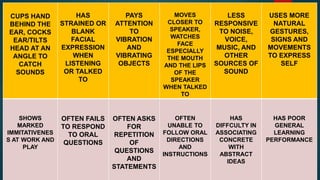
CUPS HAND
BEHIND THE
EAR, COCKS
EAR/TILTS
HEAD AT AN
ANGLE TO
CATCH
SOUNDS
HAS
STRAINED OR
BLANK
FACIAL
EXPRESSION
WHEN
LISTENING
OR TALKED
TO
PAYS
ATTENTION
TO
VIBRATION
AND
VIBRATING
OBJECTS
MOVES
CLOSER TO
SPEAKER,
WATCHES
FACE
ESPECIALLY
THE MOUTH
AND THE LIPS
OF THE
SPEAKER
WHEN TALKED
TO
LESS
RESPONSIVE
TO NOISE,
VOICE,
MUSIC, AND
OTHER
SOURCES OF
SOUND
USES MORE
NATURAL
GESTURES,
SIGNS AND
MOVEMENTS
TO EXPRESS
SELF
SHOWS
MARKED
IMMITATIVENES
S AT WORK AND
PLAY
OFTEN FAILS
TO RESPOND
TO ORAL
QUESTIONS
OFTEN ASKS
FOR
REPETITION
OF
QUESTIONS
AND
STATEMENTS
OFTEN
UNABLE TO
FOLLOW ORAL
DIRECTIONS
AND
INSTRUCTIONS
HAS
DIFFCULTY IN
ASSOCIATING
CONCRETE
WITH
ABSTRACT
IDEAS
HAS POOR
GENERAL
LEARNING
PERFORMANCE
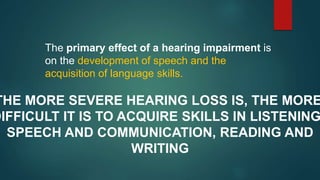
The primary effect of a hearing impairment is
on the development of speech and the
acquisition of language skills.
THE MORE SEVERE HEARING LOSS IS, THE MORE
DIFFICULT IT IS TO ACQUIRE SKILLS IN LISTENING
SPEECH AND COMMUNICATION, READING AND
WRITING
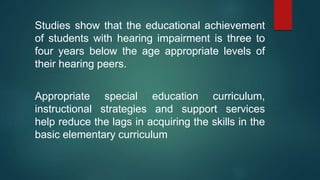
Studies show that the educational achievement
of students with hearing impairment is three to
four years below the age appropriate levels of
their hearing peers.
Appropriate special education curriculum,
instructional strategies and support services
help reduce the lags in acquiring the skills in the
basic elementary curriculum
Identification and
Assessment of
Children with Hearing
Impairment
EARLY IDENTIFICATION OF A
HEARING IMPAIRMENT
INCREASES THE CHANCES FOR
THE CHILD TO RECEIVE EARLY
TREATMENT AND SPECIAL
EDUCATION INTERVENTION
the assessment program includes audiological
evaluation, test of mental ability, and test of
communication ability.
1. AUDIOLOGICAL EVALUATION
AUDIOLOGY - is the science of testing and evaluating
hearing ability to detect
and describe hearing impairments.
AUDIOLOGICAL EVALUATION - is done by an
audiologist through the use of sophisticated instruments
and techniques.
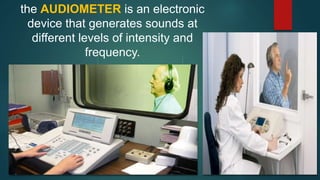
the AUDIOMETER is an electronic
device that generates sounds at
different levels of intensity and
frequency.
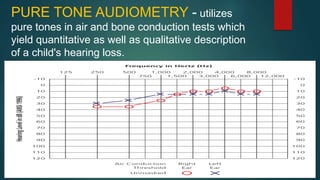
PURE TONE AUDIOMETRY - utilizes
pure tones in air and bone conduction tests which
yield quantitative as well as qualitative description
of a child's hearing loss.
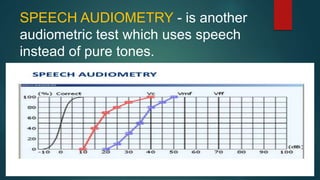
SPEECH AUDIOMETRY - is another
audiometric test which uses speech
instead of pure tones.
there are alternative audiometric techniques
for hearing evaluation;
 SOUND FIELD AUDIOMETRY
 EVOKED RESPONSE AUDIOMETRY
 IMPEDANCE AUDIOMETRY
 PLAY AUDIOMETRY
 OPERANT CONDITIONING AUDIOMETRY
 BEHAVIOUR OBSERVATION AUDIOMETRY
INFORMAL HEARING
TESTS
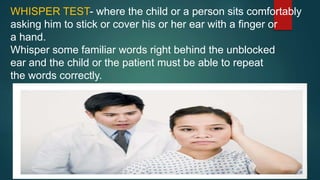
WHISPER TEST- where the child or a person sits comfortably
asking him to stick or cover his or her ear with a finger or
a hand.
Whisper some familiar words right behind the unblocked
ear and the child or the patient must be able to repeat
the words correctly.
CONVERSATIONAL LIVE VOICE TEST - Keeping
the same position, but facing the child, ask him or
her to repeat words that contain high or low
consonants.
Start with a whisper and increase the intensity up
to 20 dB moving away from the child little by little.
IF A CHILD CAN HEAR AT A DISTANCE OF 3 TO
6 METERS, HEARING IS NORMAL
AND IF HE OR SHE CANT, THE CHILD MIGHT
BE HARD OF HEARING.
BALL PEN CLICK TEST - use a retractable ballpen
and place it one inch away from the ear. While the
other ear is blocked by a finger, press the button of
the ballpen down to release it. Do it only once. The
child indicates that he or she hears the click by
either raising a hand or acknowledging it with a yes
or a nod.
2. COGNITIVE ASSESSMENT
The assessment tools that measure intellectual capacity of
children having hearing impairment do not rely primarily on
verbal abilities.
In the United states, The Hiskey - Test of Learning Aptitude,
the Wechslers Intelligence Scale for Children (WISC) and the
Standford Achievement test (SAT) are widely used because
of nonverbal performance subtests.
3. Assessment of Communication
Abilities
Assessment of speech and language abilities
includes an analysis of the development of the
form, content and use of language. Articulation,
pitch, frequency, and quality of voice are
examined.
4. SOCIAL AND BEHAVIORAL
ASSESSMENT
Hearing Impairment brings about significant
effects on social-emotional and personality
development as result of the restrictions in
interactive experiences and communication
activities with their age group. Linguistics
difficulties oftentimes show in low self-concept
and social emotional maladjustment.
EDUCATIONAL
PLACEMENT
The degree and classification of
hearing loss are important factors
in deciding the most appropriate
special education program for
children with hearing impairment.
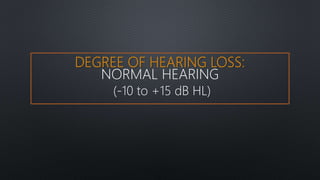
DEGREE OF HEARING LOSS:
NORMAL HEARING
(-10 to +15 dB HL)
no difficulty in this degree
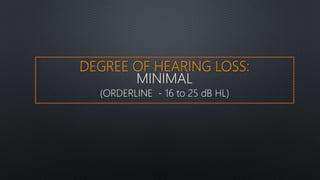
DEGREE OF HEARING LOSS:
MINIMAL
(ORDERLINE - 16 to 25 dB HL)
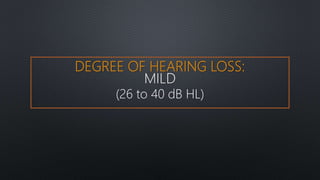
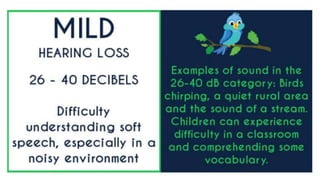
DEGREE OF HEARING LOSS:
MILD
(26 to 40 dB HL)
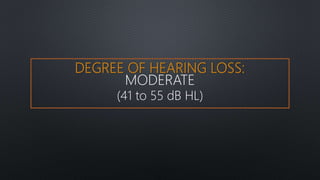
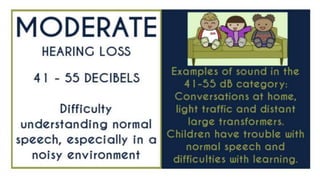
DEGREE OF HEARING LOSS:
MODERATE
(41 to 55 dB HL)
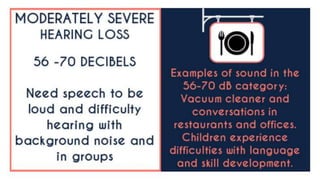
DEGREE OF HEARING LOSS:
MODERATE TO SEVERE
(56 to 70 dB HL)
DEGREE OF HEARING LOSS:
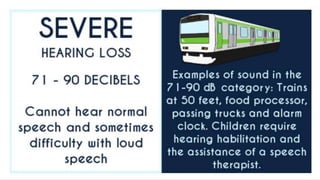
SEVERE
(71 to 90 dB HL)
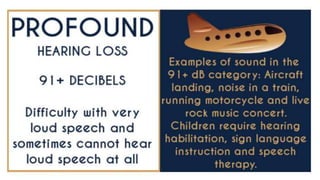
DEGREE OF HEARING LOSS:
PROFOUND
(91 dB HL or more)
DEGREE OF HEARING LOSS:
UNILATERAL
(one normal hearing ear and one ear with at
least a permanent mild hearing loss)
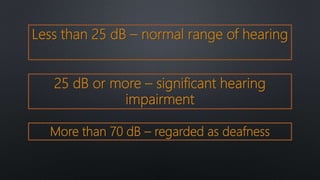
Less than 25 dB – normal range of hearing
25 dB or more – significant hearing
impairment
More than 70 dB – regarded as deafness
EDUCATIONAL PLACEMENT
In the Philippines, students with hearing
impairment like other students with
disabilities are mainstreamed in regular
classes either on full-time or part-time
basis.
SUPPORT SERVICES
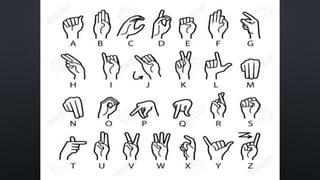
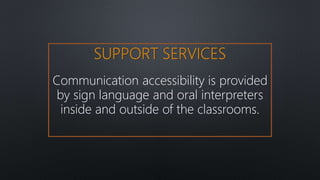
Communication accessibility is provided
by sign language and oral interpreters
inside and outside of the classrooms.
CHAPTER 10: STUDENTS WITH HEARING IMPAIRMENT
SUGGESTIONS FOR
TEACHING STUDENTS
WITH HEARING
IMPAIRMENT IN REGULAR
CLASS
1. Promote acceptance of the
student with hearing impairment
in the regular class.
2. Be sure that prescribed
hearing aids and other
amplification devices are used.
3. Provide preferential seating.
4. Increase visual information.
5. Minimize classroom noise.
6. Modify teaching procedures.
7. Have realistic expectations.

Students with Hearing Impairment 3

  • 1.
  • 2.
    Individuals with hearingimpairment compose a widely diverse group of persons. Since the major effect of deafness is in language development, concomitant issues occur on intellectual and social development, speech and language development that are connected to educational concerns.
  • 3.
    DEAFNESSis defined asinvisible handicapping condition because there are only few physical and observable manifestations to indicate its presence such as the absence of outer ear, closed ear canal and fluid discharge from the ear.
  • 4.
    SOME OF OBSERVABLE BEHAVIORALAND LEARNING CHARACTERISTICS OF A CHILD WITH HEARING IMPAIRMENT
  • 5.
    CUPS HAND BEHIND THE EAR,COCKS EAR/TILTS HEAD AT AN ANGLE TO CATCH SOUNDS HAS STRAINED OR BLANK FACIAL EXPRESSION WHEN LISTENING OR TALKED TO PAYS ATTENTION TO VIBRATION AND VIBRATING OBJECTS MOVES CLOSER TO SPEAKER, WATCHES FACE ESPECIALLY THE MOUTH AND THE LIPS OF THE SPEAKER WHEN TALKED TO LESS RESPONSIVE TO NOISE, VOICE, MUSIC, AND OTHER SOURCES OF SOUND USES MORE NATURAL GESTURES, SIGNS AND MOVEMENTS TO EXPRESS SELF SHOWS MARKED IMMITATIVENES S AT WORK AND PLAY OFTEN FAILS TO RESPOND TO ORAL QUESTIONS OFTEN ASKS FOR REPETITION OF QUESTIONS AND STATEMENTS OFTEN UNABLE TO FOLLOW ORAL DIRECTIONS AND INSTRUCTIONS HAS DIFFCULTY IN ASSOCIATING CONCRETE WITH ABSTRACT IDEAS HAS POOR GENERAL LEARNING PERFORMANCE
  • 6.
    The primary effectof a hearing impairment is on the development of speech and the acquisition of language skills. THE MORE SEVERE HEARING LOSS IS, THE MORE DIFFICULT IT IS TO ACQUIRE SKILLS IN LISTENING SPEECH AND COMMUNICATION, READING AND WRITING
  • 7.
    Studies show thatthe educational achievement of students with hearing impairment is three to four years below the age appropriate levels of their hearing peers. Appropriate special education curriculum, instructional strategies and support services help reduce the lags in acquiring the skills in the basic elementary curriculum
  • 8.
  • 9.
    EARLY IDENTIFICATION OFA HEARING IMPAIRMENT INCREASES THE CHANCES FOR THE CHILD TO RECEIVE EARLY TREATMENT AND SPECIAL EDUCATION INTERVENTION
  • 10.
    the assessment programincludes audiological evaluation, test of mental ability, and test of communication ability.
  • 11.
    1. AUDIOLOGICAL EVALUATION AUDIOLOGY- is the science of testing and evaluating hearing ability to detect and describe hearing impairments. AUDIOLOGICAL EVALUATION - is done by an audiologist through the use of sophisticated instruments and techniques.
  • 12.
    the AUDIOMETER isan electronic device that generates sounds at different levels of intensity and frequency.
  • 13.
    PURE TONE AUDIOMETRY- utilizes pure tones in air and bone conduction tests which yield quantitative as well as qualitative description of a child's hearing loss.
  • 14.
    SPEECH AUDIOMETRY -is another audiometric test which uses speech instead of pure tones.
  • 15.
    there are alternativeaudiometric techniques for hearing evaluation;  SOUND FIELD AUDIOMETRY  EVOKED RESPONSE AUDIOMETRY  IMPEDANCE AUDIOMETRY  PLAY AUDIOMETRY  OPERANT CONDITIONING AUDIOMETRY  BEHAVIOUR OBSERVATION AUDIOMETRY
  • 16.
  • 17.
    WHISPER TEST- wherethe child or a person sits comfortably asking him to stick or cover his or her ear with a finger or a hand. Whisper some familiar words right behind the unblocked ear and the child or the patient must be able to repeat the words correctly.
  • 18.
    CONVERSATIONAL LIVE VOICETEST - Keeping the same position, but facing the child, ask him or her to repeat words that contain high or low consonants. Start with a whisper and increase the intensity up to 20 dB moving away from the child little by little. IF A CHILD CAN HEAR AT A DISTANCE OF 3 TO 6 METERS, HEARING IS NORMAL AND IF HE OR SHE CANT, THE CHILD MIGHT BE HARD OF HEARING.
  • 19.
    BALL PEN CLICKTEST - use a retractable ballpen and place it one inch away from the ear. While the other ear is blocked by a finger, press the button of the ballpen down to release it. Do it only once. The child indicates that he or she hears the click by either raising a hand or acknowledging it with a yes or a nod.
  • 20.
    2. COGNITIVE ASSESSMENT Theassessment tools that measure intellectual capacity of children having hearing impairment do not rely primarily on verbal abilities. In the United states, The Hiskey - Test of Learning Aptitude, the Wechslers Intelligence Scale for Children (WISC) and the Standford Achievement test (SAT) are widely used because of nonverbal performance subtests.
  • 21.
    3. Assessment ofCommunication Abilities Assessment of speech and language abilities includes an analysis of the development of the form, content and use of language. Articulation, pitch, frequency, and quality of voice are examined.
  • 22.
    4. SOCIAL ANDBEHAVIORAL ASSESSMENT Hearing Impairment brings about significant effects on social-emotional and personality development as result of the restrictions in interactive experiences and communication activities with their age group. Linguistics difficulties oftentimes show in low self-concept and social emotional maladjustment.
  • 23.
  • 24.
    The degree andclassification of hearing loss are important factors in deciding the most appropriate special education program for children with hearing impairment.
  • 25.
    DEGREE OF HEARINGLOSS: NORMAL HEARING (-10 to +15 dB HL)
  • 26.
    no difficulty inthis degree
  • 27.
    DEGREE OF HEARINGLOSS: MINIMAL (ORDERLINE - 16 to 25 dB HL)
  • 29.
    DEGREE OF HEARINGLOSS: MILD (26 to 40 dB HL)
  • 31.
    DEGREE OF HEARINGLOSS: MODERATE (41 to 55 dB HL)
  • 33.
    DEGREE OF HEARINGLOSS: MODERATE TO SEVERE (56 to 70 dB HL)
  • 35.
    DEGREE OF HEARINGLOSS: SEVERE (71 to 90 dB HL)
  • 37.
    DEGREE OF HEARINGLOSS: PROFOUND (91 dB HL or more)
  • 39.
    DEGREE OF HEARINGLOSS: UNILATERAL (one normal hearing ear and one ear with at least a permanent mild hearing loss)
  • 40.
    Less than 25dB – normal range of hearing 25 dB or more – significant hearing impairment More than 70 dB – regarded as deafness
  • 41.
    EDUCATIONAL PLACEMENT In thePhilippines, students with hearing impairment like other students with disabilities are mainstreamed in regular classes either on full-time or part-time basis.
  • 43.
    SUPPORT SERVICES Communication accessibilityis provided by sign language and oral interpreters inside and outside of the classrooms.
  • 45.
    CHAPTER 10: STUDENTSWITH HEARING IMPAIRMENT SUGGESTIONS FOR TEACHING STUDENTS WITH HEARING IMPAIRMENT IN REGULAR CLASS
  • 46.
    1. Promote acceptanceof the student with hearing impairment in the regular class.
  • 47.
    2. Be surethat prescribed hearing aids and other amplification devices are used.
  • 48.
  • 49.
    4. Increase visualinformation.
  • 50.
  • 51.
    6. Modify teachingprocedures.
  • 52.
    7. Have realisticexpectations.