Cerebral Palsy Presentation of Physical Disabilities Presented by: Shirlyn, Crystal, Sushi & Suhaidah
What are Physical Disabilities? Physical disabilities affect the function of a person’s motor mobility. Different types of PD: Cerebral Palsy Non progressive lesion to the brain that affect the motor movement Spinal Bifida   Paralysis due to damage to the spinal cord Muscular Atrophies   Weak muscles, delayed in motor development  Spinal Muscular Mypathies Low muscle tones Osteogenesis Imperfecta   Brittle bones
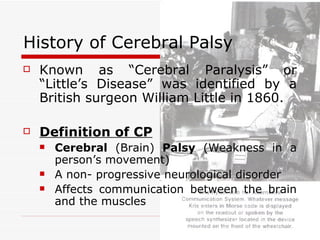
History of Cerebral Palsy Known as “Cerebral Paralysis” or “Little’s Disease” was identified by a British surgeon William Little in 1860. Definition of CP Cerebral  (Brain)  Palsy  (Weakness in a person’s movement) A non- progressive neurological disorder  Affects  communication between the brain and the muscles
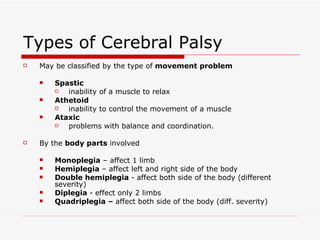
Types of Cerebral Palsy May be classified by the type of  movement problem Spastic inability of a muscle to relax  Athetoid  inability to control the movement of a muscle Ataxic problems with balance and coordination. By the  body parts  involved  Monoplegia  – affect 1 limb Hemiplegia  – affect left and right side of the body Double hemiplegia  -   affect both side of the body (different severity) Diplegia  -   effect only 2 limbs  Quadriplegia –  affect both side of the body (diff. severity)
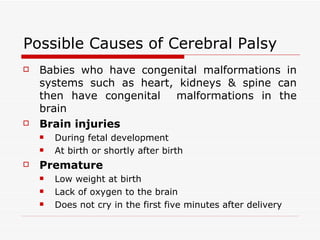
Possible Causes of Cerebral Palsy Babies who have congenital malformations in systems such as heart, kidneys & spine can then have congenital  malformations in the brain Brain injuries   During fetal development  At birth or shortly after birth   Premature  Low weight at birth  Lack of oxygen to the brain Does not cry in the first five minutes after delivery
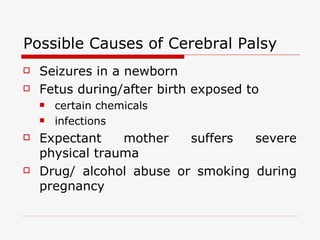
Possible Causes of Cerebral Palsy Seizures in a newborn  Fetus during/after birth exposed to  certain chemicals  infections  Expectant mother suffers severe physical trauma Drug/ alcohol abuse or smoking during pregnancy
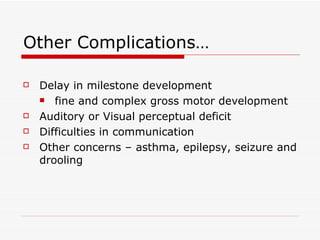
Other Complications… Delay in milestone development  fine and complex gross motor development Auditory or Visual perceptual deficit Difficulties in communication  Other concerns – asthma, epilepsy, seizure and drooling
What Educators / Para educators can do to help in the classroom? Physical setting   Students in wheelchair and with auditory or visual problem   seated where there are minimal movement behind them near the teacher and blackboard Classroom should be organised promote social, cultural and emotional development & academic progress.  Provide mattress to cushion the fall during seizure attack
What Educators / Para educators can do to help in the classroom? Instructional Cues   Talking books   aid in learning  Give  1 direction at a time .  Use short, simple, one concept phrase to give direction.  Be patient and look at the student when giving instruction.  repeat verbal directions slowly, firmly and clearly or use visual cues.
What Educators / Para educators can do to help in the classroom? Social Emotional Support Encourage sharing sessions among peers to develop friendships  Include them in most class and outdoor activities  (E.g. P.E lessons, excursions, field trips) Home-school partnership – Parental involvement Behavioural Aspect No special consideration and provision concerning rules and regulation, unless the need arises
Importance of Teacher’s Role Teachers should be ready for specialized and high-tech equipment to be part of classroom environment Teachers must be confident about specific procedures and in case of emergency (E.g. epilepsy, seizure) Modify and accommodate  curriculum to support the learning  give extra time to complete schoolwork or tests Provide opportunities for participation and success.  Focus on student’s strengths
Local resources / local practices / links /article The  Spastic Children's Association of Singapore  (SCAS) was established in 1957 to provide medical treatment and therapy for children with cerebral palsy in Singapore  http://www.spastic.org.sg/ National Neuroscience Institute: Singhealth. Describes Neurosurgical Treatment of Spasticity in Cerebral Palsy  http://www.nni.com.sg/ForDoctorsandHealthcareProfessionals/ClinicalNeuroscienceUpdates/Neurosurgical+Treatment+of+Spasticity+in+Cerebral+Palsy+-+an+Update.htm Rainbow Centre runs 3 programmes, 2 of which caters to children with Physical CP:  EIPIC  - Early Intervention Programme for Infants & Young Children  PCMH  - Programme for Children with Multiple Handicaps  http://www.rainbowcentre.org.sg/sped.htm
Conclusion “ … disorder of movement .. caused by a damage to the brain …  they are not stupid” Source: (Stanton, M.1992. The Cerebral Palsy Handbook : A guide for parents and carers. London: Random House) *Handouts will be given…

Presentation Of Physical Disabilities

  • 1.
    Cerebral Palsy Presentationof Physical Disabilities Presented by: Shirlyn, Crystal, Sushi & Suhaidah
  • 2.
    What are PhysicalDisabilities? Physical disabilities affect the function of a person’s motor mobility. Different types of PD: Cerebral Palsy Non progressive lesion to the brain that affect the motor movement Spinal Bifida Paralysis due to damage to the spinal cord Muscular Atrophies Weak muscles, delayed in motor development Spinal Muscular Mypathies Low muscle tones Osteogenesis Imperfecta Brittle bones
  • 3.
    History of CerebralPalsy Known as “Cerebral Paralysis” or “Little’s Disease” was identified by a British surgeon William Little in 1860. Definition of CP Cerebral (Brain) Palsy (Weakness in a person’s movement) A non- progressive neurological disorder Affects communication between the brain and the muscles
  • 4.
    Types of CerebralPalsy May be classified by the type of movement problem Spastic inability of a muscle to relax Athetoid inability to control the movement of a muscle Ataxic problems with balance and coordination. By the body parts involved Monoplegia – affect 1 limb Hemiplegia – affect left and right side of the body Double hemiplegia - affect both side of the body (different severity) Diplegia - effect only 2 limbs Quadriplegia – affect both side of the body (diff. severity)
  • 5.
    Possible Causes ofCerebral Palsy Babies who have congenital malformations in systems such as heart, kidneys & spine can then have congenital malformations in the brain Brain injuries During fetal development At birth or shortly after birth Premature Low weight at birth Lack of oxygen to the brain Does not cry in the first five minutes after delivery
  • 6.
    Possible Causes ofCerebral Palsy Seizures in a newborn Fetus during/after birth exposed to certain chemicals infections Expectant mother suffers severe physical trauma Drug/ alcohol abuse or smoking during pregnancy
  • 7.
    Other Complications… Delayin milestone development fine and complex gross motor development Auditory or Visual perceptual deficit Difficulties in communication Other concerns – asthma, epilepsy, seizure and drooling
  • 8.
    What Educators /Para educators can do to help in the classroom? Physical setting Students in wheelchair and with auditory or visual problem seated where there are minimal movement behind them near the teacher and blackboard Classroom should be organised promote social, cultural and emotional development & academic progress. Provide mattress to cushion the fall during seizure attack
  • 9.
    What Educators /Para educators can do to help in the classroom? Instructional Cues Talking books aid in learning Give 1 direction at a time . Use short, simple, one concept phrase to give direction. Be patient and look at the student when giving instruction. repeat verbal directions slowly, firmly and clearly or use visual cues.
  • 10.
    What Educators /Para educators can do to help in the classroom? Social Emotional Support Encourage sharing sessions among peers to develop friendships Include them in most class and outdoor activities (E.g. P.E lessons, excursions, field trips) Home-school partnership – Parental involvement Behavioural Aspect No special consideration and provision concerning rules and regulation, unless the need arises
  • 11.
    Importance of Teacher’sRole Teachers should be ready for specialized and high-tech equipment to be part of classroom environment Teachers must be confident about specific procedures and in case of emergency (E.g. epilepsy, seizure) Modify and accommodate curriculum to support the learning give extra time to complete schoolwork or tests Provide opportunities for participation and success. Focus on student’s strengths
  • 12.
    Local resources /local practices / links /article The Spastic Children's Association of Singapore (SCAS) was established in 1957 to provide medical treatment and therapy for children with cerebral palsy in Singapore http://www.spastic.org.sg/ National Neuroscience Institute: Singhealth. Describes Neurosurgical Treatment of Spasticity in Cerebral Palsy http://www.nni.com.sg/ForDoctorsandHealthcareProfessionals/ClinicalNeuroscienceUpdates/Neurosurgical+Treatment+of+Spasticity+in+Cerebral+Palsy+-+an+Update.htm Rainbow Centre runs 3 programmes, 2 of which caters to children with Physical CP: EIPIC - Early Intervention Programme for Infants & Young Children PCMH - Programme for Children with Multiple Handicaps http://www.rainbowcentre.org.sg/sped.htm
  • 13.
    Conclusion “ …disorder of movement .. caused by a damage to the brain … they are not stupid” Source: (Stanton, M.1992. The Cerebral Palsy Handbook : A guide for parents and carers. London: Random House) *Handouts will be given…