Chapter 2
Physical and Motor
Development of
Children and
Adolescents
I. Physical and Motor
    Development.
Children from higher socio-economic groups
  tend to be better nourished, and receive
better prenatal and postnatal care, variations
 in height, weight and muscular dev’t are in
                 their favor.
EARLY CHILDHOOD

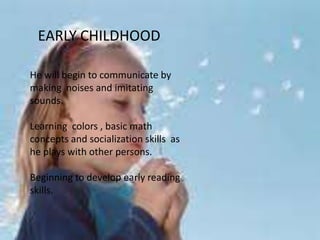
He will begin to communicate by
making noises and imitating
sounds.

Learning colors , basic math
concepts and socialization skills as
he plays with other persons.

Beginning to develop early reading
skills.
MIDDLE CHILDHOOD
Enjoys practicing both motor and learning skills
to improve his abilities.

GROSS MOTOR SKILLS
The large scale body movement skills such as
walking and running.

Boys develop these skills slightly faster than do
girls, except for skills involving balance &
precise movements.

Girls to tend to develop fine motor skills
slightly faster than boys.
Adolescence
The early signs of maturation is the adolescent
growth spurt or a noticeable increase in height
& weight.

Female: usually begins bet. ages 10 and 14 and
ends by age 18.

Male: usually begins bet. Ages 10 and 16, and
ends with 18.
MENARCHE- onset menstruation among girls


   NOCTURNAL EMISSIONS- (wet dreams)
     experience by the teen age boys a
   harmless release of semen during sleep.
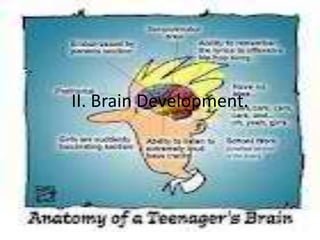
II. Brain Development.
A. Early childhood

 Brain continues develop after birth. It
doubles in weight after 6mos. at which
  time it weighs about half that of the
              adult brain.
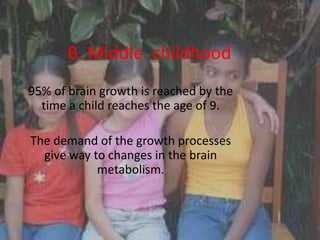
B. Middle childhood
95% of brain growth is reached by the
  time a child reaches the age of 9.

The demand of the growth processes
  give way to changes in the brain
            metabolism.
C. Adolescence.

Teenaged years , there are two major brain
growth spurts (1) occurring bet. ages 13 to
 15. and the (2) beginning around age 17
 and w/c continues into early childhood.
Environmental influences of
     dev’t of the brain.

            chronic malnutrition.
            Bad environments.
              Lateralization.
- The corpus collosum , grows , and matures
  during the early childhood years at faster
    rate than in any other period of life.
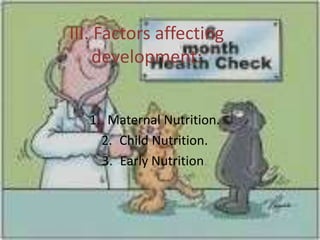
III. Factors affecting
     development:


  1. Maternal Nutrition.
    2. Child Nutrition.
    3. Early Nutrition.
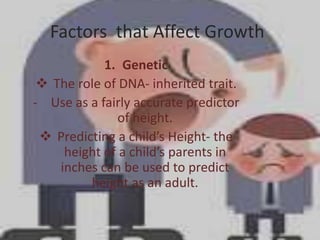
Factors that Affect Growth
            1. Genetic
  The role of DNA- inherited trait.
- Use as a fairly accurate predictor
              of height.
  Predicting a child’s Height- the
     height of a child’s parents in
    inches can be used to predict
         height as an adult.
 Delayed Growth Patterns- the
problem maybe delayed born aged.
   -Constitutional growth delay.
Other factors affecting growth- a
  deficiency of growth hormones.
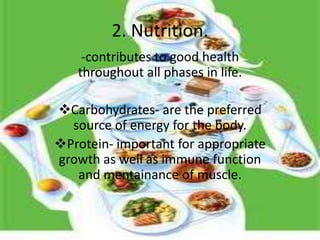
2. Nutrition.
    -contributes to good health
   throughout all phases in life.

Carbohydrates- are the preferred
  source of energy for the body.
Protein- important for appropriate
growth as well as immune function
   and mentainance of muscle.
Healthy Fats- is often given a bad rap.
Breakfast- is the most important meal of
                 the day.
 Dairy- is an essential mineral for bone
              development.
               B vitamins
3. Medical condition- kids and teens
  grow and go through puberty at
          different times.
4. Exercise- influences statural,
hypertrophic and reparative growth.
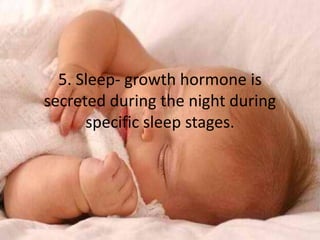
5. Sleep- growth hormone is
secreted during the night during
      specific sleep stages.
6. Emotional well-being.

The key to a happy and healthy life.
IV. Exceptional Development:
                 A. PHYSICAL DISABILITIES..
The physically handicapped have impairments that are temporary
   or permanent such as: paralysis, stiffness or lack of motor
coordination of bones, muscles or joints so that they need special
               equipment or help in moving about
           Crippling disabilities include the following:
     Impairment of the bone and muscle systems which affects
 mobility and manual dexterity difficult and impossible as in the
        case of the amputees and those with severe fractures;
  Impairment of the nerve and muscle systems making mobility
         awkward and uncoordinated as in cerebral palsy; and
Deformities or absence of body organs and systems necessary for
      mobility like in the case of the club-foot and paraplegics.
  It is evident that growth is affected by physical disabilities like
orthopedic handicaps, disfunction of the neuro-muscular system ,
and congenital deformities. These are contributory factors in the
 making of the group of exceptional children called the crippled.
Causes of Handicaps
A number of factors have been identified as cause of
crippling handicaps, impairments, and disabilities.
                   These are   :
1. Prenatal factors . These are factors that affect
    normal development before and after conception
  virtually rasting up to the first trimester or the third
trimester of life . Specially these include the following:
  A. Genetic or chromosomal aberrations. This results
  from blood incompatibility of the husband and wife.
  There is a transfer of defective genes from parent to
                         offspring.
B. Prematurity. Birth of the fetus is usually earlier than
              the ninth month of pregnancy.
 C. Infection. This is caused by bacteria or virus on the
  fetus in the womb of the mother, the germs usually
 come from highly communicable diseases like rubella
and veneral diseases. The neonatal sepsis is caused by
     infection either directly from the mother or the
   outside environment like poorly sanitized delivery
   room, infected hospital gadgets, and many others.
D. Malnutritions. Insufficient intake of food nutrients
necessary to sustain growth and development of the fetus and
the mother.
E.Irradiation. Pertains to the exposure of the pregnant mother
to radioactive elements like x-ray. Exposure of the mother also
affects the fetus.
F. Metabolic disturbances. Inability of
 the mother or the fetus to make use of
               food intake.
G. Drug abuse. Entry of large quantities
     of medicines into the body thus
effecting the fetus. Thalidomide used by
   mothers has affected thousands of
  babies who were born without limbs
          and other extremities
2. Perinatal factors. These are factors causing
crippling conditions during the period of birth.

a .birth injury. These are injuries suffered by the
  newborn baby. Injury to the spine will cause
                paralysis kernicterus.
   b. difficult labor. Hard and prolonged labor
   before the actual birth which interrupts the
     oxygen intake of the mother to uterus.
c. hemorrhage. Profuse bleeding of the mother
during birth which might be caused by damage
                    of the uterus.
3. Postnatal factors. These are factors
   causing crippling conditions after birth.
a. infections. These are caused by illness like
        diphtheria, typhoid, meningitis,
  encephalomyclitis, and rickets in infants.
   b. tumor and abscess in the brain. They
    destroy the brain cells connected with
     movement thus impairing mobility.
   c. fractures and dislocations. These are
    destructions of mobility organs either
  through falls and other accidents causing
         bone fractures or dislocation.
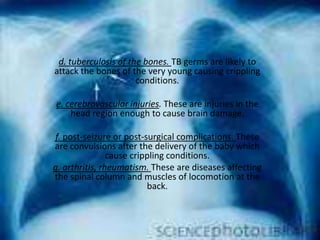
d. tuberculosis of the bones. TB germs are likely to
attack the bones of the very young causing crippling
                      conditions.

e. cerebrovascular injuries. These are injuries in the
    head region enough to cause brain damage.

f. post-seizure or post-surgical complications. These
are convulsions after the delivery of the baby which
                cause crippling conditions.
g. arthritis, rheumatism. These are diseases affecting
the spinal column and muscles of locomotion at the
                          back.
B. SENSORY IMPAIREMENTS

1. Visual impairement.

2. Blindness is the inability of the
    person to see anything.
CAUSES OF DEAFNESS:

1.   Prenatal causes:
a.   Toxic conditions.
b.   Viral causes
c.   Congenital defects
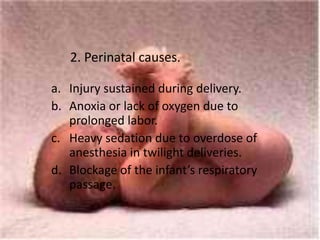
2. Perinatal causes.

a. Injury sustained during delivery.
b. Anoxia or lack of oxygen due to
   prolonged labor.
c. Heavy sedation due to overdose of
   anesthesia in twilight deliveries.
d. Blockage of the infant’s respiratory
   passage.
3. Postnatal causes.


  a. Diseases , ailments and ther
     conditions.
  b. Accidents/trauma falls, head
     bumps , overexposure to high
     frequency sounds and extremely
     loud explosions.
4. Other causes.
a. heredity.
b. Prematurity.
c. Malnutrition.
d. Rh factor- blood incompatibility of
   parents.
e. Overdosage of medecine.
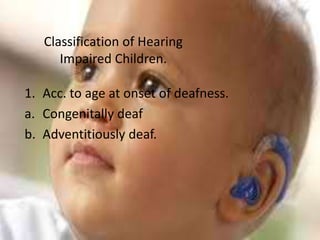
Classification of Hearing
      Impaired Children.

1. Acc. to age at onset of deafness.
a. Congenitally deaf
b. Adventitiously deaf.
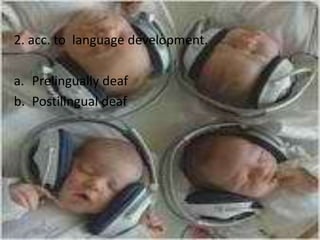
2. acc. to language development.

a. Prelingually deaf
b. Postilingual deaf
3. Acc. to place of impairement.

a. Conductive hearing loss.
b. Sensory neutral hearing loss.
c. Mixed hearing loss.
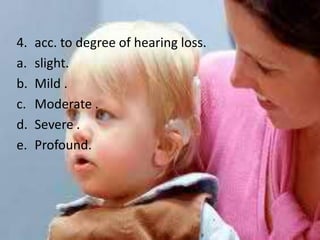
4.   acc. to degree of hearing loss.
a.   slight.
b.   Mild .
c.   Moderate .
d.   Severe .
e.   Profound.
C. Learning Disabilities.

 The inability to listen well, process
information readily, and inability to talk,
read, write, spell, and even add numbers.

Also referred to as perceptual handicaps,
brain injury, brain dysfunction and the like.
The different types learning disabilities
                   are:
1.   Dyslexia – reading
2.   Dysgraphia- writing
3.   Visual agnosia- sight
4.   Motor aphasia- speaking
5.   Dysathria- sttutering
6.   Auditory agnosia- hearing
7.   Olfactory agnosia- smelling
8.   Dyscalcula -math
D. Attention Deficit Hyperacivity Disorder
                   (ADHD)

Refers to a chronic biobehavioral that
initially manifests in childhood & is
characterized by hyperactivity, impulsivity,
and or inattention.
Symptoms:
Inattention:
Fails to give close attention to details
or makes careless mistakes in
schoolwork.
Difficulty sustaining attention in tasks
or play activities.
Often forgetful in daily activities.
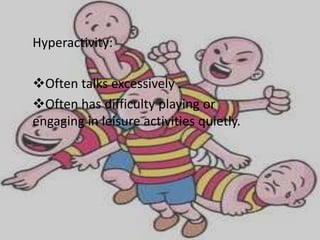
Hyperactivity:

Often talks excessively .
Often has difficulty playing or
engaging in leisure activities quietly.
Impulsivity:
Often blurts out answers before
questions have been completed
Often has difficulty awaiting in
his/her turn
Often interrupts or intrudes on
others
3 Principles of behavior therapy are:

1. Set specific goals.
2. Provide rewards & consenquences.
3. Keep using the rewards and
   consequences.
THANK YOU..!

Rosette

  • 1.
    Chapter 2 Physical andMotor Development of Children and Adolescents
  • 2.
    I. Physical andMotor Development.
  • 3.
    Children from highersocio-economic groups tend to be better nourished, and receive better prenatal and postnatal care, variations in height, weight and muscular dev’t are in their favor.
  • 4.
    EARLY CHILDHOOD He willbegin to communicate by making noises and imitating sounds. Learning colors , basic math concepts and socialization skills as he plays with other persons. Beginning to develop early reading skills.
  • 5.
    MIDDLE CHILDHOOD Enjoys practicingboth motor and learning skills to improve his abilities. GROSS MOTOR SKILLS The large scale body movement skills such as walking and running. Boys develop these skills slightly faster than do girls, except for skills involving balance & precise movements. Girls to tend to develop fine motor skills slightly faster than boys.
  • 6.
    Adolescence The early signsof maturation is the adolescent growth spurt or a noticeable increase in height & weight. Female: usually begins bet. ages 10 and 14 and ends by age 18. Male: usually begins bet. Ages 10 and 16, and ends with 18.
  • 7.
    MENARCHE- onset menstruationamong girls NOCTURNAL EMISSIONS- (wet dreams) experience by the teen age boys a harmless release of semen during sleep.
  • 8.
  • 9.
    A. Early childhood Brain continues develop after birth. It doubles in weight after 6mos. at which time it weighs about half that of the adult brain.
  • 10.
    B. Middle childhood 95%of brain growth is reached by the time a child reaches the age of 9. The demand of the growth processes give way to changes in the brain metabolism.
  • 11.
    C. Adolescence. Teenaged years, there are two major brain growth spurts (1) occurring bet. ages 13 to 15. and the (2) beginning around age 17 and w/c continues into early childhood.
  • 12.
    Environmental influences of dev’t of the brain.  chronic malnutrition. Bad environments. Lateralization. - The corpus collosum , grows , and matures during the early childhood years at faster rate than in any other period of life.
  • 13.
    III. Factors affecting development: 1. Maternal Nutrition. 2. Child Nutrition. 3. Early Nutrition.
  • 14.
    Factors that AffectGrowth 1. Genetic  The role of DNA- inherited trait. - Use as a fairly accurate predictor of height.  Predicting a child’s Height- the height of a child’s parents in inches can be used to predict height as an adult.
  • 15.
     Delayed GrowthPatterns- the problem maybe delayed born aged. -Constitutional growth delay. Other factors affecting growth- a deficiency of growth hormones.
  • 16.
    2. Nutrition. -contributes to good health throughout all phases in life. Carbohydrates- are the preferred source of energy for the body. Protein- important for appropriate growth as well as immune function and mentainance of muscle.
  • 17.
    Healthy Fats- isoften given a bad rap. Breakfast- is the most important meal of the day. Dairy- is an essential mineral for bone development. B vitamins
  • 18.
    3. Medical condition-kids and teens grow and go through puberty at different times.
  • 19.
    4. Exercise- influencesstatural, hypertrophic and reparative growth.
  • 20.
    5. Sleep- growthhormone is secreted during the night during specific sleep stages.
  • 21.
    6. Emotional well-being. Thekey to a happy and healthy life.
  • 22.
    IV. Exceptional Development: A. PHYSICAL DISABILITIES.. The physically handicapped have impairments that are temporary or permanent such as: paralysis, stiffness or lack of motor coordination of bones, muscles or joints so that they need special equipment or help in moving about Crippling disabilities include the following: Impairment of the bone and muscle systems which affects mobility and manual dexterity difficult and impossible as in the case of the amputees and those with severe fractures; Impairment of the nerve and muscle systems making mobility awkward and uncoordinated as in cerebral palsy; and Deformities or absence of body organs and systems necessary for mobility like in the case of the club-foot and paraplegics. It is evident that growth is affected by physical disabilities like orthopedic handicaps, disfunction of the neuro-muscular system , and congenital deformities. These are contributory factors in the making of the group of exceptional children called the crippled.
  • 23.
    Causes of Handicaps Anumber of factors have been identified as cause of crippling handicaps, impairments, and disabilities. These are :
  • 24.
    1. Prenatal factors. These are factors that affect normal development before and after conception virtually rasting up to the first trimester or the third trimester of life . Specially these include the following: A. Genetic or chromosomal aberrations. This results from blood incompatibility of the husband and wife. There is a transfer of defective genes from parent to offspring. B. Prematurity. Birth of the fetus is usually earlier than the ninth month of pregnancy. C. Infection. This is caused by bacteria or virus on the fetus in the womb of the mother, the germs usually come from highly communicable diseases like rubella and veneral diseases. The neonatal sepsis is caused by infection either directly from the mother or the outside environment like poorly sanitized delivery room, infected hospital gadgets, and many others.
  • 25.
    D. Malnutritions. Insufficientintake of food nutrients necessary to sustain growth and development of the fetus and the mother. E.Irradiation. Pertains to the exposure of the pregnant mother to radioactive elements like x-ray. Exposure of the mother also affects the fetus.
  • 26.
    F. Metabolic disturbances.Inability of the mother or the fetus to make use of food intake. G. Drug abuse. Entry of large quantities of medicines into the body thus effecting the fetus. Thalidomide used by mothers has affected thousands of babies who were born without limbs and other extremities
  • 27.
    2. Perinatal factors.These are factors causing crippling conditions during the period of birth. a .birth injury. These are injuries suffered by the newborn baby. Injury to the spine will cause paralysis kernicterus. b. difficult labor. Hard and prolonged labor before the actual birth which interrupts the oxygen intake of the mother to uterus. c. hemorrhage. Profuse bleeding of the mother during birth which might be caused by damage of the uterus.
  • 28.
    3. Postnatal factors.These are factors causing crippling conditions after birth. a. infections. These are caused by illness like diphtheria, typhoid, meningitis, encephalomyclitis, and rickets in infants. b. tumor and abscess in the brain. They destroy the brain cells connected with movement thus impairing mobility. c. fractures and dislocations. These are destructions of mobility organs either through falls and other accidents causing bone fractures or dislocation.
  • 29.
    d. tuberculosis ofthe bones. TB germs are likely to attack the bones of the very young causing crippling conditions. e. cerebrovascular injuries. These are injuries in the head region enough to cause brain damage. f. post-seizure or post-surgical complications. These are convulsions after the delivery of the baby which cause crippling conditions. g. arthritis, rheumatism. These are diseases affecting the spinal column and muscles of locomotion at the back.
  • 30.
    B. SENSORY IMPAIREMENTS 1.Visual impairement. 2. Blindness is the inability of the person to see anything.
  • 31.
    CAUSES OF DEAFNESS: 1. Prenatal causes: a. Toxic conditions. b. Viral causes c. Congenital defects
  • 32.
    2. Perinatal causes. a.Injury sustained during delivery. b. Anoxia or lack of oxygen due to prolonged labor. c. Heavy sedation due to overdose of anesthesia in twilight deliveries. d. Blockage of the infant’s respiratory passage.
  • 33.
    3. Postnatal causes. a. Diseases , ailments and ther conditions. b. Accidents/trauma falls, head bumps , overexposure to high frequency sounds and extremely loud explosions.
  • 34.
    4. Other causes. a.heredity. b. Prematurity. c. Malnutrition. d. Rh factor- blood incompatibility of parents. e. Overdosage of medecine.
  • 35.
    Classification of Hearing Impaired Children. 1. Acc. to age at onset of deafness. a. Congenitally deaf b. Adventitiously deaf.
  • 36.
    2. acc. tolanguage development. a. Prelingually deaf b. Postilingual deaf
  • 37.
    3. Acc. toplace of impairement. a. Conductive hearing loss. b. Sensory neutral hearing loss. c. Mixed hearing loss.
  • 38.
    4. acc. to degree of hearing loss. a. slight. b. Mild . c. Moderate . d. Severe . e. Profound.
  • 39.
    C. Learning Disabilities. The inability to listen well, process information readily, and inability to talk, read, write, spell, and even add numbers. Also referred to as perceptual handicaps, brain injury, brain dysfunction and the like.
  • 40.
    The different typeslearning disabilities are: 1. Dyslexia – reading 2. Dysgraphia- writing 3. Visual agnosia- sight 4. Motor aphasia- speaking 5. Dysathria- sttutering 6. Auditory agnosia- hearing 7. Olfactory agnosia- smelling 8. Dyscalcula -math
  • 41.
    D. Attention DeficitHyperacivity Disorder (ADHD) Refers to a chronic biobehavioral that initially manifests in childhood & is characterized by hyperactivity, impulsivity, and or inattention.
  • 42.
    Symptoms: Inattention: Fails to giveclose attention to details or makes careless mistakes in schoolwork. Difficulty sustaining attention in tasks or play activities. Often forgetful in daily activities.
  • 43.
    Hyperactivity: Often talks excessively. Often has difficulty playing or engaging in leisure activities quietly.
  • 44.
    Impulsivity: Often blurts outanswers before questions have been completed Often has difficulty awaiting in his/her turn Often interrupts or intrudes on others
  • 45.
    3 Principles ofbehavior therapy are: 1. Set specific goals. 2. Provide rewards & consenquences. 3. Keep using the rewards and consequences.
  • 46.