Presented
By ,
SONU A.S
   The ability of a refractivity corrected eye
    to discriminate fine details.
   It’s the is the resolving power of the eye.
   Primary measurement tool – chart
    introduced in 1862 by Donders and
    Snellen.
   Visual acuity is represented by Visual
    Angle.
   Visual Angle – angle made by the object
    with the nodal point of the eye.
   Most eye problems can be treated if detected
    early.
   Useful in decision making.
   To know if visual development is normal.
   Helps to decide eligibility for low vision and
    rehabilitation services.
   Chart illumination:
    luminance level of minimum 12-20 foot
    candles(130-215 lux).

   Testing Distance:
    generally 6 meters.
   Response to light 
    An infant will blink in response to a bright light.

   Pupil response 
    Measuring the response of the pupil (the black
    center part of the eye) by shining a penlight in
    the eye is one way to test an infant's vision.

   Ability to follow a target 
    The most common vision acuity test in infants is
    a test to check their ability to look at and
    follow an object or toy.
1.   Very soon after birth – Can fix and follow a
     light source.
2.   1 months – Fixation is central, steady and
     maintained. Can follow a slow target.
3.   3 months – Binocular vision and eye
     coordination.
4.   6months – Reaches out accurately for toys.
5.   9months – looks for hidden toys.
 
   Visual Evoked Potential (VEP) Testing.
   Preferential Looking Test (PLT).
   OptoKinetic Nystagmus (OKN) Testing.
   Central Steady Maintain (CSM) Method.
   Cat ford Drum Test.
Parents or caretakers are asked routinely
whether the child responds to silent smile or
follows objects around etc.
   For those who are unable to read the letter
    chart, the visual evoked potential (VEP) can
    be used.


   It measures acuity by assessing the response
    of the brain to alternating black and white
    stripes or checks.
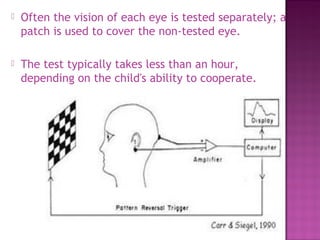
   To do the test, three small metal discs are placed on the
    child's head.

   The discs are connected by wires to a computer.

   The child is then positioned in front of a TV screen
    displaying alternating black and white stripes that
    progressively get narrower.

   As the child views the stripes, a signal is relayed from
    the eyes to the brain (the visual cortex).

   This signal is detected by the electrodes.

   The test is designed to find the finest black and white
    stripes that reliably produce a response.
   Often the vision of each eye is tested separately; a
    patch is used to cover the non-tested eye.

   The test typically takes less than an hour,
    depending on the child's ability to cooperate.
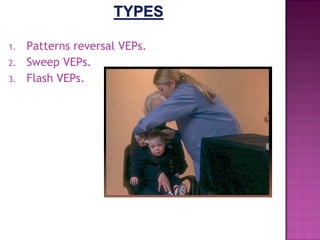
1.   Patterns reversal VEPs.
2.   Sweep VEPs.
3.   Flash VEPs.
   The Preferential Looking test is used to assess visual
    acuity in infants.

   who are unable to identify pictures or letters.

   The child is presented with two stimulus fields, one
    with stripes and the other with a homogeneous gray
    area of the same average luminance as the striped
    field.

   The location of the stripes is randomly alternated.

   Typically, infants and children will look at the more
    interesting stripes (if they can detect them) rather
    than at the blank field.
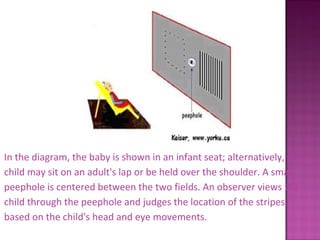
In the diagram, the baby is shown in an infant seat; alternatively, the 
  child may sit on an adult's lap or be held over the shoulder. A small 
  peephole is centered between the two fields. An observer views the 


  child through the peephole and judges the location of the stripes 
  based on the child's head and eye movements.
   If the child can see the stripes, he/she will prefer to
    look at them.

   If the child cannot see them, the striped field will
    look the same as the blank gray field, and the child
    will not show a preference.

   The smallest stripe width for which the observer can
    consistently identify the location of the stripes is
    considered to be the child's resolution threshold
    (visual acuity).
   It is done with one eye fixation on an
    accommodative target held at 40cm.

   ‘C’ refers to the location and corneal light
    reflex as the patient fixates the examiners
    light under monocular conditions.

   ‘S‘ refers to steadiness of fixation on
    examiners light as it is held motionless and
    also as it slowly moves up.
   ‘M’ refers to the ability of the path to
    maintain alignment first with one eye then
    with the other eye, as the opposite eye is
    uncovered.
OPTOKINETIC NYSTAGMUS
          (OKN) TESTING
   Nystagmus can be elicited using this test

   The only cooperation required in this test is that the
    infant be awake and should hold both eyes open.

   Procedure: passing a succession of black and white
    stripes through the patients field of vision. The visual
    angle subtended by the smallest strip width that still
    elicits an eye movement is a measure of visual acuity.

   Its reported that OKN acuity is at least 6/120 in the
    newborns and improves fairly rapidly during the first
CATFORD DRUM TEST
   It is a detection acuity test, useful in infants and
    preschool children
.
    In this test, the child is made to observe an
    oscillating drum with black dots of varying
    sizes.

   The smallest dot that evokes pendular eye
    movements denotes the level of visual acuity.

   This test is unreliable since it overestimates the
THANKS

Infants va

  • 1.
  • 2.
    The ability of a refractivity corrected eye to discriminate fine details.  It’s the is the resolving power of the eye.  Primary measurement tool – chart introduced in 1862 by Donders and Snellen.  Visual acuity is represented by Visual Angle.  Visual Angle – angle made by the object with the nodal point of the eye.
  • 3.
    Most eye problems can be treated if detected early.  Useful in decision making.  To know if visual development is normal.  Helps to decide eligibility for low vision and rehabilitation services.
  • 4.
    Chart illumination: luminance level of minimum 12-20 foot candles(130-215 lux).  Testing Distance: generally 6 meters.
  • 5.
    Response to light  An infant will blink in response to a bright light.  Pupil response  Measuring the response of the pupil (the black center part of the eye) by shining a penlight in the eye is one way to test an infant's vision.  Ability to follow a target  The most common vision acuity test in infants is a test to check their ability to look at and follow an object or toy.
  • 6.
    1. Very soon after birth – Can fix and follow a light source. 2. 1 months – Fixation is central, steady and maintained. Can follow a slow target. 3. 3 months – Binocular vision and eye coordination. 4. 6months – Reaches out accurately for toys. 5. 9months – looks for hidden toys.
  • 7.
       Visual Evoked Potential (VEP) Testing.  Preferential Looking Test (PLT).  OptoKinetic Nystagmus (OKN) Testing.  Central Steady Maintain (CSM) Method.  Cat ford Drum Test.
  • 8.
    Parents or caretakersare asked routinely whether the child responds to silent smile or follows objects around etc.
  • 9.
    For those who are unable to read the letter chart, the visual evoked potential (VEP) can be used.  It measures acuity by assessing the response of the brain to alternating black and white stripes or checks.
  • 10.
    To do the test, three small metal discs are placed on the child's head.  The discs are connected by wires to a computer.  The child is then positioned in front of a TV screen displaying alternating black and white stripes that progressively get narrower.  As the child views the stripes, a signal is relayed from the eyes to the brain (the visual cortex).  This signal is detected by the electrodes.  The test is designed to find the finest black and white stripes that reliably produce a response.
  • 11.
    Often the vision of each eye is tested separately; a patch is used to cover the non-tested eye.  The test typically takes less than an hour, depending on the child's ability to cooperate.
  • 12.
    1. Patterns reversal VEPs. 2. Sweep VEPs. 3. Flash VEPs.
  • 13.
    The Preferential Looking test is used to assess visual acuity in infants.  who are unable to identify pictures or letters.  The child is presented with two stimulus fields, one with stripes and the other with a homogeneous gray area of the same average luminance as the striped field.  The location of the stripes is randomly alternated.  Typically, infants and children will look at the more interesting stripes (if they can detect them) rather than at the blank field.
  • 14.
    In the diagram, the baby is shown in an infant seat; alternatively, the  child may sit on an adult's lap or be held over the shoulder. A small   peephole is centered between the two fields. An observer views the  child through the peephole and judges the location of the stripes  based on the child's head and eye movements.
  • 15.
    If the child can see the stripes, he/she will prefer to look at them.  If the child cannot see them, the striped field will look the same as the blank gray field, and the child will not show a preference.  The smallest stripe width for which the observer can consistently identify the location of the stripes is considered to be the child's resolution threshold (visual acuity).
  • 16.
    It is done with one eye fixation on an accommodative target held at 40cm.  ‘C’ refers to the location and corneal light reflex as the patient fixates the examiners light under monocular conditions.  ‘S‘ refers to steadiness of fixation on examiners light as it is held motionless and also as it slowly moves up.
  • 17.
    ‘M’ refers to the ability of the path to maintain alignment first with one eye then with the other eye, as the opposite eye is uncovered.
  • 18.
    OPTOKINETIC NYSTAGMUS (OKN) TESTING  Nystagmus can be elicited using this test  The only cooperation required in this test is that the infant be awake and should hold both eyes open.  Procedure: passing a succession of black and white stripes through the patients field of vision. The visual angle subtended by the smallest strip width that still elicits an eye movement is a measure of visual acuity.  Its reported that OKN acuity is at least 6/120 in the newborns and improves fairly rapidly during the first
  • 19.
    CATFORD DRUM TEST  It is a detection acuity test, useful in infants and preschool children .  In this test, the child is made to observe an oscillating drum with black dots of varying sizes.  The smallest dot that evokes pendular eye movements denotes the level of visual acuity.  This test is unreliable since it overestimates the
  • 20.